Introduction
In Australia higher education music institutions are named variously as Conservatoriums, Music Departments, Schools and Faculties of Music. While titles differ, all have been incorporated into larger Universities and, despite local variations, offer similar degrees in performance, composition, music education and musicology. This approach is different from UK and Europe where a greater divergence exists between the curricula of Conservatoriums and Universities. All Australian tertiary music students are given access to instrumental lessons as part of their degrees.
In this study we seek to answer the following questions: What is being taught in tertiary instrumental music lessons in Australia? Where does the emphasis lie? Are there any gender differences in the approach?
Literature on lesson content
Relevant lesson content is an important element of effective teaching (Leinhardt & Greeno, Reference LEINHARDT, GREENO and Goodyear1991). Research has highlighted various aspects of instrumental lesson content: for example Neill-Van Cura (Reference NEILL-VAN CURA1995) focused on technical aspects, sound production (intonation, colouring) and expression (phrasing, dynamics, style) when describing the teaching of master violinist Dorothy DeLay. A study of three violin master teachers in Sydney, Australia, emphasised intonation, rhythm, tone beauty and repertoire choice as important lesson content areas contributing to teacher effectiveness (Low, Reference LOW2000). A recent study by Young et al. (Reference YOUNG, BURWELL and PICKUP2003) found that technique was the predominant area of study in instrumental music lessons in higher education.
The classification of topics and the rationale for their groupings under various subheadings in previous research are at times problematic. The present study aims to be detailed and precise in definitions of specific categories while providing a broad perspective of lesson content that is not instrument-specific. Prior to commencement of this study research under the topics of Pitch, Rhythm, Tempo, Dynamics, Expression, Articulation, Technique, Structure, and Recordings was reviewed.
Pitch
The area of pitch poses different problems for different instrumentalists. For non-pianists, playing in tune is a vital aspect of mastering the instrument. Tiny adjustments of hand position on a string instrument and of embouchure on a wind instrument can cause large changes in pitch. Therefore, questions of intonation accuracy become very important for non-pianists. For pianists pitch problems tend to arise in sight-reading, which is more complex since they have to read two lines of notation at the same time. They are also expected to perform from memory in solo recitals while other instrumentalists play from memory only in concerto situations. Much research has been undertaken in all of these areas, as outlined below.
(i) Intonation accuracy
Previous research has confirmed the tendency of musicians to play sharp (Salzberg, Reference SALZBERG1980). Intonation also depends on the size of intervals, with musicians having a tendency to increase large intervals, such as sevenths and octaves, and to diminish small intervals such as minor seconds (Rakowski, Reference RAKOWSKI1990). Intonation problems can be corrected by comparison to tuning machines, fixed pitch instruments, such as the piano, or by teacher comments. Salzberg (Reference SALZBERG1980) found verbal feedback to be the most effective in improving pitch accuracy as compared with tape-recorder playback, model performance, free practice and no instruction. More recently Gruzelier and Egner (Reference GRUZELIER, EGNER and Williamon2004) have reported renewed interest in the use of biofeedback and neurofeedback as an educational aid to reduce errors in string and wind players.
(ii) Sight-reading
Ability to sight-read fluently is often seen as an essential skill for a pianist. The amount of practice undertaken by students does not seem to predict their sight-reading performance, but experience in accompanying and, especially, the size of their accompanying repertoire, appear to be better indicators of expertise (Lehmann & Ericsson, Reference LEHMANN and ERICSSON1993). Sight-reading ability has been linked to the understanding of musical language, such as knowledge of form and style (Sloboda, Reference SLOBODA1978) and perception of phrase structure (Sloboda, Reference SLOBODA1974). Recent research (Thompson & Lehmann, Reference THOMPSON, LEHMANN and Williamon2004) continues to stress the knowledge of style as the top priority in acquiring good sight-reading skills. The most frequent sight-reading errors are rhythmic and these can be overcome by scanning the music for relevant information and mentally rehearsing prior to playing (McPherson, Reference MCPHERSON1994). While predictors of sight-reading expertise have been identified (Kopiez et al., Reference KOPIEZ, WEIHS, LIGGES and LEE2006), educators need to focus on the development of sight-reading pedagogy, materials and training methods to improve this skill in students (Lehmann & McArthur, Reference LEHMANN, MCARTHUR, Parncutt and McPherson2002).
(iii) Memory
Since the introduction of performing from memory by Franz Liszt early in the 19th century (Ott, Reference OTT1992), the tradition of playing without the score has established itself in the arena of the piano recital. Today one hardly ever witnesses a piano concert where a score is being used, the only exception granted for very difficult avant-garde music. The benefits cited for performing from memory include superiority of performance and positive influence on audience's ratings (Williamon, Reference WILLIAMON1999). Silently perusing the score away from the instrument (Rubin-Rabson, Reference RUBIN-RABSON1941) and analysing the structure of the work (Reichling, Reference REICHLING1989) have been found to be useful strategies for memorisation. This has been supported in more recent work of Ginsborg (Reference GINSBORG and Williamon2004) who highlights the role of structural analysis and phrase boundaries in developing musicians’ conceptual memory. She also recommends combining physical practice (kinaesthetic memory) with visual and aural memorisation.
Rhythm
Execution of correct rhythm when playing on a musical instrument depends on two factors: first, the performer's theoretical understanding of counting, note values and groupings, and second, the player's practical ability to implement it. In a higher education setting the students are presumed to have developed this skill to an advanced level.
Musician's experience of rhythm draws upon the musical structure, motion character and emotional properties of music (Gabrielsson, Reference GABRIELSSON and Clynes1982). Clarke (Reference CLARKE and Deutsch1999) views rhythm as an interaction between meter and grouping. Research into rhythm has concentrated on the following.
(i) Timing
Clynes and Walker (Reference CLYNES and WALKER1986) have found that global duration of performances of the same work remains stable over a long period of time, demonstrating that musical concepts govern their realisation. This stability of the performer's approach manifests not only in the tonal and metric music, but also for more complex 21st century works (Clarke et al., Reference CLARKE, COOK, HARRISON and THOMAS2005). While local deviations of timing patterns vary subtly from performer to performer, these alterations serve to underline the structure of the piece and occur most frequently at phrase boundaries and at moments of melodic or harmonic tension (Repp, Reference REPP1990, Reference REPP1992; Clarke & Baker-Short, Reference CLARKE and BAKER-SHORT1987).
(ii) Expression
Rhythm has been linked to expression, with research suggesting that expressiveness lies in departure from metrical rigidity, i.e. rubato (Todd, Reference TODD1985; Johnson, Reference JOHNSON1996). Expressive microstructure of music relies upon a ‘composer's’ pulse, which is recognised even by untrained listeners (Repp, Reference REPP1989). It is the role of a teacher to pass on his/her experience of expressive rhythm to the student (Gabrielsson, Reference GABRIELSSON1985). See below for further discussion of ‘Expression’.
(ii) Musical synchronisation
Repp (Reference REPP, Altenmuller, Wiesendanger and Kesselring2006) highlights the ability to coordinate rhythmic movement with rhythmic sound as fundamental to music performance. He suggests playing music with the metronome as an effective practice strategy for synchronisation of complex movements with a simple rhythmic pulse.
Tempo
Linked to the understanding of rhythm is the ability to maintain a steady tempo for a particular movement or section of the piece and to change tempo as required by the composer. By the time music students enter a tertiary institution, most have been learning their instrument for at least 10 years and have developed this ability to a substantial degree. Yet, even college students seem to identify tempo changes more clearly when these increase rather than decrease (Geringer & Madsen, Reference GERINGER and MADSEN1984) and to hear ornamented melodies as being faster than plain ones (Kuhn & Booth, Reference KUHN and BOOTH1988). Research suggests that performance tempo is harder to maintain if it is faster or slower than the originally learnt speed, with more pitch errors occurring at a faster tempo (Duke & Pierce, Reference DUKE and PIERCE1991), and that basic performance speed remains stable while local tempo varies continuously around it in an expressive way (Repp, Reference REPP1994).
Dynamics
Variations in dynamics are a powerful tool in the interpretation of music (Kopiez, Reference KOPIEZ1994; Shaffer, Reference SHAFFER1995). Instrumental music teachers spend a great deal of lesson time on developing a wide range of sound from the softest to the loudest. Even at the higher education level teachers have to urge their students to exaggerate the volume of sound to make their intentions more obvious to the audience. Research into dynamics considers the communication of dynamics from the performers to the listeners, finding that crescendo is easier to play and recognise than decrescendo, and that the impression of crescendo is enhanced by rising pitch, while decrescendo is enhanced by falling pitch (Nakamura, Reference NAKAMURA1987).
Expression
Expressive playing is the ultimate goal of music teaching, but perhaps is the most difficult to convey. Musicians attribute elaborate meanings to music, often based on highly subjective criteria as well as emotional triggers inherent in the score (Persson, Reference PERSSON, Juslin and Sloboda2001). Many performers rely on emotional and visual memories when conceptualising interpretation of a work. Musical performances are often conceived in terms of emotions, moods or scenarios (Juslin, Reference JUSLIN, Juslin and Sloboda2001). The performer's intentions are encoded in particular expressive cues (e.g. tempo and loudness), which are then decoded by the listener.
Gabrielsson and Lindstrom (Reference GABRIELSSON, LINDSTROM, Juslin and Sloboda2001) have identified factors of musical structure that contribute to the perceived emotional expression: tempo, loudness, pitch, mode (major/minor), rhythm and harmony. However, despite considerable research in this area, there remain doubts about the specific effect these structural factors have on expression. For example, research on harmony tends to focus on dissonance/consonance, the impact of melody is often measured by its range and direction, and the effect of intervals and specific rhythmic patterns has been neglected. It is therefore not surprising that many instrumental teachers continue to rely on their own intuition and experience.
Little empirical evidence exists on how expression is taught in applied music lessons. Woody (Reference WOODY2000) found that verbal instruction was the main method of teaching expressivity in instrumental lessons of college students. Music teachers use metaphor to assist their students’ understanding of the character of music, for instance describing a scene, a story, a mood (calm, still/excited, involved), a physical sensation (warm/cold) or a colour (bright/dark). While traditional strategies for teaching of expressivity are useful, it is also important to address the sound quality and experiment with modern technology (e.g., user-friendly cognitive feedback software developed by Juslin et al., Reference JUSLIN, FRIBERG, SCHOONDERWALDT, KARLSSON and Williamon2004).
Articulation
Articulation is another powerful tool in the interpretation of a musical score and a vital ingredient of rubato (Clarke & Baker-Short, Reference CLARKE and BAKER-SHORT1987). While it is expected that tertiary music students will have already mastered the basics of articulation, such as playing legato and staccato, they often need guidance on its application. Here, the role of teacher is indispensable in passing on the performance experience and solving technical problems. Articulation is closely linked to phrasing, such as the way we group a number of notes together to make up a musical thought. The subtle art of phrasing is referred to as agogics. Kopiez (Reference KOPIEZ1994) suggests that there are perceivable and quantifiable differences in the use of agogics by different performers, and that these are part of the artist's signature style.
Technique
Research has documented increased difficulty of music, growth of performance expertise and emphasis on technical training over the last 300 years (Lehmann, Reference LEHMANN, Altenmuller, Wiesendanger and Kesselring2006). Achieving a reliable, flawless and fluent technique is by far the greatest goal in applied music teaching at the tertiary level (Young et al., Reference YOUNG, BURWELL and PICKUP2003).
The abundance of technical manuals for various instruments is daunting, and a review of these will not be attempted here. But overriding these differences of approach are the common goals of ease of playing, effective coordination and minimal exertion (Reubart, Reference REUBART1985). In addition to traditional methods of teaching technique, the instrumental teacher needs to consider factors related to motor control such as psychology, movement analysis and brain functions (Altenmuller et al., Reference ALTENMULLER, WIESENDANGER and KESSELRING2006). Research suggests that the mechanics of playing exhibited by professional musicians are more rapid and more fluent than those of amateur players (Shaffer, Reference SHAFFER1981). Superior motor programming leads to a more expressive and more creative performance (Jerde et al., Reference JERDE, SANTELLO, FLANDERS, SOECHTING, Altenmuller, Wiesendanger and Kesselring2006).
Structure
Earlier comments on rhythm, dynamics, expression and articulation indicate a relationship between these areas and the musical structure. A study by Sloboda (Reference SLOBODA1991) has investigated emotional response in listeners to musical structure, finding that passages containing sequences and appoggiaturas often evoke tears, and that new and unexpected harmonies arouse shivers. This study demonstrates the effect of certain musical formulae on human emotions and seems to imply that discussions of overall musical structure, harmony, part writing, style and period should be part of an applied lesson. Recent developments in thinking about music as cognitive structures (Temperley, Reference TEMPERLEY2001; Zbikowski, Reference ZBIKOWSKI2002) have renewed music educators’ interest in structural theories as the means of identifying and describing the basic musical elements (meter, melodic phrase, counterpoint, pitch, harmony and key), modelling musical infrastructure using computer science, and the role of structure in understanding and communicating unique musical concepts of each composer. Clarke et al. (Reference CLARKE, COOK, HARRISON and THOMAS2005) have shown that such an analytical approach is equally relevant to the study and performance of complex 21st century music as to the traditional repertoire. The role of the tertiary instrumental teacher is to relate this academic knowledge to the pieces studied in lessons.
Recordings
Technology in general has affected every aspect of modern life since the Second World War. The quality of musical recordings has improved tremendously during this time. Tertiary music students have access to many recordings of standard repertoire through the use of music libraries. Recordings also help in the preparation of works such as a concerto with orchestra or a chamber work, where a performer plays only one of many parts and is thus unable to hear the complete work when practising alone. The comprehensive use of tape-recorders in lessons and practice is still infrequent in instrumental teaching even though it was advocated by Greer in Reference GREER1980.
The literature reviewed in the area of lesson content demonstrates a substantial body of evidence investigating Pitch, Rhythm, Tempo, Dynamics, Expressions, Articulation, Technique, Structure and Recordings. As most of this research focused on individual aspects of teaching and/or musical performance, the relative importance of these topics in instrumental music lessons is not yet clear.
Literature review of gender issues in music
Researchers of gender in music and musicians have taken divergent views on a number of issues. On the one hand, there is evidence of gender stereotyping of musical instruments. Studies report that boys tend to choose instruments perceived as masculine (brass, percussion and guitar) and girls prefer instruments seen as feminine (wind, strings and piano) (Delzell & Leppla, Reference DELZELL and LEPPLA1992; O'Neill & Boulton, Reference O'NEILL and BOULTON1996; Green, Reference GREEN1997). Stereotyping of instruments also influences our judgements of musical performance (Elliot, Reference ELLIOT1995). On the other hand there are accounts of musicians’ androgyny (Kemp, Reference KEMP1982, Reference KEMP1996; Wubbenhorst, Reference WUBBENHORST1994), which suggest attitudes contrary to typical gender orientation.
Research into left and right brain functions has identified gender differences in brain development of primary school-age children (Connell & Gunzelmann, Reference CONNELL and GUNZELMANN2004). As children mature into adults, the females retain a stronger link between the right and left hemispheres of their brains which allows for more sensitivity, while in the male brain the left hemisphere functions more independently from the right hemisphere, resulting in more factual thinking (Nadeau, Reference NADEAU1996). These differences suggest that teachers might need different approaches when explaining the same topics to male and female students.
Gender issues in music teaching require urgent investigation. In a classroom music setting girls have been observed as conforming to teachers’ expectations, standards of behaviour and musical values (Green, Reference GREEN1997). Girls’ perseverance and harder work make them easier to teach than boys. There is little empirical evidence of gender attitudes in individual instrumental music teaching since much of the research is conducted as case studies. Zhukov (Reference ZHUKOV2006) has reported stereotypical teacher and student behaviour in applied lessons in Australian Conservatoriums.
The brief overview of literature on gender issues in music raises some questions: are there gender differences in instrumental lesson content and, if so, are the attitudes stereotypical or atypical?
Method
Twelve expert teachers of piano, strings and winds from five Australian tertiary music institutions were observed in this study. All teachers were nationally known as both teachers and performers by virtue of being Heads of Departments, or having published a work on teaching, or known as performing and/or recording artists. All had extensive successful teaching records and wide experience of teaching in public (e.g. giving Master Classes). Each teacher was asked to select two tertiary degree students, one male and one female, to demonstrate diverging teaching. This ensured that realistic lessons were being offered instead of showcases of best students. The reason for the multi-instrumental approach was to arrive at descriptions of tertiary teaching styles that are not instrument-specific. The higher education setting is unique in providing access to master teachers and advanced instrumentalists of similar age and skill level, thus ensuring a homogeneous sample. The fieldwork was spread geographically to minimise the effect of the strong institutional culture.
The sample was instrument and gender balanced for both teachers and students. Four teachers (two male and two female) in each of the three instrument groups were observed, each teaching one male and one female student. The 24 lessons of approximately one hour duration were each videotaped using an unmanned camera in order to minimise the ‘observer’ effect. Other strategies to verify the legitimacy of the collected data included debriefing of students after the lessons and the initial selection of experienced teachers with high public profile.
In order to analyse a vast number of teacher/student interactions a tailor-made observational instrument was developed based on earlier methods of assessment of music teaching and practising (Abeles, Reference ABELES1975; Gipson, Reference GIPSON1978; Hepler, Reference HEPLER1986; Gruson, Reference GRUSON and Sloboda1988; Abeles et al., Reference ABELES, GOFFI and LEVASSEUR1992). The initial draft incorporated categories previously used by other researchers. When these were tested on data from pilot studies, a number of new categories emerged and others were refined into more precise definitions. The instrument was validated for criterion and content and tested in pilot studies by the present author who also established inter-judge and intra-judge reliability (for details see Zhukov, Reference ZHUKOV2005).
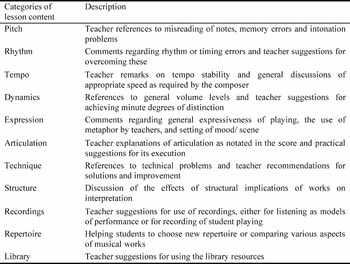
The large number of categories of observed behaviour was classified under four subheadings of lesson content, lesson structure, teaching method and teacher/student relationship. Here only the results for lesson content are reported. Each teacher verbal utterance and physical action was categorised (see Fig. 1) and the frequencies in each category were counted.
Description of lesson content categories

Since all lessons varied slightly in duration, a score per hour was calculated by dividing the total score in each category into Net Lesson time and multiplied by 60. The results were subjected to various statistical analyses with regard to gender, including correlations between the categories of lesson content and teaching method to discover any links between topics taught and particular teaching strategies, for example praise and questioning.
Results
In order to ascertain which topics are being emphasised in tertiary instrumental music teaching, the lesson content categories were compared proportionally in this study. The results were represented in percentages of the total lesson content categories per hour of lesson. The effects of gender differences between teachers and students on lesson content were examined.
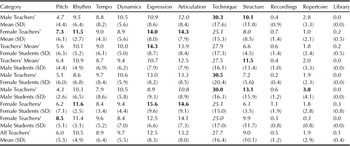
The highest mean for all teachers was in the area of Technique (see Table 1; M = 27.7). This was followed by Articulation (M = 13.2), Expression (M = 12.5), Rhythm (M = 10.5), Dynamics (M = 9.7), Structure (M = 9.0), Tempo (M = 8.9), Pitch (M = 6.0), Repertoire (M = 1.9), Recordings (M = 0.5) and Library (M = 0.1).
Summary of lesson content analyses

Note. Results are shown in percentages of all lesson content categories per hour of lesson.
The scores of more than 1% above the Mean are shown in bold.
The scores of more than 1% below the Mean are shown in italics.
The male teachers scored higher than the female teachers in the categories of Technique (M = 30.3) and Structure (M = 10.1), while the female teachers had higher scores in the categories of Articulation (M = 14.3), Expression (M = 14.0), Rhythm (M = 11.5) and Pitch (M = 7.3).
There appeared to be differences in two lesson content areas, Structure and Expression, for students of different gender. The male students received more instruction in the area of Structure (M = 11.5) and the female students were taught more Expression (M = 14.3).
The four teacher/student gender pairings (same-gender and different-gender) were considered to obtain further clarification. In the lessons of male teachers/female students Technique was emphasised (M = 30.5) and Rhythm was downplayed (M = 8.6). In the lessons of male teachers/male students the priorities were Technique (M = 30.0), Structure (M = 13.1) and Repertoire (M = 3.8), while Pitch (M = 4.3), Expression (M = 8.9) and Articulation (M = 10.8) were less important than average.
The female teachers in lessons with female students were more concerned with Expression (M = 15.6), Articulation (M = 14.6) and Rhythm (M = 11.6) and less focused on Technique (M = 25.1) and Structure (M = 6.1). In the lessons of male students the female teachers were more interested in working on Pitch (M = 8.5) rather than Technique (M = 25.0) and Repertoire (M = 0.3).
Discussion
Relevance of the subject matter is a significant variable that contributes to teacher effectiveness (Leinhardt & Greeno, Reference LEINHARDT, GREENO and Goodyear1991), with advanced technical skills and interpretation previously highlighted as important areas in instrumental music teaching at the tertiary level (Neill-Van Cura, Reference NEILL-VAN CURA1995). The survey of literature has identified the following possible topics in the area of lesson content: Pitch, Rhythm, Tempo, Dynamics, Expression, Articulation, Technique, Structure and Recordings. While most studies have investigated one of these topics individually, Young et al. (Reference YOUNG, BURWELL and PICKUP2003) measured the comparative significance of a number of these types of variables and concluded that Technique is the prime focus of instrumental music lessons in higher education.
This study collected data on frequencies of occurrence of 11 lesson content categories in advanced instrumental music lessons. The data were analysed according to the percentages of all the categories in lesson content per hour of lesson to ascertain the importance of various topics and examine gender differences. The lesson content areas are discussed in decreasing order of priorities.
Technique
Research has documented the current overemphasis on perfect technical execution in musical performance (Lehmann, Reference LEHMANN, Altenmuller, Wiesendanger and Kesselring2006). Achieving a reliable, flawless and fluent technique is the major goal of advanced instrumental teaching (Young et al., Reference YOUNG, BURWELL and PICKUP2003) as this leads to more expressive performance (Jerde et al., Reference JERDE, SANTELLO, FLANDERS, SOECHTING, Altenmuller, Wiesendanger and Kesselring2006). The results support these findings given that the highest overall mean was in this category.
Teacher gender analysis indicates that male teachers were much more interested in Technique than any other subject matter. This notion was supported by a significant correlation of .63 between Net Lesson time and Technique for the male teachers. The female teachers in this sample adopted a more balanced approach, where their considerable interest in Expression and Articulation was combined with the strong emphasis on Technique. In terms of student gender, teachers treated both groups similarly in the category of Technique. The results show gender differences between the teachers in this area and no gender differentiation towards the students.
Articulation
Research has highlighted the vital role of articulation in interpreting music (Clarke & Baker-Short, Reference CLARKE and BAKER-SHORT1987), and its contribution to the development of an individual performance style (Kopiez, Reference KOPIEZ1994). The results show that overall, Articulation was the second highest mean among the lesson content topics and support earlier research on importance of articulation. For both teacher groups Articulation remained the second highest priority among the lesson content categories. The female teachers scored slightly higher than the male teachers in this category. The greater interest in Articulation by the female teachers was confirmed by the link between Articulation and Positive Global Evaluation, given a significant correlation of .82 between these variables for the female teachers. This statistic suggests that much of the female teachers’ praise was directed towards improvements in Articulation. This was not the case for the male teachers.
The slightly higher mean for Articulation in the lessons of female students than in the lessons of male students indicates greater attention to this topic in their lessons. This notion was validated by a significant correlation of .68 between the Articulation and Positive Global Evaluation in the lessons of female students. The correlation between these two variables was much weaker in the lessons of male students, suggesting less teacher interest in Articulation and its praise in the lessons of male students.
Expression
Research has demonstrated that music is often interpreted in terms of emotions or stories (Juslin, Reference JUSLIN, Juslin and Sloboda2001), and highlighted factors affecting expressiveness of performance, such as tempo, loudness and harmony (Gabrielsson & Lindstrom, Reference GABRIELSSON, LINDSTROM, Juslin and Sloboda2001). As expected Expression was very high on the teaching agenda, coming third overall among the lesson content categories. Verbal instruction, metaphor and demonstrations of sound quality were widely used, supporting previous research (Woody, Reference WOODY2000; Juslin et al., Reference JUSLIN, FRIBERG, SCHOONDERWALDT, KARLSSON and Williamon2004).
Results show that in this category, gender differences between teachers and students were noticeable. The female teachers scored higher in this category than the male teachers. The female students received more attention in this area than the male students. The higher results in the category of Expression for the female teachers and the female students support the stereotypical notion than females are more expressive than males.
Rhythm
The rhythm work undertaken by instrumental teachers at the advanced level is often linked to expressive timing, which serves to underline the structure of the work, in particular the ends of phrases and sections (Clarke et al., Reference CLARKE, COOK, HARRISON and THOMAS2005; Repp, Reference REPP1990, Reference REPP1992; Clarke & Baker-Short, Reference CLARKE and BAKER-SHORT1987). The role of teachers in passing down the traditions and conventions of appropriate use of ‘rubato’ remains vital (Gabrielsson, Reference GABRIELSSON1985). However, even at the tertiary level of instrumental teaching synchronisation work (playing against the metronome or teacher clapping the beat) continues, supporting research that highlights its importance (Repp, Reference REPP, Altenmuller, Wiesendanger and Kesselring2006).
The results show Rhythm to be an important area of lesson content, overall in fourth place among the 11 categories. The degree of its significance varied among the teachers, with the female teachers being more concerned with Rhythm than the male teachers. For both groups of students Rhythm was fourth in order of importance, indicating no significant difference in the treatment of students. The results suggest that the female teachers were more particular about precision of rhythm, supporting the meticulous image of female teachers in line with higher scores in the category of Articulation already noted. Yet, in terms of student gender a uniform approach among the teachers was evident in this category.
Dynamics
Research has highlighted the powerful role of dynamics in interpretation of music (Shaffer, Reference SHAFFER1995; Kopiez, Reference KOPIEZ1994). In this sample Dynamics proved to be high on the teachers’ agenda, coming in the fifth place of overall importance. A similar approach was taken by both teacher groups towards both groups of students, with no large differences emerging in the four gender pairings. The results indicate a uniform approach to the teaching of Dynamics.
Structure
Musical structure plays an important role in understanding and communicating composers’ intentions (Temperley, Reference TEMPERLEY2001; Zbikowski, Reference ZBIKOWSKI2002), be it in traditional or avant-garde repertoire (Clarke et al., Reference CLARKE, COOK, HARRISON and THOMAS2005). It is important to be aware of the effect of particular musical formulae on the listener (Sloboda, Reference SLOBODA1991).
It is not surprising that Structure was a fairly important topic among the lesson content categories, coming in the sixth place overall. The male teachers were more interested in Structure than the female teachers. This notion was supported by significant correlations between Structure and teacher General Questions and between Structure and student Answers in the lessons of male teachers. The correlations between these variables were not significant in the lessons of female teachers.
Teachers spent more time on Structure in the lessons of male students than in the lessons of female students. This observation was validated by significant correlations between the categories of Structure and teacher General Questions and between Structure and student Answers in the lessons of male students. No significant correlations between these categories were found in the lessons of female students. The results show higher scores in the category of Structure for the male teachers and in the lessons of male students, implying a stronger analytical trend amongst the males.
Tempo
Research has shown that even trained musicians do not perceive tempo changes exactly (Geringer & Madsen, Reference GERINGER and MADSEN1984; Kuhn & Booth, Reference KUHN and BOOTH1988), and have difficulties in maintaining performance speed when it is different from the originally learnt tempo (Duke & Pierce, Reference DUKE and PIERCE1991).
The results show that in this sample the teachers spent a reasonable amount of time on Tempo, this topic being the seventh in order of priority among all lesson content categories. The numerical averages for Tempo were similar for both male and female teachers. This was also the case for both student groups. The results indicate that in the category of Tempo a uniform approach was in evidence across the sample.
Pitch
Research suggests that biofeedback and neurofeedback are the new tools for improving pitch accuracy in string and wind players (Gruzelier & Egner, Reference GRUZELIER, EGNER and Williamon2004). In this study wind and string teachers used tuning machines and verbal feedback (e.g., ‘This is sharp’) to address intonation issues.
Despite considerable research into sight-reading (Thompson & Lehmann, Reference THOMPSON, LEHMANN and Williamon2004; Kopiez et al., Reference KOPIEZ, WEIHS, LIGGES and LEE2006), only one instance of sight-reading was observed in the 24 lessons, lending weight to the notion of the lack of pedagogy and materials in this area (Lehmann & McArthur, Reference LEHMANN, MCARTHUR, Parncutt and McPherson2002).
While structural analysis has been highlighted as a useful strategy for memorisation (Reichling, Reference REICHLING1989; Ginsborg, Reference GINSBORG and Williamon2004), there was little evidence of that in the lessons in this sample.
Overall, results show that Pitch occupied a small portion of the lesson content in advanced instrumental music lessons, taking the eighth place among the 11 categories. The female teachers scored higher in this category than the male teachers. The scores in the lessons of male students were slightly higher than in the lessons of female students. The results suggest meticulous attention to detail by the female teachers, which was already noted with regard to Articulation and Rhythm, and perhaps better performance by the female students in this category.
Repertoire
Anecdotal evidence suggests that effective teachers have an uncanny ability to match repertoire to their students’ ability and personality, thus motivating them to learn and to improve. In practical terms teachers often demonstrate two or three suitable pieces, discuss their features and allow students to choose the one they would like to learn. Yet, discussions of repertoire formed a very small part of the lessons in this study. A similar approach was evident between the two teacher groups and the two student groups. The results indicate a uniform approach to Repertoire across the sample, suggesting that this category plays only a minor role in the lesson content of advanced instrumental music lessons.
Records and library
Comprehensive use of tape-recorders in lessons has not as yet become common practice in mainstream instrumental music teaching in Australia. However, professional recordings of studied repertoire are frequently used as ideal models for students to imitate. Teachers make suggestions as to which particular versions/interpretations they want their students to hear, and at times loan students their own recordings. University Libraries are wonderful sources of information, yet instrumental music students, in particular at the beginning of their degrees, need encouragement to utilise these resources. Discussions of recordings and of the use of libraries occupied a tiny portion of the lessons overall. Very little difference emerged between teacher and student groups, and, since the numerical results in these categories were under 1%, it is impractical to draw inferences from the results.
Conclusions
This study offers new insights into applied music teaching by providing detailed information on the order of importance of topics being taught in higher education instrumental music lessons in Australia together with gender attributions of lesson content.
The first finding of this study is that Technique is the highest priority in advanced instrumental music lessons. This result supports recent research and is also a reflection of a greater emphasis on technique and precision in public performances in the 21st century. The attainment of flawless technique, demonstrated by highly accomplished internationally renowned artists in recitals and on compact disc, has become an obsessive goal for many young musicians. The next three topics in lesson content were Articulation, Expression and Rhythm, which are usually associated with interpretation in musical performance.
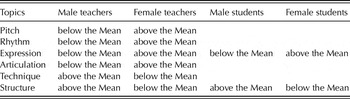
In this sample subtle gender differences emerged in teacher preferences with regard to topics taught in lessons (see Summary in Table 2).
Summary of gender differences in lesson content

The results indicate that male teachers tended to focus more on Technique and Structure, demonstrating a strong analytical approach with emphasis on technique. The female teachers were more inclined to teach a balanced range of topics, which comprise Technique, Expression, Articulation, Pitch and Rhythm, indicating a more emotional approach with meticulous attention to details. For example, in a number of lessons the male teachers were observed discussing musical structure as a starting point to solving various problems, while the female teachers addressed technical solutions, expression, articulation and dynamics directly, without reference to the structure. These differences of approach correspond to the authoritarian role taken by the male teachers and the more facilitating position used by the female teachers in other aspects of teaching methodology (Zhukov, Reference ZHUKOV2006). For example, the analyses of teacher behaviour showed that male teachers gave more general directions and explanations, while the female teachers provided more answers and practice suggestions to their students.
The teaching of both student gender groups was mostly uniform, with differences emerging in only the two categories of Expression and Structure. The female students received more tuition in the area of Expression, which corresponds to the traditional image of females as being more emotional than males. The male students spent more of their lesson time on Structure, which suggests a more analytical attitude typical of males. Some differences emerged in the analysis of the four gender pairs but no clear pattern was evident in the same-gender/different-gender combinations. The differences in topics taught to male and female students indicate that at the higher education level of instrumental teaching stereotypical tendencies associated with gender (females being more expressive and males being more analytical) do exist.
While these results might be particular to this sample of teachers and students and need to be replicated in a larger study of advanced instrumentalists, the gender differences amongst the teachers and students observed in lesson content suggest attitudes associated with stereotype male and female roles. Future research needs to consider gender implications in all aspects of music teaching to inform and improve teaching practice.