





Introduction
Infant temperament and long-term implications
Temperament is a multifaceted construct that refers to early-appearing individual differences in emotional reactivity and self-regulation, shaping how infants respond to and recover from stimulation in their environment (Rothbart, Reference Rothbart2007). Commonly studied dimensions include negative affectivity, surgency, and effortful control (Rothbart, Reference Rothbart1981). These dimensions are not equally associated with developmental risk. In particular, elevated negative affectivity, characterized by frequent distress, fearfulness, irritability, and poor soothability, has been identified as a potential risk factor because it may heighten infants’ sensitivity to stress and make regulation more difficult. Infants high in negative affectivity are more likely to show later internalizing problems, such as anxiety and withdrawal, as well as externalizing difficulties, including anger, oppositional behavior, and poor behavioral regulation (Padilla et al., Reference Padilla, Hines and Ryan2020). High surgency, characterized by elevated activity, impulsivity, and strong approach tendencies, may also confer risk when combined with weak regulatory capacities, as it has been linked to later externalizing outcomes such as impulsive behavior, hyperactivity, and difficulties with inhibitory control (Peisch et al., Reference Peisch, Ferrara, Gourdet, Zimon, Mastrangelo and Arnett2025). By contrast, stronger effortful control, or in infancy, early regulatory capacities involving attention and arousal modulation, may function as a protective factor, buffering against distress and supporting more adaptive socioemotional development (Lee et al., Reference Lee, Chang and Olson2024). Lower effortful control, in turn, has been associated with greater vulnerability to both internalizing and externalizing symptoms (Hermansen et al., Reference Hermansen, Syrstad, Røysamb and Melinder2022). Importantly, temperament should not be understood as deterministic; rather, it represents an early dispositional profile that may increase or decrease susceptibility to later outcomes depending on the caregiving environment. Nonetheless, because infant temperament has been linked not only to later behavioral and emotional problems but also to developmental and mental health disorders in later childhood (Kikuchi et al., Reference Kikuchi, Michikawa, Morokuma, Hamada, Suetsugu, Ikeda, Nakahara, Kato, Ochiai, Shibata, Tsuji, Shimono, Kawamoto, Ohga, Kusuhara, Yamazaki, Ohya, Kishi, Yaegashi, Hashimoto, Mori, Ito, Yamagata, Inadera, Nakayama, Iso, Shima, Kurozawa, Suganuma and Katoh2023; Tobarra-Sanchez et al., Reference Tobarra-Sanchez, Riglin, Agha, Stergiakouli, Thapar and Langley2022), it is increasingly viewed as an important early marker of psychopathology risk.
Dual nature of infant temperament
Although some evidence suggests that maternal mood patterns during pregnancy are associated with children’s negative affect over time (Glynn et al., Reference Glynn, Howland, Sandman, Davis, Phelan, Baram and Stern2018), most studies have not examined how mother–infant interactions may influence this association. Among the studies that have considered this issue, many have neglected the role of children’s temperament traits in shaping maternal parenting behaviors (Zhang et al., Reference Zhang, Sayler, Hartman and Belsky2022). In the absence of longitudinal evidence, it remains unclear whether children at risk can be identified in early infancy based on temperament traits, and whether these traits can be modified through targeted interventions during this period. Some researchers argue that temperament is relatively stable and largely genetically determined (Goldsmith et al., Reference Goldsmith, Buss, Plomin, Rothbart, Thomas, Chess, Hinde and McCall1987; Rothbart & Derryberry, Reference Rothbart, Derryberry, Lamb and Brown2013), whereas others contend that its expression can be shaped and regulated by environmental influences (Davis et al., Reference Davis, Schoppe-Sullivan, Mangelsdorf and Brown2009; Planalp & Braungart-Rieker, Reference Planalp and Braungart-Rieker2015). Although no consensus has emerged regarding the stability of temperament over time, this debate suggests that temperament is both biologically grounded and developmentally malleable. Accordingly, both prenatal and postnatal factors should be considered in the study of children’s socioemotional development. For example, whereas maternal emotional functioning during pregnancy may influence fetal development (Salisbury et al., Reference Salisbury, Yanni, LaGasse, Lester, Nadel and Muir2005), maternal emotional states after birth may change and shape the home environment in ways that differ from prenatal influences (Kasamatsu et al., Reference Kasamatsu, Tsuchida, Matsumura, Shimao, Hamazaki and Inadera2020), thereby affecting infant outcomes beyond what would be predicted by prenatal patterns alone.
Maternal emotional states during pregnancy
Emotional states are subserved by a complex, interconnected network of brain regions, primarily within the limbic system and prefrontal cortex, rather than by a single “emotion center” (Cardinal et al., Reference Cardinal, Parkinson, Hall and Everitt2002). These neural systems influence how individuals appraise experiences, generate emotional responses, and regulate those responses over time. Accordingly, emotional experiences during pregnancy and the transition to parenthood may vary substantially across women (Wong et al., Reference Wong, Tung and Ip2025a, Reference Wong, Tung and Ip2025b; Wong, Tung, Tsang, et al., Reference Wong, Tung, Tsang, Ko, Leung and Ip2025), reflecting not only vulnerability to distress but also the capacity to experience positive affect and mixed emotional states during this period. At the same time, pregnancy and the postpartum period are characterized by substantial emotional and psychological changes, and depressive symptoms are relatively common across both periods. Meta-analytic evidence indicates that approximately 20.7% of pregnant women experience depressive disorders, with major antenatal depression affecting about 15.0% (Yin et al., Reference Yin, Sun, Jiang, Xu, Gan, Zhang, Qiu, Yang, Shi, Chang and Gong2021). During the postnatal period, the prevalence of postpartum depression has been estimated at approximately 12.0%, with rates of around 17.0% even among otherwise healthy mothers with no prior history of depression (Shorey et al., Reference Shorey, Chee, Ng, Chan, Tam and Chong2018). Importantly, depressive symptoms often persist across the transition to parenthood: longitudinal evidence suggests that 39% of women who experienced depression during pregnancy also develop postnatal depression (Underwood et al., Reference Underwood, Waldie, D’Souza, Peterson and Morton2016). Together, these findings indicate that a substantial proportion of infants may be exposed to maternal depressive symptoms both before and after birth. At the same time, focusing exclusively on depressive symptoms risks oversimplifying maternal emotional experience during pregnancy. Many women experience mixed emotions, including joy, excitement, hope, and emotional connection to the developing infant alongside stress, sadness, or depressive symptoms. Positive affect is therefore not simply the absence of depression, but a distinct aspect of emotional functioning that may shape maternal adaptation and the infant’s early environment in important ways. Considering both negative and positive affect may offer a more complete account of prenatal and postnatal emotional experience than a deficit-focused approach alone.
Maternal perinatal mood and infant outcomes
The association between maternal postnatal depressive symptoms and infant socioemotional development is already well established. Longitudinal studies have shown that parental depression and child temperament are linked over time, with evidence for both parent-to-child and child-to-parent effects (Hanington et al., Reference Hanington, Ramchandani and Stein2010; Takács et al., Reference Takács, Smolík and Putnam2019). Further research has also identified cascading associations between maternal depressive symptoms and infant temperament across the first year of life (Rigato et al., Reference Rigato, Stets, Bonneville-Roussy and Holmboe2020). Together, these studies provide strong evidence that maternal mood after birth is meaningfully associated with infant emotional and behavioral functioning. Precisely because postnatal effects are well documented, however, an important unresolved question is whether prenatal emotional experience contributes uniquely to infant outcomes above and beyond maternal postnatal mood. Addressing this question requires longitudinal studies that examine maternal prenatal and postnatal emotional states within the same framework, yet such studies remain comparatively limited. This gap is especially evident in research that moves beyond depressive symptoms alone to consider mothers’ broader emotional profiles, including positive affect and mixed emotional experiences. As a result, it remains unclear whether infant outcomes reflect specific prenatal emotional exposure, the persistence of maternal distress into the postpartum period, or the joint influence of negative and positive emotional experiences across the transition to motherhood. A more integrated approach across the prenatal and postnatal periods may therefore help clarify the timing, specificity, and emotional complexity of maternal influences on infant development.
Inherited and learned affective responses during infancy
Individual differences in infant affective responding are likely shaped by both inherited vulnerability and early environmental exposures (Takegata et al., Reference Takegata, Matsunaga, Ohashi, Toizumi, Yoshida and Kitamura2021). Maternal depressive symptoms during pregnancy may confer genetic risk for later emotional difficulties (Burkhouse & Kujawa, Reference Burkhouse and Kujawa2023) and may also affect infant temperament through fetal programming of the hypothalamic-pituitary-adrenal axis, a core neuroendocrine system involved in stress regulation (Rinne et al., Reference Rinne, Somers, Ramos, Ross, Coussons-Read and Dunkel Schetter2023). Depression during pregnancy has been linked to elevated maternal cortisol, which can cross the placenta and influence fetal brain systems involved in emotional reactivity and regulation (Davis et al., Reference Davis, Glynn, Schetter, Hobel, Chicz-Demet and Sandman2007; Van den Bergh et al., Reference Van den Bergh, van den Heuvel, Lahti, Braeken, de Rooij, Entringer, Hoyer, Roseboom, Räikkönen, King and Schwab2020). When depressive symptoms persist into the postpartum period, they may further shape infants’ reactivity and regulation by disrupting maternal functioning, caregiving sensitivity, and the emotional climate of early interactions (Mehu & Scherer, Reference Mehu and Scherer2015; Pearson et al., Reference Pearson, Evans, Kounali, Lewis, Heron, Ramchandani, O’Connor and Stein2013). One important pathway through which this may occur is maternal-infant bonding, defined as the mother’s early emotional tie to her infant. Postpartum depressive symptoms have been associated with impaired bonding, including reduced feelings of closeness, less pleasure in interaction, and greater emotional distance from the infant (O’Dea et al., Reference O’Dea, Youssef, Hagg, Francis, Spry, Rossen, Smith, Teague, Mansour, Booth, Davies, Hutchinson and Macdonald2023; Radoš et al., Reference Radoš, Matijaš, Anđelinović, Čartolovni and Ayers2020). In turn, poorer bonding has been linked to lower maternal sensitivity and more dysregulated mother–infant exchanges, suggesting that bonding may help explain how maternal mood influences infants’ emerging regulatory capacities (Lunkenheimer et al., Reference Lunkenheimer, Sturge-Apple and Kelm2023).
However, genetic vulnerability does not operate deterministically, nor should maternal emotional functioning be understood only in terms of risk. Environmental factors, including the quality of family relationships and the presence of positive maternal affect, may alter how vulnerability is expressed in early life. For example, when mothers are able to sustain warm and supportive interactions, infants may be less adversely affected by maternal negative mood (Aktar & Bögels, Reference Aktar and Bögels2017). This buffering process may be especially plausible in some Chinese family contexts, where parenting often emphasizes endurance, family responsibility, and the maintenance of relational harmony, and where extended family support may help preserve stable, responsive caregiving despite maternal distress. At the same time, maternal positive affect may foster more engaged, emotionally available, and responsive caregiving, giving infants repeated experiences of sensitive co-regulation and emotional support that are conducive to the development of emerging self-regulatory capacities, including effortful control, while also encouraging key aspects of surgency, such as greater approach, enthusiasm, and engagement with the environment (Liu et al., Reference Liu, Zheng, Ganiban and Saudino2023; Tomlinson et al., Reference Tomlinson, Hunt, Daelmans, Rollins, Ross and Oberklaid2021). In this way, a strong mother–infant bond may serve as a relational protective factor, helping to offset the potential effects of maternal distress on early socioemotional development. From this perspective, infant emotional development is shaped not only by exposure to maternal negative affect, but also by the broader relational and caregiving context in which the affect is experienced.
The present study
The present study extends prior research by examining maternal emotional experience across both prenatal and postnatal periods, with particular attention to the co-occurrence of negative and positive affect. In doing so, it moves beyond the already well-established postnatal effect of maternal depressive symptoms to test whether the prenatal emotional context, characterized by both depressive symptoms and positive affect, makes a unique contribution to early infant temperament. Specifically, we used a longitudinal design to examine how maternal depressive symptoms and positive affect during pregnancy would be associated with mothers’ ratings of their children’s temperament at 24 months postpartum. We hypothesized that higher prenatal depressive symptoms would predict greater child negative affectivity at 24 months postpartum, whereas higher prenatal positive affect would predict greater surgency and effortful control. We also examined maternal postpartum depressive symptoms and perceived bonding difficulties as potential mediating processes linking maternal prenatal emotional states to child temperament at 24 months postpartum.
Method
Participants, procedure, and ethics
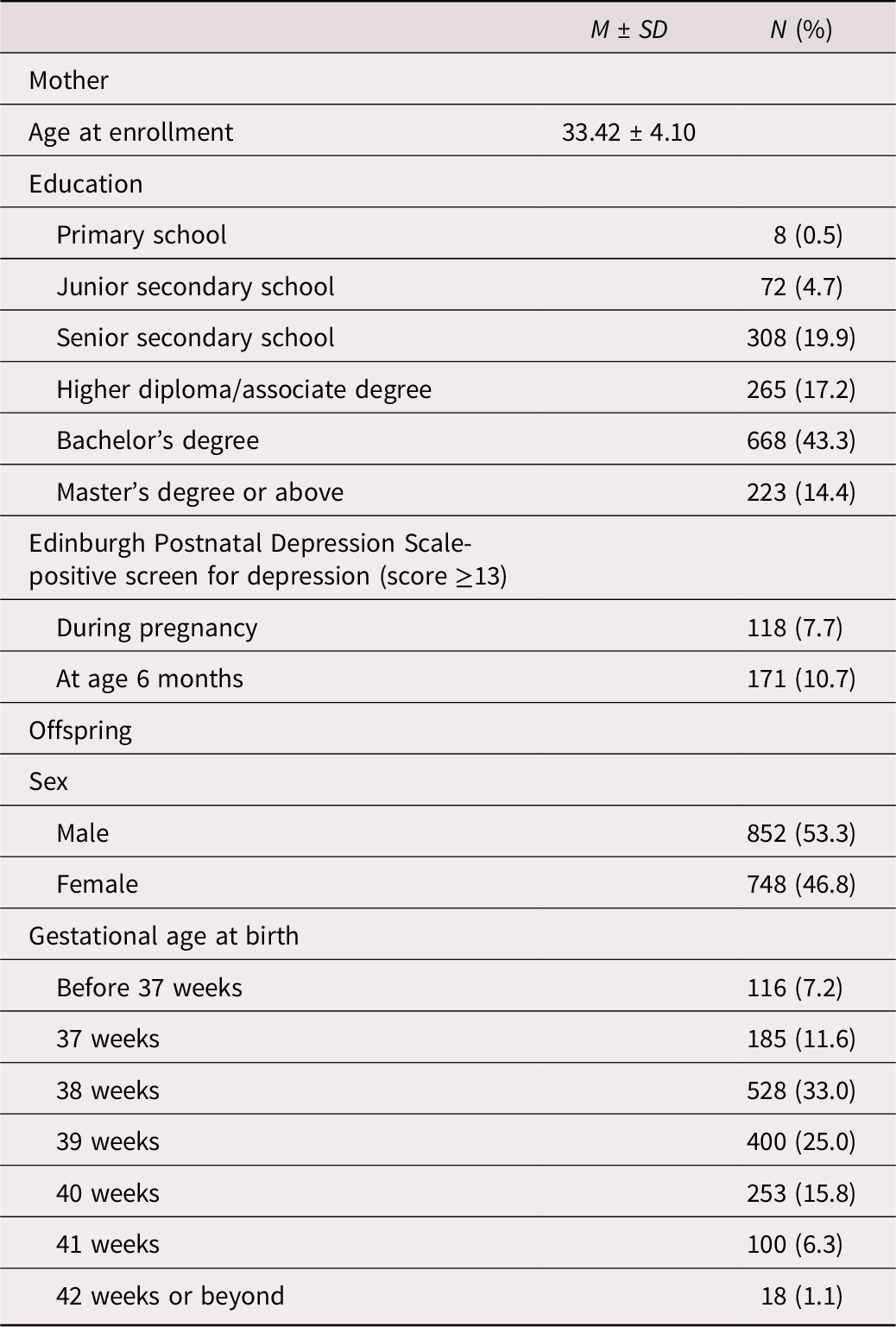
Between 2021 and 2023, 1,600 expectant mothers were recruited from the waiting areas of antenatal clinics at public hospitals in Hong Kong. At enrollment, participants were between 25th and 35th week of gestation and ranged in age from 19 to 44 years (M age = 33.42; SD = 4.10). None of the mothers reported alcohol, nicotine, or other substance use during pregnancy. After providing written informed consent, participants completed baseline questionnaires assessing demographic characteristics, depressive symptoms, and positive affect during pregnancy (T0). Six months after childbirth (T1), mothers were contacted via text message and invited to complete the depressive symptoms questionnaire again, along with measures of mother–infant bonding and infant temperament. Follow-up assessments were conducted again at 12 months (T2) and 24 months (T3) postpartum using the same set of questionnaires. As described in Table 1, most participants had completed at least a bachelor’s degree (57.6%). When using Edinburgh Postnatal Depression Scale (EPDS) to screen for depression, 7.7% of participants screened positive at T0, and 10.7% at T1. Prior to data collection, all participants were informed of the study design and objectives and provided written informed consent. All data were analyzed anonymously, and participant privacy was protected. This study was approved by the Institutional Review Board of the University of Hong Kong/Hospital Authority Hong Kong West Cluster Research Ethics Committee (UW 13-055 and UW 19-497).
Participant characteristics (n = 1,600)

Table 1. Long description
A table summarizing characteristics of 1,600 expectant mothers recruited in Hong Kong between 2021 and 2023. The table has 16 rows and 3 columns. The columns are labeled M ± SD, N, and (%). The rows are categorized under Mother and Offspring. Under Mother, the table lists Age at enrollment, Education levels (Primary school, Junior secondary school, Senior secondary school, Higher diploma/associate degree, Bachelor’s degree, Master’s degree or above), and Edinburgh Postnatal Depression Scale-positive screen for depression (During pregnancy, At age 6 months). Under Offspring, the table lists Sex (Male, Female) and Gestational age at birth (Before 37 weeks, 37 weeks, 38 weeks, 39 weeks, 40 weeks, 41 weeks, 42 weeks or beyond). Each row provides specific data points for the respective categories.
Missing data not shown
Measures
Edinburgh Postnatal Depression Scale (EPDS)
The EPDS (Cox et al., Reference Cox, Holden and Sagovsky1987) is a 10-item self-report scale used to assess maternal perinatal depressive symptoms during the 7 days preceding assessment at T0 and T1. Items are rated on a 4-point scale from 0 (no symptoms) to 3 (severe symptoms), yielding total scores from 0 to 30. Higher scores indicate more severe depression. In the present study, the average internal consistency of the EPDS across time points was α = 0.86.
Positive and Negative Affect Schedule – Positive Affect (PANAS – PA)
The PANAS – PA (Watson et al., Reference Watson, Clark and Tellegen1988) is a 10-item self-report measure assessing maternal state positive affect during the 7 days preceding the T0 assessment. Items are rated on a 5-point scale from 1 (very slightly or not at all) to 5 (extremely), yielding total scores from 10 to 50. Higher scores indicate more positive affect. In the present study, the internal consistency of the PANAS – PA at T0 was α = 0.92.
Postpartum Bonding Questionnaire (PBQ)
The PBQ (Brockington et al., Reference Brockington, Fraser and Wilson2006) is a 25-item self-report scale used to assess maternal feelings and emotions toward the infant at T1 and T2, which can be categorized into four subscales: general difficulties in mother–infant relationship (score range 0–60), rejection and pathological anger (scores 0–35), anxiety about the infant (scores 0–30), and incipient abuse (scores 0–10). Positive responses were scored from 0 (always) to 5 (never) and negative responses from 5 (always) to 0 (never). Due to skewed distribution, the subscale scores were combined into a single parameter labeled “mother–infant bonding difficulties” using confirmatory factor analysis. Higher scores on PBQ indicate greater bonding difficulties. The Chinese version of the PBQ has been validated in a Hong Kong postpartum sample, with convergent and criterion validity supported by associations with clinical assessments from the Birmingham Interview for Maternal Mental Health, a semi-structured interview that assesses mother–infant relationship impairments (Siu et al., Reference Siu, Ip, Chow, Kwok, Li, Koo, Cheung, Yeung and Hung2010). In the present study, the average internal consistency of the PBQ subscales across time points was: general factor, α = 0.84; rejection and pathological anger, α = 0.76; anxiety about the infant, α = 0.86; incipient abuse, α = 0.86.
Infant Behavior Questionnaire-Revised Very Short Form (IBQ-RVS)
The IBQ-RVS (Putnam et al., Reference Putnam, Helbig, Gartstein, Rothbart and Leerkes2014) is a 37-item mother-report scale used to assess maternal perceptions of infant behaviors across three key temperament domains at T1, T2, and T3: negative affectivity, such as sadness and fear; effortful control, such as low-intensity pleasure and duration of orienting; and positive affectivity/surgency, such as approach and smiling and laughter. Scores range from 1 to 7, with higher scores indicating greater levels of negative affectivity, effortful control, or positive affectivity/surgency in the infant. In the present study, the average internal consistency of the IBQ-RVS subscales across time points was: negative affectivity, α = 0.84; effortful control, α = 0.76; and positive affectivity/surgency, α = 0.86.
Data analysis
Descriptive statistics and Spearman’s rank correlation were performed using SPSS (v. 27.0; IBM, New York, USA). A small proportion of participants had missing data on the mother–infant bonding measures at follow-up (3.56% at T1; 1.94% at T2), and overall variable-level missingness was below 5%. Participants with complete versus missing data did not differ on demographic characteristics. To reduce potential bias associated with missingness and maximize use of available data, we handled missing data using multiple imputation under the assumption that data were missing at random. Multiple linear regression analyses were first conducted to examine the association between maternal prenatal emotional states and offspring temperament at 24 months postpartum. Subsequently, structural equation modeling (SEM) was employed to test the hypothesized model, with maternal postnatal depressive symptoms and perceived bonding difficulties as mediators of each significant association identified in the multiple linear regression analyses. Following a two-step approach (Anderson & Gerbing, Reference Anderson and Gerbing1988), we first evaluated the measurement model and then specified the structural model. SEM analyses were conducted in R (version 4.3.1) using the lavaan package. In the figures, latent variables are represented as ellipses and observed variables as rectangles. Standardized effect sizes are reported. The model’s goodness-of-fit was assessed using several fit indices. The Chi-square (χ 2) test was initially considered, with p > .05 indicating a good fit (Hu & Bentler, Reference Hu and Bentler1999). However, recognizing that the χ 2 test can be heavily influenced by sample size (Dilalla, Reference Dilalla, Tinsley and Brown2000), additional fit indices were used to evaluate the model, including the Comparative Fit Index (CFI) and Tucker–Lewis Index (TLI), where values above 0.90 suggest a good fit (Hu & Bentler, Reference Hu and Bentler1999; Kline, Reference Kline2023). The root mean square error of approximation (RMSEA) and the standardized root mean square residual (SRMR) were also used, with values of 0.08 or below indicating an acceptable fit (Hooper & Coughlan, Reference Hooper and Coughlan2008; Marsh & Hocevar, Reference Marsh and Hocevar1985). The models were adjusted for baseline and demographic covariates, including maternal age and education level, offspring sex and gestational age, and recruitment year. All tests were two-tailed, with p < .05 indicating statistical significance.
Results
Descriptive statistics and correlations
Descriptive statistics for the sample and the measures are shown in Table 1 and Table 2, respectively. Most participants indicated experiencing strong and positive bonds with their offsprings, as evidenced by all aspects of postpartum bonding falling within the normal range. Table 2 shows the correlations between study variables. Most of the relationships were significant. However, T1 offspring effortful control was not associated with offspring negative affectivity at either T1 or T2, and T2 effortful control was also unrelated to T2 negative affectivity. In contrast, T3 effortful control was significantly and negatively associated with T3 negative affectivity (r = −0.11). This pattern suggests that the regulatory processes linking effortful control to negative affectivity may emerge later in development, potentially because regulating negative emotions requires more time to develop than regulating positive emotions or motor activity.
Correlation analysis
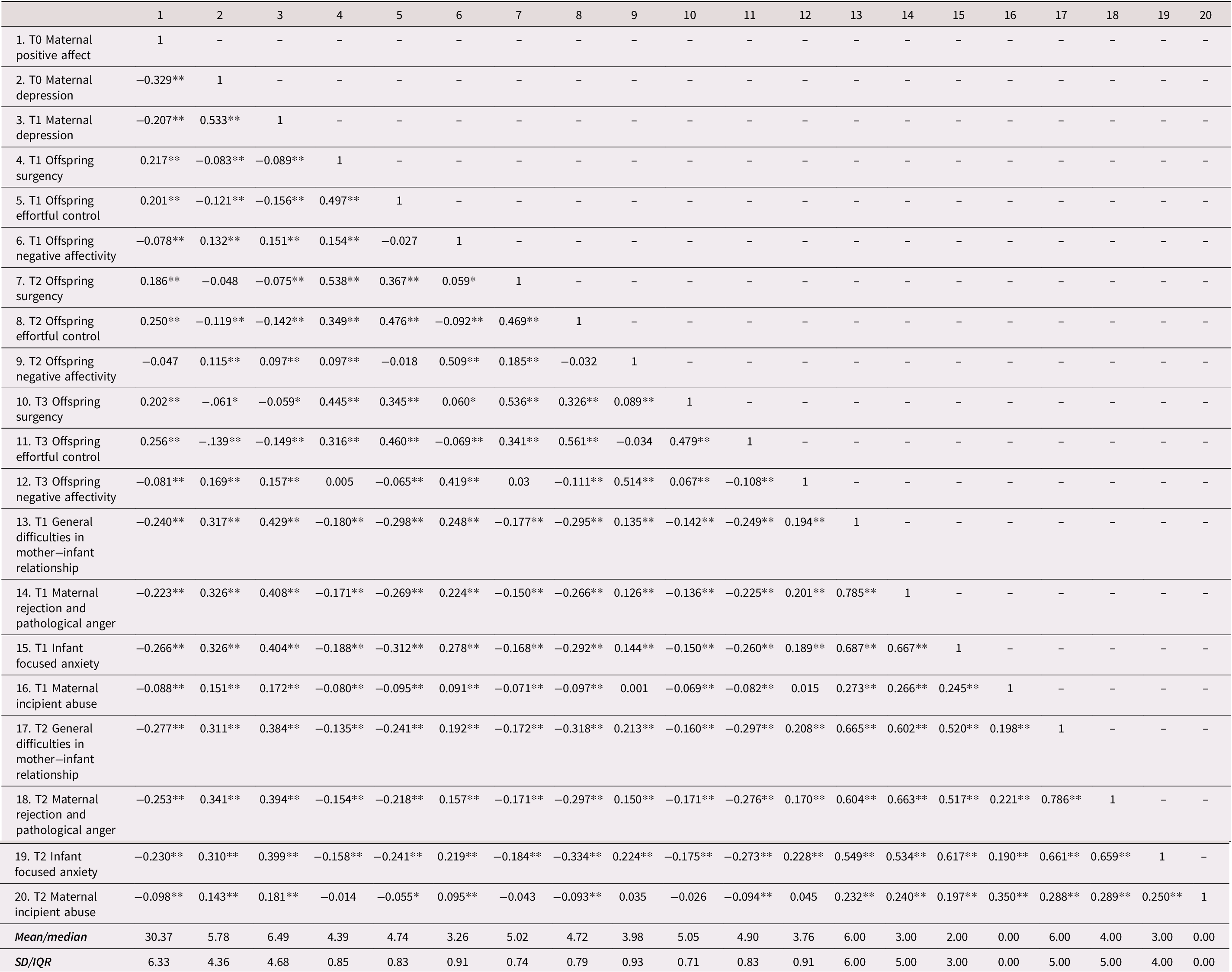
Table 2. Long description
A table with 20 rows and 20 columns showing correlations between study variables. The table includes correlation coefficients and significance levels. Row labels include variables such as maternal positive affect, maternal depression, offspring surgery, offspring effortful control, offspring negative affectivity, and general distress in mother-infant relationship. Column headers are numbered from 1 to 20. Notable trends include significant correlations between many variables, with some exceptions such as T1 offspring effortful control not being associated with offspring negative affectivity at T1 or T2. The table also includes mean and standard deviation values for each variable.
**Correlation is significant at the 0.01 level (2-tailed).
*Correlation is significant at the 0.05 level (2-tailed).
Regression analysis of maternal prenatal emotional states and infant temperament
The multiple linear regression analysis, which simultaneously adjusted for T0 maternal depressive symptoms, T0 maternal positive affect, and demographic covariates, showed that only T0 maternal depressive symptoms (β = 0.17, p < .001) were associated with T3 offspring negative affectivity (R 2 = 0.05, F 7,1592 = 12.555, p < .001). In contrast, T3 offspring surgency (R 2 = 0.07, F 7,1592 = 16.080, p < .001) and effortful control (R 2 = 0.08, F 7,1592 = 19.0582, p < .001) were significantly associated only with T0 maternal positive affect (β = 0.21, p < .001 and β = 0.24, p < .001, respectively).
Path analysis of maternal prenatal emotional states and infant temperament via postnatal depressive symptoms and bonding difficulties
Based on the regression analysis, we specified three models to further examine the significant associations. Prior to testing each hypothesized structural model, we evaluated the measurement model used to construct the latent variable “mother–infant bonding difficulties,” which was defined by the four PBQ factors. This measurement model showed excellent fit at both T1 (χ 2 (2) = 3.085, p > .05, TLI = 0.999, CFI = 1.000, SRMR = 0.006, RMSEA = 0.019 [CI 0.000–0.052]) and T2 (χ 2 (2) = 4.790, p > .05, TLI = 0.996, CFI = 0.999, SRMR = 0.009, RMSEA = 0.030 [CI 0.006–0.053]).
-
a. The association between T0 maternal depressive symptoms and T3 offspring negative affectivity
Figure 1 shows the pathways from T0 maternal depressive symptoms to T3 offspring negative affectivity. Maternal depressive symptoms at T0 were positively associated with offspring negative affectivity at T1 (β = 0.15, p < .001), which showed significant continuity from T1 to T2 (β = 0.53, p < .001) and from T2 to T3 (β = 0.51, p < .001). In addition, higher maternal depressive symptoms at T0 predicted greater mother–infant bonding difficulties at T1 (β = 0.33, p < .001), which remained highly stable from T1 to T2 (β = 0.76, p < .001). Maternal depressive symptoms at T0 showed moderate stability to T1 (β = 0.52, p < .001), and T1 maternal depressive symptoms, in turn, predicted higher levels of mother–infant bonding difficulties at T2 (β = 0.07, p < .01). Bonding difficulties at T2 were subsequently associated with increased offspring negative affectivity at T3 (β = 0.07, p < 0.01). These indirect pathways accounted for 52.9% of the association between maternal depressive symptoms at T0 and offspring negative affectivity at T3. The model showed adequate fit: χ 2 (94) = 310.948, p < .001, TLI = 0.963, CFI = 0.975, SRMR = 0.027, RMSEA = 0.038 [CI 0.034–0.042].
Structural equation model linking T0 maternal depressive symptoms to T3 offspring negative affectivity. Adjusted for maternal age, gestational age, education level, T0 positive affect, child gender, and recruitment year. Note. *p < .05; **p < .01; ***p < .001.

-
b. The association between T0 maternal positive affect and T3 offspring surgency
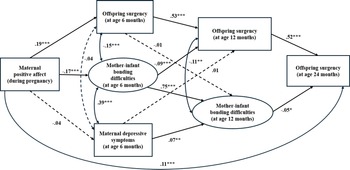
Figure 2 shows the pathways from T0 maternal positive affect to T3 offspring surgency. Maternal positive affect at T0 was positively associated with offspring surgency at T1 (β = 0.19, p < .001), which remained stable from T1 to T2 (β = 0.53, p < .001) and from T2 to T3 (β = 0.52, p < .001). A second pathway to higher surgency at T3 operated though reduced mother–infant bonding difficulties: T0 maternal positive affect was negatively associated with bonding difficulties at T1 (β = −0.17, p < .001), which showed strong stability into T2 (β = 0.75, p < .001). In turn, bonding difficulties at T1 were associated with lower offspring surgency at T2 (β = −0.09, p < .001). Maternal depressive symptoms at T1 were not significantly associated with T0 maternal positive affect or with offspring surgency at T1 or T2. Together, these pathways explained 47.6% of the association between T0 maternal positive affect and T3 offspring surgency. The model showed adequate fit to the data: χ 2 (94) = 279.819, p < .001, TLI = 0.968, CFI = 0.978, SRMR = 0.026, RMSEA = 0.035 [CI 0.031–0.039].
Structural equation model linking T0 maternal positive affect to T3 offspring surgency. Adjusted for maternal age, gestational age, education level, T0 depressive symptoms, child gender, and recruitment year. Note. *p < .05; **p < .01; ***p < .001.
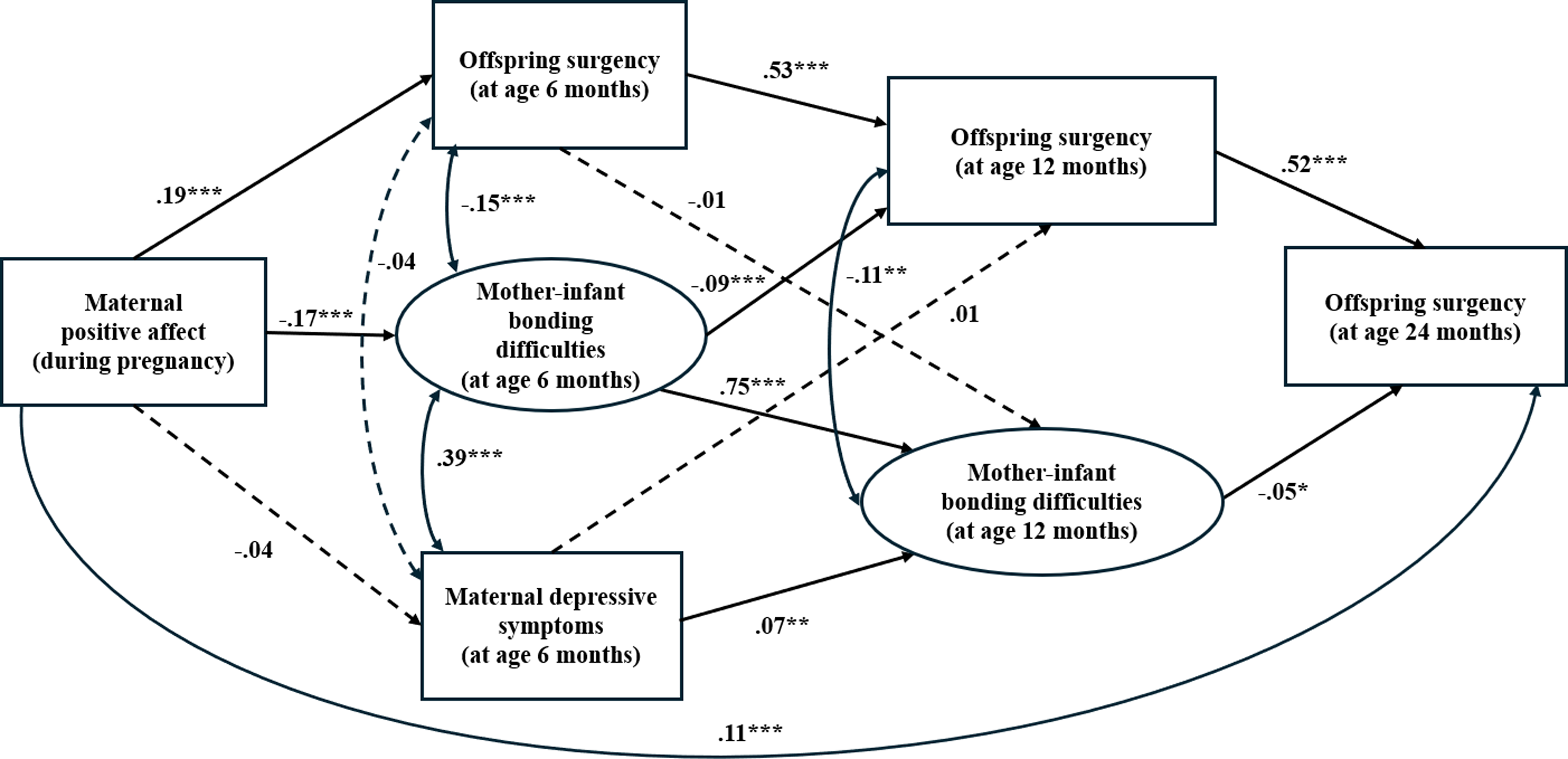
Figure 2. Long description
A structural equation model diagram linking maternal positive affect during pregnancy to offspring surgency at ages 6, 12, and 24 months. The model includes several key components: Maternal positive affect during pregnancy, offspring surgency at 6 months, mother-infant bonding difficulties at 6 months, maternal depressive symptoms at 6 months, offspring surgency at 12 months, mother-infant bonding difficulties at 12 months, and offspring surgency at 24 months. Arrows indicate the directional relationships between these components, with solid lines representing significant paths and dashed lines representing non-significant paths. The model is adjusted for various factors including maternal age, gestational age, education level, maternal depressive symptoms, child gender, and recruitment year. Significant paths are marked with asterisks indicating levels of significance: *p < .05, **p < .01, ***p < .001.
-
c. The association between T0 maternal positive affect and T3 offspring effortful control
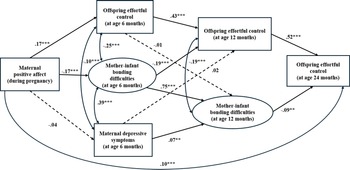
Figure 3 shows the pathways from T0 maternal positive affect to T3 offspring effortful control. The model predicting T3 offspring effortful control closely resembled that for T3 offspring surgency and demonstrated adequate fit to the data: χ 2 (94) = 331.445, p < .001, TLI = 0.960, CFI = 0.973, SRMR = 0.030, RMSEA = 0.040 [CI 0.036–0.044]. Collectively, the pathways accounted for 58.3% of the association between maternal positive affect at T0 and offspring effortful control at T3. Nonetheless, unlike surgency, effortful control at T1 was significantly associated with maternal depressive symptoms at the same point (β = −0.10, p < .001). In addition, mother–infant bonding difficulties at T1 showed a stronger association with offspring effortful control than with surgency at T2 (−0.19 vs −0.09), suggesting that effortful control may be more susceptible to environmental influences.
Structural equation model linking T0 maternal positive affect to T3 offspring effortful control. Adjusted for maternal age, gestational age, education level, T0 depressive symptoms, child gender, and recruitment year. Note. *p < .05; **p < .01; ***p < .001.

Discussion
This longitudinal study examined the associations between maternal emotional states during pregnancy and mother-reported infant temperament over the first 24 months of life in a large sample of 1,600 mother–infant dyads. We further considered the extent to which hereditary and environmental factors may contribute to individual differences in offspring temperament during this developmental period. Moving beyond the traditional emphasis on prenatal depressive symptoms, the present study examined the association of prenatal exposure to both depressive symptoms and positive affect with infant temperament. After mutual adjustment, maternal depressive symptoms during pregnancy remained independently associated with higher infant negative affectivity at 24 months. By contrast, infant surgency and effortful control were more strongly related to maternal prenatal positive affect than to prenatal depressive symptoms. However, because postnatal positive affect was not assessed, these associations should not be interpreted as evidence of a specific prenatal effect. Continuity in maternal positive emotional experience across the prenatal and postnatal periods may also have contributed to the observed associations. Overall, these findings are consistent with the view that maternal emotional experiences during pregnancy play a role in fetal development and early socioemotional functioning (Van den Bergh et al., Reference Van den Bergh, van den Heuvel, Lahti, Braeken, de Rooij, Entringer, Hoyer, Roseboom, Räikkönen, King and Schwab2020).
Research on maternal emotional states during pregnancy has predominantly focused on depressive symptoms (Yin et al., Reference Yin, Sun, Jiang, Xu, Gan, Zhang, Qiu, Yang, Shi, Chang and Gong2021). Nevertheless, the emotional landscape of pregnancy extends beyond psychological distress and often includes positive states such as joy and excitement. This broader affective context may also have implications for offspring development, yet limited attention has been given to whether maternal positive and negative emotional states show distinct associations with children’s early emotional and regulatory capacities. Although antenatal depression has been linked to subsequent behavioral and developmental difficulties in offspring (Hermans et al., Reference Hermans, Avraam, Schuurmans, Soares, Lahti-Pulkkinen, Girchenko, Vrijkotte, de Rooij, Elhakeem, van der Waerden, Heude, Vainqueur, Yang, Cheung, Lewer, Strandberg-Larsen, Cadman, Popovic, Candelora and El Marroun2026), relatively few studies have investigated these links during infancy, a developmental period in which emerging temperament may reflect the combined influence of hereditary factors and early environmental exposures (Bokhorst et al., Reference Bokhorst, Bakermans-kranenburg, Pasco fearon, Van ijzendoorn, Fonagy and Schuengel2003). The present findings, demonstrating an association between maternal emotional well-being during pregnancy and early offspring socioemotional development, highlight the importance of future research that incorporates both prenatal and postnatal assessments of negative and positive affect in order to clarify the timing, specificity, and developmental significance of these associations.
The observed stability of offspring temperament from 6 to 24 months, reflected in moderate continuity across the three assessment points, suggests that temperament has an early-emerging and partially enduring basis, potentially reflecting genetic contributions. However, the moderate magnitude of these associations also indicates that temperament is not entirely fixed in infancy but remains developmentally dynamic, leaving scope for environmental influences over time. This interpretation is consistent with prior research showing that both shared and non-shared environmental factors can contribute to infant emotional development (Ogren & Johnson, Reference Ogren and Johnson2020; Planalp et al., Reference Planalp, Van Hulle, Lemery-Chalfant and Goldsmith2017). Importantly, when examining the associations between maternal emotional states during pregnancy and offspring temperament at 6 and 24 months, we found that maternal postnatal depressive symptoms and perceived bonding difficulties explained substantial proportions of the variance in temperament across this period: 46% for negative affectivity, 42% for surgency, and 41% for effortful control. Although shared method variance cannot be excluded, as all measures were mother-reported, these findings suggest that infant temperament, while partly biologically rooted, remains modifiable by postnatal influence, particularly effortful control, highlighting the important role of maternal psychological well-being and responsive caregiving environment in early socioemotional development.
Consistent with previous evidence that maternal depressive symptoms during pregnancy often persist into the postpartum period (Le Bas et al., Reference Le Bas, Youssef, Macdonald, Mattick, Teague, Honan, McIntosh, Khor, Rossen, Elliott, Allsop, Burns, Olsson and Hutchinson2021), our findings further suggest that sustained maternal depression from pregnancy through infancy is associated with greater infant negative affectivity, partly through increased mother–infant bonding difficulties. Previous research has shown that interactions marked by lower sensitivity, reduced emotional availability, and diminished contingent responsiveness may impair soothing and co-regulation (O’Dea et al., Reference O’Dea, Youssef, Hagg, Francis, Spry, Rossen, Smith, Teague, Mansour, Booth, Davies, Hutchinson and Macdonald2023; Radoš et al., Reference Radoš, Matijaš, Anđelinović, Čartolovni and Ayers2020), thereby reinforcing infant distress and constraining the development of emotion regulation (Lunkenheimer et al., Reference Lunkenheimer, Sturge-Apple and Kelm2023). These effects may operate through disrupted attachment processes and repeated activation of infant stress-response systems (Davis et al., Reference Davis, Glynn, Schetter, Hobel, Chicz-Demet and Sandman2007; Van den Bergh et al., Reference Van den Bergh, van den Heuvel, Lahti, Braeken, de Rooij, Entringer, Hoyer, Roseboom, Räikkönen, King and Schwab2020). Notably, we found no evidence that child temperament at 6 months postpartum predicted mother–infant bonding difficulties at 12 months postpartum. This is in line with the mixed evidence regarding bidirectional child-to-parent and parent-to-child effects and highlights the need for further investigation (Hanington et al., Reference Hanington, Ramchandani and Stein2010; Takács et al., Reference Takács, Smolík and Putnam2019). By contrast, the lack of a significant association between maternal prenatal positive affect and postnatal depressive symptoms suggests that positive emotional experiences during pregnancy may not necessarily protect against postpartum depression, which may also be influenced by factors such as postpartum hormonal changes (Wenzel et al., Reference Wenzel, Frye, Roberson-Nay and Payne2025). Taken together, these findings suggest that postpartum support should not be limited to women who appear distressed during pregnancy; rather, comprehensive postpartum care should be offered universally, with particular attention to maternal mood, bonding, and the quality of early mother–infant interactions, given their potential role in shaping infant temperament and early socioemotional development.
Although higher maternal positive affect during pregnancy was not associated with a lower risk of postpartum depression, it was linked to a lower likelihood of mother–infant bonding difficulties at 6 months. One plausible explanation is that prenatal positive affect may foster more adaptive maternal representations of the child during pregnancy and facilitate the transition to motherhood, thereby promoting a warmer and more emotionally connected postnatal relationship (Foley & Hughes, Reference Foley and Hughes2018; Steele et al., Reference Steele, Perez, Segal, Fearon, Fonagy and Steele2025). However, because postnatal positive affect was not controlled for, this association may also partly reflect continuity in mothers’ positive emotional functioning from the prenatal to the postnatal period. In turn, fewer perceived bonding difficulties at 6 months may support infants’ subsequent positive affect and regulatory capacities by enhancing opportunities for emotional attunement, soothing, and co-regulation by 12 months, consistent with evidence that positive caregiving behavior supports infant affective development (Planalp et al., Reference Planalp, Van Hulle, Lemery-Chalfant and Goldsmith2017). By contrast, elevated maternal depressive symptoms may contribute to bonding difficulties through reduced maternal sensitivity and emotional engagement (Binda et al., Reference Binda, Figueroa-Leigh and Olhaberry2019). Our findings further indicate substantial continuity in bonding difficulties from 6 to 12 months, with persistent difficulties across this period associated with greater infant negative affectivity at 24 months. These results highlight the importance of supporting mothers in the first six months postpartum, particularly in ways that promote emotional well-being and strengthen the early mother–infant bond.
This study has several strengths, including its large sample size, the distinction between positive and negative emotions as separate constructs, and repeated assessments spanning pregnancy to 24 months postpartum. However, caution is warranted when interpreting the findings due to methodological limitations. First, all maternal and infant outcome measures were based on maternal self-report. As a result, the observed associations may partly reflect shared method variance or reporter bias, rather than true associations between maternal emotional states and infant temperament. For example, mothers with depressive symptoms may be more likely to perceive and report their infants as more negatively reactive or less well regulated. Although maternal perceptions are clinically relevant, reliance on a single informant limits the ability to disentangle infants’ actual behavior from maternal interpretation. Future research should incorporate medical records or clinician-administered assessments to validate maternal mental health diagnoses, along with direct observational measures and reports from additional caregivers to obtain a more objective, multi-informant assessment of infant temperament. Second, the study focused exclusively on maternal emotional states and mother–infant bonding, without considering paternal influences, such as fathers’ emotional states, which may also affect outcomes and warrant investigation in future research. Third, unlike maternal depressive symptoms, maternal positive affect was assessed at only one time point. This limits the ability to examine its stability over time or to draw conclusions about potential timing effects in relation to infant outcomes. Lastly, the sample predominantly consisted of healthy mothers in Hong Kong and had a relatively low rate of postpartum depression, which may limit the generalizability of the results to higher-risk groups or other populations.
Conclusion
This longitudinal study, spanning pregnancy through 24 months postpartum, provides evidence that maternal emotional states during pregnancy are significantly associated with infant temperament across the first two years of life. Higher maternal positive affect during pregnancy predicts greater infant positive affect and stronger regulatory capacities, whereas maternal depressive symptoms during pregnancy tend to persist into the postnatal period and are associated with greater infant negative affectivity. These findings suggest that mother–infant bonding may be a promising target for interventions designed to promote positive emotional and regulatory outcomes in both mothers and infants through 24 months postpartum. Given that bonding difficulties may become more stable after the first six months postpartum, intervention efforts to strengthen the mother–infant bond during this early period may be especially important for supporting healthy developmental trajectories.
Data availability statement
Data and code are available upon reasonable request from the authors.
Acknowledgments
The authors would like to thank all participants in this study for their support and participation.
Funding statement
This study was supported by the seed funding grant (RG 56/2025-2026R and RG 20/2023-2024R) from The Education University of Hong Kong and the Health Medical Research Fund (No. 23240351) from the Health Bureau of Hong Kong Special Administrative Region.
Competing interests
The authors declare that they have no competing interests.
Pre-registration statement
This study was not pre-registered. The research questions and main analyses were defined prior to data analysis; however, no formal pre-registration document was created. We report all measures, conditions, and analyses conducted.


 Open access

