I grew up listening to my grandfather’s voice on vinyl records, learning the sounds and cadences of Yiddish poetry and songs I didn’t understand. Clicking and popping, with a shrill hum and the static of digitization, my grandfather’s voice is how I first met him, through the urgency of his prayers, the stories he tells. These recordings of my grandfather, Dovid Zisman (1914–1960), are the lens I use to understand inherited generational experiences, a way to capture the personal alongside the historical. I have been fascinated with Zisman’s poems  (“Ghetto/Aktzia,” Reference Zisman1943) and
 (“A Spark of Freedom,” 1945) for as long as I can remember. Both are recorded on vinyl records, the first by Zisman himself, and the second by his youngest daughter (my mother), who recited it when she was a child at a memorial several years after his passing. In “Ghetto/Aktzia,” written in Łódz´ in Reference Zisman1943, Zisman describes the removal and transport of Jews from the ghetto to the camps and then to the gas chambers. In “A Spark of Freedom,” written in Buchenwald in Reference Zisman1945, Zisman imagines a hopeful future.Footnote
1
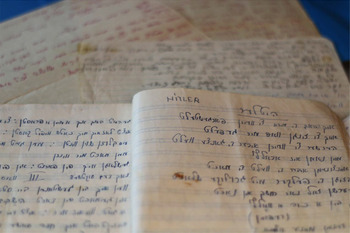
Dovid Zisman’s journals with song entitled, “Hitler.” (Photo by Laine Halpern Zisman)

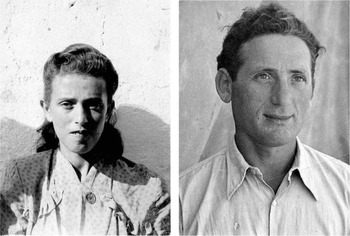
Born in Łódz´ in 1914, Zisman began writing poetry and plays at a young age. In 1943 he was sent to the Hasag-Pelcery work camp in Czeístochowa and later to Buchenwald. He was known as “The Poet” in the ghetto (Pups Reference Pups1962:61) and performed his works in the camps. While his defiant poetry was a means of perpetuating hope, he was also forced to perform for the Nazis to entertain them. My grandmother told me that his performances contributed to his survival on more than one level. His written journals and audio recordings document the living and breathing recitations that kept his spirit alive. After his liberation in 1945, Zisman married Helen (Chaya) Helfgot, also a survivor of the camps (Leipzig-Mansfeld, in Germany, and Skarzæysko-Kamienna, in Poland). They briefly lived in Palestine-Israel with their first daughter before moving to Toronto, Canada, where my mother, their second daughter, was born. Zisman continued to write poetry, plays, and music, perform in Yiddish theatre groups, and work as a furrier.
As I grow older and grapple with the violent deaths of my ancestors, I am translating my grandfather’s works in order to understand the legacies and tragedies my maternal grandparents pass down. What does it mean to be in the third generation? What have I inherited from their experiences in the camps? While my grandmother was at times at a loss for words when talking about the torture and violence she endured for six years in the camps, my grandfather’s creative work provided him with an outlet and a means to move beyond everyday language. Poetry, song, and performance were his way to speak the unspeakable.
In 2012, I received an email from a researcher at the Emanuel Ringelblum Jewish Historical Institute (JHI) in Warsaw, Poland, asking if my family was related to the Holocaust survivor, poet, and playwright Dovid Zisman. They were trying to find Zisman’s daughters to provide permission to publish one of his poems in an upcoming anthology. Through further email communication with the JHI, I found that the Institute had five pages of Zisman’s poems in their archives — some of which my family had never seen. While my family knew that Zisman wrote poetry and performed in the Buchenwald concentration camp, we did not know that his works extended beyond the private recordings and handwritten journals tucked away in my grandmother’s basement. Online searches and some additional research through personal documents revealed that his name was included in several pamphlets and bibliographies of poets in Łódz´ , Poland, but few of his works were published. In the summer of 2019, I asked the JHI about the material they had, requesting more legible scans of Zisman’s work — this time, they sent back a 47-page document that included handwritten letters, journals, and poems sent to them by my grandfather just a few months before he passed away from cancer in 1960. A new thread of family history.
Through my process of discovering this history and translating my grandfather’s texts I’ve found connections with queer theoretical frameworks and my own queer identity.Footnote 2 Jewish practice, ritual, creativity, and memory intersect with queer theory’s refusal of singularity, temporal cohesion, and linear causality (Dinshaw et al. Reference Dinshaw, Edelman, Ferguson, Freccero, Freeman, Halberstam, Jagose, Nealon and Nguyen2007; Muñoz Reference Muñoz2009). Yiddish too possesses a kinship with queer aesthetics and theories, a language defined by a nomadic zombie status, always returning from the dead (Halpern Reference Halpern2007). Both endangered and being revitalized, Yiddish picks up words, phrases, and rhythms from Hebrew, German, Jewish-French, Jewish-Italian, Aramaic, and the Slavic languages (Avineri Reference Avineri2014; Halpern Reference Halpern2007; Shandler Reference Shandler2006b; Steinmetz [1986] Reference Steinmetz2001). Yiddish’s current status is deeply bound with trauma. Many second-generation survivors grappling with their parents’ struggles work to assimilate into other cultures, and distance themselves from the past. In contrast, many third-generation survivors try to return to roots that have been severed, wanting to reestablish connections to a past culture and identity (Morales Reference Morales2017). In contradistinction to thinking of Yiddish as premodern and obsolete, I look to both present and past use of Yiddish as evidence of its continuing productive contributions to cultural and religious identity. For all that, to me, a nonnative speaker, Yiddish remains slightly out of reach.
While I focus here on my grandfather’s poetry, I do not approach his works as static texts, but as performances. I learned fragments of his poetry as a child not by reading his handwritten scrawl but by mimicking the tonality, rhythms, and sounds of his recordings. I struggled to understand the words, to feel the vibrations resonate on my tongue as I strived to grasp a language that is increasingly distanced from my memory, yet undeniably embedded in me and embodied in my endeavors.
Within Jewish worship, boundaries between poetry and song, performance and written text, are blurred and traversed. The final commandment of the Torah reads  (Write this song for yourselves) (Deuteronomy 31:19), commanding the Jewish people to write a Torah scroll. Here, the written Torah scroll is referred to as a song to be put in the mouths of the next generations. This is not a rhetorical flourish. Culturally and religiously, there is an emphasis on enacting, speaking, and performing text. Repeatedly throughout Jewish liturgy, poetry and song are emphasized. Indeed, in both Yiddish and Hebrew, the words for song and poem (
 in Yiddish and
 in Hebrew) can be used interchangeably. These concepts would not have been foreign to my grandfather. Growing up in a Jewish home, performance was part of his everyday practices; singing inflected his Jewish life.
Repeatedly, biblical texts, oral traditions, and commentaries point to singing as essential to elevate prayer and learning. The Hasidic movement gave singing a sacred role, even beyond text. Music, according to the Baal Shem Tov (1698–1760, the founder of Hasidism), transcends the limitations of spoken language. The words of the Torah are read aloud with a specific musical cantillation, notes known as trop in Yiddish and ta’amim in Hebrew. The Talmud instructs us to learn and teach with melody; singing is a part of our daily prayers. We chant prayers with a specific musical style or nusakh, and the character of that tune, the composer, and the history tell a story of who you are, where you are from, what customs you follow, what sect you belong to. These compositions are orientation devices; they place each Jewish person within a larger narrative. It is no surprise then that when I listen to my grandfather’s performance, the words are not read, but sung, his cadence keeping time and melody, becoming a lesson and a prayer. While my grandfather’s written journals are invaluable, it is clear from the musicality of his recorded performances that his words were meant to be recited; they are inherently theatrical.
Together in the Flames
Developing an Intimate Methodology through a Queer Jewish Lens
A large part of this research is inherently autoethnographic, a reflexive ongoing conversation on the Holocaust and intergenerational trauma.Footnote 3 3 It is my own rich embodied performance and practice of learning, of frustration, of anxiety, of sadness. I use autoethnography as my methodological approach because, as Naila Keleta-Mae writes, it is “invested in the communication of personal ideas and observations in complex, accessible ways that mobilize but are not beholden to literal interpretations of the first personal singular” (Reference Keleta-Mae, Levin and Schweitzer2017:317). Autoethnography provides an opportunity to complicate my experience as a grandchild of two Holocaust survivors, not to essentialize my narrative as universal, but rather as part of a diverse collective.
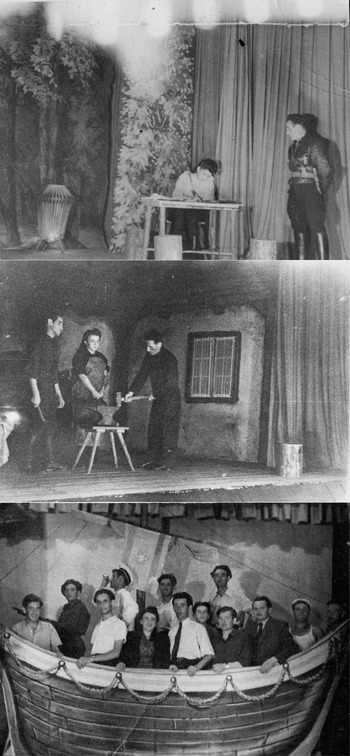
Production shots from plays produced postliberation from the concentration camps with unknown performers and Dovid Zisman. (Photos courtesy of Laine Halpern Zisman)

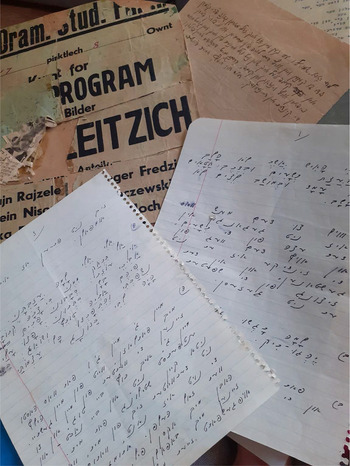
It was only recently that I located and began sifting through new pages of my grandfather’s handwritten poetry. The pencilled words are dull; his cursive in places, illegible. I need the audio recordings to follow along, to decipher the letters and their meaning. And when the recordings skip, when the static and noise distort the words, these journals are the key to untangling his words. They work together, each lifting the other, a voice, a crossed-out word, a rewritten chorus. There is an intimacy to this process of discovery, to sifting through documents, hearing my grandfather’s disembodied voice. A layered and complicated encounter with his writing, rewriting, recording, repeating, and creation of these poems and songs.
My partner asked me why I didn’t hire a translator.Footnote 4 This would be less time consuming; I could find out what every recording meant. Why struggle with my own understanding of Yiddish? I now recognize my intention was to develop an intimate methodology, like getting to know a stranger slowly. I am committed to a stubborn process of slow research, a refusal to rush, a task that’s taken years of slowly sounding out syllables and conjugating verbs; of unearthing more about the horrific abuse and violence my family members endured; and of creating, as I perform my grandfather’s work and produce media projects. This mixed methodology is how I grapple with what Marianne Hirsch calls the “postmemory” of the third generation: “the relationship that the generation after those who witnessed cultural or collective trauma bears to the experiences of those who came before, experiences that they ‘remember’ only by means of the stories, images, and behaviors among which they grew up” (Reference Hirsch2008:106).
Dovid Zisman’s journals. (Photo by Laine Halpern Zisman)

The third generation does not possess the direct memory of their ancestors’ experiences, but they are shaped in part by their internalized perceptions of them. This form of intergenerational or collective memory connects the individual to their communities and shapes cultural identities, values, and perspectives (Denham Reference Denham2008:399). Thus, rather than interpreting and translating my grandfather’s poetry as a static articulation of events from the past, I use his works, infused with both trauma and resistance, as an opportunity to understand how memory, space, and time continually shape each other. Citing Daniel Mendelsohn’s The Lost (Reference Mendelsohn2006), Victoria Aarons and Alan L. Berger refer to the third generation as the “hinge generation” (2017:69).Footnote 5 This is a generation that connects future generations to past generations relying on the transmission of first- and second-hand memories. This generation is always at risk of being “unhinged.” When the hinge is closed, this generation conceals what is at its core; but when the hinge is open, it reveals intergenerational experiences that, as Mendelsohn notes, are “rich in keepsakes,” but have “no memories to go with them” (Reference Mendelsohn2006:182). Cvetkovich describes trauma not as an isolated singular moment or event, but as “the hinge between systemic structures of exploitation and oppression and the felt experience of them” (Reference Cvetkovich2003:12). Trauma is not the thing that happened to you or your ancestors, but how what happened to them is experienced in your body. Navigating this territory is as much about learning what you cannot know as it is about past events. As Julia Creet asks, “If memory is a creature of the present, invoked by very present needs, as much as it is an incorporation of the past, then how do we negotiate these tricky relations between center and periphery with respect to the memory of the Holocaust and its generations?” (Reference Creet2014:76). As I reach for the memories that are not my own, and try to grasp familial histories through my grandmother’s stories, my grandfather’s poems, and my mother’s retelling of them, my peripheral memories are deeply shaped by both queer temporal logics and Jewish philosophy—each offering a framework to understand my own experience of intergenerational trauma as a queer third-generation survivor, as well as a lens to analyze my grandfather’s work as he directly grapples with his traumatic experiences.
Performing Poetry as Resistance

The first lines above are the conclusion of Zisman’s poem “A Spark of Freedom,” imagining a new, free world, a future founded on collective unity and peace. I learned this poem for my eighth-grade speech contest. I remember sitting with my mother at the dining room table, listening to her 12-year-old voice boom from our speakers, as I played and replayed her old vinyl. She read it then, as she does now, with an underlying melody, a rhythm that propels its message. Years later, I would hear my grandmother recite the same poem at the conclusion of her 1995 interview for the USC Shoah Foundation Institute’s Visual History Archive. After telling her own story in the interview, she insists on telling her late husband’s. She then recites “A Spark of Freedom,” just as my mother had, just as I would. The gravity of her words is penetrating; her flow from hopeful to urgent is familiar to me, just like my mother performed the poem as a child. Three generations of women, performing these lines, a performative legacy, melting poetry into song, birthing hope and making the unimaginable manifest. Our tempo and pitch rise and fall, continuing my grandfather’s narrative and imagining the musicality and beats of his own recitations, which vow for a resistance leading towards unity and freedom. These words are a throughline in my life, an activism inherited across generations: my mother said these words at my wedding; my sister recited them at her son’s bris.
The second quotation is from the conclusion of “Ghetto/Aktzia,” which moves from death and despair to a promise of revenge. In this performance, Zisman’s voice is not the soft warm grandpa I might have envisioned giving me a warm hug or a pat on the head. Throughout his performance of this poem, Zisman takes on different characters: a child, a mother, a lieutenant, and in these final lines, the “Jew that remains,” the anticipated survivor. The character of each person’s voice is distinct: the desperation and breathlessness of the mother, differentiated from the coarse laughter of the lieutenant with “the white gloves, and the stick in his hand.” In his final words, the Jew that remains does not stutter or pause. His rising volume and accelerating verses are urgent pleas pulsating and enraged, a simultaneous condemnation and prayer to a God he could not understand. This is a call to arms and battle cry. Zisman’s words are haunting in their intensity, but they are not a ghostly apparition. They promise a future reckoning. Rage propels survival. Despite the violence against the Jewish people narrated throughout the poem, the final stanza assures those listening that the fight is not lost. More will die but tomorrow will come; the war will end and revenge will be at hand.
Two poems, two endings, two recitations, two turns toward revolution and justice. Both poems are emblematic of, and perform, the capacity for creative resistance to enact change. Taken together, these two endings offer multiple and at times perhaps incompatible futurities, differing in their approach but intersecting in their calls for resistance. Both works see a future beyond the attempted annihilation of the Jewish people, while still recognizing death’s imminence. Frieda W. Aaron explains that Holocaust poetry illustrates a shift in how Jewish communities attempted to secure their acceptance and security in Europe. Whereas previously Jewish populations may have focused their energy on appeasing dominant groups, in the crisis of the Holocaust apathy and placation proved inadequate (Reference Aaron1990:134). Calling for revenge and resistance was a means to rally beyond assimilation and conformity—promising instead retribution. Performing poetry is not only effective as a tool for resistance, but also complicates essentialized and universalized genocide statistics. Zisman’s work makes individual experiences visible, and also makes possible a past and future resistance through his refusals to submit or be defeated.
Lee Anne Bell and Dipti Desai note in their discussion of social justice and the arts that art provides “a particularly potent way to activate imagination and a broader understanding of injustice, its consequences, and the range of alternative possibilities” (Reference Bell and Desai2011:287). Creative arts have the capacity to make visible those stories and voices that are “rendered invisible by structures of dominance” (288). While cultural oppression and violence might generate intergenerational trauma, they can also enact intergenerational resilience (see Berger and Berger Reference Berger and Berger2001; Braga et al. Reference Braga, Mello and Fiks2012; Denham Reference Denham2008; Shmotkin et al. Reference Shmotkin, Shrira, Goldberg and Palgi2011). Resilience refers to a positive adaptation when facing adversity, trauma, or stress (Braga et al. Reference Braga, Mello and Fiks2012; Luthar et al. Reference Luthar, Cicchetti and Becker2000). While creative writing as resistance might generate resilience, it is dangerous to valorize it despite its celebratory tone. Resilience might put the onus on the survivor (or the parent) to “bounce back” (Braga et al. Reference Braga, Mello and Fiks2012:2), creating a binary of healed/traumatized that privileges those who can overcome. While resilience might be positive, when I use the term resistance, I do not assume that everyone has the same capacity to resist or that such resistance makes an individual “better” or “stronger.” Creative practice as resistance makes space for different types of change. It makes and holds space for those able to and desiring to fight, those who cannot fight, and those who can only imagine a fight when tomorrow comes.
In his essay “Czestochowa Jews in the Nazi Era,” Binyamin Orenstayn addresses the relationship between resistance and artistic practice in the ghettos, noting that carrying out creative projects in and of itself put Jewish artists at risk because these activities were prohibited by the Nazis. Orenstayn, explaining that words were a battle call, references this stanza from Zisman’s “Hasag” (1944) about the work camp Hasag-Pelcery:
A Hasag Jew has no solution,
like a dog, he carries a number on his back,
he is treated just like an animal,
yet he still fights for a new world. (in Orenstayn Reference Orenstayn, Froimowitz and Singer1958)
I think about the Hasag Jew — the dehumanized figure who still fights for a different world — in relationship to Sara Ahmed’s (Reference Ahmed2014) willful subject, who embodies the title character in the Grimm fairy tale “The Willful Child.” The willful child dies because of her willfulness, but when she is buried, her arm comes up through the earth: she refuses to die. While Ahmed’s concept of willfulness does not entirely align with my analysis of creative Jewish resistance, I am struck by the image of the arm as the sign of a willful refusal to die. “Arms” are weapons — an especially poignant image in Zisman’s “A Spark of Freedom”:

My mother speaks these words with mounting volume in her recording of the poem, emphasizing  — rise — a command, like the willful child, to refuse to die. The arms of the dead will not be stilled, ever: “Now is the time.” Adolf Hitler wrote that he believed his work was “the will of the Almighty Creator,” that the destruction of the Jewish people was the will of God ([1925] Reference Hitler and Manheim1992:60). Through the Hasag Jew’s “fight for a new world,” and the fists that rise from the ovens, Zisman performs the refusal to be exterminated. Indeed, my mother’s voice, that of the next generation, makes manifest survival and defiance. Zisman’s works are not anthems of hope, but a call to arms across space and time to us — as spectators, listeners, readers.
This figure of the Jewish fighter also follows a thread from Jewish biblical narratives. Although these are often presented as constraining discourses necessitating obedience and conformity, they are filled with people who challenge authority. Abraham refuses the norms in his society and becomes a monotheist. Miriam, though born into a time of immense oppression, rebels with her mother Yocheved against Pharaoh by refusing to drown the newborn Moses (indeed Miriam’s name comes from the root meri, meaning rebellion). Rivka, knowing her blind husband Yitzchak favors the wrong son, takes the incredible risk of tricking him so that Yitzchak blesses their second born, Yaakov, over their first, Esav. On the Jewish High Holidays, we read about Chana who prays with so much spirit, who was so overwhelmed by emotion, that she is presumed drunk. She goes against the norms of prayer and we celebrate her for it. Zisman’s work arises from this tradition of resistance, of people who pushed boundaries, challenged norms, and risked their lives for what they believed was just and right.
We Are Together in the Streets
Recitations of Place and Space


I work my way backwards to the beginning, refusing linearity in practice, as much as Zisman does in imagery and representation. The opening lines of both “A Spark of Freedom” and “Ghetto/Aktzia” do not simply set the tone of the verses but also position the reader and the narrative in time and space. They are maps to places that should not be forgotten.
“A Spark of Freedom” begins with an imperative:  (See the sun). This line may be read as an instruction, guiding our gaze from the space we inhabit to the light outside and above us. We are in the camp the moment the poem begins. Even though we who are free can never live this experience, we can recognize that it happened beneath the same shining sun. Space is not universalized so much as it is extended. Buchenwald becomes more real as we situate ourselves in a reality no longer disconnected from our own. There is a lightness to the way we recite these words, a glance upwards to a blue sky, before we are brought back down to earth: “in Buchenwald the concentration camp. You are here.” The opening lines are almost a song, like Jewish prayers. The recording is inflected, rhythmic.
Even more explicitly, with the opening lines of “Ghetto/Aktzia” Zisman situates his audience by naming the ghetto, Litzmannstadt (the Nazi German name for Łódz´ ), specifying the street, Mianowskiego, and giving us a date, 1943. Perhaps he knew the ghetto would be erased. As I slowly learned this poem over the course of two years, first from Zisman’s vinyl recording and then from the written text retrieved from the JHI, I was struck by these first lines. He performs them without emotion, as if reading a stage description in a script, setting the scene with the kind of numbness and detachment trauma breeds.
Where is important, but in my research I couldn’t find the physical location he was referencing. Through different spellings, I attempted to navigate online databases and maps, trying to find where the poem takes place. After many attempts, staring at pictures, trying to make out blurry words on pixilated online maps, I finally found it: Mianowskiego, a street in the Łódz´ ghetto. My eyes had failed to pick up on the little letters labelling the street; it was there all along. Still, it was odd; the name hadn’t come up on web searches despite my many attempts using transliterated spelling. I tried again, using the spelling from the online map image. When the Nazi’s occupied Łódz´ , they renamed the streets. Mianowskiego became Belugas; after the war, it resumed its old name, but the ghetto was gone. In locating Zisman’s street from the word in his recording, I felt relief, confusion, sadness: elation at locating a piece of my grandfather’s story, fear and trepidation at realizing how this mark on a map signified the death of most of my family and the struggle and violence for those who survived.
Zisman describes the streets in these first moments of his recording. His voice begins neutrally descriptive, then becomes soft and melodious as he goes on. When he describes his home and activities, an urgency incrementally builds, swelling to crescendo with “Ghetto, dark is the night.” A jarring declaration, no longer a description, but an imperative. “Ghetto,” he utters, his raspy voice gasping, “what have you made of us?” A plea that sounds anything but rhetorical. “Always pain, constant dread. When will this come to an end?” The urgency of these lines dissipates as he continues to map his day. Zisman’s voice is animated with a kind of sadness as he narrates a conversation with his mother, and she asks if he knows what day it is today and tells him to go to pray. He describes the holiday spirit in the streets on the eve of Yom Kippur. He retreats to description, returning us to the everyday: the people in the streets, the old men who bless him, the Jewish graves. Then the tempo slowly swells again, as we hear the familiar opening strains of the Kol Nidre prayer service. What instrument is playing softly in the recording, an organ? a theremin? I wish I could ask my grandfather about this sudden accompaniment. In a hush, he hums the melody, rising with the music and climaxing with the words: Kol Nidre. I feel these words in my bones, a prayer that each year begins the day of atonement. These waves of emotion through his performance, waning in intensity, show how the extraordinary can become a norm through the pulsing rhythms of his everyday activities. Witnessing is sensorial: I hear and see him through his words.
Zisman’s works map a great trauma, refusing to detach place from memory. This happens here because it happened there, because those streets were just like our streets, those homes were just like our homes. This transfer recurs in Zisman’s other poems like “Hasag-Pelcery,” “Vilna Ghetto,” and “Hitler.” Even after his liberation such mapping continued, as he moved to Toronto, tracing geographies through street names, noting the Jewish neighborhoods with their tailors and furriers in his song “Spadina” (1958), and marking the routes Jews took as they moved with gentrification and rising prices in “Bungalow” (1958). Such mapping should not be trivialized as simply narrative description; it is an effective and compelling act of naming and situating experiences of (im)mobility and trauma, a refusal to erase or generalize lived experiences of oppression and violence; of mapping footprints, following new paths and acknowledging old.
Translating these works and mapping my grandparents’ pasts triggered memories in me that are not my own. I do not simply imagine where they were, but internalize their narratives, shaping my own everyday activities; I navigate spaces differently, at times feeling out of place, in danger, too seen, too visible. I feel anxious when someone asks where my family is from, wondering if I pass as non-Jewish and if not, how my Jewishness is perceived. I tuck my Magen David necklace under my collar, look around me at synagogue, clocking exits and surveying spaces. I knew, as I began this project, that translating and analyzing my grandfather’s performances — testimony that far outlived his life — was something I felt passionate about. But it wasn’t until I saw the 2017 VICE News episode “Charlottesville: Race and Terror” showing neo-Nazis and white supremacists in Charlottesville, Virginia, that intergenerational trauma felt viscerally real and inescapable. I have experienced overt and implicit anti-Semitism in my life, but at this moment my grandfather’s work suddenly felt more present, more inevitable.
C. Nadia Seremetakis explores how the senses are implicated in memory and histories in The Senses Still (Reference Seremetakis1996). Artifacts, like Zisman’s audio recordings and journals, are multisensory inheritances that form my memories of what might have been and what currently is. Seremetakis explains: “sensory memory as the meditation on the historical substance of experience is not mere repetition but transformation which brings the past into the present as a natal event” (Reference Seremetakis1996:7). When I watched in my living room the first few minutes of “Charlottesville: Race and Terror” I fell to the floor. Fixating on my family members who were murdered, I felt claustrophobic as I envisioned them in the gas chambers at the last moments of their lives. My world was shattering, as I could not disassociate from these pervasive thoughts, feelings, and images. My breath hurried, my chest tightened, and my fists clenched. I felt consumed by my grandfather’s words. From the ovens we rise with our fists in the air, the refrain echoing as I fought to regulate my breath. In that moment, I was terrified that I existed in this world where neo-Nazis maintain some semblance of control; where white supremacy is rampant; where the Canadian Nationalist Party is an official party in Canada.Footnote 6
I remember a story my grandmother shared with me. Sitting around the table with her siblings and her parentsFootnote 7 before Germany invaded Poland, they were deciding whether or not to leave the country. They chose to stay, uttering “that could never happen here.” Here — the places we move through that seem unremarkable. But we must mark these places, map them, name them, unsettle their neutrality, their blankness. This my grandfather did. His explicit positioning of the audience within the geographies of his poems is a bridge between privileged experiences of space and the presumed disembodied place of genocide. A genocidal place distant from our daily experiences, presuming that such actions can only occur in an indistinct and disconnected there, not an experienced and present here.
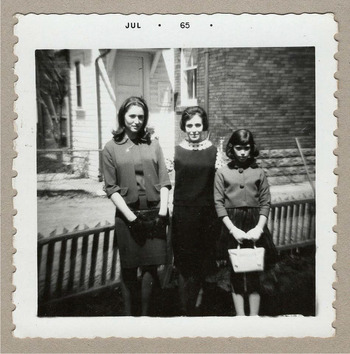
Dovid Zisman’s wife and daughters — five years after his passing. Toronto, Ontario, July 1965. (Photo courtesy of Laine Halpern Zisman)

In the opening of these two poems, Zisman makes events personal — no longer about the six million murdered but about an embodied and distinct individual experience that happened under our shared sun. Mapping space here is an intentional form of resistance against the invisibility and transience of unwritten, rewritten, and erased places. It engages our senses and bodies, bringing the past into our present. This is not simply a spatial experience, but a temporal one as well. How do these maps engage with both a past Zisman describes and a future he imagines, not only traversing geographies but cohering time periods as well?
Now Is the Time!
Exploring Queer Jewish Temporalities

Place and memory have an intimate relationship. We locate the past, we map historical traumas, we bring them from then to now, from there to here, despite the gaps in our realities that make it impossible for us to understand these horrific events. Time is set, interrupted, fragmented not only through the words in Zisman’s recordings, which describe the passage of time, but through shifts in musicality, tempo, and pace. Desperate breathless cries for help, a pleading voice of a mother, are transformed into rageful premonitions of retribution at the end of “Ghetto/Aktzia.” Zisman’s work does not simply refuse a universalization or erasure of site specificity, it also willfully rejects isolating histories, locking them away from the present. Slipping in and between the past, present, and imagined future, Zisman’s poems illustrate how our experiences of time directly influence and are influenced by our experiences of space.
While there is no documentation of how Zisman performed his poems in the camps, I imagine through his audio recordings how his body, gestures, and movements might have archived a time not yet here, bringing alternate realities into fruition through his acts of creative defiance in the camps. Human geographer Doreen Massey explains that we should think of time and space together, because “the imagination of one will have repercussions […] for the imagination of the other and […] space and time are implicated in each other” (Reference Massey2005:18). The space of the ghetto and the camps, the Jewish orientation within them, are influenced not only by the present genocide Zisman describes, but also by past oppression and by what he imagines liberation will be.
The temporal logic in Zisman’s writing, which brings the past and future into the present, manifests both queer and Jewish temporalities. Briefly, queer time has been theorized as an interruption, a refusal or inability to exist in tandem with the expectations of “straight time,” a nonlinear, sometimes cyclical experience of time (Halberstam Reference Halberstam2005). Queer temporality reveals the ways in which temporal expectations are constructed based on normative understandings of power and productivity that work to maintain the status quo — to keep the powerful in power and the past in the past. Like queer temporality, Jewish time is nonlinear. Even the Jewish calendar year complicates the alignment of experiences to the normative Christian Gregorian calendar. The Jewish holidays serve as milestones in a cycle: returning to where we have been, rather than moving forward. Extending this notion of cyclical temporality, the Shulchan Aruch, a book detailing the code of Jewish law, explains that the four-letter name for God in Hebrew represents that which simultaneously is, was, and will be:  ; the past, present, and future are one. There is, in this conception of the universe, an understanding of time as a single whole synchronic unit. Not distinct or isolated moments of past, present, and future, but an understanding that these are constantly shaped by their relations to each other. Whether or not you ascribe my feelings to a religious doctrine, there are certainly resonances for me, as a queer Jew, between the queer challenge to linearity and the Jewish oneness of time. This coalescence of time is useful in terms of understanding trauma not only as a present circumstance, but as a past and future one too. It is also an analytic tool showing how time is represented in Zisman’s works.
When Zisman wrote his poems, the present moment may have by and large been one of helplessness and torment. Yet, by bringing a future world into the present, he does not simply collapse time, but provides an opportunity for resistance in the present. Putting this into queer Jewish terms, I borrow from Jasbir Puar’s anticipatory temporality, which involves “not only or primarily anticipating the future, but also recording the future that is already here, yet unknown but for a split second” (Reference Puar2007:xxviii). Similarly, as José Esteban Muñoz writes when discussing the oppression of queer youth of color, “The way to deal with the asymmetries and violent frenzies that mark the present is not to forget the future. The here and now is simply not enough” (2009:96). For those whose futures are threatened, the past and present do not suffice. Envisioning alternative futures, bringing them (if only for a split second) into this moment, is perhaps the spark that Zisman references in his title: that which ignites revolutionary change. This is not something that exists in an unreachable future. In the opening lines, Zisman sees it: “[N]o it will not always be this way / I see a spark of freedom, it clangs out the hour.” It is already here, marking the passage of time. When Zisman’s daughter and his granddaughters perform these words, we are testaments to the futurity the poem itself promises.
In sliding between Zisman’s present and our future, Zisman gives meaning to meaningless death, creating an army from the collective corpses: From the ovens we rise. And yet, even in so doing, he does not situate his depiction of futurity within an overly heroic narrative of overcoming and persevering. Indeed, as his subjects “rise from the ovens,” they do not survive. Without promising an optimistic outcome for each individual Jew, acknowledging the dead and those who will die, he nonetheless commits to tomorrow. We anticipate futures in order to resituate ourselves in an incomprehensible present. We look back on our dead and dying in order to move forward, to identify possibilities for what comes next.
If “A Spark of Freedom” imagines a hopeful future from beneath the present sun in Buchenwald, “Ghetto/Aktzia” begins in the present and moves to a recent past when Jews were being loaded into freight trains:

Zisman’s memory of two weeks prior begins a narrative describing violent travel to the camps, without food, water, or knowledge of where they are going. As the next stanza continues, Zisman maps the travels to the camps, with the train arriving and Jewish people crying softly in desperation: Where are we? Where are we? An officer answers, slowly singing: Treblinka, Treblinka, here. Treblinka’s a good place for every Jew, for all who stop here remain, remain forever. The Nazi’s song changes how time is represented. The memory from two weeks prior is situated in the past, but now they are arriving in a place where time has no end. The officer responds to their cries: You are in the Fatherland. The train is emptied. We hear the sounds of the Jewish people from the showers, as Zisman sings their final words,  (“Hear, O, Israel”), the start of the key daily prayer, the last phrase a Jewish person traditionally says before death.
Then, an abrupt change in scene, a stage direction: “In the Office.” The lieutenant’s voice is distinct, pragmatic. He proudly announces to his superior officer the day’s tally of murdered Jews:

The everydayness of “Max’s” tallying of the number of Jewish dead is jarring in its matter-of-factness, his noting “success” juxtaposed against the “pain and fear” of the transport to the gas chamber. But this scene is brief, answered by the aforementioned concluding stanza of the poem, about “the Jew that remains.” No longer helpless or confused, the recording ends in anger. The final lines are a vow for retribution as Zisman’s unrelenting voice increases in speed, volume, and urgency. He does not quiver or hesitate. This Jew defies the Nazi’s song of perpetual death. The banality of evil in the office is defeated by an anticipated future of active resistance. Zisman’s register of revenge in the closing lines of his recording are both an act of survival and the conviction that the future will be better.
I think about the slippage and copresence of time not only in terms of Zisman’s performance of his poetry, how he navigates futurity, but also in relation to my project: how trauma is transmitted through generations, my slow learning of Yiddish, my engaging with memory as a means of coalescing, shortening, and blending times. Memories and pasts seep into present as I ask my mother about her memories of her father; as I read my grandfather’s imaginings of what will come in a world after the camps. As I listen to my grandfather’s voice, a “haunting, ghostly apparition” that, as Carla Freccero writes in her discussion of queer historiography, “reminds us that the past and the present are neither discrete nor sequential. The borderline between then and now wavers” (Reference Freccero, Haggerty and McGarry2007:196). Each act of memory, research, discovery brings the past into my living room, into my present, and shapes my orientation in the world. It is impossible to chart any of these histories or presents linearly.
Helen and Dovid Zisman. (Photos courtesy of Laine Halpern Zisman)

Remember This Well
Collective Living Archives
Part of the process of writing this article and transcribing and translating my grandfather’s poetry was to reach out to my mother’s cousins—Zisman had two sisters who survived the war — to ask their children what they knew about my grandfather’s life. I discovered that my grandfather had not two, but five sisters, three of whom died in ghettos and camps. His sister Devorah and her son Yitzchak were murdered in Auschwitz; his sister Ruza died in Warsaw where she was studying law; his sister Bracha died of starvation in the Łódz´ ghetto; and his sister Paula (who survived along with his sister Mala) lost two children, Yezik and Yitzchak, to starvation in the Łódz´ ghetto. Zisman’s mother, Shifra, was murdered in Auschwitz, his father, Israel, died of starvation in the Łódz´ ghetto. I mark these deaths not simply to honor their names, but to mark the memories I did not previously have, all things I did not know. The archive grows, breathing itself into being with each new name, reattaching severed branches to the family tree. Zisman’s poetry tells me part of his story, but I continue to discover new histories as I chart my familial pasts. These discoveries are not peripheral to acts of translation. They animate my interpretations, shaping how I hear, understand, and internalize his voice and message.
I am trying to create an archive, but every part of me resists. It is a slow archive, a heavy archive, a selfish archive. An intimate archive of intergenerational trauma and intergenerational resistance. An archive of fear, hate, art, revenge, hope, death. An archive of music, voices I do not know, languages I do not understand. This archive is simultaneously embodied and living, dead and decaying. According to my grandmother, when my grandfather was asked how he could sing and produce art in the camps, in a living cemetery, he responded simply, “A cemetery is exactly where we need to do this work” (USC Shoah 1995).
So, I use his poetry and performance to tell a story that is not my own, memories I cannot claim, experiences I cannot fathom. I perform an archive of intergenerational trauma and resistance. Like a hinge, I open and close, reveal and conceal, a past that I am defined by yet cannot wholly grasp. Like a hinge, I am affixed to the strength of my ancestors, tied to the language of a culture, a community, a history that I will never mostly know. I hinge with each verse of trauma and resilience that appends post-memory to daily experience. My whole life I have imagined those fists, ashes rising from the ovens, hearing my mother’s young voice, my grandmother’s defiant recitation, my own broken Yiddish joining the chorus. When I speak Dovid Zisman’s words I become a queer archive of imagined and transmitted memory, of revolution and fear, of inheritance and generations, at once a burden and a source of empowerment. An embodiment of my grandfather’s premonition of the Jew that remains.
To view supplemental materials related to this article, please visit https://doi.org/10.1017/S1054204321000290.