In recent decades, governments across the developing world have embarked on significant investments in infrastructure to attempt to improve citizens’ access to basic services such as electricity, schools, clean water and roads. Yet, especially because these public works programs often occur in contexts where the rule of law is weak and where political influence over the bureaucracy runs rampant, the question of whether these programs lead to development or whether they simply result in the creation of rent-seeking opportunities is often debated. On the one hand, some studies have argued that public infrastructure projects serve mainly as cash cows, used by political elites to generate kickbacks for their own private ends (Boas, Hidalgo and Richardson Reference Boas, Hidalgo and Richardson2014; Lehne, Shapiro and Eynde Reference Lehne, Shapiro and Eynde2018; Rose-Ackerman Reference Rose-Ackerman1999; Samuels Reference Samuels2002). On the other hand, however, previous studies have argued that when incumbents face competitive elections, they have an incentive to use their control over infrastructure programs to improve the provision of public goods (Bueno de Mesquita et al. Reference BuenodeMesquita2003; Harding Reference Harding2015; Lake and Baum Reference Lake and Baum2001; Stasavage Reference Stasavage2005). This article presents a novel argument supported by evidence from India to reconcile these two competing views of public works provision.
How does political influence shape the implementation of public works programs? This article takes as its starting point the notion that, although non-programmatic distribution may be less normatively desirable than programmatic distribution (for example, Stokes et al. Reference Stokes2013), some types of non-programmatic distribution may be far more beneficial to ordinary citizens than others. In particular, although non-programmatic distribution of government goods and services is often referred to derogatorily as ‘pork’, these ‘outputs’ of public infrastructure programs often improve the lives of ordinary citizens (for example, Asher and Novosad Reference Asher and Novosad2016; Dinkelman Reference Dinkelman2011). Conversely, non-programmatic distribution that results in the ‘inputs’ of infrastructure provision being allocated so as to allow politicians and bureaucrats to extract substantial rents in the process often occurs at the expense of ordinary citizens. In some cases, rent seeking may occur by allocating spending for public goods that is in excess of what is actually required to provide the goods (for example, Golden and Picci Reference Golden and Picci2005; Kunicova and Rose-Ackerman Reference Kunicova and Rose-Ackerman2005). In other cases, rent seeking may occur through the underprovision of inputs and may thus detract from the quality of public goods provision (for example, Wade Reference Wade1982). In all of these cases, rent seeking is a source of inefficiency that will generally be to the detriment of the average citizen.
Consequently, although political elites often seek to use their influence to extract private rents, such rent-seeking behavior may come into conflict with their desire to appeal to voters through the provision of public goods. How do elites manage this trade-off? To address the question, the present research builds on the insight that parliamentary systems with single-member districts create a situation in which an individual politician’s success in gaining and maintaining office is closely tied with the electoral success of her party as a whole (for example, Cain, Ferejohn and Fiorina Reference Cain, Ferejohn and Fiorina1984). In this context, the incentives of individual members within a ruling party should – according to the argument – be aligned when it comes to ensuring the delivery of public goods to their constituents, but not when it comes to allowing the creation of rent-seeking opportunities.
When it comes to providing public goods to constituents, the argument suggests that members of the governing coalition who exert control over the governmental machinery for implementing infrastructure projects should seek to use their influence to ensure that all their fellow party members are able to deliver the infrastructure necessary to win their seats. However, when it comes to creating rent-seeking opportunities, the incentives for co-operation between members of the same party should diminish. Specifically, since the benefits of rent-seeking opportunities are primarily private, government elites with control over the machinery for implementing infrastructure projects should have an incentive to concentrate rent-seeking opportunities within their own hands and in the hands of a select set of powerful party colleagues. Meanwhile, since rent seeking could detract from public goods provision and ultimately hurt the ruling party’s electoral prospects, those with control over infrastructure provision should seek to minimize the rent-seeking opportunities available to their less powerful party colleagues. Thus, rather than partisan criteria determining access to rent-seeking opportunities, the argument suggests that there should be a division of roles within ruling parties between those who use public works programs to gain access to rent-seeking opportunities and those who use such programs to deliver infrastructure more efficiently. In a parliamentary context where ministers typically have either formal power over the governmental machinery used to implement development projects or informal leverage with party leaders or both, this division of roles – the argument suggests – should be largely determined by a party member’s ministerial status.
The article provides support for this argument using evidence from a large-scale rural roads development scheme in India launched in 2000 which is known by the acronym PMGSY.Footnote 1 The dataset used in this article consists of a range of information for over 30,000 road projects across seven states in North IndiaFootnote 2 that were geocoded and located in individual politicians’ constituencies. Since state governments were responsible for administering this scheme, analyses were conducted at both the state constituency level and the individual road project level, focusing on how the implementation of this roads scheme varied across state constituencies based on the ministerial status and partisan alignment of the state legislators in those districts. A focus on the PMGSY scheme is beneficial since it furnishes rich and fine-grained data on a host of characteristics of thousands of road projects, thus providing a rare window into the inner workings of public works programs and how they are manipulated through political influence. At the same time, since large-scale public infrastructure projects are common in many countries (for example, Golden and Picci Reference Golden and Picci2005; Harding Reference Harding2015; Lewis-Faupel et al. Reference Lewis-Faupel2016; Rose-Ackerman Reference Rose-Ackerman1999), the argument and findings of this research can shed light more broadly on the contexts in which such programs are likely to be successful.
Analyses using the above-mentioned data provide compelling support for the argument, showing that legislators aligned with the ruling party demonstrate a greater ability to deliver infrastructure outputs regardless of whether they are ministers or ordinary legislators. However, when it comes to rent-seeking opportunities – measured using spending leakages (for example, Golden and Picci Reference Golden and Picci2005) and further corroborated using evidence on inefficiencies in contractor selection, on the quality of road construction and on expenditures on unproductive projects – ministers’ constituencies consistently benefit at the expense of the constituencies of ordinary legislators from the ruling party. The use of a variety of techniques for causal inference – including a regression discontinuity design (RDD) based on close elections – increases confidence that these results are not driven by unobservable confounding factors. Further analyses show that the lower prevalence of rent seeking in the constituencies of ordinary legislators aligned with the ruling party is largely driven by the influence of co-partisan ministers. Moreover, additional results help to rule out the possibility that the observed differences in access to rent-seeking opportunities between ministers and ordinary legislators are driven by: (1) ordinary legislators having less control than ministers over the implementation of public works programs, (2) ordinary legislators having a greater need to establish competence due to their relatively junior positions within their parties, (3) ordinary legislators facing higher levels of electoral competition than ministers or (4) ordinary legislators being left with a smaller share of the pie of rent-seeking opportunities once ministers have had their chance to extract rents. These additional findings provide further support for the argument that the observed differences arise because of ministers’ incentives – or lack thereof – to co-operate with their junior partisan colleagues.
The findings contribute to the vast and growing literature on the politics of public goods provision. Several studies have emphasized the role that democracy and electoral competition play in shaping political elites’ incentives to provide public goods (for example, Bueno de Mesquita et al. Reference BuenodeMesquita2003; Chhibber and Nooruddin Reference Chhibber and Nooruddin2004; Harding Reference Harding2015; Lake and Baum Reference Lake and Baum2001; Min Reference Min2015; Stasavage Reference Stasavage2005). The present study shows, however, that public goods provision depends not only on electoral considerations but also on the incentives for co-operation between members of the ruling party. In doing so, this research relates to previous studies highlighting the important role that local bureaucrats play in delivering public services (for example, Bhavnani and Lee Reference Bhavnani and Lee2018; Bussell Reference Bussell2012; Gulzar and Pasquale Reference Gulzar and Pasquale2017), as well as those that have examined how the degree of control that elected representatives have over the bureaucracy shapes developmental outcomes (for example, Asher and Novosad Reference Asher and Novosad2017; Golden and Min Reference Golden and Min2013). The present research builds on these insights by shedding light on the question of how political elites with control over the bureaucracy manage the trade-off between vote seeking and rent seeking.
This research also relates to the growing literature that focuses on how political elites distribute government goods and services (for example, Dunning and Nilekani Reference Dunning and Nilekani2013; Golden and Min Reference Golden and Min2013; Keefer and Khemani Reference Keefer and Khemani2009; Stokes et al. Reference Stokes2013). While these previous studies have largely focused on how distribution is governed by partisan considerations, this research sheds light on the conditions under which divisions within (rather than between) parties matter for distributive outcomes. In doing so, it sheds new light on the factors shaping the distribution of key outcomes associated with infrastructure provision.
Finally, the present research helps contribute to a better understanding of the mechanisms through which the institutional context can shape incentives for public goods provision as opposed to rent seeking. For example, while there is an ongoing debate over whether parliamentary or presidential systems provide more scope for corruption and inefficiency (for example, Gerring and Thacker Reference Gerring and Thacker2004; Kunicova and Rose-Ackerman Reference Kunicova and Rose-Ackerman2005; Persson and Tabellini Reference Persson and Tabellini2005), this article provides micro-level evidence to support the argument that one often overlooked mechanism through which parliamentary systems can reduce inefficiencies in public infrastructure provision is by aligning the political fates of government elites and ordinary legislators from the same party.
Argument
Parliamentary systems with single-member districts are known to create strong incentives for co-operation between ministers and their partisan colleagues in the legislature who are outside the government (Carey and Shugart Reference Carey and Shugart1995; Cain, Ferejohn and Fiorina Reference Cain, Ferejohn and Fiorina1984; Denemark Reference Denemark2000). The present argument suggests, however, that the existence of these incentives for co-operation between ministers and ordinary legislators depends on the type of good being distributed. On the one hand, the ‘outputs’ of infrastructure provision – such as roads, electricity, health care centers and schools – are quasi-public goods that are non-excludable at least to citizens within a certain area. On the other hand, rents from infrastructure provision are rival and excludable. Thus politicians should – following the logic of selectorate theory (BuenodeMesquita et al. Reference BuenodeMesquita2003) – prefer to use the outputs of infrastructure provision to gain electoral support from a broad base of citizens, but should prefer to use the rents they derive from infrastructure provision for their own enrichment or for the enrichment of a small set of cronies.
While parties are often treated as unitary actors, there is frequently a substantial division of power within ruling parties in terms of members’ abilities to exercise control over the government machinery responsible for delivering public goods and services. How do government elites with control over the implementation of public works programs choose to exercise their influence? Since government elites in a parliamentary system are affected by the electoral fortunes or misfortunes of their co-partisan colleagues (for example, Cain, Ferejohn and Fiorina Reference Cain, Ferejohn and Fiorina1984), and since the provision of public goods typically affects these electoral fortunes, the interests of government elites and their co-partisan colleagues should be aligned when it comes to ensuring the provision of public goods. Thus the argument suggests the following hypothesis:
Hypothesis 1 All else equal, there should be more road provided in constituencies that have a legislator who belongs to the ruling party or ruling coalition – regardless of her ministerial status – than in constituencies that have a legislator who belongs to an opposition party.
The logic underlying the hypothesized effect is that ordinary legislators belonging to a governing party benefit from the backing of key ministers who have influence over implementation because these ministers have an incentive to help their party colleagues deliver public goods.
In addition to providing politicians with the ability to target public goods, however, public works programs also give politicians opportunities for rent seeking. In turn, these rents often serve as private goods for politicians and their families, allowing them to enrich themselves (for example, Fisman, Schulz and Vig Reference Fisman, Schulz and Vig2014) and their family members. Even if politicians use these rents to fund their election campaigns (for example, Kapur and Vaishnav Reference Kapur and Vaishnav2011; Samuels Reference Samuels2002), the rents still largely represent a private benefit to politicians in allowing them to defray the costs of electoral campaigns that may otherwise have been financed out of their own pockets or through other costly activities.
Because of the ‘private good’ nature of rents, the interests of ruling party members should be, according to the argument, far less aligned when it comes to using political influence over infrastructure provision to create rent-seeking opportunities. In particular, a ruling party legislator with control over infrastructure provision should seek to concentrate rent-seeking opportunities in her own hands by creating such opportunities in an area where she has the knowledge and connections to ensure that she can derive a personal profit from these opportunities – such as in her constituency. She should also seek to allow access to such opportunities to a select set of other partisan colleagues – especially those who could offer their own lucrative sources of rents in exchange or those whose loyalty she or her party leaders wish to earn or keep. Since ministers in a parliamentary system tend to have both formal control over departments as well as informal leverage with the head of government or other important leaders, the key observable criterion that should determine a party member’s access to rent-seeking opportunities from infrastructure provision is her ministerial status.
Yet, while rent seeking can provide private benefits to legislators or ministers, it can also be costly for two reasons. First, in the context analyzed here, rent seeking may result in expenditures on road projects that are higher than warranted (Golden and Picci Reference Golden and Picci2005). In turn, as long as there is some sort of budget constraint,Footnote 3 these inflated expenditures may often force state governments to proportionately reduce their spending in other areas that could be electorally beneficial. For example, inflated expenditures on road construction may force governments to reduce spending on other public goods or welfare benefits that could help garner political support. However, because the benefits of rent-seeking opportunities are primarily private rather than electoral, ministers should typically prefer to reduce the electoral costs of rent seeking by minimizing the rent-seeking opportunities available to their fellow party members rather than by curtailing their own rent seeking.
Secondly, rent seeking that occurs through the underprovision of inputs or through the hiring of inefficient contractors could be electorally costly for an incumbent in whose constituency such rent seeking is taking place. Indeed, although voters may not observe rent-seeking practices directly, these types of rent seeking could affect outcomes – such as the quality of the road provided or the timeliness of road completion (for example, Lehne, Shapiro and Eynde Reference Lehne, Shapiro and Eynde2018) – that are typically visible and salient to voters. Thus rent seeking could increase the likelihood that an incumbent could lose her seat. Consequently, given that a minister’s chances of holding office depend on the number of seats her party wins in the legislature, ministers should seek to curtail electorally costly rent-seeking behavior on the part of their partisan colleagues. Even if their colleagues’ chances of re-election were slim due to the incumbency disadvantage often experienced by Indian state legislators (Uppal Reference Uppal2009), failing to curtail such rent seeking could hurt the reputation and therefore the electoral prospects of the ruling party while yielding little personal benefit to the minister.
However, although ministers have little incentive to facilitate their partisan colleagues’ rent-seeking opportunities, they may often have an incentive to engage in rent seeking for their own private gain. Typically, road projects in ministers’ own constituencies would provide the best opportunities for such rent seeking.Footnote 4 However, if rent seeking does pose an electoral cost for a minister, then ministers should – all else equal – face a trade-off between, on the one hand, extracting rents in the short term and decreasing their chances of getting re-elected and, on the other hand, foregoing rent extraction in the short term and, as a result, increasing their chances of re-election (Fearon Reference Fearon1999).Footnote 5 If a minister faces a high underlying electoral risk – that is, a high risk that she will fail to be re-elected regardless of her rent-seeking behavior while in office – then this, as suggested by the literature on retrospective voting (for example, Healy and Malhotra Reference Healy and Malhotra2013), could make a minister more apt to favor extracting rents in the short term despite the electoral costs of doing so. Conversely, although ministers may have little incentive to forego rent seeking altogether, those who face a more promising chance of re-election may favor reducing their levels of rent seeking in the current electoral term enough to allow for continued opportunities to engage in rent seeking in the subsequent term.Footnote 6 Thus in a context in which elected representatives face a sufficiently high underlying electoral risk, we should expect the following hypothesis to hold:
Hypothesis 2 Rent-seeking opportunities in road projects should be more prevalent in ministers’ constituencies than in constituencies of ordinary legislators who are members of the ruling party or coalition.
Since previous studies on India suggest that the underlying electoral risk faced by Indian state incumbents is generally high (for example, Nooruddin and Chhibber Reference Nooruddin and Chhibber2008; Uppal Reference Uppal2009) and since further investigation suggests that state incumbents who are ministers often face a high risk as well,Footnote 7 the Indian context may – in general – meet the necessary scope conditions for Hypothesis 2. At the same time, an additional implication is summarized in the following hypothesis:
Hypothesis 3 Electorally costly rent-seeking opportunities in road projects should be more prevalent in ministers’ constituencies where there is a higher underlying electoral risk.
The argument also suggests that the incentives for ministers to facilitate their junior party colleagues’ access to resources should differ based on the type of good in question. Since providing public goods is likely to be electorally beneficial, ministers should seek to assist junior party colleagues when it comes to accessing the expenditures required to deliver roads to their constituents. Thus, the argument implies that:
Hypothesis 4.1 Ruling party legislators’ constituencies should have greater access to expenditures for productiveFootnote 8 road projects than opposition legislators’ constituencies.
At the same time, while some road projects are designed to be productive, others are designed primarily to be ‘rent-seeking vehicles’, the main purpose of which is to generate kickbacks rather than to deliver roads.Footnote 9 Since ministers have an incentive to limit the extent to which road projects in the constituencies of their co-partisan junior colleagues remain incomplete, they should seek to minimize the prevalence of rent-seeking vehicles in the constituencies of their co-partisan junior colleagues. In turn, since high levels of expenditure on a project that ends up incomplete (that is, an unproductive project) is often an indication that the project is a rent-seeking vehicle, lower levels of expenditure on unproductive projects should indicate a lower prevalence of projects that are rent-seeking vehicles. Accordingly, the argument implies that:
Hypothesis 4.2 Ruling party legislators’ constituencies should have lower levels of expenditure on unproductive projects than the constituencies of opposition legislators.
Moreover, since the argument emphasizes the influence of ministers in minimizing access to rent-seeking activities in the constituencies of their non-ministerial co-partisans, it suggests that the degree to which ordinary legislators aligned with the state ruling party have access to rent-seeking opportunities should depend on the extent of ministerial oversight. Thus, a final implication is that:
Hypothesis 5 Rent seeking in the constituencies of ordinary legislators aligned with the state ruling party should be less prevalent in cases where the relevant co-partisan ministers exercise more influence and oversight.
Scope Conditions
The above argument should be applicable to democracies across the developed and developing world that satisfy the following two scope conditions: (1) some or all members of the executive branch in the ruling party have greater discretion over the local implementation of public works programs than other members of the ruling party and (2) the ability of politicians to gain or maintain executive office in the future depends significantly on the electoral success of other party members.
The first condition is likely to hold in patronage-based systems that are common especially in new democracies but also in some advanced industrialized democracies as well (Kitschelt and Wilkinson Reference Kitschelt and Wilkinson2007). The second condition should hold across parliamentary systems as well as other systems – such as premier–presidentialism and president–parliamentary (Shugart and Carey Reference Shugart and Carey1992, 15) – in which an individual politician’s prospects of becoming a minister or cabinet member is tied to her party’s electoral success.Footnote 10
Thus the argument should be applicable to many political systems around the world including Bangladesh, Botswana, Japan, Malaysia Russia and Thailand. Indeed, as suggested by the argument, ministerial corruption connected to governmental contracting or public works programs has been observed in many of these contexts including Japan,Footnote 11 RussiaFootnote 12 and Botswana.Footnote 13 Further research is required to examine whether the present argument can explain the observed patterns.
Background and Data
This article focuses on the Pradhan Mantri Gram Sadak Yojana (PMGSY) – a rural roads scheme that was launched by the Indian national government in December 2000. The PMGSY is one of the central government’s largest flagship schemes devoted to rural areas. It received an allocation of about 28 per cent of the Ministry of Rural Development’s overall budget under the Twelfth Five Year Plan.Footnote 14 Thus the scheme represents a sizeable portion of the overall resources potentially available for infrastructure provision in a given area.
The PMGSY was launched in recognition of the fact that, in the year 2000, an estimated 40 per cent of the country’s habitationsFootnote 15 remained unconnected by all-weather roads.Footnote 16 The scheme was thus designed to provide roads that connect these areas with market centers and administrative headquarters as well as roads that connect habitations to each other and to the nearest major road or highway. The scheme prioritizes the provision of new roads, but also provides funds to upgrade poor-quality existing roads.
Like many of India’s development schemes, the PMGSY is funded by the central government but implemented at the state level. India has a federal parliamentary system that currently has 29 states and 9 union territories. Indian states also have a parliamentary form of government in which the head of government is the chief minister. Members of the state legislative assembly – known as MLAs – are elected through a first-past-the-post electoral system with single-member districts. With the PMGSY, each state is given a fixed allocation of funds from the central government and the state government is responsible for deciding where and how the roads are to be built in the state and how the allotted expenditures are to be utilized.
The analyses in this article focus on seven states in North India – Rajasthan, Madhya Pradesh, Uttar Pradesh, Bihar, Chattisgarh, Uttarakhand and Jharkhand – that together comprise over 40 per cent of India’s overall population. These states have historically lagged behind other Indian states in terms of human development and have been categorized as BIMARU states – an acronym that plays on the Hindi word bimar or sickness. The historically low levels of infrastructure provision in these states have rendered road provision a highly salient issue, and voters in these states often cite the importance of bijli, sadak, pani (electricity, roads and water) as being a primary concern driving their vote choice.Footnote 17 These conditions in the BIMARU states offer an excellent opportunity to use the fine-grained data on road provision available for the PMGSY to test the article’s broader argument about the politics surrounding the provision of public goods that are salient to voters and that also allow opportunities for rent seeking.
Data were collected for all roads that were sanctioned in the above-mentioned states under the PMGSY from 2000 when the scheme began until 2014. The data on roads were scraped from the website housing the online management, monitoring and accounting system for the PMGSY maintained by the National Rural Roads Development Agency.Footnote 18 Information contained on the online system regarding the sub-villages or habitations that benefited from each road project was then used to match each project to a state assembly constituency. Appendix Section A.2 provides further details on the matching procedure. Since expenditure on a road project could be incurred any time after a project was sanctioned,Footnote 19 information about the timing of the sanctioning of the project was then used to match each project to a given legislator’s term.
The key variables identifying the alignment of the legislator with state ruling parties are coded according to the partisan affiliation of the legislator and information on the state ruling parties.Footnote 20 Since a key component of the research design is to isolate the effect of partisan alignment while holding constituency-level characteristics constant, the analyses are restricted to elections in the time period before constituency boundaries were redrawn in India. Appendix Section A.3 describes the constituencies, states and years included in the analysis.
Scope for Political Influence in PMGSY: Ministers and Ordinary Legislators
India is a federal country in which state governments can exert significant control over the bureaucracy responsible for administering development schemes at the state level (Iyer and Mani Reference Iyer and Mani2012; Wade Reference Wade1982). Thus although the PMGSY is sponsored by the national government and overseen by a national government agency, state governments can still exert a significant amount of control over how the scheme is implemented at the local level. In particular, decisions regarding how much should be spent on the road and how the road should be executed fall under the purview of a state-level bureaucratic agency, and the day-to-day implementation of the scheme is carried out by a Programme Implementation Unit of this executing agency that oversees either one administrative district or a group of districts. In turn, state governments exert control over these units because they have significant influence over the careers of the bureaucrats within these units which stems in large part from their ability to transfer officers from one post to another (Iyer and Mani Reference Iyer and Mani2012; Wade Reference Wade1982). State governments could also exercise leverage over these bureaucrats by arranging the suspension of uncompliant bureaucrats on some trumped up grounds or by intervening to prevent a bureaucrat who is charged with malfeasance or negligence from being suspended.Footnote 21 Thus, although ordinary legislators at the state level have some formal input into deciding where roads are initially allocated under the PMGSY,Footnote 22 decisions regarding how the road project is carried out fall squarely in the hands of state-level bureaucrats whose careers are heavily controlled by state governments.
State chief ministers have the final official authority to transfer bureaucrats.Footnote 23 In practice, the chief minister often issues transfer and suspension orders at the behest of ministers in the state government who control the department to which the bureaucrat belongs.Footnote 24 Therefore the chief minister as well as the ministers of the departments concerned with rural roads provision in the given state would have the most direct authority to transfer bureaucrats responsible for administering the PMGSY. Other ministers may also, however, use their informal leverage with party leaders to exercise control over bureaucrats in departments other than their own.Footnote 25
Ministers could use their leverage over the bureaucracy to manipulate the implementation of the PMGSY in a number of ways. In some cases, these ministers could use their influence to enhance the efficiency of public goods provision in a given constituency. For example, they could pressure PMGSY officials in a given district to speed up the completion of road projects through their negotiations with contractors.Footnote 26
In other cases, however, state government ministers could use their influence over the bureaucracy in a given district to facilitate the creation of rent-seeking opportunities. They could do this by pressuring bureaucrats to select favored contractors,Footnote 27 by encouraging officials to turn a blind eye to the underprovision of inputs or by encouraging officials to sanction unnecessary expenditures. Indeed, although there are several mechanisms in place to prevent the misuse of funds under the PMGSY,Footnote 28 there have been significant irregularities noted with regard to the implementation of the scheme. Audits by a central government agency uncovered numerous instances of irregularities in several states including the selection of unqualified contractors,Footnote 29 the submission of payment against fake invoices, and the incurring of expenditures that were well in excess of those necessary to complete the road works according to the prescribed guidelines.Footnote 30
While both ministers and ordinary legislators may wish to benefit from rent-seeking opportunities generated by the irregularities described above, doing so usually requires the ability to pressure a bureaucrat to bend the rules to manipulate the process of contractor selection to the politician’s advantage, to overlook fake invoices or to inflate expenditures to allow for kickbacks. However, bending the rules is often risky for bureaucrats, especially given the mechanisms in place to monitor and audit local PMGSY implementation.Footnote 31 Thus, although there may be some baseline level of corruption that falls under the radar or that is even implicitly tolerated by everyone involved, an ordinary legislator who does not have the backing of a minister may not be able to pressure a bureaucrat to incur the risk involved in going beyond this baseline level. Conversely, a bureaucrat would typically be more likely to egregiously bend the rules at the behest of a minister who has the power to offer her protection from suspension and reward her with a desirable promotion or transfer if she complies, or to get her transferred to an undesirable post or get her suspended on trumped up charges if she fails to do so.
Observable Implications
This section describes the logic of the measures used in this research to test the hypotheses described above. Further details and descriptive statistics for all variables mentioned in this section are available in Sections A.5 and A.6 in the Appendix.
To test Hypothesis 1, which considers the circumstances under which legislators provide development, a variable Total Road Completed in Term is used. This variable measures the total road length sanctioned and completed in the given constituency and electoral term.
Meanwhile, the tests of Hypothesis 2 – which considers the distribution of rent-seeking opportunities – are predicated on the idea that a common way that rent seeking occurs in infrastructure provision is through kickbacks. If certain politicians (for example, ministers) exercise control over bureaucrats’ careers, they can exert pressure on these bureaucrats to select certain contractors who then must pay off not only the bureaucrat but also the relevant politicians in charge (for example, Wade Reference Wade1982). In turn, contractors generate the funds required to pay off the bureaucrats and politicians by either inflating their expenses or underproviding inputs and thereby saving on the costs of the inputs (Wade Reference Wade1982). With this logic in mind, four observable implications of rent seeking are examined. The first implication is tested with a constituency-level analysis while the rest are tested with analyses at the level of the individual road project.
The first observable implication of rent-seeking opportunities in infrastructure provision is the prevalence of spending leakages or spending inefficiencies – whereby spending on roads would be in excess of some baseline level of expenditure required to produce a given amount of road (for example, Golden and Picci Reference Golden and Picci2005). This observable implication is tested in Appendix Section A.11.4 with a specification that investigates the effect of alignment and ministerial status on road provision at the constituency level (as measured by the variable Total Road Completed in Term) after controlling for variables capturing the expenditure on road projects in the constituency and other factors affecting the cost of the inputs into road construction in the constituency.
A second observable implication of rent-seeking activity is nepotism towards contractors whereby contractors are selected on the basis of their personal loyalties or familial connections with the representative in a given constituency as opposed to their qualifications and experience. Absent data on these personal connections and loyalties, one indication that a given politician is engaging in nepotism is that the contractors that they select to execute road works in their constituencies will be less successful at winning contracts overall than the ones selected in the constituencies of non-nepotistic politicians. This implication is tested using a specification with the dependent variable Total Value of Contracts Won by Contractor in State which measures the total value of PMGSY contracts that the contractor hired for the given individual road project has won in the state as a whole.Footnote 32 Since the argument posits that ministers should be more likely to hire contractors on the basis of personal connections and loyalties, Hypothesis 2 implies that there should be a negative association between ministerial status and the variable Total Value of Contracts Won by Contractor in State after controlling for the size and value of road projects in ministers’ constituencies.
A third observable implication of rent-seeking opportunities is that roads are of lower quality even after controlling for the expenditure on the road and other road characteristics. This implication reflects the possibility that, rather than inflating costs, contractors may have skimped on materials required to ensure the quality of the road construction. The implication is tested using a specification with the dependent variable Road Quality Rating which reflects the rating of the quality of the road project assigned by an independent monitor.Footnote 33 Hypothesis 2 suggests that, after controlling for the expenditure and cost of a given project, there should be a negative association between ministerial status and Road Quality Rating.
Finally, a fourth observable implication of rent seeking is a relatively higher level of expenditure on unproductive projects. Although projects may remain incomplete for a variety of reasons other than corruption, high levels of expenditure on projects that are never completed are often a result of payments made against fake invoices – a common type of corruption that occurs in road projects in India.Footnote 34 Thus a high level of expenditure on an incomplete project is often a good indication that the project is primarily a rent-seeking vehicle. This implication is tested by examining the effect of ministerial status and alignment on the variable Expenditure–Unproductive Project which captures the total expenditure to date on an ‘unproductive’ road project – defined here as a project that was sanctioned at least five years prior to the time of data collectionFootnote 35 – but that remained incomplete at the time of data collection. Given the goal of capturing expenditure on projects conditional on them being unproductive, the variable is missing for road projects that were completed within a five-year period. Since the argument posits that ministers’ constituencies should be more likely to have rent-seeking vehicles, Hypothesis 2 implies that ministerial status should have a positive effect on the variable Expenditure–Unproductive Project. In turn, Hypothesis 3 implies that expenditure on unproductive projects should be on average higher in those ministers’ constituencies that had displayed a higher level of previous competitiveness, which should indicate a higher level of underlying electoral risk (that is, risk independent of the representative’s current performance).
The variable Expenditure–Unproductive Project is also used to test Hypothesis 4.2, which suggests that ruling party aligned ordinary legislators should have fewer rent-seeking vehicles (that is, they should have, on average, significantly lower levels of expenditure on unproductive projects in their constituencies) than opposition legislators. Meanwhile, we test Hypothesis 4.1 by examining whether ruling party aligned ordinary legislators have significantly greater access to ‘expenditure premiums’ on productive projects – defined as projects that get completed within a normal timeframe of two years – than do opposition legislators. Expenditure premiums – which refer to expenditures over and above the cost initially sanctioned for a given project – are particularly appropriate for testing the hypothesis since our interviews revealed that such premiums require special administrative approval from higher-level agenciesFootnote 36 and, thus, that accessing such premiums may require intervention by ministers.
Finally, Hypothesis 5 is tested by examining whether ‘aligned’ ordinary legislators’ constituencies incur fewer unproductive expenditures (measured by the variable Expenditure–Unproductive Project) when co-partisan ministers in charge of departments involved with rural road works exercise more oversight. To operationalize ministerial oversight, the analysis takes advantage of the fact that the administration of the PMGSY occurs at the level of the administrative district, which encompasses multiple state assembly constituencies. Since ministers should typically have a special interest in their own constituencies, we would expect them to have closer relationships with bureaucrats in the administrative district that overlaps with their own constituency. Thus ministers should exercise greater oversight over road projects in constituencies within this administrative district than in constituencies outside. Hypothesis 5 therefore implies that the effect of ruling party alignment on the expenditure incurred on unproductive projects should be lower when an incumbent legislator shares the administrative district of a minister involved with rural roads provision who is also from the ruling party.
Research Design
The article uses data from the PMGSY described above to test the hypotheses linking the partisan identity and ministerial status of the legislator with roads provision and road spending leakages. There are likely to be a host of factors that could confound the association between the characteristics of legislators and the characteristics of road provision in a constituency. For example, ruling party legislators may be more commonly found in areas with stronger bureaucratic capacity or in strongholds of certain parties. Consequently, a simple ordinary least squares regression that does not deal with unobserved constituency characteristics would likely lead to a biased estimate of the effect of ruling party alignment and road provision. Thus three complementary approaches are used to estimate the causal impact of legislators’ characteristics: a regression discontinuity design (RDD), a first-differences (FD) approach and a project-level analysis with constituency fixed effects. Each of these approaches is described in further detail below.
The test of Hypothesis 1 utilizes an RDD (Imbens and Lemieux Reference Imbens and Lemieux2008) relying on close races in which the ruling party either won or lost by a small margin (Lee Reference Lee2008). The forcing variable is the proportion of votes gained by the ruling party’s candidate (that is, the candidate of the chief minister’s party) in constituency i in the most recent state election. The variable is positive when the ruling party candidate just won the election and negative when a ruling party candidate just lost the election and another party’s candidate won. Constituencies in which a ruling party candidate was neither the winner nor the runner-up are excluded from the analysis. The cut-point of the forcing variable is a 0 per cent vote margin that separates constituencies with a ruling party legislator from other constituencies.
Thus the RDD compares constituencies in which a ruling party candidate barely won the most recent election with those in which a ruling party candidate barely lost the most recent election and a candidate from another party won. The logic of the design is that a candidate from an opposition party could just as easily have won in the constituencies in which a legislator from the ruling party just barely won, and vice versa. Thus, in constituencies with very close races, ruling party alignment in a given constituency likely occurs by chance and can be considerede as good as random (Lee and Lemieux Reference Lee and Lemieux2010, 282). Specifically, the RDD rests on the assumption that constituencies with narrow vote margins with and without a legislator aligned with the ruling party should not be any different from each other, on average, in terms of their pre-existing characteristics. Note that although recent research has questioned the validity of this assumption in the context of US House elections (for example, Caughey and Sekhon Reference Caughey and Sekhon2011), Eggers et al. (Reference Eggers2015) show that this design is valid for a large range of other contexts including India. Moreover, as recommended by Lee and Lemieux (Reference Lee and Lemieux2010), the tests described in Appendix Section A.8 are used to provide support for the validity of this assumption by investigating the balance in pre-treatment covariates. Section A.8 also displays the results of the McCrary test, which shows no evidence that candidates were able to manipulate their chances of winning in close races. As described further in the appendix, these tests affirm confidence in the ‘as-if-random’ assumption underlying the RDD, thus suggesting that constituencies with and without a legislator from the ruling party should be similar, on average, in terms of both observed and unobserved factors.
Denoting the forcing variable by V and denoting the variable indicating alignment with the chief minister’s party as T, the RDD involves estimating an equation of the following form for constituency i and electoral term t:

where X
i,t
refer to control variables measured at the level of constituency i and electoral term t and u
s,t
refer to state-electoral term fixed effects. The dependent variable y
i,t
is the total length of road sanctioned and completed in constituency i during election term t. If no roads were sanctioned during the electoral term in constituency i, then y
i,t
equals 0. The order of the polynomial chosen is p. The interaction of T with each term in the polynomial allows for a separate estimation of the relationship between y
i,t
and V to the left and right of the cut-point. The estimated coefficient $\hat{\pi }_{0} $ identifies the treatment effect right at the cut-point of 0. Appendix Section A.7 in the Appendix also presents the results obtained when implementing the RDD using non-parametric methods.
While the RDD is appropriate for examining the effect of alignment with the chief minister’s party, such an approach is not well suited to comparing the influence of ordinary legislators vs. ministers. Thus, additional analyses are conducted that utilize first differencesFootnote 37 to compare and distinguish the effect of alignment and ministerial status on roads provision while holding constant unobserved fixed constituency characteristics (see Section A.11.2 for further details on this approach). To address the problem of unobserved time-varying factors within a constituency, the FD approach is also applied to a restricted sample of cases for which neither the constituency’s incumbent nor her partisan affiliation changed across consecutive electoral terms. Since this specification holds constant any legislator characteristics that remain fixed across electoral terms, it allows us to separate the effect of ministerial status from the effect of fixed characteristics of the politician – such as prior wealth or political connections – that could also independently influence their propensity to engage in development and rent seeking.
Finally, in order to test Hypotheses 2–5, additional specifications are utilized in which the unit of analysis is the individual road project. This level of analysis is especially conducive to studying rent seeking, as it allows for a more precise method of controlling for project characteristics than analyses conducted at higher levels of aggregation. For these analyses, the following equation is estimated:

where r refers to the individual road project, i refers to the constituency in which the road was located and t refers to the year in which the road was sanctioned. Alignment r,i,t is coded 1 if road r in constituency i was sanctioned in a year during which the legislator of constituency i was aligned with the chief minister’s party. Minister r,i,t is coded 1 if road r in constituency i was sanctioned in a year during which the legislator of constituency i belonged to the state government’s Council of Ministers. X r,i,t refer to road-specific and constituency-electoral term-specific control variables described further in Appendix Section A.12. The use of dummies for the sanction year γ t helps control for temporal shocks, and state-electoral term dummies help control for electoral term shocks specific to each state.Footnote 38 Since the sample includes individual road projects from multiple electoral terms, these analyses include constituency (or district) fixed effects u i to control for unobserved characteristics of constituencies (or districts) that remain fixed over time – such as geographic features and demographic characteristics.
Results
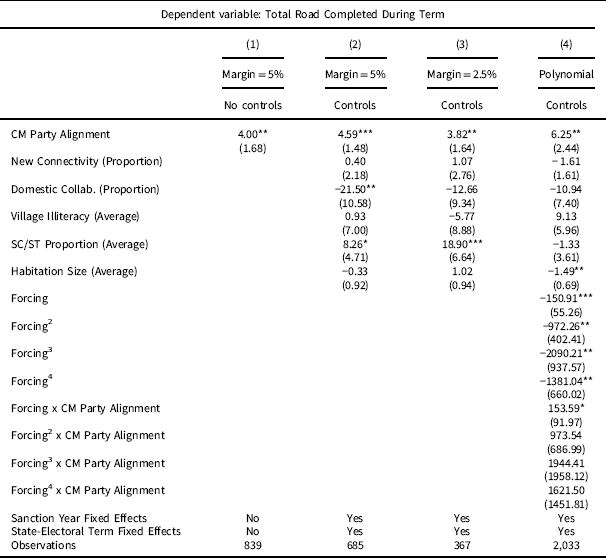
Table 1 shows the results of the RDD analysis used to test Hypothesis 1. Columns 1–3 show the results of a linear regression restricting the sample to constituencies with a vote margin in the most recent election of 5 per cent (Columns 1 and 2) or 2.5 per cent (Column 3). Column 4 shows the results of the estimation of Equation 1 with the full sample and a fourth-order polynomial. Standard errors in each of the specifications are heteroskedasticity consistent and clustered by state assembly constituency. Column 1 shows the specification with no controls, while the rest of the columns include controls.Footnote 39 Appendix Section A.5 describes the control variables used in the analyses and provides summary statistics.
The effect of ruling party alignment on the total road length completed during the electoral term

Note: the unit of analysis is the constituency-electoral term. Forcing refers to the forcing variable, which is the vote margin of the candidate from the chief minister’s party. Constituencies in which a candidate from the chief minister’s party was neither the winner nor the runner-up are dropped. Since Columns 2 and 3 include control variables that measure the characteristics of road projects in a constituency, constituency-electoral terms that do not have any road projects are dropped in these specifications. Heteroskedastic-consistent standard errors clustered by state constituency are shown in parentheses. *significant at 10%; **significant at 5%; ***significant at 1%
The coefficient on CM Party Alignment is statistically significant across all four specifications, showing evidence of a treatment effect around the 0 per cent vote margin cut-point. The estimates of the effect of alignment on road provision range from a 3.82 km increase to a 6.25 km increase. Since the median length of a road is about 2.6 km, and since the median population of habitations benefited by a road is about 705, these estimates indicate that alignment with the chief minister’s party benefits at least 1,000 additional people in the constituency even after controlling for a host of other factors.
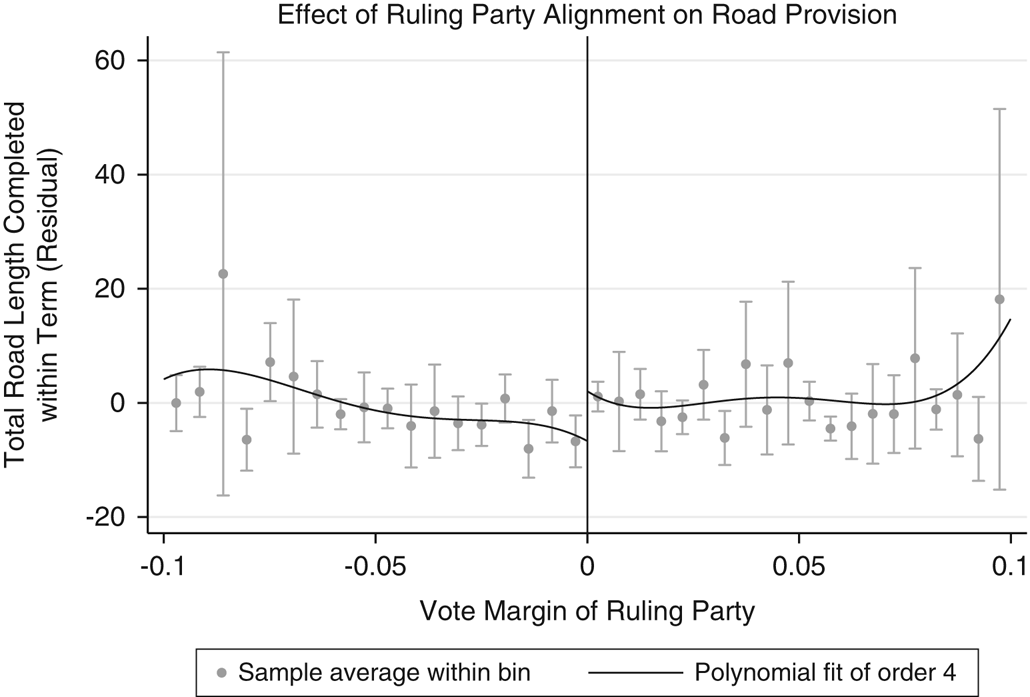
Figure 1 shows an RDD plot using the data-driven method recommended by Calonico, Cattaneo and Titiunik (Reference Calonico, Cattaneo and Titiunik2015). The x-axis shows the forcing variable as described above. Following Lee and Lemieux (Reference Lee and Lemieux2010, 331), the dependent variable – the total road length completed within the term in the constituency – is ‘residualized’ to reduce sampling variability.Footnote 40 The figure shows evidence of a sharp discontinuity at the 0 per cent vote margin cut-point, indicating that there is a clear difference in the quantity of road completed by ordinary legislators aligned with the ruling party compared to those who are not aligned.Footnote 41
RDD plot: The effect of ruling party alignment on road length sanctioned and completed within term Note: the figure shows an RDD plot generated using the data-driven method recommended by Calonico, Cattaneo and Titiunik (Reference Calonico, Cattaneo and Titiunik2015). The x-axis shows the vote margin of the ruling party in the given constituency in the most recent election – constituencies in which the ruling party was neither the winner nor the runner-up are omitted. The y-axis shows the residuals of a regression of the total length of road completed in the constituency during the relevant electoral term on control variables described in the text. The plot shows a fourth-order polynomial with a triangular kernel. The bars depict 90 per cent confidence intervals. The dots represent the mean of the residuals within bins of the forcing variable whose widths are chosen by the evenly spaced bin selection method recommended by Calonico, Cattaneo and Titiunik (Reference Calonico, Cattaneo and Titiunik2015) which suggested a bin width of 0.006 to the left of the cutpoint and a bin width of 0.005 to the right of the cutpoint.

Appendix Section A.7 presents a series of robustness checks. Table A4 presents analyses implementing the RDD with non-parametric methods and shows the robustness of the results to alternative bandwidth choices. Figure A3 shows a plot with a second-order rather than a fourth-order polynomial, and Appendix Figure A4 shows the results for the ‘raw’ rather than the ‘residualized’ dependent variable. These alternative specifications continue to show a robust positive and significant effect of a legislator’s alignment with the chief minister’s party on roads provision.Footnote 42 Table A7 shows that similar results hold when we examine the effect of a legislator’s alignment with any party in the ruling coalition on road provision.
The FD analyses presented in Appendix Section A.11.2 confirm the findings of the main RDD analysis showing that a legislator’s alignment with the ruling party significantly increases the average total length of roads provided in their constituency. Moreover, Columns 3 and 4 in Appendix Table A9 show – consistent with Hypothesis 1 – that there is no significant difference between ministers and ordinary legislators aligned with the chief minister’s party when it comes to roads provision in their constituencies.Footnote 43
Appendix Table A10 presents the first test of Hypothesis 2, which examines the effect of alignment and ministerial status on completed roads after controlling for the actual expenditures on the road completed during the term, for the budgeted amount for the given road projects, as well as for several other road characteristics that could influence the cost of the road. Thus these specifications shed light on how alignment and ministerial status affect the efficiency of road production during the electoral term. These specifications show that the efficiency of road production is significantly lower, on average, when the representative of a constituency is a minister relative to when the representative is an ordinary legislator aligned with the ruling coalition. The inclusion of control variables capturing the actual cost of the road – including a variable Sanctioned Cost which reflects a cost estimate by an independent technical agency that takes into account physical conditions that could increase the cost of constructing a given road – makes it unlikely that this result is driven by the fact that ministers may be building roads in harder-to-reach places, or that they may be undertaking more difficult-to-execute road projects. If spending inefficiencies or leakages are indicative of the availability of rent-seeking opportunities, these results offer preliminary support for Hypothesis 2, which posits that rent-seeking opportunities should be more prevalent in ministers’ constituencies than in the constituencies of aligned ordinary legislators.
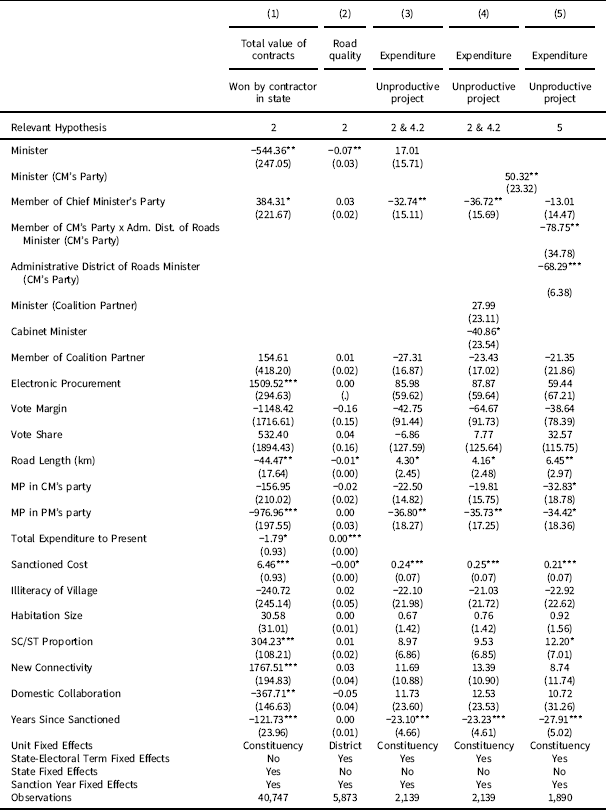
Table 2 shows an examination of three additional observable implications of Hypothesis 2 as described in Section 2.2.Footnote 44 Consistent with Hypothesis 2, Table 2 Column 1 shows that even after controlling for the value and size of the individual road project, the total value of all contracts in the state won by contractors hired in ministers’ constituencies is significantly less than the total value of all contracts in the state won by contractors hired in the constituencies of ordinary legislators aligned with the ruling coalition.Footnote 45 This result is consistent with ministers’ propensity to hire contractors with whom they may have personal connections but who may not otherwise have the necessary qualifications and experience to execute road projects, and who may therefore be less likely to be selected to execute road projects in other constituencies.
The effect of alignment and ministerial status on rent seeking: analysis of individual road projects

Note: the unit of analysis is the individual road project for Columns 2 to 5 and the project–contractor for Column 1. Column 2 includes all road projects in the sample for which a quality rating by either a state or national monitor is available. Columns 3, 4 and 5 include only road projects that were sanctioned at least five years prior to data collection and that remained incomplete at the time of data collection. Column 5 excludes road projects in ministers’ constituencies. Heteroskedastic-consistent standard errors clustered by state assembly constituency are shown in parentheses. *significant at 10%; **significant at 5%; ***significant at 1%
Also consistent with Hypothesis 2, Table 2 Column 2 shows that, after controlling for expenditures and other factors that could influence the quality of road construction, road construction in ministers’ constituencies is rated to be of lower quality than road construction in the constituencies of ordinary legislators aligned with the ruling party. These results suggest a form of rent seeking financed through the underprovision of inputs necessary for satisfactory road construction (for example, Wade Reference Wade1982).
Table 2, Columns 3–4 examine Hypothesis 2 by probing the differences in the levels of expenditure incurred on unproductive projects in the constituencies of ministers and ruling party aligned ordinary legislators. The coefficient on the Minister variable falls short of statistical significance in Column 3, but Column 4 – which breaks down the type of minister – shows that the coefficient on the variable indicating a minister from the chief minister’s party is positive and statistically significant. Thus, road projects in these ministers’ constituencies are more likely to provide rent-seeking opportunities than projects in the constituencies of ordinary legislators aligned with the ruling party. Taken together, the results in Table 11 and in the first four columns of Table A9 show remarkably robust evidence consistent with Hypothesis 2, which posits that rent seeking is more prevalent in road projects located in ministers’ constituencies than in constituencies of ordinary legislators aligned with the ruling party.Footnote 46
Appendix Section A.13 shows that the results presented in Table 2 are robust to dropping ministers with formal control over the PMGSY bureaucracy – such as chief ministers or ministers whose departments were wholly or partially responsible for the provision of rural road works. Thus consistent with the present argument, which emphasizes both the formal power of ministers as well as their informal leverage within their parties, ministers are found to have, on average, greater access than their junior party colleagues to rent-seeking opportunities even if they do not have formal power over rural roads provision.
Appendix Table A12, Column 1 presents analyses that shed light on Hypothesis 3. Consistent with Hypothesis 3, the results in Appendix Table A12, Column 1 show that the average expenditure on unproductive projects is significantly higher in the constituencies of ministers with previously higher levels of electoral competition than in the constituencies of ministers with previously lower levels of electoral competition. These results are consistent with Hypothesis 3, which suggests that ministers are more likely to engage in rent seeking when they face a relatively higher underlying electoral risk. The results for the other measures of rent seeking, while not significant at conventional levels, also point in a direction consistent with Hypothesis 3.Footnote 47
Turning to Hypothesis 4.2, the results in Table 2, Columns 3 and 4 show that the coefficient on the variable Member of Chief Minister’s Party is negative and statistically significant, indicating that ruling party aligned ordinary legislators have significantly lower levels of expenditure on unproductive projects in their constituencies than do opposition legislators. These results provide evidence consistent with Hypothesis 4.2 which suggests that ruling party aligned ordinary legislators should have fewer rent-seeking vehicles in their constituencies. However, Appendix Table A14, Column 1 shows that the relative disadvantage that ruling party aligned ordinary legislators experience in accessing expenditures for unproductive projects in their constituencies does not hold when it comes to accessing expenditures for productive projects in their constituencies that get completed within a normal timeframe of two years. Moreover, consistent with Hypothesis 4.1, Table A14, Column 2 shows that, for such productive projects, ruling party aligned ordinary legislators experience an advantage over other legislators when it comes to accessing expenditure premiums for road projects in their constituencies. The results suggest that ministers intervene on behalf of their partisan colleagues to allow them access to discretionary expenditure that would facilitate their timely delivery of infrastructure to their constituents.
To examine Hypothesis 5, Table 2 Column 5 sheds light on whether the constituencies of ordinary legislators belonging to the chief minister’s party incur less unproductive expenditures when co-partisan ministers in charge of departments involved with rural road works exercise more oversight. The results, based on a specification excluding ministers’ constituencies, show that the interaction term is negative and statistically significant, indicating that ordinary legislators from the chief minister’s party suffer a particular disadvantage with regard to accessing rent-seeking opportunities when their constituencies share a bureaucratic jurisdiction with the constituency of a co-partisan minister whose department is charged with rural roads provision. The results thus suggest that the lower levels of expenditure on unproductive projects in the constituencies of ruling party aligned ordinary legislators are largely driven by the influence of the relevant ministers in their own party. This finding is consistent with the notion that ministers seek to minimize the prevalence of rent-seeking vehicles in the constituencies of their co-partisans.
Alternative Explanations
While the argument advanced in this research suggests that the observed differences in access to rent-seeking opportunities between ministers and ordinary legislators shown in the previous section arise because of the ministers’ incentives – or lack thereof – to co-operate with their junior partisan colleagues, there are several alternative explanations for these differences. However, these explanations do not appear consistent with the evidence as a whole.
First, one alternative explanation for the differences in the prevalence of rent seeking between the constituencies of ministers and ordinary legislators is that they may be driven by the fact that ordinary legislators have less control than ministers over the implementation of public works programs. However, although it is true that ordinary legislators do not have any formal control over the bureaucracy, the results in Table A9 show that ruling party aligned ordinary legislators enjoy similar advantages to ministers in terms of their ability to deliver roads to their constituents. Further analyses unpack this result further, showing that the advantage that these ‘aligned’ legislators enjoy pertains not so much to the initial allocation of road projects to their constituenciesFootnote 48 but – as Table 1 shows – to the completion of road projects allocated to their constituencies. Since the completion of road projects falls squarely in the hands of the bureaucracy, and since ordinary legislators have no formal control over the bureaucracy, these results suggest that ministerial intervention is likely to play a key role in helping co-partisan ordinary legislators deliver completed roads to their constituents. Thus, far from being powerless, ordinary legislators belonging to the ruling party are able to exert significant influence over the implementation of road projects when it comes to providing development due their partisan alignment with key ministers.
Secondly, the evidence also casts doubt on the possibility that the differences are entirely driven by ordinary legislators having a greater need to establish competence due to their relatively junior positions within their parties. In particular, the results show that ordinary legislators aligned with the ruling party have influence over specific aspects of PMGSY implementation – such as road completion and access to expenditure premiums – that, qualitative research reveals, would typically only be possible through the backing of key ministers. Thus while it may be the case that ordinary legislators have an incentive to provide public goods to establish their competence within their parties, these incentives could not be realized without the help of ministers. The evidence in the article cannot therefore be explained by the career concerns of ordinary legislators without taking ministers’ incentives into account.
Further analyses also rule out a third possibility, which is that differences in the nature of electoral competition faced by ministers and ordinary legislators could be driving the results. In particular, while it is theoretically possible that ministers and ordinary legislators have different propensities to engage in rent seeking due to the fact that ordinary legislators on average face higher levels of electoral competition than ministers, Column 1 of Appendix Table A12 shows that the constituencies of ordinary legislators aligned with the ruling party show no advantage in gaining access to rent-seeking opportunities regardless of their prior levels of electoral competitiveness. Meanwhile, the same column shows that ministers’ constituencies that were more competitive in previous elections had greater access to rent-seeking opportunities in the form of higher levels of expenditure on unproductive projects (which, in turn, is consistent with Hypothesis 3).
A fourth possible explanation for the results is that, rather than being concerned about the electoral costs of rent seeking on the part of their fellow party members, ministers may simply wish to horde rent-seeking opportunities in their own constituencies at the expense of all others. However, several pieces of evidence discussed in Appendix Section A.17 suggest that ministers may in fact be more willing to tolerate rent seeking in the constituencies of opposition party legislators than in those of legislators from their own party. One possible interpretation of this finding is that ministers may manipulate the bureaucracy to ensure that road projects in opposition-held constituencies remain incomplete or that they are of low quality and then may allow bureaucrats located in these constituencies to benefit from the rent-seeking opportunities associated with these projects as a reward for their co-operation. This interpretation is consistent with Iyer and Mani (Reference Iyer and Mani2012), who find evidence supporting the argument that chief ministers are more likely to install loyal bureaucrats in opposition constituencies than in constituencies of their own party members.
Conclusion
How do government elites use their influence over public works programs? Overall, the findings support the argument that government elites in a parliamentary system seek to derive private benefit from their influence, while at the same time ensuring that their party members are able to provide the infrastructure to their constituents necessary for their party to be successful at the polls. Thus, although ministers tend to concentrate rent-seeking opportunities in their own hands at the expense of their junior party colleagues, they also facilitate public goods provision both in their own constituencies and in the constituencies of their junior colleagues.
This research advances our understanding of distributive politics in part by offering a corrective to the widespread assumption that political influence over the bureaucracy inevitably leads to inefficiency and corruption. Instead, it suggests that although political influence over the implementation of development projects may result in non-programmatic distribution, the presence of electoral pressures in combination with incentives for intraparty co-operation in a parliamentary system can mitigate the prevalence of rent seeking in public infrastructure provision. The findings therefore offer a more nuanced view of public infrastructure provision in patronage-dependent systems with important implications for our understanding of the merits of public programs for infrastructure provision in the developing world.
Supplementary material
Data replication sets are available in Harvard Dataverse at: https://doi.org/10.7910/DVN/4YXPHO, UNF:6:qu6DoxCKw6mZAaDVxxNZrQ== [fileUNF] and online appendices at: https://doi.org/10.1017/S0007123418000376
Acknowledgements
For helpful comments and feedback, I am grateful to Sam Asher, Thad Dunning, Robin Harding, Mark Schneider, Jacob Shapiro, Emmanuel Teitelbaum, Johannes Urpelainen and Ashutosh Varshney as well as seminar participants at the UBC Comparative Politics workshop, the American Political Science Association annual meeting, the Indian Political Economy workshop at the Carnegie Endowment for International Peace, the Center for Advanced Study of India Speaker Series at the University of Pennsylvania and the ‘India at 70’ conference at Claremont McKenna. I am also thankful to Ashish Ranjan for his assistance in conducting interviews in Uttar Pradesh and Bihar and to Himanshu Mistry at NYU Data Services for his assistance with the GIS maps. The data, replication instructions, and the codebook can be found at https://doi.org/10.7910/DVN/4YXPHO.