

Introduction: the evaluation of music and the notion of musical ghostliness
Values
Since the 1980s there has been a swing towards aesthetic relativism. Some writers have taken a position which ultimately denied the objective nature of the musical work altogether, and consequently espoused (ironically) an absolute relativism (see for instance Goehr Reference Goehr1992; Griffiths Reference Griffiths1999; Moore Reference Moore2012; Kramer Reference Kramer1991). On the other hand, Frith raised the need to evaluate music (Frith Reference Frith1998, pp. 6–16), for that is, as he says, what fans or other listeners do all the time. Why should not music theorists, musicologists and others involved in the scholarly investigation of music do so?
How can music be evaluated? Are there reasonable criteria which may, for example, be used to criticise a song by someone else for being either ‘over-structured’ or ‘all chopped up’, or for being so over-differentiated as to sound rambling and amorphous? Many people would believe it fair to say yes: but only with respect to being chopped up or rambling in relation to the music's style, for in this way like is compared with like. There is little point in attempting a comparative evaluation of a 3 minute song with a 20 minute symphonic movement, just as it would be foolish to evaluate one of Haydn's songs against one of Webern's, or one of Joni Mitchell's against one of Schumann's. However, it can be interesting to think about the relative value of any two songs in a Schubert song-cycle, or between two of Mitchell's songs. Furthermore, it can be provocative to compare the relative value of a song by Schubert with another by Schumann, or the musical value of one Joni Mitchell song against another by, say, Bob Dylan or Leonard Cohen from roughly the same time. I leave this issue to readers; and am curious to know whether my criteria for celebrating Joni Mitchell's music hold for at least some of her later work
Focusing
As I will often return to, the phenomenon of music, meaning its (deceptive) material existence caught between the subject and object of musical experience, is fluid and expansive. I think of this complex phenomenon as ‘ghostly’ because of music's evanescence on the one hand and its undeniable power over us. Music is resistant to reason, and can seem almost magical, as in the cliché ‘the magic of music’. But music is material – it exists independently of us, it can be measured, recorded, played back and represented in a range of ways. Furthermore it can be analysed and evaluated, and its effects upon us can, to some extent, be replicated or explained.
Music's delicate materiality can seem to open and expand its own metaphysical being free from the limitations of reason. This perhaps has something to do with why the music which people identify with in their youth can seem to ‘haunt’ their adult lives. Surely some of the things that affect us most are those very phenomena that we don't notice, and don't even know are affecting us: phenomena that are un-conceptualized, free from language and reason.
In this essay I will consider the albums that Lloyd Whitesell, in his authoritative The Music of Joni Mitchell, refers to as belonging to her ‘first period’ (Reference Whitesell2008, p. 16). These are: Song to a Seagull (1968, hereafter Seagull), Clouds (1969), Ladies of the Canyon (1970), hereafter Ladies, Blue (1971) and For the Roses (1972), hereafter Roses. I also make passing reference to three concert recordings during that time: Joni Mitchell Live at the Second Fret (1963), Joni Mitchell Live at the Newport Folk Festival (1969) and Joni Mitchell and James Taylor, The Circle Game (Live at the Albert Hall, 1970).
Whitesell's highly sensitive analyses constitute just one of only four texts to address Joni Mitchell's music rather than her words and/or her biography. Another is Joel Bernstein's introduction to his Joni Mitchell Songbook (Reference Bernstein1996), which precedes his superb transcriptions of all of her songs, together with their tunings and guitar tablature.Footnote 1 Thirdly, Bennighof's The Words and Music of Joni Mitchell (Reference Benninghof2010) discusses the music of all Mitchell's songs in chronological order, but focuses mainly on chordal functions. Fourth, and yet in a chronological sense first, there is Charles Hartman's (Reference Hartman1977) detailed analysis of ‘Michael from mountains’.
Doubts have been raised about the propriety of using the discourse of classical music theory for analysing popular song, as I do occasionally. For instance, my references to ‘accented passing notes’ derive from formal counterpoint, ‘musical redundancy’ from L.B. Meyer (Reference Meyer1967, pp. 118–20), ‘motivic integration’ from Haydn and Beethoven studies, and ‘melodic proliferation’ from Adorno's celebration of Schonberg's thematic ‘generosity’ (Adorno Reference Adorno1967, p. 151f)! On the other hand, of course, there is no evidence in Joni Mitchell's music of any contrapuntal development or large-scale tonal planning, or any themes within a song that are as sharply contrasted as are many sonata form first and second subjects. Nonetheless, there is no reason why classical music analysis should not inform the analysis of popular music, although in the absence of spatial notation musical phenomena are far more ghostly and theoretically evasive. In other words, aural analysis, it hardly needs saying, does not address the spatial and visual representation of music through notation, but heard musical sounds in time.
Polio left Mitchell with a weak left hand which made it hard for her to hold down barre chords (O'Brien Reference O'Brien2002, p. 50). This in turn limited her to first-position chord shapes. However, blessed with unusual creativity, a willingness to embrace chance,Footnote 2 and a phenomenal musical imagination, she began a lifetime habit of retuning her guitar in quite idiosyncratic ways before performing almost every song.Footnote 3 The germ of each song seems in some ways to have often arisen from these original guitar tunings, perhaps a variant of one she often used, or one that she had just invented. It is as if the song came from the tuning, which itself carried an element of chance.
Well over half the tunings that Mitchell used, and which Bernstein identified in his Joni Mitchell Songbook, form major triads (Bernstein Reference Bernstein1996). Then there are eight ‘rogue’ tunings used for these early songs, which is to say those not forming major or minor triads. For instance, ‘Sisotowbell Lane’ (Seagull) uses E–C–F–D–G–C; ‘I don't know where I stand’ (Clouds) uses only G–A–C–F; ‘Ladies of the canyon’ (Ladies) uses E–C–F–D–G; in ‘A case of you’ (Blue), Mitchell tunes her dulcimer to just two notes – D and A; and ‘Woman of heart and mind’ (Roses) uses D♯–B–E–C♯–F♯–B.Footnote 4
When she applied simple left-hand fingering shapes to these as it were ‘mis-tuned’ strings, strange four- and five-note chords emerged in ways that were almost entirely unpredictable, yet without losing any sense of a tonal ground. This is because Mitchell's tetrachords sound nothing like those of the ‘jazz standards’ repertoire, as typified by Broadway songwriters Jerome Kern, Richard Rodgers and George Gershwin, whose harmony is more directed than Mitchell's, which in turn is more colouristic.
The harmony of her first hit song – ‘Both sides now’ (Clouds 1969) – is a case in point. For this song she used an E major tuning over which she slid primary, three-finger D7 chord shapes up and down one and three frets, which necessarily results in continuous mild and local dissonance, probably rooted in Flamenco guitar practice. Such tunings leave some strings open, and in ‘parallel motion’, which is to say with all notes moving in the same direction from one chord to another (Benninghof Reference Benninghof2010, pp. 19, 33).
My first task in this search for the ghostly, fluid temporality of Joni Mitchell's early music has been to listen closely to those of her ‘first period’ songs that I have identified as being metrically irregular in various ways. Whilst in itself fascinating, this exercise was limited to just 16 songs, leaving some expansive musical flows in other metrically regular songs unmentioned. Consequently I spread my attention to all 52 songs, and drew up a rough working list of seven basic analytic questions to this end.Footnote 5
• Where pertinent, what is the nature of the songs’ instrumentation and arrangement?
• Is the overall harmonic sense of the song modal or diatonic?
• How regular are the song's periods?
• How regular is the song's metre?
• What is the nature of the song's ‘melodic forms’ or phrases; and their number, duration, metric position – ‘up-beat’ for instance – and profile – ‘convex arch’ for instance.
• Is there any chromaticism in the song?
• Where is the melody situated in Mitchell's vocal tessitura?
After prolonged interrogation the songs yielded sufficient common features to support Whitesell's idea of Mitchell's musical ‘first period’.
‘First period’ style
These issues are addressed under six headings: instrumentation and arrangement; modality and diatonicism; metre and periods; internal structure; harmony; and, finally, melody.
Instrumentation and arrangement
Mitchell nearly always accompanied herself on finger-picked guitar, there being only three strummed songs on her first two LPs. Thereafter she more-or-less alternated between picking and strumming, although for half of the songs on her third and fifth albums she accompanied herself on the piano, whilst on Blue (alone) she used an Appalachian dulcimer to accompany four songs.
Mitchell made increasing use of other players in recording sessions. Apart from songs with her own dubbed extra voice or voices, which are common to so much of Mitchell's music from her first LP onwards, we often hear a single woodwind instrument, or an electric bass, usually with discrete congas or hand-claps. The fifth LP, Roses, has more diverse sounds: ‘Let the wind carry me’ and ‘Judgement of the moon and stars’ both incorporate extended instrumental sections; ‘Barangrill’ combines three flutes with a soprano sax; and ‘Blonde in the bleachers’ features a rock band (Hinton Reference Hinton1996, p. 146).
Modality and diatonicism
Whilst the majority of the songs on Mitchell's first two LPs are modal, this does not prevail.Footnote 6 There are eight major key songs on Ladies, six on Blue and seven major and two minor key ones on Roses.Footnote 7 Aside from a couple of songs with chromatic inflections, six are highly chromatic. ‘The Pirate of Penance’ is the only such song on the first album (Seagull). The other five highly chromatic songs are all on her second LP, Clouds): ‘Marcie’, ‘I Don't Know Where I Stand’, ‘Roses Blue’, ‘The Fiddler and the Drum’ and ‘Songs to Ancient Children Come’, which latter features chromatically descending groups of minor thirds (Whitesell Reference Whitesell2008, p. 129f). This, the relative chromaticism of Clouds, contributes to its sense of ‘hardness’ or ‘darkness’.
Metre and periods
Only three of the songs on these five LPs are not in common time or 4/4: ‘Song to a Seagull’ is in 6/8; ‘Night in the City’ is in 12/8 (Seagull); and ‘For Free’ (Ladies) is in triple time. Very many post-war Anglophone popular songs are divided into 4-bar phrases in a typically 4 + 4 4 + 4 = 16-bar arrangement. I follow Lerdahl and Jackendoff (Reference Lerdahl and Jackendoff1981) in calling such things ‘periods’ meaning collections of whole bars, whereas phrases are better thought of in terms of groups of notes, or melodic forms that can both start and end in various parts of the bar. Nearly all of Mitchell's 52 songs of this period divide into 4-bar periods.Footnote 8 The third section of this essay – ‘Flow through irregularity’ – includes a discussion of some that don't.
Internal structure
Most of Mitchell's songs of this time balance structure and flow, although there are a few that have cadences within them, rather than just at the end of their component parts, and which could, in this sense alone, be said to be ‘over-structured’. On Seagull, ‘I Had a King’, ‘Michael from Mountains’ and ‘Night in the City’ all have internal cadences, or the musical equivalent of full-stops within verses. Interestingly perhaps, there are no examples of such songs on Clouds or Blue, but there are six on Ladies: ‘Morning Morgantown’, ‘Ladies of the Canyon’, ‘The Priest’, ‘Big Yellow Taxi’, ‘Woodstock’ and ‘The Circle Game’. Then there is just one such internally divided song on Roses, and that is the gloriously happy song ‘You Turn Me On, I'm a Radio’,Footnote 9 which has a unique structure comprising an instrumental introduction, followed by a chorus, three verses and a further four choruses.
Harmony
As suggested above, Mitchell's harmonic language, as well as her wonderful melodic gift, grew from her tunings, and it is notable in this respect that the handful of piano songs on these five LPs are significantly more triadic and consonant than are her guitar songs. Her fingerings of unique guitar tunings give rise to, on the one hand, unisons and octave unisons, and on the other hand to particular types of dissonance, which are conventionally referred to as ‘slash’ chords, as for instance when a D major triad sounds over a bass E, or a C underpins a G minor chord. Then again there are concatenations of fourths and fifths with no clear tonal centre, such as C–F–G–D. Bernstein distinguished between these ‘slash’ chords and what he calls ‘sus’ or ‘suspended’ chords, by which he means not a note or notes held over changing harmony but piles of thirds that give four- and five-note chords such as Cm7or G13. Because both types involve a collection of treble notes, many of which will inevitably disagree, or be dissonant with the bass notes below them (Monk Reference Monk2012, p. 71), I prefer to make a distinction between these two types of dissonance, not on the basis of how they arise but on how they sound. Thus I distinguish between relatively ‘sweet’ tetrachords that prioritise thirds and sixths, and relatively ‘hard’ ones that prioritise fourths and fifths.
Perhaps Clouds sounds altogether darker than Seagull which preceded it, or Ladies which followed, because of its relatively high proportion of hard-sounding tetrachords, the five chromatic songs mentioned above and the relative lack of structures or punctuation throughout the album. The following are examples of songs that foreground ‘hard’ tetrachords, thereby imbuing the whole with a sense of overall ‘hardness’ or ‘darkness’. From here on I give just one example from each of the five albums, in this instance: ‘Marcie’ (Seagull), then ‘That Song about the Midway’ (Clouds), ‘The Arrangement’ (Ladies), ‘Blue’ (Blue), ‘Cold Blue Steel and Sweet Fire’ (Roses). A different type of dissonance arises when the note Joni Mitchell sings does not correspond with its harmonic accompaniment. For instance, she might sing g1 over F major, or d2 over A minor.Footnote 10 This type of melody/chord disagreement has been common practice in post-war jazz, and was embraced by Broadway songwriters. Here are some momentary, melodic/chordal dissonances on the five albums together with their precise timings.
Seagull: ‘The Dawntreader’ – ‘stakes all the silver’ is sung to d then a over Bb major harmony (1′07′′–1′12′′).
Clouds: ‘Tin Angel’ – ‘on tapestries’ is sung to f–e–f over C7 and then over A major (0′34′′–0′38′′).
Ladies: the first line of ‘Willy’ when ‘child’, as in ‘Willy is my child’, is sung as an f over C major harmony (0–12′′–0′18′′).
Blue: ‘All I Want’ – ‘well come on’ is sung as F over A major and e over Bm7 (1′10′′–1′13′′).
Roses: at the very end of ‘Lesson in Survival’ the words ‘magnet and iron’ are sung as b then e over G9 (2′55′′–3′00′′).
Sometimes a distinctive tetrachord can impart a particular harmonic flavour to a whole song. For instance, ‘Roses Blue’ (Clouds) is infused by a shift from a held G under first Bbmaj7 and then F minor. Similarly, a recurrent harmonic shift from, Gmaj7 to Am7 binds together the harmonic sense of ‘Electricity’ (Roses).
Melody
Mitchell's unusual melodic gift was already prodigious during her first period. We hear turning figures, some ornamented, others broken or complete, ascending or descending scales and arpeggios, and broad concave and convex arches, very often with different notes for every syllable, and with seventh, octave and even ninth leaps between her alto and soprano registers. The great majority of the songs on these five LPs each comprise three or four quite distinct melodic forms, although there are several with just two. Meanwhile, ‘The Dawntreader’ (Seagull) and ‘Banquet’ (Roses) each have seven, whilst ‘Lesson in Survival’ (Roses) has eight distinct melodic forms – a proliferation that is probably rare in post-war Anglophone popular song.
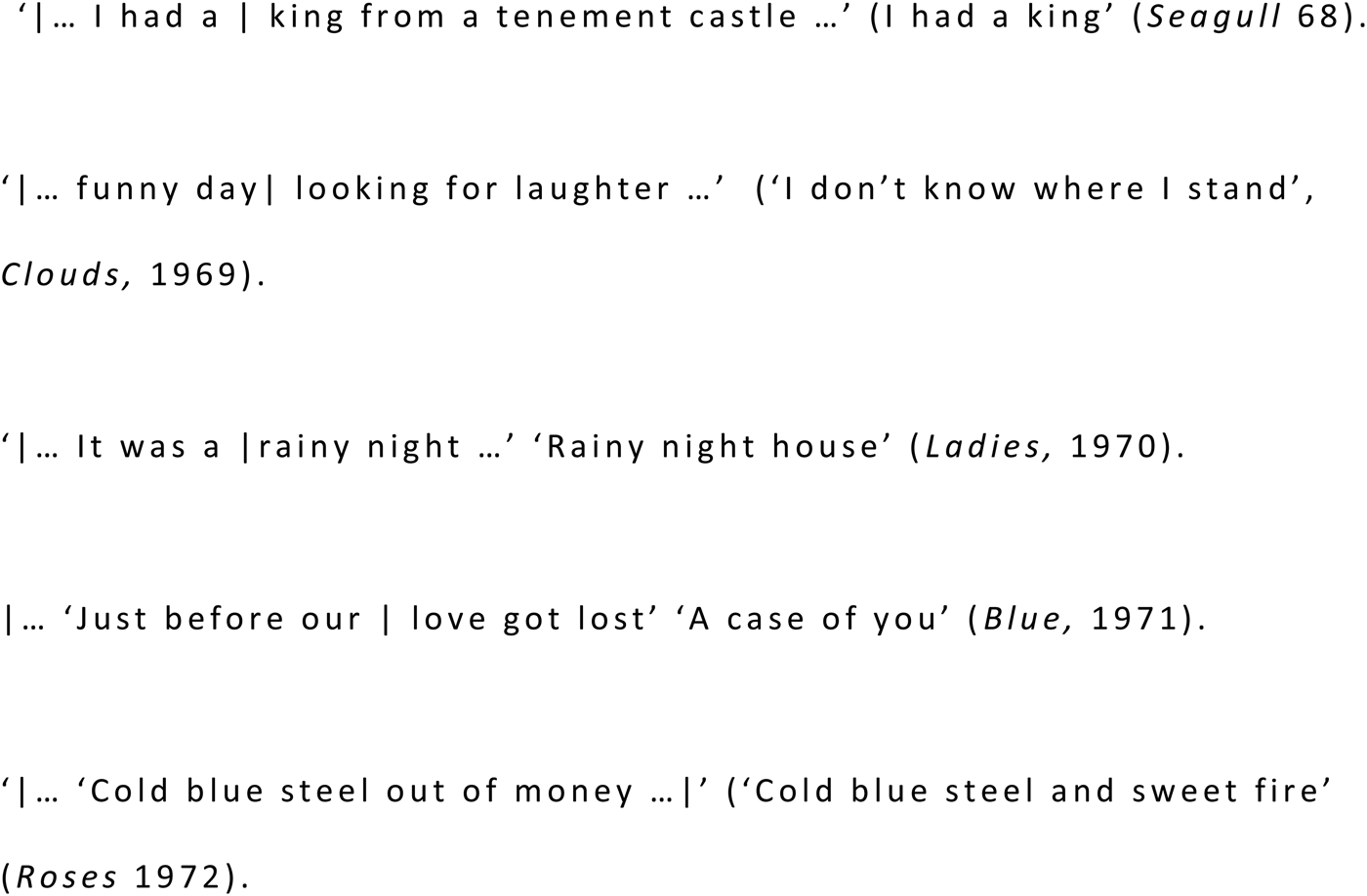
On these five LPs Mitchell often began melodies on the second beat as if in response to a prior note or chord on the downbeat, or as an anticipatory, 3-beat upbeat. Perhaps this is common practice in popular song, because after all it helps singers find their first note. In the following five examples from the beginnings of songs vertical beams represent bar lines whereas ellipses represent ‘missing’ downbeats (Example 1).
Typical second beat phrase beginnings.

Just as Mitchell had a favourite way to begin phrases, so too did she like to end them with what I call (playfully) ‘TAPs’, meaning ‘terminal accented passing notes’. In other words, rather than going to the last note of a phrase directly, she would first sing one immediately above or below it (Example 2).
Typical accented terminal passing notes (TAPS).

Ten of Mitchell's songs of this period vary, and in this sense develop melodic motives, a procedure more usually associated with classical music. This quality is exemplified by ‘Marcie’ (Seagull), ‘I Don't Know Where I Stand’ (Clouds), ‘The Arrangement’ (Ladies) and ‘Woman of Heart and Mind’ (Roses).‘Marcie’ (Seagull), which I will return to later, is unified by chromatic turning figures that change their pitches and durations, probably as a result of applying simple handshapes to strangely tuned strings, and to the syntactical determinants of words. Similar motivic development can be heard in ‘I Don't Know Where I Stand’, ‘That Song about the Midway’ (Clouds 1969), ‘Roses Blue’, ‘Willy’, ‘The Arrangement’,Footnote 11 ‘Rainy Night House’ (Ladies) and ‘Little Green’, ‘Blue’ and ‘California’ (Blue).
Summary of first period general features
There is a cornucopia of melodic ideas on these five albums, mostly accompanied by fingerpicked guitar in unusual if not unique tunings, although from her third LP, Ladies, she also used the piano. Her songs shift from modality on her first two LPs to almost complete diatonicism on the fifth, Roses. Many of her melodic forms begin on the second beat, and many end with TAPs. Several songs incorporate a dubbed-on voice, and several make use of another instrument. There is quite a lot of dissonance throughout these five LPs, mostly quite sweet (in the sense given above) with a little chromaticism. Almost all 52 songs are in common time, and the great majority are metrically regular. Now I turn to those of her songs that are irregular.
Fluidity and expansiveness through irregularity
Most of my observations until now have been simple, empirical and ‘objective’, but when I turn to examine even short passages of musical fluidity and expansiveness, I am at once caught up in its musical temporality, and am thus more liable to introspective interpretation. Another way to put this is to say that I now move away from a distinctly empirical analysis towards a more phenomenological approach to such ‘ghostly’ musical phenomena.
Stretched musical time
Rhythmic irregularities of various kinds can enhance musical flow. Consider first ‘periodic irregularity’. As mentioned before, by ‘periods’ I mean numbers of whole bars, rather than melodic forms that move around and between them. Ten of the 52 songs on these five LPs are not entirely in the ‘normal’ 4-bar periods of Anglophone rock: ‘Nathan la Franeer’ (Seagull); ‘That Song About the Midway’, ‘I Think I Understand’ and ‘The Gallery’ (Clouds), ‘The Priest’ (Ladies), ‘Blue’, ‘All I Want’, ‘This Flight Tonight’ and ‘A Case Of you’ (Blue), and ‘Blonde in the Bleachers’ (Roses), which latter ends with a unique C section that runs five times through a 6 + 4 + 4-beat metric pattern. Many of these songs have undivided 5-bar periods, rather than those that merely follow four bars of voice by one bar of accompaniment as for instance in ‘Songs to Aging Children Come’ (Clouds). Such musical ‘rests’ tend to stand between one phrase or sub-phrase and the next, thereby holding back musical flow across them.
‘That Song About the Midway’ interlocks 5- and 4-bar periods in both verses and choruses (Bennighof Reference Benninghof2010, p. 30). The 5-bar ones arise when Mitchell stretches syllables in time, which lends a sense of expansive relaxation, or staying with things – musical things. Consider for instance, ‘That Song about the Midway’ in which there are interlocked 5- and 4-bar periods in both verses and choruses. The 5-bar ones arise when Mitchell stretches syllables in time, which lends a sense of expansive relaxation, or staying with things. Often the 5-bar periods come during the repeat of words such as for ‘once or twice’, and then again, ‘once or twice’, although now with the repeated ‘twice’ sung to many notes. In the examples below onset timings are written in minutes and seconds, followed by the number of verse or B section. The underlined syllables are those that are stretched in time, as with ‘twice’ when the words ‘once or twice’, are given several notes to one syllable when repeated (Example 3).
Stretched musical time’ in ‘That Song about the Midway’ (Clouds).

I now move on to the phenomenon of metric irregularity, which is far more effective than periodic irregularity.
Gunther Schuller, in his masterful Early Jazz, pointed out that by playing jazz in 4/4, first Jelly Roll Morton in the 1920s then Duke Ellington in the 1930s achieved a more ‘linear’, less chopped up form of swing compared with the on/off 2/4 marches of New Orleans marching bands (Schuller Reference Schuller1968, pp. 10, 34, 144, 256, 266, 284). A similar tendency for music to flow through irregular downbeats can be heard in some of Joni Mitchel's songs.Footnote 12
Whitesell (Reference Whitesell2008, pp.161–78) addresses Mitchell's rhythms in terms of numbers of syllables, whereas I prefer to think of them musically as numbers of beats in bars, the length of melodic forms and their positions within and across metre. Metric irregularity can take the form of a few rogue bars, such as in the live version of ‘Marcie’ that was recorded in the Second Fret Club in 1963 (five years before the studio version), and which has one 3/4 bar in each of its two B sections. ‘Cactus Tree’ (Seagull, 1968) has many 2 + 4-beat patterns in its B sections; ‘The Arrangement’ (Ladies, 1970) has some 4 + 6-beat structures in the wordless verse towards the end (beginning at 2′33′′); ‘My Old Man’ (Blue, 1971) has some 6 + 2-beat structures. Then there are six songs on Roses that have a few rogue bars: ‘Banquet’ and ‘Lesson in Survival’ have a few 5- and 6-beat bars; ‘Cold Blue Steel and White Fire’ has 9-beat bars at the end of four of its six verses; ‘For the Roses’, ‘Lesson in Survival’ and ‘Blonde in the Bleachers’, the latter of which ends with repeated 6 + 4 + 4-beat metric patterns.
On the other hand, there are seven far more thoroughly metrically irregular songs on these five LPs: ‘The Dawntreader’, ‘The Pirate of Penance’ and ‘Sisowtowbell Lane’ (Seagull), ‘The Fiddler and the Drum’, ‘Tin Angel’ (Clouds) and ‘The Priest’ (Ladies). Then apart from the six songs with a few rogue bars on Roses listed above, ‘Barangrill’ is far more irregular. I will mention this song again during the following more detailed discussions of ‘The Priest’ and ‘Sisotowbell Lane’.
I explained earlier how the 5-bar periods in ‘That Song About the Midway’ (Clouds) arise because of the way Mitchell stretches words for an extra bar. In ‘The Priest’ (also on Clouds) similar syllabic stretching is played out at the far more immediately effective level of metre in a diverse collection of 4-, 5- and 6-beat bars.Footnote 13 The only trace of any constancy here is a 4 + 5 + 5-beat cell that sounds six times across the song.
Consequently it is by far the most metrically irregular of all Mitchell's songs in her first period. Nearly always the stretched syllable is the penultimate one of the verse, as in the first verse:
He was wearing his father's tie, (0′22′′–0′24′′)
Whenever the words ran dry (0′32′′–34′′)
Meanwhile, the second parts of the second and fourth B sections of ‘The Priest’ (Example 4) are different to each other and verse six has no precedent. However, the B sections are regular in their irregularity – 4 + 5 + 5 6 + 6 + 2Footnote 14 – though the last bar of the third and last B section is expanded to four bars (Example 5).
Stretched musical time in ‘The Priest’.

Elisions in ‘The Priest’ (Clouds).

The ‘/E’ signs at the ends of the B sections above signify ‘elisions’,Footnote 15 which is to say when the last two beats of the line are effectively annulled by the simultaneous return of the guitar introduction. In other words, the end of one period is simultaneously the beginning of the next, resulting in a form of temporal contraction that gives a sense of ‘hastening on’, so much so that the music that has just been gets taken up into the music that is now and will be, letting the ends of both verses and B sections flow over into the following dynamic guitar ‘fills’.
Almost all the irregularity in ‘The Priest’ arises from syllabic stretching. This quality lends a troubled sense of time that seems to ebb and flow, especially at the ends of B sections where the elided turbulent guitar passages support the disturbed sexuality of the subject. More precisely, this disturbance can be thought to sound a dangerous and licentiousness blasphemy, an erotic lingering, as in the words of the first B section:
His eyes said me and his eyes said you
And my eyes said let us try. (0′42′′–0′45′′)
Now compare the stretched time of ‘The Priest’ with the often ambiguous periodicity of ‘Sisotowbell Lane’.
Regulated and ambiguous metric irregularity: ‘Sisotowbell Lane’ (Seagull)
The title of ‘Sisotowbell Lane’ spells out the acrostic, ‘Somehow In Spite Of Trouble Ours Will Be Everlasting Love’ (O'Brien Reference O'Brien2002, p. 86), and suitably, its words celebrate domestic happiness. It is in D major with just two d♯1 chromatic inflections. The tuning – E–C–F–D–G–C – with a capo on the third fret (Bernstein Reference Bernstein1996, p. 44) is one of those ‘rogue’ tunings mentioned above that do not form a major triad. Mitchell calls this one her ‘California kitchen tuning’ (O'Brien Reference O'Brien2002).Footnote 16
The musical temporality of the opening few seconds of every verse of ‘Sisotowbell Lane’ is unutterably beautiful. The title words, which begin verses 1, 3 and 5,Footnote 17 can only be metred by holding onto the secure pulse of the preceding guitar figure. In the first verse time stands still for a ghostly microsecond as the downbeat of the second bar, which seems to begin just after the onset of the titular words, is only articulated by a guitar harmonic (Example 6).
Openings of ‘Sisotowbell Lane’ verses 1 and 2.

The melody of each verse divides into two melodic forms with the first being re-divided into three sub-forms thus (in verse 1): ‘Sisowtobell Lane| Noah is mending the pump in the lane| he knows us no shame|’. These sub-forms are barely distinguishable from one another, largely because the second and third ones begin with the same note that ends the previous, which lends a sense of unbroken continuity. The angular second melodic form, which leaps back and forth between a and a1 with d♯-e between them, sets the words (in verse 1): ‘We always knew that he always knew’ (0′21′′–0′28′′).Consequently, five of the six verses share a 6 + 4 2 + 4 + 6, 4 + 4-beat bar scheme, whilst that of the second verse (beginning at 0′33′′) has 6 + 3 3 + 4 + 6-beats. Example 7, which unfortunately skates over the song's vagaries of pulse, shows how the words of the first two lines of the first two verses correlate with the metric scheme written beneath. The 6-beat bars at the end of the second parts of verses arise from an extended upbeat into the third part, such as for ‘he brings us no shame’ in verse 1, and for ‘with stories to tell’ in verse 2. These extended upbeats serve to unite the second and third parts of each verse.
Beats, metre and words at the opening of ‘Barangrill’.

The irregularity here can be heard as the almost regular pattern: 4 + 4 4 + 4 + 4 4 + 6 (4 + 4). Similarly the 5 + 3-beat scheme in the second part of B2, because it adds up to eight beats, can easily be heard as 4 + 4-beats. I don't know which is ‘better’ but to my ears the rhythm sounds more irregular if counted in a regular manner, and I prefer that, though someone else might well object to imposing measure onto something that is inherently immeasurable. Whether or not the song's irregularities were planned, these ambivalences raise an important distinction between ‘irregular’, ‘highly irregular’ and ‘regulated irregular’ metric phenomena. The emphatic nature of regulated irregularity tends to squash words into predetermined metric formulae, and thus sound clompy and/or sometimes comical. On the other hand, occasional metric irregularities, such as the odd 6-beat bar as here, nearly always result in a longer, more fluid and less disrupted ‘musical now’.
Compare the stretched time of both ‘That Song About the Midway’ and ‘The Priest’ along with the ambiguous irregularity of ‘Sisotowbell Lane’ with ‘Barangrill’ (Roses), which sounds far more chopped-up than fluid, because of the highly regulated and articulated exchanges between woodwind and voice that throw up alternating 3- and 4-beat bars (Bennighof Reference Benninghof2010, p. 61).
The guitar introduction to ‘Barangrill’ returns at the ends of all of the verses and B sections, beginning in their last bars. These elisions combine with the song's accumulative melodic structure, its ambiguous metre, the way the voice floats over beats and bar lines, the varying lengths of vocal upbeat figures, the lack of clear metric accents in the guitar accompaniment, and the few, albeit slight, variations of pulse to give the wonderful temporal fluidity that sounds though only within verses. In Example 7 I show how the elided instrumental interpolations enter just before ‘slings’ (0′17″–0′28′′).
Swinging around the beat
I have just mentioned how Mitchell swung around the beat in ‘Sisotowbell Lane’. This form of deviation is my third source of flow through irregularity after periodic and metric types. There is a dramatic rise in vocal rhythmic flexibility up to and including Blue, in which it is most apparent in her impassioned performance of ‘Little green’. This flexibility presages Mitchell's so-called ‘jazz-influenced’ albums of 10 years later, such as The Hissing of Summer Lawns (1975) and Heijira (1976).Footnote 18 Either way these vocal habits nearly always break down any sense of a clear metre, and thereby increase fluidity.
The number of such songs with relatively free vocal lines increases across the first four LPs – three, four, seven, nine – but then drops back to four on Roses. Perhaps this sudden relative vocal rhythmic stability correlates with regulated irregularity, because it is in the four songs with a band (aside from ‘Banquet’, which is a piano song) that Mitchell does not swing her voice around the beat, presumably because these songs’ regularly changing metres had to be agreed on amongst all involved, possibly notated, and stuck to. In this context I want to go on to demonstrate the effect of combining changing phrase positions vis-à-vis the metre with swinging around the beat in ‘Banquet’Footnote 19 (Roses).
Bennighof points out how different ‘Banquet’ is from any other song on Joni's preceding four albums’ jagged rhythms and melodic lines, chromaticism, frequently changing meters, and a kaleidoscope of verbal images quickly
convey a world far removed from that of, say, ‘River’ or ‘A case of you’. (Bennighof Reference Benninghof2010, p.59)
The opening words are held together in a single dynamic unity by the changing position of phrases vis-à-vis bar lines. Whereas the first melodic form for ‘Come to the dinner gong’, begins with a 3-beat upbeat, the second, for ‘tables are laden high’, begins just a quaver before the bar line, whilst the next, for ‘Fat bellies and hungry little ones’ (0′10′′–0′19′′), is as the first. The 6 + 4-beat metric scheme at the ends of verses and the 3-beat bar that begins the two B sections are constant as is the second beat beginning of the verses. However, changing upbeat lengths, a constantly variable pulse, and the way Mitchell sings across it, lend a formidable sense of struggle and turbulence that is appropriate for expressing the awful disparities between rich and poor with which the words are concerned (Example 8).Footnote 20
Banquet: phrase structure.

Five of the six verses have a penultimate 6-beat bar whereas verse 4 has only four beats at the equivalent point. These metric changes dynamise the music to such an extent as to lift or transcend the structural punctuation at the ends of lines. The two B sections sound between verses two and three (beginning at 0′43′′) and between verses four and five (at 1′42′′). Thus there is one 34′′ flow from the beginning of the first verse through the second to the beginning of the first B section; a 32′′ flow across the third and fourth verses, and another 32′′ one across the fourth and fifth verse.
Melodic flow
Now I want to draw attention to spans of musical continuity or flow on these five LPs that do not arise purely on the basis of the three forms of rhythmic irregularity outlined above: irregular periods, irregular metres and singing across the beat. Melodic flow is maintained and generated by at least five, principally melodic factors: elisions at the ends of lines; changing upbeat patterns; additive rather than hierarchically organised melodic forms; and melodic and harmonic continuity across them, such as when the last note of one melodic form is the same as the first note of the next; or when the pitch implications of one form are realised by the next. In Joni Mitchell's songs of this time such flows often run throughout verses, choruses or B sections, and even, though rarely, across such structures. All the musical flows over 15′′ long that I have found on these five LPs are listed below with their lengths in seconds.
Seagull
‘I had a king’: 16′′ through choruses.
‘Michael from Mountains’: 25′′ flow through choruses.Footnote 21
‘Marcie’: 19′′ flow across second parts of verses.
‘Sisotowbell Lane’: 23′′ melodic flow through verses.
‘The Dawntreader’: 24′′ and 30′′ flows in verses and B sections.
‘Cactus Tree’: 27′′ flows in B sections.
Clouds
‘Roses Blue’: 26′′ melodic flow through verses.
Ladies
‘Willy’: lightly punctuated 73′′ flow across verses.
‘Rainy Night House’: 31′′ flow through second half of verses and following piano passage.
‘Blue Boy’: 20′′ flow across middles of verses.
Blue
‘All I Want’: hardly broken 33′′ flow through B sections.
‘Little Green’: 19′′ flow through second parts of verses.
‘A Case of You’: 56′′ and 70′′ flows across verses and choruses.
‘The Last Time I saw Richard’: 27′′, 28′′ and 34′′ flows across verses and B sections.
For the Roses
‘Banquet’: 34′′ and 32′′ flows through verses and B sections.
I now draw attention to six of these songs: ‘The Last Time I Saw Richard’, ‘Marcie’, ‘Cactus Tree’, ‘The Dawntreader’, ‘Willy’, and ‘A Case of You’.
‘The Last Time I Saw Richard’Footnote 22
Sometimes words, together with music, contribute to the overall temporal fluidity of a song, primarily because of syntactic continuity, and also by the use of connecting words like ‘and’ or ‘but’ or interjections such as ‘Oh!’ This is particularly apparent in ‘The Last Time I Saw Richard’, not least because it is a relatively ‘wordy’ song.Footnote 23 The sheer number of repeated notes in the melody, or in other words the high proportion of words to notes, make it seem like melodically inflected speech.Footnote 24 Each verse goes over the same descending pitch shapes – b–c1–b–a–g–e – in the verses, while the B sections reach up to f2. These two melodic forms, though often concealed, hold the song together.
There are 10 irregular bars: four slight temporal ‘gives’ in the piano introduction, within the first B section (1′31′′) and at the ends of verses three and five. The phrasing is often complex as in ‘Banquet’ (Roses, 2′03′′), but it is the loud punctuating piano gestures at the ends of verses 1, 3 and 5 (1′12′′, 2′10′′, 3′03′′) that are most disturbing. Why divide verses up from one another in this way, and why use similar gestures to divide up the first B section? Might it have something to do with the seemingly personal and embittered words?
Yet despite these piano interruptions and the fragmentary and low-profile melody, the song has remarkable flows within its six verses because of syntactic continuity, or in other words, how sentences hold melodies together throughout verses. Think, for instance, of the long first sentence that starts the song: ‘The last time I saw Richard was Detroit in ‘68’ through to ‘boring someone in some dark café’. Whilst the melody for these words is divided into three or four distinguishable melodic forms, verbal syntax guarantees temporal unity.
At the ends of verses 2, 4 and 6 Mitchell repeats the last words of the verse at the beginning of the following B section: ‘pretty lies’ (1′30′′), ‘love so sweet’ (2′40′′) and ‘dark café days’ (3′25′′), thereby imbuing them with bitter irony. These links act like elisions by drawing together the preceding verse and the following B section The repeated words at the ends of their preceding verses and the beginnings of the following B sections, rather like elisions, draw the two parts together into long 27′′, 38′′ and 34′′ musical flows.
Similarly reflective words can be heard in two other songs on Blue (1971): the title track and ‘River’. ‘Blue’ is particularly challenging for my approach because it is metrically quite regular and melodically integrated, but it is also severely interrupted by changing phrase lengths together with many slowings-down and pauses. Mitchell sings two exceptional 3-beat bars for the words ‘acid booze and ass, needles, guns and grass’, and then slowly repeats ‘Lots of laughs … lots of laughs’ (1′14–1′27′′) as an ironic if not bitter reflection.Footnote 25 Because musical retrospection involves digging into our recent past, such phenomena sound psychological introspection.
As can be seen from the list above, there are no less than six songs with expansive flows on Joni Mitchell's first LP (Seagull 1968), all of which arise from repeated motives. I will discuss three of them before launching into more detailed discussions of the extraordinarily expanded flows of ‘Willy’ (Ladies 1970), and ‘A Case of You’ (Blue).
‘The Dawntreader’
The metre of ‘The Dawntreader’ takes on the characteristics of regulated irregularity insofar as there is a 3 + 5+5 + 3-beat pattern in all six verses, and a similar one in the three B sections. These switch chromatically from A minor to G minor for four forms of two relatively low profile, even dull turning figures, each ending with TAPs (first B section (0′46′′–1′06′′):
harbor wake … rigging makes … spray he takes … learns to give … learns to live
Yet it is from these rather dreary and anonymous repeated cells that the B sections take flight, giving roughly 20′′ flows. Several of Mitchell's flows begin in this way. The same could be said of the barely noticeable, and certainly unmemorable beginning of the rarely expansive fluidity of The Bee Gees’ ‘How Deep is Your Love’ (1977), which at just over two octaves, is probably wider than any other popular song I have heard.
‘Cactus Tree’
The guitar introduction to this song sounds so idiosyncratic because it is doubled, and played into a grand piano with the lid up and the sustain pedal down!Footnote 26 Aside from a couple of idiosyncratic melodic switches between octaves, the melody of ‘Cactus Tree’ is grounded in expansions of first one, then another single pitch, giving a chant-like effect comparable with Dylan's ‘A Hard Rain's a-Gonna Fall’ and ‘Masters of War’ on The Freewheelin’ Bob Dylan (1963), and ‘The Gates of Eden’ on Bringing it All Back Home (1965). Similar passages of repeated cells can be heard in the verses of ‘Chelsea Morning’, throughout those of ‘Roses Blue’ (Clouds), in the second part of the verses of ‘Rainy Night House’ (Ladies), in those of ‘All I Want’, and throughout ‘Blue’ and ‘California’ (Blue), and finally, throughout the verses of Roses.
Such repetition is anathema within classical musicology for which it is tantamount to redundancy in the sense that it can only be aesthetically justified in terms of the extent to which it props up or sets off something else, such as repeated notes at the ends of sonata form expositions.Footnote 27 On the other hand, consider Keith Negus's spirited defence of Dylan's motivic repetition.
The riff allows the song to form, to take shape; it provides an integral part of the architecture of a song. It is the cyclical, non-goal oriented repetition of musical phrases and verbal sounds that draws us in, allowing us to enter the song. The riff becomes the song, and words and vocal melody are held in tension to the riff, intimated by and implicated in it. (Negus Reference Negus2008, p. 134)
I think Negus would agree that it would be unwise to either value or condemn musical repetition per se, whether that of the particular song or the broader context of its style. To my classical and jazz and popular music-oriented ears the two series of repeated notes in ‘Cactus Tree’ are of dubious value, although they are somehow rescued by leaps up to c2 at the end of the first series (0′20′′), and again in the middle of the second series of repeated notes (0′45′′).
However, and this is a very ticklish and often unconsidered point, when I recall ‘Cactus Tree’ in my imagination as a ghostly unity it combines the beautiful sound of the mesmeric sounds of her guitar (see footnote 34) and split vocal registers. Consequently, when I hear the song again, I bring all this to bear, and thus perhaps don't find the repeated notes tedious but beautiful?
‘Marcie’ (Clouds 69)Footnote 28
I have already mentioned the unusual chromaticism of ‘Marcie’ as well as its melodic integration, which arises from moving constant left hand shapes up and down the fretboard. Now I want to go into a little more detail to further reveal the song's niceties. The fixed shapes give various forms of a chromatic turning cell, the second, third, fifth and sixth of which end with Mitchell's idiosyncratic TAP-notes, some falling, some rising.Footnote 29 The first two forms of the ‘a’ cell are repeated, then, with the words beginning ‘So she'll wash her flowered curtains’ there are five more forms, the last two being identical to the opening ones thus: a1+a2, a1+a2, a3+a4+a1+a2.
The verses are divided into three by guitar interpolations, and are similarly separated from the two B sections. These are lent continuity by the descending line formed by the first note of each of the four cells – (pitches) g2–e2–d2–c2. This flow is extended to 24′′ by the final held note over the return of the guitar part. The two B sections from ‘And Summer Goes’ (1′33′′), and ‘Like Magazines’ (2′54′′), are variants of the same chromatic turning figure, although now with a leap up to d2, and ending with one further extended chromatic turning cell thus: a5+ a6.
These two sections form an only very slightly divided 0′41′′ flow from ‘And Summer Goes’ through to ‘To the Sea’, the first word of which is leant tremendous emphasis by the way it ends the preceding musical flow. Furthermore, the veiled similarity between the chromatic turning figures of both A and B sections have a strange quality, which arises because of the way they sound so musically other and are yet so similar – a conjunction that, as often mentioned here, I find both ghostly and beautiful in a variety of musical and non-musical phenomena.Footnote 30
‘Willy’ (Ladies 1969)Footnote 31
This piano song is in the Mixolydian mode. Its exceptionally long two verses – beginning at 0′13′′ and 1′27′′ (there is no chorus or B section) – are barely punctuated, and their melodies each drift, via elisions, into interpolated piano passages to form an unbroken continuous flow.Footnote 32 I will discuss just the first verse in some detail.
The opening phrase for the words, ‘Willy is my child he is my father’ (0′13′′–0′18′′) are ‘answered’ after a slight break by a variation of that phrase for the words ‘I would be his lady all my life’. This latter phrase moves upwards to a sustained a1 (for ‘life’ at 0′25′′), which opens up these two relatively static and similar 4-bar phrases to a ‘higher’ musical future. The upwards inclination here is realised by a further and more outstanding ascent to d1 for ‘He says he'd love to live with me but for an ancient injury that has not healed’ (0′29′′–0′39′′). All these words are set to a fluid, unbroken 4-bar scalar descent from c1 to a, and thence down to f.
Perhaps there is a possible break before the words, ‘He said, I feel once again … ’ (0′41′′) but to my ears continuity is maintained because this phrase begins with the same pitch that ended the previous one. Like the first phrase, it is varied and points upwards at its end. The following minor mode variation of it for, ‘He stood looking at the face on the conquered moon’, returns to the static f–e–d oscillations of the opening with the word ‘face’ sounding the downbeat, and a consequent lull, rather than a break in continuity. The sense of waiting here that derives from repetition sounds like an unwilling acceptance of the dreariness of the friend's words.
The melody leaps again, now to the upper register d1 (0′58′′), then falls through c1–b–a. Perhaps it is the returned yet changed equivalence of ‘He said he'd to love with me’ then and ‘counting all the cars’ now, together with the way these words sound metric downbeats, that is so fascinating here. As with ‘Marcie’, experiences of return without recognition of the facticity of that return, can in many spheres of life, be highly charged because such ghostly phenomena carry the weight of the past without us knowing so, thereby evading reason, which is always such a blessed relief! The following phrase for ‘and the stars on my window sill’ (1′02′′) continues the previous descent in an angular b–a–d–A shape, and thence down to C–G to end.
In sum, musical continuity or flow across the first 30-bar verse is only structured or punctuated twice, slightly for the leap up to ‘he says he'd love to live with me’, and more so for ‘And counting all the cars’. Then the flow continues through the following elided piano interpolation: 1′13′′ in all. However, I must, once again, as in my discussion of ‘Cactus Tree’, entertain self-doubt when trying so hard to grasp the evasive ghostliness of musical phenomena. Is it merely the outstanding continuity of the music for the words (in verse one), ‘He says he'd love to live with me but for an ancient injury that has not healed’ which has made me project this quality onto the rest of the two verses?
‘A Case of You’ 1971Footnote 33
In this the last analysis of this essay, I discuss in detail most of its verses, although firstly I want to point out some general features. Mitchell accompanies herself by strumming and slapping (most gracefully)Footnote 34 a tiny four-string Appalachian dulcimer, which she tuned to three Dbs and an Ab for this song that is a passionate cry of sexual disillusion and home sickness. Its diverse and exceptionally beautiful melodies include a variety of turning figures and broad convex arches that change in every verse, and there are three switches into high falsetto decorations. The extraordinary overall fluidity is enhanced by how Mitchell sings all around the beat. More generally the song confuses our sense of verses and choruses, so much so that to recollect it as a ghostly whole in the aural imagination seems to evoke a certain ‘swimmyness’’ in the form of exceptionally lovely, musical-temporal escapes from drear reason!
There are five verses and three choruses that sound between verses 2 and 3, 4 and 5, and once again to end the song.Footnote 35 All of them, apart from the second which is unique, divide asymmetrically into 4 + 5 = 9-bar broad melodic forms. Their first 4-bar form always divides into two sub-forms, the first of which is always a turn around f except in the fifth verse. The second, 5-bar form of the choruses is usually continuous. The first of its sub-forms always decorate a turn – a–g–ab–eb–f, whilst the fourth is another around d–eb–db–c, which latter is constant apart from in the second verse.
The choruses also divide into two melodic forms, though the second of these incorporates a 6-beat bar and divide into three sub-forms, unlike the binary division of the second part of the verses.
Here begins a verse-by-verse musical commentary, beginning with the fascinating though simple introduction, which returns as instrumental interludes after each chorus. It is peculiarly fluid because its two 4-bar parts are linked by an ambiguous 2-beat upbeat that softens the distinction between them.
The first verse (0′19′′), begins with the words ‘Just before our love got lost’ which are given a turning figure, with the word ‘love’ being emphasised by the way it sounds the metric downbeat. Then there is a concave arch for ‘I am as constant as a northern star’, which takes the form of a flurry of notes, as if waving a hand in a frivolous manner. Then the next phrase falls into four sub-forms as shown by the slashes: ‘and I said/constantly in the darkness/where's that/if you want me I'll be in the bar’. This fragmentation of phrases here further resounds with the cynicism of the words. The last word, ‘bar’, is a metric downbeat with a diphthong ‘bar-ar’ and a falling TAP note.
The first melodic form of the second verse (0′39′′) once again falls into two parts, firstly for ‘On the back of a cartoon coaster’ … and secondly for ‘In a blue TV screen light’. (From here on, the underlined words indicate the now very few metric downbeats.) The huge melodic arch of the first verse is replaced and ironed out by a turning figure for the words ‘I drew a map of Canada’. Note firstly, the nice poetic frisson between ‘darkness’ in verse 1 and ‘a blue TV screen light’ here; and secondly the diphthong ‘li-ight’ which sounds a TAP-note, like ‘ba-ar’ in the first verse.
The second sub-form within verse two is unique unto itself, and requires special treatment, for this is where the ‘swimmy’ quality of the song begins. Why do the words, ‘O Canada’ in this verse sound so portentous and so inevitable? I can think of eight reasons: firstly, this word is repeated; secondly, each syllable of these two words is given a separate, ‘emphatically strummed’ chord (Mercer Reference Mercer2009, p. 95); thirdly, Mitchell leaps up an octave in its last syllable; fourth these words are set by a wonderful 6-beat bar that stretches musical time; fifth, its expansiveness gives rise to a 6-bar period; sixth, these words sound the metric downbeat; seventh the phrase refers quite explicitly to the Canadian national anthem; and eighth a guitar and drums enter here. In this regard, it is notable that in her 1975 live version of this song (Miles of Aisles 1975) there are other instruments, which plays this moment right down. Which is better? To my ears the muddle this moment causes about the end of the second verse and the beginning of the following chorus throws reason, thereby deepening the ghostliness of the phenomena.
Mitchell's final ‘Oh’ flows over into the first words of the following chorus – ‘Oh you're in my blood like holy wine …’, which further confuses and thereby fascinates our sense of where the verse ends and the following chorus begins.
All three choruses (beginning at 1′05′′, 2′28′′ and 3′31′′) can be treated together. They all have lovely, broadly descending melodic flows that continue on from the immediately preceding melodic sub-form across their entire duration because of interjected ‘Ohs!’ at their endings which join choruses and verses together. The second and third melodic forms incorporate high decorations for the word ‘(case of) you’.
The (drunken) changing sixths in each chorus for ‘I could drink’, are followed by ‘A case of you, darling’ with the words sounding the metre thus: ‘I could drink a case of you’. The 6-beat bar with which these words are always set brings with it our ghostly memory of that other one for ‘O Canada’ in verse 2, and all the emotive inevitability and structural confusion of that moment. So once again, as in ‘Willy’, this slightly smudged recollection demonstrates the ghostly intensity of things that return, though changed; and why, when we don't recognise them as such, they are often so potent. From here on I surmise that most listeners have probably lost all sense of what is a verse and what is a chorus.
The only full cadences in the song close the three choruses, but they all have the rug pulled away from under them by the way in which their last words, ‘on my feet’, are always elided with, and thereby flow through the first two bars of the returned dulcimer introduction. Consequently, in the second half of the chorus after verse two, from the words ‘I could drink a case of you’ begins an expanded flow through the end of the returned instrumental introduction, and thence through to the beginning of verse three forming one continuous and unbroken 0′56′′ musical flow.
I have little to say about verses 3 (beginning with the words ‘Oh I am a lonely painter’ (1′45′′) and 4 (beginning with the words ‘I remember the time you told me’ (2′07′′)) despite their beauty and unique properties. Suffice it to say that, because of these interjected ‘Ohs!’, the second part of verse 3 is continuous, and verse 4 is wholly undivided.
Now an even longer musical flow begins with verse 5 (3′10′′) and runs through to the end of the song (4′22′′). Three of the words of the first melodic form of this verse sound metric downbeats as shown by the following underlining:
I met a woman … she knew your life … be prepared to bleed.
These emphases sound well the negative certainty and the dreadful unavoidability of the friend's prophecy. Nonetheless, and this is most significant, this first melodic form flows through ‘and she said go to him now’ because of the interjection ‘and she said’ that begins it. Then, as always, another ‘Oh you're in my blood’ flows directly into the following, third and last chorus.
Because of the way that Mitchell anticipates the first words of choruses by interpolated ‘Oh's’, and because of the ineffectual, since elided cadences at the ends of verses, there is a further, even longer 1′10′′ flow from ‘O Canada’ in chorus two through verse five, the third chorus and the last dulcimer passage, over which Mitchell sings wordlessly through to the end when she rudely tears this beautiful song off by way of a final unexpected B major triad – love's problems are left unresolved.
Conclusion
Mitchell's first period style can be understood empirically in relation to her unusual musical background including her guitar tunings, instrumentation and arrangement, modality and diatonicism, metre and periodisation, as well as in relation to the structure, harmony and form of her songs. Yet again, at a phenomenological level, I hope to have identified what I have called ‘ghostly’ and haunting qualities of exceptional musical fluidity and expansion. Hopefully these results will tally with the experiences of other listeners.