




No CrossRef data available.
CHRONOLOGICAL IMPLICATIONS FOR GREATER NICOYA FROM THE SANTA ISABEL PROJECT, NICARAGUA
Published online by Cambridge University Press: 19 July 2005
Abstract
The Santa Isabel Project (Nicaragua) is investigating domestic remains from a supposed Postclassic/Ometepe-period regional center on the shore of Lake Nicaragua. However, a suite of twelve C-14 dates from the site suggests that the occupation predates the currently accepted time range for the Ometepe period by several hundred years, calling into question the periodization and associated cultural processes. This paper reports and contextualizes those dates.
Information
- Type
- Research Article
- Information
- Copyright
- © 2005 Cambridge University Press
This paper reports on a suite of twelve new C-14 dates recently obtained from presumed Late Postclassic contexts from the site of Santa Isabel, located near Rivas in southwestern Nicaragua (Figure 1). Since 2000, excavations by the University of Calgary's Santa Isabel Project have focused on residential mounds in the site center where temporally diagnostic ceramics recovered in previous excavations and survey (Healy 1980; Niemel 2003) suggested the presence of late pre-contact occupation. Based on its position at the top of the settlement hierarchy identified by survey, it was hypothesized that Santa Isabel corresponded to Quauhcapolca, capital of the ethnohistorically documented Nicarao ruler named “Nicaragua” when the Spanish arrived in 1522 (Fowler 1989:68).

Lower Greater Nicoya, showing sites discussed in the text.
Nicaragua's Pacific coast comprises the northern sector of Greater Nicoya, an archaeological subarea that also includes Costa Rica's Nicoya Peninsula and Guanacaste province (Norweb 1961, 1964). The Mesoamerican Postclassic period corresponds to two locally defined Greater Nicoyan periods: the Sapoá (a.d. 800–1350) and the Ometepe (a.d. 1350–1550) periods. It is during these two periods that the subarea is typically regarded as having undergone “Mesoamericanization” associated with the migration of various central Mexican groups—including the Nahua-speaking Nicarao—into the area (e.g., Fowler 1989; Hoopes and McCafferty 1989; Vázquez et al. 1994). These migrations and the process of Mesoamericanization are the focus of the Santa Isabel Project. The occupation of Santa Isabel was assumed to extend into the Ometepe period based on the presence of abundant ceramics—including Vallejo, Madeira, and Bramadero polychromes and Castillo Engraved (Vázquez et al. 1994:274)—traditionally associated with this period and Mesoamerican influence (Figure 2).

Traditional Greater Nicoyan “Ometepe-period” diagnostic ceramic types. (a–c) Castillo Engraved; (d) Bramadero Polychrome; (e–g) Madeira Polychrome, Banda variety; (h) Madeira Polychrome, Las Marias variety; (i, j) Vallejo Polychrome, Lazo variety; (k) Vallejo Polychrome, Vallejo variety; (l) Vallejo Polychrome, Mombacho variety.
Contrary to expectations, the Santa Isabel C-14 dates are consistently earlier than the a.d. 1350–1550 range for the Ometepe period suggested by diagnostic ceramics. The samples cluster between a.d. 890 and 1280 at 2-sigma calibration, neatly spanning the Sapoá period but without overlapping the subsequent time period (Table 1). These new data therefore call into question previous assumptions about the relationship between certain Greater Nicoyan ceramic types and the Ometepe period. This in turn demands a reevaluation of the Postclassic chronology and related cultural processes of Nicaragua specifically and Greater Nicoya in general.
Radiocarbon dates from Santa Isabel (RI-44), 2000–2004 field seasons

CHRONOLOGY AND CULTURAL PROCESSES IN GREATER NICOYA
The first archaeological sequence for Greater Nicoya was the product of stratigraphic excavations in the Nicoya Peninsula by Michael Coe and Claude Baudez in the late 1950s and early 1960s (Baudez 1967; Baudez and Coe 1962; Coe and Baudez 1961). Based on ceramic typologies and a handful of radiocarbon dates, these scholars originally defined four chronological periods: the Zoned Bichrome period (300 b.c.–a.d. 200), Early Polychrome period (a.d. 200–800), Middle Polychrome period (a.d. 800–1175), and Late Polychrome period (a.d. 1175–Conquest; Baudez and Coe 1962:370; note that the a.d. 1175 date was typically rounded off to a.d. 1200 in later references). These four periods (at least in part) reflected the researchers' perception that Greater Nicoya should be considered part of Mesoamerica (Haberland 1978:403; cf. Coe 1962) and remained in standard use (with modifications) until the early 1990s.
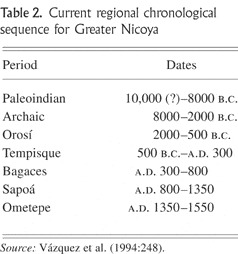
Subsequent research by these and other researchers helped to refine the Greater Nicoyan chronological sequence, although no radiocarbon dates from Nicaragua per se were published until the 1970s (Haberland 1978; Healy 1974, 1980), despite excavations in the Rivas area and on Lake Nicaragua's Ometepe Island by Gordon Willey and Albert Norweb in 1959–1961 and by Wolfgang Haberland and Peter Schmidt in 1962. By the early 1990s, additional research and a growing database of more than ninety radiocarbon dates—primarily based on work in Costa Rica and compiled and reported by Ricardo Vázquez and colleagues (1994:248–250)—contributed to the adoption of a revised and renamed chronological sequence for Greater Nicoya (Vázquez et al. 1994:248; Table 2). From a Postclassic standpoint, the most significant change in the periodization was the shift of the transition between the Middle and Late Polychrome periods (now the Sapoá and Ometepe periods, respectively) from approximately a.d. 1200 to 1350. As a consequence, ceramics that were originally assumed to be diagnostic of the Late Polychrome period were therefore now treated as being diagnostic of a period beginning 150 years later.
Current regional chronological sequence for Greater Nicoya

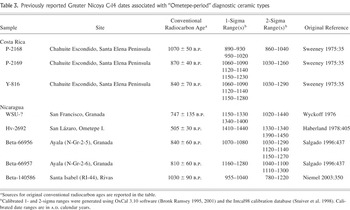
While the C-14 data reported by Vázquez and colleagues (1994) appears to justify extending the end of the Sapoá/Middle Polychrome period from a.d. 1200 to a.d. 1350 (cf. Haberland 1978: 408), the assignation of many “late”-period ceramic types to a period starting after 1350 is not well supported by the same data. This seems rather paradoxical inasmuch as the stratigraphic relationship between these ceramics and white-slipped “Sapoá-period” polychromes excavated from numerous contexts in both Nicaragua (e.g., Healy 1980; Niemel 2003; Salgado Gonzalez 1996) and Costa Rica (e.g., Baudez et al. 1992; Lange 1996; Sweeney 1975) seems to imply a clear temporal relationship. However, supposed Ometepe-period diagnostic ceramic types appear to have been typically found in contexts associated with C-14 dates that also connect these types to the Sapoá period—a factor that appears to have been overlooked when the periodization was revised and of which we were unaware when we began work at Santa Isabel. This was the case, for example, for the well-dated contexts from the site of Chahuite Escondido on Costa Rica's Santa Elena peninsula excavated by Coe, where three dates associated with late-period diagnostic types were similar to dates recovered from stratigraphically deeper, “Middle Polychrome period” contexts (Sweeney 1975:35). It was also the case for the San Francisco site at the northern end of Lake Nicaragua, where most recovered polychromes were late-period diagnostics (Vázquez et al. 1994:250; Wyckoff 1971; Table 3). In fact, at the time that the periodization was revised, only a single C-14 date from the Ometepe period (Hv-2692 from the San Lázaro site on Ometepe Island; Haberland 1978:405, 1992:109–110) could be definitively associated with a ceramic type (Madeira Polychrome) considered to be diagnostic of that period.1
With regard to five additional “Ometepe-period” dates reported in Vázquez et al. 1994, we consider three dates from the La Bocana cave site (Baudez 1967:24) to be problematic because the only Ometepe-period diagnostic ceramics recovered consisted of two sherds in the surface collection. All of the ceramic material from actual excavations of this site dated to the Zoned Bichrome period (also known as the Tempisque period, 500 b.c.–a.d. 300). Two other dates could not be associated with Ometepe-period diagnostics ceramics at all. One of these, Hv-2669, from an Early to Middle Polychrome-period cemetery on Ometepe Island, was originally reported as “[m]uch too late; probably contaminated” (Haberland 1978:405). The other date is from a possible saltmaking station at Miramar on the Santa Elena peninsula in Costa Rica, where no decorated ceramics of any type were found (Stuiver and Deevey 1961:132).
For the purposes of this paper, we have excluded discussion of radiocarbon dates drawn from neighboring regions outside the boundaries of Greater Nicoya (such as the various Arenal-area dates reported in Vázquez et al. 1994 derived from Hoopes 1987), although we acknowledge that the use of such dates for cross-dating analogous materials has played (and will continue to play) an important role in refining the periodization of Greater Nicoya.
Previously reported Greater Nicoya C-14 dates associated with “Ometepe-period” diagnostic ceramic types


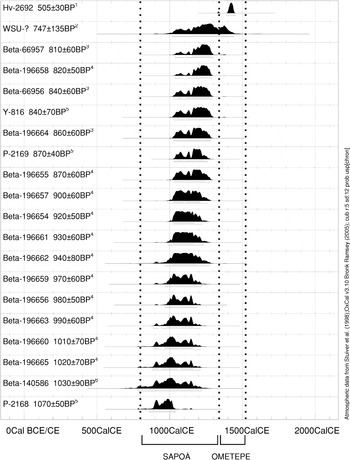
Greater Nicoya C-14 dates associated with “Ometepe-period” diagnostic ceramic types. Sources of C-14 dates: 1, San Lázaro, Ometepe Island; 2, San Francisco, Granada; 3, Ayala, Granada; 4, Santa Isabel, Rivas (University of Calgary project); 5, Chahuite Escondido, Santa Elena Peninsula; 6, Santa Isabel, Rivas (Niemel excavations).
Obviously, if ceramic types considered to be diagnostic of the Ometepe period actually date to the Sapoá period, the relationship between archaeological contexts from the two periods becomes obscured. In turn, this confounds attempts to understand cultural processes in Nicaragua during the Postclassic era, the focus of the Santa Isabel Project. As noted earlier, in Greater Nicoya the Postclassic is closely linked to ethnohistorical accounts of migrations from Central Mexico (discussed in Fowler 1989). The two most important incidences of migration that are typically assumed based on these accounts are an initial migration by Oto-manguean speakers (collectively known as the Chorotega) and a subsequent migration of Nahua speakers (including the Nicarao) several hundred years later. The timing of these migrations is a matter of some debate, and although ethnohistorical studies have made some contributions to solving this problem (e.g., Fowler 1989; Lothrop 1926), the migrations typically have been linked to the accepted chronological sequence for Greater Nicoya (e.g., Vázquez et al. 1994). The beginning of the Sapoá period circa a.d. 800 is therefore often assumed to mark the arrival of the Chorotega, while the Ometepe period is associated with the arrival of the Nicarao. By extension, the Chorotega are also associated with the white-slipped ceramics that begin to appear at the beginning of the Sapoá period—especially Papagayo Polychrome in Nicaragua—while the Nicarao are associated with the Ometepe-period diagnostic types. Any suggested change in the dates associated with the appearance of these ceramics therefore has implications with regard to the timing of the migrations, assuming that there is a true correlation between ceramics and cultural groups. Changes in the dates will also have implications for the interpretation of sites where such ceramics are identified, such as Santa Isabel.
SANTA ISABEL PROJECT: BACKGROUND AND METHODOLOGY
Santa Isabel (RI-44) is located on the shore of Lake Nicaragua, north of the modern port town of San Jorge. It was first investigated in 1959 by Willey and Norweb, whose work in the Rivas region became the basis of a dissertation by Paul Healy (1974) that generated a volume (Healy 1980) that has become a cornerstone for subsequent research. A survey project conducted by Karen Niemel (2003) documented sites along the coast of the lake and found that Santa Isabel was the largest site in terms of area. It was dated to the Ometepe period based on ceramics from surface collections and limited excavations. As the likely site of Quauhcapolca in the Rivas area, Santa Isabel was therefore selected for a multiyear excavation project to investigate Mesoamerican contact and ethnicity (McCafferty 2004; McCafferty and Steinbrenner 2003; McCafferty, Fernández, and Steinbrenner 2002; McCafferty, Steinbrenner, Debert, Gibson, Ortega, and Zambrana 2004; Steinbrenner 2002).
Ethnohistorical accounts identify the Contact-era Nicarao as ethnically Nahua, the same linguistic group that included the Mexica and Tolteca of central Mexico and the Pipil of El Salvador (Fowler 1989; Hoopes and McCafferty 1989). Typically, Nahua cultural attributes recorded for the Nicarao by chroniclers included a common language, calendar system, and religious pantheon as well as ritual practices. Pottery—in particular, Vallejo Polychrome—presumed by art-history-oriented studies to be associated with the Nicarao (e.g., Day 1984; Lothrop 1926) has also been used to support claims for their Mesoamerican identity, although connections between Nicoya polychromes and the central Mexican “Mixteca-Puebla” art style have probably been overrated (cf. McCafferty and Steinbrenner 2005). The larger goal of the Santa Isabel project is to compare the material culture of the site with expectations derived from Mexican contexts in order to evaluate this hypothesized Nahua connection (McCafferty 2004; Steinbrenner 2002).
The Santa Isabel Project began in 2000. Excavations at residential loci at the site center have developed an extensive understanding of archaeological contexts, including architectural forms, site layout, and mortuary patterns, as well as a rich material culture. This provided a baseline of “Ometepe-period” culture. This database is then available for comparison with the ethnohistorically derived model for Nicarao culture, as well as for comparison with Nahua material culture from central Mexico where the migrants presumably originated.
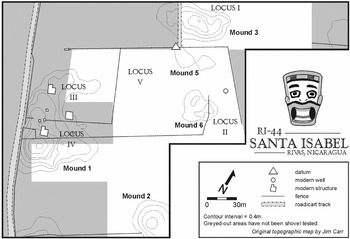
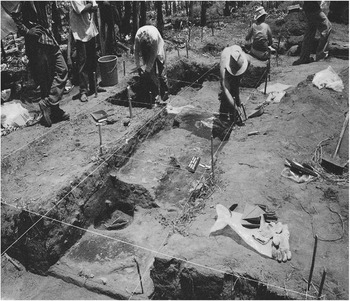
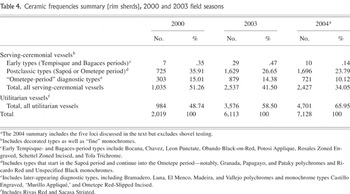
A 10-m grid of shovel tests was placed over approximately 6 ha of the site center, including mounds designated—following and expanding on designations given in Healy (1980:Figure 13)—as Mounds 1, 2, 3, 5, 6, and 7 (Figure 4). Five site loci have been tested more extensively, with 1- × 1-m excavation units that were often expanded for broad horizontal exposure (Figure 5). Soil matrix was screened through .5-cm wire mesh to recover small artifacts; soil samples were also collected and sifted through very fine screen for more careful recovery of tiny bones, seeds, beads, and so on. Outstanding preservation of organic materials allowed the recovery of fish and other small faunal remains, carbonized seeds, bone tools, and even a piece of a wooden weaving tool. A substantial percentage (10–15%) of the decorated ceramics corresponded to types established in previous research as diagnostic of the Ometepe period (Bonilla et al. 1990; Healy 1980; Vázquez et al. 1994), confirming the findings of earlier work at the site (Healy 1980; Niemel 2003; Table 4).

Santa Isabel Project, 2000–2004.

Excavations at Locus 1, Mound 3, summer 2004.
Ceramic frequencies summary (rim sherds), 2000 and 2003 field seasons

Locus 1 was located on and around Mound 3, which was identified but not tested by Willey and Norweb (Healy 1980:Figure 13). Mound 3 measures about 3 m in height, and stratigraphic testing indicated that it is made up of sequential deposition of cultural materials, including several superimposed floors. In 2000, several 1 × 1 m units were placed on and around the mound to identify the cultural sequence and search for possible architectural features. In 2004, we returned to expose the uppermost floor to get a broad horizontal exposure. A poorly preserved plaster-like floor was found, covered by remains of collapsed adobe from bajareque walls. A similar floor was found in a deeper level, indicating a sequence of reoccupation. As the only such floors found at the site to date, these floors may therefore represent a status or functional distinction.
Locus 2 included Mound 6, which was not recorded by Willey and Norweb (Healy 1980). It is also about 3 m in height at its westernmost end but slopes gradually to the east. Excavations in 2003 and 2004 concentrated on the eastern extension to explore a packed-earth floor and associated walls and a deeper floor and associated trash lenses. To the northeast of the mound was a depression that may represent a plaza between Mounds 3, 5, and 6. Two urn burials were found in this area.
Locus 4 included Mound 1, which was tested by Willey and Norweb (Healy 1980:52–55). In 2004, several operations were excavated at the top of the mound, just south and east of an existing house. A series of additional units were dug in a line extending to the south to profile that face of the mound. A floor and associated wall was found in Operation 3, and a rich midden deposit was found in Operation 2.
Excavations at two additional loci, 3 and 5, were more limited in scope. Locus 3 was an area of low artifact density that produced no C-14 dates and little material relevant to the present discussion. More notable in Locus 5 was a cluster of urn burials in an area with very low artifact densities according to the surface and shovel test survey. Nearly complete bowls of an unknown variety of Luna Polychrome, an Ometepe-period diagnostic type, were found covering the urn orifices. This area may represent an intrahouse zone with minimal disposal activity. A unit on Mound 5 (also included in Locus 5) encountered two primary burials in close association: an adult male and a child. The burials were found in an area of very high artifact density; no architectural features were encountered. Unfortunately, neither burial context was dated absolutely, and analysis of the ceramics associated with these contexts has yet to be completed. These contexts are therefore not included in the following discussion.
With this site context for background, the radiocarbon dates will be discussed with details of their precise archaeological contexts.
SANTA ISABEL RADIOCARBON DATES
Twelve carbon samples were processed by Beta Analytic, Inc., and it was reported that “each provided plenty of carbon for accurate measurement and all analyses went normally” (Darden Hood, personal communication 2004). Two of the samples received extended counting. All samples ranged between a.d. 890 and a.d. 1280 at 2-sigma calibration. The results will be reported by excavation locus, corresponding to Mounds 3, 6, and 1, respectively.
Locus 1, Mound 3
Three dates were recovered from Locus 1, Mound 3, collected during the 2000 and 2004 field seasons.
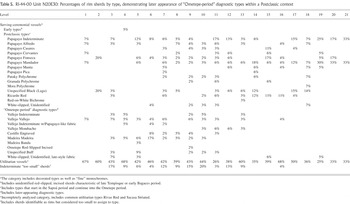
Sample 1 (Beta-196654) came from N20 E30, Level 9 and had a 2-sigma date of a.d. 1010–1230. This sample came from midway down a deep stratigraphic pit that ended at 2.2 m on the east side of Mound 3 (time constraints prevented further excavation to sterile soil). This pit demonstrated continuity from purely Sapoá-period diagnostic ceramics to strongly Ometepe-period diagnostics, with the Ometepe diagnostics beginning in Level 13 (Table 5). Level 9, from which Sample 1 was collected, contained sherds of the Ometepe-period diagnostic types Vallejo Polychrome, Madeira Polychrome, Castillo Engraved, and Ometepe Red-Slipped Incised and was therefore originally assumed to relate to an Ometepe-period deposit.
RI-44-00 Unit N20E30: Percentages of rim sherds by type, demonstrating later appearance of “Ometepe-period” diagnostic types within a Postclassic context

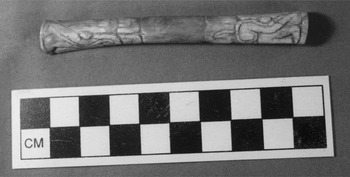
Sample 2 (Beta-196655) came from N21 E8, Level 3 and had a 2-sigma date of a.d. 1020–1270. This sample was derived from two large chunks of charred wood found on the plaster-like floor of the uppermost living surface and sealed beneath remains of collapsed bajareque walls. A beautiful carved-bone pendant was also found on this floor, featuring possible “feathered serpent” iconography reminiscent of the Mixteca-Puebla art style (Figure 6).

Carved bone “Mixteca-Puebla”–style pendant.
Sample 3 (Beta-196656) came from N30 E10, Level 10 and had a 2-sigma date of a.d. 980–1180. This sample came from another deep stratigraphic pit from the north side of Mound 3. The sample was associated with a nearly complete bowl of Madeira Polychrome, a diagnostic Ometepe-period ceramic type (Figure 7).

Madeira Polychrome bowl.
These three dates are consistent at the 2-sigma interval between a.d. 980 and 1270, a time frame that would better fit within the Sapoá period as currently interpreted. Since Samples 1 and 3 are from about the same depth and both come from the sides of Mound 3, it is reasonable to suspect that they relate to roughly contemporary periods of deposition (although the almost complete absence of soil changes or subsurface features at this locus that could be used to correlate nonadjacent units made this difficult to confirm), whereas Sample 2 likely pertains to one of the final phases of occupation, or even abandonment. Based on these data we might see Mound 3 first occupied before a.d. 1000—although probably not much earlier than a.d. 800 because of the presence of exclusively Sapoá period artifacts in the deepest levels of Unit N20 E30—and abandoned by about a.d. 1250 based on the late date of Sample 2.
Locus 2, Mound 6
Eight samples were dated from Locus 2, Mound 6, collected during the 2003 and 2004 field seasons. As with Locus 1, Locus 2 ceramics included a high proportion of Ometepe-period diagnostics (Table 4).
Sample 4 (Beta-196657) came from S10 E50, Level 4 and had a 2-sigma date of a.d. 1010–1260. This sample came from a pit dug in a low area to the north of Mound 6 and east of Mound 5, possibly representing a plaza of the mound group. Two “shoe-pot”-style burial urns were found, both containing infant burials. The carbon sample was collected at the base of the uppermost urn and above the rim of the lower urn (Figure 8). The Ometepe-period diagnostic types Castillo Engraved and Madeira Polychrome were also found in this level.

Urn burial, Locus 2, S10E50, 2003.
Sample 5 (Beta-196658) came from S60 E41, Level 4 and had 2-sigma dates of a.d. 1060–1080 and 1150–1280 (based on two intercepts). This operation was near the highest point on Mound 6. Level 4 featured a dark organic layer that extended across several units and into the adjacent sidewalls. The organic layer was immediately above what we interpreted as a compact walking surface. The Ometepe-period diagnostic types Vallejo Polychrome, Madeira Polychrome, and Castillo Engraved were found in this level.
Sample 6 (Beta-196659) came from S63 E51.5, Level 7 and had a 2-sigma date of a.d. 980–1200. The upper layers of this unit were removed in larger blocks; the Level 7 sample was actually recovered at 156 cm below datum and thus roughly at the same depth as Sample 7.
Sample 7 (Beta-196660) came from S62 E52, Feature 43 and had a 2-sigma date of a.d. 890–1180. This sample came from a 20-cm-thick sherd lens 130–150 cm below the surface and immediately above a walking surface with sherds embedded as if they were a feature of the floor construction. Although this was among the deepest levels yet excavated from Locus 2, there were Ometepe-period diagnostics (Madeira and Vallejo Polychrome and Castillo Engraved) in the sherd lens, implying cultural continuity with later deposits. Above the sherd lens, especially to the south, were layers of carbonized organic soil from which Sample 6 was collected and a lens of yellow/orange soil that possibly was the result of heating.
Sample 8 (Beta-196661) came from S70 E65, Level 9 and had a 2-sigma date of a.d. 1000–1240. This sample came from a well-preserved section of carbonized log about 8 cm in diameter that was associated with a dark carbon-rich soil stain that also featured burnt bone and shell. Level 9 was one of a series of superimposed organic stains possibly representing a cooking and/or discard area just northeast and downslope from relatively clean living surfaces that featured compact walking surfaces associated with bajareque walls.
Sample 9 (Beta-196662) came from S72 E60, Level 4 and had a 2-sigma date of a.d. 970–1260. This sample came from “soft” soil associated with an adobe wall immediately below the disturbed plow zone. It therefore likely represents a late phase of occupation and/or abandonment.
Sample 10 (Beta-196663) came from S73 E61, Level 6 and had a 2-sigma date of a.d. 960–1180. The sample was recovered from a possible walking surface and sealed beneath a layer of fallen adobe/bajareque. This structure was the most completely exposed from Mound 6 and is located to the east of the mound summit on a gradually sloping “ridge.” The walls and floors were first encountered in the 2003 season and then further explored in 2004. The packed-earth floor featured grayish clumps as inclusions, and a similar pattern was found in 2003's Operation 6, suggesting a possible extension to this structure over more than 10 m to the west.
Sample 11 (Beta-196664) came from S73 E68, Level 7 and had a 2-sigma date of a.d. 1030–1280. This sample came from the surface of a compact gray/brown walking surface with grayish mottling (similar to that described in Sample 10 but stratigraphically below it), and near a possible hearth.
These eight dates cluster between a.d. 890 and a.d. 1280 at the 2-sigma intervals, with the earliest date from the deep sherd lens (Sample 7) and the latest from the organic soil layer from the top of Mound 6 (Sample 5). They are all consistent with one another and overlap with the date range from Mound 3, indicating contemporaneity between the two occupation areas. Both of the deep samples (6 and 7) meet expectations as being among the earliest, but Samples 9 and 10 also had suspiciously early dates at the intercept point with the calibration curve (1040 and 1020, respectively). Because these two contexts probably relate to later architectural features, we suspect that the actual dates should fall toward the end of their 1-sigma ranges, post–1100. This would also place Sample 10 in better relationship with the second 1-sigma intercept of Sample 11 (i.e., a.d. 1150–1250).
Locus 4, Mound 1
A single carbon sample was recovered from Locus 4.
Sample 12 (Beta-196665) came from S82 W121, Feature 3 and had a 2-sigma date of a.d. 890–1180. This sample came from a thick sherd concentration located 80–100 cm below the surface. This sample is contemporary with the earliest dates found thus far at Santa Isabel. Overall, the artifact assemblage is very similar to that of the other loci investigated, although some interesting ceramic patterns hint at potential intrasite variability that will be investigated in future analysis.
DISCUSSION
The Santa Isabel C-14 database, when interpreted in the context of the larger Greater Nicoya database, leads us to some unexpected but inevitable conclusions.
Contrary to the indications of diagnostic ceramics, Santa Isabel may have been abandoned by the Late Postclassic period. Based on the dozen C-14 dates reported here—the largest database of C-14 dates so far reported for a single site anywhere in either Nicaragua or Greater Nicoya—the section of the Santa Isabel site under investigation appears to have been occupied between about a.d. 800 and 1250 (considering the deep, undated deposits from Mound 3). This time range significantly predates the currently accepted dates for the Ometepe period and, in fact, rather suggests an exclusively Sapoá-period occupation, despite the abundance of pottery previously considered to be diagnostic of the Ometepe period. It is therefore likely that the excavated portion of Santa Isabel—particularly, the well-dated areas of Mounds 3, 5 and 6—does not belong to the Ometepe period, as we originally assumed based on the diagnostic ceramics, and that it was abandoned well before the arrival of the Spanish. This in turn would suggest that the Nicarao ruler Nicaragua resided elsewhere—possibly in the immediate vicinity, in some other part of the large Santa Isabel site, or even in the neighborhood of San Jorge (RI-24), the second-largest archaeological site in the Rivas area identified by Niemel's survey (Niemel 2003).
Most Ometepe-period “diagnostic” ceramics are actually more indicative of Late Sapoá-period contexts. Our twelve dates are consistent with the seven dates from Chahuite Escondido, Ayala, San Francisco, and Santa Isabel summarized in Table 3 and Figure 3. Based on these nineteen dates now associated with so-called Ometepe-period diagnostic ceramics, it seems very clear that most of these “diagnostic” types are nothing of the kind, as they are consistently found (with the sole exception of the San Lázaro case) in contexts that can be dated to the Sapoá period. Obviously, this must change our perception of the Sapoá/Early Postclassic period in Nicaragua. For this period in Nicaragua, there are now far more dated contexts (fifteen) associated with Ometepe-period diagnostics than dated contexts that lack these diagnostics. In Nicaragua, only three dates from the Sapoá period—all of them from contexts on Ometepe Island—are not associated with Ometepe-period diagnostics (Table 6).
Nicaraguan Sapoá-period C-14 dates not associated with Ometepe-period diagnostics

We do not wish to imply that Ometepe-period diagnostics can be associated with the entire Sapoá period. As already noted, such an interpretation is contradicted by substantial stratigraphic evidence from Santa Isabel and other Nicaraguan sites that clearly indicates a relative chronological relationship in which “Sapoá-period” polychromes predate “Ometepe-period” diagnostics. Rather, we propose that the C-14 data, when interpreted in conjunction with this stratigraphic evidence, suggests that the presence of Ometepe-period ceramics is probably indicative of “Late” Sapoá-period contexts—perhaps starting circa a.d. 900–1000. The previously noted depositional patterns observed at Costa Rican sites further suggest that the Sapoá period may require redefinition for all of Greater Nicoya.
Naturally, redefinition of the Sapoá period will have important implications for the Ometepe period, as well. Does this mean that the ceramics formerly considered to be diagnostic of the Ometepe period actually do not extend into that period? Unfortunately, it is impossible to come to a definitive conclusion at present because (as we have noted) the small database of Ometepe-period C-14 dates from Greater Nicoya provides only a single date that can be clearly associated with an Ometepe-period diagnostic type. In light of the foregoing discussion, it is worth noting that Haberland (1992:110), the excavator of the site from which this date was obtained, did not consider this site as belonging to the Late Polychrome period. He preferred to think of it as “Late Middle Polychrome”—or, according to the current periodization, “Late Sapoá period.”
Assigning some former Ometepe-period diagnostics ceramics to the Late Sapoá period also raises the question of what kind of ceramics, if any, might then be considered truly characteristic of the Late Postclassic “Ometepe period.” While the lack of a database of well-dated Ometepe-period components makes this a difficult question to answer, previous work hints that some Ometepe-period diagnostic types actually do appear somewhat later than others and might therefore truly be considered diagnostic of the Ometepe period. Since Vallejo, Madeira, and Bramadero polychromes now seem to appear in the Late Sapoá period, good candidates for “true” Ometepe-period diagnostic types include Luna Polychrome and various polished monochrome types (including the Costa Rican types Murillo and Cuello Appliqué and their poorly defined Nicaraguan analogue Lago Black Modelled) that feature appliqué modeling and appear to be related to Castillo Engraved (Figure 9).

Potential “Ometepe-period” diagnostics. (a) Luna Polychrome, Alta Gracia variety; (b) Luna Polychrome, variety unspecified; (c) El Menco Polychrome; (d) Murillo Appliqué.
Haberland (1978:404, 1992:116) considered Luna Polychrome to be later appearing than Vallejo Polychrome and considered Luna Polychrome and Lago Black Modelled to be two markers of the final phase of pre-contact occupation on Ometepe Island (although he suggested an association with a non-Mesoamerican population). (Haberland's use of Castillo Engraved as a third marker of this final phase is disputed by the evidence from Santa Isabel.) Jeanne Sweeney (1975:398), following Coe's (1962) preliminary study, also suggests that Luna Polychrome postdates Vallejo Polychrome at Chahuite Escondido and argues for a late (and southern) origin for Murillo Appliqué (Sweeney 1975:400 ff; cf. Baudez and Coe 1962:368). Stylistically speaking, Luna Polychrome appears to “descend” from Madeira Polychrome (which this paper suggests is a Late Sapoá-period type contemporary with Vallejo Polychrome) and has been reported from burials containing Spanish trade goods (Lothrop 1926:194; but cf. Knowlton 1996:152). The facts that sherds of Luna Polychrome (and its close relative El Menco Polychrome, grouped with Luna in our preliminary analysis; cf. Bonilla et al. 1990; Knowlton 1992, 1996) were rare at Santa Isabel and found primarily in surface collections outside the area of primary excavation (as well as in potentially late Locus 5 mortuary contexts) somewhat support the identification of the type(s) as a late marker. However, the chronology of polished black ceramics at Santa Isabel, many of which do not appear to fit into established types, is less apparent based on preliminary studies. Future investigations will seek to evaluate the temporal placement of these types.
Correlating the Nicarao migration with the appearance of Late Sapoá-period diagnostic ceramics places the Nicarao arrival in the Early Postclassic period. As noted earlier, it is a common—one might even say traditional—hypothesis in Greater Nicoyan archaeology that the appearance of Mesoamerican migrant groups correlates with the emergence of certain diagnostic ceramic types. According to this practice, the findings presented here would suggest that the arrival of the Nicarao took place during the Early Postclassic rather than later—an interpretation contrary to prevailing opinions that tend to place the arrival of the Nicarao closer to a.d. 1200, immediately before the beginning of the Ometepe period (e.g., Constenla Umaña 1994; Vázquez et al. 1994).
However, if we reject the traditional hypothesis and accept that the possible correlation of Late Sapoá-period diagnostic ceramics with the arrival of Nahua speakers remains to be proved, then we must remain cautious about assuming that the new dates for the ceramic changes suggested here can provide much insight into the timing of the Nicarao arrival. In fact, Santa Isabel provides no strong reason to think that the diagnostics might be good markers of Nahua identity. With regard to the ceramics themselves, while some decoration on occasional Vallejo Polychrome sherds (and other classes of decorated artifacts) is suggestive of the Mixteca-Puebla style, most of the iconography on ceramics and other artifacts from the site is not particularly “central Mexican.” There is also no evidence of comals—typically an important utilitarian ceramic form in most central Mexican assemblages—or incense burners, key elements of Mesoamerican religious practice. Obsidian tools, trade items originating in Mesoamerica, are almost nonexistent, and there is little evidence of central Mexican-style architecture, particularly adobe construction and plaster floors. These factors in themselves cast doubt on our original hypothesis that the Santa Isabel site may have formed the nucleus of the Nicarao capital of Quauhcapolca (McCafferty et al. 2004), while the early C-14 dates call into question whether there was even an occupation in this area at the time of contact.
CONCLUSION
A suite of C-14 dates is now available for the Santa Isabel site, previously believed to date to the Ometepe period. With absolute dates ranging between about a.d. 900 and a.d. 1250, however, the “Ometepe-period” diagnostics now clearly fall within the time range usually designated as Sapoá. The immediate implication of these findings is that the existing ceramic sequence needs to be refined. Toward this end, we intend during the 2005 field season to identify potential areas with the late-period diagnostics suggested here to develop a comparable sample for analysis. Ideally, this sample will also include relevant carbon samples for absolute dating. When more dated assemblages have been analyzed, we expect to be able to propose a more accurate ceramic sequence for Postclassic Greater Nicoya.
A critical evaluation of existing chronologies is an essential step toward cultural reconstructions. The confusion over the local ceramic sequence has had more profound reverberations than simply false dating of sites. Since there has been a traditional connection between the decorated types and the ethnic identity of their consumers, this situation has affected interpretations of the migrations and relative occupations of the Greater Nicoya region. By clarifying the temporal affiliations of the different ceramic types, we are able to reevaluate the ceramics apart from their cultural connections. This will result in a more critical assessment of the cultural identity of the occupation of Santa Isabel unencumbered by the “pots equal people” paradigm that has heretofore dominated the literature.
RESUMEN
La región cultural llamada la Gran Nicoya es famosa en América Central por sus relaciones con Mesoamérica durante la época postclásica. Fuentes etnohistóricas describen el origen de grupos que han migrado, como los nicaraos y los chorotegas, hablantes de idiomas mesoamericanos y con algunos rasgos culturales similares a los del México central. Así las conexiones culturales están bien establecidas en la literatura histórica de la región. El Proyecto Santa Isabel, que inició en el año 2000, busca evidencias en la cultura material del sitio Santa Isabel, cerca del Lago de Nicaragua, para evaluar estas hipótesis de migración y las manifestaciones de identidad étnica.
Con base en estudios preliminares, Santa Isabel es reconocido como un centro regional en la época Ometepe, 1350–1550 d.C. dentro de la cronología establecida para la región. Después de tres temporadas de excavación hemos explorado cinco localidades del sector central del sitio, recolectando muestras de los Montículos 1, 2, 3, 5 y 6. El proyecto ha recuperado una extensa muestra de cerámica, lítica, restos faunisticos, y otros objetos de uso cotidiano asociados con contextos domésticos.
Un conjunto de 12 fechas de radiocarbono revelan un rango de ocupación entre 890–1280 d.C. (2-sigma). Este rango no coincide con la cronología de cerámica diagnóstica encontrada en el sitio, que deberia ser consistente con la fase Ometepe. Con base en estas nuevas fechas obtenidas continuamos con una re-evaluación de otras fechas publicadas para el área de la Gran Nicoya, ya que en realidad el complejo “Ometepe” de cerámica, posiblemente no incluye los tipos Madeira, Vallejo, Bramadero, y Castillo, que de acuerdo con nuestros resultados se sitúan en la fase Sapóa (800–1350 d.C). Hasta el momento, entonces, existe solo una fecha que claramente pertenece al postclásico tardío, y tentativamente sugerimos algunos rasgos culturales para esta fase, por ejemplo el tipo Luna Policromo.
En conclusión, los resultados del Proyecto Santa Isabel contradicen la cronología del postclásico en la Gran Nicoya, debido a que esta fase se relaciona con las migraciones históricas de ciertos grupos mesoamericanos. Los posibles cambios en la secuencia tendrían importantes implicaciones en la historia cultural de la región.
ACKNOWLEDGMENTS
The Santa Isabel Project has been made possible by funding from Canada's Social Sciences and Humanities Research Council, a University of Calgary Research Grant, and a University of Calgary Thesis Research Grant. Field investigations were conducted with permission of Nicaragua's Direction of Cultural Patrimony and were facilitated in collaboration with the National Museum in Managua and the Regional Museum of Anthropology in Rivas. The radiocarbon analysis reported here was done by Beta Analytic, Inc. in a timely and professional manner. Many scholars have contributed their time and advice to the project, particularly Karen Bruhns, Edgar Espinoza Pérez, Bill Fowler, Paul Healy, Fred Lange, Manuel Román-Lacayo, and Ramiro García Vásquez. Silvia Salgado, Jorge Zambrana, John Hoopes, Luvy Pichardo, and Karen Niemel helped conceptualize the project from the outset and continue as valuable contributors of ideas, unpublished data, and practical expertise. We are particularly grateful for the institutional collaboration with the Universidad Nacional Autónoma de Nicaragua through Jorge Zambrana and the Museo Regional de Rivas through Dr. Ramon Valdez and Dr. Jaime Marenco.
Over the duration of the project various staff members have helped make it a success. Special thanks to Rejane Boudreau Rojas, Jim Carr, Diana Carvajal, Jolene Debert, Ruth Edelstein, Deepika Fernandez, Denise Gibson, Alissa Lamb, Shawn Morton, Marco Ortega, and Citlalli Reynoso Ramos. Sharisse McCafferty has played an essential role in training students as well as monitoring excavations and aspects of the analysis. Numerous students have also participated in the project, including students from the University of Calgary, the Universidad Nacional Autónoma de Nicaragua, and the Escuela Nacional de Antropología e Historia in Mexico City. Help with the Spanish translation of the Resumen was provided by Alejandra Alonso and Diana Carvajal.
Finally, profound thanks to the people of Tolesmaida, who have helped with the field work and opened their homes and hearts to project members, and to Johana, Mario, and the rest of the staff of the Centro Integral de la Vida y la Tecnología, who have taken such good care of us over the past five years. We hope that by recovering glimpses of Nicaragua's past we can, in part, repay so much kindness.
References
REFERENCES
Baudez, Claude F.
1967
Rechèrches archéologiques dans la Vallée du
Tempisque, Guanacaste, Costa Rica.
Travaux et Memoires de l'Institut des Hautes Etudes de
l'Amerique Latine 18.
Institut des Hautes Etudes de l'Amerique Latine,
Paris.
Baudez, Claude F., and
Michael D. Coe
1962
Archaeological Sequences in Northwestern Costa Rica. In
Acta, 34th International Congress of Americanists (Vienna
1960), pp.
366–373.
Baudez, Claude F.,
Nathalie Borgnino,
Sophie Laligant, and
Valérie Lauthelin
1992
Papagayo: Un hameau précolombien du Costa Rica.
Editions Recherche sur les Civilisations,
Paris.
Bonilla, L.,
M. Calvo,
J.V. Guerrero,
Silvia Salgado, and
Frederick W. Lange (editors)
1990
La Cerámica de la Gran Nicoya.
Vínculos
13(1–2):1–327.Google Scholar
Bronk Ramsey, C.
1995
Radiocarbon Calibration and Analysis of Stratigraphy: The OxCal
Program.
Radiocarbon
37(2):425–430.Google Scholar
Bronk Ramsey, C.
2001
Development of the Radiocarbon Program OxCal.
Radiocarbon
43(2A):355–363.Google Scholar
Coe, Michael D.
1962
Costa Rican Archaeology and Mesoamerica.
Southwestern Journal of Anthropology
18:170–83.Google Scholar
Coe, Michael D., and
Claude F. Baudez
1961
The Zoned Bichrome Period in Northwest Costa Rica.
American Antiquity
26:505–15.Google Scholar
Day, Jane Stevenson
1984
New Approaches in Stylistic Analysis: The Late Polychrome Period
Ceramics from Hacienda Tempisque.
Ph.D. dissertation,
Department of Art History, University of Colorado,
Boulder.
Fowler, William R., Jr.
1989
The Cultural Evolution of Ancient Nahua Civilizations: The
Pipil-Nicarao of Central America.
Civilization of the American Indian Series, Vol. 194.
University of Oklahoma Press,
Norman.
Haberland, Wolfgang
1978
Lower Central America. In
Chronologies in New World Archaeology, edited by
R.E. Taylor and
C.W. Meighan, pp.
395–430.
Academic Press,
New York.
Haberland, Wolfgang
1992
The Cultural History of Ometepe Island: Preliminary Sketch (Survey
and Excavation, 1962–1963). In
The Archaeology of Pacific Nicaragua, pp.
63–117.
University of New Mexico Press,
Albuquerque.
Healy, Paul F.
1974
Archaeological Survey of the Rivas Region, Nicaragua.
Ph.D. dissertation,
Department of Anthropology, Harvard University,
Cambridge, MA.
Healy, Paul F.
1980
Archaeology of the Rivas Region, Nicaragua.
Wilfred Laurier University Press,
Waterloo, ON.
Hoopes, John
1987
Early Ceramics and the Origins of Village Life in Lower Central
America.
Ph.D. thesis,
Department of Anthropology, Harvard University,
Cambridge, MA.
Hoopes, John W., and
Geoffrey G. McCafferty
1989
Out of Mexico: An Archaeological Evaluation of the Migration Legends
of Greater Nicoya.
Paper presented at the 54th Annual Meeting of the Society for
American Archaeology,
Atlanta.
Knowlton, Norma E.
1992
Ancient Mortuary Ceramics from Nicaragua: A Study of Luna
Polychrome.
M.A. thesis,
Department of Anthropology, Trent University,
Peterborough, ON, Canada.
Knowlton, Norma E.
1996
Luna Polychrome. In
Paths to Central American Prehistory, edited by
Frederick W. Lange, pp.
143–176.
University Press of Colorado,
Niwot.
Lange, Frederick W.
1996
The Bay of Salinas: Coastal Crossroads of Greater Nicoya.
In
Paths to Central American Prehistory, edited by
Frederick W. Lange, pp.
119–141.
University Press of Colorado,
Niwot.
Lothrop, Samuel Kirkland
1926
Pottery of Costa Rica and Nicaragua.
2 vols.
Museum of the American Indian, Memoir No. 8.
Heye Foundation,
New York.
McCafferty, Geoffrey G.
2004
Buscando a los Nicaraos: La arqueología de etnicidad en Santa
Isabel, Rivas, Nicaragua. Paper presented at the 5th Congreso Centro
Americana de Antropología, Managua, Nicaragua.
McCafferty, Geoffrey G., and
Larry Steinbrenner
2003
N-RI-44-00, Informe Preliminar.
Report submitted to the Dirección de Patrimonio
Cultural,
Managua, Nicaragua.
McCafferty, Geoffrey G., and
Larry Steinbrenner
2005
The Meaning of the Mixteca-Puebla Stylistic Tradition on the
Southern Periphery of Mesoamerica: The View from Nicaragua. In
Art for Archaeology's Sake: Style and Material Culture across
the Disciplines, edited by
Andrea Waters-Rist,
Christine Cluney,
Calla McNamee, and
Larry Steinbrenner.
Proceedings of the 33rd Annual Chacmool Conference, University
of Calgary,
in press.
McCafferty, Geoffrey G.,
Deepika Fernández, and
Larry Steinbrenner
2002
Santa Isabel Revisited: Preliminary Excavations at a Late Period
Site in Rivas, Nicaragua.
Paper presented at the 67th Annual Meeting of the Society for
American Archaeology,
Denver.
McCafferty, Geoffrey G.,
Larry Steinbrenner,
Jolene Debert,
Denise Gibson,
Marco Ortega, and
Jorge Zambrana
2004
The Nahua Way? Preliminary Interpretations of Ethnic Identity
Strategies from Domestic Contexts in Santa Isabel, Nicaragua.
Paper presented at the 69th Annual Meeting of the Society for
American Archaeology,
Quebec.
Niemel, Karen
2003
Social Change and Migration in the Rivas Region, Pacific Nicaragua
(1000 b.c.–A.D. 1522).
Ph.D. dissertation,
Department of Anthropology, State University of New York,
Buffalo.
Norweb, Albert Holden
1961
The Archaeology of the Greater Nicoya Subarea.
Ms. on file, Peabody Museum of Archaeology and Ethnology.
Harvard University,
Cambridge, MA.
Norweb, Albert Holden
1964
Ceramic Stratigraphy in Southwestern Nicaragua. In
Actas y memorias 35th International Congress of Americanists
1:551–561.Google Scholar
Salgado González, Silvia
1996
Social Change in a Region of Granada, Pacific Nicaragua (1000
b.c.–1522 A.D.).
Ph.D. dissertation,
Department of Anthropology, State University of New York,
Albany.
Steinbrenner, Larry
2002
Ethnicity and Ceramics in Rivas, Nicaragua, A.D.
800–1550. M.A. thesis,
Department of Archaeology, University of Calgary.
Stuiver, Minze, and
Edward S. Deevey
1961
Yale Natural Radiocarbon Measurements VI.
Radiocarbon
3:126–140.Google Scholar
Stuiver, Minze, and
H. van der Plicht
1998
Editorial Comment.
Radiocarbon
40(3):ii–xiii.Google Scholar
Stuiver, Minze,
P.J. Reimer,
E. Bard,
J.W. Beck,
G.S. Burr,
K.A. Hughen,
B. Kromer,
G. McCormac,
J. van der Plicht, and
M. Spurk
1998
INTCAL98 Radiocarbon Age Calibration, 24000–0 cal b.p.
Radiocarbon
40(3):1041–1083.Google Scholar
Sweeney, Jeanne W.
1975
Guanacaste, Costa Rica: An Analysis of Precolumbian Ceramics from
the Northwest Coast.
Ph.D. dissertation,
Department of Anthropology, University of Pennsylvania,
Philadelphia.
Talma, A.S., and
J.C. Vogel
1993
A Simplified Approach to Calibrating C14 Dates.
Radiocarbon
35(2):317–322.Google Scholar
Vázquez, Ricardo L.,
Frederick W. Lange,
John W. Hoopes,
Oscar Fonseca Z.,
Rafael González R.,
Ana C. Arias,
Ronald T. Bishop,
Nathalie Borgnino,
Adolfo Constenla U.,
Francisco Corrales U.,
Edgar Espinoza P.,
Laraine A. Fletcher,
Juan V. Guerrero M.,
Valérie Lauthelin,
Dominique Rigat,
Silvia Salgado González, and
Ronaldo Salgado G.
1994
Hacia futuras investigaciones en Gran Nicoya.
Vínculos
18–19:245–277.Google Scholar
Wyckoff, Lydia L.
1971
A Suggested Nicaraguan Pottery Sequence Based on the Museum
Collection.
Museum of the American Indian, Indian Notes 58.
Heye Foundation,
New York.
Wyckoff, Lydia L.
1976
The Role of Northwestern Nicaragua in the Relations between
Mesoamerica and the Greater Nicoya Sub-Area.
M.A. thesis,
Department of Anthropology, Wesleyan University,
Middletown, CT.
Current regional chronological sequence for Greater Nicoya
Previously reported Greater Nicoya C-14 dates associated with “Ometepe-period” diagnostic ceramic types
Greater Nicoya C-14 dates associated with “Ometepe-period” diagnostic ceramic types. Sources of C-14 dates: 1, San Lázaro, Ometepe Island; 2, San Francisco, Granada; 3, Ayala, Granada; 4, Santa Isabel, Rivas (University of Calgary project); 5, Chahuite Escondido, Santa Elena Peninsula; 6, Santa Isabel, Rivas (Niemel excavations).
Santa Isabel Project, 2000–2004.
Excavations at Locus 1, Mound 3, summer 2004.
Ceramic frequencies summary (rim sherds), 2000 and 2003 field seasons
RI-44-00 Unit N20E30: Percentages of rim sherds by type, demonstrating later appearance of “Ometepe-period” diagnostic types within a Postclassic context
Carved bone “Mixteca-Puebla”–style pendant.
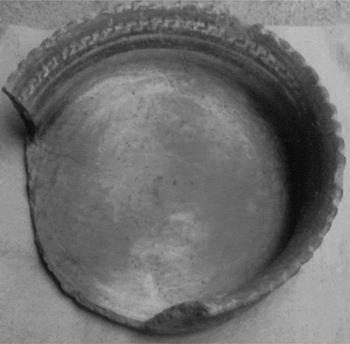
Madeira Polychrome bowl.
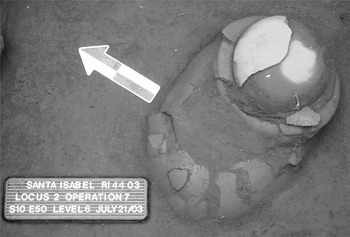
Urn burial, Locus 2, S10E50, 2003.
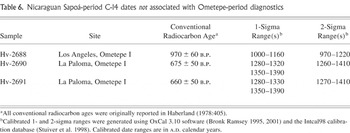
Nicaraguan Sapoá-period C-14 dates not associated with Ometepe-period diagnostics
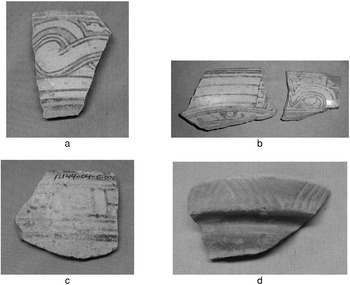
Potential “Ometepe-period” diagnostics. (a) Luna Polychrome, Alta Gracia variety; (b) Luna Polychrome, variety unspecified; (c) El Menco Polychrome; (d) Murillo Appliqué.
 You have
Access
- 12
- Cited by