Secrets of nature and of art have long proven politically useful to the competitive world of politics.Footnote 1 Ancient paradigms of politically important secret knowledge of nature included Solomon's legendary lost studies of nature, the Emerald Tablet of the philosopher-king Hermes Trismegistus, and the pseudo-Aristotelian Secret of Secrets, which according to legend allowed Alexander to extend his empire over the world.Footnote 2 Pamela Long has shown how, following the invention of guns, the political utility for war of the mathematical arts, mining and metallurgy encouraged the authorship of treatises on these subjects in the fifteenth century. The elevation of what had been craft secrets to the level of an authored text granted them an expanded readership and a greater epistemic status, she argued.Footnote 3 The sixteenth-century extramural professors of secrets studied by William Eamon had also implied that knowledge of nature was power. In books of secrets, the art of serving in the court appeared right between the ‘art of perfume’ and ‘the merchant's art’ among other extramural crafts.Footnote 4
Despite such time-honoured links between politics and the secrets of nature and art, the scope, methods and ends relating natural knowledge to politics changed due to an empirical turn in the study of politics in the late sixteenth century. Writers on the newly fashionable ‘reason of state’ gathered arcana imperii (secrets of empire) out of the study of the Roman historian Tacitus.Footnote 5 They transformed the style of political counsel from idealized mirrors-for-princes to collections of useful particulars in the form of secrets. In their seemingly fusty commentaries upon ancient history, they urged the value of empiricism for the state.
This newly empirical politics, based on experiences collected through travel and art, has been compared to empirical turns in the study of nature and art. Jacob Soll has suggested that historians of science look to a cultural transition towards historicism to explain the empirical turn in the study of nature.Footnote 6 Peter Burke compared the collection of particulars in the new politics to other empirical practices of the sixteenth century, such as botany and astronomy.Footnote 7 The secrets of empire were also compared by writers of the time to the secrets of nature and art. As Arnold Clapmar, the seventeenth-century authority on political secrets, pointed out, secrets could be found not only in politics, but in theology, jurisprudence, business, painting, war, domestic affairs, mathematics, medicine and rhetoric.Footnote 8
The relationship between secrets of empire, of nature and of art did not leave secrets of nature and art unchanged. The secrets of empire, as exemplified in Tacitus' studies of Tiberius and Nero, entailed not just exclusive knowledge, as in the pseudo-Aristotelian Secret of Secrets, but also the strategic manipulation of knowledge. Francis Bacon defined the ‘Arts of State, and Arts of Life, as Tacitus well calleth them’, as that ‘Penetration of Judgment, as he can discerne, what Things are to be laid open, and what to be secretted, and what to be shewed at Halfe lights, and to whom, and whence’.Footnote 9 Due to the reason of state, prudence came to be redefined as a type of cunning.Footnote 10 Thus the study of arcana imperii stressed not only the empirical collection of knowledge as the basis of politics, but the clever management of that knowledge.
The value placed upon strategic thinking encouraged political writers of the time to look for roundabout, non-obvious sources of power. The metaphor of a political mine deployed by Botero, Bacon, Bornitz and Bernegger captured this new emphasis upon strategic knowledge. While an actual mine exemplified the collection of actual natural goods hidden deep within the bowels of the earth, there were above-ground mines, Botero argued, hidden in plain sight. These were the mines of industry and commerce from which, via the complicated interactions of global supplies and demands, more silver could be extracted than from the direct mining of nature.
The idea of the existence of a market abstracted from the actual marketplace in the local town square, which could be strategically manipulated and ‘mined’ to produce actual cash, might seem obvious to us today. Yet the global marketplace was anything but manifest before Giovanni Botero's idea of the ‘above-ground mine’. At the time, ‘economics’ referred not to the study of this abstract market, but to actual household management. The shift from domestic management to economic strategizing was so radical that Joyce Appleby characterized it as ‘Kuhnian’.Footnote 11
It was the cunning of reason of state which lead Giovanni Botero to identify whole new areas of knowledge to be strategically studied and manipulated beyond the arts of dissimulation and calculated cruelty exemplified by Tacitus' portrayals of Tiberius and Nero. The new economic focus Botero introduced to politics increased the utility of the older concepts of secrets of art and nature to politics. In an age of economic thought, the secrets of empire were not only analogous to, but also encompassed, natural and technological intelligence. Furthermore, the cunning ideas about knowledge management in which writers on reason of state specialized transformed the practices of collecting this intelligence.
The strategic collection of natural knowledge was of prime importance to economically oriented political writers such as Botero and his followers. In turn, such concepts also affected attitudes towards the philosophical study of nature. A politician such as Francis Bacon not only developed Botero's idea of the ‘above-ground mine’ in his political writings. He also brought this tactical thinking to his strategizing about information-collecting personnel for the study of nature.
The study of Bacon's philosophy has often of late been separated from his political thinking, and his political thinking has been differentiated from Continental ideas concerning Tacitism and the reason of state. More generally, Tacitism has been seen as opposed to new philosophies of nature. As Richard Tuck has argued, those seeking to understand and master nature ‘tried to make too great a break with the humanist culture of their age’. The future of political thought lay, rather, in ‘the emergence of a new kind of humanism, based on the unlikely figure of Tacitus’.Footnote 12 I hope to show that Tacitism was not divorced from new attitudes towards the study of nature. Rather, an ancient link between secrets of art, nature and empire became ever closer and more strategically pursued due to the political cunning encouraged by the study of Tacitus.
I will show first the role of the knowledge of nature and art in Botero's formulation of the ‘above-ground mine’ and in Bornitz's and Bacon's subsequent reiterations of this theme. I will argue that in the period the rhetoric of the Tacitean humanist was not seen as distinct from scientific rhetoric, but the style of Hippocratic aphorisms which became such a vogue for Tacitists also informed Bacon's aphorisms and essays in both politics and natural philosophy.
Tacitism was never divorced from the study of the real world; rather, the study of history was part of a two-part plan for the acquirement of political prudence which also included personal observation through methodical travel. Furthermore, commentaries upon Tacitus, particularly among the students of the international preceptor of Tacitus, Strasbourg professor Matthias Bernegger, often reveal surprisingly current discussions concerning industry, inventions and the idea of progress. Bernegger and his students saw themselves as novatores and praised other innovative thinkers such as Galileo and Bacon. In turn, the information collection techniques in which Tacitists specialized informed the natural, artisanal and political intelligence of individuals today considered ‘Baconian’, such as Samuel Hartlib. The viewpoint of an international Tacitean political practice can cast new light on the familiar features of utilitarianism, empiricism and maker's knowledge associated with Francis Bacon.
The above-ground mine of Giovanni Botero
An often underestimated thinker, Giovanni Botero reinvigorated the belief that knowledge is power. He developed an anti-Machiavellian reason of state based around the empirical collection of knowledge and its deployment in administration and industry.Footnote 13 Botero defined the reason of state in 1589 as information (notitia) concerning the ways to found, preserve and expand a constant dominion over a people.Footnote 14 Such an informed political practice showed, Botero contended, that dominion need not rest upon violence nor upon base Machiavellian deceptions. As Michel Senellart put it, Botero contrasted an economic view of the reason of state against an older military one, and the subsequent history of statist thought offered various combinations of these two competing political approaches.Footnote 15
Botero's reorientation of reason of state entailed a fundamentally different relationship between the state and knowledge of nature. According to Botero, the prince must learn about useful arts as well as a very long list of natural particulars, from the qualities of the soul to minerals, herbs, animals and meteors such as rainbows.Footnote 16 His best-selling geopolitical surveys of world, the Relazioni (1591–1598), encompassed not only political constitutions, national habits, resources and characteristics, but also the study of nature and its transformation through art. He offered a sample political study of nature and art in his ‘Relations on the Sea’, which included a project on how to freshen saltwater. It was appropriate to dedicate his ‘Relations on the Sea’ to Stanislaw Koscielecki, the governor of Marienburg, Botero said, due to Koscielecki's delight in the ‘notitia of nature’ and his role in the administration of Baltic Prussia, an area known for its Dutch-style engineering.Footnote 17
Botero's focus on the utility of industry elevated the status of crafts for politics. Subsequent seventeenth-century politicians could not afford to despise the craft knowledge of secrets, since they believed that political advantage rested upon it.Footnote 18 Art, however, was not only a tool for politics; it also presented a model for politics. There were some arts, said Botero, such as architecture, sculpture, painting and all those which made things out of wood, iron, wool and silk, which displayed a complete control over material. Practitioners were thus able to reach their intended ends, and realize their conceptions, within matter. Other arts, however, such as agriculture, navigation, medicine, politics and, above all, the military arts, lacked such a ‘complete dominion over matter’.Footnote 19 Botero's reason of state advised princes about how to act as a true head of state; that is, as an artisan displaying complete dominion over matter.
In a chapter ‘On industry’ originally printed in his 1588 On the Greatness of Cities, but also included in his 1589 On the Reason of State, Botero stressed both the utility and the exemplarity of industry through an analysis of mining and manufacture. In an iron mine, humans drew raw material out of the earth, and this matter could then be increased in value through art. Likewise, the state might also learn to act as an artist, and use art to draw forth wealth from its own subject matter, people. Because art surpassed nature, political mining could far outstrip actual mines in its moneymaking potential.
Why an iron mine? The lands of the Duke of Savoy, one of Botero's patrons, did not abound in gold or silver, but they were rich in iron.Footnote 20 The base metal of those hard Alpine rocks did not seem a likely competitor to the glittering silver fleet sailing home to Spain. Although it seemed counterintuitive, Botero suggested that an iron mine could compete with a mine of silver not in the value of its ore, but in the money it could produce if properly linked with diverse sources of revenue. True riches did not come from nature alone, but from the canny ways man perfected nature and increased its value.
‘The reuenew gotten out of the Iron Mynes, is not the greatest’, wrote Botero,
But of the proffit that is drawen out of the worke, and vpon the trade and traffique thereof, a number of people liue and are maintained; such I meane, as digge it out of the Myne, scowre it, melt it, forge it, cast it, sell it by whole sale, or by retayle … In somuch as he that should compare the reuenews the owners reape of their Iron Mynes, with the proffit the Artificers draw out of the workemanship thereof, and the merchants with their Industrie (and hereof the Princes are mightely enriched also, by the custome that growes vpon it) shall finde, that Industrie and Art exceedeth Nature far … At a word, such a wealth there is in Art and Industry, that neither the mynes of Siluer, nor the mynes of gold in Noua Hispania nor in Peru, can be compared with it. And the custome of the merchandize of Milan, bringes more mony to the king of Spaines cofers, than the Mines of Zagateca and of Salisco.Footnote 21
Botero's analysis of seemingly negligible sources of revenue revealed staggeringly unexpected effects. The envied natural resources of the greatest overseas empire, he suggested, did not equal the customs tax on a single European industrial center. The true power of the Spanish Habsburgs lay in exported manufactured goods, not in imported American natural resources. Italy, France and especially Flanders all lacked significant mines, yet through ‘inestimable Art and Cunning … There was not a Country throughout all Europe, neither more rich, nor more inhabited’ than Flanders. That was why Flanders was called ‘the Emperor's Indies’. Savoy, if managed carefully as an industrial center like Flanders, could compete after all with the mountains of silver in the New World.
The perfecting of nature undergirded the above-ground mine on several levels. In the New World, nature produced precious metals out of matter, and those metals were mined by man. In the above-ground mine of Flanders, man produced profitable works of art from nature, and the state mined precious metals from those men in the form of taxes and other revenue streams. Thus the process of perfecting nature did not end with the artificer. To the above-ground mine, the artisans and merchants served again, as it were, the role of the natural commodity. The population of miners, forgers, casters and merchants could be further cultivated and refined by the tender attentions of political miners as they artfully achieved a complete dominion over their material.
Botero himself pointed to the centrality of perfective views of nature in his analysis of industry. Referring to a long-standing rivalry between art and nature, he claimed that art surpassed nature due to its perfective ability. ‘Nature bringeth forth her formes in Materia prima: And mans Art and cunning, worketh upon the naturall compound, a thousand kindes of naturall formes. For, nature is to the workeman, the same, that Materia prima is to the natural agent’.Footnote 22 If nature gave birth to the precious metals found in mines, the artisan fashioned these metals into innumerable new objects filling an even richer mine for the state to exploit.
The mine of revenue drawn from industry and trade might not exist in any obvious location, and in that sense it was even more hidden than an actual mine. The gold filling the imperial treasury from the ‘Emperor's Indies’, however, was all too real. Cunning political miners could locate such above-ground mines in order to perfect the mines of nature, turning base iron into gold.
Botero's mine in the political thought of Jakob Bornitz and Francis Bacon
Botero's ingenious conception of an above-ground mine was quickly imitated by other political writers who shared his perfective view of nature. A jurist and imperial councilor at Schweidnitz under Emperors Rudolf and Matthias, Jakob Bornitz repeatedly developed Botero's idea of the above-ground mine. Bornitz introduced the idea of the ‘reason of state’ to German-speaking lands in his On Acquiring Political Prudence of 1602. He equated prudence with the true (i.e. anti-Machiavellian) reason of state collected by a political artisan (artifex politicus) through both history (including natural history) and experience.Footnote 23
In a 1608 work, On Coins, Bornitz drew on Botero's idea of the above-ground mine. Bornitz described how manufacturing goods served as ‘the oblique way’ to get silver from the New World.Footnote 24 One could travel overseas and dig silver up, or, using the instrument of the reason of state, one could sell domestic manufactures to the Spanish and acquire New World silver in a more artful way. In his chapter ‘On producing an increase of coins in a Republic’, Bornitz developed these views at length. There were two ways of producing an abundance of coins: either direct mining or the importation of coins. The latter was the true mine of princes. This was due to the ever-increasing ability of mankind to perfect nature, so that art often seemed to surpass nature (‘ut saepè ars naturam superare videatur’). The riches accruing to Milan, the Netherlands, Nuremberg and China due to art were proof of this. Rather than directly mining nature for coins, man could increase the value of nature by shaping raw material into infinite new forms to sell abroad to other peoples always eager for novelties.Footnote 25
The very divisions of Bornitz's lengthiest work, On a Sufficiency of Things of 1625, demonstrated the importance he placed on improvement upon nature through industry. The first section dealt with agriculture, hunting and mining (fifty pages), the second with mechanical arts (172 pages), and the third with trade (seventeen pages). The final section devoted only six pages to administration, although Bornitz promised to expand this discussion into a second volume, On Conserving a Republic (alas Bornitz died before its appearance).Footnote 26
Bornitz explained that in using the term ‘mechanical arts’ (in which he included the arts of design, such as painting and architecture) he intended no disrespect. The status of the mechanical arts should be determined by their utility for civil and military life alone. The ways many German princes displayed their control over matter through ivory-turning showed how noble and useful the mechanical arts could be. Bornitz portrayed the status granted to art and manufactures at the Rudolfine court as the fulfillment of a cutting-edge, statist political theory promoting the mastery of nature through art.Footnote 27
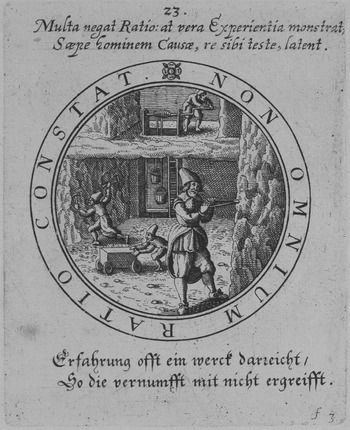
Bornitz encapsulated his central ideas concerning the importance, for the political artisan, of innovation, art, empirical discovery and an open mind in a posthumously published emblem book.Footnote 28 The oddness of these emblems drew on the esoteric nature of emblematic culture to suggest the wide horizon of possibility provided by art's perfective ability and the ways that cunning could find roundabout means to reach desired ends. One man walking on the surface of water wearing winged trousers (p. 88), another writing with his toes (p. 90), an alchemical distillatory (p. 94) and a glass workshop (p. 98) all showcased the ability of art and practice to surpass nature. Reason alone could not determine possibility or impossibility. Miners prising jewels from the mine walls (Figure 1) showed that ‘reason denies many things which experience shows to be true’.
Jakob Bornitz, Emblematum Sacrorum et Civilium miscellaneorum, Heidelberg: Clement, Ammonius, 1659. Herzog August Bibliothek Wolfenbüttel, H: P 545a.4° Helmst. (3):2.

In following oblique routes, politicians imitated a secretive nature. Botero suggested using ‘a secret art’ to reach political ends rather than a magnificent show of force, just as nature leads pines and cedars to the greatest heights insensibly.Footnote 29 ‘Oblique courses’ rather than ‘direct methods’ were, according also to Francis Bacon, the most effective means in politics.Footnote 30 Like Bornitz, Bacon also developed Botero's idea of the mine of industry, which allowed the state to acquire wealth in roundabout ways. ‘Worke, and Carriage, is more worth, then the Materiall, and enricheth a State more; As is notably seene in the Low-Countrey-men, who have the best Mines, above ground, in the World’, he said.Footnote 31 The ability of the Emperor's Indies to provide more silver from trade and manufacture than Spain gained through its New World mines became a commonplace.Footnote 32
Bacon's mines: from politics to natural philosophy
In The Advancement of Learning, Bacon extended the idea of an above-ground mine from politics to natural philosophy. Like Botero, he drew upon the perfective ability of art to support the metaphor.Footnote 33 He said,
If then it bee true that Democritus sayde, That the truthe of Nature lyeth hydde in certaine deepe Mynes and Caves; And it bee true likewise, that the Alchymists doe so much inculcate, That Vulcan is a second Nature, and imitateth that dexterouslie and compendiouslie, which Nature worketh by ambages, & length, It were good to devide Naturall Phylosophie into the Myne and the Fornace, and to make two professions or occupations of Naturall Philosophers, some to bee Pionners, and some Smythes, some to digge, and some to refine, and Hammer.
While philosophical miners sought causal knowledge or ‘Naturall Science’ deep within the recesses of nature, philosophical smiths further refined nature through art, to produce the effects of nature again in the above-ground mine of what Bacon termed, in an analogy with political prudence, ‘Naturall Prudence’.Footnote 34 The miner collected information, and the smith used that information to achieve, as Botero would say, a dominion over matter.Footnote 35
Bacon's link between operative natural philosophy and political prudence at this juncture owes much to Botero. Botero had already politicized natural knowledge, and matter theory had already shaped his view of political prudence. Both Botero and Bacon explored how the perfective arts allowed man to act as a ‘second Nature’, while political cunning encouraged him to look for knowledge in new places.
Bacon's writings are, of course, rich in metaphor. The hunt for causal knowledge within a mine can be likened to the ‘epistemology of the hunt’ so central to Bacon's view of secrets, according to William Eamon.Footnote 36 In its important links with Botero and the perfective manipulation of metals, however, the mining metaphor brings to the surface certain characteristics of Bacon's view of knowledge particularly well.
One of the benefits of the mine, argued Botero, was the way it integrated many different individuals, increasing the population of cities and thus the opportunities for wealth through taxation and other incidental profit-making. To Botero, the revenues of the single owner of the mine were negligible compared with the diverse professions tangentially supported by the mine. Likewise, Bacon stressed a multiplicity of professions, and the integration of diverse types of people in the project of knowing and perfecting nature. Yet although the mine integrated the work of many within a larger institution, it did not necessarily make the work of each known to others or to the public at large. The mining metaphor demonstrates how Bacon's conception of research could be collaborative without being public through the clever articulation of social structures for knowledge.
Bacon's simultaneously collaborative and secretive view of research is most pronounced in his New Atlantis. The staff of information collectors in Salomon's House gathered material through travel, books and personal experience. Disguised Merchants of light ‘adopting the names of other Nations (for our own we conceal)’ sailed to foreign lands and brought back books, abstracts and experiments. Pirates or ‘Deprepators’ (sic) collected experiments out of books. ‘Mystery-men’ collated the secrets of various arts and professions, while ‘Pioneers or Miners’ tried out their own experiments. All this information was then methodized by ‘Compilers’. The fellows of Salomon's House carefully consulted about which works to publish and which ‘to keep secret: though some of those we do reveal sometimes to the state and some not’.Footnote 37
This was where Bacon's mining metaphor diverged from Botero's. Bacon's ultimate end was not the state, but knowledge, and thus he imagined an arena of research free from both the public and the state. Bacon hoped to make the ‘Spyalls and Intelligencers of Nature’ semi-independent of the spies of state, even if he expected both to rely upon the same source of funding.Footnote 38 Despite the vaunted public nature of Baconianism, it was not publicity which differentiated Bacon's plans for intelligencers from the collectors of arcana imperii. Botero, Bornitz and Bacon all envisioned miners collecting valuable nuggets from hidden spaces; only Bacon, however, imagined some of those nuggets remaining hidden in a shadowy corporation separate from both the state and the people.
Broken knowledge in politics and science: bringing together Baconian science and Tacitism
Botero's metaphor of the above-ground mine could be found in the political writings of both Bornitz and Bacon, as well as in Bacon's philosophical writings. This metaphor links both Bacon's philosophical thinking to political models, and his political models to international writers on the reason of state. Both these links contradict some current views. Bacon's political thinking has been differentiated sharply both from contemporary reason of state and from his own natural philosophy. Markku Peltonen, drawing in large part on Bacon's essay ‘On the true greatnesse of kindomes and estates’, distinguished between Bacon's politics (a Machiavellian republicanism intended for a time of war) and his apolitical plans for learning in times of peace, exemplified by his philosophical writings such as An Advancement of Learning.Footnote 39
Peltonen's points about not assuming coherence in Bacon's thought are well taken. However, the flexible reason of state was supposed to adapt to differing circumstances. Botero had drawn an influential distinction between the different arts needed to found, preserve and extend an empire.Footnote 40 The Flemish humanist Lipsius also advised that violence was necessary in times of war, but knowledge was needed for peace.Footnote 41 According to the Palatine ambassador Hippolytus à Colli, peaceful (as opposed to military) prudence required the prince to know something about all the arts practised in his realm, as well as ethics, politics and even natural philosophy (physica) and mathematics.Footnote 42
In his 1623 expansion of the Advancement of Learning, Bacon also distinguished between three political duties belonging to the art of empire (which itself was but one of three different types of political prudence): ‘that a Kingdome or State be conserved’, ‘that it may become happy and flourishing’ and ‘that it may be amplified and the bounds thereof propagated and extended’. He included the essay ‘On the true greatnesse’, retitled ‘A Summary Treatise touching the enlarging of the Bounds of Empire’, as an example of the last.Footnote 43 This was not the same political knowledge Bacon would deploy, however, in order to make a state ‘happy and flourishing’.
Peltonen, while conceding that ‘some themes’ from Botero and Lipsius can be discerned in Bacon's writings, argued that ‘on the whole, his treatises on civic greatness should be understood as a highly critical reaction to these accounts’. For Peltonen, Bacon's references to the ‘principles of estate’ and to ‘true reason of state’ signaled Bacon's rejection of the reason of state of Botero and Lipsius, and his adherence to Machiavelli. However, Botero and Lipsius themselves cast their projects as part of a true reason of state. Rejections of a so-called ‘false’ reason of state associated with Machiavelli were legion across Europe. Such statements did not counter the reason of state, but supported a multifaceted political practice grounded in knowledge more than upon violence.Footnote 44
The distinction between Bacon's political and natural philosophical work is a symptom of a much wider historiographical divide. The rise of two allegedly contrasting cultures in the sixteenth and seventeenth centuries – late humanist Tacitean politics and experimental science – has been analysed in separate historiographies. Since arcana imperii appeared in the form of commentaries upon ancient historians, the collection of political arcana has been seen as a backwards-looking political practice that had little to do with the empirical study of the present or innovative attempts to transform the future.Footnote 45
‘State’, deriving from ‘standing’ (stare), implied that the reason of state largely concerned the idea of maintaining the status quo.Footnote 46 New ideas would perturb and trouble the state. As Bacon wrote in ‘On Innovation’, ‘It is good also, not to try Experiments in States; Except the Necessity be Urgent, or the utility Evident’.Footnote 47 However, if changes were to be made, Bacon recommended that they be radical, ‘For it is a Secret, both in Nature, and State; That it is safer to change Many Things, then one’.Footnote 48
Both the content of scientific writing and its form have been distinguished sharply from contemporary Tacitism and the reason of state. Stephen Clucas, for instance, once differentiated between the anti-Ciceronian, humanist use of aphorisms and Francis Bacon's scientific aphorism. The former, he argued, was a closed form privileging ancient knowledge, while Bacon's aphorism pressed forward in an exploration of things rather than words.Footnote 49
More recently, Hubert Treiber drew a similar distinction between Richard Cumberland's scientific interest in the real world and the Strasbourg historian Matthias Bernegger's inability to escape his bookish viewpoint. Treiber cited Bernegger's edition of Galileo (1635) where Bernegger discussed the changes in the topical method in his time, and described how Galileo's telescopic observations allowed him to make the ‘places’ argument capable of proof. According to Treiber, Bernegger differentiated himself from Galileo as ‘a disciple of a different kind of proof’. The ‘text-bound’ viewpoint of Matthias Bernegger, ‘a card-carrying Tacitist’, ‘imprisoned’ him ‘in his conventional manner of thought’.Footnote 50
Bernegger gave no evidence of distancing himself from Galileo. In fact, in his preface to another translation of Galileo over twenty years earlier, Bernegger developed at length the reasons why mathematics, despite the contempt in which it was held by many, ought to be considered central to the study of politics. It was the practical rather than contemplative parts of mathematics which were important for the politician, whose job it was to collect knowledge useful and necessary for the public good.Footnote 51
Tacitism was not opposed to the empirical study of nature, art and trade. Nor, despite being conducted in Latin, was the study of Tacitus opposed to the vernacular and to new literary forms. In his defense of the German vernacular, Martin Opitz, Bernegger's student, cited Tacitus and the history of invention to show that the moderns could compete with the ancients.Footnote 52 As Morris Croll and Joseph Levine have pointed out, it was not English science which originated the broken, exploratory style of the aphorism and the essay, but the international vogue for Seneca and Tacitus.Footnote 53 Francis Bacon's vernacular aphorisms and essays, like Montaigne's, fit easily within the Tacitean political culture which by the turn of the seventeenth century was well established in England, as elsewhere.Footnote 54
The political aphorism itself was originally drawn from medicine. Those who offered counsel to the body politic were not only often themselves doctors. They also frequently compared the reason of state to medical knowledge found in aphorisms adapted to particular cases.Footnote 55 The rhetoric of politics circa 1600 was that of broken pieces of empirical knowledge, with a preference for res over verba.Footnote 56
For instance, rather than offering a beautifully polished image of the ideal polity as in older humanist political oratory, Justus Lipsius descended below the level of the finished text in his influential Politica to compose a flexible patchwork of ‘places’ taken from ancient historians which could be employed in almost any political situation.Footnote 57 Bernegger's student, the Strasbourg professor Johann Heinrich Boeckler, specified that most of the ‘places’ Lipsius used were intended as information, not as rhetorical ornament.Footnote 58 Such informative places were gathered in open-ended ‘questions, observations, digressions, dissertations, and political or historico-political discourses’. This method, ‘if the term method can even be applied’, said Boeckler's student, the Jena professor Johann Andreas Bose, was employed by Tacitean commentators and, among other authors, by Bacon in his Essayes.Footnote 59
Another Bernegger student, Christoph Colerus, equally esteemed Bacon among the novel writers on politics, and he was not alone in doing so; Bacon's essay, the Smith of Fortune (Faber fortunae) was particularly popular.Footnote 60 To Bacon's Continental readers, the Smith of Fortune appeared as a useful extension to the already extant literature on the arcana imperii. The Dutch Cartesian, Brandenburg counsellor and professor at Frankfurt an der Oder Martin Schoock included an excerpt from Bacon's Smith of Fortune in his 1668 expansion of Clapmar's by-then-classic On Secrets.Footnote 61
To modern historians, the integration of Bacon's writings into the Continental political rhetoric of the period has sometimes appeared astonishing. David Halsted, noting Christoph Colerus's treatments of Bacon's Smith of Fortune, remarked that ‘Colerus saw in a “project unburdening Western philosophy of its dependence on authority” a source of lessons in political prudence’.Footnote 62 To Halsted, this seemed like an inventive misreading rather than evidence that Bacon's Smith of Fortune was not that distinct from other essays on political prudence. To Bacon's early modern Continental readers, however, his writings fit easily with the newly fashionable political genres of secrets, aphorisms and essays.
History, the mother of prudence: Bernegger's above-ground mine
Those seeking political prudence found it in the empirical study of art, nature and empire. Empiricism, however, came in two forms: travel and history. Neither was intended to function on its own. Experience, or ‘notitia of human things, through sight and touch’, was the father of Prudence, and Memory, or the ‘notitia of examples, through hearing or reading’, was its mother.Footnote 63 Reason of state included both the Tacitean commentary and the personal collection of particulars through learned travel (the ars apodemica).
The political study of Tacitus was never divorced from knowledge of and action within the real world. Anthony Grafton, Lisa Jardine and William Sherman have shown how pragmatic readers of ancient and modern history sought practical knowledge for political ends.Footnote 64 Kevin Sharpe has studied how one early Stuart reader, Sir William Drake, read as a ‘gatherer’ actively searching for secrets to collect out of writers such as Tacitus, Guicciardini, Botero, Machiavelli, Bornitz and Bacon.Footnote 65
In the second half of the seventeenth century, humanistically trained historians and librarians had to integrate an increasingly technical body of natural and technological knowledge into their practices of information collection, and they cut their teeth on the reading of Tacitus.Footnote 66 Bernegger and his student Boeckler, and Boeckler's student Bose, were renowned as information collectors and bibliographers. Boeckler, for instance, advised Hermann Conring and the politician Johann Christian von Boyneburg on how to form an archive; it was also in travel that one collected the secret relazioni of foreign ambassadors which formed the riches (opes) of any government archive, he said.Footnote 67The German Princely State (1656), the work of another student of Bernegger, the politician Veit Ludwig van Seckendorff, was widely read as a guide for how to use such information collections in concrete political practice.Footnote 68
If Bacon fit with Tacitism, Tacitism also furnished information-collecting tools to individuals conceived of today as Baconians. The London-based Prussian intelligencer Samuel Hartlib especially admired Bernegger's information-collection techniques. Although ostensibly a commentary upon a single ancient author, Bernegger's Miscellaneous Questions upon Tacitus was in fact more like an encyclopedia, he said. Hartlib debated the merits of Bernegger's ‘invention’ of the miscellaneous question with his correspondent, the Brandenburg political agent Joachim Hübner.Footnote 69 Hübner was himself experimenting with using the miscellaneous question in his study of Tacitus.Footnote 70 They both admired the indices composed by Bernegger and Freinsheim for their 1638 editions of Tacitus, and Hübner praised Bernegger's way of composing notes on difficult places in the text.Footnote 71
Although deeply learned, Bernegger's Tacitism was still geared towards the real world. In politics, one had to think about realia and forget the ‘verbalia of the scholastics’, Hübner told Hartlib. Any child could select sententiae and phrases out of authors, but really getting behind arcana Politica and, as it were, making Tacitus speak (‘Tacitum loquentem’) was another matter, in which Bernegger truly excelled. Hübner himself had collected over five hundred political, moral and military aphorisms out of the first three books of Tacitus alone.Footnote 72 ‘After the sacred scriptures, there is no book, I believe, which can better inform one about prudence for human life’ than Bernegger's edition of Tacitus, he said.Footnote 73
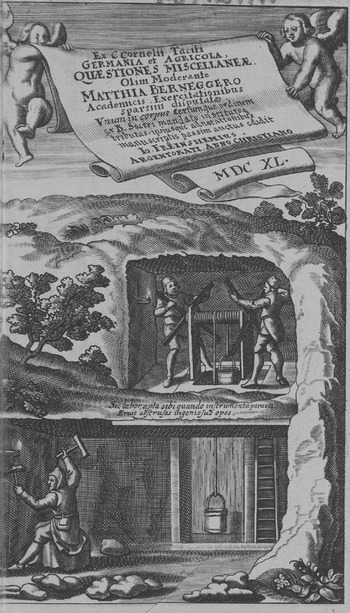
Bernegger's Miscellaneous Questions appeared in 1640, edited by Bernegger's son-in-law and student Johann Freinsheim. A scene of miners on the title page (Figure 2) exemplified how ingenious work could excavate hidden treasures when supplied with the right instruments. It was Tacitism that supplied the textual technology with which a generation of politicians dug for valuable information.
Matthias Bernegger, Quaestiones Miscellaneae, Strassburg, 1640. Herzog August Bibliothek Wolfenbüttel, M: QuN 581 (1).

Travel, the father of prudence
Besides reading history, the aspiring seventeenth-century political artisan was expected to practise the art of methodical travel codified by the Swiss Theodor Zwinger in the sixteenth century.Footnote 74 Jakob Bornitz set methodical travel as a centrepiece of his political ‘art’ (1602). In addition to the query lists of Zwinger, he suggested that the ‘political artisan’ might survey naturalia, medica and mechanica.Footnote 75 Matthias Bernegger drew heavily on Bornitz for his Discourse on Travel of 1619.
In countering the suggestion that books about foreign lands might replace travel, Bernegger cited Bornitz to show that a ‘journey is considered to surpass history in experiences [experimentis] and certainty. Those things depending on a historical source should be confirmed by one's own senses in travel’.Footnote 76 Yet the advancement of knowledge gained through empirical travel was still supported by the study of Tacitus. Answering his question on Tacitus, ‘Why Germany is much more fertile and cultured now than in the past’, Bernegger credited the art of travel, ‘which was not as common among the ancients’, with ‘having much advanced the culture of Germany’.Footnote 77
Boeckler, in another Tacitean dissertation, wove in a strenuous argument for the modern study of mathematics, art and inventions as a preparation for travel. How else would the traveller be able to converse with the likes of Galileo, Kircher, Mersenne and Gassendi? How could anyone hope to truly understand the secret workings of the Republic without an inner knowledge of manufactures? Just as one cannot see the little bodies from which everything is composed without a microscope, so too one cannot understand the complicated fabric and hidden links of society, which lie secreted from plain view, without first preparing the mind through the knowledge of art. For Boeckler, the reason of state depended upon a body of secrets of nature and art collected beneath the surfaces of things.Footnote 78
Artistic, natural and political intelligence in England
Thomas Palmer was one of several Englishmen, including Bacon, who sought to bring the Continental practice of the ars apodemica to an English reading public in the early seventeenth century. To Palmer, the knowledge of ‘draughts of nature, kept secret from the vulgar sort’, was a premier ‘point of knowledge’ to be aimed for in travel.Footnote 79 Melanie Ord has also pointed to the attitudes shared between the ambassador Henry Wotton and Bacon in collecting knowledge through travel.
Ord suggested that Wotton anticipated the ‘approbation of those English ambassadors abroad’ voiced by Thomas Sprat, historian of the Royal Society. Such ambassadors collected, according to Sprat, ‘Relations, and Secrets of Nature, as well as of State’. Ord proposed that Wotton's use of aphorisms may have been related to Bacon's preference for the ‘unsystematic and incomplete nature of aphoristic writing … diametrically opposed to a humanist wish for an early-instituted and strictly maintained educational programme’.Footnote 80
The attitudes of both Bacon and Wotton do not oppose the political culture of their time in anticipation of future science. Rather, they both relate to the reason-of-state-influenced late humanism. Reading Bacon's Novum Organum, Wotton saw its author as the most ‘inward a secretary’ of Nature's ‘cabinet’.Footnote 81 For Wotton, such natural intelligence was part and parcel of political practice. As Wotton described to Prince Henry, ‘having a long love of philosophy, and from the contemplative part being slid into the practical’, he desired to ‘entertain your Highness now and then with some experiments, especially such as do not end in wonder, but reach to public use’. He began ‘this kind of intelligence’ with a ‘secret’ ‘not long since imparted to this State [Venice] … namely, a way how to save gunpowder from all mischance of fire in their magazines’.Footnote 82
In the seventeenth century, Henry Wotton was seen as an ideal collector of secrets from both ancient history and travel. The State of Christendom, a collection of arcana imperii gathered from both ‘Modern observations’ and ‘many ancient passages’, was printed and attributed to Henry Wotton in 1657. This work, including an analysis of the works of Antonio Perez (also known as Rafael Peregrino, the double agent and friend to the Bacon brothers), has more recently been attributed to Anthony Bacon.Footnote 83 Yet Wotton, like Bacon, was also a pragmatic reader for the Earl of Essex, for whom he also read and analysed Perez's scandalous collection of political secrets, the Relations.Footnote 84 The interests of Bacon and Wotton in the study of nature does not prove that they flew high above the heads of either bookish humanists or dirty spies, but that political and natural intelligence mixed, thus eliding ‘the functions of information gatherer and spy’.Footnote 85
English networks of pragmatic readers and political agents were fully informed of contemporary Continental reason of state. For example, Elizabeth's spymaster, Francis Walsingham, sent Robert Ashley of the Middle Temple abroad, as Ashley later wrote, to ‘acquire political prudence’ (‘prudentiam politicam comparandam’).Footnote 86 Ashley gathered a very extensive collection of Continental literature, including Bornitz's On Acquiring Political Prudence of 1602, his On Coins of 1608, and an impressive array of alchemical literature, which remains today in the Middle Temple library.Footnote 87
The increasing prominence of agents with artistic qualifications or expertise in the decades following Ashley was one effect of art's new utility and exemplarity for politics. In Bacon's time, these agents included Philipp Hainhofer, Peter Paul Rubens, Jean de Montfort, Cesare Scaglia, Pieter Spierink, Endymion Porter, Theodore Mayerne and Balthazar Gerbier.Footnote 88 Such agents often drew on their travels and international networks in the collection of political, artistic and natural secrets.
For instance, the Huguenot physician Theodore Mayerne had composed a manuscript account of his grand tour in 1599, and published a youthful travel guide to France, Germany, Italy and Spain.Footnote 89 As Trevor-Roper has pointed out, Mayerne's later famous collection of artistic methods (Sloane Ms. 2052) was of a piece with his lifelong habit of collecting chemical and industrial knowledge. Within it he referred back to artistic practices he had observed in his youthful travels.Footnote 90
Such agents cast artistic, natural and political knowledge as ‘secrets’ useful for politics. Late in his life, the international agent and artist Balthazar Gerbier reflected upon the political nature of methodical travel. The ‘main end of Travell’ ought to be the ‘Interest’ of one's ‘Native Country’. Through both one's own ‘improvement’ and ‘in the opening the Secrets of State’, one ought to ‘returne (well fraughted) with necessaries as may serve to Posterity’.Footnote 91
Gerbier himself, he argued, was qualified to act as an agent due to his ‘seuerall languages, good hand in writing, skill in sçiences, as Mathematicks, Architecture, drawing, painting, contryuing of scenes, Masques, shows and entertainments for greate Princes, besides many secrets which I had gathered from diuers rare persons’.Footnote 92 Such secrets, for Gerbier, included political, military, chemical, natural-philosophical, artistic and industrial knowledge. In a 1654 manuscript collection, Gerbier cast ‘Drawing, Geometry, Military Architecture, Perspective, Cosmography, Geography, Miniature Painting, Architecture, and experimental natural philosophy’ all as ‘secrets useful to Princes and Peoples’.Footnote 93
Gerbier's network of ‘rare persons’ included fellow artists such as Rubens and Van Dyck, also members of Mayerne's extensive network of Huguenot and Flemish artisanal informants. Both Gerbier's collection of secrets and Mayerne's massive manuscript archives could be compared to the similar archives of their contemporary intelligencer, Samuel Hartlib. According to Trevor-Roper, the difference between Hartlib and Mayerne was one ‘of personality, not of policy’.Footnote 94 Gerbier and Hartlib did in fact collaborate.Footnote 95 Despite differing political and religious sympathies, Mayerne, Gebier and Hartlib shared the practice of political, natural and artisanal intelligence.
Like Mayerne and Gerbier, Hartlib intermingled the search for secrets of art, nature and politics in travel. He recommended that one travel furnished with ‘addresses and directions How to observe or get the Traditional Histories and other mysteries of State and Policy, The Excellent Artificers, Experiments, Projectors, etc’.Footnote 96 The plans he worked out with John Dury for an ‘agent’ and ‘intelligencer’ to negotiate a union between the Christian churches also always included on the side the aim of collecting ‘all rare and profitable M.S., secrets, and inventions, of all sorts, both in Sciences, and Artifices’.Footnote 97 The combination of the collector of secrets of science, art and politics (in this case church politics) was not unique to the religiously motivated intelligencers such as Hartlib. By the Interregnum, it was a model well established by previous political agents and Tacitist historians alike.Footnote 98
Conclusion
My aim in drawing comparisons between Bacon's political and philosophical writings; between Bacon and other Tacitists; and between the secrets of art, nature and empire has been to link historiographies which have developed largely separately. The relationship between empirical turns in politics and the study of nature can contribute to narratives of the Scientific Revolution. It can also point to particular features of Bacon's project less manifest from the perspective of the history of science alone.
Bacon applied a mining metaphor both to an economically oriented politics and to the philosophical investigation of nature (1605). In this he was preceded by Botero (in 1588), whose redefinition of the reason of state was itself already shaped by philosophical ideas about the perfectibility of nature. Miners prising precious minerals from stone also appeared in the posthumously published works of Bornitz (1638) and Bernegger (1640), reflecting their view of political practice as the discovery of precious secrets in the above-ground mines of Tacitus and travel.
A comparison of Bacon's miners to those of Botero emphasizes the centrality of their perfective view of nature and its relationship to the investigation of hidden actions so important to the emergence of economic strategizing. The metaphorical mine exists because of the human perfective ability to fabricate a ‘second Nature’ which can serve as the ore of industry to be mined and refined in the above-ground mine. If nature was already secretive in producing mineral ore, humans also practised craft and cunning in producing art. And if real miners must work in an underground, technologically equipped collaborative to find nature's ore, both political and philosophical miners must use the tools of prudence to refine, administer and direct an even more oblique, although above-ground, resource. The mine also highlights the importance of a multiplicity of professions and poses the idea of collaboration without publicity. Indeed, Bacon's philosophical miners in the New Atlantis, protecting as they do their knowledge both from the people and from the state, appear even more secretive than the political miners of Botero.
While my aim has been to draw comparisons, and to point to comparisons drawn in the period, various types of secret and their role for these thinkers might also be differentiated. Of course, given the different religious and geographical identities of these writers, their political affiliations and ideals differed. Furthermore, although ideas drawn from the study of nature and art were formative for Botero and even more so for Bornitz, their ultimate goals remained political. And although political ideas shaped some of Bacon's philosophical ideas and formulations, his ultimate aim in The Advancement was epistemic.
Thus the balance of secrets discussed by Botero, Bornitz and Bernegger (and Bacon in his political writings) remains the more strictly political arcana imperii. Secrets of empire focus on simulation or dissimulation – that is, the fabrication of a reality – whereas secrets of art and nature suggest instead truths hidden not necessarily by falsehood, but by a less valuable or informative level of reality. Such differences, however, serve to highlight the peculiar importance of the mining metaphor in the context of other arcana imperii. The above-ground mine does suggest the ways that the search for a more valuable truth, like a secret of nature, can itself be a secret of empire precious enough to rival the New World mines of nature herself.
Collectors of political information raised the status of empiricism within nature and art. Far from mired in the past, Tacitists welcomed Bacon's views on the advancement of knowledge, which they saw as harmonizing with their own viewpoints. In turn, Tacitism also served as a useful tool of information collection for combined political and natural intelligencers with Baconian interests.
Closely printed Latin glosses on ancient history might seem retrogressive, yet within their commentaries upon Tacitus many debated the idea of progress.Footnote 99 As Bernegger wrote in his Miscellaneous Questions upon Tacitus, ‘I do not see why, once fruits have been discovered, we must feed on acorns, and why we must prefer the uncouth and rough simplicity of the ancients to the culture of our times’.Footnote 100 As Bose wrote in a Tacitean dissertation, ‘we cannot agree with those who think that the world of sciences has been so set and defined that nothing more can be added; On the Advancement of Learning of the most learned Verulam alone easily disproves that’.Footnote 101