INTRODUCTION
In Japan, cancer is the primary cause of death (about 30%), with about 300,000 people dying from it each year (Ministry of Health, Labour and Welfare Percentage, 2006). Assurance of end-of-life cancer care in Japan was established when “palliative care unit fees” were first incorporated in the treatment fees paid to medical institutions under the medical insurance system (Umeda & Iwasaki, 2001). Guidance and management fees for cancer patients living at home and treatment fees paid to medical institutions for home terminal cancer patients were also established under the medical insurance system. An “additional palliative care treatment fee,” for treatment in general hospitals by palliative care teams that meet given criteria, was further established in 2002 (Komoto, 2002). As a result, appropriate, ongoing palliative care is now available at all stages of the treatment of cancer patients, and a smooth transition of patients to palliative care units and home palliative care is expected.
The period immediately after discharge, that is, the week or two preceding the first outpatient visit, is fraught with various problems associated with the transition to home care (Okaya, 2000; Sakai, 2002). Providing information about emergency measures suited to the physical state of the patient, coordinating the many home medical care and welfare-related professional services, and assisting with complicated issues that increase the anxiety of patients and primary family caregivers (PFCs) are considered to be important (Okaya, 2000; Hakata et al., 2002). Few patients make the decision to “live at home until the end” during the initial period of home care, but it is reported that many talk it over with their families and make the decision when their living situation has become clear, between the end of the initial period and 1 to 3 weeks prior to death (Okaya, 2000). Thus, the extent to which the patient wishes to live at home and whether assistance that is consistent with the patient's wishes is given are necessary considerations in the home care process. Adequate assessment and support during the initial period of home care is of prime importance.
The levels of pain experienced by terminally ill cancer patients are a source of anguish for the patient's entire family (i.e., the family caring for the patient) (Tsuneto, 1999; Suzuki et al., 2001). It is presumed that the physical and mental state of PFCs is affected by the physical and mental state of the patient (Rossi Ferrario et al., 2003), and also that the desire of PFCs to provide home care, together with their perception of burden or of well-being and satisfaction with life, will affect the quality of life of the patient and the patient's willingness to continue living at home (Sawada et al., 2001). The finding that the stronger the wish of both patient and PFCs to continue home care the more likely it is that the patient will die at home (Schaapveld & Cleton, 1989; Ishigaki, 1998) suggests that taking into account the experience of not only the patient but also the family is vital to continuing home care (Kaye, 1999).
An understanding of the factors affecting terminally ill cancer patients' willingness to continue living at home during the period of transition from Clinical Cancer Centers (CCCs) to home care will permit the development of a concrete strategy for the improvement the home care environment, and this can be expected to raise retention rates. It will thus contribute to the overall improvement of the experience of palliative care for terminally ill cancer patients and their family members.
The objectives of this study were (1) To identify the current rate of willingness of terminally ill cancer patients to continue living at home after discharge from CCCs in Japan and and (2) to identify factors associated with the willingness of the patients to continue living at home.
METHODS
Sample
The subjects were terminally ill cancer patients discharged from CCC institutions and their PFCs. All approved of the study and participated voluntarily, and written consent was obtained. The eligibility criteria were (1) terminally ill cancer patient and the patient's PFCs, (2) aged 18 years or older, (3) free from impaired consciousness and psychiatric disorders, and (4) the physician in charge approved the patient's participation.
CCCs are hospitals and equivalent medical facilities in Japan engaged in research into and prevention, diagnosis, and treatment of cancer and other malignant neoplasms and holding seminars for health care professionals.
Study Samples
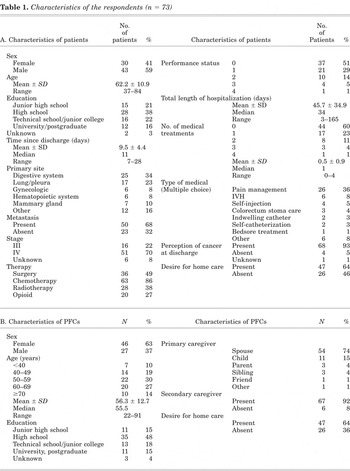
A total of 294 pairs of patients and PFCs were selected from 13 of the 27 CCCs that agreed to participate in the study. Then 143 eligible patients (49%) and 121 eligible PFCs (41%) returned their completed questionnaire. Of these, 59 patients and 37 PFCs were not eligible, and 11 patients and 11 PFCs expressed a lack of desire to participate in the study by return postcard. As a result, data from 73 pairs of patients and PFC (25%) were ultimately analyzed. Table 1 shows the characteristics of the patients and PFCs.
Characteristics of the respondents (n = 73)

Procedure
In September 2001, requests for participation in the study were mailed to all of the Japanese Association of Clinical Cancer Centers asking for their cooperation. The cover letter explained that the survey would be both confidential and anonymous. The CCCs were requested to supply the details of eligible patients. If the CCCs had had eligible patients during the study period, they selected all eligible patients ready for discharge after the study began.
Ethical Considerations
The study was conducted only after obtaining the approval of the Institutional Review Board of Kanagawa Cancer Center and of each institution. The subjects were informed in writing in the cover letter of the role of participants and of the procedures for ensuring privacy in the handling of data and protecting patient rights. Written consent was obtained prior to the commitment to participate and again at the commencement of participation. All data in the present study were rigorously managed by the researchers so as to ensure privacy.
Questionnaire
The questionnaire was developed based on a systematic literature review (World Health Organization, 1990; Nagae, 1998; Okamoto, 1998; Miyashita et al., 1999; Naylor et al., 1999; Nagae et al., 2000; Naylor, 2000; Ogata et al., 2000) and on pilot study interviews with several terminally ill cancer patients and their PFCs, two directors of home nursing stations providing terminal cancer care, and four oncologists as well as on the experience of the investigators.
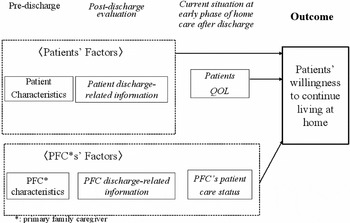
The researchers developed the framework of the study (Fig. 1). We proposed two groups of factors associated with the willingness of patients to continue living at home: patient factors and PFC factors. The former were divided into predischarge “patient characteristics,” which had been defined at discharge and could not be changed (or were difficult to change) by health care and welfare professionals, and “patient discharge-related information,” which was both documented and related to matters that occurred after discharge or could be altered by subsequent events. These data were normally used for postdischarge evaluation, in the wake of discharge assistance. PFC factors were related to the characteristics of PFCs.

Research framework of terminally ill cancer patients' and their primary family caregivers' willingness to continue living at home during the early phase of home care after discharge.
The study variables were grouped as follows:
- Patient sociodemographic variables (sex, age, education level).
- Patient clinical and functional variables: diagnosis; metastasis; stage; therapy undergone before discharge (surgery, chemotherapy, radiotherapy, etc); perception of cancer at discharge; number of medical treatments; performance status (Eastern Cooperative Oncology Group Performance Status; PS) scale (European Organization for Research and Treatment of Cancer, 1996), whose scores range from 1 to 4 (higher scores represent greater functional dependence); and presence or absence of patient desire for home care at discharge.
- Patient discharge-related information: patient relationship with PFCs; extent of gap between home care envisioned at discharge and reality; patient satisfaction with discharge care (eight items; five-point scale from “very unsatisfactory” (0) to “very satisfactory” (4): The total score of eight items was used as a single subscale in the subsequent analyses, due to good internal consistency (Cronbach's alpha coefficient = .91), a higher score indicating higher satisfaction with discharge care, within a possible range of 0–32); and stability of correspondence of reality to their image of living at home before discharge.
- Patient's quality of life: assessed using the subscales of the 27-item Japanese version of FACT-G (QOL). QOL consists of four domains: physical well-being (PWB, 7 items; range 0–28), social well-being (SWB, 8 items; range 0–32), emotional well-being (EWB, 5 items; range 0–20), and functional well-being (FWB, 7 items; range 0–28). Each response was calibrated using a five-point scale. Higher scores indicate higher levels of well-being (Cella, 1997).
- PFC variables: sociodemographic variables (sex, age, education level); relationship with patient; extent of gap between home care as envisioned at discharge and reality; presence or absence of other family caregivers; and satisfaction with discharge care. The same items as for patients were employed (Cronbach's alpha coefficient = .89).
- Characteristics of caregiver's support at the time the questionnaire was filled out (after discharge): eight items relating to the PFCs' perception of burden in their situation, such as arrangements for and information held relating to support available when there are changes in medical treatment, or whether respite care is utilized. Respondents chose one of five responses from “inapplicable” to “very applicable.”
- The patient's and the PFC's willingness, or not, to continue with living at home arrangements in the future.
Statistical Analysis
To determine the potential determinants of patients' willingness to continue living at home from the data, preliminary univariate analyses were conducted, as appropriate, using the unpaired t test, the chi-square test (Fisher's exact methods), and the trend test (Cochran–Armitage's trend test) for contingency tables with ordinal data.
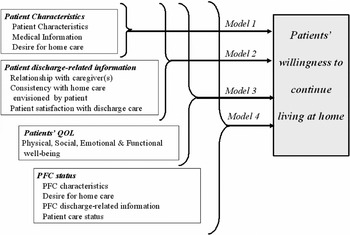
The next objective was to simultaneously explore the relationship to patients' willingness to continue living at home to the groups of items covering “patient characteristics,” “patient discharge-related information,” “patient QOL,” and “PFCs' status” (Fig. 2). After the univariate analysis, a hierarchical logistic regression analysis (backward elimination; p > .2), in four steps, was performed to extract the higher determinants of the patients' willingness to continue living at home: Model 1 consisted of “patient characteristics” alone; Model 2 consisted of Model 1 with “patient discharge-related information” added; Model 3 consisted of Model 2 with “patient QOL” added; and Model 4 consisted of Model 3 with “caregiver status” added. Data analyses were conducted using the SAS ver.8.2 statistical software package (SAS Institute, Cary, NC, USA). All p values were two-tailed and statistical significance was set at the p < .05 level.

Analysis model of factors related to patients' willingness to continue living at home during the early phase of home care after discharge.
RESULTS
Patients' Willingness to Continue Living At Home and Related Factors
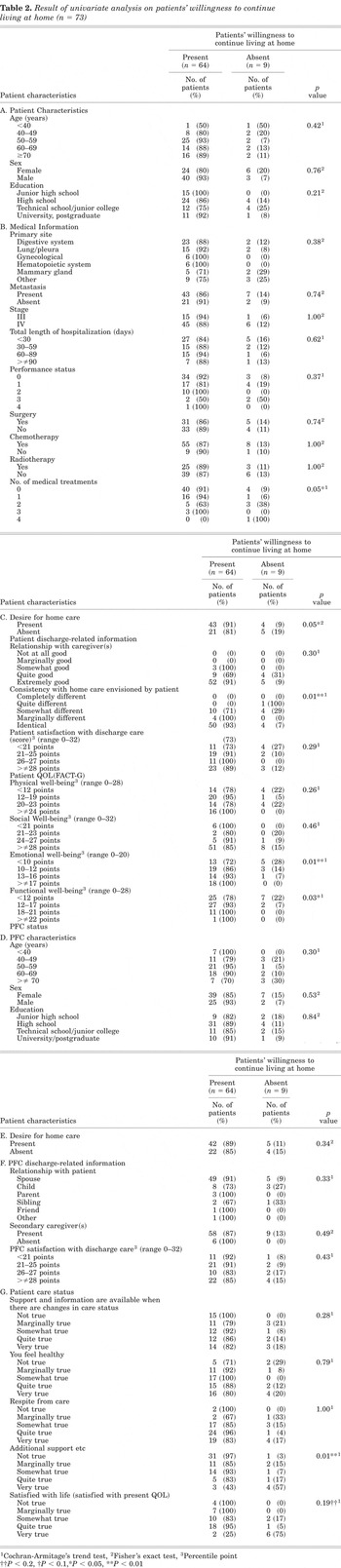
At about 10 days after discharge, 64 patients (88%) wished to continue living at home. The significance levels of the correlations between patients' willingness to continue living at home and patients' and PFCs' sociodemographic variables are shown in Table 2.
Result of univariate analysis on patients' willingness to continue living at home (n = 73)

The willingness to continue living at home was significantly lower in patients who underwent a larger number of medical treatments than in patients who underwent fewer treatments (p = .05). Patients who had desired home care at discharge also showed a significantly greater willingness to continue living at home (p = .05). The more consistent patients felt that their home care after discharge was as they envisioned it before discharge, the more willing they were to continue (p = .01). And finally, the higher the score for emotional well-being and the higher the score for functional well-being, the more willing patients were to continue living at home (p = .01 and p = .03, respectively).
Turning our attention to PFC variables, the fewer PFCs who expressed the need for further care-related support, the more patients responded that they were willing to continue living at home (p = .002). In addition, the higher the caregivers' satisfaction with life, the more willing patients tended to be to continue living at home (p = .19).
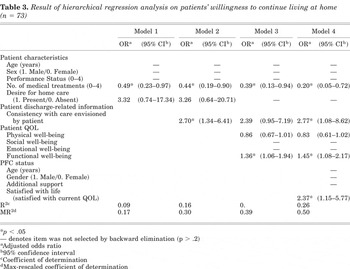
For variables that exhibited a significant correlation in the univariate analysis, a hierarchical logistic regression analysis was performed using age, sex, and four domains of QOL as independent variables (Table 3).
Result of hierarchical regression analysis on patients' willingness to continue living at home (n = 73)

In Model 1, the number of medical procedures undergone (OR = 0.49, 95% CI: 0.23–0.97, p < .05) was significant. In Model 2, the number of medical procedures (OR = 0.44, 95% CI: 0.19–0.90, p < .05) and the perception of consistency between care at home as envisioned by the patient and the reality (OR = 2.70, 95% CI: 1.34–6.41, p < .05) were both significant. In Model 3, the number of medical procedures undergone (OR = 0.39, 95% CI: 0.13–0.94, p < .05) and level of functional well-being (OR = 1.36, 95% CI: 1.06–1.94, p < .05), as a domain of patient QOL, were significant. The perception of consistency of care at home as envisioned by the patient and the reality (OR = 2.39, 95% CI: 0.95–7.19, p < 0.2) was no longer statistically significant in Model 3.
In Model 4, the significance of number of medical procedures (OR = 0.20, 95% CI: 0.05–0.72, p < .05) was low, the significance of perception of consistency of care at home as envisioned by the patient and the reality (OR = 2.77, 95% CI: 1.08–8.62, p < .05) was high, the significance of functional well-being (OR = 1.45, 95% CI: 1.08–2.17, p < .05) was high, and the higher the caregivers' satisfaction with life (OR = 2.37, 95% CI: 1.15–5.77, p < .05), the more willing the patient tended to be to continue living at home.
The model contribution ratios were 17%, 30%, 39%, and 50% for Models 1, 2, 3, and 4, respectively, increasing in order from Models 1 to 4.
DISCUSSION
In the present study, we investigated factors relating to the willingness of patients, early in the period of transition from CCC to home care, to continue living at home, in order to identify possible concrete support strategies for terminally ill cancer patients in this period of home care.
The Association between Characteristics of the Early Phase of Home Care and the Willingness of Terminally Ill Cancer Patients to Continue Living at Home
This study revealed that the physical and psychological burden caused by a large number of medical treatments and inconsistency between home care as envisioned and its reality were factors that made it difficult to accept the continuance of home care (Kaye, 1999). Another important finding is that care provided after discharge should be, as far as possible, consistent with that envisioned by patient before discharge.
Discharge services should address this aspect (Naylor et al., 1999, 2000; Naylor, 2000). Furthermore, the factor where the greater the patient's perception of functional well-being, the more likely are the functions of daily living to proceed smoothly was found to be associated with the desire to maintain the current home care.
The support of the caregiver is an essential part of home care, and it seems that patients are sensitive to the situation of the caregivers close to them and worry about their caregivers' well-being since it relates to their giving care at home. The caregivers' satisfaction with life appears to bolster the willingness of patients to continue home care.
In the present study, the model contribution ratios were increased by adding the variables of caregiver status to those of patient characteristics, indicating that the attitudes and well-being of caregivers are important factors in the willingness of patients to continue home care and should be taken into account.
Assistance during the Early Phase of Home Care of Terminally Ill Cancer Patients to Promote Its Continuance
Taking account of the caregiver's status is essential if appropriate assistance is to be given during the early phase of home care. Our results indicate that efforts to promote consistency between the care envisioned by the patient and its reality are important, as are measures to reduce patients' fears of difficulties resulting from medical treatments. Thus, there is a substantial need to improve discharge assistance and continuing care, for example, via outpatient counseling for both patients and caregivers (Naylor et al., 1999, 2000; Naylor, 2000).
The importance of the role of caregivers, who are in closest contact with patients, was confirmed by the finding that the level of satisfaction with life of caregivers is associated with the willingness of patients to continue home care. Therefore assessment over time and finding a place to discuss such matters as the feelings about their current lives, not only of patients but also of caregivers, is desirable.
Our results suggest that the following aspects of care should be considered in the development of high quality transitional care from CCCs to the patient's own home in Japan: tailoring a support system for cancer pain relief and other physical suffering, coordinating care with other medical facilities, explaining the medical condition to the patient, coordinating the patient/family relationship with regard to telling the patient the diagnosis, and coordinating the provision of welfare services such as nursing, equipment rental, and provision of home helpers.
We recognize that this study has several limitations. The percentage of valid responses was low. However, virtually no studies exist in which an equal number of responses have been obtained from terminally ill cancer patients and their caregivers (Rinck et al., 1997). In addition, this study was cross-sectional. Future work should measure changes in the willingness of patients to continue home care over time and to further elucidate factors affecting this outcome, such as changes occurring in the living environment during home care.
This is the first quantitative study of the transition period from CCC to home care experienced by both terminally ill cancer patients and their caregivers in Japan. An understanding of the factors that determine the willingness of patients to continue living at home is necessary for planning the support required for a smooth transition to care at home and for providing solutions to problems encountered by health care professionals who provide home care.
ACKNOWLEDGMENTS
We thank all participants and the staff of the Japanese Association of Clinical Cancer Centers (JACCCs) who made this study possible. We gratefully acknowledge the contributions of the medical doctors at JACCCs, who provided supervision and valuable support in accomplishing this study. The study was supported by a Grant-in-Aid for Improving District Cancer Care Facilities from the Japanese Ministry of Health, Labour and Welfare for Cancer Research (No. 12-1). Cooperating JACCCs were:
National Sapporo Hospital, Aomori Prefectural Central Hospital, Yamagata Prefectural Medical Center for Cancer and Lifestyle-Related Disease, Gunma Prefectural Cancer Center, Saitama Cancer Center, Cancer Research Hospital of the Japanese Foundation for Cancer Research, Tokyo Metropolitan Komagome Hospital, Kanagawa Cancer Center, Niigata Cancer Center Hospital, Fukui Medical Center for Adults, National Nagoya Hospital, National Kure Medical Center, and National Shikoku Cancer Center.