Introduction
The co-existence of medical conditions such as mental disorder (MD) and substance use disorder (SUD) is referred to as dual diagnosis, comorbidity, co-occurring disorders or multimorbidity (Brown Reference Brown2017). The term patient complexity is sometimes referred to describe the overall effect of the multiple disorders on the individual, based on their morbidity burden and other related factors (Valderas et al. Reference Valderas, Starfield, Sibbald, Salisbury and Roland2009). In this paper the term comorbidity is used for ease of reference.
Comorbidity may occur concurrently (disorders are present at the same time) or successively (at different times in an individual’s life) (Langås et al. Reference Langås, Malt and Opjordsmoen2011). Sometimes the causal relationship between two or more disorders can be easily identified, such as in the case of MD symptoms or disorders resulting from substance intoxication or withdrawal. However, sometimes it can be more difficult and challenging to establish this relationship. Three main hypotheses regarding the relationship between the comorbid disorders have been proposed: (1) the substance use is causing mental health (MH) symptoms as discussed above; (2) the MH disorder leads to substance use because of the individual’s attempt to cope/manage MH symptoms (self-medication hypothesis); and (3) both disorders are happening due to pre-existing risk factors that make the individual vulnerable to both (Brown Reference Brown2017; NIMH 2023).
Whatever the relationship between the disorders is, comorbidity is associated with greater rates of hospitalisations, suicide, substance use relapse, and overall early mortality. Comorbid disorders are reciprocally interactive in a cyclical pattern, and poor prognoses for both disorders is expected if treatment does not address both (Flynn and Brown Reference Flynn and Brown2008; Wüsthoff et al. Reference Wüsthoff, Waal and Gråwe2014).
The prevalence of comorbidity has been reported to be very high in populations receiving MD services and even higher in populations receiving SUD services (Weaver et al. Reference Weaver, Madden, Charles, Stimson, Renton, Tyrer, Barnes, Bench, Middleton, Wright, Paterson, Shanahan, Seivewright and Ford2003; Kingston et al. Reference Kingston, Marel and Mills2017; Santo et al. Reference Santo, Campbell, Gisev, Martino-Burke, Wilson, Colledge-Frisby, Clark, Tran and Degenhardt2022). More recently it was reported that in England, 71% of individuals entering the treatment system for adult SUD between 2022 and 2023 also reported having a MD need. However, 21% of these individuals were not receiving any treatment to address this need, including at the level of primary care (Gov UK, 2023).
Three main types of treatment models have been proposed and tested. The traditional sequential treatment model proposes that it is imperative to successfully complete SUD treatment first before starting treatment for MD. The sequential model has been shown to delay treatment for MD, compromise individual’s motivation, and progress in SUD treatment and ultimately result in poor clinical outcomes (Drake et al. Reference Drake, Mercer-McFadden, Mueser, McHugo and Bond1998).
The parallel treatment model involves individuals accessing services at the same time through two separate streams to overcome the above shortfalls either in primary care or at secondary specialist services level. However, major challenges have been reported regarding adoption of the parallel treatment model in the UK, including difficulties in communication and cooperation between services, varying treatment philosophies which hinder identification of individuals with co-morbidity, and poor cross-referral practices (Weaver et al. Reference Weaver, Madden, Charles, Stimson, Renton, Tyrer, Barnes, Bench, Middleton, Wright, Paterson, Shanahan, Seivewright and Ford2003). Additional workforce training was advocated for successful implementation of the parallel model (Weaver et al. Reference Weaver, Madden, Charles, Stimson, Renton, Tyrer, Barnes, Bench, Middleton, Wright, Paterson, Shanahan, Seivewright and Ford2003). Subsequently, Public Health England (2017) developed guidance, stating that it is “everyone’s job” and that there is “no wrong door,” i.e., regardless of which service individuals attend, assessing their needs and taking care to address them should take priority and not create barriers.
Integrated treatment models have been proposed as a solution to overcome the limitations associated with both sequential and parallel models. Variable integrated models have been implemented in several countries (Sacks et al. Reference Sacks, Chaple, Sirikantraporn, Sacks, Knickman and Martinez2013; Wüsthoff et al. Reference Wüsthoff, Waal and Gråwe2014). Some models involve simply co-location of two separate services with varying levels of co-management, whilst others involve components of one service integrated within another, with the most advanced model consisting of a separate service dedicated to the care of only this clinical population with co-morbid SUD and MD (Flynn and Brown Reference Flynn and Brown2008).
Despite the positive overarching principle of the integrated models and the intention to resolve challenges associated with the sequential and parallel models, there have been conflicting reports regarding the clinical outcomes of integrated models. It has been reported that interventions might have reduced number of days of drug or alcohol consumption but had no impact on MH psychopathology or outcomes (Kikkert et al. Reference Kikkert, Goudriaan, de Waal, Peen and Dekker2018; Wüsthoff et al. Reference Wüsthoff, Waal and Gråwe2014). Reports suggest that a higher percentage of SUD programmes offer MD treatment (assessment and management) compared to MD programmes offering SUD treatment (Harris and Edlund Reference Harris and Edlund2005; Timko et al. Reference Timko, Dixon and Moos2005; Busari and Crowe Reference Busari and Crowe2023). Nevertheless, a significant number of individuals still have their MD needs unidentified and unmet (Harris and Edlund Reference Harris and Edlund2005).
The parallel model has been the most prominent model used for managing comorbidity in England since 2000. The differences in the local implementation of the model mostly depend on the local configuration of specialist MH and SUD services. There seems to be good collaboration and coordinated provision of services for both disorders when individuals present with a severe and enduring MD (such as schizophrenia and Bipolar Disorder I) and a secondary SUD or if there is major risk of harm to self and/or others (Weaver et al. Reference Weaver, Madden, Charles, Stimson, Renton, Tyrer, Barnes, Bench, Middleton, Wright, Paterson, Shanahan, Seivewright and Ford2003). However, the management of individuals presenting with a MD diagnosis other than the above and/or when risk is assessed as not high, can be challenging. At times there is no concurrent provision of services, and it seems that a sequential type of approach is dominant. With vulnerable individuals not being able access MH treatment unless they are abstinent. This leads to escalation of risk, poor outcomes for SUD, given that MD symptoms compromise the ability of the individual to access, progress or complete SUD treatment, as well as for MD.
Following the main principle of the Public Health England (PHE 2017) guidance of “no wrong door,” and the reported high prevalence of unidentified and untreated MD within populations attending SUD services in England, a special outpatient clinic was set up and run by the SUD service in South England. Of note, the same National Health Service (NHS) trust provides both MH and SUD services for the population of this geographical area, within a parallel treatment model. The specialist outpatient clinic was therefore conceived as a type of integrated service within the overarching parallel treatment model.
The aim of the clinic was to overcome barriers that individuals might experience due to an undiagnosed or untreated MH disorder, to facilitate and optimise treatment for the comorbid disorders within the same service and avoid any delays or overcome any other barriers associated with the parallel model. Professionals of the SUD team were encouraged to book an assessment appointment with the consultant psychiatrist if an individual had difficulties to (a) engage with or (b) progress or achieve progress milestones or (c) complete SUD treatment.
Method
All individuals seen by the consultant psychiatrist of the SUD service, during the calendar years of 2022 and 2023 were identified from the electronic record database (Systm1). The list was reviewed manually. Individuals seen by the consultant psychiatrist for a medical review or intervention, as part of the standard SUD service were excluded. For the remaining sample, a retrospective examination of the notes was done. Data was collected on: (1) demographics such as age, gender and also the problem substance; (2) reason for appointment such as (a) lack of engagement through the relevant pathway, (b) lack of progress, (c) lack of completion/inability to maintain outcome (detoxification from substitution treatment or abstinence from alcohol or other drugs); (3) MD diagnosis; (4) medication prescribed; (5) treatment outcome for MD; and (6) treatment outcome for SUD.
Results
Out of 216 individuals seen during the two years, 118 were seen for potential comorbidity management. Of those 74 were males. The mean age was 44.8 years (median 40.00 years). Ten individuals were referred due to poor engagement, 68 due to lack of progress and 40 due to lack of completion of treatment. An average of six appointments were offered (mode 3, median 6, range 1–22).
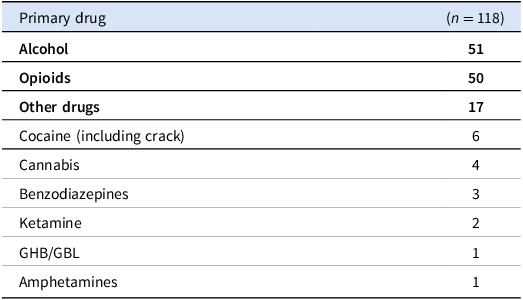
The primary substance for which treatment was provided was alcohol (51, including 10 individuals comorbidly using cocaine), followed by opioids (n = 50), and others (n = 17). Results are summarised in Table 1. Prioritisation of the problem substance was made in consultation with the individual, when care plan was agreed.
Primary substance used

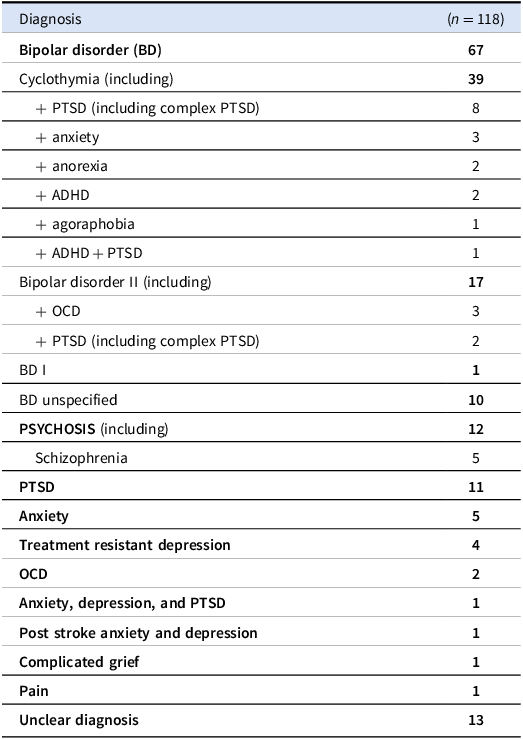
The most frequent diagnosis was bipolar disorder (67), followed by psychosis (12), PTSD (11). For 13 individuals an independent to the SUD MH diagnosis could not be established during the treatment episode. See Table 2.
Mental health diagnosis

Terminology: Post Traumatic Stress Disorder (PTSD); Attention Deficit and Hyperactivity Disorder (ADHD); Obsessive Compulsive Disorder (OCD).
Most of the individuals were already prescribed antidepressants by their primary care physician. Within the clinic, 99 individuals had started an antipsychotic/mood stabiliser and 13 individuals had started a secondary medication to the antipsychotic/mood stabiliser.
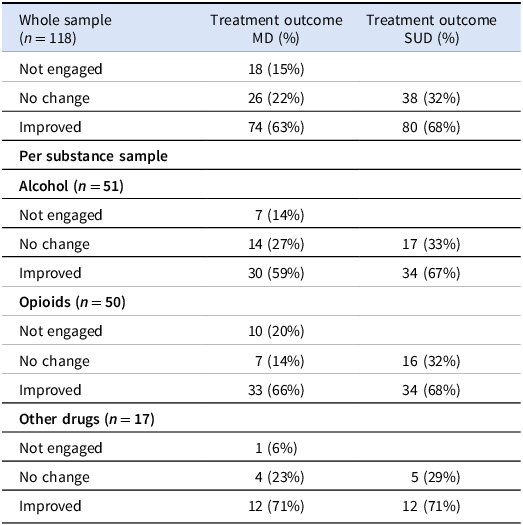
Out of the 118 referred to the clinic, 18 individuals did not engage, which was recorded as non-engagement with the MH intervention, given that they were all treated within the SUD service. For the remaining individuals, 74 (63%) had improved in MH and 80 (68%) improved in SUD. Individuals using other substances than alcohol or opioids showed the highest improvement rates for both MH and SUD (71% for each outcome), whilst individuals in treatment for alcohol as primary substance reported lower improvements for both MD (59%) and SUD (67%).
See Table 3.
Treatment outcome for mental disorder and substance use disorder

Discussion
The results of this study suggests that there are advantages in providing MH assessment and treatment for individuals attending SUD who are not open to MH services and who have difficulties accessing, progressing and/or completing SUD treatment. During the period of the two years, 2,519 individuals were under the care of the SUD service. Of those, 397 (16%) were also under the care of MD service and further 118 (5%) required the integrated service, as a complimentary service with improved outcomes within the widely accepted and implemented parallel model.
Most individuals seen by the integrated clinic, were males (double the number of females), with a primary alcohol, or opioid use disorder (equal numbers) reflecting the overall population attending the SUD service. Interestingly, the proportion of people with “other” SUD (e.g., stimulants) seen at the integrated clinic was higher compared to what we usually see at the SUD service, possibly suggesting that individuals using stimulants and other substances have more MH needs.
More than half of individuals were referred to the integrated clinic because they could not progress in their SUD treatment, meaning either they could not achieve stability on opioids replacement treatment (ORT) or achieve abstinence from alcohol or other substances. Cyclothymia and Bipolar Disorder II (BD II) were the most frequent diagnosis followed by psychosis, post traumatic stress disorder (PTSD) and surprisingly very low rate of anxiety and depression. The low numbers of individuals with depression and/or anxiety and PTSD seen at the clinic, might mean that either they are treated adequately by primary care or that MD improves as SUD treatment is progressing and therefore no integrated service is required.
These results suggest that engaging with the integrated clinic could lead to improved outcomes for both MD and SUD. The results were similar across substance groups. The provision of MD treatment within the SUD service, with optimisation of the role of the psychiatrist and more in-depth formulation of the interplay between the two disorders, might have other advantages, such as better satisfaction by individuals and staff, faster and more effective and cost-effective management of risk, which were not assessed in this project.
The results of this study should be interpreted with caution due to the naturalistic design of the study. Major limitations are that (i) the outcome assessment was not based on specific criteria or standardised measurement tools, and (ii) was done by the consultant psychiatrist running the clinic and not an independent person, hence subject to personal bias.
Conclusion
Despite the above limitations, this early work suggests that an integrated type of provision of MH treatment within SUD service might have a beneficial complementary role within the existed parallel treatment model implemented in England.
Funding statement
This research received no specific grant from any funding agency, commercial, or not-for-profit sectors.
Competing interests
None.
Ethical standards
The authors assert that all procedures contributing to this work comply with the ethical standards of the relevant national and institutional committee on human experimentation with the Helsinki Declaration of 1975, as revised in 2008. The authors assert that Surrey and Borders Partnership NHS Foundation Trust Audit Committee determined that ethical approval from the local Ethics Committee was not required for publication of this open label study/ service evaluation. The authors have provided written confirmation of this from the Audit Committee and local clinical director.