Implications
Distant hybridization can integrate the advantages of both parents, resulting in heterosis and improved growth rates, survival rates and disease resistance. Similarly, odd-ploidy breeding is of great importance in agricultural production, but it is not always easy to obtain double ploidy parents. In this study, we found that the cross between S. wangchiachii and P. pingi could produce stable pentaploid hybrid fishes under the impact of odd-ploidy and distant hybridization. This is the first report to show a stable pentaploid generation produced by hybridization of natural polyploid fishes in aquaculture and provides a successful case of hybridization and a new breeding pathway in Schizothorax fishes even more polyploid fishes.
Introduction
Triploid breeding has substantial economical and ecological benefits in aquaculture, it usually can reduce the energy distribution in reproductive development, leading to sterility and thereby improving the ability of nutritional growth, disease resistance, genetic containment and so on, but it is not always easy to obtain double ploidy parents (Valérie, Reference Valérie2008; Piferrer et al., Reference Piferrer, Beaumont, Falguiere, Flajshans, Haffray and Colombo2009; Liu, Reference Liu2010; Zhang et al., Reference Zhang, Chen, Li, Tao, Zhang, Qin, Xiao and Liu2014). Compared with higher vertebrates, the genome duplication in fishes is more frequent (Vogel, Reference Vogel1998; Zhou et al., Reference Zhou, Cheng and Tiersch2001; Venkatesh, Reference Venkatesh2003; Meyer and Van de Peer, Reference Meyer and Van de Peer2005), which has led to the diversiform chromosome number in fishes (Song et al., Reference Song, Liu, Xiao, He, Zhou, Qin, Zhang and Liu2012; Yang et al., Reference Yang, Sado, Hirt, Pasco-Viel, Arunachalam, Li, Wang, Freyhof, Saitoh, Simons, Miya, He and Mayden2015), it may provide natural parental resources for odd-ploidy breeding.
Schizothorax fishes are important economic cold-water fishes and are widely distributed in and around the Qinghai–Tibet Plateau, such as China, India and Pakistan and so on (Yue, Reference Yue2000). The presence of both tetraploids and hexaploids within the Schizothorax genus has attracted the attention of evolutionary biologists (Yang et al., Reference Yang, Sado, Hirt, Pasco-Viel, Arunachalam, Li, Wang, Freyhof, Saitoh, Simons, Miya, He and Mayden2015; Wang et al., Reference Wang, Gan, Li, Chen and He2016) and our research team. Another protagonist is Percocypris fishes, which are also important economic cold-water fishes but are distributed only around the eastern Qinghai–Tibet Plateau (Yue, Reference Yue2000). Morphologically, Schizothorax and Percocypris were once thought to belong to two different subfamilies (Yue, Reference Yue2000). However, molecularly, they were shown to be sister genera in a recent study (Wang et al., Reference Wang, Yang and Chen2013 and Reference Wang, Gan, Li, Chen and He2016).
Distant hybridization, defined as a cross between two different species or higher-ranking taxa, can integrate the advantages of both parents, resulting in heterosis and improved growth rates, survival rates and disease resistance (Liu, Reference Liu2010). However, it may also result in a risk of low hybridization efficiency and a high progeny malformation rate due to hybrid incompatibility (Chen et al., Reference Chen, Zhiguo and Lin2016). Schizothorax fishes and Percocypris fishes are compatible parents for hybridization because of their great differences in morphological characters but only slight differences genetically. Therefore, our research team attempted a distant cross between S. wangchiachii and P. pingi, both with similar reproductive periods and that are distributed in the upper reaches of the Yangtze River and its tributaries (Ding, Reference Ding1994; Yue, Reference Yue2000), to obtain new fish varieties. Our research team observed the development of embryos, larvae and juveniles of the hybrid fishes and found that the embryos were well developed, with a fecundability of 95.33% and a hatching rate of 71.12%. Under the same conditions, the embryos could not develop normally by reciprocal cross. At the beginning of the blastocyst stage, the number of dead individuals increased, and 85.83% of the embryos died at the end of the gastrula stage. The causes were mainly the rupture of the yolk membrane and the overflow of the yolk material in the process of blastoderm downwards wrapped, resulting in the death of the embryo (Yang et al., Reference Yang, Chen, Wan, Deng, He, Wang and Jin2018).
The karyotypes of P. pingi has been recorded as 2n = 4X = 98 = 42m + 30sm + 10st + 10t (Zan et al., Reference Zan, Song and Liu1984; Li et al., Reference Li, Tie, Duan, Zhao, Yang, Guo and Yang2017). The karyotypes of many Schizothorax fishes have been reported (Supplementary Table S1), but the karyotypes of S. wangchiachii have not been reported. In terms of the number of chromosomes, P. pingi is a tetraploid species, but there are both tetraploid and hexaploid species of Schizothorax fishes. Studies have shown that homoploid hybridization and different ploidy-level hybridization have different hybridization results and breeding significance (Liu, Reference Liu2010). Additionally, under the both impacts of distant hybridization and different ploidy level, the unreal hybridization and genetic instability may occur in hybrid offspring (Liu et al., Reference Liu, Qin, Xiao, Lu, Shen, Li, Liu, Duan, Zhang, Tao, Zhao, Yan and Liu2007; Wang et al., Reference Wang, Ye, Wang, Chen, Lin, Yi, Mao, Hu, Zhao, Wang, Zhou, Ren, Yao, Tao, Zhang, Xiao, Qin and Liu2017 and Reference Wang, Yang, Luo, Zhang, Qin, Huo, Song, Tao, Zhang and Liu2018). In summary, it is very important to carry out relevant genetic research for the future development of the hybrid fishes.
In this study, morphology, karyotypes, red blood cell (RBC) DNA content and inter-simple sequence repeat (ISSR) of the hybrid fishes and their parents were compared to understand the genetic composition and stability of the hybrid fishes. We provided basic genetic and morphology information on the hybrid fishes and their parents for aquaculture and further research on hybrid fishes and present a new pathway of breeding for Schizothorax fishes and potentially other polyploid fishes.
Materials and methods
Experimental fishes acquisition
In March 2016, the hybridization experiment was carried out in Xichang Jiahe Agriculture Co. Ltd in Xichang Sichuan’s Xide County. Both the parental fishes of S. wangchiachii and P. pingi were 3 to 4 years old with a body mass of 1500 to 2000 g, bred in 25 m2 fishponds with a water temperature of 14.5°C ± 1.0°C and a pH of 8.10 to 8.52. The sexually mature female S. wangchiachii and the male P. pingi were injected with human chorionic gonadotropin and luteinizing hormone-releasing hormone. After 48 to 72 h, the mature parental fishes were pressed gently on the abdomen, and the mature eggs and sperm were obtained naturally. Then, hybridization was conducted by dry fertilization. When the fertilized eggs fully absorbed water and expand, they were incubated evenly on the hatching net (2000 to 3000 eggs/m2) with a water temperature of 14.5°C ± 1.0°C and a pH of 8.10 to 8.81. Juvenile fishes were placed in the circulating water system at our laboratory breeding facility.
Morphology
P.pingi (122.03 ± 1.78 mm, 25.2 ± 1.05 g, n = 30), S. wangchiachii (106.78 ± 1.41 mm, 18.43 ± 0.74 g, n = 30) and the hybrid fishes (125.84 ± 2.71 mm, 29.22 ± 1.85 g, n = 30) were studied using traditional morphometrics, which includes meristic and measurable traits, and the examination standards were basically referred to Zou et al. (Reference Zou, Fang and Zhou2008). The body shapes were photographed by a SLR camera (Canon EOS 100D, Japan), and the details of the head were photographed by a stereomicroscope (Nikon SMZ25) after fixation by Bouin’s fixative. Ten meristic traits (lateral line scales, scales above the lateral line, scales below the lateral line, hard and soft rays of the dorsal fin, hard and soft rays of the pectoral fin, hard and soft rays of the pelvic fin and hard and soft rays of the anal fin) and 13 measurable traits (whole length, body length, body height, body width, head length, snout length, snout barbel length, maxillary barbel length, caudal peduncle length, caudal peduncle depth, eye diameter, interorbital width and the distance of eyeballs ( ± 0.01 mm)) of each fish were recorded. Where, whole length, body height, body width, head length and caudal peduncle length were divided by body length, caudal peduncle depth was divided by caudal peduncle length, interorbital width was divided by the distance of eyeballs and snout length, eye diameter, interorbital width, vsnout-barbel length and maxillary barbel length were divided by head length to eliminate the effect of different body sizes on experimental results. Euclidean distance (ED) between individuals was calculated using the following formula:
 $${\rm{ED}}ij = \sqrt {\sum\limits_{k = 1}^n {{{(Xik - Xjk)}^{\rm{2}}}} } $$
where EDij represent ED between two random individuals (i and j); within a group, i and j represent random two individuals in a group; between groups, i and j represent random two individuals from different groups; k represents Z-score of the ratio of different characters, which was calculated by SPSS 21.0.
Karyotype
Since karyotypes of P. pingi have been reported, only S.wangchiachii and the hybrid fishes were analyzed in this study. Mitotic chromosome preparations were obtained from the kidney tissues of S. wangchiachii (n = 10) and the hybrid fishes (n = 20), and an air-drying technique was adopted (Foresti et al., Reference Foresti, Oliveira and Almeidatoledo1993; Liu et al., Reference Liu, Liu, Zhou, Zhang, Luo, Feng, He, Zhou and Yang2001). For each type of fish, 100 well-dispersed chromosomes were selected for counting and 10 clear, dispersed and good quality metaphase spreads were used for the analysis of karyotype that were classified by previous standards (Levan et al., Reference Levan, Fredga and Sandberg1964; Liu et al., Reference Liu, Liu, Zhou, Zhang, Luo, Feng, He, Zhou and Yang2001). The pairing of metaphase chromosomes through Adobe Photoshop CS6 and the length measurement of chromosomes by ImageJ. In the hybrid fishes, chromosomes were not arranged in pairs. Since their parents both were paleopolyploids, that already were diploidization in the long evolutionary process, their parents can only be considered as diploids with different numbers of chromosomes from the perspective of breeding.
Red blood cell DNA content
RBC DNA content was determined according to the technique described by Tao et al. (Reference Tao, Zhang, Ma, Sun, Zhou, Cao and Li2012) with slight modifications. Peripheral blood was taken from the caudal veins of 5 S.wangchiachii, 5 P. pingi, and 10 hybrid fishes that were same with morphology. In addition, five Schizothorax davidi (2n = 4X = 98, 16.5 to38.9 g) were selected as a double control between P. pingi with same ploidy and congeneric S.wangchiachii. The blood samples were stained according to PI Stain (50 ug/ml, including RNase) (Leagene, Beijing, China). A BD Accuri C611000-type flow cytometer was used for detection. Under excitation light at 488 nm and Fluorescent Light 3 channel, fluorescence was collected, and then, a DNA histogram was obtained. The data analysis was conducted using FlowJo V10. The RBC DNA content of chicken (Gallus sp., whose DNA content is 2.50 pg) was used as a standard reference, and the RBC DNA content of fishes was calculated by the following formula:
 $${P_1} = {{({E_1} \times {P_2})} \mathord{\left/{\vphantom{{({E_1} \times {P_2})} {{E_2}}}} \right.} {{E_2}}}$$
where P 1 indicates the RBC DNA content of the fishes. P 2 indicates the RBC DNA content of cook. E 1 represents the absorbance of the RBC DNA content of cook and E 2 denotes the absorbance of the fishes.
Inter-simple sequence repeat
Fin tissues were, respectively, taken from eight hybrid fishes and their parents, which were from wild population. Nineteen ISSR-PCR primers were screened preliminarily for this investigation is shown in Supplementary Table S2 and were synthesized by the Beijing Genomics Institute. Genomic DNA was extracted from fin tissues using the Qiagen DNeasy Kit (Qiagen, Shanghai, China), according to the instructions of the manufacturer. PCR reactions were conducted in 25 ul volumes containing the following: 1 ul genomic DNA (100 ng/ul), 1 ul 10 uM of primer, ddH2O 10.5 ul and Tap Plus Master Mix 12.5 ul (Vazyme, Nanjing, China). The following conditions were used for PCR reactions: (1) pre-denaturation at 95°C for 4 min; (2) denaturation at 95°C for 45 s; (3) annealing at 51°C for 45 s; (4) elongation at 72°C for 1.5 min (repeated 2 to 4 stages 35 times) and a final elongation at 72°C for 7 min. The PCR products were size-separated by standard horizontal electrophoresis in 2% agarose gels (0.4 g agarose, 2.5 ul ethidium bromide, 40 ml 1 × TAE buffer (40 mmol/L Tris-HCL, 40 mmol/L acetic acid and 1 mmol/L EDTA)) and run with 1 × TAE buffer at 120 V for 90 min. The gels were viewed and photographed by GelDoc XR + Bio Imaging Systems (Bio-Rad, Shanghai, China). Only robust bands that were readily distinguishable were considered in this study.
According to the hypothesis of Apostol et al. (Reference Apostol, Black, Reiter and Miller1996), each band was examined as a locus; the percentages of polymorphic loci = number of polymorphic loci of total loci × 100% were calculated. Each polymorphic ISSR band was given a score of 1 for presence or 0 for absence, and the data were transferred to a binary (1/0) data matrix. The data matrix was used to cluster and genetic distances (GD) analysis based on Nei’ method (Nei and Li, Reference Nei and Li1979). GD between individuals were calculated using the following formula:
 $${\rm{G}}{{\rm{D}}_{ij}} = {\rm{1}} - {{{\rm{2}}{N_{ij}}} \mathord{\left/{\vphantom{{{\rm{2}}{N_{ij}}} {{\rm{(}}{N_i} + {N_j}{\rm{)}}}}} \right.} {{\rm{(}}{N_i} + {N_j}{\rm{)}}}}$$
where GDij represent genetic distance between two individuals; Nij represent the number of DNA amplification fragments shared between individuals i and j; N i and N j, respectively, are the number of DNA amplification fragments of individuals i and j.
Statistical analyses
Descriptive statistics are presented as the means ± SE by SPSS 21.0. In morphology, meristic and measurable traits between the hybrid fishes and their parents were analyzed by one-way ANOVA. The Tukey test was used to detect differences between the hybrid fishes and their parents. The ED within a group was calculated as the average ED between two individuals of the group. The ED between groups was calculated as the average of the EDs among all randomly paired individuals from different groups. The morphological clustering and ED were performed in each fish by SPSS 21.0. In ISSR, the genetic clustering and genetic distance were analyzed based on unweighted pair group method average by Popgene 1.32 (Yeh et al., Reference Yeh, Yang and Boyle1999). The calculation method used for genetic distance inside and outside the groups was the same as that used for the ED.
Results
Morphology
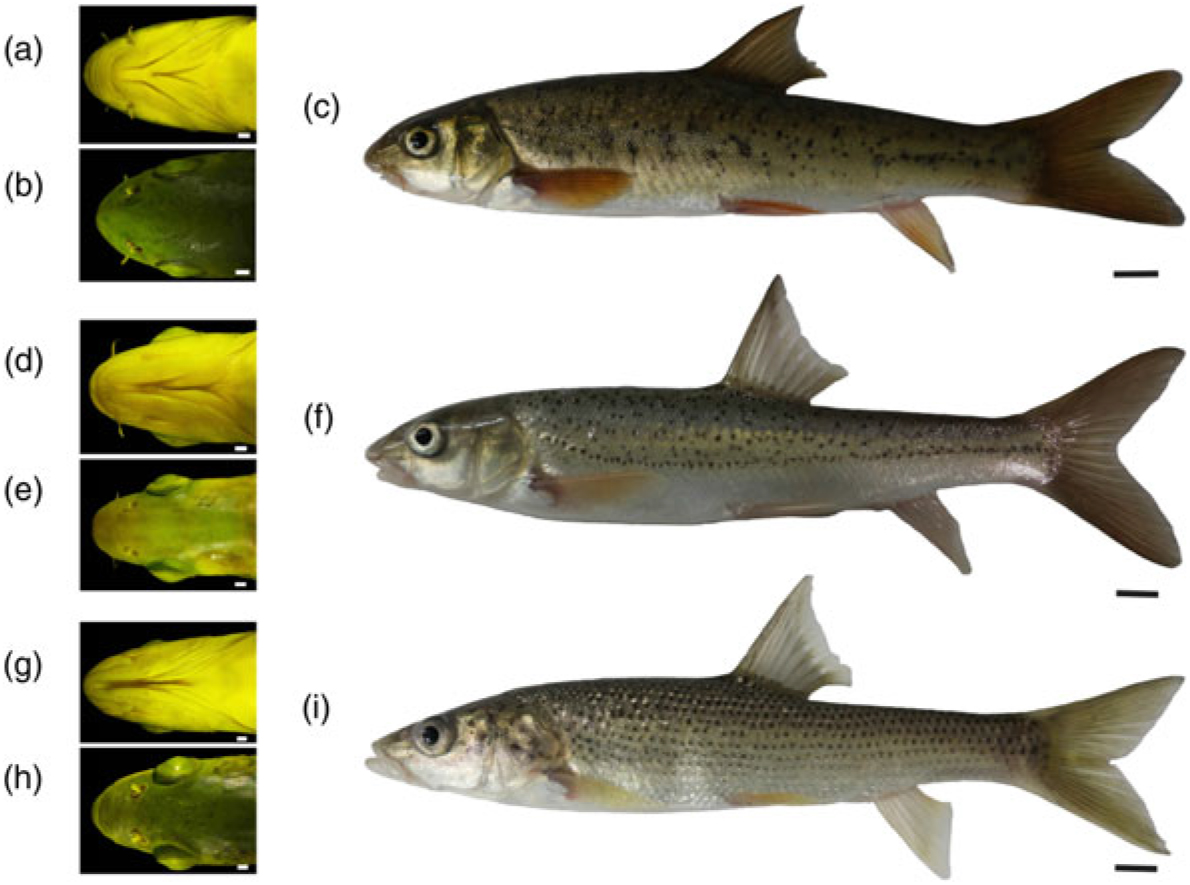
The morphology difference among the hybrid fishes and their parents was larger (Table 1 and Figure 1). In body color, the melanin of P. pingi was distributed evenly on each scale, whereas it was unevenly distributed in S. wangchiachii. Interestingly, melanin was only found on scales along the lateral lines and above in the hybrid fishes. In scale, P. pingi had larger scales than S. wangchiachii, and the hybrid fishes had intermediate scale size. The head of the P. pingi was relatively slender with a developed branchial membrane, a lower lip with higher radian, a lower jaw without keratinization, a terminal mouth, a deeper mouth crack, bulgier eyeballs and a longer snout barbel and maxillary barbel. Comparatively, the head of S. wangchiachii is relatively round with an undeveloped branchial membrane, lower lip with a lesser radian, lower jaw with keratinization, inferior mouth, shallower mouth crack, slightly bulging eyeballs and a shorter snout barbel and maxillary barbel. In general, the head traits of hybrid fishes were between their parents, but there were some special features, such as longer maxillary barbel than both parents, lower jaw without keratinization that was same as P. pingi and so on (Figure 1).
External morphological comparison in the hybrid fishes and their parents. (a) The ventral head of S. wangchiachii; (b) the reverse head of S. wangchiachii; (c) the full view of S. wangchiachii; (d) The ventral head of hybrid fish; (e) the reverse head of hybrid fish; (f) the full view of hybrid fish; (g) the ventral head of P. ping; (h) the reverse head of P. ping; (i) the full view of P. ping. The white scale is 1 mm; the black scale is 10 mm.

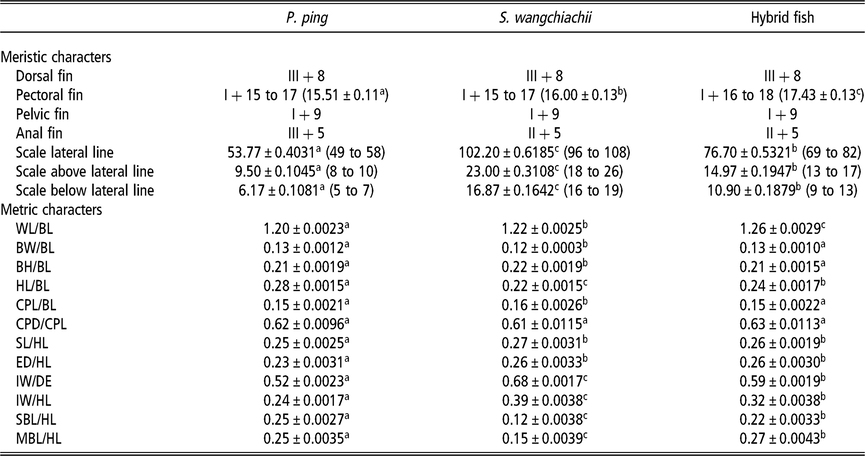
Traditional metric and meristic characters of the hybrid fishes and their parents

WL = Whole length; BL = Body length; BW = Body width; BH = Body height; HL = Head length; CPL = Caudal peduncle length; CPD = Caudal peduncle depth; SL = Snout length; ED = Eye diameter; IW = Interorbital width; DE = Distance of eyeballs; SBL = Snout-barbel length; MBL = Maxillary-barbel length. a,b Values within a row with different superscripts differ significantly at P < 0.01 based on Tukey test.
In 10 meristic traits, generally, the hybrids and their parents were similar, but the number of soft rays of the pectoral fin of hybrid fishes was much than those in both parents, and the hard rays of anal fin were the same in the hybrids as in S. wangchiachii. In 12 metric traits, most of the traits were significantly different (P < 0.01) among the hybrids and their parents, especially the traits of the head (Table 1).
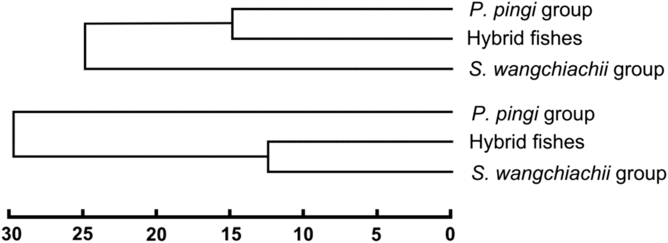
In ED based on morphology, the morphological difference within a group of hybrid fishes was similar to that of their parents. Between groups, the morphological differences of hybrid fishes were generally intermediate between the two parents but with slightly greater similarity to S. wangchiachii (Table 2). However, the clustering showed that the hybrid fishes and P. pingi shared a common branch (Figure 2). Based on the above two results, this study suggests that the morphology of hybrid fishes was intermediate between parents without an obvious preference for one or the other.
The morphology and genetic clustering in the hybrid fishes and their parents’ groups. (a) The morphology clustering analysis based on Euclidean distance, and it was downsized based on Supplementary Figure S1 by showing only the first branch; (b) the genetic distance clustering based on inter-simple sequence repeat (ISSR). Both (a) and (b) were redrawn through Adobe Photoshop CS6 based on Supplementary Figure S1 and Supplementary Figure S2.

Euclidean distance based on morphology and genetic distance based on inter-simple sequence repeat (ISSR) among the hybrid fishes and their parents

P = P. ping; S = S. wangchiachii; PS = The hybrid fishes.
Karyotype
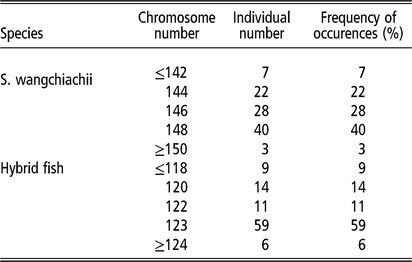
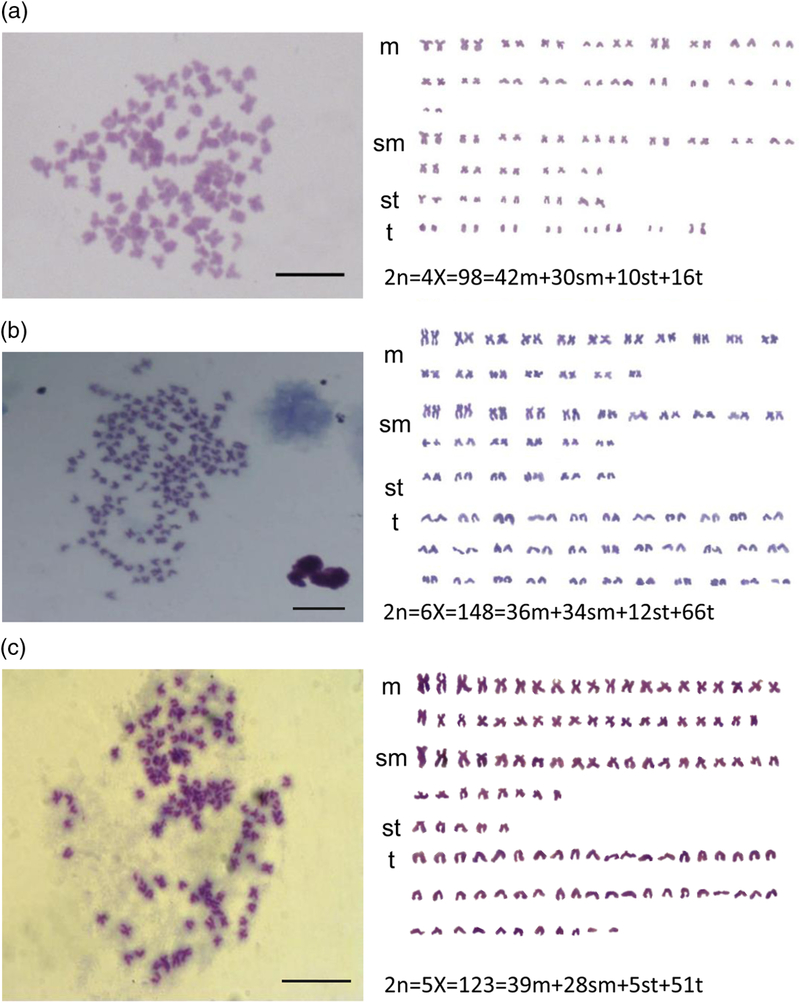
According to the statistical results of chromosome number (Table 3), it can be preliminarily determined that the chromosome number of S. wangchiachii was 148, which is consistent with the reported chromosome number of hexaploid Schizothorax fishes (Supplementary Table S1). The chromosome number of the hybrid fishes was 123, which is half of the sum of the chromosomes of P. pingi and S. wangchiachii. No polyploidization or gynogenesis was found in the chromosome counting of 20 hybrids.
Chromosome counts of S. wangchiachii and the hybrid fishes

According to the statistical results of the karyotype (Figure 3, Supplementary Table S3 and Supplementary Table S4), the karyotype of S. wangchiachii was 2n = 6X = 148 = 36m + 34sm + 12st + 66t; the karyotype of P. pingi was 2n = 4X = 98 = 42m + 30sm + 10st + 16t; the karyotype of hybrid fishes was 2n = 5X = 123 =39m + 28sm + 5st + 51t.
The spread of metaphase chromosomes and the karyotype of the hybrid fishes and their parents. (a) The metaphase chromosomes and karyotype of P. pingi refer to Li et al. (Reference Li, Tie, Duan, Zhao, Yang, Guo and Yang2017); (b) The metaphase chromosomes and karyotype of S. wangchiachii in this study; (c) The metaphase chromosomes and karyotype of the hybrid fish in this study. The scale is 10 μm. m = metacentric chromosome; sm = submetacentric chromosome; st = subterminal chromosome; t = terminal chromosome.
Red blood cell DNA content
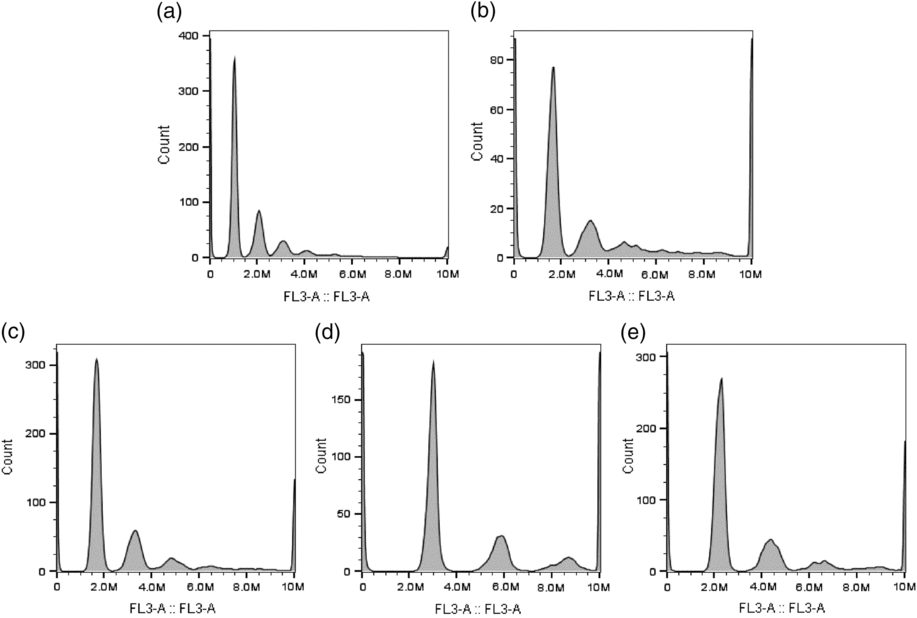
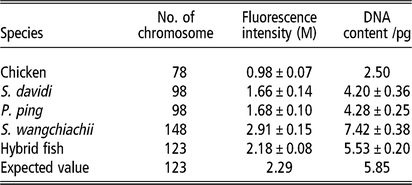
The results of the DNA content determined by flow cytometry showed that (Table 4 and Figure 4), in the case of RBC DNA content of cook (2.50 pg) as a standard control, the average RBC DNA content of S. davidi was 4.20 ± 0.36 pg, the content of P. pingi was 4.28 ± 0.25 pg, the content of S. wangchiachii was 7.42 ± 0.38 pg and the content of the hybrid fishes was 5.53 ± 0.20 pg, which was minimally different from the expected value. No polyploidization or gynogenesis was found in the RBC DNA content of the 10 hybrid fishes.
Flow cytometric RBC DNA content histograms of chicken, S. davidi, the hybrid fishes and their parents. (a) Chicken; (b) S. davidi; (c) P. ping; (d)S.wangchiachii; (e) the hybrid fishes. FL3-A = the area of fluorescent light 3 channel.

Red blood cell (RBC) DNA content of Chicken, S. davidi, the hybrid fishes and their parents

Expected value is half the average amount of RBC DNA content of both P. ping and S. wangchiach.
Inter-simple sequence repeat
Nineteen ISSR primers were used to analyze the hybrid fishes and their parents, generating a total 178 bands, of which 149 were polymorphic. Partial electrophoretic results were presented in Supplementary Figure S3. The average polymorphism of ISSR makers was 83.7% (Supplementary Table S2). The genetic distance based on ISSR between 24 individuals of the hybrid fishes and their parents is shown in Supplementary Table S5.
In the genetic diversity study within a group based on ISSR (Table 2), the average value of P. pingi (0.0630 ± 0.0248) was 0.625 times higher than that of S. wangchiachii (0.1076 ± 0.0349), which was related to their ploidy (0.6 times), and the genetic diversity of the hybrid fishes (0.1364 ± 0.0416) was higher than that of the parents.
In the genetic distance study between groups (Table 2), the average value between P. pingi and S. wangchiachii (0.9043 ± 0.0345) was much larger than that of their respective groups. Interestingly, the GD of hybrid fish between P. pingi and S. wangchiachii were 0.5457 ± 0.0227 and 0.3606 ± 0.0283, respectively, which are also an almost 0.6 times relationship. According to the cluster analysis (Figure 2), the hybrid fishes were similar to S. wangchiachii in genetics based on ISSR.
Discussion
Morphology
Within a group, there was morphologic diversity in three groups, which mainly came from the genetic diversity of parents and the recombination of parental genetic material in meiosis (Mugal et al., Reference Mugal, Nabholz and Ellegren2013). The average ED in the hybrid fishes and their parents was similar, indicating that the parental genetic material in the hybrid fishes was normal combination without disorder. Female S. wangchiachii can provide more genetic material than male P. pingi in hybrid fish, whether from nuclear genes or mitochondrial genes. However, the morphology of hybrid fishes was intermediate between parents, and there was no obvious preference. Of course, this may be related to the selection of the quantitative indicators. On the other hand, this hybridization is a typical and successful hybridization in which the hybrid fishes consistently combine the genetic material of their parents. The traits such as lateral line scales, melanin distribution, structure of the lip, length of maxillary and snout barbels and so on can be used as an index to distinguish the hybrid fishes and their parents in aquaculture later.
Karyotype of S. wangchiachii
In this study, the karyotype formula of S. wangchiachii was 2n = 6X = 148 = 36m + 34sm + 12st + 66t, and the chromosome number was consistent with other reported hexaploid Schizothorax fishes (Supplementary Table S1). Hexaploid Schizothorax fishes are derived from tetraploid (Wang et al., Reference Wang, Gan, Li, Chen and He2016). Although the mechanism of origin of hexaploid in the Schizothorax fishes is still poorly understood, in artificial breeding, autotriploids and allotriploids can be produced by inhibiting the exclusion of a second polar body and distant hybridization (Valérie, Reference Valérie2008; Piferrer et al., Reference Piferrer, Beaumont, Falguiere, Flajshans, Haffray and Colombo2009), and even the latter can be produced naturally without artificial inhibition (Liu et al., Reference Liu, Qin, Xiao, Lu, Shen, Li, Liu, Duan, Zhang, Tao, Zhao, Yan and Liu2007; He et al., Reference He, Qin, Liu, Li, Wang, Xiao, Xie, Zhang and Liu2012; Hu et al., Reference Hu, Liu, Xiao, Zhou, You, He, Zhao, Song and Liu2012; Xiao et al., Reference Xiao, Kang, Xie, Qin, He, Hu, Zhang, Zhao, Wang, Luo, Liu and Liu2014). Similarly, this process could happen in nature. In particular, the reported hexaploid Schizothorax fishes were only distributed around the eastern Qinghai–Tibet Plateau in China (Yue, Reference Yue2000), where may be the origin area of hexaploid Schizothorax fishes. Currently, FishBase contains 127 species (subspecies) of Schizothorax fishes, but only a few karyotypes have been reported. Therefore, it is not clear whether the hexaploid Schizothorax fishes are widely distributed or only distributed in the above water system. Therefore, more karyotype studies on Schizothorax fishes are needed in the future.
Karyotype of the hybrid fishes
The karyotype of the hybrid fishes was 2n = 5X = 123 = 39m + 28sm + 5st + 51t, and the expected value of it was 2n = 5X = 123 = 39m + 32sm + 11st + 41t, which was half the average of parental karyotypes. In above, the actual value and the expected value are not exactly equivalent, which may be caused by statistical errors or karyotype variation (Zhao et al., Reference Zhao, Bao, Bi, Huang, Wang, Hu and Yang2006). However, this result still was a typical hybridization in general. In fish distant hybridization, different ploidies may be produced in hybrid offspring (Liu et al., Reference Liu, Qin, Xiao, Lu, Shen, Li, Liu, Duan, Zhang, Tao, Zhao, Yan and Liu2007; He et al., Reference He, Qin, Liu, Li, Wang, Xiao, Xie, Zhang and Liu2012; Hu et al., Reference Hu, Liu, Xiao, Zhou, You, He, Zhao, Song and Liu2012; Xiao et al., Reference Xiao, Kang, Xie, Qin, He, Hu, Zhang, Zhao, Wang, Luo, Liu and Liu2014). However, in this study, the hybridization is relatively stable, and no different ploidy progeny or gynogenetic progeny were found in the karyotype detection of 20 hybrid fishes and in the RBC DNA content detection of 10 hybrid fishes.
Triploid breeding is of great value in aquaculture. The most common induction methods are based on the suppression of the second meiotic division of fertilized eggs, but this approach is restricted to some extent by the uncertainty of 100% triploid progeny, parental reproductive behaviour, dysplasia of offspring, mosaicism and other factors. Another common method is based on the suppression of the second first cleavage to breed autotetraploids, which can interbreed with diploids to produce triploids. However, in practice, this has proved difficult to achieve in aquaculture, and there have been no reports of sexually fertile groups; these factors contribute to the high cost of autotetraploid breeding (Valérie, Reference Valérie2008; Piferrer et al., Reference Piferrer, Beaumont, Falguiere, Flajshans, Haffray and Colombo2009; Song et al., Reference Song, Liu, Xiao, He, Zhou, Qin, Zhang and Liu2012). In contrast to the above methods, natural distant hybridization without any induction can acquire stable, sexually fertile allotetraploid (Liu et al., Reference Liu, Liu, Zhou, Zhang, Luo, Feng, He, Zhou and Yang2001) and autotetraploid groups (Qin et al., Reference Qin, Wang, Wang, Dai, Xiao, Hu, Luo, Tao, Zhang, Liu and Liu2014), but this approach is rare and requires long-term breeding. In this study, the hybrid fishes were pentaploid, which had the same breeding significance as triploid fishes, but were bred by natural parents, which greatly reduced breeding time. Tetraploid and hexaploid species exist in the Schizothorax, which is very rare in vertebrates and the large natural parents of pentaploid fish. The above tetraploid and hexaploid fish hybridization can be used to produce pentaploid fishes, and if the production characteristics are favorable, these hybrids can be directly put into production with a good development prospect.
In the homoploid distant hybridization of red crucian carp (2n = 100) (♀) × common carp (2n = 100) (♂), bisexual fertile F3–F18 allotetraploid hybrids (4n = 200) were formed, and it can produce sterile triploid fish by backcrossing with their parents (Liu, Reference Liu2010). In Megalobrama amblycephala (2n = 48) (♀) × Xenocypris davidi (2n = 48) (♂), allotriploid hybrids (3n = 72) can be obtained directly (Hu et al., Reference Hu, Liu, Xiao, Zhou, You, He, Zhao, Song and Liu2012). Could the homoploid hybridization in tetraploid Schizothorax and Percocypris fishes produce similar results? This is of great significance both in the future study of the origin of hexaploid Schizothorax fishes and in genetic breeding.
Red blood cell DNA content
The actual RBC DNA content in the hybrid fishes was not significantly different from the expected value, and the SE of hybrid fishes was lower than that of two parents, indicating that its genome was stable, and half that of S. wangchiachii and P. pingi. There was no significant difference in the average RBC DNA content between S. davidi and P. pingi, both of which had 98 chromosomes. According to the RBC DNA content of S. davidi, it is speculated that the RBC DNA content of S. wangchiachii should be 6.30 pg, but the actual content was 7.42 pg. In general, polyploidized species produce a large number of redundant genes, which tend to be lost, silenced or subfunctionalized in the process of evolution toward diploidization (Ozkan et al., Reference Ozkan, Levy and Feidman2001; Ma and Gustafson, Reference Ma and Gustafson2005). However, in this study, the RBC DNA content of S. wangchiachii was more than 1.5 times that of S. davidi, and the specific reason for this remains to be further studied.
Inter-simple sequence repeat
ISSR can efficiently detect polymorphisms, and are reproducible, stable and reliable. Unlike SSR, ISSR markers are generated using primers that amplify regions between SSR loci (Zeitkiewicz et al., Reference Zietkiewicz, Rafalski and Labuda1994).
Within a group, there was also some genetic diversity in ISSR in three groups, and the reason is similar to morphology. Interestingly, the genetic diversity of tetraploid P. pingi was 0.625 times than that of hexaploid S. wangchiachii, suggesting that the genetic diversity base ISSR gene may be related to ploidy, and in both species, the variational probability of sequence repeats on each chromosome may be similar. Different from morphology, in the hybrid fishes, the genetic diversity based on ISSR was higher than that of their parents, rather than between them, as assumed above. Suggesting that, on the one hand, parental genes were integrated in the hybrid fishes, on the another hand, recombination, insertion and loss of DNA fragments in connection with sequence repeats may occur in the hybrid fishes (Ye et al., Reference Ye, Jiao, Tang, Chen, Ye, Ren, Hu, Wang, Wen, Zhang, Tao and Liu2017). In addition, it was possible that the genetic material of the parents was diluted in the hybrid fishes, so that some bands of the parents were not obvious, leading to wrong judgment.
Between groups, the genetic distance of hybrid fishes between P. pingi and S. wangchiachii was almost 3 : 2, which was consistent with the parental ploidy. There are no sequence repeats satisfying ISSR primers in the complete mitochondrial sequence of S. wangchiachii (Chen et al., Reference Chen, Cheng, Qiao, Zhu, Chen and Ren2013), and ISSRs segregate mostly as dominant markers following simple Mendelian inheritance. Taken together, above phenomenon showed that coexistence of parental genetic material in hybrid fishes without partiality.
Conclusion
In morphology, the average ED within a group in the hybrid fishes and their parents was similar; in karyotype, no different ploidy progeny or gynogenetic progeny were found; in RBC DNA content, the SE of hybrid fishes was normal compared to that of their parents, and no different ploidy progeny or gynogenetic progeny were found; in ISSR, the diversity of hybrid fishes was higher than their parents, this may be due to the normal interaction of parental genes. In summary, all results showed that the hybrid fishes were stable pentaploid. Therefore, in fish, it is feasible to cross natural tetraploid parents with hexaploid parents to produce stable pentaploid offspring. These findings provide a successful case of hybridization and a new breeding pathway in Schizothorax fishes even more polyploid fishes.
Supplementary material
To view supplementary material for this article, please visit https://doi.org/10.1017/S1751731119001289.
Acknowledgements
This work was funded by Chongqing education commission project (CY160219). The authors would like to thank the members of the Deng, He and Wang laboratories for their helpful discussions and assistance in sample collection.
Declaration of interest
The authors declare that they have no competing interests.
Ethics statement
The authors claim that none of the material in the paper has been published or is under consideration for publication elsewhere. The submission is original, and all authors are aware of the submission and agree to its publication in Animal. We declare that there is no conflict of interests regarding the publication of this paper.
Software and data repository resources
The authors declare that the data of this research are not deposited in any official repository.