INTRODUCTION
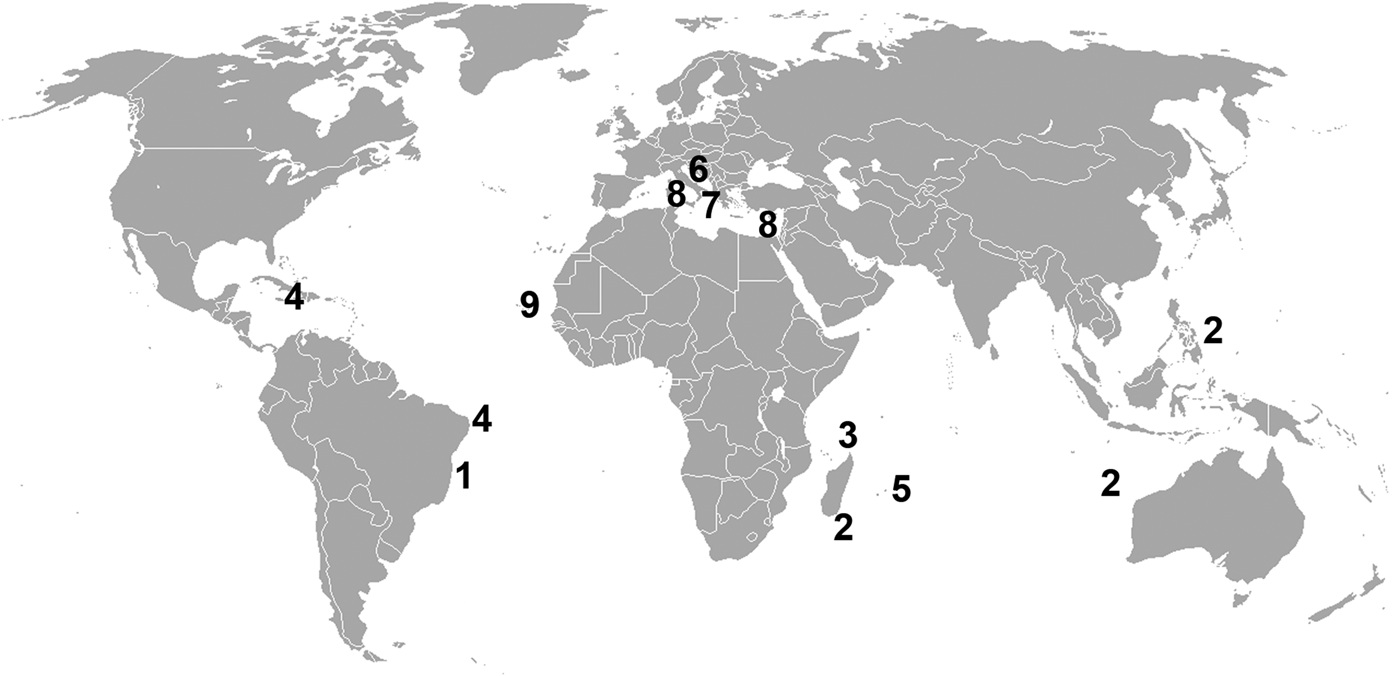
The genus Didiscus Dendy, Reference Dendy1922 is known from the Eocene–Oligocene (Hinde & Holmes, Reference Hinde and Holmes1891). It is defined by possession of an ectosomal crust of ‘discorhabd’-like microxea microscleres (Hooper, Reference Hooper, Hooper and van Soest2002), which is the most important diagnostic feature distinguishing the genus among the Halichondrida (Corriero et al., Reference Corriero, Scalera-Liaci and Pronzato1997). Hiemstra & van Soest (Reference Hiemstra and van Soest1991) reorganized the taxonomic status of Didiscus and van Soest (Reference van Soest1993) discussed the problem of the homogeneity of the taxon based on historical and geographic data. The genus currently has eight valid species (van Soest et al., Reference van Soest, Boury-Esnault, Hooper, Rützler, de Voogd, Alvarez, Hajdu, Pisera, Vacelet, Manconi, Schoenberg, Janussen, Tabachnick and Klautau2014; see Figure 1): Didiscus aceratus (Ridley & Dendy, 1886 from the Indopacific), D. anisodiscus Vacelet & Vasseur, Reference Vacelet and Vasseur1971 (Madagascar), D. oxeata Hechtel, Reference Hechtel1983 (Western Atlantic), D. placospongioides Dendy, Reference Dendy1922 (Indian Ocean), D. pseudodidiscoides (Corriero et al., Reference Corriero, Scalera Liaci and Pronzato1996 from the Mediterranean), D. spinoxeatus Corriero et al., Reference Corriero, Scalera-Liaci and Pronzato1997 (Mediterranean), D. stylifer Tsurnamal, Reference Tsurnamal1969 (Mediterranean), D. verdensis Hiemstra & van Soest, Reference Hiemstra and van Soest1991 (Eastern Atlantic). In Brazil, the genus has records of one species (D. oxeata) and another without identification at specific level (Muricy et al., Reference Muricy, Lopes, Hajdu, Carvalho, Moraes, Klautau, Menegola and Pinheiro2011).
Known distribution of all valid species of Didiscus. Numbers indicate approximate localities from which species were reported: (1) Didiscus gladius sp. nov.; (2) D. aceratus; (3) D. anisodiscus; (4) D. oxeata; (5) D. placospongioides; (6) D. pseudodidiscoides; (7) D. spinoxeatus; (8) D. stylifer; (9) D. verdensis.

The present paper describes the new species of Didiscus and focuses on interspecific affinities and differences within the genus. In addition, a key to all species of Didiscus is provided.
MATERIALS AND METHODS
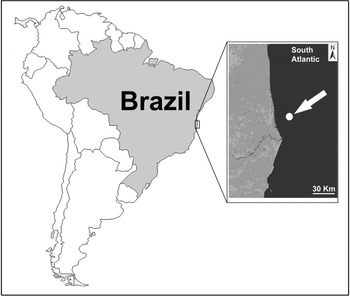
Specimens were collected manually during a faunistic survey conducted in the area of the Camamu-Almada Basin (15°35′5.91″S 38°46′36.35″W), situated in the Bahia State (Eastern Brazil Ecoregion, North-eastern Brazil geopolitical region) coastline (Figure 2). Dissociated spicule mounts and skeletal sections were made using classical procedures for Demospongiae (Hajdu et al., Reference Hajdu, Peixinho and Fernandez2011). A minimum of 30 spicules from each category were measured. Images of specimens, sections and SEM preparations were obtained digitally. The specimens were preserved in 80% ethanol and deposited in the Porifera collection of Universidade Federal de Pernambuco (UFPEPOR). The classification followed in this work is proposed by Hooper & van Soest (2002) in Systema Porifera. Taxonomic comparisons were made with data tabulated for all species of Didiscus available in the World Porifera Database (van Soest et al., Reference van Soest, Boury-Esnault, Hooper, Rützler, de Voogd, Alvarez, Hajdu, Pisera, Vacelet, Manconi, Schoenberg, Janussen, Tabachnick and Klautau2014).
Map indicating in detail the type locality of the new species of Didiscus. Circle and arrow indicate position of the new species.

SYSTEMATICS
Class DEMOSPONGIAE
Order HALICHONDRIDA Gray, 1897
Family HETEROXYIDAE Dendy, 1905
Genus Didiscus Dendy, Reference Dendy1922
Synonymy
Didiscus Dendy, 1922b: 135; van Soest et al., 1990: 33; Hiemstra & van Soest, Reference Hiemstra and van Soest1991: 45; Diaz et al., 1993: 145.
Definition
Heteroxyidae with ectosomal crust of ‘discorhabd’-like microxea microscleres (Hooper, Reference Hooper, Hooper and van Soest2002). Type species: Didiscus placospongioides Dendy, Reference Dendy1922 (by monotypy).
Didiscus gladius sp. nov.
(Figures 1–4, Table 1)
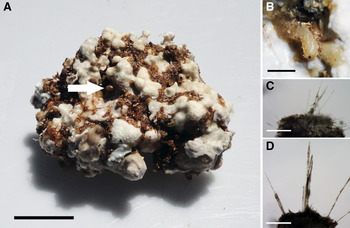
Didiscus gladius sp. nov. (A) Whole specimen. Arrow points at holotype (UFPEPOR 1535); (B) Detail showing the holotype; (C) thick section showing the ectosome and choanosome; (D) thick section showing the spicules protrude externally. Scale bars: A, 1 cm; B, 3 mm; C, 400 μm; D, 200 μm.

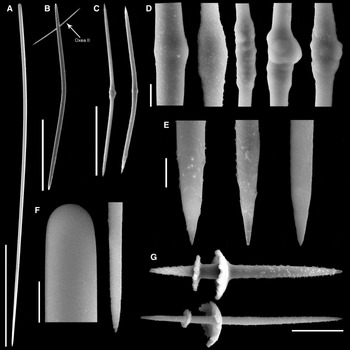
Scanning electron micrographs of spicule complement from Didiscus gladius sp. nov. (UFPEPOR 1535, holotype) A, styles; B, oxea I and oxea II; C, two variations of oxea II; D, details of lumped swellings on oxea II; E, details of the apex of oxea II; F, details of the base and apex of a style; G, two variations of discorhabd. Scale bars: A, 200 μm; B, 250 μm; C, 80 μm; D and E, 5 μm; F, 1 μm; G, 20 μm.

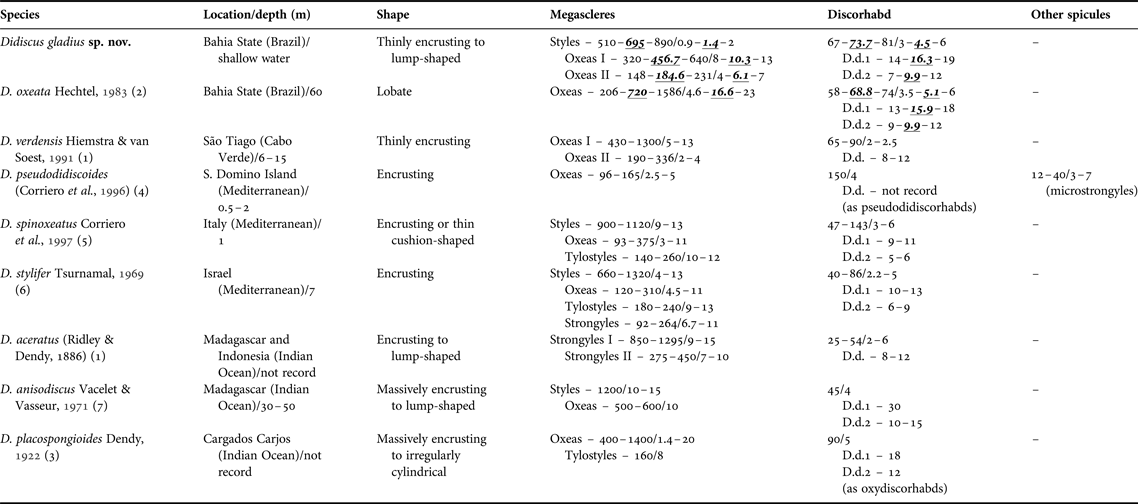
Comparative micrometric data on the spicules of the living species of Didiscus. Values are in micrometres (μm), expressed as follows: minimum–maximum or minimum–mean–maximum length, length/width or disc diameter (D.d. – in the case of discorhabd). References are numbered in parentheses and listed after the table.

References: (1) Hiemstra & van Soest (Reference Hiemstra and van Soest1991); (2) Hechtel (Reference Hechtel1983); (3) Dendy (Reference Dendy1922); (4) Corriero et al. (Reference Corriero, Scalera Liaci and Pronzato1996); (5) Corriero et al. (Reference Corriero, Scalera-Liaci and Pronzato1997); (6) Tsurnamal (Reference Tsurnamal1969); (7) Vacelet & Vasseur (Reference Vacelet and Vasseur1971).
TYPE MATERIAL
Holotype. UFPEPOR 1535, off Canavieiras, Camamu-Almada Basin (15°35′5.91″S 38°46′36.35″W), Bahia State, Brazil, 25–50 m depth, X. 2011.
Paratype. UFPEPOR 1536 (collected together with the holotype).
DIAGNOSIS
Didiscus gladius sp. nov. is the only Didiscus with styles and two categories of megascleres exclusively oxeas.
DESCRIPTION
Thinly encrusting (5 mm length × 1 mm thickness) to lump-shaped (3 mm height), with large styles and oxeas projected beyond the surface (Figure 2A). Consistency is compressible and fragile. Colour is a translucent beige or brown in ethanol (80%). In the translucent regions spicules are clearly visible (Figure 2B). Oscules not observed.
Skeleton
An ectosomal layer of discorhabds (very dense) arranged diffusely to the surface (Figure 2D). Choanosomal skeleton shows confused radial tracts that support the ectosome (Figure 2C); discorhabds are diffusely distributed; little spongin.
Spicules
Styles (Figure 3A, F, Table 1): Longer, slender, usually slightly curved, completely smooth body (510–695–890/0.9–1.4–2). Oxeas I (Figure 3B): Longer, usually slightly curved, completely smooth body (320–456.7–640/8–10.3–13). Oxeas II (Figure 3C–E): smooth body to rugose (granular spination), slightly curved, swellings (irregular and nodulose swellings) often occur at the middle of the shaft of the spicule (few spicules do not have swellings) (148–184.6–231/4–6.1–7). Discorhabds (Figure 3G): rugose or finely spined (except at the apices) microxeas, sharply pointed with ragged points, possessing two unequally sized discs asymmetrically aligned along the shaft. The discs average 9 and 16 μm in diameter and the major are typically curved inwards (67–73.7–81/3–4.5–6).
ECOLOGY
Encrusting calcareous nodules along with some colonies of bryozoans (e.g. Aetea curta Jullien, 1888; Arbocuspis belulla (Hincks, 1881); Cradoscrupocellaria curacaoensis (Fransen, 1986); Exechonella sp.; Micropora sp.; Nolella stipata Gosse, 1855; Parasmittina sp.; Plesiocleidochasma sp. and Puellina sp.).
DISTRIBUTION
At present, Didiscus gladius sp. nov. is known only from the type locality (off Canavieiras, Bahia State, Brazil), depth range from 25 to 50 m.
ETYMOLOGY
The specific name refers to the occurrence of discorhabds resembling swords.
REMARKS
The new species display the typical morphology of Didiscus spp., most of which are encrusting or amorphous massive. Didiscus gladius sp. nov. differs from others by its combination of styles and oxeas in two size categories. Its closest affinity is with D. verdensis (from Eastern Atlantic; see Figure 1). Both species have discorhabds, very similar in shape: sharp, microspined in most of its length and with rough, irregular discs. But both differ mainly on size of larger discs: 12 μm (D. verdensis) against 19 μm (D. gladius sp. nov.). Finally, both species can be distinguished in megascleres categories: Didiscus verdensis has only two categories (the first oxeas with styloid and strongylote modifications, the second centrotylote oxeas with some strongylote modifications but always with smooth tips) vs three categories of megascleres in Didiscus gladius sp. nov. (styles, oxeas I and oxeas II). The presence of styles distinguishes Didiscus gladius sp. nov. from the three species: D. oxeata (from Brazil), D. pseudodidiscoides (Mediterranean) and D. placospongioides (Indian Ocean). Additionally, despite D. oxeata having the same geographic distribution as the new species, it differs by its shape, which is generally lobate, the absence of styles and oxeas II, and discorhabds having oxeote tips.
Another four species contain styles like the new species: D. spinoxeatus (Mediterranean), D. stylifer (Mediterranean), D. aceratus (Indian Ocean) and D. anisodiscus (Indian Ocean), but they differ in other ways.
Didiscus spinoxeatus has tylostyles with bi-trilobate head and large size of discorhabds with irregular shape (nodulose swellings; they rarely show true discs). Didiscus stylifer has strongyles and tylostyles. Didiscus aceratus has strongyles and short discorhabds (see Table 1). Finally D. anisodiscus has short discorhabds with parallel or upward turned discs and oxea with a few stylote modifications.
KEY TO THE SPECIES OF DIDISCUS DENDY
1. Only oxeas present as megascleres ................ 2
- Other megascleres present ................ 3
2. Oxeas in two sizes, slender and discorhabds thin with disc edges frayed ................ D. verdensis
- Microscleres are microstrongyles and pseudodidiscorhabds ................ D. pseudodidiscoides
- Discorhabds with rounded tips and blunt-ended ................ D. oxeata
3. Megascleres predominantly oxeas or stylotes ....... 4
- Only strongyles present as megascleres and discorhabds short ................ D. aceratus
- Megascleres predominantly styles; discorhabds small (not over 60 μm), blunt ended, discs incurved ................ D. stylifer
- Megascleres may be oxeas, styles and tylostyles ................ D. spinoxeatus
4. Styles may show transitions to tylostyles ................ 5
- Discs of the discorhabds of highly unequal diameter, bowl-shaped; discorhabds <50 μm in length ................ D. anisodiscus
5. Megascleres predominantly tylostyles; discorhabds stout ................ D. placospongioides
- Megascleres are slender styles, oxeas I (stout) and oxeas II (centrotylote); microscleres are discorhabds, with disc edges malformed ................ D. gladius sp. nov.
ACKNOWLEDGEMENTS
Special thanks to Dr André Esteves (Universidade Federal de Pernambuco – UFPE) for donating the type material. Francisco Rangel and Janaina Melo (Centro Tecnológico do Nordeste – CETENE) for technical assistance with samples preparation and scanning electron microscopy (SEM). We thank Dr Leandro Vieira (UFPE), M.Sc. Lucas Lima (UESPI), Adélia Alliz, Yuri Niella and Letícia Assis for laboratory technical assistance.
FINANCIAL SUPPORT
G.G.S. and U.P. are grateful to CAPES (Coordenação de Aperfeiçoamento de Pessoal de Nível Superior), CNPq (Conselho Nacional de Desenvolvimento Científico e Tecnológico – Edital PROTAX: 562320/2010-5) and FACEPE (Fundação de Amparo à Ciência e Tecnologia do Estado de Pernambuco) for providing grants and/or scholarship.