


Introduction
Generalized anxiety disorder (GAD) involves excessive anxiety and worry about everyday concerns such as work, family and finances [American Psychiatric Association (APA), 2013]. To date, much of the research concerning GAD has focused on identifying the cognitive and somatic features of the disorder (Andrews et al., Reference Andrews, Mahoney, Hobbs and Genderson2016). The extent to which maladaptive behaviors are relevant to the GAD classification is unclear. Behaviors are used to classify most of the other anxiety disorders in DSM-5 and were proposed for the DSM-5 classification of GAD (Andrews et al., Reference Andrews, Hobbs, Borkovec, Beesdo, Craske and Heimberg2010; APA, 2013). The proposed behaviors included excessive situational avoidance, preparatory activities, procrastination, and reassurance seeking. Although empirical evaluations demonstrate that individuals with GAD engage in these malaptive behaviors (e.g. Beesdo-Baum et al., Reference Beesdo-Baum, Jenjahn, Hofler, Lueken, Becker and Hoyer2012; Coleman et al., Reference Coleman, Pieterfesa, Holaway, Coles and Heimberg2011; Schut et al., Reference Schut, Castonguay and Borkovec2001), the measurement and specificity of behavioral avoidance associated with GAD has been questioned (Starcevic et al., Reference Starcevic, Portman and Beck2012).
Theoretical models of GAD and pathological worry propose that cognitive avoidance maintains the disorder (Borkovec et al., Reference Borkovec, Alcaine, Behar, Heimberg, Turk and Mennin2004; Dugas et al., Reference Dugas, Gagnon, Ladouceur and Freeston1998; Wells, Reference Wells1999). Cognitive avoidance involves avoiding or reducing distressing internal experiences (e.g. thoughts and emotions) via mental strategies such as thought suppression and distraction (Sexton and Dugas, Reference Sexton and Dugas2008). However, behavioral avoidance, i.e. avoiding or reducing distress by keeping away from distressing situations and activities, may be related to cognitive avoidance and may also play a significant role in the maintenance of pathological worry. While reducing maladaptive behaviors is recommended in contemporary cognitive treatment protocols for GAD, e.g. meta-cognitive therapy (MCT; Wells, Reference Wells1995, Reference Wells1999) and intolerance of uncertainty therapy (IUT; Robichaud, Reference Robichaud2013), the relationships between pathological worry, anxiety, cognitive avoidance and behavioral avoidance require ongoing scrutiny. For instance, Beesdo-Baum et al. (Reference Beesdo-Baum, Jenjahn, Hofler, Lueken, Becker and Hoyer2012) found that higher post-treatment cognitive and behavioral avoidance predicted greater worry at 6 and 12 months follow-up. An additional study found that while cognitive avoidance predicted subsequent rumination, worry and sadness, behavioral avoidance was only predictive of subsequent anxiety (Dickson et al., Reference Dickson, Ciesla and Reilly2012). Further research is therefore needed to clarify the role of maladaptive behaviors in perpetuating GAD.
Before important diagnostic, theoretical and clinical questions can be addressed, a reliable and valid measure of maladaptive behaviors associated with GAD needs to be established. The limitations of existing scales led to the development of the Worry Behaviors Inventory (WBI; Mahoney et al., Reference Mahoney, Hobbs, Newby, Williams, Sunderland and Andrews2016), which was designed to provide a clinically meaningful index of maladaptive behaviors that are associated with GAD. Items were derived with reference to GAD diagnostic criteria, cognitive models of GAD, and the extant literature on maladaptive behaviors associated with GAD. The preliminary psychometric properties of the scale were examined in a large sample of adults seeking internet-delivered cognitive behavior therapy (iCBT) for their symptoms of anxiety and depression. The 10-item measure consisted of two related factors, labelled Safety Behaviors (e.g. items assessed checking, watching, planning, reassurance seeking and controlling others) and Avoidance (e.g. items assessed avoidance of decision making, worrying situations, people and activities). Given that the former study was the first to examine the psychometric properties of the WBI, additional studies are needed replicate its findings. Four facets of that study need to be replicated and/or extended. First, additional structural analyses are needed to examine the stability of the two-factor model. Given that face-to-face clinical settings continue to be the most common method of providing psychological therapies, further structural evaluations of the WBI among samples consisting of patients undertaking face-to-face psychotherapy would complement the existing data gathered from online treatment-seekers.
Second, in the initial psychometric evaluation, the WBI correlated positively with GAD symptom severity, thereby providing support for the convergent validity of the scale. The WBI also correlated with measures of depression, panic disorder and social phobia symptom severity. Interestingly, the Safety Behaviors scale was more strongly related to GAD symptoms than symptoms of other disorders, while the Avoidance scale was as strongly related to GAD symptom severity as to depression, panic disorder and social phobia symptom severity. These associations require replication and extension given concerns about the specificity of maladaptive behaviors associated with GAD. It has been argued that the maladaptive behaviors that have been associated with GAD are also likely to characterize a number of conditions such as other anxiety disorders, depressive disorders and personality disorders (Starcevic et al., Reference Starcevic, Portman and Beck2012). For example, situational avoidance forms part of the classification for panic disorder and avoidant personality disorder, and excessive reassurance seeking has been frequently observed in individuals with severe health anxiety (APA, 2013; Salkovskis and Warwick, Reference Salkovskis and Warwick1986).
Third, convergent validity analyses should not be limited to examining associations between the WBI and symptom measures. Convergent validity analyses should be extended to examine factors that are theorized to maintain symptoms, for instance evaluating the associations between the WBI and existing measures of behavioral avoidance and behaviorial inhibition. Additionally, the incremental validity of the WBI needs to be assessed in order to determine whether the WBI predicts unique variance in GAD symptom severity over and above existing measures of maladaptive behaviors and behavioral inhibition.
Finally, Mahoney et al. (Reference Mahoney, Hobbs, Newby, Williams, Sunderland and Andrews2016) found that WBI scores discriminated between patients with and without a probable diagnosis of GAD. These analyses should be extended to examine the degree to which WBI scores discriminate between patients and community participants. These data are critical for identifying the clinical threshold of maladaptive behaviors, i.e. at what point the use of maladaptive behaviors is likely to be pathological. Furthermore, the temporal stability and treatment sensitivity of the WBI is currently unknown. These indices are all important in clinical contexts where patients are screened and monitored over time and following interventions.
In order to establish the utility of the WBI across multiple clinical settings this study sought to replicate and extend the psychometric profile of the WBI in a large hospital-based out-patient sample and in a community sample. We predicted that the two-factor structure of the WBI would demonstrate adequate fit in the clinical sample. Consistent with previous findings, we predicted that the WBI subscales would demonstrate differential associations with measures of symptom severity. We expected that the Safety Behaviors subscale would be more strongly related to GAD symptom severity compared with symptoms of other disorders including depression, panic disorder, health anxiety and personality disorders. Alternatively, we predicted that the Avoidance subscale would be as strongly correlated with GAD symptom severity as symptoms of the other disorders. Investigating the incremental validity of the WBI, we anticipated that the scale would uniquely predict GAD symptom severity over and above measures of behavioral inhibition and checking behaviors. Lastly, we expected that the WBI would be sensitive to change such that WBI scores would be significantly reduced by cognitive behavior therapy.
Method
Participants
Clinical participants
639 consecutive patients, referred to the Anxiety Disorders Clinic at St Vincent's Hospital, Sydney between 16 September 2013 and 30 December 2014 by their general practitioner, completed the WBI as part of their standardized intake assessment. On average, patients were 35.71 years of age (SD = 12.38, range = 18–80 years) and 56.5% were female. Most patients were born in Australia (79.8%) and described themselves as single/never married (54.0%) or married/de facto (36.6%), working full (36.5%) or part-time (24.1%), and completed a university degree (47.9%). 96.9% of patients completed modules of the Mini-Composite International Diagnostic Interview (Mini-CIDI; Sunderland et al., Reference Sunderland, Slade and Andrews2012), which assessed for GAD, social phobia, panic disorder, agoraphobia, major depressive disorder (MDD) and dysthymic disorder (further details are provided below). Of these, 16.3% did not meet diagnostic criteria for any of the assessed disorders, 41.0% met criteria for one disorder, 25.2% for two disorders, 11.5% for three disorders, 4.0% for four disorders, and 1.6% for five disorders. Proportions meeting criteria for each diagnosis were: GAD = 40.1%, social phobia = 39.7%, panic disorder = 5.85%, agoraphobia = 17.1%, MDD = 24.9%, and dysthymic disorder = 22.5%.
A subset of the clinical sample [n = 107, 57.9% female, mean age (SD) = 35.63 (12.17) years] completed the WBI prior to treatment commencing and formed the sample that was used to examine the temporal stability of the scale. A proportion of this subsample [n = 48, 54.2% female, mean age (SD) = 39.81 (15.35) years] completed the WBI a third time after completing an online CBT course that formed part of their treatment at the hospital.
Community participants
An unselected sample of 55 adult participants was recruited from the community via advertisements on local community noticeboards. On average, community participants were 44.37 years of age (SD = 15.1, range = 26–70 years). Most were female (70.9%), born in Australia (76.4%), and working full (42.2%) or part-time (31.5%).
Measures
Patients completed the Mini-CIDI, Generalized Anxiety Disorder 7-item (GAD-7), Penn State Worry Questionnaire-Ultra Brief Version (PSWQ-3), Patient Health Questionnaire-9, Panic Disorder Severity Scale Self-Report Version, Whiteley Index-7, Self-Report Standardized Assessment of Personality-Abbreviated Scale; WBI, Obsessive Compulsive Inventory-Revised: Checking Subscale, and Behavioral Inhibition System Scale.
Community participants completed the GAD-7, PSWQ-3, WBI and Threat-related Reassurance Seeking Scale.
Mini-Composite International Diagnostic Interview
The Mini-CIDI (Sunderland et al., Reference Sunderland, Slade and Andrews2012) is a computerized, self-report, short-form version of the World Mental Health Composite International Diagnostic Interview (WMH-CIDI 3.0), which is a structured interview for DSM-IV common mental disorders (Kessler et al., Reference Kessler, Abelson, Demler, Escobar, Gibbon and Guyer2004). The Mini-CIDI has excellent concordance with the CIDI 3.0 for each of the disorders that were assessed in this study (Sunderland et al., Reference Sunderland, Slade and Andrews2012).
Measures of symptom severity
Generalized Anxiety Disorder 7-item
The GAD-7 is a seven-item self-report screener for a probable diagnosis of GAD and of GAD symptom severity over the past two weeks (Spitzer et al., Reference Spitzer, Kroenke, Williams and Löwe2006). A total score ≥10 indicates a probable GAD diagnosis (sensitivity = 89%, specificity = 82%: Spitzer et al., Reference Spitzer, Kroenke, Williams and Löwe2006). Studies support a unidimensional structure, reliability (α = .92, r = .83 over one week) and validity (e.g. convergent/divergent validity with the measures of anxiety, depression, self-esteem; criterion validity with respect to diagnosis) of the GAD-7 (Löwe et al., Reference Löwe, Decker, Müller, Brähler, Schellberg and Herzog2008; Spitzer et al., Reference Spitzer, Kroenke, Williams and Löwe2006). Internal consistency in the current samples was α = .89 (clinical sample) and α = .74 (community sample).
Penn State Worry Questionnaire-Ultra Brief Version
The PSWQ-3 is a three-item measure of trait worry (Berle et al., Reference Berle, Starcevic, Moses, Hannan, Milicevic and Sammut2011). Evidence of internal consistency (α = .85) and validity (e.g. convergent/divergent validity via correlations with measures of anxiety, depression, social anxiety; treatment sensitivity; discriminant validity) has been reported (Berle et al., Reference Berle, Starcevic, Moses, Hannan, Milicevic and Sammut2011; Kertz et al., Reference Kertz, Lee and Björgvinsson2014). Current internal consistency was α = .82 (clinical sample) and α = .78 (community sample).
Patient Health Questionnaire-9
The PHQ-9 is a nine-item self-report screener for probable MDD in the past two weeks (Kroenke et al., Reference Kroenke, Spitzer and Williams2001). Evidence of a one- or two-factor structure, reliability (α = .86, r = .84 over 48 h), and validity (including convergent/divergent validity via correlations with measures of depression, health, disability; criterion validity via sensitivity/specificity with respect to diagnosis; treatment sensitivity) has been provided (Beard et al., Reference Beard, Hsu, Rifkin, Busch and Björgvinsson2016; Kroenke et al., Reference Kroenke, Spitzer, Williams and Löwe2010). Current α = .87.
Panic Disorder Severity Scale Self-Report Version
The seven-item PDSS-SR measures symptoms of panic disorder in the past week (Shear et al., Reference Shear, Brown, Barlow, Money, Sholomska and Woods1997). Evidence supports the reliability (α = .92, ICC over 2 days = .81), validity (e.g. correlations with the interviewer-administered PDSS; treatment sensitivity), and single-factor structure of the measure (Houck et al., Reference Houck, Spiegel, Shear and Rucci2002; Shear et al., Reference Shear, Rucci, Williams, Frank, Grochocinski and Vander Bilt2001). Current α = .91.
Whiteley Index-7
The seven-item WI-7 is a self-report screener for somatization disorder and health anxiety with analyses indicating a one-dimensional structure (Fink et al., Reference Fink, Ewald, Jensen, Sorensen, Engberg, Holm and Munk-Jorgensen1999). Evidence of internal consistency (α = .68), convergent validity (e.g. correlations with measures of somatization symptoms) and discriminant validity (e.g. distinguishes between those with and without somatoform disorders) has been provided (Conradt et al., Reference Conradt, Cavanagh, Franklin and Rief2006; Fink et al., Reference Fink, Ewald, Jensen, Sorensen, Engberg, Holm and Munk-Jorgensen1999). Current α = .79.
Self-Report Standardised Assessment of Personality-Abbreviated Scale
The SAPAS-SR is an eight-item, self-report screener for personality disorders with total score ≥ 4 indicating a probable diagnosis (Germans et al., Reference Germans, Van Heck, Moran and Hodiamont2008). Evidence of reliability (r = .89 over 2 weeks, and α = .45 which is thought to appropriately reflect the heterogeneous construct of ‘personality disorder’), criterion validity (e.g. sensitivity/specificity with respect to diagnosis) and predictive validity (predicts treatment outcome) has been provided (Germans et al., Reference Germans, Van Heck, Moran and Hodiamont2008; Goddard et al., Reference Goddard, Wingrove and Moran2015). Current α = .63.
Measures of maladaptive behaviors and behavioral inhibition
Worry Behaviors Inventory
The WBI is a 10-item, self-report measure that assesses how often respondents typically use maladaptive behaviors to control or prevent worry about everyday concerns (see Appendix). Evidence of the internal consistency (total α = .86, Safety Behaviors subscale α = .85, Avoidance subscale α = .75) and validity (e.g. convergent/divergent validity and discriminant validity) has been provided (Mahoney et al., Reference Mahoney, Hobbs, Newby, Williams, Sunderland and Andrews2016).
Obsessive Compulsive Inventory-Revised: Checking Subscale
The three-item checking subscale of the OCI-R assesses excessive checking behaviors over the preceding month (Foa et al., Reference Foa, Huppert, Leiberg, Langner, Kichic and Hajcak2002). Evaluations support the reliability (α = .83; r = .74 over 1–2 weeks) and validity (e.g. convergent validity with measures of checking; divergent validity with indices of depression; discriminant validity via distinguishing between those with and without OCD) of the scale (Abramowitz and Deacon, Reference Abramowitz and Deacon2006; Foa et al., Reference Foa, Huppert, Leiberg, Langner, Kichic and Hajcak2002). Current α = .84.
Threat-related Reassurance Seeking Scale
The TRSS is an eight-item transdiagnostic measure of reassurance seeking (Cougle et al., Reference Cougle, Fitch, Finchman, Riccardi, Keough and Timpano2012). Analyses support the two-factor structure, reliability (α = .85 and .86, and r = .80 and .79 over one month for the General and Evaluative Threat scales, respectively) and convergent validity (e.g. correlations with measures of reassurance seeking and anxiety symptoms) of the TRSS (Cougle et al., Reference Cougle, Fitch, Finchman, Riccardi, Keough and Timpano2012). Internal consistency in the community sample was α = .89 and .93 (General and Evaluative Threats scales, respectively).
Behavioral Inhibition System Scale
The BIS is a seven-item self-report measure of temperamental harm avoidance, sensitivity to threat, and proneness to anxiety (Carver and White, Reference Carver and White1994). Evaluations support the unidimensional structure, reliability (α = .74, r = .66 over 8 weeks) and validity (e.g. convergent/divergent validity with measures of harm avoidance, negative affectivity and novelty seeking; criterion validity by predicting nervousness during experimental tasks) of the BIS (Carver and White, Reference Carver and White1994). Current α = .61.
Procedure
Prior to their initial in-person assessment at the out-patient hospital clinic, patients completed the following self-report assessments via the internet: Mini-CIDI, GAD-7, PSWQ-3, PHQ-9, PDSS-SR, WI-7, SAPAS-SR, WBI, OCI-R-Checking, BIS and WHODAS-II.
A subset of patients (n = 107) completed the WBI a second time prior to commencing an online CBT programme (2–4 weeks after initial administration) as part of their treatment at the clinic. This sample provided an index of the test–retest reliability of the WBI. A portion of this subsample (n = 48) completed the WBI a third time after completing their online CBT programme, thereby providing an index of treatment sensitivity. The online cognitive behavior therapy (iCBT) programmes contained six lessons and were completed over 12 weeks. In the test–retest reliability sample, 35 participants (32.7%) enrolled in the GAD iCBT course and 72 (67.3%) participants enrolled in the iCBT course for GAD and depression. In the treatment sensitivity sample, 15 participants (31%) completed the GAD iCBT course and 33 participants (69%) completed the course for GAD and depression. Both iCBT courses are efficacious and effective, and have been described in detail elsewhere (Newby et al., Reference Newby, Mackenzie, Williams, McIntyre, Watts and Wong2013, Reference Newby, Mewton, Williams and Andrews2014; Mewton et al., Reference Mewton, Wong and Andrews2012; Robinson et al., Reference Robinson, Titov, Andrews, McIntyre, Schwencke and Solley2010). In brief, the programmes involve (a) psycho-education about the nature of GAD, (b) arousal reduction skills, (c) cognitive restructuring to shift unhelpful thought patterns (including those associated with cognitive distortions, intolerance of uncertainty and metacognition), (d) graded exposure and behavioral experiments to reduce cognitive avoidance and maladaptive behaviors, and (e) relapse prevention. The two iCBT courses lead to comparable effect size reductions in GAD symptom severity, functional impairment and psychological distress (Newby et al., Reference Newby, Mewton and Andrews2017).
All patients in the clinical sample were informed and provided electronic informed consent that their data would be collected, their pooled data analysed and published in scientific journals. Patients could opt out of the use of their data for these purposes via email with no impact on their receipt of treatment.
Community participants completed the WBI, GAD-7, PSWQ-3 and TRSS online. The human ethics committee at St Vincent's Hospital, Sydney approved all study procedures involving community participants (LNR/13/SVH/325).
Analyses
Factor structure
Confirmatory factor analysis (CFA) examined the model fit of the two-factor model in the clinical data. This model was examined in the MPlus v5.12 software package (Muthén and Muthén, Reference Muthén and Muthén1998–Reference Muthén and Muthén2009) using a weighted least squares mean and variance estimator that is suitable for ordinal variables. Model fit was assessed with reference to the comparative fit index (CFI), Tucker–Lewis index (TLI), and the root mean square error of approximation (RMSEA). Hu and Bentlet (Reference Hu and Bentler1998) suggest that CFI and TLI values > .90 indicate acceptable fit and values ≥ .95 indicate good fit, while RMSEA values < .05 indicate good fit. MacCallum et al. (Reference MacCallum, Browne and Sugawara1996) recommend that RMSEA values between .08 and .10 indicate mediocre fit, and Browne and Cudeck (Reference Browne, Cudeck, Bollen and Long1993) propose that RMSEA values > .10 indicate poor fit.
Changes in WBI scores over time
Paired t tests and Pearson correlation coefficients were used to assess the temporal stability of the WBI in the clinical subset that completed the WBI on two occasions. Paired sample t-tests with associated Cohen's d effect sizes were used to estimate the treatment sensitivity of the WBI in the clinical subset that completed the WBI following their iCBT programme.
Validity
Pearson correlation coefficients between WBI scores and symptoms of GAD (GAD-7, PSWQ-3), and measures of maladaptive behaviors and behavioral inhibition (BIS, OCI-R-Checking, TRSS) were estimated to provide indices of convergent validity. Correlations between WBI scores and measures of related but theoretically distinct constructs (PHQ-9, PDSS-SR, WI-7 and SAPAS-SR) provided indices of divergent validity. Steiger's z was used to examine differences between the magnitudes of overlapping correlation coefficients to assess whether the WBI had stronger associations with measures of GAD symptom severity than with symptoms of other disorders (Diedenhofen and Musch, Reference Diedenhofen and Musch2015; Steiger, Reference Steiger1980).
Independent samples t tests and receiver operating characteristic (ROC) analyses were used to indicate the extent to which the WBI scores discriminated between community participants and clinical participants with and without a probable GAD diagnosis (defined as individuals with a diagnosis of GAD according to the Mini-CIDI and scoring ≥ 10 on the GAD-7). Analyses also compared WBI scores between patients with and without with a probable GAD diagnosis.
Finally, to examine the incremental validity of the WBI in the clinical sample, a hierarchical regression was conducted to determine if the WBI demonstrated a unique relationship with GAD symptom severity over and above behavioral inhibition and checking behaviors. In this regression, the GAD-7 was the dependent variable. The BIS and OCI-R-Checking subscale were entered in Step 1, and the WBI was entered in Step 2.
Results
Symptom measure descriptives
In the clinical sample, mean scores for the symptom measures were GAD-7 = 12.49 (5.36), PSWQ-3 = 11.61 (2.83), PHQ-9 = 13.37 (6.67), PDSS-SR = 11.10 (6.59), WI-7 = 3.72 (2.24) and SAPAS-SR = 3.80 (2.03). The community sample's mean scores were GAD-7 = 2.98 (2.32), PSWQ-3 = 4.98 (2.21), TRSS-General Threat = 10.22 (5.42) and TRSS-Evaluative Threat = 10.11 (6.19). On all measures, the clinical sample's means fell within clinical ranges while community means fell within non-clinical ranges (Berle et al., Reference Berle, Starcevic, Moses, Hannan, Milicevic and Sammut2011; Cougle et al., Reference Cougle, Fitch, Finchman, Riccardi, Keough and Timpano2012; Fink et al., Reference Fink, Ewald, Jensen, Sorensen, Engberg, Holm and Munk-Jorgensen1999; Germans et al., Reference Germans, Van Heck, Moran and Hodiamont2008; Shear et al., Reference Shear, Rucci, Williams, Frank, Grochocinski and Vander Bilt2001; Spitzer et al., Reference Spitzer, Kroenke, Williams and Löwe2006; Wittkampf et al., Reference Wittkampf, Naeije, Schene, Huyser and van Weert2007).
Factor structure
The two-factor structure was examined in the clinical sample. CFI and TLI indicated acceptable to good fit, while RMSEA did not (CFI = .93, TLI = .96 and RMSEA = .11).
Reliability
Internal consistency
In the clinical sample, the internal consistency of the WBI was good (α = .83, .82 and .70 for the total, Safety Behaviors and Avoidance subscales, respectively). In the community sample α = .81, .77 and .67 for the total, Safety Behaviors and Avoidance subscales, respectively. In the clinical sample, the WBI total correlated strongly with the Safety Behaviors subscale (r = .96, p < .001) and moderately with the Avoidance subscale (r = .73, p < .001) subscales. The subscales correlated moderately with each other (r = .53, p < .001). Similar correlations were found in the community sample.
Temporal stability and treatment sensitivity
For the test–retest sample, correlations between time 1 and 2 scores indicated temporal stability (r = .89, .89 and .74 for WBI total, Safety Behaviors and Avoidance, respectively, all p values < .01). WBI scores did not significantly differ from time 1 to time 2 (WBI total mean (SD) = 17.18 (8.03) vs 17.23 (7.52), t (106) = .16, p = .88; Safety Behaviors mean (SD) = 11.25 (6.35) vs 11.34 (5.75), t (106) = .30, p = .89; Avoidance mean (SD) = 5.93 (2.73) vs 5.90 (2.66), t (106) = –.15, p = .88).
Supporting the treatment sensitivity of the WBI, WBI scores significantly reduced from pre- to post-iCBT (WBI total mean (SD) = 18.77 (9.12) vs 12.58 (7.78), t (47) = 6.77, p < .001, d = .73; Safety Behaviors mean (SD) = 12.35 (6.90) vs 8.02 (5.81), t (47) = 6.35, p < .001, d = .68; Avoidance mean (SD) = 6.42 (2.89) vs 4.56 (2.61), t (47) = 5.24, p < .001, d = .68).
Validity
Convergent and divergent validity
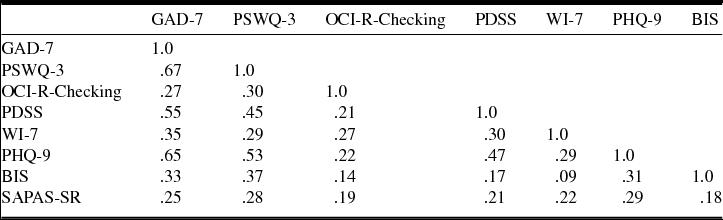
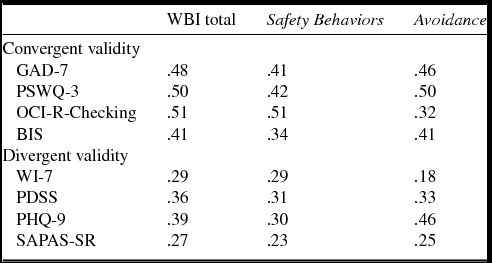
Correlations between study measures are provided in Table 1 (all p values<.01, except p < .05 for the WI-7/BIS and SAPAS-SR/BIS correlations). Moderate, positive correlations were found between the WBI total score and measures of GAD symptoms, checking behaviors, and behavioral inhibition (see Table 2, r values = .32 to .51, all p values < .001). The WBI total was also significantly correlated to measures of anxiety, depression and personality pathology (r values =.18 to .46, all p values <.001; Table 2). Supporting the divergent validity of the WBI, tests of significant differences between the magnitude of overlapping correlations suggested that the WBI total score was more strongly correlated with the GAD-7 than the PDSS (z = 3.61, p < .001), PHQ-9 (z = 3.08, p < .001), WI-7 (z = 4.72, p < .001), and SAPAS-SR (z = 4.85, p < .001). This pattern of results was identical for the Safety Behaviors and Avoidance subscales with one exception; the Avoidance scale was as strongly related to the GAD-7 as it was to the PHQ-9 (z = .00, p = 1.00). This pattern of results was identical when the PSWQ-3 replaced the GAD-7 in these analyses.
Correlations between self-report measures completed by the clinical sample

GAD-7, Generalized Anxiety Disorder 7-item scale; PSWQ-3, Penn State Worry Questionnaire-3 item version; OCI-R, Obsessive Compulsive Inventory-Revised; PDSS, Panic Disorder Severity Scale; WI-7, Whitely Index-7 item; PHQ-9, Patient Health Questionnaire-9; BIS, Behavioral Inhibition System scale; SAPAS-SR, Self-Report Standardized Assessment of Personality-Abbreviated Scale.
Correlations between WBI scores and validity measures in the clinical sample

WBI, Worry Behaviours Inventory; GAD-7, Generalized Anxiety Disorder 7-item scale; PSWQ-3, Penn State Worry Questionnaire-3 item version; OCI-R-Checking, Obsessive Compulsive Inventory-Revised- Checking Subscale; BIS, Behavioral Inhibition System scale; WI-7, Whitely Index- 7 item; PDSS, Panic Disorder Severity Scale; PHQ-9, Patient Health Questionnaire-9; SAPAS-SR, Self-Report Standardized Assessment of Personality-Abbreviated Scale.
In the community sample, moderate correlations were found between the WBI total score and the GAD-7 (r = .32, p < .01), PSWQ-3 (r = .49, p < .001), TRSS-General Threat (r = .65, p < .001) and TRSS-Evaluative Threat (r = .46, p < .001). Similar results were found for the WBI subscales.
Discriminant validity
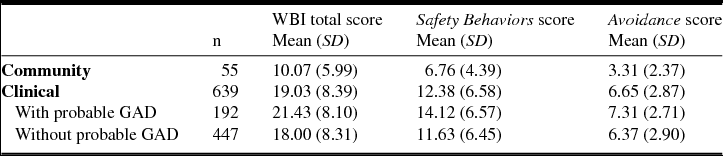
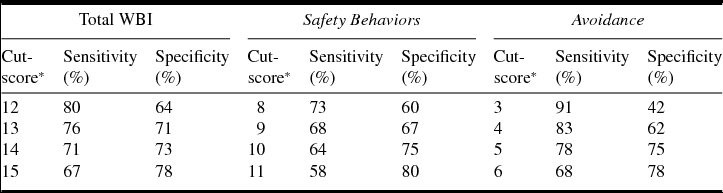
WBI scores were higher in the clinical sample compared with the community sample (see Table 3, total score t (692) = 7.75, p < .001, d = 1.23; Safety Behaviors t (692) = 6.21, p < .001, d = 1.00; Avoidance t (692) = 8.39, p < .001, d = 1.27). ROC analyses suggested that WBI scores discriminated between clinical and community participants {total WBI score area under the curve [AUC (95% CI)] = 0.80 (0.75–0.86); Safety Behaviors = 0.75 (0.70–0.81); Avoidance = 0.81 (0.75–0.86)}. The operating characteristics of the WBI are shown in Table 4. Sensitivity and specificity for the discrimination between the clinical and community samples were maximized at cut scores of 13 for the WBI total score, and 10 and 5 for the Safety Behaviors and Avoidance subscales, respectively.
Descriptive statistics for the WBI in the clinical and community samples

WBI, Worry Behaviors Inventory; SD, standard deviation; GAD, generalized anxiety disorder.
Operating characteristics between the WBI and a probable diagnosis of generalized anxiety disorder at varying cut-scores

WBI, Worry Behaviors Inventory. *Cut-score: the actual WBI score is greater than or equal to the cut-score shown.
The clinical sample was divided into patients with and without a probable diagnosis of GAD (defined as a diagnosis of GAD according to the Mini-CIDI and scoring ≥ 10 on the GAD-7). Patients with a probable diagnosis of GAD had significantly higher WBI scores than those without GAD (see Table 3, total t (637) = 4.82, p < .001, d = .42; Safety Behaviors t (637) = 4.45, p < .001, d = .38; Avoidance t (637) = 3.82, p < .001, d = .33), but ROC analyses suggested that discrimination between these groups was sub-optimal [AUC (95% CI) = 0.61 (0.57–0.66) for total; 0.60 (0.56–0.65) for Safety Behaviors; 0.59 (0.54–0.64) for Avoidance)].
Incremental validity
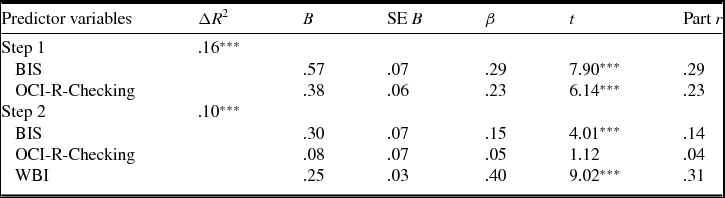
WBI total scores predicted symptoms of GAD over and above behavioral inhibition and checking behaviors (see Table 5). This pattern of results was identical when (i) WBI subscales were entered in Step 2 instead of the total score, and (ii) the PSWQ-3 replaced the GAD-7 as the criterion variable.
Summary of hierarchical regression analysis for variables predicting GAD-7 scores (n = 631)

BIS, Behavioral Inhibition System scale; OCI-R-Checking, Obsessive Compulsive Inventory-Revised Checking subscale; WBI, Worry Behaviours Inventory; Δ, change. ***p < .001.
Discussion
Understanding how people with GAD engage in maladaptive behaviors is important from both a theoretical and clinical perspective because the use of such behaviors may contribute to the maintenance of the disorder. Before the role of maladaptive behaviors in maintaining GAD can be appropriately scrutinized, an empirically supported measure of these behaviors is needed. The aim of this study was to replicate and extend Mahoney et al.’s (2016) initial psychometric evaluation of the WBI in order to provide clinicians and researchers with a reliable and valid index of the maladaptive behaviors that are associated with GAD.
Confirmatory factor analysis supported the two-factor structure of the WBI. Consistent with the initial structural examinations of the WBI (Mahoney et al., Reference Mahoney, Hobbs, Newby, Williams, Sunderland and Andrews2016), the CFI and TLI indicated acceptable to good fit, however, the RMSEA was slightly over the threshold of the a priori cut-point of 0.10. The internal consistency of the WBI was good in both the clinical and community samples, although the internal consistency of the Avoidance subscale was fair (α = .70 and .67). This partly reflects the small number of items in the Avoidance scale, and future investigations could evaluate whether adding further items to the Avoidance scale from the original WBI item pool would enhance its internal consistency without weakening its validity. To complement the current findings of the traditional psychometric properties of the WBI, future research may also examine the psychometric properties of the WBI items within an item-response theory framework. Such analyses would provide additional details about the relationship between the behaviors that are associated with GAD, GAD symptom severity and the likelihood of engaging in each maladaptive behavior. Additionally, the small size of the community sample precluded examination of the factor structure in a non-clinical population. Nevertheless, the two-factor structure of the WBI has now been observed in two large clinical samples – one drawn from a face-to-face treatment clinic and the other from an online clinic (see Mahoney et al., Reference Mahoney, Hobbs, Newby, Williams, Sunderland and Andrews2016). These are the most common settings where individuals with GAD undertake CBT and are therefore most likely to benefit from the use of the WBI to identify maladaptive behaviors that can be addressed in treatment.
The WBI demonstrated temporal stability and treatment sensitivity. The online CBT programmes lead to moderate effect size reductions in WBI scores (d range = 0.68–0.73) which are commensurate with previously reported treatment outcomes for these programmes (Mewton et al., Reference Mewton, Wong and Andrews2012; Newby et al., Reference Newby, Mewton and Andrews2017). Although replication of our findings is needed, the current estimates of temporal stability and treatment sensitivity suggest that the WBI can be reliably used to identify problematic behaviors associated with GAD and to monitor patients’ progress through treatment. It is currently unclear whether reductions in worry across treatment cause reductions in maladaptive behaviors or whether these relationships are more complex. Future research is now needed to understand the mechanisms that are responsible for the reduction of maladaptive behaviors during CBT and whether these reductions predict treatment outcomes.
The WBI discriminated well between the clinical and community samples. The WBI scores of the clinical participants were about twice as high as those of the community participants. Sensitivity and specificity for discriminating between these groups were maximized at cut scores of 13 for the total score, and 10 and 5 for the Safety Behaviors and Avoidance subscales, respectively. Clinicians can use these thresholds as a guide for identifying pathological levels of maladaptive behaviors when screening and assessing patients as well as identifying when patients are approaching non-clinical levels of maladaptive behaviors during treatment. Our findings supporting the incremental validity of the WBI also attest to the clinical utility of the scale. We found that the WBI predicted symptoms of GAD over and above existing measures of checking and behavioral inhibition. Compared with existing measures, the WBI indexes a wider range of clinically meaningful maladaptive behaviors that clinicians can use to inform their case formulation and treatment plan. The WBI is also brief, which is particularly important in settings where there is limited time to administer measures.
The current study found evidence in support of the convergent and divergent validity of the WBI. The WBI total and subscales correlated moderately with measures of GAD symptom severity, safety-seeking behaviors (reassurance seeking, checking behaviors) and behavioral inhibition. Although the WBI also significantly correlated with symptoms of other disorders (depression, panic disorder, health anxiety, and personality disorders), the WBI was invariably more strongly related to GAD symptom severity. The one exception was that the Avoidance subscale was as strongly related to the GAD-7 as it was to the PHQ-9. These results are similar to the findings of the initial psychometric evaluation of the WBI (Mahoney et al., Reference Mahoney, Hobbs, Newby, Williams, Sunderland and Andrews2016). It is unsurprising that the WBI correlates with symptoms of multiple mental disorders because of the risk factors and clinical correlates that are shared by these disorders (e.g. Goldberg et al., Reference Goldberg, Andrews, Krueger and Hobbs2009). Nevertheless, our results suggest that the maladaptive behaviors assessed by the WBI demonstrate relative specificity to GAD symptoms compared with symptoms of other disorders. We also found that patients with a probable diagnosis of GAD reported significantly higher WBI scores than patients without a probable diagnosis of GAD. However, ROC analyses suggested that the WBI's ability to discriminate between these two groups was suboptimal. This again suggests that while the maladaptive behaviors indexed by the WBI may be most strongly related to GAD, these behaviors are not exclusively related to GAD but are associated with other anxiety disorders and depression.
Several implications for the conceptualization and classification of GAD can be drawn from this study. Supporting cognitive models of GAD, participants with a probable diagnosis of GAD reported using maladaptive behaviors to manage their worry more frequently than patients without probable GAD and community participants. Moreover, CBT significantly reduced the use of these behaviors. It is now important to understand how maladaptive behaviors interact with the more established maintaining factors of GAD such as cognitive avoidance, intolerance of uncertainty and metacognitive beliefs, and whether there is a causal relationship between maladaptive behaviors and symptoms of GAD. When behavioral criteria were considered for the DSM-5 classification of GAD, scant data were available for determining which behaviors were specific to GAD and at which threshold behaviors became pathological. This study found that the maladaptive behaviors indexed by the WBI discriminated well between patients and community participants, and while these behaviors were not specific to GAD, they were more strongly related to symptoms of GAD than symptoms of other disorders. That said, our findings must be interpreted within their context. This study relied exclusively on self-report data. We did not conduct clinician-rated structured diagnostic assessments and we did not assess all disorders where maladaptive behaviors associated with worry may be prevalent (e.g. post-traumatic stress disorder and separation anxiety disorder). As such, many questions remain about the diagnostic specificity of maladaptive behaviors in GAD. It also remains to be seen if including maladaptive behaviors in the GAD classification would enhance the reliability, validity and clinical utility of the diagnosis.
Conclusion
The WBI provides clinicians and researchers with a brief, self-report index of clinically meaningful maladaptive behaviors that are associated with GAD. The psychometric performance of the scale has now been evaluated in two large clinical samples with findings supporting the reliability and validity of the scale.
Acknowledgements
Financial support: A.M. is supported by an Australian Government Research Training Program Scholarship. J.N. is supported by a NHMRC Early Career Research Fellowship (1033787).
Ethical statement: All authors have abided by the Ethical Principles of Psychologists and Code of Conduct as set out by the APA. Data from the clinical sample were collected within the Quality Assurance Activities of St Vincent's Hospital, Sydney Australia. All patients were informed and provided electronic informed consent that their data would be collected, their pooled data analysed and published in scientific journals. Patients could opt out of the use of their data for these purposes via email with no impact on their receipt of treatment. The human ethics committee at St Vincent's Hospital, Sydney approved all study procedures involving community participants (LNR/13/SVH/325).
Conflicts of interest: Alison Mahoney, Megan Hobbs, Jill Newby, Alishia Williams and Gavin Andrews have no conflicts of interest with respect to this publication.
Appendix: Worry Behaviors Inventory
People can worry about everyday things, like their family, finances, work, health, the future, or minor things like being on time. This questionnaire concerns the sorts of things people do to prevent, control, or avoid worrying. Please select the number that best describes what you do generally.


Items 4, 7 and 8 form the Avoidance scale. Remaining items form the Safety Behaviors scale.



Comments
No Comments have been published for this article.