Introduction
Otolaryngology has traditionally been a highly competitive specialty.Reference McNally1 However, recent trends show application rates are declining at an alarming rate with competition ratios for an otolaryngology specialty year three training post falling from 3:1 in 2013 to 1.5:1 in 2016.Reference Green, Steven and Haddow2 In 2017, some otolaryngology year three training posts were left unfilled for the first time since national selection has been in place.Reference Green, Steven and Haddow2 The 2018 application process saw a rise in competition ratios to 2.36:1, but it is not yet clear whether this signifies a true recovery in application numbers.3 Similar trends have been observed in Canada and the USA. In 2017, there was a record low in the number of applications to otolaryngology residency in the USA, with 14 posts left unfilled.Reference Schmalbach4 This is following a continual decline in application rates since 2014.Reference Kramer5 National data from the Canadian Resident Matching Service for the period from 2002 to 2007 compared with 2008 to 2013 showed a 16.1 per cent decline in first-choice applications to otolaryngology.Reference Kay-Rivest, Varma, Scott, Manoukian, Desrosiers and Vaccani6
Medical graduates’ career choices are important to understand, being the major determinants of the future medical workforce.Reference Takeda, Morio, Snell, Otaki, Takahashi and Kai7 Demands on otolaryngology service provision are predicted to increase with problems such as hearing loss, dizziness and epistaxis being prevalent in the growing ageing population. In the UK, there are concerns that future workforce demands in otolaryngology will outstrip supply.Reference Wilmot, Davis and Carrie8 In 2011, The British Association of Otolaryngologists recommended a consultant workforce to population ratio of 1:50 000, with figures at the time around 1:86 000.9 Using those recommendations today, we would require a consultant workforce body of around 1300, but figures from 2018 show there were just 771 consultants in otolaryngology posts.Reference Wilmot, Davis and Carrie8
In this study, we aimed to establish what factors influence medical students’ and junior doctors’ decision to pursue a career in otolaryngology. Doing this may help to facilitate active recruitment into otolaryngology higher surgical training programmes. Our objective is to systematically review the informative, published literature relating to the factors that attract or deter medical students and junior doctors from pursuing otolaryngology as a future career.
Materials and methods
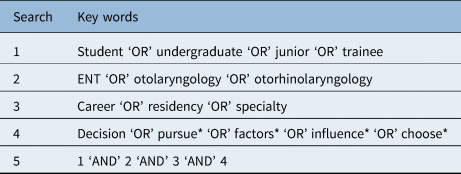
This study was conducted according to the Preferred Reporting Items for Systematic Reviews and Meta-Analyses 2009 checklist recommendations. We performed a literature search of three major databases, PubMed, Embase and Medline, in January 2019. PubMed was searched using the terms ‘ENT career’, ‘otolaryngology residency selection’ or ‘otolaryngology career’. The search strategy for Medline and Embase is shown in Table 1. The reference lists of retrieved articles were screened for identification of other pertinent literature.
Search strategy used for Medline and Embase

*indicates truncation. ‘OR’ and ‘AND’ are Boolean operators
For the purpose of the study, medical students were defined as individuals in medical school or internships who had not graduated as doctors. Junior doctors were defined as those who had graduated from medical school but had not yet begun a higher surgical training post. The intention to apply to otolaryngology higher surgical training posts or otolaryngology residency was considered equivalent to pursuing a career in otolaryngology. Primary research using quantitative, qualitative or mixed methodology to investigate the factors that influence medical students’ and junior doctors’ decision to pursue a career in otolaryngology was included. Studies that investigated career choice in general but did not contain information specific to otolaryngology as a career choice were excluded. Studies that did not address the research question or studies involving participants other than junior doctors or medical students were excluded. There were no location, language or publication date restrictions.
Results of the search strategy were catalogued using Mendeley Library software, and duplicates were removed. Studies were initially screened by title and abstract by two reviewers (AW Mayer and KA Smith) to identify potentially relevant studies. Any disagreement between the two reviewers was settled by discussion. Full-text articles of studies identified in the initial screen were reviewed against the inclusion and exclusion criteria. Data from eligible full-text articles were collected using a standardised data extraction form comprising general characteristics (author, date of publication, study design, study population and sample size), methodology and results.
Results and analysis
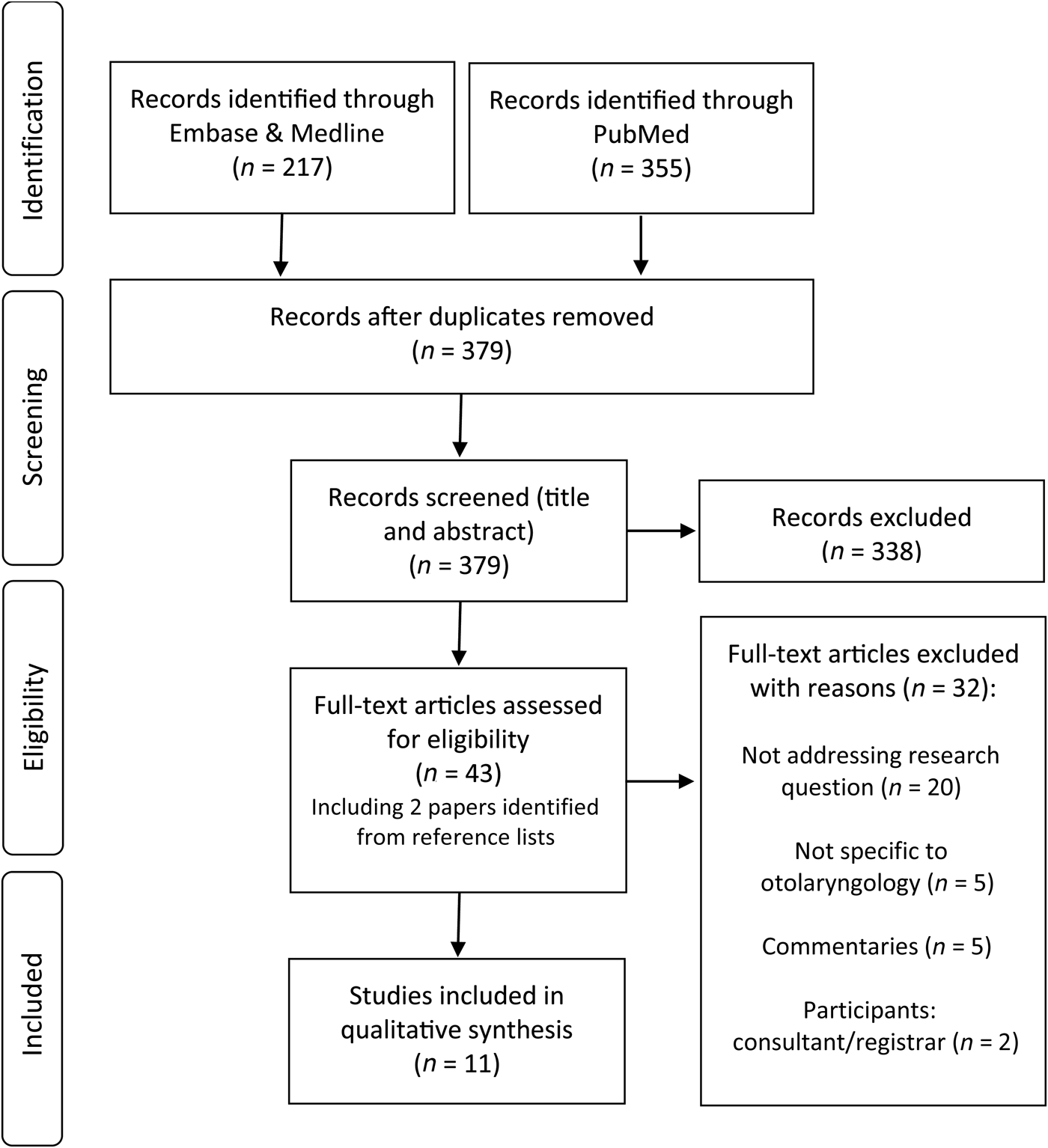
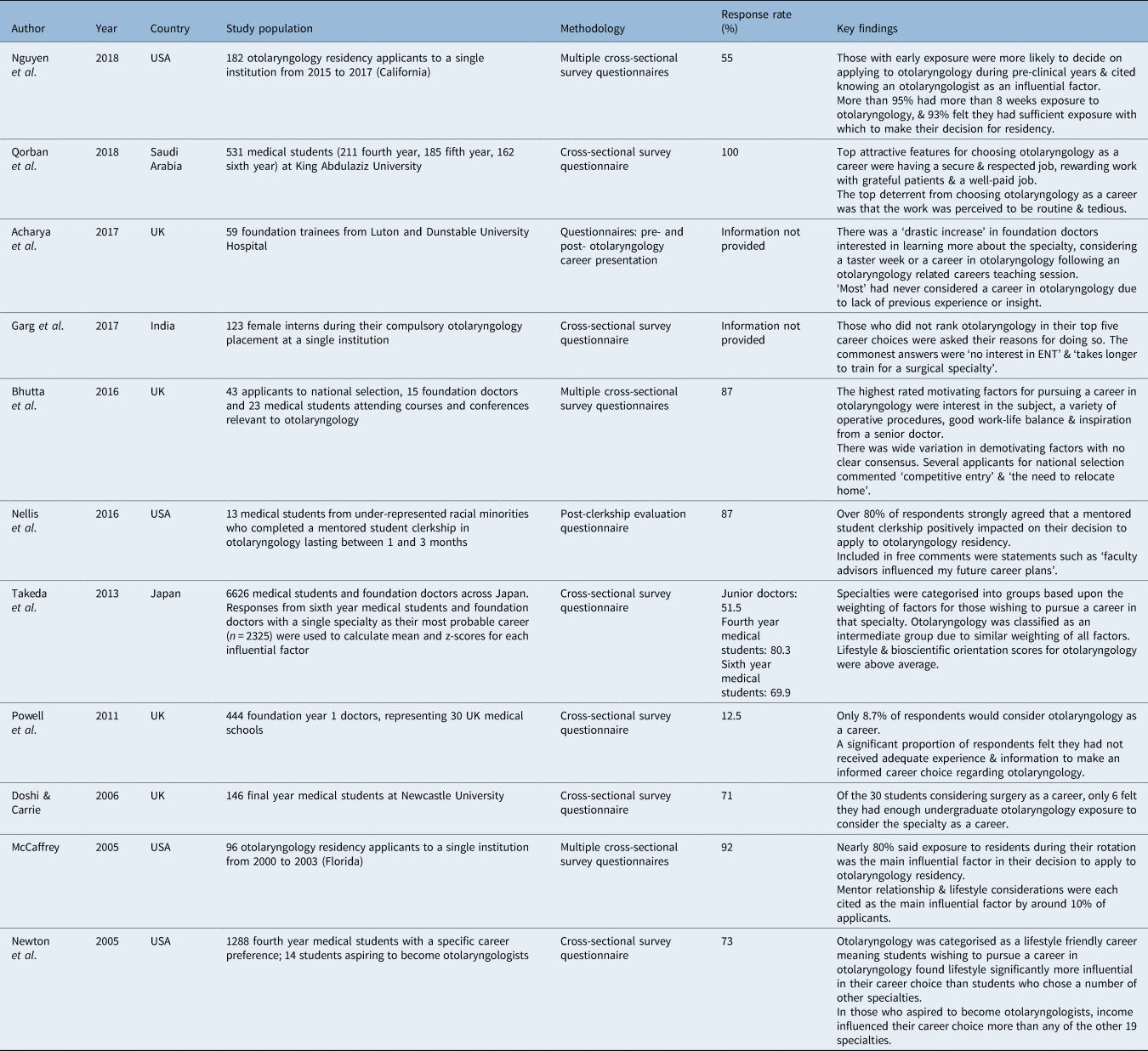
We identified 355 studies from PubMed and 217 from Embase and Medline. After removal of any duplicates, 379 articles were screened by title and abstract, and 338 were excluded as they were not relevant to the research question. Full-text review of the remaining 43 papers resulted in further exclusion of 32 papers (see Figure 1 for exclusion reasons). In total, 11 papers were included in our final review. Key findings are summarised in Table 2.
Preferred Reporting Items for Systematic Reviews and Meta-Analyses flow diagram.

Summary of the characteristics and key findings of included studies

Themes
Exposure to otolaryngology
Three studies identified lack of exposure to otolaryngology as a deterrent from pursuing it as a career.Reference Powell, Cooles, Carrie and Paleri10–Reference Doshi and Carrie12 Similarly, three other studies identified exposure to otolaryngology at undergraduate level as an important influential factor in medical students’ decision to pursue it as career.Reference Nguyen, Liu and Church13–Reference Nellis, Eisele, Francis, Hillel and Lin15 One study suggested that even late exposure to otolaryngology can have a powerful influence on junior doctors’ future career plans. Bhutta et al. surveyed 43 applicants to national selection in the UK: of these, 16 per cent had not been exposed to otolaryngology in medical school or foundation training years. This group had not considered otolaryngology as a career until they were exposed during a core surgical training post, at which point otolaryngology became their definite and preferred career choice.Reference Bhutta, Mandavia, Syed, Qureshi, Hettige and Wong16
Role models
Four studies identified mentor relationship, role models or inspiration from senior doctors as a positive influential factor in medical students’ and junior doctors’ decision to pursue otolaryngology as a career.Reference Nguyen, Liu and Church13–Reference Bhutta, Mandavia, Syed, Qureshi, Hettige and Wong16
Lifestyle
Four studies reported results relating to the influence of lifestyle considerations on the choice of otolaryngology as a career.Reference Takeda, Morio, Snell, Otaki, Takahashi and Kai7,Reference McCaffrey14,Reference Bhutta, Mandavia, Syed, Qureshi, Hettige and Wong16,Reference Newton, Grayson and Thompson17 Newton et al. analysed questionnaire data from 1288 fourth year medical students with specific career preferences from two US medical schools. The survey asked participants to rate the influence of various career attributes on their selection of career specialty using a four-point Likert scale (1 = no influence, 4 = major influence). Otolaryngology was categorised as one of eight ‘lifestyle friendly’ careers with a lifestyle factor score of 3.10.Reference Newton, Grayson and Thompson17
Interest in otolaryngology
Bhutta et al. found interest in the subject of otolaryngology was amongst the most highly rated motivating factors for pursuing a career in otolaryngology with respondents giving a median score of five for their questionnaire (1 = not at all important, 5 = very important).Reference Bhutta, Mandavia, Syed, Qureshi, Hettige and Wong16 Takeda et al. found that the factor score for ‘bioscientific orientation’ (encompassing interest in otolaryngology as a subject) was higher for otolaryngology than other specialties on average.Reference Takeda, Morio, Snell, Otaki, Takahashi and Kai7 Garg et al. found that amongst their cohort of female medical students, lack of interest in otolaryngology was the main reason for not pursuing it as a career.Reference Garg, Arora, Kumar and Singh18
Income
Newton et al. showed students who aspired to become otolaryngologists found income influenced their career choice more so than any of the other nineteen specialties analysed with a mean Likert score of 3.24 (1 = no influence, 4 = major influence).Reference Newton, Grayson and Thompson17
Discussion
Potential biases
Ten studies recruited participants through non-random selection, introducing a risk of sampling bias.Reference Takeda, Morio, Snell, Otaki, Takahashi and Kai7,Reference Powell, Cooles, Carrie and Paleri10,Reference Doshi and Carrie12–Reference Qorban, Al-Khatib, Howldar, Allinjawi, Jawa and Baig19 Three of these studies recruited participants through their applications to otolaryngology residency or national selection, subjecting their results to membership bias.Reference Nguyen, Liu and Church13,Reference McCaffrey14,Reference Bhutta, Mandavia, Syed, Qureshi, Hettige and Wong16 Similarly, four studies surveyed medical students with a specific interest in otolaryngology.Reference Takeda, Morio, Snell, Otaki, Takahashi and Kai7,Reference Nellis, Eisele, Francis, Hillel and Lin15–Reference Newton, Grayson and Thompson17
Two studies were only available as conference abstracts.Reference Acharya, Kuo, Raithatha, Haywood, Sharma and Kothari11,Reference Nguyen, Liu and Church13 As a result, we obtained limited information on these studies with no details of the sampling methodologyReference Acharya, Kuo, Raithatha, Haywood, Sharma and Kothari11 or the method of statistical analyses.Reference Nguyen, Liu and Church13 This limited our ability to appraise their data collection methods.
All included studies relied on questionnaires to collect data, with the inherent limitation that this restricts the opportunity for participants to express their views. Six studies used questionnaires that consisted entirely of closed questions which further compounds this disadvantage.Reference Takeda, Morio, Snell, Otaki, Takahashi and Kai7,Reference Powell, Cooles, Carrie and Paleri10,Reference Doshi and Carrie12,Reference McCaffrey14,Reference Newton, Grayson and Thompson17,Reference Qorban, Al-Khatib, Howldar, Allinjawi, Jawa and Baig19 Response rates showed wide variation, with one study that had only a 12.5 per cent response rate.Reference Powell, Cooles, Carrie and Paleri10 One study did not specify whether responses to their questionnaire were anonymous.Reference Nellis, Eisele, Francis, Hillel and Lin15 If participants were not promised confidentiality their responses may have been altered through response bias or the Hawthorne effect, where participants' awareness of being observed leads to alterations in their behaviour, potentially undermining the results. Three studies had notably small sample sizes leaving results prone to sampling error and limiting the power to detect significance where statistical analysis was applied.Reference Doshi and Carrie12,Reference Nellis, Eisele, Francis, Hillel and Lin15,Reference Newton, Grayson and Thompson17
Reliability and validity
Copies of questionnaires could not be obtained for five studies, prohibiting a thorough assessment of their reliability and validity.Reference Acharya, Kuo, Raithatha, Haywood, Sharma and Kothari11,Reference Nguyen, Liu and Church13,Reference Nellis, Eisele, Francis, Hillel and Lin15–Reference Newton, Grayson and Thompson17 Six studies provided copies of their questionnaire, five of which appeared to have good face validity.Reference Takeda, Morio, Snell, Otaki, Takahashi and Kai7,Reference Powell, Cooles, Carrie and Paleri10,Reference Doshi and Carrie12,Reference McCaffrey14,Reference Garg, Arora, Kumar and Singh18 The questionnaire by Qorban et al. was poorly designed: it could not be ascertained whether a large proportion of responses were in the context of attracting or deterring the students from choosing otolaryngology as a career.Reference Qorban, Al-Khatib, Howldar, Allinjawi, Jawa and Baig19 These results were neither acknowledged nor discussed by the authors. Instead, responses from the remainder of the questionnaire were used to draw conclusions. Thus, we feel this study has poor face and internal validity. Three studies analysed results based on self-reported specialty preferences of medical students. It was not demonstrated whether these specialty preferences had predictive validity for application to otolaryngology training.Reference Takeda, Morio, Snell, Otaki, Takahashi and Kai7,Reference Bhutta, Mandavia, Syed, Qureshi, Hettige and Wong16,Reference Newton, Grayson and Thompson17
The external validity of the findings is limited. There was wide variation in the geographical location of the studies. None of the included studies showed an equal representation of medical schools or teaching hospitals within the country where they were completed. One study included only female participants.Reference Garg, Arora, Kumar and Singh18
Implications for clinical practice
A key finding in our review was the importance of exposure as an influential factor in medical students’ and junior doctors’ decision to pursue a career in otolaryngology. In the UK, otolaryngology is under-represented in medical school, typically comprising less than 1 per cent of the curriculum.Reference Davies and Elhassan20 The average duration of undergraduate otolaryngology placement in the UK varies between 8 to 13.7 days, with most UK medical graduates feeling they have not received enough otolaryngology undergraduate training.Reference Ferguson, Bacila and Swamy21 Similar findings are observed in Canada, with mean placement duration of 4.6 days, and in the United States, with placement durations showing wide variance between 4 hours and 4 weeks. Like the UK, a significant proportion of medical schools lack mandatory otolaryngology placements.Reference Ishman, Stewart, Senser, Stewart, Stanley and Stierer22–Reference Campisi, Asaria and Brown24 Furthermore, this appears to result in important omissions from the curriculum. A recent review of UK otolaryngology undergraduate curricula showed only two thirds of medical schools include taking an otolaryngology history, and only 58 per cent included tonsillitis.Reference Steven, Mires, Lloyd and McAleer25
One possible way to increase exposure is through more widespread use of e-learning. E-learning carries several advantages: learners have control over the content, pace, time and place in which learning occurs.Reference Zehry, Halder and Theodosiou26 A wealth of otolaryngology e-learning resources exists online, illustrated by the recent development of a validated tool to assess the quality of educational websites in otolaryngology (the Modified Education in Otolaryngology Website assessment tool).Reference Yang, Hosseini, Mascarella, Young, Posel and Fung27 So how does e-learning compare to traditional teaching methods? A recent systematic literature review by Tarpada et al. assessed the efficacy of e-learning for otolaryngology education. This demonstrated that, when compared with standard teaching methods, the use of e-learning improved objective performance in academic or clinical measures or resulted in no difference in performance but higher student satisfaction.Reference Tarpada, Hsueh and Gibber28 But despite a growing body of evidence to support e-learning in otolaryngology, only a minority of UK medical schools are using it as a teaching method.Reference Steven, Mires, Lloyd and McAleer25
Optional clerkships, or student selected components, can influence students’ career prospects.Reference Peel, Schlachta and Alkhamesi29 One study in our review demonstrated that a student clerkship in otolaryngology not only positively influenced a participant's decision to pursue otolaryngology as a career but also had predictive validity for application to otolaryngology residency.Reference Nellis, Eisele, Francis, Hillel and Lin15 In the UK, around two thirds of medical schools offer student selected components in otolaryngology, which is lower than that of Canada and USA where around 81 per cent and 89 per cent, respectively, offer selective clerkships in otolaryngology.Reference Boscoe and Cabrera-Muffly23,Reference Campisi, Asaria and Brown24 Wider availability of otolaryngology student selected components in the UK, particularly for those in the early years of medical school may help to increase interest in the field and application rates to higher surgical training posts. Student selected components also provide a clinical supervisor who can act as a mentor and positive role model. Medical students’ interest in surgery has been shown to significantly increase when partnered with a surgical mentor.Reference Peel, Schlachta and Alkhamesi29 Otolaryngology undergraduate leads should therefore be identifying motivated consultants and registrars who would make suitable mentors.
A recent systematic review of factors affecting surgery as a career choice demonstrated the critical importance of exposure during pre-clinical years. Peel et al. suggested that decisions about specialties of interest are formed during this period without dissuasion from considerations of work-life balance or lifestyle.Reference Peel, Schlachta and Alkhamesi29 A common way in which medical students are exposed to specialties at an early stage is through university societies, the significance of which should not be underestimated. A recent study of 276 Brazilian medical graduates assessed the impact of participating in a surgeon-led trauma society during medical school. This showed that over 90 per cent of participants believed that participating in the society provided knowledge and information that the medical school curriculum could not provide and had positively influenced their career choice.Reference Simões, Dorigatti, Silveira, Calderan, Rizoli and Fraga30 Although several undergraduate otolaryngology societies exist in the UK, not every medical school has one. Widespread availability of such societies and greater representation of otolaryngology within generic surgical societies should be facilitated by senior otolaryngologists in order to maximise undergraduate exposure.
Comparison with other reviews
In our review, neither a lack of same-sex role models or gender discrimination were identified as deterrents from pursuing a career in otolaryngology. In contrast, a gender-specific deterrence to a career in surgery for women has been clearly defined.Reference Peel, Schlachta and Alkhamesi29 This disparity may in part be explained by the larger consultant female workforce in otolaryngology, but also due to the greater propensity for less than full-time training within the specialty.Reference Wilmot, Davis and Carrie8,9 Although our review did not identify gender bias as a deterrent, there is evidence that it is present within otolaryngology.Reference Johnson31 Our study population was exclusively medical students and junior doctors not yet on higher surgical training programmes. Therefore, it may be that gender discrimination is only recognised and experienced during training within the specialty.
Lifestyle and work-life balance were identified as key influential factors for pursuing a career in otolaryngology. There is a lack of objective data from the UK regarding lifestyle and work-life balance in otolaryngology; however, a recent systematic review by Pulcrano et al. provided a comprehensive understanding of quality of life and burnout rates amongst surgeons practising in the USA. Analysis of eight studies specifically pertaining to quality of life in otolaryngology residents and attending physicians showed that they had some of the highest rates of career dissatisfaction amongst the surgical specialties.Reference Pulcrano, Evans and Sosin32 They found that 20 per cent of otolaryngologists reported low quality of life. This suggests there is perhaps a mismatch between medical students’ and junior doctors’ perceptions of otolaryngology and the reality of training and working within the specialty. It should be noted however that quality of life parameters were better for attending physicians than residents.Reference Pulcrano, Evans and Sosin32 In the USA, otolaryngology residents work around 71 hours per week on average.Reference Garcia-Rodriguez, Sanchez, Ko, Williams, Peterson and Yaremchuk33 In the UK, the European Working Time Directive together with the introduction of a new junior doctor's contract in 2016 limits average working hours to 48 per week, with a maximum of 72 hours in a 7-day period.34 Further research is needed to ascertain whether the quality of life of otolaryngologists in the UK is comparable to that in the USA.
Implications for research
Given the limitations of our study, the results are not generalisable and no causation can be inferred. However, we hope that this review highlights where further research may be directed. Most of our review findings were based upon the responses of applicants to otolaryngology training programmes or students with intent to pursue a career in otolaryngology. More research to explore the views of those not considering otolaryngology as a career is required. Given the limited undergraduate exposure to otolaryngology, it is possible that we are losing potential otolaryngologists due to lack of awareness or knowledge about the specialty.
Conclusions
This review reiterates the need for greater undergraduate exposure to otolaryngology. In today's crowded medical school curriculum, otolaryngology teaching leads should consider the advantages of more widespread use of e-learning. In addition, mentorship for students with an interest in otolaryngology should be a priority. This may help facilitate active recruitment of medical students and junior doctors into otolaryngology higher surgical training.
Competing interests
None declared