Introduction
Let us stipulate that a sensus divinitatis is a (broadly speaking) cognitive faculty or mechanism by which one may gain non-inferential justification for theistic beliefs.Footnote 1 As standardly conceived, this faculty will be triggered in certain characteristic kinds of cases – e.g. seeing a beautiful sunset, feeling guilty for some wrong, wondering at the immensity of the universe or at a fortuitous happening of events. As a result, the agent comes to believe in God's existence (or some proposition obviously supporting his existence). Let us assume that humans have a sensus divinitatis (which, being ours, we shall call ‘the’ sensus divinitatis), and that some gain non-inferential justification for theism thereby.Footnote 2
In the most prominent model of the sensus divinitatis – Alvin Plantinga's Aquinas/Calvin model (Plantinga (Reference Plantinga2000), 168–186) – the sensus divinitatis is a special religious faculty. It is ‘special’ in that ‘if there is no such person as God, of course, then there is no such thing as a sensus divinitatis’ (ibid., 187). The fact that the sensus divinitatis is the sort of thing that is obviously absent if God does not exist suggests that it is not ‘standard equipment’ in our rational package, that it is separate from and possessed in addition to the rational faculties that non-theists admit, such as reason, perception, memory, and introspection. In this article, we argue for a quite different model, one related to a tradition far older than Calvin,Footnote 3 on which the sensus divinitatis emerges from our standard rational faculties. The operations of the sensus divinitatis are carried out, on a fundamental level, through reason, perception, and other faculties. We think there are formidable advantages to modelling the sensus divinitatis in this way – ones that make our model a better explanation of non-inferentially justified theistic belief.
You might wonder whether our task is to reform reformed epistemology or to replace it, to reduce the sensus divinitatis or to remove it. It is tough to tell what the difference is without a detailed understanding of which features are more or less central to reformed epistemology – something we do not claim to possess. Michael Bergmann, a reformed epistemologist himself, characterizes it as ‘the view that belief in God can be rational even if it is not inferred from any other beliefs’ (Bergmann (Reference Bergmann, Pojman and Rea2014), 613). Andrew Moon concurs, ‘Reformed epistemology, roughly, is the thesis that religious belief can be rational without argument’ (Moon (Reference Moon2016), 1). If the possibility of non-inferentially justified theistic belief is the defining feature of reformed epistemology, then our theory qualifies as an instance. Perhaps it is also important that the view be consonant with the historical reformed tradition. We are no experts in the reformed tradition, but there is no obvious tension between our model of the sensus divinitatis and Calvin's original idea (see ‘The advantages of reduction’ section below). In short, we think that our view has a strong claim to being an instance of reformed epistemology. Regardless, our main objective is to explain how individuals gain non-inferential justification for theistic belief (assuming they do), and along this dimension of evaluation, we think our model not only matches but in some ways surpasses the other models on offer.
In the next section, we give the necessary details on current models of the sensus divinitatis, establishing the context for our own, which we develop in the sections that follow. It should be noted that certain features of our model will be relevant not only to religious epistemology but epistemology generally conceived.
Current models of the sensus divinitatis
Plantinga uses the sensus divinitatis to model warranted theistic belief – warrant being that which, in sufficient quantity, makes the difference between knowledge and mere true belief (Plantinga (Reference Plantinga2000) ). Our discussion is focused on the different but related positive epistemic status of epistemic justification. Thus, we will reframe Plantinga's model in terms of justification. This is fair since Plantinga thinks warrant implies justification (Plantinga (Reference Plantinga1993), 192–193), and the model is arguably no less plausible for the swap.Footnote 4 Furthermore, Plantinga's model is often used to explain the justification of theistic belief, whether he intended it to serve this purpose or not, so it is worth assessing its merits in such a role. For convenience, we will speak as though Plantinga intended for his model to be used in this way (referring to it as ‘Plantinga's model’).
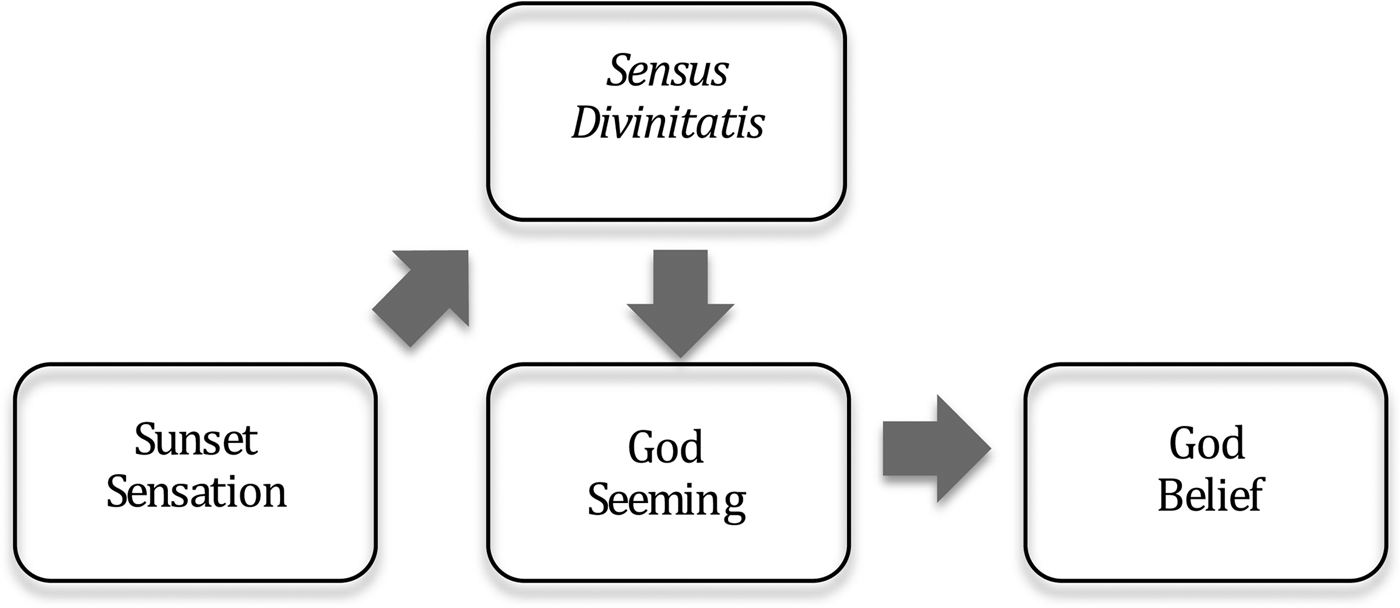
According to Plantinga, the sensus divinitatis is ‘a kind of faculty or a cognitive mechanism, . . . which in a wide variety of circumstances produces in us beliefs about God’ (Plantinga (Reference Plantinga2000), 172). He continues, ‘we can think of the sensus divinitatis, too, as an input-output device: it takes the circumstances mentioned above [experiences of flowers, sunsets, the starry skies above, the moral law within, etc.] as input and issues as output theistic beliefs’ (Plantinga (Reference Plantinga2000), 174–175). Tucker (Reference Tucker, Clark and VanArragon2011, 61) diagrams Plantinga's model as follows (Figure 1).
Plantinga's Model Version 1.

The sensations of a sunset, for instance, trigger the sensus divinitatis, which produces a theistic belief in turn. On a proper functionalist theory of justification, this theistic belief is justified if it results from the proper functioning of a faculty that is reliably aimed at truth and that is operating in the circumstances for which it was designed.Footnote 5 So, assuming God exists and created the faculty at work to reveal his existence, this theistic belief is justified.
Recently, Chris Tucker (Reference Tucker, Clark and VanArragon2011) has made several amendments to Plantinga's original model. These changes are a substantial step in the right direction, and we incorporate them into our own model. We will focus on three of Tucker's revisions.Footnote 6 The first is that the outputs of the sensus divinitatis are experiences about God (as opposed to beliefs about God). The experiences Tucker has in mind are the kinds of mental states one has when something seems true. Accordingly, such mental states have come to be called ‘seemings’. Seemings have propositional content and a distinct phenomenal character (variously) called ‘forcefulness’, ‘assertiveness’, and ‘felt veridicality’.Footnote 7 Tolhurst describes this phenomenology as ‘the feel of truth, the feel of a state whose content reveals how things really are’ (Tolhurst (Reference Tolhurst1998), 298–299). While this is the most prominent characterization of seemings, it is also contested.Footnote 8 Addressing these debates would take us too far afield. We will simply assume the aforementioned characterization of seemings and voice our conviction that the best arguments bear this view out.Footnote 9
Tucker's second amendment is that theistic beliefs are formed on the basis of theistic seemings. The basing relation at issue here is the one epistemologists are interested in; the one we speak about when we say that doxastically justified beliefs are ‘based on’ justifiers. On Plantinga's model, the theistic belief is most immediately based on the sensations that triggered its formation. On Tucker's model, these sensations continue to play a causal role in triggering the sensus divinitatis, but the belief is directly based on the theistic seeming, which inclines the subject to believe its content.
The third amendment is that, on Tucker's model, the theistic belief is non-inferentially justified by the seeming on which it is based. Implementing this suggestion requires that we adopt a view on which seemings at least sometimes provide evidence. We will use a view called reasons commonsensism:
Reasons Commonsensism (RC): If it seems to S that p, then S thereby has a pro tanto reason for believing p.Footnote 10
There are more moderate epistemic principles that could serve here. It is sufficient that the particular kinds of seemings produced by the sensus divinitatis provide reasons to believe their content or, even more modestly, that such seemings will regularly provide reasons to believe their content in the contexts faced by ordinary believers.
After implementing all of these suggestions, we get the following picture (Figure 2; from Tucker (Reference Tucker, Clark and VanArragon2011), 62).
Tucker's Model Version 1.

The sensus divinitatis inputs an experience and outputs a theistic seeming. This seeming gives the subject a pro tanto reason to believe the theistic content of that seeming. Potentially (if the seeming is strong enough and one's total evidence does not include stronger reasons that oppose the content of the seeming), one can form a non-inferentially justified theistic belief on the basis of this experience (or on the basis of many such experiences). Notice that the justification is indeed non-inferential, stemming from the immediate support provided by the seeming.
There are serious advantages to Tucker's framework. We will explain some of these advantages here, but an extended defence of these points will take us too far off track. Our goal is to revise and expand Tucker's view, not rehash it. For a fuller comparison of Tucker and Plantinga's models, we would point you to Tucker's own work.
The first advantage is that Tucker's model avoids some implausible implications of the proper functionalist account of evidence (ibid., 58–63). On proper functionalism, a mental state, m, is evidence for p for S if
i. belief that p is based on m, and
ii. S's belief that p is formed by the proper functioning of S's reliable, truth-aimed faculties operating in the environment for which they were designed.Footnote 11
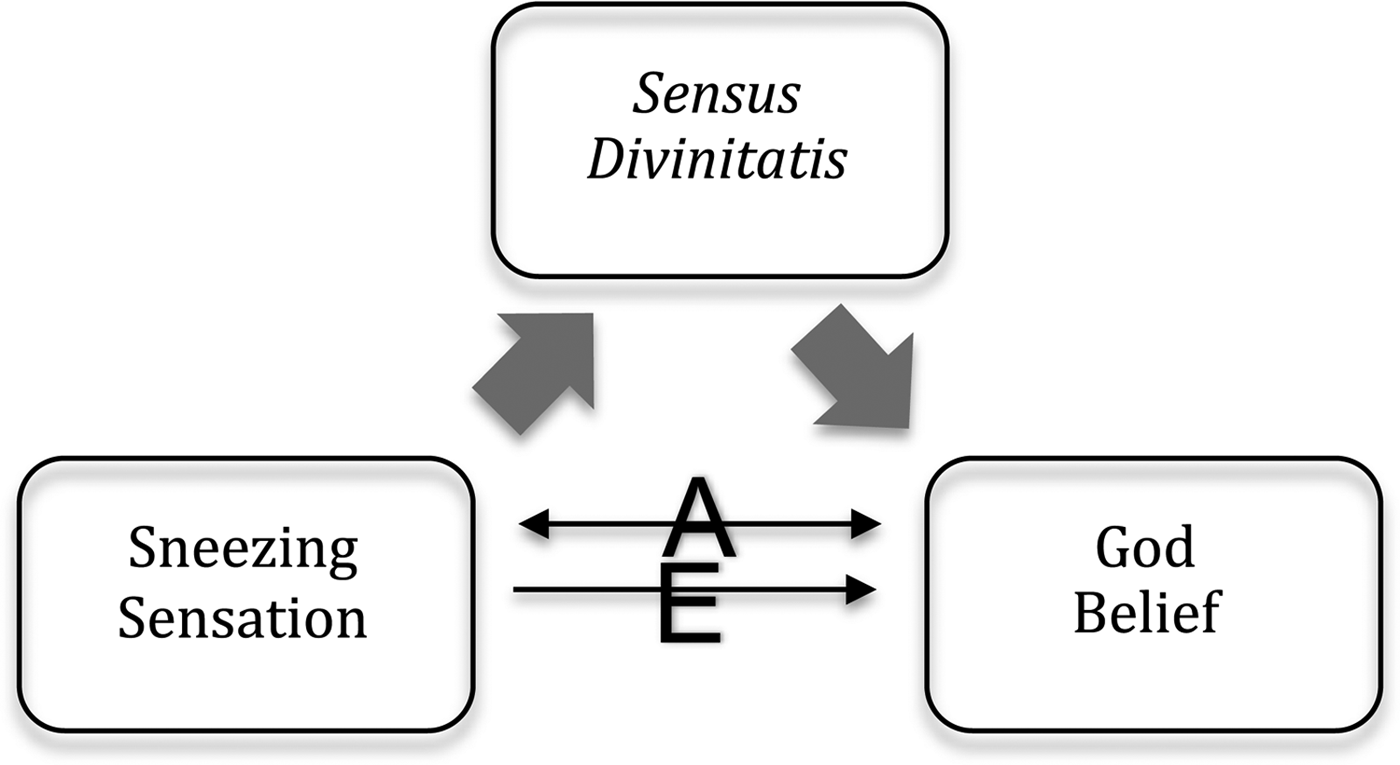
Applying this to the matter at hand, if God designs S's sensus divinitatis to produce belief in his existence in the presence of m, and S believes that God exists on the basis of m, then m is evidence of God's existence for S. Things become odd when you realize that, for all Plantinga has said, God could programme any mental state to trigger the sensus divinitatis. For instance, if the sensus divinitatis is designed to be triggered by sneezing or brushing one's teeth or reading the phone book (and this occurs), then the experience of sneezing or brushing one's teeth or reading the phone book becomes evidence that God exists. This is hard to swallow.
The root of the problem is that Plantinga's model, with its proper functionalist account of evidence, allows God's existence to be evidentially supported by apparently arbitrary experiences – ones that seem completely unrelated to God's existence. It is difficult to characterize precisely an ‘apparently arbitrary experience’, but we can at least say that those mental states whose content is, from the subject's perspective, probabilistically independent of God's existence are arbitrary in the intended sense. Let ‘←A→’ designate the relation of ‘apparent arbitrariness’. This relation exists between two mental states and is relative to a subject. m1←A→m2 is true for S iff the content of m1 and the content of m2 are probabilistically independent from S's perspective. Let ‘—E→’ designate a relation between a mental state, m, and a belief. For S, m—E→belief(p) is true iff m provides evidence for p for S. We can diagram the concern with Plantinga's model as follows (Figure 3).
Plantinga's Model Version 2.

To translate, the sneezing sensation provides evidence for God's existence, even though the content of the sneezing sensation and the existence of God are probabilistically independent from the subject's perspective. This is odd. How can a mental state provide evidence for God's existence if these things apparently have nothing to do with one another?
Tucker's model avoids this concern. On this framework, the sensation triggering the sensus divinitatis is not evidence for God's existence. Rather, it is the theistic seeming resulting from the sensus divinitatis that provides evidence (see Figure 4).
Tucker's Model Version 2.

Its seeming that God exists provides evidence that God exists. While this position has its own challenges, one charge it clearly avoids is that of arbitrariness. We are not tempted to say that the content of this seeming is completely irrelevant or unrelated to God's existence.
You might wonder whether Tucker's model offers any real advantage on this point. For all Tucker has said, the theistic seemings output by the sensus divinitatis might be prompted by experiences whose content apparently bears no probabilistic connection to the content of those seemings. Plantinga may have to admit that a sneeze can trigger belief that God exists, but is it any better to say that a sneeze can trigger a seeming that God exists? Both admit a prominent role for apparently arbitrary experiences (see Figure 5).
Tucker's Model Version 3.

The key difference – and the source of Tucker's advantage – is that, on Tucker's model, the triggering experience is not supposed to be evidence for the theistic seeming or its content. Seemings, as experiences, are not even the sort of thing you can have evidence for (McCain (Reference McCain2012), 48), nor can seemings be justified or unjustified (Huemer (Reference Huemer2001), 97–98). They are the experiential foundations underlying our noetic structures. On Tucker's model, the only evidential relations in play are those that exist between theistic seemings and theistic beliefs. In contrast, Plantinga must say that whatever triggers the formation of theistic beliefs in the properly functioning mind is evidence for those beliefs (or their content). Thus, we think Tucker's model offers a real advantage here.
This is not to say that Tucker's model rids itself of every problematic feature. In particular, we think it preferable (for reasons spelled out later) to remove the apparent arbitrariness between the experience that triggers the sensus divinitatis and the theistic seeming. We do not contend that the sensus divinitatis must be modelled in a way that removes this arbitrariness, but only that there are advantages to doing so. More on this shortly.
At present, we should mention some other advantages Tucker's model claims over Plantinga's. One is that it contains a psychologically superior account of belief formation. Experience confirms that we usually do not just find ourselves with basic beliefs – beliefs not based on any other beliefs – rather we form a basic belief in something because it seems true. Even Plantinga seems ready to admit this. He states: ‘Could it really be that you should believe a proposition, even though it had none of this phenomenal attractiveness, this seeming-to-be-true . . .?’ (Plantinga (1992), 193). So it is more accurate to model the sensus divinitatis as producing theistic belief via seemings.
A final advantage of Tucker's model is that it makes non-inferentially justified theistic belief consistent with evidentialism (at least as described in Conee and Feldman (Reference Conee and Feldman2004) ) and internalism. It broadens the appeal of the sensus divinitatis, and reformed epistemology more generally, to have an internalist-friendly model available. What is especially nice is that the basic framework of Tucker's model is externalist-friendly as well. While RC is implausible given externalism, there are externalist principles that can fill the role of RC in Tucker's model. For instance, if it is proper function to form theistic beliefs on the basis of theistic seemings, then a proper functionalist could endorse a version of Tucker's model.Footnote 12 Thus, Tucker's model (at least the basic framework) is something both internalists and externalists can get behind.
The reductive model: preliminaries
Like Tucker, we model the sensus divinitatis as a cognitive mechanism producing theistic seemings that provide evidence for theistic belief (in accordance with some epistemic principle like RC); but we go beyond Tucker in at least two principal ways. First, we simplify our model by avoiding any special religious faculty. Second, we fill out our model by giving an account of how these seemings are produced. This account of seeming formation is widely applicable and so is of relevance to epistemology more generally. We call our model ‘the reductive model’ since it reduces the sensus divinitatis to a sub-function of more fundamental cognitive faculties.
We begin by highlighting some of the intellectual abilities afforded to us by our standard rational faculties. We will then argue that the operations of the sensus divinitatis can be carried out by these standard rational faculties. Afterwards, we expand on the advantages that reducing the sensus divinitatis in this fashion affords us.
We start with the mundane observation that humans can sometimes tell when one proposition (or set of propositions) supports another. Properly understood, this is a platitude. Consider elementary argument forms like modus ponens. We can see that the premises of these deductively valid argument forms maximally support their conclusions.Footnote 13 To give another example, we can see that a reliable expert earnestly testifies that p, in concert with ordinary sorts of background information, supports p. Arguably, all rational inference requires this ability. How can we rationally infer one proposition from another if we cannot appreciate that the one supports the other?
A support relation exists between propositions when one proposition genuinely supports the others (for the relevant subject). We can therefore describe the ability to tell when one proposition supports another as the ability to ‘perceive’ support relations between propositions. The analogy with perception is less than ideal, as perceiving is a factive state – you cannot perceive a table if the table is not there – but you can ‘perceive’ a support relation in the intended sense even if there is, in actual fact, no support relation present. This occurs, for instance, when we look at an argument and mistakenly take it to be valid or when a doctor commits the base-rate fallacy and thinks that a single positive test result makes likely an extremely rare infection. The same shortcoming is shared by other metaphors we might use, such as ‘detecting’ or ‘discerning’ the existence of support relations. So, for convenience, we will continue to talk about the ability to perceive support relations with the understanding that this ability is fallible.
Since nearly everyone is committed to our having the ability to perceive support relations, there is no special burden on us to explain how it works.Footnote 14 We do not need to take a stance on this. The same can be said about some other pressing questions. How far does this human ability extend? How accurate is it? Why can some perceive support for a proposition where others cannot? Given the limited focus of our article, it is not incumbent on us to answer these questions. Our only task is to explicate and defend the features of this ability that will figure into our model of the sensus divinitatis. Everything else, however important, can be fairly set aside.
Let us focus, then, on some relevant features of this ability. The first thing to note is that it can operate on a tacit level. That is, the exercise of this ability does not require a conscious reasoning process in which one proposition is explicitly thought to support another. Often, the support relations are unconsciously perceived. Take, for instance, a normal situation in which you enter your home, see your spouse's keys on the table, and shout, ‘Honey, I'm home!’ You shout because you are confident that your spouse is home, and you are confident of this because you took his or her keys on the table to be evidence of his or her presence. But no conscious reasoning took place. You did not stop to consider explicitly the evidential connection between the keys and your spouse's presence in the home. The best explanation seems to be that you tacitly perceived the connection.
The ability to perform tacit operations of this sort should not surprise us. A lot of complex cognitive processing unfolds at this level. Consider Magnus Carlsen, a chess prodigy who took over the world No. 1 ranking when he was 19 and (as of 2017) has the highest peak rating ever. In an interview with 60 Minutes, Carlsen explains how he determines his next move.
Most of the time, I know what to do. I don't have to figure it out. I don't have the sit there [and] calculate for 45 minutes, an hour to know what the right move [is]. Usually I can just feel it immediately. . . . I have to, you know, verify my opinion, see that I haven't missed anything. But a lot of the time it's fairly useless because I know what I'm going to do, and then I sit there for a long time and I do what I immediately wanted to do.Footnote 15
Given Carlsen's success, the intuitions guiding his play cannot be blind, gut reactions. They are the result of stunningly complex, subconscious calculations performed at a shockingly fast pace. Carlsen is obviously a unique specimen, but the mental difference between Carlsen and the normal human is one of degree, not kind. For a more mundane example, consider the complex calculations involved in simply carrying on a conversation. Supercomputers are only now at (or approaching) the point where they are capable of imitating normal human conversation. The fact that this task is effortless for most humans does not show that conversing is simple but, rather, that we can perform enormously complicated calculations in the blink of an eye. We are just observing that sometimes our unconscious calculations include the perception of support relations.
The ability to tacitly perceive support relations is further confirmed by cognitive science. It is generally accepted that humans possess a collection of cognitive tools, many of which can operate on an unconscious level. One of these tools, for example, is an agency detection device (Barrett (Reference Barrett2004) ). This cognitive tool ‘looks for evidence of beings (such as people or animals) that not merely respond to their environment but also initiate action on the basis of their own internal states, such as beliefs and desires’ (ibid., 4). Devices of this sort ‘operate implicitly and automatically. The fluidity with which they solve problems renders them largely invisible to conscious reflection or evaluation’ (ibid., 5). To identify stimuli as evidence of agency, this device must have the ability to recognize which stimuli support the presence of an agent – that is, it must be able to perceive support relations between various stimuli and the existence of agents. Thus, this agency detection device (or any relevantly similar cognitive tool) confirms our ability tacitly to perceive support relations.
Sometimes this tacit processing can be made explicit. Returning to the keys example, if asked why you thought your spouse was home, you would presumably be able to recount the unconscious calculations that led you to this conclusion. At other times, however, we are unable to explicitly draw out our tacit processing. Say you walk into your house and immediately sense that something is wrong. You begin to get nervous. It seems very strongly that someone else – someone who does not belong – has been in this room. You are probably unconsciously registering signs of invasion: say, a below-average room temperature or a slight breeze indicating an open door or window. Still, you may be at a complete loss to say why it seems that an intruder has been inside.
This leads to our final point. When we tacitly perceive that a proposition is supported by other propositions that we already believe or that are already probable on our evidence, it can result in that proposition seeming true. Thus, it seems that your spouse is home or that there is an intruder in the house when you subconsciously perceive that the content of your perceptual experience, along with your background evidence, supports these claims. This is one of the ways your unconscious mind communicates its findings to the conscious self: by making those things it deems to be probable seem true.
This leads to a natural account of seemings according to which they result from tacit graspings of support relations. Obviously, this need not be the way that all seemings are formed. Perhaps in some cases we can ‘just see’ the truth of a fact and this direct ‘seeing’ prompts a seeming in that proposition's truth. Perhaps our minds are just contingently hard-wired to produce certain seemings when undergoing certain experiences. Our only contention is that sometimes a proposition seems true because we tacitly perceive that this proposition is supported by other propositions that are already believed or supported for us.
To review quickly, we have seen that the power to perceive support relations is among our standard human intellectual abilities. This ability often operates on a tacit level, detecting complex connections between propositions that we may or may not be able to rehearse on a conscious level. When a well-supported proposition p (or a set of such propositions) is tacitly seen to support a different proposition q, it will sometimes seem to the subject that q is true. In the following section, we will argue that this ability can fully account for the operations of the sensus divinitatis, eliminating the need for any special faculty.
A sketch of the reductive model
On the reductive model, the sensus divinitatis functions by tacitly perceiving support relations between the content of our experiences (in conjunction with our background information) and propositions implying the existence of God. The latter propositions then seem true, conferring non-inferential justification on them in accordance with RC (or some other suitable principle). In Figure 6, this looks similar to Tucker's model.
The Reductive Model.
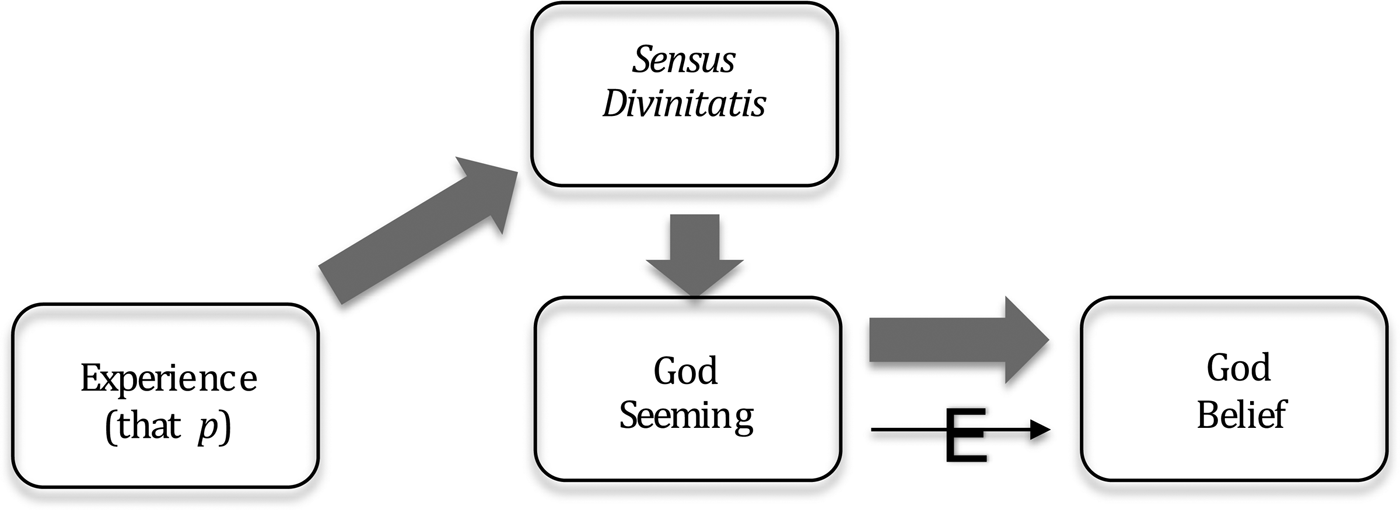
But what this diagram does not show are the inner workings of the sensus divinitatis. On both Tucker's and Plantinga's models, the sensus divinitatis is a bit of a black box. It takes in sensations and outputs seemings or beliefs with no deep explanation for why or how this occurs. The reductive model fills out this story.
In a little more detail, the story goes like this. We undergo an experience with propositional content; for instance, it seems that you have violated a moral law. Through the sensus divinitatis we intuitively grasp a support relation between this experiential content, in conjunction with your background evidence, and a proposition about God; for instance, you tacitly perceive that violating a moral law implies that there is a moral law, that the existence of a moral law supports the existence of a moral lawmaker, that the only plausible moral lawmaker is God, and, hence, that violating the moral law makes you guilty before God. The sensus divinitatis then produces a seeming with theistic content – e.g., that you are guilty before God – the strength of which corresponds to the probability of the supporting propositions and the strength of the perceived support relation. Given RC, this theistic seeming provides the subject with a pro tanto reason to believe in the existence of God.
There is not much difference between this example and the ones given in the previous section. There, the content of your experiences was tacitly recognized to support the existence of an agent, making it seem to you that your spouse was home or that an intruder had broken into your house. Here, the content of your experience is tacitly recognized to support the existence of God, making it seem that you are guilty before him. In this way, the reductive model of the sensus divinitatis requires nothing over and beyond the standard rational ability tacitly to perceive support relations. Accordingly, the reductive model eliminates the need to posit any special intellectual faculty. Its operations can be carried out, on a more fundamental level, by those faculties already present in our standard rational package. We have a sensus divinitatis simply because we have a tendency to draw connections between the content of our experiences and propositions implying the existence of God. Thus, on our model, the sensus divinitatis is nothing other than a sub-function of our standard rational faculties. (This is another important feature that is not represented in Figure 6.)
A couple of clarifications should be made before we expand on the advantages of the reductive model. First, as you may recall from the previous section, when we say that the sensus divinitatis ‘perceives’ a support relation, we are not using this as a success term. That is to say the sensus divinitatis may misfire and ‘perceive’ a support relation that is not actually there. For instance, perhaps the existence of a moral law does not make probable the existence of a moral lawmaker. Even so, you might mistakenly ‘glimpse’ a connection between the moral law and a moral lawmaker. And given RC, seemings that result from misperception still provide pro tanto reasons to believe their content.Footnote 16 Of course, this reason is defeasible and would be effectively countered if the subject has some reason to suspect that the seeming resulted from faulty insight. In the case of an undetected error, the subject may lack some other positive epistemic status such as warrant, but their justification would remain intact.Footnote 17
Second, we expect the experiences triggering the sensus divinitatis to possess robust propositional content such as that one has violated the moral law, that the universe did not have to exist, that this sunset is objectively beautiful, and so on. The input is not limited to mere sensations or propositions about the immediate contents of one's mind. To clarify, let us return to the standard case of a subject who gazes at a beautiful sunset and forms the belief that God created it. As shown in the above diagrams, Tucker and Plantinga say that a ‘sunset sensation’ – the phenomenal ‘image’ of a sunset in the subject's mind – triggers the sensus divinitatis. We model things differently. If we assume this is a normal case of perception, such sunset sensations will be accompanied by a second mental state – a perceptual seeming – in which it seems to the subject that the sunset is beautiful or that this sunset is especially colourful or perhaps just that the sunset looks thus and so. Tucker has argued at length for the difference between sensations and the perceptual seemings that follow them (Tucker (Reference Tucker2010), 530–531; Idem (2011), 56–58), and Plantinga seems open to this as well (Plantinga (Reference Plantinga1993), 91–92). On our model, the sensus divinitatis is triggered by this sunset seeming with its propositional content, not the sunset sensation.
Furthermore, it is unlikely to be the sunset seeming in and of itself that triggers the sensus divinitatis but rather this seeming in conjunction with the subject's background information. As we saw in the guilt example above, drawing the connections between one's apparent violation of the moral law and the existence of a God as moral lawmaker requires the subject to bring in all sorts of additional principles about the origins of the moral law, the identity of the moral lawmaker, and so on. Presumably, the same will be true for any apparent connections drawn between the content of a sunset seeming and a proposition about God.
These are important additions. If the inputs of the sensus divinitatis were limited to sensations or one-off seemings, then one might be justifiably sceptical about whether subjects could perceive (even mistakenly) any support relations between these triggers and theistic propositions. Tucker, for instance, doubts that there is any plausible evidential connection between sunset sensations and propositions about God (Tucker (Reference Tucker, Clark and VanArragon2011), 59–60). Our model avoids such worries by greatly expanding the amount of information that is tacitly perceived to support the existence of God.
Third, the recognition of these support relations – at least in the formation of the relevant theistic seemings – occurs on a sub-personal, unconscious level. There is no guarantee that the subject will be able to explicitly rehearse these connections.Footnote 18 For instance, someone might tacitly perceive a connection between her experience of the cosmos and the existence of a divine creator while being completely unable to specify precisely what the connection is supposed to be. If one manages to explicitly describe the apparent support relations, then this constitutes the construction of a theistic argument. In fact, a great deal of natural theology can be plausibly understood as attempts to unpack support relations that were first recognized on an intuitive level.Footnote 19 Unpacking these relations is difficult and most people do not operate at this level of reflection and abstraction. Thus, it is fitting that God make people capable of grasping these connections on a tacit level. In this way, one might intuitively see that an experience confirms God's existence without seeing how it does so (much less working it out). From the subject's perspective, one merely takes in a wonder of nature and it seems that God exists.
Lastly, you might wonder whether the unconscious processing posited by our model qualifies as an unconscious inference. If it does, the worry becomes that our model no longer explains the non-inferential justification of theistic belief. Even if we grant that our model involves an unconscious inference, we do not see this as a problem. These automatic, sub-personal calculations are not things that we, properly speaking, do. They are things that happen in us. The sense of ‘non-inferential justification’ which foundationalists have in mind is of justification that does not result from any inference we make. Thus, the existence of an unconscious inference does not endanger our success in modelling non-inferentially justified theistic belief. Indeed, walking the line in this way enables us to bring together insights from reformed epistemologists and natural theologians in new and compelling ways. More on this in the conclusion.
The advantages of reduction
Eliminating the need for a special religious faculty is a serious advantage. We account for the same data (i.e. non-inferentially justified theistic belief in matters of general revelation) with a simpler, slimmer ontology than the alternatives. This in itself may be enough to tip the scales in favour of reduction.
Preferring the simpler theory is good practice in general, but it is especially so in this case. It seems to many – theists, atheists, and agnostics alike – that positing a special religious faculty is an ad hoc attempt to salvage one's deeply held religious beliefs; or at least this is a common first impression.Footnote 20 As a result, many are adverse to reformed epistemology from the outset. Our model, on the other hand, has no appearance of being ad hoc since theistic beliefs are justified by the same faculties and in the same manner as many non-theistic beliefs. In fact, on the reductive model, even atheists can acknowledge the existence of the sensus divinitatis.Footnote 21
Another major advantage is that our model better aligns with certain findings in the cognitive science of religion. There is a growing consensus that humans are naturally inclined to believe in God (or gods) and that the faculties responsible are ‘part of the general conceptual toolkit for negotiating life as a human and not some special religion-specific faculty or “god spot” in the brain’ (Barrett & Church (Reference Barrett and Church2013), 312–313). These findings jar with models on which the sensus divinitatis is a special religious faculty. In contrast, these are welcome findings for the reductive model on which the sensus divinitatis is nothing more than our standard rational faculties acting on religious content.
Consider what is arguably the most prominent theory in the cognitive science of religion: the Hypersensitive Agency Detection Device (HADD) (Barrett (Reference Barrett2004) ). This hypothesis builds on the agency detection device introduced in a previous section. HADD suggests that our agency detection device is especially sensitive – we are assiduously attuned to signs of agency (and perhaps even prone to ‘perceiving’ stronger connections between stimuli and the existence of agents than actually exist) (Barrett (Reference Barrett2004), 31; Guthrie (Reference Guthrie1993) ). As a result, our agency detection devices will regularly register evidence of divine agents, thus helping to explain widespread belief in God (or gods).
HADD and our model go together like milk and cookies. Earlier, we used the agency detection device as a prime example of our ability tacitly to grasp support relations. If this device is responsible for producing our theistic seemings, it just serves to confirm our model. The sensus divinitatis is nothing other than a sub-function of our agency detection device (or a combination of such standard cognitive tools).
In contrast, non-reductive models of the sensus divinitatis must say that there are two agency detection devices: the regular one and a second, divine agency detection device that is specially programmed to register the presence of supernatural agents and may operate in ways wholly different from the standard agency detection device. As mentioned before, this clashes with growing consensus in cognitive science that there is no special ‘divine detection’ tool, and that belief in God results from the same sorts of processes that bring about belief in other non-divine agents. Thus, we think the reductive model coheres much better with findings in the cognitive science of religion than the alternative models.
Finally, scripture seems to teach that nature reveals God, but leaves somewhat open how this revelation takes place. For example,
Ever since the creation of the world his eternal power and divine nature, invisible though they are, have been understood and seen through the things he has made. (Romans 1:20, NRSV)
The heavens are telling the glory of God; and the firmament proclaims his handiwork. (Psalm 19:1, NRSV)
There are more and less plausible ways of filling out the story. We argue that the reductive model lends itself to a particularly fitting explanation of nature's role in natural revelation.
Start with the reductive model of the sensus divinitatis. Add in the assumption that God exists and gave us this faculty to reveal himself through nature. The following account of natural revelation emerges. Nature reveals God by standing in discernible support relations to his existence. We can readily grasp these support relations on a tacit, intuitive level. Accordingly, even those with little education or lower intelligence are able to receive the testimony of nature, for it does not require them to explicitly rehearse the ways in which nature speaks to the existence of God. We think this is a plausible account of natural revelation.
This account also appears to be consonant with the reformed tradition, cementing the reductive model's status as a genuine instance of reformed epistemology. Consider Calvin's theory of natural revelation, which we will treat as representative of the reformed tradition. Calvin proposes that creation testifies to the existence and authorship of God by providing evidence to this effect. Thus, in his Institutes of the Christian Religion, Calvin writes,
There are innumerable evidences both in heaven and on earth that declare this wonderful wisdom; not only those more recondite matters for the closer observation of which astronomy, medicine, and all natural science are intended, but also those which thrust themselves upon the sight of even the most untutored and ignorant persons, so that they cannot open their eyes without being compelled to witness them. (Calvin (Reference Calvin, McNeill and Battles1960), 53)
A little later, Calvin marvels at the many ‘proofs of [God's] powers’ present in nature (ibid., 60). Elsewhere, Calvin compares God to a sculptor and says, ‘upon his individual works he has engraved unmistakable marks of his glory’ (ibid., 52).Footnote 22 To draw out the analogy, just as a sculptor leaves characteristic marks on the marble that provide evidence of her creative role (differentiating it from a naturally occurring rock formation), so God has left marks on creation that provide evidence of his authorship. Calvin is careful to emphasize, however, that such proofs are accessible to everyone, ‘even unlettered and stupid folk’ (ibid., 52).
We see that no long or toilsome proof is needed to elicit evidences that serve to illuminate and affirm the divine majesty; since from the few we have sampled at random, whithersoever you turn, it is clear that they are so very manifest and obvious that they can easily be observed with the eyes and pointed out with the finger. (ibid., 61–62)
Calvin's point does not seem to be that natural revelation operates independently of any rational faculty, but only that natural revelation doesn't require any special training or gifting in the use of reason. Long and toilsome arguments are unnecessary, not because the sensus divinitatis is indifferent to support relations between nature and God, but because such support relations are apparent at a glance. All of this fits seamlessly with the reductive model's account of natural revelation.
Now compare this account to an alternative view on which experiences of nature trigger the sensus divinitatis only because God specially programmed it to output theistic seemings (or beliefs)Footnote 23 upon receiving certain experiences of nature as input. In essence, this view says that God designed the sensus divinitatis to execute a series of input/output protocols. For instance,

And so on. The chosen protocols were manually selected by God, and he might have chosen differently. He might have, for example, designed the sensus divinitatis to make it seem that God is majestic every time we sneeze or read the phone book. He might also have removed any tendency for experiences of sunsets or starry skies to occasion theistic seemings. On this view, whether an experience apparently bears support relations to truths about God is irrelevant to its role as a trigger. From the subject's perspective, an output might be completely unrelated to the input that triggers it. Even if the input happens to confirm the content of the output, it is not in virtue of this support relation that the output is produced and one need not be aware of it on any level. Let us call this position ‘the indifferent view’ since it claims that the sensus divinitatis is indifferent to support relations. On the indifferent view, nature only reveals God's existence because God happened to select some experiences of nature to trigger theistic seemings.
Besides its inelegance, our main problem with the indifferent view's account of natural revelation is that it does not allow nature to reveal God in the right way. On the indifferent view, nature only reveals God because it was manually selected to perform this function. The revelation does not occur because nature possesses features that, apart from God's special activity, are liable to reveal God to us. This is either because nature does not possess such features or because God chose not to use the revelatory power of such features. Either option is problematic.
First, consider the idea that nature, apart from God's special activity, has no notable power or tendency to reveal God to us. This would imply that nature does not provide any evidential support for God's existence – at least none that is readily appreciable by us. It also implies that an experience of the cosmos in all of its majesty is no more intrinsically liable to reveal God to us than an experience of sneezing or of reading the phone book or of getting a root canal. We think this is an implausible feature of natural revelation as such. Nor does it have any precedent in the early reformed tradition, as far as we can tell. In fact, it stands in direct tension with the interpretation of Calvin given above.
If we say instead that nature is, apart from God's special activity, especially liable to reveal God to us, then it is puzzling why God would not just use that tendency to reveal himself through nature. Why resort to special activity when such activity was not needed? The most plausible position seems to be that nature does have a strong liability to reveal God to us (apart from any special divine activity) and that nature reveals God to us precisely because it has this special liability. The reductive model can accommodate this position since nature reveals God by virtue of bearing support relations to its creator – ones that we do not need special divine assistance to pick up on. A model employing the indifferent view does not have this option.
As it stands, Plantinga and Tucker have not explicitly endorsed the indifferent view, though it seems they may have been implicitly assuming something like this position. As far as we can tell, nothing Plantinga or Tucker has said commits them to the indifferent view, so they are welcome to make additions to their models in light of the concern we raise here. To address our concern, Plantinga and Tucker would need to give an account of how nature is intrinsically liable to reveal God to us and develop a corresponding model of the sensus divinitatis – one that uses this natural tendency in the production of theistic seemings or beliefs. It is difficult to see, however, what nature's intrinsic liability to reveal God might consist in besides the bearing of readily appreciable support relations to God's existence.Footnote 24 So, to bring their models in line, Plantinga and Tucker will probably have to hold that the sensus divinitatis produces theistic seemings or beliefs by picking up on support relations between God and nature. Since our standard rational faculties can perform these functions, there is no need to postulate a special religious faculty. If Plantinga and Tucker retain a special religious faculty, they are opting for a needlessly cumbersome ontology. If they reduce the sensus divinitatis to a sub-function of our standard rational faculties, they become proponents of the reductive model.
Now we have not said that alternative models of the sensus divinitatis – such as those employing the indifferent view – are impossible, but only that they are less satisfactory than the reductive model. Nor have we said that all seemings more generally must bear an apparent evidential connection to the experiences that trigger them. If Thomas Reid is correct, for instance, then perception is one domain in which seemings are sometimes triggered by sensations that bear no evidential connection to the content of those seemings;Footnote 25 the principles governing their production are simply hard-wired into us as a part of our natural constitutions.Footnote 26 We do not deny that this might be the case. We just think that there are (i) general advantages to minimizing instances of brute hard-wiring, and (ii) specific advantages (presented above) to modelling the sensus divinitatis without appeal to brute hard-wiring. Our argument is that we should prefer the reductive model of the sensus divinitatis, not that the reductive model is the only possible choice.
Conclusion
Building on the work of Tucker and Plantinga before him, we have presented a new model of the sensus divinitatis – one that is simpler and more fleshed out than previous models. It is simpler in that it eliminates the need for a special religious faculty. It is more fleshed out in that we shed light on the internal operations of the sensus divinitatis. Few epistemologists have tried to explain the inner workings of how seemings are produced, and no philosophers of religion have tried to connect those accounts of seeming-formation with the sensus divinitatis.Footnote 27 Because we develop a general account of seeming-formation – one that applies to far more than just the special case of theistic seemings – our model is relevant not only to religious epistemology, but to epistemology more generally.
We have also continued the important project, in which Tucker and others are engaged, of showing that reformed epistemology (or at least non-inferentially justified theistic belief) is harmonious with evidentialism and natural theology. With regard to the former, evidentialists who allow experiences to provide evidence have no essential conflict with reformed epistemologists and may well populate their ranks. The real dispute is between reformed epistemologists and those who think that belief in God must be supported by arguments.Footnote 28 With regard to natural theology, many (including Plantinga) have noted that arguments might be helpful for theists, even if not necessary.Footnote 29 They can, for instance, supplement one's justification for believing that God exists. Our model suggests that there might be even deeper concord than this. On the reductive model, the sensus divinitatis – a key source of non-inferential justification in matters of general revelation – basically operates by tacitly engaging in natural theology. Of course, those subjects who tacitly perceive support for God in nature are often unable to rehearse these connections. For them, it simply seems that God exists and they base their belief on this experience. Those that do attempt to work out these connections become natural theologians in the truest sense of the term. This picture acknowledges the vital role of nature in providing evidence for God while simultaneously preserving the reformed insight that theistic belief need not be based on arguments to be justified. This is, we think, a compelling account of general revelation and yet another way in which adopting the reductive model significantly broadens the appeal of reformed epistemology.