I
In April 2012, I made a research trip to the village of Gousda in order to study the concept kirdi,Footnote 1 a term hitherto used to indicate ‘pagans’ like the inhabitants of the Mandara Mountains, who could be enslaved. During my stay, I interviewed both individuals and groups. Thus, I asked a group of eight persons the following question: ‘Do you recognize yourself in the term kirdi?’ Instead of responding directly to the question, the participants began spontaneously to sing a song praising the bravery of the Montagnards. After having sung, one of them spoke up to challenge this concept, though recognizing that it was used to designate a ‘pagan’ and a slave. Using their songs to boast of their bravery served to present an alternative memory based not directly on slavery, but on resistance. In all of the traditions I have collected until now, there is no mention of the role of slavery in the occupation of the Mandara Mountains.
There is, however, a paradoxical opposition between the absence of slavery in the sources and the oral traditions and the political elite's claim of a kirdi identity. For example, I was at a political meeting in Moskata shortly before the legislative elections of 30 September 2013, where a member of the elite called on people to vote for Rassemblement Démocratique du Peuple Camerounais (RDPC), the party in power. The speaker began by thanking his kirdi brothers for returning him in the previous election to the seat in the National Assembly he had held since 1992. At the same meeting, another leader commented on a clash that took place between a Montagnard farmer and a Fula pastoralist in November 2012. The event provoked a hue and cry among the Montagnards, who reproached the Fulbe for pasturing cattle in their millet fields. The leader mentioned this incident to assure his ‘Kirdi brothers’ of his support in the defence of their rights and ended his speech by claiming that ‘if yesterday we were sold as slaves, today the wind is blowing in our direction’.
The cases mentioned above show the existence among the peoples of the Mandara Mountains of memories of slavery, which show a division between older and younger and between traditional and modern elites and which are at the same time dissonant and complementary. Thus, among the elders, the memory of slavery is almost absent, and is characterized by repression.Footnote 2 Their memories are constructed around resistance to assimilation and are supported by oral traditions (myths and songs). These elders who, for the most part, are descendants of those who were enslaved and had to defend themselves constantly against slave raids, are repressing both the idea of assimilation and the memories of enslavement.Footnote 3 In contrast, among the new elite, the memory of slavery is not denied; it is made the object of public reclamation in interviews and public meetings. These two forms of memory were articulated in different periods: the repression of the memory of slavery seems to have been constant from the end of colonization to the 1990s. By contrast, the public claim of a servile heritage was made in the context of the democratic opening of the 1990s. We have to ask, therefore, why memories of slavery are linked to two different interpretations. Why is the concept kirdi either denied or claimed depending on the context? Why is the reality of slavery a ‘public secret’Footnote 4 among the older generation while it is openly asserted by the modern elite? Such questions lead us to the studies of memory, which have flowered since the publication of Pierre Nora's Lieux de mémoire three decades ago.Footnote 5 The virtue of Nora's approach is that it enables us to shift from the memory itself to the site of memory. It is through the sites of memory that the events of the past are constantly reinterpreted to give a consistent identity to the type of collectivity that we want to construct in the present and the future.
Nora's work has favourably influenced Africanists working on slavery and its impact on contemporary African societies.Footnote 6 In fact, internal slavery has long existed in West Africa as a legal,Footnote 7 economic,Footnote 8 and social scheme.Footnote 9 Notwithstanding the abolition of most of its legal and economic aspects since the beginning of the twentieth century, the inhabitants of former slave societies continue to practise an ‘ideology of slavery’Footnote 10 whereby genealogy determines one's identity and social status.Footnote 11 On the other hand, a number of scholars recognize the difficulty that former slaves and their descendants have in discussing their servile past.Footnote 12 While it is difficult to determine with precision the exact circumstances in which the ‘silence of memory’Footnote 13 was transmitted and at what moment the chain of transmission took place, they suggest that they could have taken place in the first decades after the abolition of slavery in the regions concerned.Footnote 14 Many works have also demonstrated that the sequestering of the memories of enslavement occurred both among former slaves and their descendantsFootnote 15 and among researchers working on these issues.Footnote 16 While examining the politics of commemoration among the coastal population of contemporary Ghana, Holsey notices that they have ‘forgotten’ the complicity of their ancestors.Footnote 17 But what does this silence really mean? Does it mean that nothing is remembered about slavery? In other words, has this past been completely obliterated?
Rosalind Shaw's seminal work on Sierra Leone has addressed these questions by offering a subtle analysis of how slavery is otherwise remembered.Footnote 18 As in the Mandara Mountains, Sierra Leoneans prefer to remain silent instead of remembering their shaming past. However, Shaw notes that ‘there are other ways of remembering the past than by speaking of it’.Footnote 19 As such, she suggests that, while the historical memory of the slave trade is no longer found in speech, it is embodied into contemporary rituals of divination and into mask representations.Footnote 20 In other words, the slave trade remains present in a spectral form through dance and rituals, which Lotte Pelckmans considers as ‘embodied forms of memory work’.Footnote 21
This article extends this notion of embodied forms of memory work to songs collected in the Mandara Mountains. In fact, if narratives on slavery are absent or nearly absent, the former slaves and their descendants have created ways to maintain and transmit their servile past in other ways that frustrate researchers.Footnote 22 In the Mandara Mountains, songs are a way to maintain memories of slavery in an indirect and non-discursive manner. Nevertheless, we have to note that since the 1990s, this non-discursive logic is matched by the public claim to a servile heritage, which becomes a political issue in national politics. Thus, two logics of memory co-exist: the first denies the heritage of slavery and opposes to it a memory centred on resistance and presented through oral traditions; the second recognizes and openly claims a servile descent in order to present its claims in the political arena.
The diversity of ethno-historical and archival information collected during fieldworks allows us to juxtapose the two memory logics I have presented. On the basis of these data, I postulate that far from being opposed, these two logics are implicitly part of the same body of memories and are articulated differently according to the circumstances of their production and sometimes according to chronological and generational distinctions. Thus, after having presented the geographical and historical context of the practice of slavery, I will show how songs are used to sequestrate memories of slavery and to open up alternative memories centred around the Montagnard resistance identity. Along the same line, I will focus on the manner in which the colonial memory, itself instrumental, is used to open up the idea according to which the Montagnards are hard-working people. I will end by focusing on the reactivation of the memory of slavery in the democratic context of the 1990s via the public reclamation of the concept kirdi in the contemporary political situation.
II
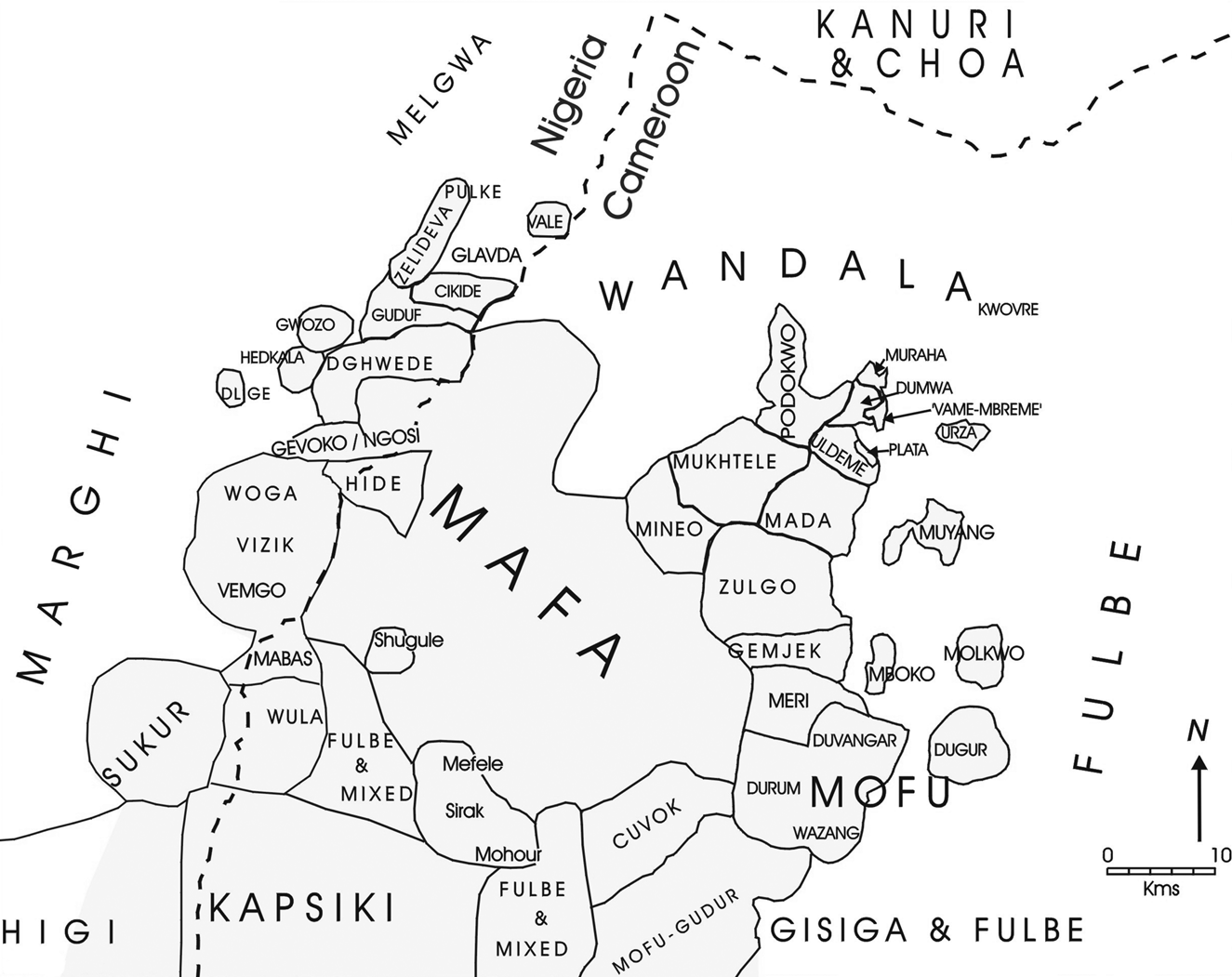
Figure 1 shows the geographic location of the Mandara Mountains where I have spent a total of twenty-eight months in the field during four periods of research. The first was from March to July 2007 in the Podokwo villages of Udjila and Godigong, where I studied the relationship between material culture, ethnicity, and servile memory. From June 2009 to March 2010, I spent ten months among the Muktele at Baldama and Zuelva studying the relationship among architecture, identity, and servile memory within the framework of my thesis. Then, the villages of Dume and Mura-Massif became my principal research for six months from September 2011 to February 2012, documenting the religious life of the Mura and relating it to ethnicity and servile memory. In March 2012, I expanded my research to the Mafa with a two-month stay in Moskata, Koza, and Gousda collecting more material on slavery, notably songs and narratives. Finally, I returned to Udjila and Moskota between April and October 2016 to continue my inquiries on material culture and slavery.
Ethnic groups in and around the Mandara Mountains.

During these different research trips, I have carried out more than a hundred interviews and collected ethnohistoric data among different groups, notably the Podokwo, Muktele, Mura, Kapsiki, Mafa, Plata, Vamé, and Bremé. Most of my knowledge of slave raids comes from Podokwo, Muktele, Kapsiki, and Mafa informants. The Podokwo and Muktele were raided by the kingdom of Wandala. The Kapsiki and Mafa experienced the raids of Hamman Yaji during the early twentieth century. I interviewed in these groups both men and women and both older and younger persons. Informants aged seventy to eighty-five provided most of the information on the slavery and colonial periods, while those aged thirty to sixty talked about the post-colonial period. The former talked about a period when slavery was still possible though younger informants got information on that period from their parents.Footnote 23 Participant observation was also important in the collection of information. Funerals, communal work, local festivals, and different meetings which I attended permitted the collection of such ethnohistorical data as songs, proverbs, metaphors, myths, but also intrigues. Archival documents were consulted in the Archives Nationales of Yaounde, the Archives of the Basle Mission, and the Nigerian National Archives in Kaduna. Personal memories and other field materials collected by different researchers were also consulted.
After several decades of research on slavery in the Mandara Mountains, we now know that numerous Montagnards – men, women, and children – were enslaved in very different contexts and over a long period of time. This commerce strongly shaped the local cultural milieu and radically modified the way local people think about and utilize space.Footnote 24 In this area, there is a constellation of small groups speaking Chadic languages, who are politically decentralized and define themselves as ‘mountain people’, probably to differentiate themselves from the Wandala and Fulbe living in the surrounding plains.Footnote 25 For four centuries, these latter have constantly sought slaves in the mountains. It was the Wandala who first threatened the Montagnards.
Nicholas David suggests that until the nineteenth century, the Mandara Mountains were a source of slaves for a regional market controlled by Wandala.Footnote 26 Dixon Denham and Hugh Clapperton gave us the first and most vivid description of the way the slaving economy operated at Mora. In 1823, Denham visited Mora and saw contingents of slaves arriving from the mountains.Footnote 27
From the beginning of the jihad led by Othman Dan Fodio during the early nineteenth century, the zone in which Wandala operated was progressively reduced. Strümpell indicates that Yllaga Fulbe ended Wandala domination of some mountain societies from the late nineteenth century.Footnote 28 From this time on, Fulbe raiders regularly attacked pagan populations, and especially the Montagnards. The most serious threat came from Hamman Yaji, ruler of Madagali, heavily involved in slavery at the beginning of the twentieth century.Footnote 29 His slaving activities may have pre-dated colonial conquest, but they continued into the 1920s. Yaji regularly organized raids into the southern parts of the Mandara Mountains, seizing, torturing, and killing men, women, and animals, and punishing villages which refused to provide him with slaves. The Montagnards remember him as a monster, who committed horrible atrocities.Footnote 30 Walter Van Beek cites the words of one of his Kapsiki informants, Vandu Zra Tè, one of the rare persons to talk about the atrocities committed during Haman Yaji's raids:
He used people as money, Haman Yaji. He asked a Fulbe woman for a pounding stick and paid with a slave. He bought a mat and paid with a slave. To buy a calabash, or a stick, he paid with people. Even a jar with shikwedi [a crop for the sauce] he paid with a slave. That is what he did.Footnote 31
Feared by the people of the mountains, Haman Yaji was seen by colonial authorities as a tyrant who oppressed slaves with unbelievable cruelty over a quarter-century.Footnote 32 Though Haman Yaji is seen as the prototype of the brutal slaver, he was certainly not the only ruler to make incursions into Montagnard territory. He was only the visible part of the iceberg that involved similar practices throughout the region. Yaji is known as emblematic figure of slavery simply because his personal journal was seized by British colonial officials when they arrested him in August 1927. Written between 16 September 1912 and 25 August 1927 by his slave scribe, this journal lists his activities in and around the Mandara Mountains. It cites 118 raids led by Haman Yaji in sixty-four localities over nine years (1912–20). A little more than 2,000 slaves were captured and 168 people were killed in the attacks and more than 3,500 livestock were seized.Footnote 33
The journal of Haman Yaji and the testimony of Dixon Denham cited above indicate that the number of slaves captured in the mountains was very large. Jacques Lestringant (1964) suggests that the slave trade was the only commerce that flourished in the nineteenth and early twentieth centuries. Antoinette Hallaire estimates that nearly half of the population of Wandala was made up of slaves.Footnote 34 We must add to that gifts of different kinds that were regularly offered to Muslim rulers by Montagnards in order to have peace. The central question to ask is: where were these slaves sent and to what end? Yaji's journal and oral histories of the Mandara Mountains provide few details on this subject. Nevertheless, the work of Paul Lovejoy on the slaving practices in the Sokoto Caliphate, of which Madagali was part, allow us to suggest that many of the Montagnard slaves went to Sokoto.Footnote 35 According to Lovejoy's estimates, Adamawa, which included present-day North Cameroon, exported about 5,000 slaves a year to Sokoto after the end of the transatlantic trade, of which the grand majority were women in their teens or early twenties.Footnote 36
Haman Yaji's diary confirms also the notion put forward by Robertson and Klein that the prices of female slaves in African internal slavery were consistently higher than were the prices of males.Footnote 37 Higher prices paid for females in the market add further confirmation.Footnote 38 For example, Bernard Juillerat reports that at the beginning of the twentieth century, the prices at the slave market in Mora were twenty cotton boubous for a young girl, twelve to seventeen for a young man, and seven boubous for an older man.Footnote 39 The higher price for young women can be explained by the fact that they were destined for concubinage, which according to Paul Lovejoy was part of a strategy for integration and acculturation of slaves within the Muslim empires of West Africa.Footnote 40 But women also did all kinds of physical work, and the French anthropologist Claude Meillassoux argues that physical productivity was sometimes more important than the potential of reproduction in the lives of these females.Footnote 41 In fact, the fertility of slave women was generally so low that their labour was at least as high as that of men. While subscribing to this point of view, Martin Klein relativizes somewhat the importance of productivity by asserting that the power of reproduction has also measurably contributed to their market value.Footnote 42 In addition, men's greater potential for escape and uprising significantly reduced their relative value on the market. Women were indeed less likely to flee, especially after they had children.
On the other hand, many women and girls were pawned by their own parents in the depression conditions common in the early twentieth century. Pawning permitted families to place their daughters in situations where they would be fed and provided money to guarantee the survival of other members of the family. This form of servitude survived well after the arrest of Haman Yaji in 1927. The collective memory of the Montagnards is strongly marked by it even though even though oral traditions only accord such memories a limited place.
III
In an article published in History in Africa in 1989, Martin Klein encouraged historians to study the historical traditions of slave descendants carefully to see the importance that they gave to the transmission of servile memories.Footnote 43 His central argument was that ancient slaves and descendants of slaves do not seem to want to talk about their past, and that oral traditions remain silent about slavery.Footnote 44 This text remains a key reference for authors working on slavery, even though Klein himself remains sceptical of the possibility of finding the traces because the question is the object of self-censorship in the societies concerned.Footnote 45 Following Klein, I have shown that in the Mandara Mountains, references to slavery were rare in interviews as well as in oral traditions.Footnote 46 At the same time, I have argued that memories of slavery have not disappeared, but that they have simply been integrated in other forms of narration. In focusing on the production of myths of origin, I have shown that the silence of the myths does not necessarily indicate an absence of traces, but that it was explained by the fact that slavery was considered as a ‘public secret’ whose memory could only be transmitted in a metaphoric manner.Footnote 47
Contrary to the myths of origin which are marked by a strategic amnesia, songs are more explicit in their evocation of slavery. Most of these songs have survived within the framework of folk tales, through which elders transmit to young people certain aspects of their history. The two songs analysed below were originally collected by Alexandre Gaimatakwan: the first from an interview with Yakadam Matakone on 20 June 2007 at Mozogo, and the second in an interview with Douka Matakone on 21 June 2007 at Moskota. These two informants were respectively aged fifty-four and fifty when these songs were recorded.
During my research tour in the villages of Moskota, Mozogo, and Gousda in April 2014, I met the two informants and had them listen to recordings of the songs. Both were able to sing them with a certain nostalgia, regretting nevertheless having forgotten the details of tales containing them. They referred me to an elder named Matakwan, known as a brilliant story-teller, who lived in the village of Soulédé. In October 2015, I went to meet him in the company of a Master's student working under my direction. When we had him listen to the songs, Matakwan, then over eighty-four years old according to his estimate, was able to tell the stories on which the songs were based. He confirmed that tales were told by the elders to the young, after a dinner, and usually in a period of a rising moon. To understand the meaning of these songs, it is best to present them separately in the transcribed and translated version and to define the context of their elaboration.
The first song is contained in a tale involving the Wandala and a Mafa female slave. According to the tale, the Mafa slave had been captured by a Wandala incursion during the slavery period. During her captivity, she sang and danced under the admiring eyes of her masters. Once, when she sang the first song, she began to dance as usual, but this time gradually distancing herself from her master till she fled. In other words, she used the songs and dances to deceive the vigilance of her abductors. Here is the song and its transcription/translation:
The song gives the impression that the audience the young slave is addressing is made up of Wandala, which seems astonishing on first view since the Mafa territories (Moskota and Mozogo) where the song was collected had passed under Fulbe influence from the beginning of the twentieth century.Footnote 48 It is true that the Wandala continued to raid these areas, but their activity was very much limited to the northern mountains of Mora.Footnote 49 Thoughts of slavery from this period were largely associated with the Fulbe, in particular with Haman Yaji, and not with Wandala, which leads us to an earlier period.
We notice that the young slave seems to use intermediaries to address herself to the Wandala. The first and third verses begin with the injunctions ‘Tell’ or ‘Go tell’. Though the identity of the carriers of the message is not known, we can deduce that she is addressing several persons because she uses the plural gadama and va gadata rather than the respective singulars gadana and gadata. The tenor of the message is brief and concise: ‘tell…That the way to Wandala causes me to lose my mind.’ By this tale, Mafa society expresses in a veiled manner the refusal of assimilation which slaves faced in a receiving society dominated by Muslim culture. The reasons for this fear are contained in the following verse: ‘Tell the Wandala that they put me in the middle. I am afraid.’
The term ‘middle’ should be explained and contextualized. In effect, it designates not a geographic middle, but a situation between two cultures or civilizations: on the one hand, Montagnard civilization and on the other, that of Wandala.Footnote 50 By these words, the young slave formulates a vow toward her masters. She asks that they permit her to remain a slave without becoming like them, that is to say, without becoming Muslim. A more conceptual translation of this song then gives this:
This song can thus be inscribed in the context of intensification of raids into the mountains, first by the Wandala and then by the Fulbe. Even if it is difficult to situate with precision the conditions for the production of this song, we can deduce that it recalls a period that the collective memory associated slavery with Wandala and not with the Fulbe, although the latter were active from the beginning of the twentieth century. This hypothesis is all the more plausible because it confirms oral data collected by researchers who preceded me. Godula Kosack, for example, collected important oral testimonies on slavery at the beginning of the twentieth century in and around the locality of Gousda.Footnote 51 Scott MacEachern has collected oral testimonies on slavery in the northern mountains, particularly among the Uldeme and the Plata.Footnote 52 The words of the song cited above and the data collected by these two authors seem to refer to the end of the nineteenth and the beginning of the twentieth centuries. The informants cited by Godula Kosack at Gousda refer to Wandala and not to the Fulbe, as is the case with the songs presented here. Some of my informants, such as Matakwan, were between seventy and eighty years old when I did my field research in 2014. That means that they lived during the last phase of slave-raiding, which continued through the 1930s.Footnote 53
In stressing the identity crises that the slaves experienced in their host societies, the song brings to mind the ideas of Orlando Patterson, who through his concept of social death, argues that slavery did not only tear slaves from their community, but also plunged them into inexpressible degradation, humiliation, and suffering.Footnote 54 In other words, they were doubly orphans because after being torn from their original society, slaves did not have a normal life in their new communities, where they lived as social zombies, that is to say, as the living dead.Footnote 55 The condition of the slaves was not limited to assimilation, but also integrated fear, dishonour, and an identity crisis: ‘tell my sister…That being like the Wandala people is too hard for me…I am scared.’ Finally, the message that the society presents is that integrating the community of the slavers is more dreadful than being a slave: ‘tell the Wandala people that they let me only be their servant, without being like them’. Such songs have reinforced Montagnard identity and the resistance against assimilation. Thus, although referring to slavery, the first song rejects the degrading aspect of slavery to stress the aspect of identity.
The second song displays itself in the same dynamic and describes the arrival of the Wandala in immodest and bantering terms. The word ‘already’ used from the first verse does not indicate that it was welcome or that it constituted an event long awaited. It rather expressed the beginning of an encounter that was disastrous for the Montagnards. The Wandala came looking for people wandering in the mountains, in particular, women looking for water or young people seeking grass for livestock.Footnote 56 Here is the song transcribed and translated:
In the second song, the profound resentment of the Montagnards toward the Wandala is expressed in an outrageous manner. ‘Those who have the tassel (of the rod) out have already come.’ These satiric verses ridicule the circumcised. In effect, the Montagnards considered circumcision a sacrilege, a public act of renunciation of one's culture. In 1955, Hans and Gertrud Eichenberger collected the following proposition from Kiligaï, a Mafa elder:
Then one day, the son of a man from Doumsaraï, Abdulahi's brother, who had been circumcised at Maroua, came during the night. He had heard that I wanted to have myself circumcised. He came to tell me ‘You should never have yourself circumcised! You should remain true to your Mafa people.’Footnote 57
This statement expresses not only the rejection of circumcision, but more important, the rejection of Islam, which was seen as the religion of the slavers as animism was the religion of the Montagnards. A Montagnard converted to Islam had dishonoured his culture and had become thenceforth one with the Wandala and the Fulbe.Footnote 58 The famine of 1930 was to change that because it led many Montagnard women into concubinage and thus into Islam. Referring to the testimonies of former slaves collected by Müller-KosackFootnote 59 and by van Santen,Footnote 60 we can place the composition of these songs in the context of concubinage. In effect, though slavery was officially ended in 1927 with the arrest of Haman Yaji, the famine of 1930 led to a recruitment of women through adoption, concubinage, and servitude that lasted until the end of the first half of the twentieth century. Concubinage enabled Muslim aristocrats to achieve two objectives. First, it permitted them to have more than four wives and thus to circumvent Islamic law. Concubines were in effect considered as slaves and not as true wives.Footnote 61 Second, the birth of children to concubines contributed to the growth of family size. This important role of women in the system of slavery explains the perpetuation of their servitude long after the abolition of slavery.Footnote 62
Nevertheless, though enslaved, the status of concubines meant that they were better treated than male slaves.Footnote 63 They had more rights and privileges than other kinds of slaves. Some had access to better food, better clothing, and education. This led some Montagnard women to see concubinage positively and to value the Muslim life. The testimony of one of van Santen's informants at Mokolo illustrates this:
When the white people came, they told all the slaves that they could return home. [This was when the British took over the territory around Madagali after the First World War.] My mother was waiting for me to take me home, but as I had become a Muslim and was married to an Islamised Mafa I refused to return to the mountains. She thereupon started to cry and put herself in front of the door of the white man, called Wilkinson. They asked her, ‘What do you want?’ She said, ‘I want my daughter back.’ Thereupon a policeman accompanied her to go and get me, and they said, ‘Well, there you are: there is your daughter.’ But I explained to my mother, ‘I have grown up as a Muslim, I already have a child. I cannot return.’Footnote 64
Considering the context of female interest in concubinage, we can hypothesize that the songs were an effort to influence women. In the two songs, a female fugitive slave is addressing a sister who remained in her father's house: ‘Tell my sister who is in Mblevme's house.’ The goal might have been to dissuade women in the mountains, who had a precarious situation, from being tempted by concubinage. According to testimonies collected by van Santen, some former slaves, integrated in Muslim societies, preferred the Islamic lifestyle to that of the mountains, as is illustrated by the testimony of this former Mafa slave met at Maidagali in 2014: ‘How can I return to the mountain if I can no longer eat dog meat or drink bil-bil.’Footnote 65 There were certainly former slaves who returned to the mountains when the British occupied Maidagali after the partition of German Kamerun between the British and French in 1920. However, many of those who had become Muslim settled in the Muslim centre of Mokolo and not in the dominantly Animist and Christian villages they came from.
It is without a doubt that the objective of the first song was to question the ideal of well-being held by these former slaves: ‘Go and tell the Wandala people that they let me only be their servant, without being like them. I am scared.’ It is a discourse of inversion designed to counter the privileges associated with concubinage (clothing, education, civilization, etc.) and to reveal struggles over identity more disturbing than the life of slaves. The attribution of the words of these songs to a fugitive slave is very important because they seek to dissuade and to validate her testimony as lived experience. Thus, through the songs, transmitted as folk-tales, the servile memory stresses the importance of remaining Montagnard instead of recognizing the benefits associated with concubinage.
We can thus consider the transmission of servile by songs as the reverse of the American phenomenon of ‘passing’, which involves the adoption of a white identity by blacks and the suppression of memories of their African ancestry.Footnote 66 Here, it is instead the Montagnard identity stressed indirectly by stigmatization of the Muslim Other (see the second song), and by the accent put on the difficulty of assuming the identity of the slaver, which leads to the fear expressed by the fugitive slave in the first song. The celebration of Montagnard identity is similar to the phenomenon of passing in the way it sorts what it transmits and what it forgets.Footnote 67 However, such events, always traumatic, took place during the same periods as the slave raids of Haman Yaji (1902–27). The songs hide the fact that it was during these famines that some Montagnards sold their relatives, especially girls, in exchange for food they needed to survive.Footnote 68
All the same, contrary to Martin Klein,Footnote 69 who finds the argument that slaves were people without history as an explanation for the non-transmission of servile history, I hypothesize that it is rather linked to the work of memory, which is inevitably selective. Besides, it is this capacity of memory to recycle the past in terms of the present that distinguishes memory from history, which is understood as events which happened in the past and must be understood in terms of the present. In fact, the work of memory is silent about degrading aspects of slavery (slave raids) while reversing the way concubinage is understood and giving it a new significance. It is not really silence, but rather an absence of content in that the songs provide other indexes for the maintenance of this discourse on slavery. In embellishing memory, it reduces the shameful character of slavery and transmits it in a picturesque and sometimes crude language. In other words, the songs are also a way to repress and hide the more tragic aspects of the past which are the place for the construction of memory, undoubtedly imaginary, of the conditions of slavery in the host country. This form of memory will remain a more or less constant characteristic throughout the twentieth century. It is only with the democratic transition of the 1990s that recognition of a slave past and servile identity became important, notably with the opening of Cameroon to political pluralism and electoral competition.
IV
The era of slavery began to decline with the establishment of German colonial rule in 1902, though slavery survived through the 1930s and 1940s.Footnote 70 It survived because the Germans depended on the political systems of Wandala and the Fulbe to control the Montagnards. After the defeat of the Germans in North Cameroon in August 1914, British and French troops gradually took control of the cities and the surrounding plans, notably Maroua, Mora, and Maidagali.Footnote 71 After the Treaty of Versailles deprived Germany of its colonies, the French and British zones became League of Nations mandates. After thus being authorized to administer Cameroon, the French and British continued to depend on Wandala to control the northern part of the Mandara Mountains and on the Fulbe to control the southern part. Not surprisingly, the Montagnards were very hostile to the colonial powers because their former oppressors were the representatives of these powers.Footnote 72 Colonial reports testify both to regular difficulties the colonial authorities had in collecting taxes and to frequent confrontations with the Montagnards.Footnote 73
All things considered, in relying on Wandala and the Fulbe, the Germans and the French integrated the Montagnards within the existing hierarchical structures of the Muslim lamidats because they were convinced that ‘everywhere the Fulbe have penetrated the Kirdi, they have civilized them’.Footnote 74 This led to numerous clichés presenting the Montagnards as particularly savage and retrograde people with primitive customs. For example, Captain Remiré wrote the following in March 1929:
The plight of the country is still the Kirdis who are engaged in the almost safe theft and looting of impunity. An isolated person cannot travel in the country without being killed or stripped. They still think they are the kings of their mountains. They have remained unknown for too long, and subdivision chiefs have not always had the means to repress their crimes.Footnote 75
The Montagnards were thus perceived as the ‘enemies’ of civilization with a pronounced taste for irrational violence which could only be controlled by rational violence. A military post was created at Mokolo in 1922 to control this inclination to violence. In this context, many Montagnards had to take part in forced labour to construct roads in the mountains.
Just as the memory of slavery was transformed by myths and songs, memories of the colonial experience became the basis for social status and identity.Footnote 76 Its transmission followed generational lines. Among people having lived through the colonial period, particularly the last period (1930–60), the colonial memory continued to feed the Montagnards–Wandala–Fulbe dichotomy, which marked both the slavery and colonial periods. At the same time, contrary to the dominant discourse of this period, memories of the colonial period, especially among the elders, associated the Montagnards with the image of ‘hard workers’. In constructing this new image, informants relied on the fact of having participated under colonial rule in works of public interest, although this was assuredly forced labour. Also, this forced labour was used by the Montagnards to establish comparison with inhabitants of the plains, especially Fulbe and Wandala, who they considered ‘weak, incapable of work demanding physical strength’.Footnote 77 The Fulbe and the Wandala appeared in this new discourse as people unfit for hard labour, and were treated as being like women. Like women, they could not do manual labour: ‘The Wandala cannot work. They love ease like women, which is why they pay others to work in their place.’Footnote 78 In contrast, the Montagnards were proud of being good workers, talking regularly of works of public interest that they were forced to undertake during the colonial period.Footnote 79
All this said, the violence and forced labour of the colonial system has been domesticated and incorporated in the local code of honour. In interviews with elders who participated in forced labour during the last phase of colonial rule (1930–60), I remarked that they kept no negative memories. On the contrary, they recalled and told with nostalgia how they often worked in the cold and the rain. For these elders, forced labour was not a form of oppression, but proof of their ability to do hard labour: ‘We worked like madmen. We proved to the Whites that we could do anything. However, we got nothing from it.’Footnote 80 We must underline that among the Montagnards, resilience in the face of danger, willingness to work and the ability to carry out difficult tasks were essential criteria of masculinity and gave a person honour in the community. In associating themselves with hard tasks like cultivation of millet and construction of houses and in associating the Wandala and the Fulbe with light work like garden agriculture, commerce, and herding, the Montagnards tried on one hand to counter derogatory clichés and to give themselves an honourable status, on the other hand, to marginalize the slavers of an earlier period.
By contrast, among those born in the post-colonial period, and particularly among those who moved down to the plains after 1963, colonial memories involved not maintaining the difference from the Wandala and Fulbe, but blurring it and making it more fluid.Footnote 81 This strategy of effacing the difference is linked, on the one hand to a wave of Islamization of the young, especially between 1960 and 1982, which was the reign of President Ahijo, a Fulbe originally from North Cameroon. Ahidjo had proclaimed a policy of national unity, of which the first stage was to make of North Cameroon a homogeneous society under the command of a Muslim bloc.Footnote 82 Without a doubt, this enlarged the Muslim sphere of influence in that many kirdis copied, adopted, and claimed a Muslim identity, which was in their political and commercial interest.Footnote 83 This was important to them because Ahidjo favoured Muslim Fulbe in professional promotions, administrative competitions, and commercial activities.
On the other hand, the effacement of the cultural boundary between the Montagnards and the Wandala involved the adoption of a new architectural form, the rectangular form characteristic of the public architecture of the German and French colonizers, and of the Islamic state of Wandala.Footnote 84 Podokwo informants mentioned that until the beginning of the 1980s, all the houses in the village were round and covered with straw. Muktele informants also indicated that the first rectangular houses were built in the 1980s. Mura informants provided the same information. The rectangular form was thus not the norm among the Montagnards of the northern mountains until the 1980s. Diane Lyons remarks that the oldest rectangular buildings among the Mura of Dela date to the 1980s.Footnote 85 The importance of the rectangular form lay in colonial attitudes. In contrasting the Wandala and the Montagnards, colonial administrators treated rectangular houses as evidence that the Wandala were more civilized than the Montagnards.Footnote 86 Adoption of the rectangular form was thus a political strategy used by the Montagnards to blur the visual difference between their houses and those of the Wandala.Footnote 87
Thus, if the elders tend to make the cultural boundaries with the Wandala and the Fulbe more rigid by instrumentalizing colonial memories, young adults use rectangular houses and Islam to eliminate that boundary and also physically as well as allegorically to break away from the degrading image of ‘savages’. These houses thus constitute a revenge of the maccube (slave in Fulfulde) and what James Scott has called the ‘hidden transcripts of resistance’.Footnote 88
In contrast, among both the elders and the young adults, identity politics continues to be marked by the refusal to accept a kirdi identity. Among the elders, colonial memories contribute to the construction of a ‘Montagnard self’ parallel to a ‘Muslim Other’, while among the young, Islamization and the new architecture have functioned as a transformed identity,Footnote 89 notably during the reign of Ahidjo (1960–82) and even beyond. In effect, it is only after the democratic opening of the 1990s that the appropriation of the kirdi concept and the adoption of a servile ideology in the public space takes effect.
V
In contrast to earlier periods, the democratic transition of the 1990s favoured a memorial claim constructed around an ideology of victimhood. The evocation of memories of slavery was no longer a taboo in political debate and became one of its principal themes. This new position was held particularly by the political and intellectual elite, who worked untiringly to insert the ideology of victimhood through demonstrations of a political character, political meetings as well as the editing of memoranda.Footnote 90 Also, on the radio waves and in the national television chains, the Montagnard intellectual elite as the ‘voice of those without a voice’ recalled without cease how the kirdi were set apart and pushed into the background on both the political and economic level. In preaching about their victimhood, the Montagnards claimed social justice and sought access to the wheels of power. In other words, the desire to participate in political life consecrated memories of slavery and the status of victim is a tactic in countering the logic that consecrated over the long period the hegemony of the Wandala and later, the Fulbe.
Presenting themselves as ‘victims of history’, Montagnard elites are using memories of slavery to create and reinforce their interethnic solidarity. Taken individually, no ethnic group in the Mandara Mountains is large enough to be able to achieve even local power. In the present political situation, marked by clientelism, the rise of local elites depends on their ability to mobilize the electorate in favour of the political regime in power. The Pidgen English formula of Simon Achidi Achu translates this clientelist logic well: Politics na njangui said Achidi Achu on the eve of presidential elections of 1992, which signifies literally: politics is a tontine. In other words, politics is giving. It is in this new political context marked by clientelism that the Montagnard elites convince their people of the necessity of putting aside all ethnic concerns to promote a regional identity. One of the tools used to this end was instrumentalization and politicization of the memory of slavery.
We can legitimately consider this new tendency as being derived from the ‘logic of the earth’, of which the goal is to assume the status of ethnic spokesman on the national political scene and thus to ensure the loyalty of their people. The creation of a Kirdi Cultural Dynamic (DCK) is linked to the care to assemble all of the non-Muslim ethnic groups in a common block. The result of this ethnic confederation was to inscribe the ideology of victimhood in the national public space. It is in this sense that the elites assembled within the DCK wrote in 1993 a memorandum entitled ‘Memorandum of the oppressed majority of greater North Cameroon addressed to the president of the Republic.’ The authors denounced in it the exclusion of the kirdi from national political life, the extension of Islam to all the Montagnard peoples, and the slow growth of education and development. In the same manner, a collective of local elites wrote in 2009 a memorandum of Christian and Animist Montagnards from Mayo-Sava. The authors demanded social justice, denouncing the exclusion of animist Montagnards to the benefit of a class of largely Muslim elites from the demographic minority.Footnote 91 The history of slavery is thus used to assert social claims, not only to federate different ethnic groups, but equally to create pressure groups trying to reverse the logic of Muslim domination.
Furthermore, the term kirdi, rejected by the traditional elite, is now part of the political discourse of modern political elites. The latter have appropriated the concept of kirditude elaborated by Jean-Marc Ela to underline their pride in having kirdi roots.Footnote 92 This concept, which has become politicized, screens new actors in their protests against exclusion and discrimination in the contemporary political arena. It also denotes a consciousness of their demographic weight and their political force. Jean Baptiste Baskouda, one of the Montagnard political figures, has made an apology:
After all, kirditude reflects the refusal to be assimilated by the Islamic cultural model and especially a determination to create a political movement. The dark years of conquest, of enslavement, and of the hegemony of slaving empires have nourished frustration which can only be expressed by rejecting the monolithic context of the Ahidjo government (1960–82). The Ahidjo regime was hostile to expressions of identity because it was marked by the primacy of the ‘dictatorship of silence’ and by the ability to decide who should live and who should die.Footnote 94 Furthermore, the ideology of victimhood is expressed by a political party of kirdi origin, the Mouvement pour la Défense de la République, which was designed to counterbalance the Union Nationale pour la Démocratie et le Progrès (UNDP), which represented the Muslim hegemony.
In effect, the UNDP, led since January 1992 by Bello Bouba Maigari, of Peul origin, is considered by the Montagnards as exclusively Muslim, all the more because of the massive adhesion of the Wandala and the Fulbe. This party was suspected of being a new instrument of their enslavement. The slogan preached by the UNDP, ‘Cameroon wartan bana nane’ or ‘Cameroon will become as before’, is interpreted as an attempt at the rebirth of the Islamo-Fulbe hegemony. It therefore results that the claims based on memories of victimhood in the Mandara Mountains essentially serve ideological and political ends. In other words, the memory of slavery gives to suffering the recognition it deserves.Footnote 95 Nevertheless, the politicization of memory serves the particular interests of elites and becomes the basis for their search for a position on the national political scene. Finally, it became political capital for would-be clients to position themselves toward power seeking an electorate. Since then, the history of slavery used as a ‘site of memory’ has been a pillar of the political positions of Montagnard elites.
VI
Maurice Halbwachs had already pointed out that when dealing with the past, individuals constantly revise the social frameworks of memory to serve the interests of the present.Footnote 96 In this vein, the memorial discourse, unlike the historical speech, is anachronistic by nature and should be seen as a strategy people employ to negotiate their oppressive conditions and to defend their social identity in the present.Footnote 97 As Jewsiewicki-Koss has demonstrated, the ability to remember, to speak about, and to commemorate a repressive past is implicitly based on the ability to sort and to silence certain events in the past.Footnote 98 This ‘memory work’ is more emphasized in societies that have experienced slavery and the slave trade. This study addressed these issues raised by the memory of slavery in the Mandara Mountains, namely the suppression of its memory, its circumvention, and institutionalization of silence.
Through song, it can be seen that the memory of slavery was not really cast into oblivion and resulted more in its repression than its destruction. The memory of slavery contained in local oral traditions was repressed because of its traumatic and affective power. In other words, the transmission of memories of slavery conflicted with the image the people of the Mandara Mountains had about themselves. The circumvention of the memory of slavery was achieved through an ‘official’ memory that minimized the experience of servitude and surfaced as a myth of résistancialisme, as reflected through traditional architecture that was the key element of their defence system against invaders. By 1990, this memory was overshadowed and buried to serve political interests in a context of liberalization. Rather than collective amnesia, people had adopted a ‘policy of oblivion’ that has been reversed in a changed political environment. As such, the repression of the memory of slavery took place within the mountain ethnic groups as a non-discursive and embodied form of ‘memory work’.Footnote 99
This study also illustrates the close relationship between memory and identity. Within specific contexts, different memory forms were used to construct identity. The purpose of repressing and circumventing the memory of slavery was to establish an identity based on a myth of the resistance to slave raids. As for the institutionalization of the memory of slavery, we have shown that this memory represents, in the current context of democratic openness, a potential identity of major importance. Its reappropriation and insertion into the national political sphere became a major political issue; that is why it has gained strong ideological value.
The capture of the Mandara Mountains by Boko Haram in 2014 has accentuated this ‘policy of oblivion’. The inhabitants see in Boko Haram a return to the slave raids of previous centuries because this group has not stopped burning homes, pillaging harvests, stealing livestock, and massacring people in the mountains.Footnote 100 With Boko Haram, women and children are still the targets of capture in a way reminiscent of Haman Yaji. That is why the capture by Boko Haram of 237 high school girls at Chibok in Nigeria surprised no one in the Mandara Mountains. These events are interpreted not as terrorist acts, but as a repetition of the history of slavery from the sixteenth to the twentieth century. It would be useful to link these contemporary questions to the larger historical context, all the more so because the practice of slavery and of jihad are key doctrinal and discursive references for the recruitment of young Montagnards and for kidnappings and massacres.