Introduction
The foetal origin hypothesis ‘Developmental Origin of Health and Disease (DOHaD)’ had its beginning over 25 years ago, when Barker identified a relationship between birth weight and cardiovascular disease in the adult offspring.Reference Barker, Winter, Osmond, Margetts and Simmonds 1 According to this hypothesis, a suboptimal intrauterine environment may permanently alter organ structure and function of the body’s biological feedback systems and render an individual susceptible to diseases later in life.Reference Barker, Osmond, Forsen, Kajantie and Eriksson 2
Hypertensive disorders of pregnancy, which include chronic hypertension, gestational hypertension, preeclampsia/eclampsia and preeclampsia superimposed on chronic hypertension, complicate up to 10% of pregnancies worldwideReference Roberts, August and Bakris 3 and are a leading cause of maternal, foetal, and neonatal morbidity and mortality.Reference Rugolo, Bentlin and Trindade 4
According to the currently accepted definitions of the International Society for the Study of Hypertension in PregnancyReference Brown, Lindheimer, de Swiet, Van Assche and Moutquin 5 and the American College of Obstetricians and Gynaecologists, hypertension in pregnancy is a systolic blood pressure⩾140 mmHg or a diastolic blood pressure⩾90 mmHg; chronic hypertension (CH) is the presence or history of hypertension preconception or before 20 weeks of gestation; gestational hypertension is de novo hypertension alone, appearing after gestational week 20; preeclampsia is the combination of gestational hypertension with proteinuria, renal insufficiency, liver disease, neurological problems, haematological disturbances or foetal growth restriction; and preeclampsia superimposed on chronic hypertension is the development of signs or symptoms associated with preeclampsia, after gestational week 20 in woman with chronic hypertension.
Many studies have been conducted to identify the consequences of hypertensive disorders of pregnancy on the health of the offspring, especially during the perinatal period. The aim of this study was to systematically review available evidence from observational studies to give an overview of articles published in recent years comprising all possible medium and long-term outcomes after intrauterine exposure to maternal hypertensive disorders.
Methods
The review protocol has been registered in the international prospective register of systematic reviews, PROSPERO (Registration number: CRD42015020838). The review was related in accordance with the preferred reporting items for systematic reviews and meta-analyses (PRISMA) (see PRISMA checklist in Supplementary Table S1).
Search strategy
To investigate the effect of hypertensive disorders during pregnancy on the offspring’s health, we conducted a search on PubMed/MEDLINE and Bireme databases (May 2013) using different combinations of terms related to pregnancy, hypertensive disorders and offspring’s outcomes. The search was limited to studies published during the previous 5 years, due to the large number of publications in the area that would make it impossible to carry out the review. After the selection, we also hand searched the reference lists of the identified articles looking for additional papers (snowball method). A second complementary literature search was carried out on April 2015 for all studies published between May 2013 and April 2015 (The specific terms and filters used in the two searches are listed after the PRISMA checklist in Additional file 1).
Selection of articles
The papers were screened for the following inclusion criteria:
-
(1) Observational studies;
-
(2) Human subjects;
-
(3) Published in English, Spanish or Portuguese;
-
(4) Independent variables: antenatal exposure to maternal hypertensive disorders in pregnancy;
-
(5) Dependent variables: any health outcome measured after the 6th month of life.
After the removal of duplicates, two authors independently and blindly reviewed the titles, abstracts and, finally, full papers, selecting only those that meet all inclusion criteria. For each step, a third reviewer was requested to decide disagreements regarding the inclusion or exclusion of papers.
Data extraction
Data of included studies were extracted and compiled into an evidence table, which provided information on: title, authors, year, country, study design, sample size, comparison groups, length of follow-up, percentage of dropouts, age of the subjects when the outcome was evaluated, diagnostic criteria for hypertensive disorders, outcome measurements and cut-off points, statistical adjustment for confounders and mediators, summary of the findings and quality grading of the paper.
Quality assessment
Quality assessment of each included study was independently and blindly performed by two authors and by a third author when the first two had different assessments. We used a three categories summary grading system based on the suggested by Ip et al.Reference Ip, Chung and Raman 6
A (good): The study contemplate most of the following quality concepts: clear description of population, setting and comparison groups; appropriate measurement and description of outcomes; appropriate statistical analyses and reporting of the findings; honest and clear description of bias and fragilities; <20% dropout; clear reporting of dropouts, and adjustment for potential confounders.
B (moderate): The study does not meet all quality criteria; however, the weaknesses are not likely to cause major biases. The study may have suboptimal adjustment for potential confounders or have missing information, making it difficult to assess potential problems and limitations.
C (poor): The study either did not consider potential confounders or did not adjust for them appropriately. These studies may have serious shortcomings in design, analysis or reporting; have large amounts of missing information, or discrepancies in reporting.
Results
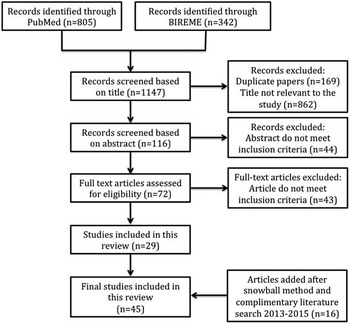
The selection of articles is displayed in Fig. 1. Out of the 1147 potentially relevant citations identified, 29 fulfilled all inclusion criteria and were included in this review. Six additional articles were incorporated after the search through the reference lists of identified articles and 10 after the complementary search performed in 2015, giving a total of 45 articles, which were categorized into four groups of outcomes.
Flow chart of study search and selection.

Diagnostic criteria for hypertension in pregnancy
Hypertension during pregnancy was uniformly defined by the studies as a systolic blood pressure⩾140 mmHg or a diastolic blood pressure⩾90 mmHg, following currently accepted definitions. Some authors considered preeclampsia and gestational hypertension only when symptoms appeared after 20 weeks of gestation while others considered the 24th week as the cut-off point. Only nine papers measured the intensity of preeclampsia. Among these, one study defined severe PE when arterial pressure was⩾180/110,Reference Ehrenstein, Rothman, Pedersen, Hatch and Sorensen 7 while others considered ⩾160/110 or just a diastolic blood pressure⩾110. Few works have considered the gestational time in which the disease began, distinguishing early-onset PE from late-onset PE.
Cardiovascular effects
Twelve papers (six good and six moderate) investigated offspring’s cardiovascular outcomes after intrauterine exposure to maternal hypertension. Eleven of them reported data on offspring’s blood pressure. Among these, gestational hypertension was consistently associated with higher offspring’s blood pressure, in subjects aged from 9 to 69 years, both in studies that separated gestational hypertension from the other hypertensive disordersReference Kajantie, Eriksson, Osmond, Thornburg and Barker 8 – Reference Miettola, Hartikainen and Vaarasmaki 12 and in those that put gestational hypertension and preeclampsia in the same group.Reference Lazdam, de la Horra and Pitcher 13 – Reference Mamun, Kinarivala and O’Callaghan 15
Studies that analysed the effect of preeclampsia alone on the offspring’s blood pressure, on the other hand, had mixed results. Oglaend et al. found an increase only in systolic blood pressure,Reference Oglaend, Forman, Romundstad, Nilsen and Vatten 16 while Miettola et al. found higher diastolic and mean arterial pressure after preeclampsia exposure.Reference Miettola, Hartikainen and Vaarasmaki 12 Other three papers from the ALSPAC cohort, using data from different assessments of the study, found higher systolic and diastolic blood pressure in children exposed to preeclampsia, although the adjustments attenuated the association towards the null.Reference Geelhoed, Fraser and Tilling 9 – Reference Fraser, Nelson, Macdonald-Wallis, Sattar and Lawlor 11
Lazdam et al. identified both peripheral and central systolic blood pressure significantly higher only in offspring of early onset preeclampsia.Reference Lazdam, de la Horra and Diesch 17 The authors highlight that many children in this group were also born preterm and some small for gestational age, factors that are linked with higher blood pressure during childhood. Fugelseth et al. found no differences in blood pressure between children exposed and unexposed to preeclampsia.Reference Fugelseth, Ramstad and Kvehaugen 18
Kajantie et al. were the only to consider the severity of the disease and found an increased risk of hypertension just in adults exposed to severe maternal preeclampsia.Reference Kajantie, Eriksson, Osmond, Thornburg and Barker 8 They also analysed offspring’s cardiovascular health and found that gestational hypertension and severe preeclampsia were associated with an increased risk for offspring’s thrombotic stroke.Reference Kajantie, Eriksson, Osmond, Thornburg and Barker 8 Mild and moderate preeclampsia, in turn, were associated with an increased risk for offspring’s haemorrhagic stroke. There was no evidence of an association between hypertensive disorders and offspring’s coronary heart disease. From the CHASE study, offspring exposed to preeclampsia had smaller hearts, increased heart rate and increased late diastolic velocity at mitral valve attachments, however no major differences were found in myocardial function.Reference Fugelseth, Ramstad and Kvehaugen 18
Two studies investigated offspring’s vascular function. Lazdam et al. found that 20 years old preterm offspring exposed to hypertension had greater carotid intima-media thickness compared to preterm or full-term offspring from normotensive pregnancies.Reference Lazdam, de la Horra and Pitcher 13 Measures of pulse wave velocity, flow-mediated dilatation and nitrate-mediated dilatation were similar between the groups. Lawlor et al. assessed 9–12 years old children from the ALSPAC cohort and found no association of gestational hypertension or preeclampsia with offspring’s brachial artery distensibility, brachial artery flow-mediated dilatation or arterial stiffness assessed by carotid to radial pulse wave velocity.Reference Lawlor, Macdonald-Wallis and Fraser 10
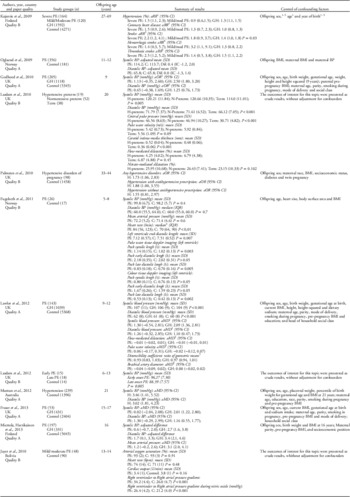
One study evaluated pulmonary artery pressure in 13–14 years old adolescents permanently living at the same high-altitude location in Bolivia (3600 m).Reference Jayet, Rimoldi and Stuber 19 Offspring exposed to mild and moderate preeclampsia had a 30% increase in pulmonary artery pressure compared to those unexposed. The authors hypothesized that oxidative stress may represent an underlying mechanism because plasma concentration of thiobarbituric acid-reactive substances was increased in those exposed to preeclampsia (Table 1).
Summary of papers on cardiovascular effects

aMD, adjusted mean difference; aOR, adjusted odds ratio; aRR, adjusted relative risk; BMI, body mass index; BP, blood pressure; C, control group; CI, confidence interval; GH, gestational hypertension; H, hypertension; IQR, interquartile range; OR, odds ratio; PE, preeclampsia; SD, standard deviation.
Immune effects
Four good quality studies evaluated offspring’s immune outcomes after intrauterine exposure to maternal preeclampsia. All papers revealed an association of preeclampsia with at least one of the immune outcomes measured, though the results were inconsistent among the studies. Keski-Nisula et al. found that adolescents born after pregnancies either with preeclampsia or placental abruption had an increased risk of allergic sensitization and severe atopic sensitization.Reference Keski-Nisula, Heinonen, Remes and Pekkanen 20 Byberg et al. found that only the severe form of maternal preeclampsia was associated with allergic rhinoconjunctivitis and with high level allergic sensitization at late childhood.Reference Byberg, Ogland, Eide and Oymar 21 The authors found no association of maternal preeclampsia with atopic dermatitis or asthma development.
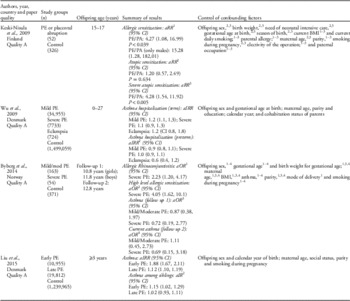
Wu et al. found that mild preeclampsia slightly increased the risk of hospitalization for asthma in children born at term, but not among those born preterm.Reference Wu, Nohr and Bech 22 Severe preeclampsia and eclampsia were not associated with the outcome regardless of gestational age at birth. Liu et al. noted that only early onset preeclampsia was associated with an increased incidence of asthma in children 3 years or older.Reference Liu, Olsen and Agerbo 23 When the authors compared siblings with discordant histories for preeclampsia exposure or asthma diagnosis, the strength of the association was attenuated, indicating that unmeasured confounding factors shared by the family could be partially responsible for the increased risk (Table 2).
Summary of papers on immune effects

aIRR, adjusted incidence rate ratio; aOR, adjusted odds ratio; aRR, adjusted relative risk; BMI, body mass index; CI, confidence interval; PA, placental abruption; PE, preeclampsia.
Mental, behavioural and neurological effects
Twenty-four papers (15 good, four moderate and five poor) examined mental, behavioural and neurological outcomes after antenatal exposure to maternal hypertensive disorders.
Eight of these papers evaluated the risk of cerebral palsy. While most articles raised the possibility that preeclampsia and eclampsia exposure may increase the risk of cerebral palsy,Reference Wu, Nohr and Bech 22 , Reference Kulak, Sobaniec, Okurowska-Zawada, Sienkiewicz and Paszko-Patej 24 – Reference Tronnes, Wilcox, Lie, Markestad and Moster 28 four papers also reported a reduced risk of cerebral palsy after preeclampsia exposure when only preterm children entered the analysis.Reference Wu, Nohr and Bech 22 , Reference Mann, McDermott, Griffith, Hardin and Gregg 27 – Reference Beaino, Khoshnood and Kaminski 29 The authors discusses that this result must be carefully interpreted for it probably reflects that other causes of prematurity may be more harmful than preeclampsia in cerebral palsy’s development, and not a beneficial effect of the disease.
Eight studies evaluated offspring’s intellectual abilities and all of them found evidence that intrauterine exposure to maternal hypertensive disorders, especially preeclampsia, might have a negative impact on cognitive functioning throughout life. Ehrenstein et al. evaluated Danish men aged 18–19 years and verified a higher prevalence of low cognitive function among those exposed to preeclampsia or gestational hypertension.
Tuovinen et al. investigated intellectual abilities in the Helsinki Birth Cohort Study in two papers, one addressing men at 20.1 yearsReference Tuovinen, Raikkonen and Kajantie 30 and the other at 20.1 and at 68.5 years.Reference Tuovinen, Raikkonen and Kajantie 31 At both ages, men whose mother had any type of hypertension during pregnancy presented reduced arithmetic and total ability scores compared with men born by normotensive pregnancies. The second paper also shows a greater decrease in arithmetic and total ability between 20 and 68 years of age in men exposed to maternal hypertension. Also with the Helsinki cohort, Tuovinen et al. examined cognitive impairment at the average age of 69.3 years.Reference Tuovinen, Eriksson and Kajantie 32 Offspring born after a preeclamptic pregnancy had higher scores for cognitive failures, distractibility and false triggering. Among women born after gestational or chronic hypertension, more frequent complaints of cognitive failures, forgetfulness and false triggering was reported.
Morsing and Maršál evaluated 5–8 years old children born very preterm after intrauterine growth restriction and noted that children exposed to preeclampsia had lower verbal intelligence coefficient (IQ) scores and full-scale IQ scores compared to those from normotensive pregnancies.Reference Morsing and Marsal 33 Van Wassenaer et al. found that 4.5 years old children exposed to severe early-onset hypertension had mean IQ score 8 points above the normal population range.Reference van Wassenaer, Westera and van Schie 34 The percentage of moderately delayed and abnormal scores indicates that children exposed to severe early onset hypertension could present more cognitive problems than the average population.
Whitehouse et al. evaluated verbal and non-verbal ability on 10 years old participants of the Western Australian Pregnancy Cohort Study.Reference Whitehouse, Robinson, Newnham and Pennell 35 Offspring of pregnancies complicated by preeclampsia had a mean verbal IQ score lower than children from gestational hypertensive pregnancies, who in turn, had lower scores than children from normotensive pregnancies. There were no significant differences between groups on non-verbal ability scores.
Heikura et al. calculated that 11 years old children whose mothers had gestational hypertension had a risk 2.4 times higher of having mild cognitive limitations (IQ 50–85) compared with children born from a normotensive pregnancy.Reference Heikura, Hartikainen and Nordstrom 36 Stratifying mild cognitive limitation into two categories, gestational hypertension had a stronger association with borderline intellectual functioning (IQ 71–85) than with mild intellectual disability (IQ 50–70).
Four studies also investigated the association of maternal hypertensive disorders with a variety of mental and social disorders in the offspring. Depressive symptoms measured by the Beck Depression Inventory (BDI) were studied by Tuovinen et al. at the ages of 60 and 63 years.Reference Tuovinen, Raikkonen and Kajantie 37 The BDI scores were higher in those whose mother was primiparous and had preeclampsia compared to the primiparous without preeclampsia. Among those with multiparous mother, BDI was not associated with preeclampsia exposure. Gestational hypertension also had no significant effect on BDI scores.
Tuovinen et al. also evaluated the risk for severe mental disorders in the same cohort.Reference Tuovinen, Raikkonen and Pesonen 38 The findings show that offspring born after pregnancies complicated by chronic or gestational hypertension had an increased risk for any mental disorder, mood and anxiety disorder. Men exposed to preeclampsia, on the other hand, had lower risk of any mental disorder or substance use disorder.
Tuovinen et al. again investigated adaptive functioning and psychiatric and psychological problems in adults over 60 years.Reference Tuovinen, Aalto-Viljakainen and Eriksson 39 They found that offspring exposed to preeclampsia had an increased risk of reporting: adjustment problems in adaptive functioning with spouse/partner, total problems, problems on the critical items scale; anxious/depressed, functional impairment, memory, thought and irritable/disinhibited problems on syndrome scales; and depressive and psychotic problems. Offspring born after chronic or gestational hypertensive pregnancies did not differ from normotensive pregnancies on total problems and critical items, but had more depressive symptoms on DSM-oriented scales.
Wade and Jenkins analysed the association between maternal hypertension during pregnancy and children’s neuropsychological difficulties in a study with important limitations.Reference Wade and Jenkins 40 They found that hypertension was negatively associated with children’s social cognition at 18 months of age and theory of mind and executive functioning variable at ages 3 and 4.5 years.
Three papers investigated the impact of hypertension during pregnancy on child behaviour, with mixed results. Robinson et al. applied the Child Behavior Checklist (CBCL) at 2, 5, 8, 10, and 14 years in participants from the Western Australian Pregnancy Cohort.Reference Robinson, Mattes and Oddy 41 The exposure to gestational hypertension was positively associated with the scores for total, internalizing and externalizing behaviour at 8, 10 and 14 years and with total behavioural morbidity at 8 and 10 years. Inversely, the relationship between preeclampsia and CBCL was negative. In the same cohort, Robinson et al. also examined offspring’s temperament at 1 year and found that mothers who had gestational hypertension or preeclampsia were more likely to report difficult temperament of their child.Reference Robinson, Oddy and Whitehouse 42 Van Wassenaer et al., on the other hand, found that children exposed to severe early-onset hypertension had behavioural scores similar to the normal population.Reference van Wassenaer, Westera and van Schie 34
Two papers investigated the association of exposure to maternal hypertension and offspring’s epilepsy. Wu et al. found that those born at term after mild or severe preeclampsia had an increased risk of hospitalization for epilepsy from birth to 27 years.Reference Wu, Nohr and Bech 22 Among preterm children only mild preeclampsia was significantly associated with an increased risk of hospitalization for epilepsy. Mann and McDermott conducted a retrospective study and found that maternal preeclampsia was associated with an increased risk of epilepsy overall and in full-term children but not in preterm children.Reference Mann and McDermott 43 The association was stronger for children born at term whose mother had late onset preeclampsia.
Two studies also measured motor development in the offspring. Van Wassenaer et al. assessed 4.5 years old children, finding that those exposed to severe early-onset hypertension had a higher proportion of subnormal and abnormal scores in the motor test.Reference van Wassenaer, Westera and van Schie 34 The outcomes were not different in children born after maternal HELLP, severe preeclampsia, or foetal growth restriction in combination with pregnancy induced hypertension.
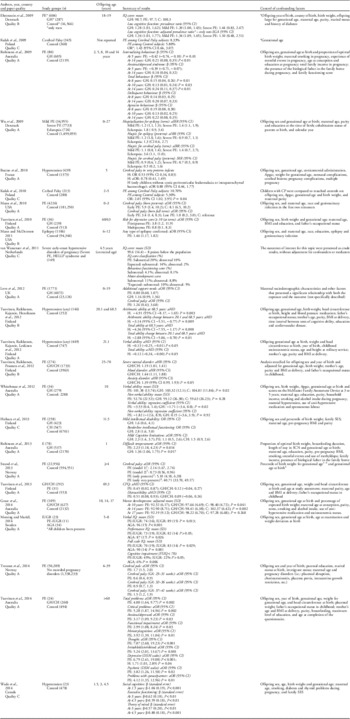
Grace et al. evaluated motor development at 10, 14 and 17 years using the Neuromuscular Development Index (NDI).Reference Grace, Bulsara, Pennell and Hands 44 Adjusted analysis revealed that, at 10 and 14 years, but not at 17, the mean NDI of offspring exposed to preeclampsia was lower than that in hypertensive and normotensive groups. Using mixed linear model to assess the longitudinal impact of the diseases, preeclampsia imposed a greater risk than hypertension for lower motor competence in late adolescence (Table 3).
Summary of papers on mental, behaviour and neurological effects

AGA, appropriate weight for gestational age; aHR, adjusted hazard ratio; aMD, adjusted mean difference; aOR, adjusted odds ratio; β, regression coefficient; BMI, body mass index; CH, chronic hypertension; CI, confidence interval; GA, gestational age; GH, gestational hypertension; H, hypertension; IQ, intelligence coefficient; IRR, incidence rate ratio; IUGR, intrauterine growth restriction; OR, odds ratio; PE, preeclampsia; SD, standard deviation; SES, socioeconomic status; SGA, small for gestational age.
Metabolic effects
Thirteen papers (seven good and six moderate) evaluated offspring’s metabolic outcomes after intrauterine exposure to maternal hypertension. Ten of these papers, from seven different studies, assessed the relationship between hypertensive disorders during pregnancy and offspring’s body composition. The results among the studies were very heterogeneous for all the outcomes investigated.
Four papers found no significant association between preeclampsia exposure and anthropometric measurements in subjects 5–27 years of age.Reference Miettola, Hartikainen and Vaarasmaki 12 , Reference Lazdam, de la Horra and Diesch 17 , Reference Miettola, Hovi and Andersson 45 , Reference Kvehaugen, Andersen and Staff 46 One of these papers also examined the exposure to gestational hypertension and equally found no significant difference on body mass index (BMI), waist circumference and hip circumference between the groups.Reference Miettola, Hartikainen and Vaarasmaki 12
Washburn et al.,Reference Washburn, Nixon, Russell, Snively and O’Shea 47 studying very low birth weight (VLBW) adolescents, found that male offspring exposed to preeclampsia had higher BMI, waist circumference, triceps and subscapular skinfold thickness and body fat percentage compared to those from normotensive pregnancies. Among females, no differences were found. Oglaend et al. also found a slightly higher BMI (Z-score 0.0 v. −0.1 SD) in adolescents exposed to preeclampsia compared to those from normotensive pregnancies.Reference Oglaend, Forman, Romundstad, Nilsen and Vatten 16
From de ALSPAC cohort, two papers presented data after the 9 years old assessmentReference Geelhoed, Fraser and Tilling 9 , Reference Lawlor, Macdonald-Wallis and Fraser 10 and two when the offspring were 17 years old.Reference Fraser, Nelson, Macdonald-Wallis, Sattar and Lawlor 11 , Reference Hannam, Lawlor and Tobias 48 At 9 years, children exposed to gestational hypertension presented higher BMI and waist circumference compared to those from normotensive pregnancies, while preeclampsia seemed to influence the measurements in the opposite direction. At 17 years, however, the offspring group exposed to preeclampsia had the highest BMI, followed by those exposed to gestational hypertension. Fat mass and lean mass, although not statistically significant, were also higher in the groups exposed to preeclampsia or gestational hypertension.
Two papers assessed offspring’s bone mineral content. Miettola et al. found that VLBW adults born after a preeclamptic pregnancy had higher lumbar spine, femoral neck and whole body bone mineral density (BMD) compare to VLBW adults born after a normotensive pregnancy.Reference Miettola, Hovi and Andersson 45 The differences were greater among men. Adults born at term exposed to preeclampsia had higher femoral neck BMD, whole body BMD and whole body bone mineral content compared to those unexposed. Hannam et al., in the other hand, found that adolescents with antenatal exposure to preeclampsia had lower total hip BMD, but not spine and total body BMD, compared with those from normotensive pregnancies.Reference Hannam, Lawlor and Tobias 48 Offspring exposed to gestational hypertension had greater BMD at all measured sites: total body, spine and total hip, but the authors attribute those differences to a ‘maternal BMI/offspring adiposity’ confounding pathway.
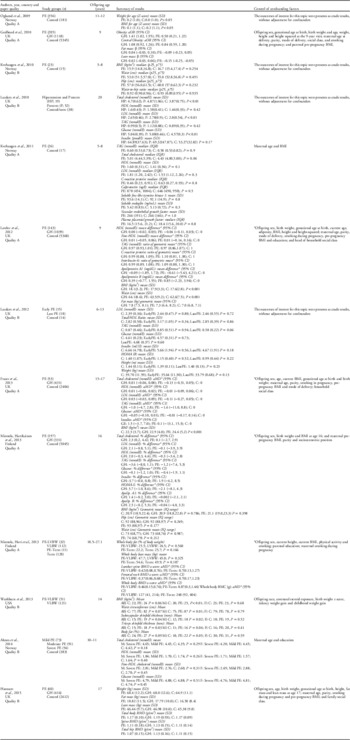
Seven studies also presented data on blood biomarkers, such as: total cholesterol, triglycerides, high-density and low-density lipoprotein cholesterol, glucose, insulin, insulin resistance, C-reactive protein, interleucin-6, apolipoprotein A1 and B, calprotectin, soluble endoglin, soluble fms-like tyrosine kinase 1, vascular endothelial growth factor and placental growth factor. The studies had consistent results showing no evidence that preeclampsia or gestational hypertension could be associated with the offspring’s blood biomarkers. Nonetheless, it is important to highlight that these studies evaluated subjects up to 20 years of age, while changes on blood biomarkers are most common with advancing age, especially in elderly people (Table 4).
Summary of papers on metabolic effects

aMD, adjusted mean difference; aOR, adjusted odds ratio; β, regression coefficient; BMI, body mass index; CI, confidence interval; F, female; GH, gestational hypertension; HDL, high density lipoprotein cholesterol; LDL, low density lipoprotein cholesterol; M, male; IQR, interquartile range; PE, preeclampsia; p25, percentile 25; p75, percentile 75; SD, standard deviation; SGA, small for gestational age; TAG, triacylglycerol.
Discussion
This review comprises 45 articles categorized into four groups of outcomes. According to our findings, the hypertensive disorders of pregnancy had an overall negative impact on offspring’s cardiovascular, neurological/behavioural and immune health, although not all parameters analysed in each group had consistent results among studies. The most prominent and reliable associations were verified between preeclampsia and offspring’s lower cognitive functioning and between gestational hypertension and higher offspring’s blood pressure.
Tuovinen et al. recently published a systematic review on maternal hypertensive pregnancy disorders and cognitive functioning.Reference Tuovinen, Eriksson, Kajantie and Raikkonen 49 They also found an association with lower cognitive ability, and evaluated that studies with extended follow-up through adulthood showed the most consistent results. The authors discuss that these findings could reflect an increase in symptoms during lifetime or could be a consequence of improvements in the management of these disorders in the last decades. The use of current pharmacologic treatment, for example, can decrease the risk of severe hypertensive disorders but may also affect the foetal brain development.
Davis et al. performed a systematic review and meta-analysis with 45,249 individuals on studies reporting traditional cardiovascular risk factors in those exposed to preeclampsia compared to controls.Reference Davis, Lazdam and Lewandowski 50 Similarly to this review, they found that in utero exposure to preeclampsia was associated with higher systolic (2.39 mmHg) and diastolic (1.35 mmHg) blood pressure during childhood and young adulthood. Additionally, the authors noted a slightly increase in BMI (0.57 kg/m2) in offspring of preeclamptic women, but with significant heterogeneity among studies (62%). This particular result is not in accordance with our study. We evaluate that body composition have conflicting and contradictory results among papers, with insufficient evidence to reach any conclusion.
All seven studies in this review that examined blood biomarkers showed no evidence that preeclampsia or gestational hypertension could be associated with lipid, glycaemic or inflammatory parameters. Nonetheless, alterations on blood biomarkers are most common with advancing age, and the studies analysed only subjects 20 years or younger.
Physiological explanations that can be underlying the observed associations between hypertensive disorders of pregnancy and offspring’s cardiovascular, neurological/behavioural and immune health may relay on: abnormal placental implantation,Reference Roberts and Redman 51 – Reference Rees and Harding 53 inflammatory biomarkers during pregnancy,Reference Zucchi, Yao and Ward 54 , Reference Jaenisch and Bird 55 maternal glucocorticoid metabolism and exogenous glucocorticoid exposure,Reference Challis, Sloboda and Matthews 56 – Reference Cottrell, Holmes, Livingstone, Kenyon and Seckl 59 and genetic and epigenetic aspects.Reference Doridot, Houry and Gaillard 60 – Reference Tsankova, Renthal, Kumar and Nestler 62 Furthermore, we cannot exclude a probable common genetic background and environmental exposure that could influence both mother and offspring, or the possibility of residual confounders in the studies.
Many authors did not consider the intensity of preeclampsia or the onset of the disease. Some studies suggested that early and late onset preeclampsia may represent separate pathogenic conditions, often leading to different outcomes in the offspring.Reference Vatten and Skjaerven 63 In our review, nearly all studies that distinguished the disease by its onset found different results for offspring exposed to early-PE compared to offspring exposed to late-PE. Severe PE was also associated with more consistent results compared with the mild or moderate disease.
Important confounding factors such as gestational age at delivery, birth weight for gestational age and the need of neonatal intensive care were also commonly overlooked. It is known that preterm-born individuals are exposed to relatively large physiological disturbances during the transition from the in utero to ex utero environment, when their cardiovascular system is still immature. Moreover, they have a high exposure to perinatal interventions such as postnatal intravenous lipids, and mechanical ventilation, which can have an independent effect on cardiovascular development, pulmonary maturity and growth.Reference Lewandowski and Leeson 64
Other important potential confounder that was seldom considered is the exogenous glucocorticoid exposure that is often administered in the antenatal period to prevent iatrogenic or spontaneous preterm delivery. A review of studies on animal models suggests that antenatal exposure to excessive glucocorticoids can reduce offspring birth weight and cause permanent hypertension, hyperglycaemia, hyperinsulinemia, altered behaviour and altered neuroendocrine responses throughout the offspring life.Reference Seckl 65
The weakness of this review is that we analysed only articles published in a limited time period of less than 10 years. This restriction was necessary due to the large amount of publications in the area that would make it impossible to carry out the review. Nevertheless, with the great advance in clinical management of preeclampsia,Reference Bell 66 limiting the year of publication brought the advantage that this review reflects mostly consequences of contemporary treatment regimes.
Our major strength is the possibility to analyse all outcomes together in a broad panorama of recently published articles. This may help researchers to design future studies with methodologies that can answer the literature gaps.
Our findings suggest that further researches are necessary to overcome the heterogeneity of the studies and to reveal the mechanisms involved in the observed associations. It is also possible that some offspring health consequences may have greater impact at older ages or have a transgenerational effect.
Acknowledgements
None.
Financial Support
This research received no specific grant from any funding agency, commercial or not-for-profit sectors.
Conflicts of Interest
None.
Supplementary material
To view supplementary material for this article, please visit http://dx.doi.org/10.1017/S2040174416000209