INTRODUCTION
The rice–wheat cropping system occupies about 13.5 million ha in the Indo-Gangetic Plains of South Asia and provides food for 400 million people (Ladha et al., Reference Ladha, Dawas, Pathak, Padre, Yadav and Singh2003). During the last one decade, the rice–wheat system has started showing the signs of stress with production of fatigue and deterioration of soil health (Timsina and Connor, Reference Timsina and Connor2001; Yadav et al., Reference Yadav, Dwivedi, Gangwar, Prasad, Rao, Johansen and Rego1998). This is especially true for areas where a continuous rice–wheat rotation predominates and system diversity is low (Fujisaka et al., Reference Fujisaka, Harrington and Hobbs1994). In many such areas, yields have started declining (Hobbs and Morris Reference Hobbs and Morris1996; Yadav, Reference Yadav1998) mainly due to changes in biochemical and physical comparisons of organic matter and gradual decline in the supply of soil nutrients causing macro and micro nutrient imbalances on account of inappropriate fertiliser application (Ladha et al., Reference Ladha, Fischer, Hossain, Hobbs and Hardy2000; Shukla et al., Reference Shukla, Sharma, Singh and Upadhay2004; Timsina and Connor, Reference Timsina and Connor2001), and compaction of subsoil layers (Balloli et al., Reference Balloli, Ratan, Garg, Singh and Krishna Kumari2000; Ladha et al., Reference Ladha, Dawas, Pathak, Padre, Yadav and Singh2003). Organic matter is a critical component of soils under the rice–wheat cropping system providing organic substrate for nutrient release and playing a critical role in maintenance of soil structure, water holding capacity and reduction in erosion. Many studies indicate strong positive relationship between the amount of carbon incorporated into soil, either from crop residues or from external sources such as manure, and the content of total soil organic carbon (SOC) (Havlin et al., Reference Havlin, Kissel, Maddux, Classen and Long1990). Restoration and build-up of organic carbon is a big challenge under intensive production system for tropical, subtropical arid and semi-arid regions where soils are inherently low in organic carbon.
Total organic carbon (TOC) in soil is composed of several fractions. These fractions include large number of organic compounds that are broadly grouped as labile pool and passive pool. The labile pool primarily composes microbial biomass carbon, while the passive pool is a complex material resistant to decomposition, often called humus, and is associated with clay in the soil. Labile pool is more readily lost from the soil than others (Mandal et al., Reference Mandal, Majumder, Bandypadhyay, Hazra, Gangopadhyay, Santaray, Misra, Chaudhury, Saha and Kundu2008). The relative proportion of these various fractions in soil determines soil quality and its susceptibility to rapid mineralisation and is therefore a critical determinant of soil carbon dynamics. Ghosh et al. (Reference Ghosh, Wilson, Mandal, Ghoshal and Growns2010) reported that conventional cultivation had the lowest TOC content (148 t ha−1), whereas NPK + farm yard manure (FYM)-amended soils had the largest TOC (207 t ha−1). The highest proportion of the labile carbon was observed under fallow whereas the proportion of non-labile carbon fraction was more under NPK + FYM. Long-term experiments have also added much to our understanding of the complex issue of carbon sequestration in soil and particularly the quantification and prediction of carbon sink potential of arable soils (Rogasik et al., Reference Rogasik, Schroetter, Funde, Schnug and Kurtineez2004). In spite of the existence of large number of long-term experiments that can provide relevant data pertaining to soil management, few studies integrate the total SOC pool and carbon lability into carbon management index (CMI) as a way to assess the capacity of management systems to promote soil quality.
Pulses or food legumes because of their ability for atmospheric nitrogen fixation, leaf shedding ability and higher belowground biomass add significant amount of organic carbon to soil (Ganeshamurthy, Reference Ganeshamurthy2009). Singh and Sandhu (Reference Singh and Sandhu1980) and Newaj and Yadav (Reference Newaj and Yadav1994) also reported that organic carbon content of soils increased over the initial level due to inclusion of pulses in the cereal-based cropping systems. Our hypothesis is that inclusion of pulses in the lowland puddled rice-based cropping system using organic and inorganic sources of nutrients for a long period may have an impact on the dynamics of different pools of SOC, and thus the quality of soil. Long-term fertility experiments would be more useful to determine the effects of cropping systems, soil and crop residue management etc. on the quantitative and mechanistic changes in SOC (Leigh and Johnstone, Reference Leigh and Johnstone1994). Effects of the pulse-based cropping system on soil carbon dynamics have not been fully quantified in the Indo-Gangetic alluvial plain region. In the present study, we examined the soils of a long-term fertility experiment under the lowland rice-based cropping system on an Inceptisol of the north-eastern Indo-Gangetic Plain zone of India (Kanpur) after seven-year cropping cycles with respect to soil carbon pool and carbon management indices.
MATERIALS AND METHODS
Description of field experiment
The data reported here were generated from a long-term fertility experiment at main research farm of Indian Institute of Pulses Research (IIPR), Kanpur, India (26° 27′ N, 80° 14′ E and 152.4 m above mean sea level (msl)). The climate is tropical sub-humid, receives annual rainfall of 722 mm and mean annual maximum and minimum temperature is 33.0 °C and 20.0 °C, respectively. The soils of experimental site comes under taxonomical class typic ustochrept with sandy loam texture having pH 8.1, bulk density 1.43 g cm−3 and with low organic carbon content (2.8 g cm−3) at the time of initiation of the experiment.
Experimental design and treatments
The long-term trial was initiated during kharif 2003 to determine the effect of different cropping systems, viz. (1) rice–wheat (RW), (2) rice–chickpea (RC), (3) rice–wheat–mung bean (RWMb) and (4) rice–wheat–rice–chickpea (RWRC) (alternate year), and three fertility levels, viz. (1) control (2) inorganic (NPKSZnB) and (3) organic (crop residues + biofertilisers + FYM @ 5 t/ha). Pant Dhan 12 (rice), PBW 343 (wheat), KWR-108 (chickpea) and cv. Samrat (mung bean) were the genotypes used in the experiment.
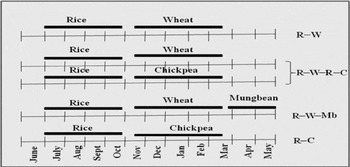
Sowing and harvesting periods of each crop in different cropping systems are presented in Figure 1. The experiment was under seventh year of crop rotation when the soil was sampled. The treatment was laid out in a split plot design with three replications. Fertilisers N, P2O5 and K2O (kg ha−1) were applied in the form of urea, diammonium phosphate and muriate of potash (KCl) at the following rates: rice and wheat (120–60–40), chickpea and mung bean (20–60–20). Sulphur was applied in the form of gypsum @ 20 kg ha−1, zinc as ZnSO4 @ 25 kg ha−1 and boron as borax @ 10 kg ha−1. Well-decomposed FYM was spread uniformly at the rate of 5 t ha−1 one month before transplanting of rice, which provided 28, 9, 26, and 448 kg ha−1 of N, P2O5, K2O and C, respectively. Full amount of dry crop residues in a system were chopped using rotatory machine, uniformly spread, mixed with soil and allowed to decompose before sowing. Biofertilisers (Azotobacter for cereals, Rhizobium for pulses and phosphate solubilising bacteria, Bacillus polymyxa, for both cereals and pulses) were applied @ 20 g kg−1 seed (107 bacteria g−1 culture) through seed treatment of PUSA inoculant (source: microbiology division, Indian Agricultural Research Institute, New Delhi).
Temporal layout of crop duration under various cropping systems.

Soil sampling and analysis
Soil samples were collected in 2010 from four soil depths (0–20, 20–40, 40–60 and 60–80 cm) from each treatment after harvesting last crop in the crop cycle. The samples were air-dried, grounded and passed through a 0.2-mm sieve, stored at room temperature and analysed for oxidisable organic carbon by wet oxidation method (Walkley and Black, Reference Walkley and Black1934). Total organic carbon was calculated using the following formula: oxidisable organic carbon × 1.33 (Hesse, Reference Hesse2002). In surface (0–20 cm) and subsurface (20–40 cm) depths, the fractions of organic carbon present in the soil was estimated through the modified Walkley and Black method as described by Chan et al. (Reference Chan, Bowman and Oates2001) using 5, 10, and 20 ml of concentrated H2SO4 resulting in three acid aqueous solution ratios, 0.5:1, 1:1 and 2:1 (which corresponded, respectively, to 12 N, 18 N and 24 N of H2SO4) (Ghosh et al., Reference Ghosh, Wilson, Mandal, Ghoshal and Growns2010). The amount of SOC determined using 5, 10 and 20 ml of concentrated H2SO4 when compared with TOC allowed separation of TOC into the following four different fractions of decreasing oxidisability: fraction 1 (Cfrac 1), organic carbon oxidisable under 12-N H2SO4; fraction 2 (Cfrac 2), difference in SOC extracted between 18 N and 12 N H2SO4; fraction 3 (Cfrac 3), difference in SOC extracted between 18 N and 24 N H2SO4 (the 24 N H2SO4 is equivalent to the standard Walkley and Black method); and fraction 4 (Cfrac 4), residual organic carbon after reaction with 24 N H2SO4 when compared with TOC (Nelson and Sommers, Reference Nelson, Sommers and Page1982).
Active and passive pools
Soil organic carbon oxidised by 12 N H2SO4 was designed as very labile pool (Cfrac 1) and the difference in SOC oxidised between 18 N and 12 N H2SO4 was termed as labile pool (Cfrac 2). These two together were designated as active pool of SOC because of their easy oxidisability (by weak 12 N and 18 N H2SO4). On the other hand, the passive pool represents the less labile pool (Cfrac 3) and the non-labile (Cfrac 4) pool of TOC. Summation of these two pools constituted the passive pool of SOC in the experimental soils:


Carbon management index (CMI)
Step 1. A lability index for SOC was computed using all the three pools (Cfrac 1, Cfrac 2 and Cfrac 3) mentioned above. The Cfrac 1, Cfrac 2 and Cfrac 3 have been designated as very labile, labile and less labile, and are given weightage of 3, 2 and 1, respectively. Subsequently, their actual values were transformed to a proportional amount of TOC and weighed with the weighing factor to get lability index for the organic carbon content in each of the soils under different depths (Blair et al., Reference Blair, Lefroy and Lisle1995),

Step 2. Carbon pool index (CPI) was derived using the following formula:

where reference total carbon is the total carbon content (mg/kg) of control plots (Blair et al., Reference Blair, Lefroy and Lisle1995).
CMI is calculated as follows:

Soil microbial biomass carbon (SMBC)
Microbial biomass carbon was analysed following the chloroform fumigation method. Fifty-gram soil was fumigated for 24 h in a vacuum desiccator using ethanol-free chloroform. After fumigation, chloroform fumes were removed by evacuation. Non-fumigated and fumigated soils (50 g each) were extracted using 200 ml of 0.5 M K2SO4 (Vance et al., Reference Vance, Brookes and Jenkinson1987). The carbon in the chloroform fumigation assay was analysed by wet combustion technique as described by Jenkinson and Powlson (Reference Jenkinson and Powlson1976),
Soil microbial biomass carbon = F c/0.45,
where F c = (Organic carbon extracted from 0.5 M K2SO4 from fumigated soil–organic carbon extracted from non-fumigated soil).
Statistical analysis
Effects of treatment were evaluated by split plot analysis of variance (ANOVA) with cropping system as main factor and nutrient management as sub-factors. ANOVA was performed using the program SPSS 11.0 for windows. The significance of the treatment effect was determined using F-test. When ANOVA indicated that there was a significant value, multiple comparisons of mean value were performed using the least significant difference (LSD) method.
RESULTS
Soil organic carbon
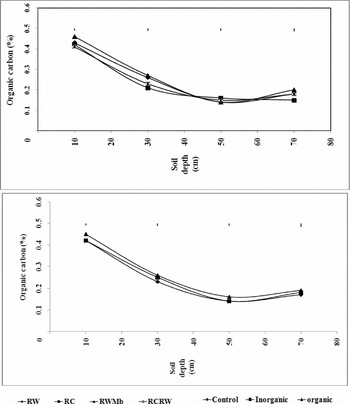
Different cropping systems (p ≤ 0.05) and nutrient management practices (p ≤ 0.05) had significant effect on SOC content (Figure 2). Among the cropping systems, rice–wheat–mung bean had the highest SOC content in surface depth, which was 6% higher than the rice–wheat system. Continuous application of organic amendments resulted in the highest increase of SOC content (10.4%) over control. The analysed data detected significant variation in depth-wise distribution of SOC with cropping system and nutrient management practices (p ≤ 0.05). The SOC content decreased up to 43% at 20–40-cm depth and further 22% at 40–60-cm depth.
Profile of soil organic carbon content (%) as affected by different cropping systems and nutrient management practices. (RW = rice–wheat; RC = rice–chickpea; RWMb = rice–wheat–mung bean; RWRC = rice–wheat–rice–chickpea; OC = organic carbon). The vertical error bars represent the standard error of means.

Carbon pools
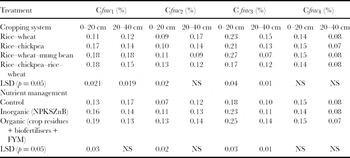
Inclusion of pulses in the rice-based system increased Cfrac 1 both at surface and subsurface layers as compared with the rice–wheat system. Maximum and significant (p ≤ 0.05) increase in Cfrac 1 (64%) at surface depth was observed under both rice–wheat–mung bean and rice–wheat–rice–chickpea systems. On the other hand, at subsurface depth, rice–wheat–mung bean recorded significantly highest Cfrac 1 over other cropping systems (p ≤ 0.01). The effect of cropping system on Cfrac 2 was also significant (p ≤ 0.05) at surface depth. The rice–wheat–rice–chickpea system resulted in greater accumulation of Cfrac 2 in surface layer, but at subsurface layer, cropping system effect for this fraction was nonsignificant (p > 0.05) (Table 1). Inclusion of mung bean in the rice–wheat system led to significantly (p ≤ 0.01) higher Cfrac 3 as compared with other cropping systems in surface depth. However, at subsurface depth, Cfrac 3 was found highest in the rice–wheat system (p ≤ 0.05). Cfrac 4 did not vary significantly (p > 0.05) with cropping systems at both soil depths. Application of organic and inorganic amendments had significant effect on distribution of different carbon pool and their share at surface depth (p ≤ 0.05). Among nutrient management practices, organic treatment (incorporation of crop residue along with FYM and biofertilisers) significantly increased Cfrac 1 (p = 0.001), Cfrac 2 (p = 0.04) and Cfrac 3 (p ≤ 0.01) over control and inorganic (NPKSZnB) but not the Cfrac 4 (p = 0.812). The distribution of different carbon fractions followed the order Cfrac 3 > Cfrac 1 > Cfrac 4 > Cfrac 2 in surface depth, whereas it was in the order Cfrac 1 > Cfrac 2 > Cfrac 3 > Cfrac 4 at subsurface depth.
Cropping system and nutrient management effect on carbon fractions in the experimental soils.

NS = Nonsignificant.
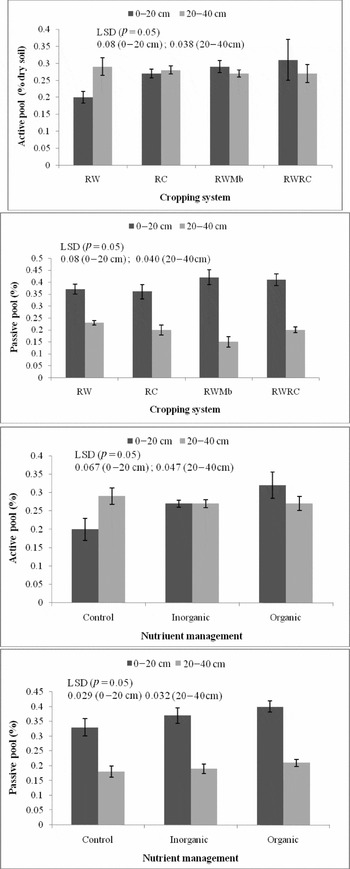
The distribution of active and passive pool with soil depth varied significantly with cropping system (p ≤ 0.05). Relatively higher amount of passive pool was noticed in surface soil than subsurface soil (Figure 3). The relative proportion of active carbon pool in surface to subsurface was highest in the rice–wheat–rice–chickpea system (1.14:1) followed by the rice–wheat–mung bean system (1.07:1), and lowest in the rice–wheat system (0.69:1). Among nutrient management practices this ratio was relatively more in organic treatment (1.19:1) followed by NPKSZnB (1.00:1) and control (0.69:1). The ratio of passive pool from surface to subsurface was maximum in the rice–wheat–mung bean system (2.63:1) system and minimum in the rice–wheat system (1.61:1). The variation in passive pool of surface to subsurface depth as affected by nutrient management practices was almost comparable.
Active pool and passive pool (% dry soil) of soil carbon under different cropping systems and nutrient management practices. (RW = rice–wheat; RC = rice–chickpea; RWMb = rice–wheat–mung bean; RWRC = rice–wheat–rice–chickpea). Vertical error bars represent the corresponding standard error of means.

Soil microbial biomass carbon
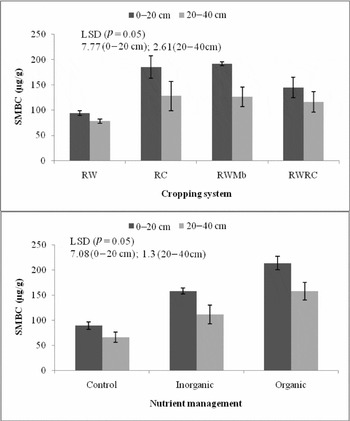
There was significantly higher SMBC upon inclusion of pulses in the rice-based system at both soil depths (p ≤ 0.01). Higher SMBC was recorded in the rice–wheat–mung bean and rice–chickpea systems at surface soil depth (Figure 4). Among nutrient management practices, significantly (p ≤ 0.01) higher SMBC (38% increase over control) was recorded in organic treatments followed by inorganic treatment in both surface and subsurface depths.
Soil microbial biomass carbon (SMBC) under different cropping systems and nutrient management practices. (RW = rice–wheat; RC = rice–chickpea; RWMb = rice–wheat–mung bean; RWRC = rice–wheat–rice–chickpea). Vertical error bars represent the corresponding standard error of means.

Carbon management index
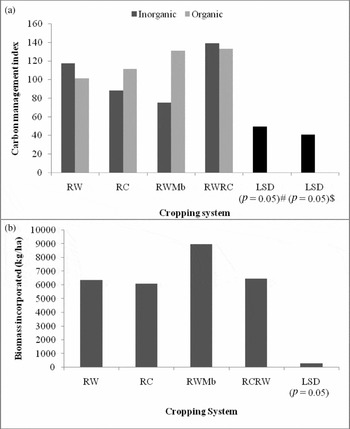
Inclusion of pulses in the rice-based system increased CMI, although its effect was nonsignificant (p > 0.05). Incorporation of crop residue along with application of FYM and biofertiliser was found to improve CMI by 14% over NPKSZnB treatment. Significant interaction effect was detected in nutrient management practices at cropping system. Rice–wheat–mung bean showed significantly (p ≤ 0.05) variable response in CMI with organic and inorganic fertilisation. The interaction of nutrient management at cropping system for CMI was also significant (Figure 5a).
(a) Carbon management index (CMI) in different cropping systems and nutrient management practices (CMI = CPI × lability index; CMI compares the changes that occur in total and labile carbon as a result of agricultural practice with emphasis on changes in labile carbon as opposed to non-labile carbon in SOM; RW = rice–wheat; RC = rice–chickpea; RWMb = rice–wheat–mung bean; RWRC = rice–wheat–rice–chickpea). #LSD (p = 0.05) for nutrient management at cropping system (interaction). $LSD (p = 0.05) for cropping system at nutrient management (interaction). (b) Annual aboveground biomass of different crops incorporated under different cropping systems. The biomass value represented in the figure is the mean of last four years.

DISCUSSION
Soil organic carbon and its fractions
Our results suggested that crop rotation had considerable effect on the relative proportion of SOC in carbon fraction. The highest increase in SOC content due to inclusion of mung bean in the rice–wheat system was associated with addition of more aboveground biomass of crop residues in this system (Figure 5b). This may be attributed to the fact that soil organic matter content and their properties are a function of agricultural practices and the kind and amount of plant residues returned to soil (Campbell et al., Reference Campbell, Biederbeck, McConkey, Curtin and Zentner1999; Cheshire et al., Reference Cheshire, Christensen and Sorensen1990; Ding et al., Reference Ding, Novak, Amarasiriwardena, Hunt and Xing2002). Intensive rice–wheat–mung bean system leads to utilise summer fallow period, which ultimately results in SOC improvement. Earlier studies reported that fallowing reduces SOC by decreasing the amount of non-harvested plant residue returned to the soil (Calegari et al., Reference Calegari, Hargrove, Rheinheimer, Ralish, Tessier, Tourdonnet and Guimaraes2008) whereas increasing the cropping intensity increases SOC (Hutchinson et al., Reference Hutchinson, Campbell and Desjardins2007). Increase in SOC in cropping system with pulses as compared with the rice–wheat system could be attributed to addition of more belowground biomass in the form of root (Ganeshamurthy, Reference Ganeshamurthy2009).
Organic fertiliser treatment resulted in higher increase in SOC as compared with inorganic and control treatment. This increase was likely due to significant increase in carbon input with organic amendments (Gong et al., Reference Gong, Yan, Wang, Hu and Gong2009; Ma et al., Reference Ma, Yang, Xia, Shen, Yin and Li2011; Purakayastha et al., Reference Purakayastha, Rudrappa, Singh, Swarup and Bhadraray2008). Powlson et al. (Reference Powlson, Smith, Cloeman, Smith, Glendining, Korshens and Franco1998) at Rothamsted (UK) also reported similar increase in SOC after manure application in long-term experiments. Across all the treatments, relatively higher proportion of carbon fraction was found in surface soil, whereas it was found to decrease with increasing soil depth. This was due to supply and availability of additional mineralisable and readily hydrolysable carbon resulting in higher microbial activity in surface layers (Kaur et al., Reference Kaur, Brar and Dhillon2008). Build up of organic carbon is more in surface layer than in lower depth because of more addition of roots and plant biomass in surface layers and lack of nutrient and biological activity in deeper layers, which ultimately constrain the rooting depth (Ingram and Fernandes, Reference Ingram and Fernandes2001; Sharma et al., Reference Sharma, Bhandari and Rana1992; Tiwari et al., Reference Tiwari, Verma and Mishra1995). Diversification through pulses in the rice-based system resulted in greater accumulation of active and passive pool in surface depth. This finding was highly correlated with soil microbial biomass carbon, which was also higher in surface depth (Figure 4). The higher SMBC observed in the rice–wheat–mung bean system was due to higher quantity and rate of decomposition of crop residues in this system and inclusion of mung bean residues with lower lignin, cellulose and carbon–nitrogen ratio. Irrespective of the cropping system and nutrient management, presence of Cfrac 3 was more than other carbon fractions. This could be due to anaerobic conditions prevailing in the lowland ecosystem. Perhaps, this is the reason why passive pool is more in the puddled rice system than active pool. Organic treatment also resulted in increase of more resistant Cfrac 3 (Table 1) that might last long and cause a perceptible change in SOC, and further confirmed the dominant role of passive pool in the puddled rice soil. The effect of cropping system on more resistant Cfrac 4 was not significant, whereas all other fractions (Cfrac 1–Cfrac 3) varied significantly due to crop rotation. Lefroy et al. (Reference Lefroy, Blair and Strong1994) also found similar variation in Cfrac1, Cfrac2 and Cfrac3, which indicated that these fractions were mainly responding to cropping. Consequently, these three fractions have been combined in the derivation of lability index component as outlined by Blair et al. (Reference Blair, Lefroy and Lisle1995). Organic amendments, like crop residues and FYM, are easily mineralised under subtropical conditions. Therefore, their effect was observed on labile fractions of carbon (Cfrac 1, Cfrac 2 and Cfrac 3) only.
Carbon management index
The SOC pool directly influences soil's physical, chemical and biological attributes, as well as the self-organisation capacity of soils (Addiscott, Reference Addiscott1995; Blair and Crocker, Reference Blair and Crocker2000; Vezzani, Reference Vezzani2001). Compared with a single measure such as TOC, CMI can be used as a more sensitive indicator of the rate of change of SOC in response to cropping system and soil management changes (Whitbread et al., Reference Whitbread, Lefroy and Blair1998). Therefore, the integration of both soil organic carbon pool and carbon lability into CMI, originally proposed by Blair et al. (Reference Blair, Lefroy and Lisle1995), can provide a useful parameter to assess the capacity of management systems to promote soil quality. In our study, legume-based systems showed higher CMI than other systems. Blair and Crocker (Reference Blair and Crocker2000), Diekow et al. (Reference Diekow, Mielniczuk, Knicker, Bayer, Dick and Kogel-Knabe2005) and Blair et al. (Reference Blair, Faulkner, Till and Poulton2006) also reported increase in CMI when legumes were introduced in crop rotations, reinforcing the role of legumes on the addition of photosynthesised carbon in soil. Under organic fertiliser management, significant increase in CMI was noticed over inorganic treatment. This is due to the increase in annual carbon input and the variation in organic matter quality, thus modifying the lability of carbon to oxidised form (Tirol-Padre and Ladha, Reference Tirol-Padre and Ladha2004). The result is similar to that by Blair et al. (Reference Blair, Faulkner, Till and Poulton2006), who reported that manure and manure with inorganic fertiliser significantly increased CMI compared with any other chemical fertiliser treatments in a long-term experiment. Significant variation in CMI in the rice–wheat–mung bean system with nutrient management was attributed to more carbon input provided by crop residues and organic amendments. Gong et al. (Reference Gong, Yan, Wang, Hu and Gong2009) also reported that 18 years of organic manure addition (alone and in combination with nitrogen fertiliser) was more effective for increasing CMI than chemical fertiliser alone in the maize–wheat system.
CONCLUSION
Inclusion of pulses and nutrient management practices played important role in influencing SOC, carbon fraction and CMI under the rice-based cropping system in Inceptisols. Cfrac 3 contributed the largest percentage of SOC, which is probably the reason for having more passive pool in the puddled rice system. Among nutrient management treatments, organic fertiliser treatment had greater amount of SOC, Cfrac 3, active pool, passive pool, CMI and is considered the best soil management practice in the present study. Among different cropping systems, rice–wheat–mung bean and rice–wheat–rice—chickpea, having higher biomass, maintained greater SOC and CMI under organic management practices, and are considered the ideal system in terms of maintenance of soil health and long-term perspective of system productivity in Inceptisol of the Indo-Gangetic plain of India.