

INTRODUCTION
During the second half of the twentieth century an attention of historians of mathematics shifted to mathematics of the Late Antiquity and its subsequent development by mathematicians of the Arabic world. Many critical editions of works of mathematicians of the Hellenistic era have made their appearance, giving rise to a new, more detailed historical picture. Among these are the critical editions of the works of Diophantus, Apollonius, Archimedes, Pappus, Diocles, and others.
This picture is complemented by numerous critical editions of the works of the scholars of the Arabic world that have led to radical change of our appreciation of their mathematical achievements. Prof. Roshdi Rashed has offered an enormous contribution to this area of research by his monumental editions of Diophantus ArabusFootnote 1 and then much awaited works of Apollonius.Footnote 2 His overall contribution to the history of mathematical sciences in the Islamic world, which is comparable to Joseph Needham's contribution to the discovery and understanding of the Chinese scientific civilization, has also revived Greek mathematics, particularly the pioneering contributions of Diophantus, Archimedes and Apollonius by transforming the image of Arabic mathematics. Prof. Rashed's research covers the entire Archimedean-Apollonian and the Diophantine traditions in the Arabic world.
THE EXTANT SOURCES
The current edition of Apollonius de Perge, La section des droites selon des rapports by Roshdi Rashed and Hélène Bellosta is the first translation in French of the anonymous Arabic version of Apollonius' treatise On the Cutting off of a Ratio (De Rationis Sectione). The Greek original is lost, but its Arabic translation is mentioned by the medieval bio-bibliographers Ibn al-Nadīm (d. 995 or 998),Footnote 3 al-Qifṭī (c. 1172–1248),Footnote 4 and al-Nuwayrī (d. 1333).Footnote 5
Rashed and Bellosta start from an examination and description of the extant manuscripts preserved in Arabic. The history of the text and its translations are examined in Chapter III of Rashed and Bellosta's lengthy Introduction.
The first manuscript, marked “I”, was probably copied in Damascus around 1228; it is part of the famous Ayasofia Collection 4830 of the Süleymaniye Library in Istanbul. The second one, marked “B”, was acquired by a library in Damascus around 1235; it is part of the Arch. Seld. A. 32 Collection from the funds of the Boldeian Library, donated by John Selden (1584–1654) in 1659. In none of the manuscripts is mentioned the name of its translator or a date of copying by a copyist. However, a mark of ownership in the second manuscript dated 633/1235–1236, allows the editors to conclude that it was copied by that date. The first of these manuscripts is considered as the best version of the text, although it is incomplete. The editors establish the proper order of the text by correcting the numbering of the first eight folios of the manuscript.
The editors conclude that these manuscripts are independent copies originating from the same source. They also challenge the authenticity of the part of the text that refers to the twenty-first locus, based on both linguistic and mathematical arguments.
THE TRANSLATIONS
Rashed and Bellosta examine also two translations of the Arabic text of the On the Cutting off of a Ratio.
The first one is Edmund Halley's (1656?–1743) translation from the Arabic into Latin in 1706.Footnote 6 It was based on the manuscript “B” only, which was available to him at that time. According to the editors, although it does not satisfy the criteria of a scholarly translation, it succeeds to render as clearly as possible the difficult mathematical content of the text, as well as to fill and explicate successfully a number of lacunas in the text. Hence, Halley's service to history of mathematics is assessed to be enormous.
The second translation into English that appeared in 1987 by Edward Macierowski and Robert SchmidtFootnote 7 is concluded as controversial by the editors, because it is declared as based on both extant manuscripts, but without providing a critical edition. The preparation of a critical edition is always a hard task that scholars occasionally prefer to avoid. Moreover, the translation is rather paraphrastic and inaccurate and introduces neologisms to render several Arabic terms.
Therefore, Rashed and Bellosta offer us the first critical edition, which may be called “definitive”, of Apollonius' work that occupies the most part of the book, i.e. pages 94–465, furnished by a detailed glossary of Arabic mathematical terms and their rendering in French, as well as complimentary notes on the terminology and their possible Greek original, whenever this is possible.
THE CENTRAL PROBLEM
Apollonius' treatise is devoted to a systematic study of a single problem:
If k is a given ratio, (AB) and (CD) are two given coplanar lines, H is a point of the plane formed by (AB) and (CD), which does not belong neither to (AB), nor to (CD), E is a given point of (AB), G a given point of (CD), then determine a line (HKL) secant to (AB) in L and (CD) in K, such as  .

The problem is stated also by Pappus in his Mathematical Collection and, as the editors notice, it fits perfectly with the formulation of the Arabic version. The editors also observe that the structure of the Arabic text corresponds to the description of Apollonius' book by Pappus, except the cases of diorisms 1.1, 1.3, 2.2, 2.3, 3.1 and 3.2 that are turned out to be elementary. Moreover, they point out that, contrary to Pappus' assertion, the loci of the second book are not all reducible to those of the first book; in particular, the fourteenth locus is not reducible to any of the loci of the first book. The comparison also reveals that the twenty-second locus, mentioned by Pappus, is missing in the Arabic text, so that the editors conclude that it should be a later insertion.
The aim and motivation of Apollonius to study this problem is unknown. It looks like a sui generis problem, unrelated to the other branches of ancient geometry. The editors also emphasize the contrast of the analytic-synthetic style of this work to the purely synthetic style of the Conics.
Apollonius proceeds throughout the solution of this problem by systematic use of the method of analysis and synthesis, in contrast to his synthetic approach in his other treatises, notably his Conics. Considerable attention is paid to diorisms. The solution is achieved by exhausting all the possible cases of the relative positions of the givens of the problem – the lines (AB) and (CD), the point H and the points E and G. Thus he divides the problem into 21 “loci” (τόπος), of which 7 are exposed in the book Ι and 14 in the book II, and, further, into 87 “incidences” (πτῶσις) – 24 of which are exposed in the book I and 63 in book II – according to the interval of the line (CD) on which the point K that determines the sought-for line (HKL) is chosen to belong.
THE READINGS (INTERPRETATIONS) OF APOLLONIUS' ON THE CUTTING OFF OF A RATIO
Rashed and Bellosta offer a survey of three major historical readings (interpretations) of Apollonius' On the Cutting off of a Ratio.
The first reading goes back to Pappus, for whom, the On the Cutting off of a Ratio belongs to the collection of the books that constitute the so called “Treasury of analysis”. As the editors note, Pappus' reading is purely descriptive, so that it is not informative on the intentions of Apollonius. He does not contribute anything neither in the precision, nor on the explanation of the type of analysis (theorematic or problematic) conducted by Apollonius in this book.
The second important reading is that suggested by Ibrāhīm ibn Sinān (296/909–335/946), who perceives the On the Cutting off of a Ratio as a model of application of the method of analysis and synthesis. According to Ibn Sinān, Apollonius' method belongs to a discipline which justifies a logical programmatic science, insofar as it makes possible to associate an ars inveniendi and an ars demonstrandi.
The third reading of the On the Cutting off of a Ratio was done by E. Halley in 1706, who associates it with Proposition 41, Book III of Apollonius' Conics. In the latter problem, for a given k the cut-off lines are tangents to certain conic sections. According to this reading, everything in the On the Cutting off of a Ratio occurs as if it were deduced from this proposition.
Halley's reading determined subsequent interpretations by historians of mathematics, notably Hieronymus G. Zeuthen in 1885Footnote 8 and Thomas L. Heath,Footnote 9 who relate the Propositions 41–43, Book III of the Conics with the problem examined in the On the Cutting off of a Ratio. This reading interprets the On the Cutting off of a Ratio as a work studying a particular case of a general projective property of a conic understood as the envelope of lines joining corresponding points of two homographic ranges with no invariant point. However, as the editors observe, conic sections are not mentioned in the text of the On the Cutting off of a Ratio. Rashed and Bellosta oppose this interpretation, principally because it suggests that the On the Cutting off of a Ratio provides a method of determination of the envelope of (a family of) lines (in particular, conics), which are cut-off by two given lines in a given ratio. They notice that although Apollonius seems to be close to this idea, we have to wait until the 17th century, when this concept was formulated by Florimond De Beaune (1601–1651),Footnote 10 Christiaan Huygens' (1629–1695) – the concepts of evolute and involute in his Horologium oscillatorium sive de motu pendularium (1673) – and Ehrenfried Walter von Tschirnhausen (1651–1708) – the concept of catacaustic curves in 1682.Footnote 11
They suggest another reading, according to which, Apollonius' aim seems to be a systematic elaboration of the method of application of areas in combination with the method of analysis and the synthesis, so that it would be possible to investigate diorisms of problems. These problems were subsequently integrated into algebra, when this discipline was established. Thus, after the birth of algebra in the 9th century, the book of Apollonius will no longer serve as a model of analysis and synthesis only, but also for developing the geometry needed to solve geometrically problems which are expressed by quadratic equations, as shows the case of Ibrāhīm ibn Sinān.
THE METHOD OF ANALYSIS AND SYNTHESIS AND ITS INTERPRETATIONS BY MEANS OF THE LANGUAGE OF LOGIC
In the subsequent part of our review we would try to clarify what new we have learned from the edition of Apollonius' work on the method of analysis and synthesis. To highlight the novelties, we choose to compare with two major interpretations that have been developed throughout history and philosophy of science: the ‘directional’ and the ‘configurational’ interpretations of analysis and synthesis.
The starting-point of these interpretations is usually a rather poor description of this method by Pappus of Alexandria in the introduction to Book VII of his Collection,Footnote 12 where he speaks of the “Treasury of Analysis” (τόπος ἀναλυόμενος) and Proclus' information found in disperse passages of his Commentary to Book I of Euclid' “Elements”.Footnote 13 Let me quote the relevant quotation from Pappus:
Now, analysis is the path from what one is seeking, as if it were established, by way of its consequences, to something that is established by synthesis. That is to say, in analysis we assume what is sought as if it has been achieved, and look for the thing from which it follows, and again what comes before that, until by regressing in this way we come upon some one of the things that are already known, or that occupy the rank of a first principle. We call this kind of method ‘analysis’, as if to say anapalin lysis (reduction backward). In synthesis, by reversal, we assume what was obtained last in the analysis to have been achieved already, and, setting now in natural order, as precedents, what before were following, and fitting them to each other, we attain the end of the construction of what was sought. This is what we call ‘synthesis’.Footnote 14
According to Pappus, a distinction should be drawn between theorematic and problematic analysis, depending on whether we are seeking to demonstrate a theorem or to carry out a construction. The distinction between theorems and problems is also found in Proclus, where “problems” are propositions, whose aim is to produce, bring into view, or construct what in a sense does not exist, and “theorems” those whose purpose is to see, identify, and demonstrate the existence or nonexistence of an attribute”.Footnote 15 This distinction remains controversial in antiquity. In the text of Apollonius' On the Cutting off of a Ratio it does not appear. It is missing also in subsequent Arabic elaborations, notably in Ibn Sinān's Treatise on the Method of Analysis and Synthesis.Footnote 16
According to the ‘directional’ interpretation, Pappus' passage expresses the idea that analysis is the reduction of a proposition to be proved or a problem to be solved to its antecedents by successive backward steps until arriving at a proposition or problem, which proof or solution is known. Since reduction is not always deductive, a question arises whether the kind of analysis described by Pappus and practiced by the ancient mathematicians is reductive or deductive. Poor evidences of purely reductive analyses in Greek mathematicsFootnote 17 have tempted historians of mathematics to adopt the view that Pappus refers to deductions. Accordingly, the term τὰ ἀκόλουθα is interpreted as “the consequences” (in the logical sense).Footnote 18 In this interpretation, a proof is constructed by inverting each step of the analysis. However, we have to wait till Ibn Sinān's Treatise on the method of analysis and synthesis to have an explicitly stated requirement to provide an analysis and a synthesis that should be strictly reciprocal to one another.Footnote 19
Hintikka and RemesFootnote 20 challenged this interpretation by suggesting that τὰ ἀκόλουθα should be rendered as “the concomitants”, interpreted as steps of “configurational analysis” (in a logically weaker sense of ‘things that go together with one another’), that is as steps in which are identified functional dependencies between successive configurations (constructed geometrical figures), instead of steps of successive deductive connections between propositions; this interpretation highlights the crucial heuristic role of auxiliary constructions in the process of analysis. Thus, they put forward the thesis that analysis depicts a search for premises, which is essentially a special case of the natural deduction method. However, in contrast to natural deduction, which terminates in an axiom, Greek analysis terminates in a “given” (δεδομένον),Footnote 21 that is in something “comprehensible” (καταληπτόν), in Marinus' understanding,Footnote 22 or in impossibility. In this interpretation, the process of analysis may provide material to construct a proof, but there is no ultimate warrant for a successful synthesis.
Both interpretations describe analysis and synthesis by means of the language of first-order predicate logic, which, however, has difficulty to capture adequately at the formal level the concept of constructions. Thus, in Hilbert's Grundlagen der Geometrie,Footnote 23 construction postulates and the traditional Euclidean problems of constructions by rule and compass are missing. Jean-Louis Gardies highlighted the fact that constructions go beyond the first-order logic.Footnote 24 Lately, Petri MäenpääFootnote 25 has attempted to resort to the language of constructive type theoryFootnote 26 to express the constructive aspect of the method of analysis. His interpretation achieves to explicate adequately Pappus' distinction between theorems and problems, by associating problems with type-theoretical rules of inference, displaying constructions.
We should emphasize that the On the Cutting off of a Ratio studies a problem, not a theorem; hence, Pappus distinction between theorems and problems is irrelevant here. Apollonius illustrates his methodology on a problem. This holds also for subsequent Arabic treatises, notably Ibn Sinān's Treatise on the Method of Analysis and Synthesis, in which only problems are studied as well.Footnote 27
Hintikka and Remes' work has influenced certain historians of mathematics, for instance, Alexander Jones.Footnote 28 However, Ian Mueller is more cautious and emphasizes the discrepancy between ancient mathematical practices and the ancient characterizations of mathematical practices.
On the whole, the Greeks were better at doing mathematics than at describing it. This disparity is particularly noticeable in connection with proof, since discussions of proof are generally based on Aristotle's Analytics and fail to do justice to the essential role of constructions and relational arguments in Greek mathematics. Hintikka and Remes are fully aware of these facts. They admit that Pappus's characterization of analysis is ambiguous, over-simplified, confused, and inaccurate. Yet they devote many pages to interpreting it. These pages seem to me inconclusive and often obscure.Footnote 29
Rashed, goes further than Mueller, by doubting that Pappus' text can provide any hint for the clarification of the method of analysis and synthesis.Footnote 30
Truly, Hintikka and Remes rely on very poor samples of mathematical practices of the method of analysis and synthesis, predominantly from Pappus. They had not seen even Halley's Latin paraphrase of Apollonius' On the Cutting off of a Ratio (1706). In this connection, the work that Rashed and Bellosta have done fills a significant gap in the scholarly literature. They actually offer us not only the work of Apollonius, which is the second in order (after Euclid's Data) in the list of Pappus' “Treasury of Analysis”, but also embed this work in a historical sequence of elaborate contributions to the mathematical practice of the method of analysis and synthesis by a number of outstanding Arabic mathematicians, notably Ibn SinānFootnote 31 and Ibn al-Haytham.Footnote 32
In Ibn Sinān's conception, analysis and synthesis becomes a powerful tool of classification of problems by logical criteria. In his view, analysis leads the geometer to determine the sought object in given terms, “by means of which it can be proved that it may be determined”.Footnote 33 In other words, in analysis the geometer determines a fixed or invariant property of the sought object, in virtue of which the sought object is identified in the course of synthesis.Footnote 34
In Ibn al-Haytham's works, Analysis and Synthesis and The Knowns, the Arabic contribution to the method of analysis and synthesis reaches its culmination. In the first, Ibn al-Haytham extends the sphere of application of analysis and synthesis to all sciences studying quantity, both discrete and continuous, that is including arithmetic. In the second, he defines the “given” as that which does not change and studies the invariant elements of figures, magnitudes, forms, and positions.Footnote 35
Thus, Rashed and Bellosta's path of research strive also to restore the historical sequence of the method in question and its applications in all historical detail and nuances, without being committed to ‘philosophically influenced’ interpretations. All this historical material opens up new perspectives of research on the ancient and medieval mathematical practice of analysis and synthesis.
RASHED AND BELLOSTA'S INTERPRETATION BY MEANS OF THE LANGUAGE OF ALGEBRA
In contrast to the above interpretations by means of the language of logic (predicate logic, constructive type-theory), Rashed and Bellosta suggest the language of algebra as a means to express adequately the geometrical approach of Apollonius. This interpretation has the advantage that it demonstrates the unity of Apollonius' work and furthermore is neatly inscribed into the Arabic algebraic tradition, which originates in the Greek analysis.
Thus, the study of Apollonius is perceived as a complete geometrical discussion which, whenever two given coplanar lines intersect, is expressed in algebraic language, by the quadratic equation

(ε = ±1) that depends on five parameters k, a, b, c, d (a > 0, b > 0).
Proceeding from the equation (1), the editors explain precisely the structure of the On the Cutting off of a Ratio, the exhaustive examination of loci and cases and explicate the nature of the diorisms. In fact, in the first book, the loci 3, 7 are represented by the equation (1) when d = 0, the loci 8–13, 17 and 21 when b > d, the loci 18-20 when b < d, and the loci 14–16 when b = d ≠ 0. The loci of the second book, except the loci 14–16, are reduced to the loci 3–7 of the first book. Consequently, Rashed and Bellosta attain to give a unified explication of the whole structure of Apollonius' text.
The demonstrations of Apollonius are structured, in each of the 87 cases mentioned above, according to the following pattern, described informally by Rashed and Bellosta in due detailFootnote 36:
(I) Analysis:
(I1) Auxiliary constructions which introduce, either points or straight lines, depending on the givens of the problem, i.e. supplementary givens, or (in book II) auxiliary unknowns.
(I2) Actual analysis, the aim of which is to show that the object sought-for – here the point K which determines the required line (HK) – is given or known, if exists, that is to say that the assumptions of the problem are sufficient to determine (to construct) it;
(II) Diorism:
Investigation, if any, of the necessary conditions, concerning the ratio of the given k, the existence of solutions, i.e., the existence of the point K;
(III) Synthesis:
Discussion of the existence of solutions for different values of k:
– If the values of k do not satisfy the necessary condition previously found, we repeat the sequence of implications of the analysis, and show that the problem has no solution;
– If the values of k satisfy the necessary condition previously found, we construct the object or objects sought-for, i.e. the points K that determine the sought-for line (HK);
It is proved that the point or points K thus constructed solve the problem (i.e. that the necessary conditions found in the analysis are sufficient and that the sequence of implications of the analysis that need to be inverted are invertible);
(IV) Study of the number of solutions:
Demonstration that the problem has no solution or the solutions that previously constructed. The latter case which is present only in the loci of the first book might seem useless at first glance, since, if the synthesis has showed that all the consequences of the implications of the analysis that could be inversed are invertible, the problem can not have any other solution than the solutions previously constructed.
Their algebraic interpretation follows this pattern faithfully. The problem is expressed as an algebraic dependence relating the “givens” (k,a,b,c,d (a > 0,b > 0)) and the “sought-for” (τό ζητούμενον, in Pappus' terms), that is the unknown x.
In the step (I1), new geometrical figures are constructed (auxiliary constructions), that is new individuals (from the point of view of logic) or new (auxiliary) unknowns (from the point of view of algebra) are introduced. The new objects are related with the “givens” (known parameters) by certain dependencies, expressed by algebraic equation(s). The auxiliary geometric constructions enter into the analytic description of the analysis of the problem by means of substitution of the unknowns, such as, for instance, by means of the substitution 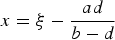 , which introduces the auxiliary unknown ξ. The different loci examined that correspond to different relative positions of the givens, (i.e. to different configurations) correspond in Rashed-Bellosta's analytic representation to different values of the parameters; further, these loci are subdivided into different “incidences”, depending of the value of the ratio
 .
In the step (I2), the transformation of algebraic equation(s) may lead to the identification of a property that remains fixed, that is an ‘invariant’, which serves as the determining property of the sought-for object.
In the step (II), a “condition of solvability” is investigated concerning the ratio of the given k. In Rashed-Bellosta's algebraic interpretation, this assumes the form of the investigation of the determinant of the equation (1), or an equivalent form of it. The “condition of solvability” follows from the requirement that the determinant must assume positive values, or to be equal to zero.
In the step (III), is provided either a proof of impossibility, in case that the “condition of solvability” is not satisfied, or else a positive proof, that is the construction of the sought-for mathematical object (by means of auxiliary constructions again) and the demonstration that the constructed object satisfies the required fixed property.
In the step (IV), it is demonstrated that if a problem has a solution, this is the solution that was previously constructed (in the step (III)) and can not have any other solutions.
As the editors emphasize the difficulty and simultaneously the originality of Apollonius' demonstrations lie not so much in the analysis or synthesis, but in the steps (II) and (IV) (whenever it may make sense). These steps are very well illuminated are more adequately represented in Rashed-Bellosta's algebraic interpretation, than in the logical interpretations described above.
CONCLUSION
To sum up, Rashed and Bellosta have produced a critical edition with the utmost care, furnished by illuminating notes and useful glossary. Taking into account that Halley's edition was based on the only one of the two manuscripts known nowadays, and the fact that the translation by Edward Macierowski and Robert Schmidt lacks a critical edition, which is a crucial task in historical-mathematical studies, we can say that this is actually the first and definitive critical edition of Apollonius' On the Cutting off of a Ratio.
The complicated mathematical content is rendered clearly and the suggested analytic interpretation is adequate and clear. The lengthy Introduction is very informative as it concerns both the earlier readings of the text, its history, as well as its new reading, suggested by the editors. Rashed and Bellosta offer the academic community of the historians of mathematics an invaluable classical work that marks the intersection of the Greek and the Arabic traditions of analysis and synthesis and serves as a starting-point for the development of the method till its transformation in the works of mathematicians in the 17th–18th centuries. Finally, the publication, as a whole, is elegant and carefully produced.


