The new coronavirus, severe acute respiratory syndrome coronavirus 2 (SARS-CoV2), was first discovered in December 2019 in Wuhan, China. It has rapidly spread globally. The World Health Organization (WHO) announced the emergence of this new pandemic disease (coronavirus disease 2019 [COVID-19])in March 2020. Its clinical presentations range from asymptomatic infection to mild symptoms or life-threatening diseases. Reference Assaf and Gutman Ya1 Patients may present weakness, lethargy, posttraumatic stress disorder (PTSD), dementia, physical or functional disabilities, dysphagia, malnutrition, myalgia, arthralgia, and acute respiratory distress syndrome (ARDS), multiple-organ failure, dyspnea on exertion, muscle atrophy, and premature death. These presentations alter the quality of life in patients and complicate and lengthen the recovery process. There are reports of national-level issues arising from prolonged periods of disease and recovery, and on the other hand, lock-down and various precautions that disturb patients’ emotional, psychological, physical, and financial welfare in any age group. This has boosted the need for prompt and accessible health care. Reference Kolbe, Jaywant and Gupta2–Reference Gao, Lee and McDonough5 This pandemic has challenged health-care systems globally and has highlighted their responsibility. Reference Assaf and Gutman Ya1 Due to the unpredictable nature of COVID-19, hospitals may occasionally face high loads of critically ill or complicated patients who need urgent care. To overcome this challenge, one should be able to successfully predict mortality, diagnose, and screen the patients. Furthermore, early detection of admitted patients and efficient management of hospital resources are necessities for patient prioritization. Reference Aslam6
Thus, global preparedness and response against COVID-19 are paramount. Reference Asadzadeh, Samad-Soltani and Rezaei-Hachesu7 An increased number of cases in this pandemic has driven health-care systems to use new technologies in prediction, diagnosis, treatment, and surveillance such as telemedicine, wearable sensors, digital call tracking, telerehabilitation, active video games, virtual reality, and augmented reality. Reference Asadzadeh, Samad-Soltani and Rezaei-Hachesu7–Reference Jalabneh, Syed and Pillai12 Many of these technologies can be used to advance health-care systems’ resources as a response to increasing demand, while some others permit distance access to clinical experts, eg, telemedicine. Reference Carlile, Hurt and Hsiao10
Artificial intelligence (AI), a rapidly growing technology, is used to automatically detect patterns in areas including image processing, natural language processing, analyzing big data, etc. Reference Carlile, Hurt and Hsiao10 It is a computational software that is capable of perception, thinking, and reasoning. The rapid growth of computational power and storage space, high volumes of data, and the development of advanced algorithms have precipitated significant growth in AI. Applications of AI are implemented in various fields, for example, machine vision; voice recognition; natural language processing; digital pathology; and data analysis. Reference Zhou, Wang and Tang13 AI approaches have been used to diagnose diseases (eg, malaria and tuberculosis); better understand the nature of epidemiology (eg, Ebola, Chikungunya); predict infectious diseases; control, manage, and interpret diseases; analyze electrocardiograms; select appropriate treatment; summarize patients’ clinical information; make clinical decisions; design personal health routines; assess pharmacotherapies; prevent disease; put surveillance; better explain virus transmission patterns Reference Malik, Sircar and Bhat14 ; track and estimate the epidemic course; evaluate severity and duration of epidemic; screen; optimize patient care; differentiate the COVID-19 from other diseases; plan and aid policy-makers. Reference Bai, Hsieh and Xiong15–Reference Shams, Hoque Apu and Rahman17
For instance, numerous AI systems have been developed addressing initial the COVID-19 detection using clinical data, chest radiography, or computed tomography (CT) -scan, mortality prediction, social media data analysis, assessing the need for assisted ventilation, etc. Reference Aslam6 In the emergency department, these systems have been used to estimate the number of out-patients, triage electronically, predict latent cardiac complications, predict sepsis, make an appropriate diagnosis by means of natural language processing of practitioners’ notes, and detect life-threatening conditions automatically in imaging studies, eg, hemorrhage, hydrocephalous, etc. Reference Carlile, Hurt and Hsiao10 Furthermore, prescreening tools using AI can screen a very large number of the population continuously with little expense, which removes the high cost of quarantine before test results. In other words, capabilities such as high operational utility and swift detection in such technologies help prioritize test cases, especially if asymptomatic. Reference Laguarta, Hueto and Subirana18
AI applications in the COVID-19 pandemic have been subject to many investigations. For instance, Laguarta et al. Reference Laguarta, Hueto and Subirana18 suggested an AI coughing test to detect COVID-19. The researchers developed a speech processing framework that adopted acoustic biomarker feature extraction to make predictions regarding COVID-19. The results showed that AI can be applied as a free, noninvasive, and robust screening tool on a large scale. Carlile et al. Reference Carlile, Hurt and Hsiao10 used deep learning for the radiographic diagnosis of COVID-19 pneumonia. They revealed that an AI-based approach can be suitably applied as an appropriate clinical tool in the emergency department. The physicians had generally high satisfaction rates. To the best of our knowledge, no comprehensive review study has assessed AI functionalities for different purposes with regard to COVID-19, eg, prediction, identification, screening, surveillance, control, etc. Few review studies have explored its applications in a specific field, such as prediction Reference Assaf and Gutman Ya1,Reference Aslam6 or diagnosis. Reference Carlile, Hurt and Hsiao10,Reference Laguarta, Hueto and Subirana18 More research can help caregivers, health researchers, policy-makers, and government authorities gain insights into how various AI models can affect prediction, control, and surveillance in COVID-19. It can also demonstrate the applicability of such technologies in scenarios other than pandemics, eg, long-distance patients, chronic illnesses, malignancies, infectious diseases, and disabilities. Therefore, this study was conducted to assess the potential functionalities of AI in the COVID-19 pandemic.
Methods
Databases and Search Strategies
The study protocol was initially registered at PROSPERO Footnote 1 under the registration number CRD42022334688. Following that, a brief search in Cochrane Library confirmed that no similar studies had been published. This scoping review was performed following the PRISMAFootnote 2 guidelines. The results were filtered through PubMed, Cochran Library, Scopus, Science Direct, ProQuest, and Web of Science from 2019 to May 9, 2022. Gray literature was also searched, including books, websites, conference papers, and theses. Discrete queries were separated by means of the “AND” operator, and synonyms by means of the “OR” operator. The queries were searched for the “Title, Abstract, and Keyword”. The search keywords were chosen from the mesh terms in PubMed database. The search strategy is illustrated in Table 1.
Search strategy for AI functionalities in the COVID-19 pandemic

Inclusion Criteria
All the review, quantitative, or qualitative studies in English, addressing the research question (ie, “what are the AI functionalities in the COVID-19 pandemic?”), and relevant to the purpose of our study that passed through the peer-review process were included.
Exclusion Criteria
The articles that were in languages other than English, did not have available full-text, did not have the search keywords in all 3 parts of title, abstract, and full-text, or were irrelevant to the objectives and the question of our study were excluded.
Study Selection and Screening
The articles were imported to an EndNote X9 library and duplicates were removed. Two authors separately screened the articles in parallel based on the inclusion and exclusion criteria in 3 steps: 1. the title; 2. the abstract/description; and 3. the full text.
The discrepancies were put to debate and, if needed, concluded by a third author. Citation and publication biases were taken into consideration. Highly cited studies were assessed through the STROBE checklist. After thoroughly studying the final articles, their information was extracted using a summary form (designed by the researchers) in Microsoft Word 2016. The summary form contains fields for title, corresponding author, study objective, study population, study sample, country, date of the study, study design, materials, methods, and results.
Results
The search resulted in 9123 articles. However, 1667 items were removed as they were duplicates. Screening the titles of 7456 articles resulted in removing 7391 (irrelevant objectives). Abstracts of the remaining 65 articles were assessed, and 54 articles were removed (irrelevant objectives). Eventually, the full texts of 11 articles were studied, and 4 were selected. Figure 1 demonstrates the study flow diagram.
PRISMA flow diagram for the paper screening approach.

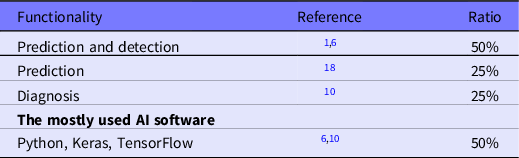
Table 2 presents a summary of the functionalities of AI in the COVID-19 pandemic (prediction, detection, and diagnosis) and the most commonly used AI software and environments. Hereby, 2 articles (50%) have applied AI to prediction and detection, 1 article (25%) to prediction, and 1 article (25%) to diagnosis. In addition, 2 articles (50%) used the Python programming language, Keras, and TensorFlow libraries.
Summary of the functionalities of AI and the mostly used software in the COVID-19 pandemic

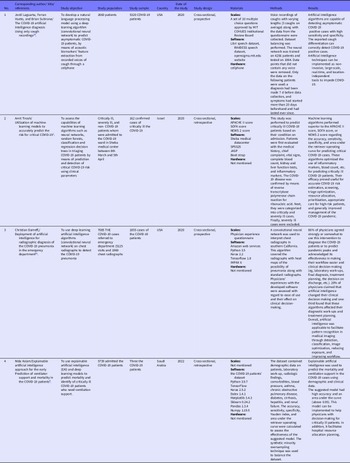
The information presented in Table 3 was summarized after a thorough examination of the full texts of these 4 studies.
Summary form for the selected studies

Discussion
This review study was carried out in 2022 with the aim of assessing the functionalities of AI in the COVID-19 pandemic. The studies of AI functionalities in the COVID-19 pandemic depict satisfactory experiences of health-care staff, improved clinical workflow, effective role of such technologies in clinical decision-making, high-risk patient prioritization, improved hospital resource allocation, decreased laboratory work-up expenses, increased diagnostic precision, community safety, and efficient control and management of the pandemic. Reference Assaf and Gutman Ya1,Reference Aslam6,Reference Carlile, Hurt and Hsiao10,Reference Laguarta, Hueto and Subirana18 Researchers and health-care staff have looked for new technologies to minimize the damage caused by the virus in this pandemic. Proper health care can take great advantage of technologies such as AI to combat new diseases and have a prospective approach. AI can help overcome the pandemic through screening the general public, medical assistance, infection prevention and control alerts and recommendations, surveillance of the pandemic prevalence, and making informed choices. Recent studies have shown the successful application of AI in health care. This technology is potentially capable of planning and improving the treatment course and outcome and is considered an evidence-based medical tool. However, to fully realize the complete potential of this technology in this pandemic requires more time and research. Reference Vaishya, Javaid and Khan19–Reference Khan, Mehran and Haq21
COVID-19 has posed many challenges to patients and health-care systems. This virus has the highest transmission rate compared with other viruses and is fatal to the elderly or some patients with background disorders. Even the countries with the fittest health-care systems have encountered ground-shaking challenges with the most basic accommodations. Reference Hussain, Mirza and Hassan22 So, it would be crucial to apply appropriate strategies to impede COVID-19. The existing evidence has shown the advantages of classic approaches for care delivery. However, logistic barriers, economical factors, lack of enough staff and hospital equipment, general circumstances of the pandemic, and lock-downs have disrupted on-time and sufficient care delivery to the critical COVID-19 patients, especially in low- and middle-income countries. New approaches are recommended in such circumstances. Reference Velayati, Ayatollahi and Hemmat23–Reference Kalhori, Bahaadinbeigy and Deldar26 AI is a relatively new appliance that can swiftly detect COVID-19, help diagnose, monitor treatment, trace physical encounters, predict mortality, help develop new medications and vaccines, and reduce health-care staff burnout. Reference Vaishya, Javaid and Khan19 In fact, AI techniques are used to analyze the data on disasters to support better management. Reference Sun, Bocchini and Davison27
The studies were performed in the United States, Reference Carlile, Hurt and Hsiao10,Reference Laguarta, Hueto and Subirana18 Israel, Reference Assaf and Gutman Ya1 and Saudi Arabia. Reference Aslam6 Although novel technologies such as AI have been more welcomed in high-income countries in light of more access to electronic instruments, substantial information technology infrastructure, higher computer literacy, and legislative support, Reference Velayati, Ayatollahi and Hemmat23,Reference Keshvardoost, Bahaadinbeigy and Fatehi28 international collaboration has assisted its application in upper middle-income countries. Other factors have brought more attention to this technology in upper middle-income countries, including low access to practitioners, health-care service disparities, the low budget allocated to health care, weak coverage of health insurance, untrained health-care staff, transportation challenges, relatively low payrolls, low quality of life, limited opportunities for education, excessive work pressure, etc. Reference Guo and Li29
All studies were designed as cross-sectional to predict, detect, or diagnose COVID-19. Reference Assaf and Gutman Ya1,Reference Aslam6,Reference Carlile, Hurt and Hsiao10,Reference Laguarta, Hueto and Subirana18 Two prospective cross-sectional studies in the United States (50%) used AI to predict or diagnose COVID-19. Reference Carlile, Hurt and Hsiao10,Reference Laguarta, Hueto and Subirana18 AI was used in 2 retrospective cross-sectional studies in Israel and Saudi Arabia, which made up 50% of the studies. Reference Assaf and Gutman Ya1,Reference Aslam6
Cross-sectional studies evaluate the prevalence of health conditions or diseases and are straightforward, economical widely used. Only 1 cross-sectional study (25%) in 2020 in America used smartphone-based AI to process recorded voices of coughs. Reference Laguarta, Hueto and Subirana18 Smartphone-based AI technologies permit cost-effective screening of medical conditions, health data analysis, efficient laboratory tests, timely diagnosis of diseases, improved treatment outcomes, analysis of vital signs, etc., using sensors and machine learning algorithms, microprocessors, and high-quality cameras. Reference Shams, Hoque Apu and Rahman17,Reference Mantena, Celi and Keshavjee30 As Sheikh et al. have seen Reference Sheikh, Bhatti and Adeyemi31 smartphone-based AI reached an accuracy of 89.5% and a specificity of 92.4% in diagnosing diabetic retinopathy. Two cross-sectional studies (50%) in 2020 in the United States and Saudi Arabia used Python, Keras, and TensorFlow to predict, detect, or diagnose COVID-19. These are among the most advanced and flexible open-source software that is used to train and test deep learning models. Reference Aslam6,Reference Carlile, Hurt and Hsiao10
The AI techniques used in these studies were deep learning and machine learning algorithms. Only 1 (25%) cross-sectional study in Israel used machine learning algorithms to triage critical COVID-19 patients (including neural network, random forest, and classification and regression decision tree). The results indicated that AI can be used as an efficient method to screen, optimize triage, deliver appropriate services to high-risk patients, and better manage the epidemic. Reference Assaf and Gutman Ya1 Three cross-sectional studies (75%) used deep learning algorithms. Two (50%) of these studies used a convolutional neural network to predict asymptomatic patients and to diagnose COVID-19 pneumonia. The results of these studies showed the relatively high accuracy, sensitivity, and specificity of these algorithms compared with other classical diagnostic methods. Reference Carlile, Hurt and Hsiao10,Reference Laguarta, Hueto and Subirana18 One study (25%) in Saudi Arabia used explainable AI to detect and predict mortality in COVID-19 patients. It showed an accuracy of more than 95% in clinical decision-making. Reference Aslam6 Machine learning and deep learning techniques take up the relationship between the input and the output of complex processes. Therefore, they are used for decision-making and prediction, although it is not conceivable to interpret these models or justify the resulting prediction or decision. Machine learning algorithms have lower predictive capability compared with deep learning algorithms. Therefore, explainable AI techniques are used to deal with the challenges of machine learning and deep learning algorithms. It permits enhanced, more reliable, and more interpretable decision-making. Reference Assaf and Gutman Ya1,Reference Aslam6,Reference Tripathy, Kabir and Arafat11
There are numerous studies that have investigated the functionalities of AI for various diseases other than COVID-19. For instance, in a clinical trial by Wu et al. Reference Wu, He and Liu32 an AI-based system (ENDOANGEl) could detect gastric cancer with an accuracy of 84.7%, a sensitivity of 100%, and a specificity of 84.3% in endoscopic imaging. In addition, a scoping review on AI in rehabilitation showed multiple applications, most commonly through robots and human-machine interaction. Most interventions were delivered in person to groups. Reference Kaelin, Valizadeh and Salgado33 Providing AI infrastructure and access to proper databases are important steps for future studies, which should be addressed properly in the forthcoming research. To the best of the researchers’ knowledge, this was the first study to examine AI’s functionalities in the COVID-19 pandemic. The limitations of the present study were including articles only in English, excluding studies that were not found eligible based on the title and abstract, and the lack of access to the Embase database.
Therefore, it is recommended to further explore AI functionalities in pandemics and health care, including conducting clinical trial studies to investigate the effectiveness of this technology in the diagnosis and treatment of diseases, health policy-makers accepting and implementing these products, designing user-centered contents for AI applications, evaluating the readiness and acceptance of this technology in different countries, developing cost-effective AI products, providing sufficient infrastructure, improving computer literacy and educating the use of AI, and developing evidence-based educational contents for AI. Also, the introduction of AI will help the LMIC more using the smartphone technologies and better management strategies.
Conclusions
The COVID-19 pandemic has forced us to apply technology for self-sufficiency, self-care, and improved quality of life. It has highlighted the use of technologies in everyday life. AI is a highly promising technology used in various areas, including health care. In this study, a scoping review was carried out on the functionalities of AI in the COVID-19 pandemic. The functionalities included prediction, detection, and diagnosis. We also concluded that deep learning and machine learning approaches are the most common approaches in AI. Most studies have used deep learning (convolutional neural networks). The results can help researchers, health-care organizations, and policy-makers gain new insights on how this technology can potentially aid a proper response to the COVID-19 pandemic or other areas in health care, and how to put it into use.
Authors contributions
Milad Ahmadi Marzaleh and Naseh Shalyari were responsible for the study’s conception and design. Milad Ahmadi Marzaleh and Naseh Shalyari searched the relevant databases and included the appropriate articles according to the study objective. At the same time, Milad Ahmadi Marzaleh supervised the whole study. All authors prepared the first draft of the manuscript. All authors did the data analysis, made critical revisions to the study for important intellectual content, and supervised the study. All authors have read and approved the final manuscript.
Financial disclosure
None declared.
Conflict of interest
The authors have no conflict of interests to declare.
Informed consent
Nil.