

I. INTRODUCTION
Taxing financial supplies is one of the more vexing aspects of a Value Added Tax (VAT). The concept underlying VAT is that the tax should apply to any fee paid as a consideration for a supply. However, where financial supplies are concerned there is a difficulty in ‘identifying that charge separately from the other elements that are included when determining levels of payments of interest or fees.’Footnote 1 Disentangling the several components of typical financial transactions is generally seen as administratively complex and costly; however, complexity levels are often even higher, as financial transactions are frequently more sophisticated, incorporating several types of financial flows.Footnote 2 As a result, most jurisdictions simply exempt financial supplies from VAT, not as a matter of principle, but rather as a necessity. As opposed to merit goods or services, such as health or education related activities, the rationale for exempting these supplies is not to diminish the regressivity of VAT or to encourage their consumption, but rather the fact that they are regarded as ‘too difficult to tax’.Footnote 3
However, the lack of deductibility of input VAT which is caused by treating financial services as exempt means that in practice exempting those supplies gives rise to significant legal difficulties and economic distortions. Awareness of these difficulties led a few countries to attempt, in recent years, an alternative VAT treatment of financial supplies,Footnote 4 namely those that have in place, what has been designated as, a ‘modern VAT’.Footnote 5 One notable example is Australia. Under the Australian Goods and Services Tax (GST), introduced in 2000, financial services supplies are still exempt—although that term is not used in the Australian system—but a ‘reduced input tax credit’ system has been set up for certain large scale financial supply providers.Footnote 6
Within the European Union (EU), as in most VAT systems, financial supplies are exempt from VAT. However, the debate on how to treat financial supplies under VAT has remained on the agenda.Footnote 7 In 2006, the European Commission issued a consultation paper with a view to assessing the reaction, of both economic operators and national tax administrations, to possible new VAT treatments.Footnote 8 Amongst these was the possibility of introducing a system similar to the Australian one. Although this solution scored highly with economic stakeholders,Footnote 9 it was ultimately deemed unrealistic by the Commission, to a large extent due to the difficulties of reaching an agreement by Member States on a common base for deduction of input tax, which introducing such a system would undoubtedly require.Footnote 10 Yet, this leaves open the question of whether disregarding political co-ordination concerns the Australian GST system would indeed constitute a better solution than the current EU VAT exemption.
This paper compares the current treatment of financial services under VAT in the EU and in Australia. In section two the current EU VAT treatment of financial services is analysed. It discusses the current legislative provisions on the matter, the case-law of the Court of Justice of the European Communities (ECJ) as regards the interpretation of those provisions, and the legal and economic problems resulting from the exemption approach. Thereafter, in section three, the Australian GST approach is described, and issues arising from that approach discussed. In particular, consideration is given to whether the Australian GST has indeed achieved its stated aim of eliminating the difficulties caused by the traditional exemption model, and whether in the process it has created additional difficulties of its own. The final section assesses whether, on the basis of the analysis undertaken in the two previous sections, the Australian GST treatment of financial supplies is indeed superior to the current EU VAT treatment of financial services, and consequently whether introducing an Australian-type model should be a policy consideration for the EU.
II. TREATMENT OF FINANCIAL SUPPLIES UNDER THE EU VAT
Supplies of financial services are broadly exempt within the EU, under article 135(1)(b) to (g) of the VAT Directive.Footnote 11 Preparatory work which preceded the approval of the Sixth VAT Directive in 1977 demonstrates that, as with most countries, financial supplies are exempt due to the absence of a readily identifiable mechanism for taxing these supplies under a VAT system.Footnote 12 There was reportedly a widespread perception at the time that a move to full taxation of these services was not only desirable, but equally a technically achievable aim.Footnote 13 In the early 1990s there were clear signs of a growing desire to review these provisions, with the publication of the so-called TCA Report.Footnote 14 Yet, nearly 30 years since the approval of the Sixth VAT Directive, the original rules regarding the VAT treatment of financial supplies remain unchanged.
A. Outline of the Current Legislative Framework
Most financial supplies, albeit not all, are exempt under Article 135(1)(b) to (g) of the VAT Directive. Contrary to what the use of the word ‘exemption’ might indicate, being exempt actually carries significant VAT costs. Under article 168 of the Directive, VAT paid on input transactions will only be deductible ‘in so far as the goods and services are used for the purposes of the taxed transactions of a taxable person’. Thus, where VAT is paid in connection with exempt financial supplies it will not, in principle, be deductible. The only exception to this rule applies to situations where the customer is established outside the Community, or where the financial transactions relate directly to goods to be exported out of the Community—in these cases the taxable person will be entitled to deduct any related input VAT under article 169 of the Directive.
This exclusion from the right to deduct input VAT means in practice that financial suppliers will have significant amounts of non-recoverable VAT, resulting in considerable tax costs. Arguably, this is the root of most, if not all, the difficulties arising from the current EU VAT treatment of financial transactions.
B. ECJ Response to the Legislative Framework
The above provisions regarding the VAT treatment of financial supplies, and in particular article 135(1)(b) to (g) of the VAT Directive, are difficult to interpret. Determining the scope of any exemption will always be a problematic task, however, this is particularly evident in the case of the exemption applicable to financial supplies. The last decade has witnessed a significant development in new forms of financial products, as well as the emergence of new supply structures, which make use of, inter alia, outsourcing, sub-contracting and pooling techniques. Traders and national tax administrations alike have been increasingly unsure as to whether these new products, and more questionably, these new supply structures, fall within the scope of those exemptions. In many cases establishing whether a particular service is exempt or taxable, can prove extremely difficult. Moreover, as demonstrated by the OECD 1998 Report on the application of VAT to financial services, Member States' application of the VAT Directive provisions in this area is far from uniform.Footnote 15
In this context, the growing level of case law emerging from the ECJ on the scope of the exemptions applicable to financial supplies should come as little surprise. In fact, since the mid-1990s, the ECJ has been consistently asked by national courts to rule on the interpretation of those exemptions. The most common concern, as well as the most controversial, has been the inclusion, or exclusion, of new commercial practices, within their scope. Ironically, whilst the Court's efforts to clarify the scope of these exemptions are not in question, it is also clear that the rulings have in many cases heightened the level of legal uncertainty. Decisions of the ECJ are by their own nature concrete and specific, based on a given set of facts. Consequently, extrapolating general principles from the Court's decisions and applying those to distinct factual scenarios can be a precarious task. In areas which are by their very nature complex, such as financial supplies, the result has been that the introduction of a general principle in a given ruling has demanded extra qualifications and explanations by the Court in subsequent rulings.Footnote 16 As a result, the body of case law in this area is not only complex, but is equally filled with factual minutiae.
When analysing this case law, it is important to consider its two components: jurisprudence regarding the application of all exemptions in general; and, case law regarding specifically the interpretation of the exemptions applicable to financial supplies.
1. Interpretative principles applicable to all exemptions
When analysing the ECJ case law as regards financial supplies, consideration should be given to general interpretative principles developed by the Court and applicable to all exemptions, in particular the principle of strict interpretation of exemptions, the principle of contextual interpretation of exemptions, and the principle of uniform interpretation of exemptions.
The principle of strict interpretation is probably the one which is most often used by the Court when interpreting exemptions. In fact, it has consistently held that ‘the exemptions provided for in [articles 132, 135 and 136 of the Common VAT Systems Directive (CVSD)] are to be interpreted strictly since they constitute exceptions to the general principle that turnover tax is to be levied on all services supplied for consideration by a taxable person.’Footnote 17 The Court's preference for a strict interpretation of exemptions has manifested itself both as regards the service providers, and the type of services which may be exempt. Yet, it is important to note that the Court has sometimes departed from this strict interpretation,Footnote 18 in particular in more recent cases, often to ensure the respect for the principle of fiscal neutrality and its corollary, the principle of VAT uniformity, or equal treatment, which precludes similar goods from being treated differently for VAT purposes.
On the application of the principle of contextual interpretation to exemptions the Court has stated that ‘exemptions constitute independent concepts of Community law which must be placed in the general context of the common system of VAT introduced by the Sixth Directive’.Footnote 19 Thus, exemptions are to be interpreted not only by reference to the context and the purpose of the rules of which they form part, but equally taking into consideration the intention of the legislator at the time when the rules were introduced in 1977.
Finally, as regards the uniform interpretation of exemptions, the ECJ has stated that ‘exemptions constitute independent concepts of Community law whose purpose is to avoid divergences in the application of the VAT system from one Member State to another’.Footnote 20 Yet, as with the principle of strict interpretation, it is noteworthy that on occasion the Court has adopted a more nuanced approach to the principle of uniform interpretation in light of the principle of fiscal neutrality.Footnote 21
It follows from the above that, in addition to the three interpretative principles already highlighted, when interpreting exemptions the Court often makes reference to the general VAT principle of fiscal neutrality. The Commission has even gone so far as to state that the rule according to which ‘the interpretation [of exemptions] must meet the requirements of the principle of fiscal neutrality on which the entire system of VAT is based’, is one of only three ECJ jurisprudential pillars on exemptions.Footnote 22 Recent jurisprudential developments as regards the financial supplies exemptions seem to highlight the accuracy of this statement, with the recent ruling in JP Morgan placing fiscal neutrality firmly at the centre of discussions over the scope of the financial services' exemptions. Asked to interpret article 135(1)(g) of the VAT Directive, the Court restricted the scope of rights granted to Member States granted under that provision on the basis of the need to respect the principle of fiscal neutrality.Footnote 23 Yet, it is equally worth noting that the Court itself has limited the applicability of the principle of fiscal neutrality, insofar as the insurance services exemption is concerned.Footnote 24 This is because, as discussed below, the existence of exemptions is itself a contravention of the principle of fiscal neutrality.Footnote 25
2. Exemptions applicable to financial supplies
Since the mid-1990s, the ECJ has been asked to interpret paragraphs (b) to (g) of article 135(1) of the VAT Directive on several occasions. An analysis of the Court's rulings shows a clear evolution in its approach to the scope of these exemptions, which began with SDC in 1997, and whose last instalment, dated 2007, is the ruling in Volker Ludwig.Footnote 26
In January 1995, following reference from the Danish courts, SDC entered the ECJ's register. The case concerned the outsourcing of activities relating to the financial supplies listed in paragraphs (d) and (f) of Article 135(1) of the VAT Directive. Specifically, the Court was asked whether outsourced services should be deemed exempt under those provisions. It started by confirming that the identity of the persons effecting the transactions is irrelevant in determining the transactions exempt under those provisions; a fact which is confirmed by the reference in paragraphs (b) and (c) of that article to ‘the persons granting it’ and to ‘the person who is granting the credit’.Footnote 27 The Court then went on to consider whether the VAT exemption should be granted where a person either performs only part of a complete service or carries out only certain operations necessary for the supply of a complete exempt financial service. Using an expression which was to become a recurrent feature of all financial services cases, it held that outsourced services would be exempt where the services in question ‘form a distinct whole, fulfilling in effect the specific essential functions of the services’ described in article 135(1)(d) and (f).Footnote 28
Referred to the ECJ by the UK courts a few years later, CSC Financial Services concerned outsourcing of so-called call centre activities by financial institutions. Re-iterating its ruling in SDC, the Court stated that in order to avail of an exemption, the service provided had to form a ‘distinct whole, fulfilling in effect the specific essential functions of the services’.Footnote 29 On the case, it concluded that the provision of call centre services to financial institutions constituted merely a preliminary stage of the provision of financial supplies, and thus should not be deemed exempt under article 135(1)(f) of the Directive. The ruling confirmed the Court's approach in SDC, i.e. that the key element for exemption of outsourced or sub-contracted financial services is the idea of a ‘distinct whole’. Where the services being outsourced or sub-contracted form a ‘distinct whole’, they will be regarded as exempt under paragraph (f) of article 135(1); however, where the outsourcing, or sub-contracting, is restricted to preliminary and technical activities, the exemption will not apply.
In 2006, it was the turn of Abbey National. Referred by the UK courts two years previously, the case concerned the interpretation of paragraph (f) of article 135(1) of the Directive and whether the activities undertaken by third-parties in relation to fund management should fall within the scope of that exemption. The ruling further developed the basic approach to the interpretation of exemptions applicable to financial supplies, already highlighted in the two previous cases. Here, the Court noted, like to the transactions exempted under paragraphs (d) and (f) of article 135(1), the management of special investment funds referred to in paragraph (g) of that article was defined according to the nature of the services provided and not according to the person supplying or receiving the services. Moreover, it stated that the wording of the provision did not in principle preclude the management of special investment funds from being broken down into a number of separate services, each falling within the meaning of ‘management of special investment funds’. These separate services, according to the Court, may all benefit from the exemption in paragraph (g), even when provided by a third party, where ‘viewed broadly, [they] form a distinct whole, fulfilling in effect the specific, essential functions of a service described in that same [paragraph (g)]’. Application of this criterion would, according to the Court, exclude from the scope of that provision ‘mere material or technical supplies, such as the making available of a system of information technology’. Footnote 30
The ruling in Abbey National confirmed the Court's willingness to apply the same criterion for determining the scope of the exemption under paragraph (g) of article 135(1), as it had applied for paragraphs (d) and (f) of that article, namely the ‘distinct whole’ criterion.Footnote 31 It is interesting to note that in her Opinion, Advocate General Kokott had argued against the full transposition of the interpretation developed by the Court for paragraphs (d) and (f), to paragraph (g). Although, the Advocate General had favoured the adoption of the ‘distinct whole’ criterion, she suggested that in applying this criterion the specificities of fund management should be taken into account.Footnote 32 The Opinion is symptomatic of the constant battle which is subjacent to all ECJ rulings on financial supplies exemptions: to apply uniform criteria for determining the scope of all exemptions, or to develop different criteria for different services? The first option would potentially ensure higher levels of legal certainty, whilst the second would allow the Court to develop criteria, which would potentially be better equipped to deal with the specificities of each type of service.
The latest instalment, in the judicial process regarding the interpretation of financial supplies exemptions, is Volker Ludwig, which concerned the interpretation of paragraph (b) of article 135(1) of the Directive.Footnote 33 Before the ruling it was unclear what would be the Court's approach to the interpretation of that paragraph: would it adopt the same criteria for determining the scope of that exemption, as it had for those applicable to other financial supplies, or it would it adopt different criteria? On one hand, the wording of those provisions seemed to point towards the second option. In this regard, it is important to note that the Court's decision in SDC seems to have been largely based on the fact that paragraphs (d) and (f) of article 135(1) do not refer to the person that provides the exempt service. However, the same cannot be said about paragraphs (b) and (c), which specifically refer to the ‘person who is granting the credit’. This raised the obvious question whether the Court would consider the nature of the person providing the service a fundamental point on cases involving outsourcing of credit-related services. On the other hand, however, was the Court's preference prior to Volker Ludwig for the adoption of uniform criteria for the determination of the scope of all financial supplies exemptions.
Ultimately, the ruling in Volker Ludwig highlights the relevance of this last consideration. Invoking the rulings in SDC and Abbey National, which it considered applied by analogy, the Court stated that ‘the transactions exempted under [article 135(1)(b) of the VAT Directive] are defined in terms of the nature of the services provided and not in terms of the person supplying or receiving the service’. The already familiar ‘distinct whole’ criterion is then applied: ‘nevertheless, […] in order to be classed as exempt transactions for the purposes of [article 135(1)(b) of the Directive], the service provided must, viewed broadly, form a distinct whole, fulfilling in effect the specific and essential functions of the service of negotiation’.Footnote 34 However, the Court finishes by introducing a seemingly new criterion: the financial related activities will be deemed to be exempt under article 135(1)(b), where it is deemed to be ancillary to the principal exempt activity.Footnote 35
3. Assessment of ECJ case law on VAT treatment of financial supplies
As the above analysis demonstrates, the case law of the ECJ on exemption of financial supplies gives rise to two principal difficulties: first, its complexity; and second, the inherent debate over the choice of criteria for determining the scope of the exemptions. Together they have enhanced the climate of legal uncertainty, which currently surrounds the EU VAT treatment of financial transactions, triggering the ongoing legislative review.Footnote 36 As it currently stands, the case law in this area can be summarised in two main points.
Firstly, it is clear that general interpretative principles developed by the Court as regards all exemptions, namely the principles of strict interpretation of exemptions, contextual interpretation of exemptions, uniform interpretation of exemptions, and to some extent, fiscal neutrality, will also apply to financial supplies. However, whilst these principles can act as useful guides, they are not applied in a fully consistent and predictable manner, with the Court often choosing the application of one to the detriment of others.
Secondly, it would appear that the main criterion for determination of the scope of the exemptions applicable to financial supplies is the ‘distinct whole’ criterion, ie financial-related supplies will fall within the scope of paragraphs (b), (d), (f) and (g) of article 135(1) of the VAT Directive, where they ‘form a distinct whole, fulfilling in effect the specific essential functions of the services described’. However, questions remain as regards the application of this criterion, in particular whether the Court will apply it to the remaining financial supplies listed in article 135(1), namely those in paragraphs (c) and (e). Furthermore, the recent ruling in Volker Ludwig also raises questions as regards the role of the concept of ‘ancillary activities’ within the determination of the scope of those exemptions. Whilst the concept has been used before in VAT case law,Footnote 37 never before had it been applied in the context of outsourcing of financial-related activities. The Court appears to be stating in that case that an outsourced activity will be deemed to be exempt, where it constitutes an ancillary activity to an exempt financial supply. If this is indeed the case, it would potentially constitute a very wide criterion—certainly much wider than the previous ‘distinct whole’—allowing the inclusion of a varied range of outsourced activities, which until now had been excluded from the scope of the exemption. This leads us to a second question which the ruling in Volker Ludwig gives rise to: what activities will be deemed to be ‘ancillary activities’ for the purposes of this new criterion? According to that same ruling, canvassing for new financial services clients does seem to fall within that concept; yet, beyond those activities, the situation is unclear.
C. Difficulties Arising from the EU Legal Status Quo
The EU VAT treatment of financial supplies gives rise to serious consequences, at both legal and economic levels. From a legal perspective the current regime gives rise to definitional and interpretative problems, creates difficulties in calculating the portion of deductible VAT, constitutes an incentive for engaging in aggressive tax planning, and has the additional problem of being conceptually incoherent with the general principles of the EU VAT system. From an economic perspective, the restrictions to the deduction of input tax, which are the consequence of the current regime, have also resulted in considerable distortions, including tax cascading, bias towards self-supply, bias towards foreign suppliers, and loss of revenue.
1. Legal consequences
a) Definitional and interpretative problems
As the above case law analysis demonstrates, the legal provisions determining the EU VAT treatment of financial supplies are susceptible to sustaining differing interpretations and applications. Whilst determining the scope of a specific exemption will always be a problematic task, the difficulties are particularly evident as regards the exemptions applicable to financial services. The last decade has witnessed a significant development in new finance products, as well as the emergence of new supply structures, which make use of, inter alia, outsourcing, sub-contracting and pooling techniques, as well as the rise of the internet as a medium for B2B and B2C transactions. Traders and national tax administrations alike have been increasingly unsure as to whether these new products, and more questionably, these new supply structures, fall within the scope of those exemptions.
This uncertainty is reflected in the fact that according to the European Commission, their services have reportedly been confronted with an increasing number of cases where both economic operators and Member States had problems in interpreting article 135(1)(b) to (g) of the VAT Directive.Footnote 38 Equally, the steady flow in references from national courts to the ECJ in the last fifteen years, focussing on the interpretation of these provisions, is not only significant in this regard; it is also symptomatic of the Court's inability, despite the numerous rulings, to resolve the inherent problems of the existing EU VAT treatment of financial transactions.
This climate of uncertainty has in turn had the effect of increasing compliance and administrative costs, as more time and resources will be devoted to establishing the correct VAT treatment of each financial supply.
b) Calculation of recoverable input VAT and apportionment of tax
One of the most obvious legal consequences of the EU VAT treatment of financial supplies is the fact that it gives rise to apportionment of input tax situations.Footnote 39 Fully exempt financial entities are probably relatively rare. More common will be the situation where one particular body has a mixed VAT nature, engaging in activities which are at the same time exempt, and taxable. This means in practice that most will be able to deduct at least part of their input VAT, under articles 173 to 175 of the VAT Directive. The difficulties lie in the fact that calculation of deductible VAT, as prescribed in those provisions, is itself problematic, and has given rise to considerable case law.Footnote 40
Although a comprehensive analysis of the different methods of apportioning input VAT is beyond the scope of this paper, it is worth noting that there are essentially two methods of determining the proportion of deductible input VAT, namely direct allocation and pro-rata. Member States can use either of these methods, or a combination of both, and in this respect they display significant discrepancies.Footnote 41 However, whichever the preferred method, the process tends to be complex, as with the definitional and interpretative problems highlighted above, thereby entailing high administrative and compliance costs. As the Commission itself has acknowledged:
This process generates considerable administrative charges for economic operators and fiscal authorities and is a continuous source of litigation, creating an atmosphere which reduces the level of legal certainty for businesses and increases budgetary insecurity for Member States.Footnote 42
c) Planning and aggressive planning
For any partially exempt legal person, faced with the reality of non-deductibility of all their input VAT, there are two basic methods of curtailing VAT costs: minimizing VAT input, by acquiring less goods and/or services which are subject to VAT; and maximizing VAT output, by increasing the number of taxable supplies and thus, the overall percentage of deductible input VAT. Whilst the legitimacy of engaging in VAT planning has been acknowledged by the ECJ in joint cases Gemeente Leusden and Holin Groep,Footnote 43 often non-tax reasons will prevent legal persons from adopting measures which will reflect either of these methods. It is in this context that so-called aggressive VAT planning, or VAT avoidance, schemes will often emerge.Footnote 44 In fact, the recent Halifax case has demonstrated how financial institutions' VAT costs, resulting from the exclusion of the right to deduct input tax, can act as a catalyst for engagement in aggressive VAT planning.Footnote 45
d) Conceptual incoherencies
From a conceptual perspective, the EU VAT treatment of financial supplies is also defective. By treating financial institutions as de facto final consumers in respect of many of their activities, the current regime is arguably contrary to the principle of VAT as a tax on consumption,Footnote 46 which constitutes one of the fundamental principles of the EU VAT system.Footnote 47 Not only should final consumers be by nature physical persons, but equally the treatment of financial institutions as final consumers does not accurately reflect practice, as goods and services supplied to those bodies will unavoidably be used as inputs to the activities, in which they are engaged in. Furthermore, as mentioned above, the EU VAT treatment of financial supplies inherently contravenes the principle of fiscal neutrality, as set out in article 1 of the VAT Directive and developed by the ECJ—another fundamental principle of the EU VAT system. As Advocate-General Jacobs so clearly stated in Waterschap Zeeuws Vlaanderen, a case concerning the right to deduct of public sector bodies, which as financial institutions are also partially exempt:
It is inherent in the existence of exceptions to the VAT system that they will interfere to some extent with the application of the principles of neutrality and of equality treatment. Whatever the merits of the decision to treat public sector bodies as final consumers, it forms an integral part of the Directive. In that in comparable situations, the treatment of taxable persons and persons excluded from the VAT system will inevitably be different.Footnote 48
2. Economic consequences
a) Tax cascading
One of the main side effects of treating activities as exempt, and the consequent non-deductibility of related input VAT, is the possibility of tax cascading.Footnote 49 Tax cascading will occur where the financial supply is an intermediate step in production, and therefore the VAT levied until then becomes a hidden cost (as it cannot be deducted). The higher the VAT rate applicable to input supplies, the potentially higher the amount of hidden VAT included in financial supplies. This is all the more important when considering that avoiding tax cascading effects is not only one of the main principles of commodity taxation,Footnote 50 but equally one of the principle reasons behind the introduction of the EU VAT system.Footnote 51
b) Erosion of VAT base/break of VAT chain
Connected to the problem of tax cascading is another negative consequence of the current EU VAT treatment of financial services. While it is widely accepted within the economic literature that VAT efficiency levels are directly related to its taxable base,Footnote 52 the current exemptions applicable to financial supplies erode the VAT base and break the VAT chain. Moreover, some authors have drawn attention to the phenomenon of ‘creeping exemptions’. They contest that, as more exemptions are granted, other sectors of the economy will be tempted to claim exemptions for themselves thus further eroding the tax base.Footnote 53 As regards financial transactions, this phenomenon is evident not only from the ECJ case law involving outsourcing and subcontracting of related services, but equally from the Commission's suggestion to extend the scope of exemptions as a method of immediate resolution of the problems of non-deductible VAT for financial institutions.Footnote 54
c) Self-supplies v outsourcing: bias away from outsourcing
Another important consequence of the EU VAT treatment of financial services is the fact that it encourages self-supplies. The reason is clear: in the case of self-supplies, the financial institutions will only have to pay VAT on the purchase of goods or services involved; on the contrary, where there is outsourcing or sub-contracting of services to another entity, VAT will be charged on the full price of those services. As the right to deduct input VAT of financial institutions is limited, VAT charged on outsourced or subcontracted activities will represent an extra cost, whilst where there is a self-supply this extra cost will be avoided.Footnote 55
This bias can, to some extent, be offset by the introduction of self-supply rules by Member States, under article 27 of the VAT Directive. However, the application of this provision is not only optional, but equally dependent on consultation with the VAT Committee.Footnote 56 In practice, therefore, the bias towards self-supply still tends to be present in most, if not all, Member States.
d) Foreign v EU suppliers: bias towards foreign suppliers
As well as creating a bias away from outsourcing, exemption of financial supplies within the EU also creates a bias towards foreign suppliers of services. This bias is present both for financial suppliers and financial services acquirers. Financial institutions will be tempted to acquire services from foreign suppliers where, by virtue of the place of supply rules, the supply will be deemed to have been affected outside the Community and, therefore, not subject to VAT. By doing so, they will decrease their input VAT, and consequently reduce their VAT costs.Footnote 57 On the other hand, taxable (and non-taxable) persons acquiring financial and insurance services will also be tempted to obtain these from foreign suppliers. Similar to any other business, Community based financial suppliers will reflect their costs in the price of their services, including any VAT costs resulting from the exclusion of the right to deduct. This will result in less competitive prices being offered by Community-based providers, creating a bias for customers to acquire their financial services from foreign suppliers.
e) Loss of revenue
Any exemption will unavoidably create loss of revenue. However, the extent of this loss will be dependent on several factors, which can be either external or internal to the VAT system. At an external level, the extent of the loss of revenue will vary according to the economic relevance of the exempt sector involved. At internal level, the national tax authorities' approach to the right to deduct input VAT will be of particular relevance. Yet, although the degree of the revenue loss will vary from Member State to Member State depending on the factors highlighted below, its significance is clear, as preliminary economic studies conducted in Germany indicate.Footnote 58
The loss of revenue will be directly proportional to the economic significance of the sectors involved, ie the higher the economic relevance of the sector, the more significant the revenue loss. In the case of the financial sector it is evident that its economic importance is very high. In fact, studies conducted in 2004 indicate that the financial services sector alone could account for as much as 27.8 per cent of GDP of EU Member States, ranging from 57.9 per cent GDP in Luxembourg, to 17.9 per cent of GDP in Ireland.Footnote 59 Offsetting, or limiting the extent of revenue loss arising from exemptions, can however be achieved through limiting the right to deduct input VAT. Some Member States have adopted such an approach, but not all.
In fact, the approaches of national tax authorities to the right to deduct input VAT are far from uniform, and usually reflect each Member States' economic and strategic priorities. This is particularly the case as regards financial institutions' right to deduct, as the Commission itself has acknowledged.Footnote 60 Where Member States give priority to budgetary issues, the focus will be on VAT collection. As the loss of revenue which results from exempting financial supplies can be (at least partially) limited by blocking providers of these services from the right to deduct VAT, the bias in these Member States will be towards adopting a strict approach to the right to deduct. Alternatively, where Member States give priority to a macro-economic interest to attract or retain what are key industry sectors, the bias will be towards adopting a flexible approach towards these industries' right to deduct. This will usually be the case in Member States where the cost of factors of production is high, or the risk of industries' displacement—moving to other countries, outweighs budgetary concerns.
D. Ongoing Review of Legislative Framework: the Role of the Australian GST Model
The current review comes in the wake of the reaction to the ECJ's latest rulings on outsourcing of insurance and financial related supplies, and in particular Accenture. Decided in 2005, Accenture concerned the outsourcing of so-called ‘back-office activities’ by an insurance company.Footnote 61 In practice, the ruling had the effect of significantly limiting the scope for outsourcing or sub-contracting of insurance-related activities: outsourced and sub-contracted insurance-related services will, almost always, fall outside the scope of the insurance services exemption, and will thus be deemed to be taxable. Consequently, a decision by insurers to resort to outsourcing or subcontracting of their activities, based on commercial considerations, will entail significant VAT costs.
Unsurprisingly, faced with the possibility of increasing VAT costs, the insurance industry reacted strongly to the Accenture ruling. This was especially the case for companies established in those countries that had until then adopted a broader approach to the insurance services exemption, stating that a change of policy in these countries would in effect increase insurance premiums.Footnote 62 The financial services sector, on the other hand, also seized the opportunity to voice their concerns over the VAT difficulties and costs that it faces. Furthermore, those Member States, such as the UK and Ireland, which had until then followed a policy of exempting outsourced insurance-related activities, were now faced with the prospect of having to review their approach. It is against this background that the European Commission's 2006 consultation paper emerged. Following the Commission's initiative, and somewhat symptomatic of the gravity of the matter, some Member States have already expressed their intention to await the conclusion of the current review process, before bringing their VAT legislation, or practice, in line with the Accenture ruling.Footnote 63
The European Commission's 2006 consultation paper identified four possible options for amendment of the VAT Directive provisions on insurance and financial services, which would satisfy its essential criteria, namely that were both technically feasible and had the capacity to address, at least partially, the problem of non-deductible input VAT.Footnote 64 These proposed options were, as follows:
— zero-rating the supply of insurance and financial services to other taxable persons, ie zero rating of business to business (B2B) transactions;Footnote 65
— extending the scope of exemptions to services supplied by other taxable persons to insurance and financial services suppliers;
— a uniform limited input credit option, on the basis of a fixed percentage, and on a designated list of acquired services, similarly to the Australian GST system;
— allowing economic operators to opt to tax their supplies and financial services on B2B transactions.
Two further options are also under consideration, as possible solutions to some of the most immediate difficulties faced by traders and tax administrations, alike:
— creation of cross-border VAT bodies (groups, cost sharing arrangements or other structures), within which transactions carried out would be deemed to be outside the scope of VAT;
— re-definition of insurance and financial exempt services, through modernization of the current Sixth VAT Directive's provisions.Footnote 66
Despite the potential benefits, all these options, including the option for an Australian GST-type system, have either practical or conceptual disadvantages, or both, something which the Commission was quick to point out. In their view, the uniform limited input credit option would have the following disadvantages:
— it could potentially give rise to complex apportionment and characterisation issues;
— issues of consistency with fiscal neutrality may be raised; and
— as recovery rates vary significantly between Member States, it could be extremely difficult to arrive at a common recovery rate; furthermore, agreement could be made harder by the range of standard VAT rates in place within the Community.
According to the summary results of the consultation process, published by the Commission a year later, this last point, namely the difficulty in reaching a common recovery rate, weighted heavily in economic operators' views of the viability, or lack thereof, of the possible introduction of such a system. Its view was that overall economic operators were of the opinion that the system would bring more disadvantages than advantages, and therefore it concluded from the contributions that ‘the introduction of a standard or limited input tax deduction is not a priority’.Footnote 67 The option for introduction of an Australian GST type system was therefore rejected in favour of other alternatives. Yet, it is worth noting these were not the conclusions reached by PWC. In their 2006 Report, PWC concluded that the solution ‘could remove the current bias in favour of vertical integration and against the use of centre of excellence, shared services, outsourcing and co-sourcing’, and thus ‘[it] scored highly in [their] evaluation’.Footnote 68
In November 2007 the European Commission finally presented two legislative proposals with a view to amending the EU VAT treatment of financial (and insurance) services.Footnote 69 In the words of the Commission, the objectives were two-fold: to increase legal certainty, and to reduce the impact of non-recoverable VAT for financial institutions. These objectives are to be fulfilled through what has been designated as ‘three pillars’:
— clarification of the rules governing the exemption for financial supplies, in particular re-definition of financial services which are subject to exemption;
— introduction of a cost-sharing group, allowing economic operators to pool investments and re-distribute the costs of these investments to the members of the group, exempt from VAT; and
— introduction of a compulsory option to tax, ie compulsory for Member States, optional for financial institutions.
Arguably, all these measures can potentially give rise to considerable difficulties.Footnote 70 However, if the new proposals suffer from considerable deficiencies, would the introduction of an Australian GST-type model offer any better results? The PWC Report invokes the fact that the model would be inspired in the Australian model, in a seemingly legitimisation manner for introduction of a limited input credit system. During the consultation process, the Commission too had argued that amongst the option's considerable advantages was the fact that it would be ‘simple to apply in principle and has worked in practice elsewhere, Australia being the best known example’.Footnote 71 The obvious question therefore is whether this was indeed a legitimate assumption, ie is the Australian GST system of treating financial supplies indeed superior to the EU VAT one?
III. TREATMENT OF FINANCIAL SUPPLIES UNDER THE AUSTRALIAN GST
At the time of Australia's introduction of its Value Added style GST in 2000 it had the benefit of the many VAT models available internationally and it was evidently mindful of the issues associated with exempting financial supplies. This is evidenced by the manner in which the rules have been structured and written.
A. Outline of the Legislative Framework
At the outset Australia adopted different, ostensibly more transparent, terminology for supplies other than taxable supplies. Supplies on which no GST was to be borne by the final consumer, normally termed zero-rated supplies in VAT jurisdictions are, in Australian terminology, ‘GST-free’ supplies. Such a supply is one on which no GST is payable and under which ‘an input tax credit for anything acquired or imported to make the supply’ is available to the supplier.Footnote 72 More pertinent to this article is the terminology used for what under VAT is ‘exempt’. In Australia such supplies are ‘input taxed’. This term means that ‘… no GST is payable on the supply … [and] there is no entitlement to an input tax credit for anything acquired or imported to make the supply’.Footnote 73 Readers may themselves decide whether this terminology is more transparent than the traditional term ‘exempt’.Footnote 74 The effect is the same as that under VAT—an input taxed supply inevitably carries within its price an element of GST borne on acquisitions and importations consumed in making the supply.
B. GST Treatment of Financial Supplies as ‘Input Taxed’ Supplies
There are only six categories of input taxed supplies in GST, but at the top of the list is the category of ‘Financial Supplies’.Footnote 75 The political process around the introduction of GST in Australia is itself worthy of a study, but that is beyond the scope of this article.Footnote 76 Some sense of the intensity of the issues around the introduction of the GST may be derived from the fact that the 1999 GST legislation (A New Tax System (Goods and Services Tax) Act 1999 [the GST Act]) was extensively amended that same year and the entire financial supply measures in the Act were repealedFootnote 77 and replaced by regulations which, as subordinate legislation, are easier to amend than an Act. It is to both the GST Act and its regulations, then, that one must turn to establish the full treatment of financial supplies under Australian GST.Footnote 78 The approach used in Australia is probably to be commended in that the standard method of dealing with input taxing financial supplies was modified as a result of consultationFootnote 79 and apparently in response to the need to alleviate the self supply bias. The broad effect of the rules in Australia is that although a business may be denied input tax credit on a domestic financial supply—it may have access to a reduced input tax credit so as to remove some of the incentive to self supply certain services consumed in the making of the domestic financial supply.
1. Detailed application of the Australian GST rules
The regulations operate as follows:
The term ‘financial supply’ is defined by reference to both the nature of the service constituting a financial supply, and the fact that the supplier of the service is immediately before making the supply either the owner of the financial supply or the creator of the financial supply.Footnote 80 This means only certain supplies of financial services made by only those suppliers who owned the thing supplied or created the thing supplied constitute financial supplies under the GST law. The Regulation helpfully gives examples of an interest in a financial supply owned by an entity immediately before its supply, and an interest in a financial supply created by an entity. The examples of the former are: ‘A share that is sold’ and ‘Rights assigned under a derivative’. The examples of the latter (a created interest in a financial supply) are ‘A share or a bond that is issued’ and ‘A derivative that is entered into’.Footnote 81 It is not unexpected that there are supplies of a financial character made by entities on the periphery to transactions. For purposes that will become clear below this peripheral category of entity engaged in financial services is identified in the regulations which prosaically explain that ‘A financial supply facilitator, in relation to a supply of an interest, [in a financial supply] is an entity facilitating the supply of the interest for a financial supply provider’.Footnote 82
Elsewhere the Regulation sets out three types of supply whose categorization has a bearing on their GST treatment. These supplement the rules concerning whether a supply is a financial supply as defined depending on whether it is owned or created by the supplier, the full definition of financial supply thus becoming cumulative of its nature (owned or created by the supplier) and its categorization.
Reg 40-5.09 sets out what supplies are financial supplies (subject to the usual provisos concerning consideration, supply in the course of an enterprise etc) in a table. Its 11 items include such supplies as:
— accounts made available in the course of an authorised banking business;
— debts, credits, and letters of credit;
— charges or mortgages over property;
— annuities and allocated pensions; and
— currency or an agreement to buy or sell currency.
The next category of supply is an incidental financial supply as defined in Reg 40-5.10. This recognizes that some supplies might not be financial supplies in their own right but may be incidental. Such a supply:
… is an incidental financial supply if:
(a) it is incidental to the financial supply; and
(b) it and the financial supply are supplied, at or about the same time, but not for separate consideration; and
(c) it is the usual practice of the entity to supply the thing, or similar things, and the financial supply together in the ordinary course of the entity's enterprise.
The final category is supplies that the regulation determined are not financial supplies. It will be noted that Reg 40-5.12 considers as ‘not financial supplies’ such items as:
— Cheque and deposit forms and books supplied to an Australian [Authorised Deposit-taking Institution] in connection with an account mentioned in item 1 in the table in regulation 40-5.09;
— Professional services, including information and advice, in relation to a financial supply;
— Debt collection services;
— Trustee services;
— Custodian services in relation to money, documents and other things;
— Australian currency, or the currency of a foreign country, the market value of which exceeds its stated value as legal tender ….
Thorough and detailed though the regulations may be, the drafters recognized that they may not have covered everything or, indeed, may have covered too much so that a ‘tie breaker’ rule states that where a supply falls into both the financial supply categoryFootnote 83 and the non financial supply categoryFootnote 84 the supply is not regarded as a financial supply.Footnote 85 The result is a more generous treatment, through entitlement to input tax credits, in cases of doubt.
This bewildering array of regulations and examples amounts to a treatment which restricts the categories of supply regarded as a financial supply—and the category of providers who make them—and allows somewhat generous treatment at the fringes. The unfavourable impact of input taxing financial supplies is further ameliorated by two further devices in the Australian legislation. These are a threshold below which financial supplies may be ignored by many businesses; and a generous input tax credit regime applicable to supplies that qualify for financial supply status under the regime described above. These two reliefs will be dealt with next.
a) The financial acquisitions threshold
Many businesses in Australia do not need to involve themselves in the detailed identification of their financial supplies by reason of the de minimis limit in the ‘financial acquisitions threshold’Footnote 86 which is introduced into the Act via s11-15(4).Footnote 87 Under this rule an acquisition is not treated as related to an input taxed supply if the only reason for doing so is that it relates to making a financial supply and the entity does not exceed the financial acquisitions threshold. The latter is defined so as to exclude a ‘borrowing’Footnote 88 that does not relate to making financial supplies, and the threshold then operates so as to identify the input tax credits that relate to acquisitions made in making financial supplies. If the total of the input tax credits (in that month and the preceding 11) that relate to the supplies is less than either $50,000 or 10% of the total input tax credits that the entity is entitled to, the threshold is not passed and all input tax credits relating to the financial supply are available to the entity.Footnote 89
The effect of this threshold is that many enterprises that are not in the main business of making financial supplies are not denied their input tax credits on financial supplies that are an insignificant part of their overall enterprise. The financial acquisitions threshold (‘FAT’) is, of course, another aspect of the entity's tax affairs that must be monitored, thus contributing to business tax compliance costs. The practical difficulty of this process is exacerbated by the fact that the threshold must be monitored not only currently and having regard to the previous 11 monthsFootnote 90 but consideration must also be given to future acquisitions and an assumption made about the input tax credits on financial acquisitions made during the month and the next 11 months.Footnote 91
The situation faced by a business at the boundary of the threshold is far more complex than one might assume from the simplistic explanatory statement in the statute that: ‘You can be entitled to input tax credits for your acquisitions relating to financial supplies (even though financial supplies are input taxed) if you do not exceed the financial acquisitions threshold.’Footnote 92
Another aspect of the ‘FAT’ that is worth comment is the fact that borrowings are excluded from the calculation of input taxed supplies to the extent that they relate to the making of supplies that are not input taxed. The result is an attempt to closely confine the threshold's regime affecting input tax credits from borrowings.
As might be expected, there are practical challenges associated with allocation and apportionment of input tax credits to the making of financial supplies. This will be discussed further below. It is likely that, at least for some businesses, the ease and simplicity of the Australian system of removing small scale financial suppliers from the input taxing regime is not as real as it is apparent.
b) The reduced input tax credits regime
For what one might term ‘proper’ financial supplies, narrowed by the definitions referred to above, and isolated by the application of the financial acquisition threshold, there is a discrete regime of allowing them some input tax credit. The Act establishes a reduced input tax credits regime by means of Div 70 stated as a refinement to the basic rules'.Footnote 93 This means that ‘… acquisitions of a specified kind that relate to making financial supplies can give rise to an entitlement to a reduced input tax credit. These are reduced credit acquisitions.’Footnote 94 There is an irony here in that the credit for such an input taxed supply is ‘reduced’ from zero under ordinary principles of a VAT to part of a full input taxed credit.
It is the reduced input tax credit (‘RITC’) regime that is the main device to remove the self-supply bias from the Australian GST and take away much of the incentive for financial services entities to in-source services.Footnote 95 Such services entitle qualifying makers of financial supplies to claim a portion of an input tax credit for those services despite their character as being for the making of financial supplies. The RITC is currently 75 per cent of a full input tax credit.Footnote 96 The rules are disclosed mainly in the regulations to the Act rather than the Act itself and the regulations list, in extensive and detailed tables, what acquisitions will be treated as reduced credit acquisitions. The lists include such general items as:
— Transaction banking and cash management services like opening, issuing, closing, operating, maintaining, or performing a transaction in respect of an account by a financial supply facilitator, including telephone banking; Internet banking; and GiroPost;
— Processing services in relation to account information for account providers, including archives storage, retrieval and destruction services; statement processing and bulk mailing etc;
— Acquisition of transaction cards by card account providers.Footnote 97
Also listed are transactions involving certain off shore acquisitions such as:
— Provision of senior management services, including corporate strategy and development; and investment strategy and performance measurement functions;
— Provision of support systems associated with the provision of senior management services;
— Provision of human resources support services, including general advice and planning; recruitment assistance etc.Footnote 98
The effect of these tables and the equally detailed Tax Office RulingFootnote 99 on the subject (the ruling, for example gives explanations of banking and payments systems with explanations of terms such as ‘processing’, ‘clearing’, ‘settling’, ‘switching’ etc.) is to considerably ameliorate the potentially adverse impact on the financial sector of the basic rules of input taxing financial supplies.
C. Difficulties Caused by the Australian Rules
Whereas Europe has extensive experience of the operation of VAT, Australia's experience is new and there have been few reported cases to date that have any bearing on the application of the financial acquisitions threshold or the reduced input tax credits system. This means it is difficult to point to documented problems with the operation of the Australian system borne out by the experiences of individual enterprises. The process of allowing reduced input tax credits and confining them to only certain inputs is not without its complexity and uncertainty but it was evidently established through consultation and the involvement of the sector and there is no apparent dissatisfaction with the rules within the sector itself. As will be apparent from the shortcomings discussed below, the same cannot be said of those who comment on the technical application of the Australian rules.
1. Legal consequences
a) Definitional and interpretative problems
The Australian rules for financial supplies have attracted considerable criticism from technical legal commentators. Edmundson comments that the ‘practical application of the RITC’ rules is ‘littered with unjustifiable glitches and ambiguities’.Footnote 100 Others have also identified areas of potential disagreement between the Tax Office and the taxpayer. Barkoczy et al mention some examples of activities which it is submitted are likely to provide fertile areas for dispute between taxpayers and the Commissioner.Footnote 101 These include:
— Transaction processing—should a party provide computing time or computing capacity for the purposes of processing rather than a service of processing the Commissioner is of the view that processing capacity is not a ‘processing service’ within the relevant regulation.Footnote 102
— Debt collection services—RITC's are available for debt collection services including litigation. Barkoczy et al ask whether this means a distinction must be drawn between a claim for a debt and a claim for unspecified damages. They ask ‘Does the availability of the RITC scheme depend on the plaintiff successfully establishing that a debt exists … if the court were ultimately to find that no debt is owing, are input GST costs included in the cost of the litigation unrecoverable under the RITC scheme?’Footnote 103
— Litigation services—Barkoczy et al point out that a RITC is ostensibly not available for costs of litigation relating to the exercise of the bank's powers under a mortgage. But such litigation may be an aspect of litigation for recovery of a debt, in which case, the RITC scheme might be applicable.Footnote 104
The authors raise similar queries and anomalies in relation to other legal services; origination of loans; commissions and franchise fees etc. Others, namely Edmundson, analyse and criticise different aspects of the drafting of the regulations identifying:
— Difficulties in determining the scope of a general item viz supplies for which a financial supply facilitator is paid commission by a financial supply provider so as to include all qualifying commission based transactions that are arguably within scope or so as to limit them only to agency relationships.Footnote 105 On this issue Edmundson is joined by Penning who strenuously criticises the Commissioner's insistence on a close agency relationship in the context of this item;Footnote 106
— Difficulty in determining the scope of a specific item viz arrangement by a financial supply facilitator of the acquisition or disposal of a security including underwriting. The issue here is what particular transaction/s are covered by the term ‘underwriting’ and Edmundson makes a suggestion, together with a warning to ensure that all relevant documentation should support the desired interpretation;Footnote 107
— Difficulties at the fringes of the regulatory categorization of services depending on whether the services are ‘mixed’ or ‘composite’ acquisitions. The latter giving rise to full RITCs if it can be shown that what is acquired is ‘a composite acquisition of something that is entirely a reduced credit acquisition’;Footnote 108 the former giving rise to a need for apportionment which might be disputed by the Tax Office.Footnote 109
b) Calculation of recoverable input VAT and apportionment of tax
The Australian rules, for all that they do address some of the problems inherent in VAT systems elsewhere in the world, bring some of their own problems and have not resolved others. There are particular apportionment issues that are of concern.
One of these is the apportionment of inputs to outputs in order to ensure that there is correct attribution of input costs to financial supplies. Hill has pointed out that the unique Australian rules ‘… mean … that in addition to supplies being classified, acquisitions will also need to be classified by financial supply providers, in order to determine whether or not RITCs can be claimed.’Footnote 110 Hill sees this as problematic should there develop a tendency in interpretation to treat supplies as mixed supplies rather than composite supplies as
[i]f supplies are treated as mixed supplies, it may be possible for the supplier to attribute a different value to each of the components of the supply. It will not be possible, however, for the recipient of the supply to dissect the supply in order to determine their entitlement to RITCs.Footnote 111
This would require very clear and detailed invoicing by the supplier, nevertheless making it sometimes impossible to disaggregate the fee for apportionment purposes. Hill's problems with apportionment practices are echoed by Edmundson.Footnote 112
Another apportionment problem arises in the application of the de minimis rule set by the FAT. This has also attracted criticisms because of the need to monitor acquisitions and supplies for purposes of the threshold. The area of law is made more difficult by the fact that the relevant statutory provisions do not include words suggestive of apportionment. Hill et alFootnote 113 have commented that
… practical allocation [of input tax credits on financial acquisitions for purposes of making supplies] is unlikely to be straightforward. One longstanding criticism of Div 189's drafting is that the definition of ‘financial acquisition’ omits the phrase ‘to the extent that’….Footnote 114
This leads these authors to warn that an acquisition of an item to be used in part for making some financial supplies and some taxable supplies might require the entire acquisition to be counted as a financial acquisition and ‘… inadvertently “tip” an entity over the threshold in circumstances where this was not intended.’Footnote 115
The ATO responseFootnote 116 has been to regard apportionment as implied by the reference to the wording in s189-15 definition of ‘financial acquisition’ to ‘… an acquisition that relates to the making of a financial supply …’ (emphasis added).Footnote 117 Despite this solution there will be inevitable differences between taxpayers and the ATO concerning the precise manner of calculation of the apportionment, whether having regard to the value, extent of use etc. of the asset whose acquisition cost is to be taken into account.Footnote 118 This area of potential dispute has recently been cleared up, to a great extent, by the ATO in a RulingFootnote 119 which not only describes several acceptable apportionment methods, with an emphasis on acceptability of direct apportionment methods, but also indicates that other methods of apportionment will be accepted provided they are fair and reasonable.Footnote 120 Even that point, however, could end up as a matter to be argued over once a case arises involving a sufficiently high incentive in value of input credits.
Apportionment issues are obviously something the Australian rules have in common with those of the VAT in the EU. The next consideration is whether the Australian rules attract a significant level of tax planning on the part of entities operating within the GST system.
c) Planning and aggressive planning
If planning and aggressive tax planning is a significant issue in relation to the operation of the Australian rules it is likely to be discussed by the courts in the context of Div 165, the general anti-avoidance rule in the GST Act. To date, however, only one caseFootnote 121 concerned with the application of Div 165 has been brought to the Australian courts. The case did not involve financial supplies or any issues related to the discussion here. It is too soon to identify through the reported cases whether there are grounds for concern that the shelters afforded under the Australian financial supplies rules encourage aggressive tax planning.Footnote 122
Another possible indicator that planning is being undertaken by businesses (although presumably not aggressive planning) is the number of private rulings sought by taxpayers in Australia on issues related to the advantageous thresholds and shelters afforded by the FAT and RITCs. The Australian Register of Private Binding Rulings contains anonymized reports of the rulings that have been sought by taxpayers seeking the ATO view on a particular transaction or proposed position. They are sought where the legislative position is unclear and the taxpayer desires certainty. At the time of writingFootnote 123 the register showed (using a topic search) that there were 45 rulings reported on ‘reduced input tax credits’ and three on the topic of the ‘financial acquisitions threshold’. There were 13 rulings in the register on the topic of ‘financial supplies’.Footnote 124 These compare with 500 rulings on the topic search ‘residential premises’ which is probably the other input taxed supply of equivalent significance in Australia.
If the Register of Private Binding Rulings is a fair measure of the aspirations of taxpayers to achieve legitimate access to the benefits of reduced input tax credits, and full input tax credits below the FAT, there is less planning being undertaken in this regard than one might have expected. In addition to these observations it is noticeable that of the 55 Taxpayer AlertsFootnote 125 by the ATO warning investors and taxpayers against various schemes that have come to the attention of the ATO only nine relate to GST and none of them relates to planning around the financial supply concessions.Footnote 126 Even if there were a lot of tax planning going on, the Australian general anti-avoidance rule is very broad and constitutes a considerable bulwark against widespread tax planning using GST rules.Footnote 127
d) Conceptual incoherencies
Edmundson's criticisms of the RITC scheme go even wider than the difficulties of apportionment and interpretation. He notes the ‘dissonance’ between the Act which states in Div 70 that input tax credits ‘may be available’ and the Regulations which purport to create an entitlement to reduced input tax credits in circumstances in which they actually should simply be listing potential RITC acquisitions'.Footnote 128 He notes too that Div 70 does not include all the words regarding entitlement to input tax credits that are found in the rules of general application elsewhere in the Act (Div 11) and this could strictly speaking result, in an example he gives, in denial of access to appropriate adjustments to input tax credits (under Div 129) where the purpose of the acquisition and the actual application of an acquisition differ.Footnote 129
2. Economic consequences
a) Tax cascading
Although the Australian rules have their own difficulties it is submitted that they are not a complete failure. Aside from reducing the self supply bias they also, necessarily, reduce the cascade effect of taxes being built into the cost of financial supplies through the denial of input tax credits. Almost all of a relevant input tax credit is available to major financial suppliers through the reduced input tax credits scheme; and full input tax credits are available to ‘small players’ making financial supplies through the effect of the FAT. This means that relatively little (although it must be accepted not ‘none’) input tax is left to cascade through to the consumer of the relevant financial supply.Footnote 130 This seems to be an improvement on the EU approach under which cascading is necessarily a greater problem.
b) Erosion of GST base
The detailed tables and narrow descriptions employed in the Australian system may cause problems with definitions and interpretation, but they do narrowly limit the nature and type of transactions and types of supply that entitle the supplier to claim input tax credits. Because RITC's can only arise where the supplier is the owner or supplier of the financial supply in question, there is limited risk of the type of supply or activity which enjoys input tax credits spreading out of control to the detriment of the tax base. Any amendment to the listed property/activities requires an amendment of the regulation and this allows the government to control the expansion of the base of inputs to the making of financial supplies which attract a credit. It is submitted that this poses less risk to the GST base than leaving the matter open to interpretation by the courts, which necessarily often have a narrow focus on the facts pertaining to the entity and its transaction rather than a wider focus on the entire operation of the GST system.
c) Self-supplies v outsourcing: bias away from outsourcing
As has been mentioned, it is the reduced input tax credit regime that is the main device to remove the self-supply bias from the Australian GST and remove much of the incentive for financial services entities to in-source services.Footnote 131 It is probably fair to say that this stated intention of the system was met, and the authors are not aware of any indications from commentators on the Australian economy that suggest any major restructuring took place after the introduction of GST due to a self-supply bias arising from the manner of treatment of financial supplies under the new GST.
d) Foreign v Australian suppliers: bias towards foreign suppliers
Just as there seems no obvious sign of the introduction of GST causing a bias towards self supply, there is similarly no obvious bias towards foreign suppliers of inputs into the making of financial supplies. One analysis does not note any tax incentives to the Australian experience of outsourcing in the relevant period.Footnote 132 Data evidencing such bias, or otherwise, however may be difficult to obtain given the free market and an existing trend to outsourcing of certain activities such as call centre support to countries within Asia. Certainly the rules do not of themselves appear to cause such a bias as the constraint of the technical definitions in the tables is common to all suppliers, whatever their geographical location.
d) Loss of revenue
The availability in Australia of three quarters of a full input tax credit to large scale suppliers of financial services; coupled with the availability of full input tax credits for those making only minor financial supplies must constitute a cost to the public purse compared to a system without input tax credits for the making of financial supplies. This loss of revenue is presumably offset, however, by economic benefits associated with the system. In addition, because of the thresholds and the tightly defined parameters that have been set in the regulations, the revenue loss is limited and unlikely to grow like a spreading stain.
It is suggested, therefore, that although the revenue take from financial services is possibly lower in Australia than it might be if Australia did not allow RITCs and full credits for businesses falling below the FAT, this is commensurate at least with treasury expectations of the system that the Australian government has put in. It is also presumably acceptable in light of the absence of other distortions created by the system.
D. Assessment of the Australian Rules
At the time of finalizing this article for publication the Australian Federal Treasury had completed, but not announced the results of, a consultation to review the GST financial supply provisions.Footnote 133 Several important respondents to the consultation indicated their satisfaction with the status quo and were particularly averse to any suggestion that complexity might be reduced by replacing the detailed legislative structure with a principles based style of drafting. This was especially evident in the submissions by the Australian Financial Markets Association (which preferred the certainty of the detail to the uncertainty of a broader principles based approach) and the Australian Bankers' Association Inc.Footnote 134 It is perhaps noteworthy that neither of these stakeholders felt that there is a high risk of avoidance under the current Australian model. Some respondents to the consultation challenged the policy underpinnings of the Australian model and believe that financial supplies should not be input taxed at all,Footnote 135 but that was not a suggestion on which advice was sought in the consultation, and several respondents made suggestions to slightly amend the existing statutory provisions without a significant change to their policy underpinnings. A fairly consistent criticism among different submissions was the concept that a borrowing could itself be a financial supply (the so-called acquisition supply concept) as this is counter intuitive and adds to complexity.Footnote 136 However there was a surprisingly high level of satisfaction with the outcomes achieved by the Australian rules.
The thrust of these comments and criticisms seems to be that although the Australian rules are awkwardly drafted, in many instances, and can only be made to work by starting from an understanding of the policy intention behind them so as to give them effect by ‘contorted’Footnote 137 interpretation of the plain words of the statute and, especially, the Regulations. And although this must occur in a vacuum of international precedent because Australia's unique approach means case law from other jurisdictions cannot be of assistance.Footnote 138 Aspects of the Australian rules do seem to achieve the desired intention of reducing cascading and moderating the self supply bias.
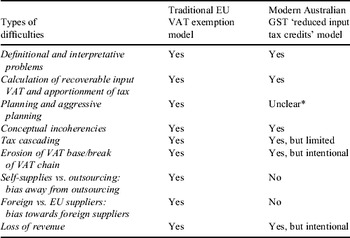
It may be that the Australian approach is unlikely to provide the solution to the problems of input taxing financial supplies that it might be thought to. But it may be a step in the right direction.Footnote 139 The following Table offers a comparison of the EU and Australian approaches, summarising the above considerations regarding the advantages of the modern Australian model, when put against the difficulties caused by the traditional European model.

* There is no obvious evidence of aggressive tax planning. It is too soon for many anti-avoidance cases to have come to light.
IV. CONCLUSIONS
It has been said that ‘the taxation systems of the major developed countries will grow to resemble each other more and more’, with the spread of VAT being offered as an example of this phenomenon.Footnote 140 Indeed there seems to be no better illustration of tax convergence worldwide than VAT.Footnote 141 Albeit a latecomer, Australia too has succumbed to the allure of this tax. As with all VAT systems, Australian GST is ultimately inspired by the EU VAT system, the original, so-called, ‘traditional VAT’. Explicitly acknowledging the difficulties associated with the EU model of taxing financial transactions, however, Australia decided to adopt an alternative approach, combining the traditional exemption with a ‘reduced input tax credit’ system applicable to most financial services suppliers, and using a de minimis threshold to shield minor suppliers of financial services from many of the financial supply issues.Footnote 142 At present, another possible tax policy transfer is the focus of attention: on this occasion in the opposite direction, from Australia to the EU, a transplantation of the GST model for taxing financial transactions to the EU VAT system.
Yet, as the above analysis demonstrates, although the Australian model might have been a step in the right direction, insofar as it tried to tackle the traditional difficulties associated with taxing financial transactions under a VAT system, it is not a complete panacea. Whilst it is true that it has solved some of the difficulties encountered under the traditional EU VAT exemption model, such as the bias towards self-supply, or foreign suppliers, and to a great extent, the problem of tax cascading, it has not solved others. Conceptual inconsistencies have not been eliminated and legal problems, such as definitional and interpretative difficulties, and the need to engage in arguable methods of apportionment of input VAT, are still present.Footnote 143 Moreover, some problems have arguably worsened; in particular the loss of revenue, already present in the EU system, would be much more significant under an Australian-type reduced input tax credit system. Additionally, transplantation of the GST model to the EU context, as the European Commission itself has acknowledged,Footnote 144 would give rise to extra problems in the context of some of the EU specificities, not present in Australia. Firstly, significant variations of recovery rates between Member States would make it difficult to arrive at a common recovery rate, especially in light of the range of standard VAT rates in place within the Community, thus increasing the risk of further economic distortions. Secondly, whilst the standard Australian GST rate is 10 per cent, within the EU much higher standard rates apply.Footnote 145 Such higher rate of VAT would certainly entail greater danger of tax cascading, planning and aggressive planning, and even self-supply and foreign supply biases.
The normal occurrence of these regional specificities is precisely one of the reasons which make public policy transfer in general, and tax policy transfer in particular, perilous at the best of times.Footnote 146 Lack of information on the real effects of the tax policy, which is to be object of the transfer, in the country of origin, will only aggravate the dangers. In this context, the recent debate regarding the adoption within the EU of an Australian-type GST model of taxing financial supplies seems unwise, not least because it appears to be ill-informed. Detailed effects of the Australian approach, given that it has been in place well under a decade, are as yet not fully known—and what is known appears rather discouraging. Undertaking the inherent risks of tax policy transfer might well be unavoidable in the context of a globalised economy.Footnote 147 Inadvertently transferring a young model, which so far has proven to offer only limited advantages, and to create extra, other, possibly significant, disadvantages, is however at the very least imprudent.