For China's rural children, the state's commitment to modernize rural education – by expanding access and increasing quality – signals promise for their future. Addressing concerns about the growing educational gap between urban and rural youth, the state has pursued an aggressive strategy to ensure access to compulsory education in rural areas.Footnote 1 In 2007, the state abolished tuition, textbook and lodging charges associated with compulsory education in impoverished rural regions, which resulted in an estimated 200,000 rural student dropouts in western China resuming their education.Footnote 2 In addition to eliminating the financial barriers to education for rural students, it has promoted several initiatives to improve teaching quality in rural schools. For example, the state has implemented a new curriculum to transform teaching practices and classroom environments in order to develop creative capabilities in students and enhance student engagement. Curriculum reform has required an overhaul of all curricular materials, a revision of textbooks, and investment in teacher training to foster new classroom practices.Footnote 3 State efforts to improve the quality of rural education also include new incentives for urban college graduates and urban teachers to teach in rural schools, targeted funds to provide reliable wages for rural teachers in poor areas, and tuition exemptions at teacher training colleges.Footnote 4 Taken together, these initiatives reflect a vigorous government agenda to address growing social inequality by narrowing the gap between urban and rural education.
As the primary institutional agents responsible for implementing state policies, teachers play a significant role in the realization of the state's goal to improve the quality of rural education. To date, efforts to improve teacher quality in rural schools have focused largely on recruiting good teachers from other areas and providing limited professional development opportunities for existing teachers. Although these strategies are expected to improve the professional skills of the rural teacher labour force, they may fall short of improving rural students’ experiences in the classroom. Teachers influence students’ educational progress not only through the pedagogical skills and content knowledge that they bring to the classroom, but also through their educational expectations.Footnote 5 Teacher expectations can be communicated both explicitly and implicitly to students, powerfully shaping their academic self-concept, academic confidence and own expectations for future schooling.Footnote 6 The educational expectations of teachers in rural schools may wield even more influence because rural parents’ unfamiliarity with the school system positions teachers' opinions as expert.Footnote 7 Regrettably, research indicates that teacher expectations are often affected by preconceived notions that they hold regarding the abilities and future life chances of particular groups. For example, in China, teachers, particularly those recruited from more urban areas, may hold traditional beliefs (on gender, socio-economic status, native place, vocational schooling) that shape their expectations for rural students. This study explores whether student and teacher background characteristics are empirically linked to teacher expectations for rural students to not finish compulsory education, enrol in vocational education, and other schooling outcomes that condition future life opportunities. It also determines the predictive accuracy of their expectations.
In this paper, we use longitudinal data from two waves of the Gansu Survey of Children and Families:Footnote 8 a survey of rural children, their families and schools in Gansu province collected in 2000, and follow-up information about subsequent educational attainment collected in 2007. We address three questions: 1) What kind of early educational expectations did teachers have for rural students in 2000? Did teacher expectations differ according to student or teacher background characteristics? 2) What student and teacher characteristics conditioned early teacher expectations for rural students? And 3) How accurate were teacher expectations for rural youth? How frequently do rural teachers underestimate rural youth's potential? Our paper begins with an overview of recent educational reforms initiated to transform rural education. Next, we review research detailing both the influence of teacher expectations on student outcomes and the factors that may shape teacher expectations. This is followed by a description of the data and methodological approach. We then present our analyses of the determinants of teachers’ expectations for rural youth as well as the predictive accuracy of these expectations. We use multinomial logistic regression to investigate links between student and teacher background characteristics and teacher expectations, controlling for relevant student and teacher characteristics. We also examine how accurately teacher educational expectations in 2000 predict child educational attainment in 2007. The article concludes with a synthesis of findings and a discussion of possible implications for educational policy and social equality in 21st-century rural China.
Transforming Rural Education
Over the last decade, government efforts to improve rural education have been an important part of the state agenda of promoting balanced development and social equality. Equality in education has emerged as an important form of social equality, and so the government has announced several policies to ensure rural students’ enrolment and completion of compulsory education. In 2003, the national government held its first conference since 1949 devoted to the development of rural education.Footnote 9 In 2004, the State Council approved the New Action Plan for Revitalizing Education (2003–2007), reaffirming its commitment to implement compulsory education in rural areas. In the same year, the government launched a massive rural boarding school construction programme spreading across nearly a thousand counties in China's western region with the aim of providing education for millions of rural students.Footnote 10 This was followed by significant state investment in rural education in 2005, with part of these funds being used to guarantee rural teachers’ salaries.Footnote 11 By 2007, the government had followed through on its commitment to remove the financial obstacles to compulsory education by not only eliminating school tuition and fees, but also by providing educational subsidies for rural students.Footnote 12 These policy initiatives underscore the government's commitment to alleviating some of the problems commonly recognized as barriers to school enrolment in rural areas.
Educational reform in China has extended beyond the issue of costs to focus on institutional factors believed to constrain the quality of education experienced by students. The national government has undertaken educational initiatives to improve the core educational practices experienced by students in classrooms – teaching and learning. In doing so, they have embarked upon a “New Curriculum” to nurture innovative and cooperative students who are positioned to help their nation compete in the global knowledge economy.Footnote 13 Teachers play an important role in this reform, and have been called upon to transform the classroom experience by putting students at the centre of learning, using praise and encouragement to motivate students, and experimenting with new approaches to teaching. New educational policies have sought not only to improve rural teaching through the transformation of what is taught and how, but have also endeavoured to recruit more qualified teachers to teach in rural schools.
Because conditions were often difficult and salaries were often late, rural schools have historically encountered problems recruiting and retaining good teachers. Such schools sometimes hired teachers who lacked the required teaching credentials, and as a result rural children were often paired with the least qualified teachers.Footnote 14 Top-ranked schools in counties and townships have higher percentages of highly qualified or high-ranking teachers compared with their rural village schools.Footnote 15 Recognition of this disparity taken together with the overall objective of improving rural education has inspired several policies, mostly consisting of financial incentives, focused on bringing high quality teachers to rural schools, at least temporarily. In 2004, the state initiated a programme that encouraged outstanding urban college graduates to work in rural schools for three years to qualify for a government subsidized, two-year master's degree.Footnote 16 In 2006, the amended compulsory education law began requiring urban teachers to work in rural schools to become eligible for job promotions.Footnote 17 In 2007, the Chinese government pledged its support for trainee teachers at the top six teaching universities to receive tuition waivers, if the student agreed to work at a primary or middle school for at least ten years and spend the first two years in a rural school.Footnote 18 In addition to state recruitment efforts, Teach for China (Zhongguo jiaoyu xingdong 中国教育行动) and other private organizations rigorously recruit high-achieving, new college graduates to rural schools. Specifically, Teach for China places these college graduates in full-time, two-year teaching commitments at high poverty, rural schools.Footnote 19 While new college graduates and experienced urban teachers will likely arrive at rural schools armed with deeper knowledge of the subjects they teach and more pedagogical training, these qualifications alone may not transform rural education. The educational expectations held by teachers for their rural students also affect the quality of students’ classroom experiences, and ultimately, students’ educational attainment.Footnote 20
Teacher Expectations
In rural China, teacher expectations primarily influence educational attainment through two mechanisms: parental expectations and student academic self-concept. Research in rural China suggests teachers uniquely influence student outcomes by aligning parental beliefs of a student's academic potential with their expectations.Footnote 21 Rural parents, who believe children's academic learning is the educator's responsibility, consider the teacher's opinions on academic matters as those of an expert. Their unfamiliarity with the school system further reinforces the respect accorded to teachers’ assessment of students and viewpoints on schooling.Footnote 22 Through official home visits with rural families and informal conversations, teachers convey their opinion of a child's progress and potential, influencing parental aspirations for their child.Footnote 23 Strikingly, when parents and teachers hold different beliefs, parents are likely to adopt the teacher's viewpoint and advice.Footnote 24 For example, separate analysis of survey data from Gansu demonstrates that high teacher expectations for rural primary school students are associated with high parental expectations four years later, even after controlling for student academic performance.Footnote 25 Just as important, a longitudinal analysis demonstrates that parents’ early educational expectations are strong predictors of children's chances of staying in school, completing compulsory education, and graduating from secondary school.Footnote 26 Parental expectations exert a strong influence on students’ expectations, academic competency and performance.Footnote 27
Teacher expectations are also a socializing influence on the formation of students' educational attitudes and academic self-concept, which predict school attainment.Footnote 28 As teachers behave in accordance with their academic expectations toward each child, the academic self-concept of a student – or how a student perceives his or her academic ability compared to others – develops in relation to a teacher's beliefs about the child's academic potential.Footnote 29 Student–teacher interactions, thus, lead students to view themselves as their teachers perceive them.Footnote 30 In the Chinese context, the same teacher usually educates a cohort for multiple years, teaching until graduation or passing the cohort to another teacher at a higher grade level.Footnote 31 The prolonged duration of a student-teacher pairing and student exposure to the same teacher increases the likelihood that Chinese students adjust their academic self-concept to their teacher's expectations. Furthermore, Chinese students from rural and other stigmatized backgrounds are likely more susceptible to teacher expectation effects.
Low status youth are particularly sensitive to teacher expectations, compared to parents’ aspirations, because of their inclination to identify with teachers in educational matters and to regard the teacher as a role model.Footnote 32 It is probable that teacher expectations more significantly impact the following subset of Chinese rural students: girls, those from low income households, ethnic minorities and those from other disadvantaged groups. US-based research conducted on low status youth consistently finds students from stigmatized groups respond more strongly to teacher perceptions of student ability compared to their high status peers.Footnote 33 Children with multiple disadvantages are more vulnerable to teacher perceptions than single-disadvantaged peers.Footnote 34
In short, rural educational reforms prioritize raising school quality by improving teacher skills and pedagogy – most often through recruiting teachers with these qualities. However, our synthesis of previous research suggests that teacher qualifications alone may be insufficient to improve rural education for all students. Teachers’ educational expectations for rural youth also affect students’ experiences in the classroom, and ultimately, educational attainment. The state's focus on teachers to transform rural education raises important questions about teacher expectations that inform classroom experiences, and about whether student and teacher characteristics condition teacher expectations.
Data and Methodological Approach
This article employs data from the Gansu Survey of Children and Families (GSCF), a longitudinal, multi-level study that examines rural children's welfare in Gansu Province, an inland province in north-western China with relatively high levels of illiteracy, widespread poverty and low rates of economic growth. In 2000, the GSCF-1 drew a representative sample of 2,000 rural children aged 9 to 12 in 20 counties. The sampling strategy included a multi-stage, cluster design with random selection procedures at the county, township and village level. At the final selection stage, 20 children were sampled from a birth roster in each of the 100 selected villages. For each child, data from linkable questionnaires of mothers, fathers, teachers, school administrators and village leaders were collected. Follow-up waves were conducted in 2004, 2007 and 2009.
We analyse data from the 2000 and 2007 waves of the GSCF to answer our research questions. To improve the comparability of the sample across years, we limit the analyses to children who were in grade three or higher in 2000.Footnote 35 Those at or beyond the third grade level should have finished compulsory education by 2007 and have had opportunity to enter post-compulsory schooling if they continued schooling at the expected rate. In our analyses, we use items from the child, household, homeroom teacher, and school administrator questionnaires to examine the predictors of teacher expectations in 2000. The outcome, teacher educational expectation,Footnote 36 is based on teacher response to the question, “What grade level do you estimate this child can attain?”
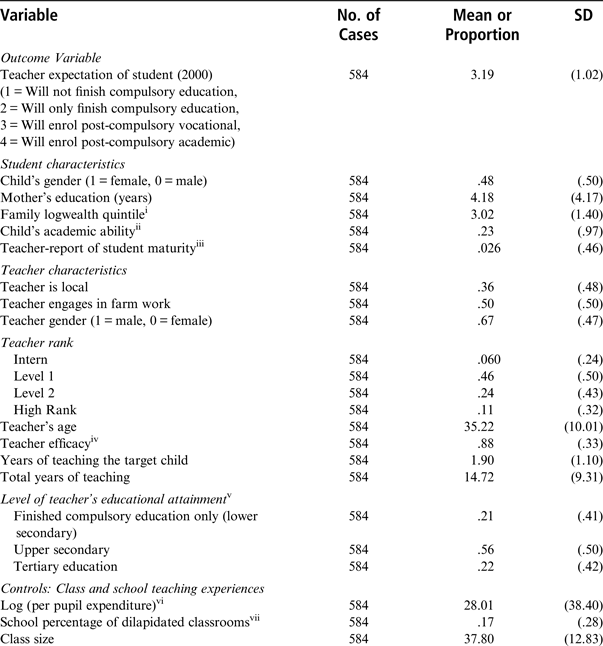
Student characteristics that may condition the formation of teacher expectations for rural student include gender, academic achievement, family wealth and teacher's evaluation of a student's non-academic behaviour. Operationalized as the teacher's perception of student maturity, an educator's evaluation of student non-academic behaviour has been empirically linked with academic expectations in prior research.Footnote 37 Teacher characteristics that may condition the formation of expectations include the teacher's connection with the community, operationalized as an educator's local origins and farm work participation. Previous research suggests that teachers who are from the same village and who engage in farm work as well as teaching are likely to possess stronger community ties.Footnote 38 Moreover, rural students with local teachers are significantly more likely to have higher student aspirations, better language scores, and higher self-reporting of regularly completing homework.Footnote 39 Such a finding suggests local teachers provide a type of motivation that non-local teachers do not and hold higher expectations for students. Local origins may condition beliefs through “native place” background congruence between students and local teachers, who share the same familial roots as the communities from which their students originate.Footnote 40 We also consider measures of professional background and teaching ability, by including teacher educational attainment, years of teaching the particular student, and rank. Certified teachers are evaluated on a yearly basis and, based on these evaluations, promoted through a ranking system that recognizes teachers for their teaching ability and skills.Footnote 41 Characteristics of professional experience, including more teaching experience and higher educational attainment, are strongly linked to lower teacher expectations.Footnote 42 In addition, because research suggests that teacher beliefs concerning their own effectiveness are an important determinant of expectations towards students, we include a variable measuring teacher efficacy – a teacher's belief in his/her skill to competently teach and maintain order in the class.Footnote 43 We also incorporate controls for classroom and school characteristics that are correlated with teacher expectations, such as class size and two measures of school quality (the percentage of dilapidated classrooms and school per-pupil-expenditure).Footnote 44Table 1 displays descriptive statistics for all of the variables used in our analyses.
Descriptive Statistics of School, Class, Teacher, Family and Student Characteristics Influencing Teacher Expectations in Rural Gansu, 2000 (standard deviation)

Notes:
i Total value of house, equipment and durable goods.
ii Normalized score for maths test administered during the first-wave survey (2000). Exams were developed to be age-appropriate for a child's mathematical level. Grade 1, 2, 3 students were given one exam, while Grade 4, 5, 6 students took another exam.
iii A 19-item scale in which teacher evaluated target child's non-academic behaviour in the classroom by reporting on the frequency of target child's behaviour over the past three months. The items, such as “cries a lot,” “is helpful to others,” covered the child's concentration, confidence, class participation and mood. The alpha reliability of the student maturity scale was 0.7883.
iv “I think that the students in my class will be successful” (strongly agree, agree, disagree, strongly disagree). High teacher efficacy was coded to be “agree” and “strongly agree.”
v Only 2 teachers among 950 did not complete compulsory education (middle school), so we did not utilize this educational level as an analytical category.
vi Total school expenditure divided by the total student population. School expenditures include: management expenses, teacher wages, student scholarships, school maintenance, water, electricity, heating, library, physical education, lab equipment and other school-related expenses. A proxy for school quality.
vii Classrooms that do not meet safety standards as reported by school principal.
Source: GSCF 2000.
The analysis proceeds in three parts. First, we examine teachers’ early expectations for students in 2000, looking for differences associated with student origin and teacher background characteristics. Next, we use a generalized estimating equation approach to model the determinants of teacher expectations.Footnote 45 All standard errors are adjusted to take into account clustering at the teacher level, since a proportion of surveyed students were assigned to the same teacher. In the final portion of the analyses, we exploit the data's longitudinal nature to examine the accuracy of teacher expectations by comparing teachers’ early expectations for rural students (2000) with the students’ actual level of school completion in 2007. This approach allows us to identify expectation patterns of overestimation or underestimation in student potential.
Research Findings: Teacher Expectations for Rural Youth
What kind of early educational expectations did teachers have for rural students in 2000? Did teacher expectations differ according to student or teacher background characteristics?
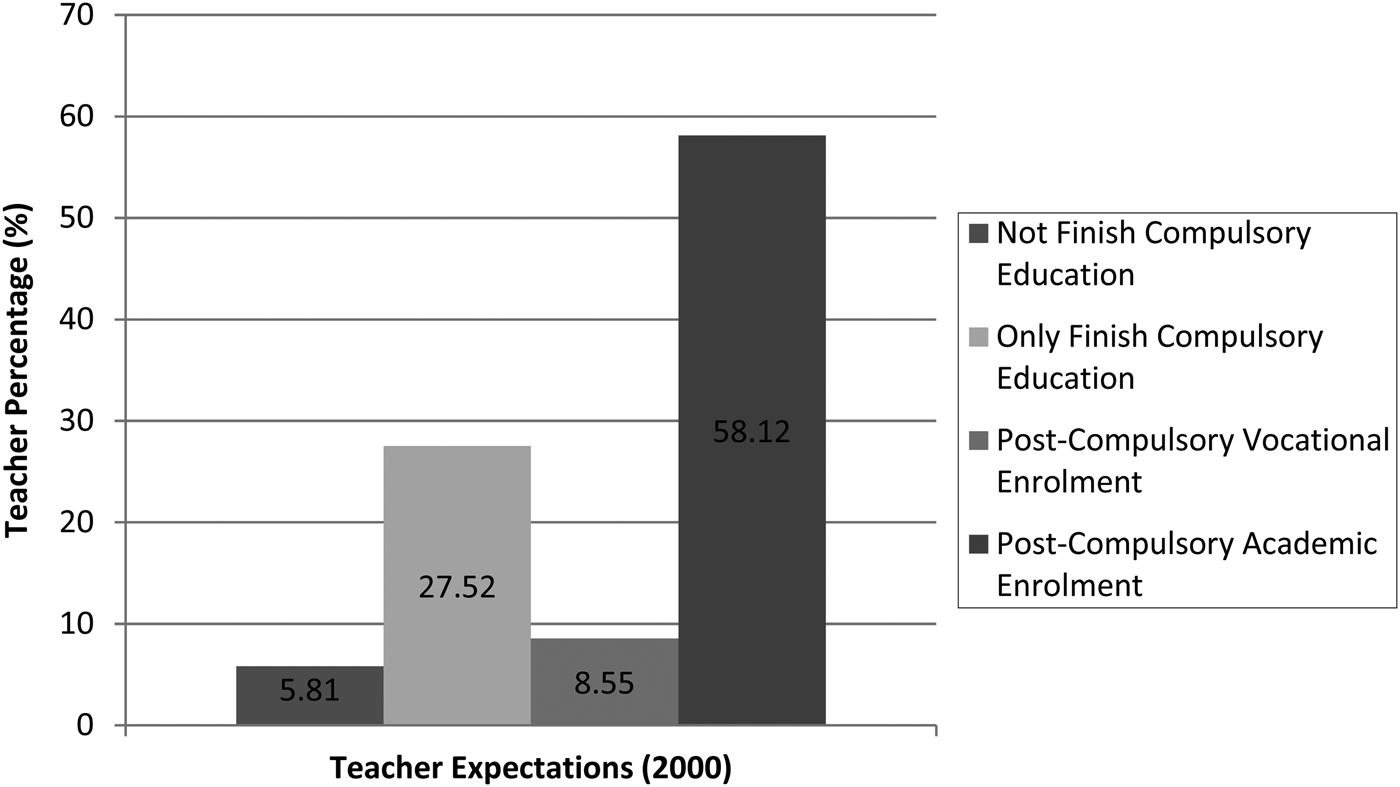
Figure 1 presents the percentage of teacher expectations in 2000 by level of expected student attainment. Perhaps surprisingly, the majority of rural children had teachers who had relatively high early expectations for them. Ninety-four per cent of the students’ homeroom teachers expected them to complete compulsory or enrol in post-compulsory education. Over half of the teachers expected students to enrol in either academic or vocational post-compulsory schooling. Interestingly, of those students with teachers who expected them to complete some kind of post-compulsory education, a comparatively low percentage of teachers expected their students to complete post-compulsory vocational schooling – only eight per cent. Negative cultural stereotypes of manual labour work, as well as the social reality that vocational education eliminates opportunity for youth to enter higher education, may underlie teachers’ unfavourable attitudes toward vocational schooling.Footnote 46 The disadvantages of vocational schooling are further exacerbated by the economic reality that this educational track is more expensive than academic schooling and often does not improve employment opportunities.Footnote 47
Teachers’ Early Expectations for Rural Students
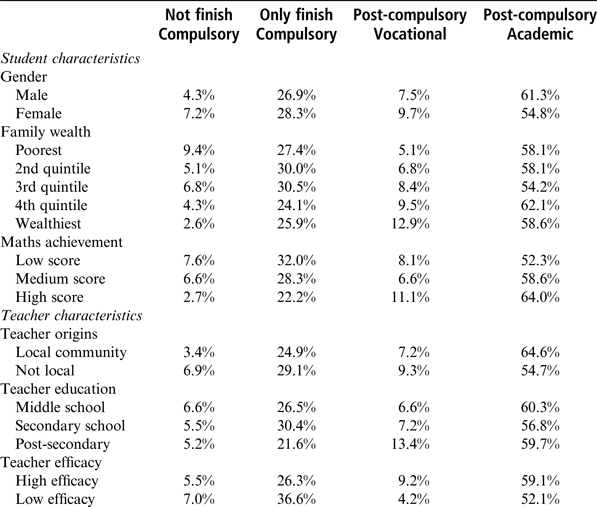
While these descriptive patterns provide a generally optimistic picture of teachers’ expectations for rural students, it is unclear whether teachers hold high expectations for all students. In fact, the generally high expectations may mask differences in teacher expectations that are associated with student origin. For instance, teachers may hold lower educational expectations for poor students, on average. It is also possible that teachers’ own background characteristics shape their views about the educational potential of rural students. Table 2, which displays teacher expectations by selected student and teacher characteristics, provides a more complex description of teacher expectations.
Teacher Expectations by Rural Student Characteristics and Teacher Background Characteristics (n = 584)
Source:
GSCF 2000.
A careful examination of Table 2 indicates that teachers’ expectations for rural students may be conditioned by both student and teacher characteristics, thus suggesting high expectations are targeted towards specific types of rural children (i.e. male, rich) and develop in relation to particular teacher-related factors. For example, teachers held different educational expectations for male and female students; 61.3 per cent of male students’ teachers expected them to attain academic post-compulsory education compared to only 54.8 per cent of female students’ teachers. Similarly, a greater percentage of teachers of students from the wealthiest quintile of families expected their students to complete some kind of post-compulsory education (71.5 per cent) compared with the teachers of students in the poorest quintile (63.2 per cent). Not surprisingly, a greater percentage of teachers of students who demonstrated high maths achievement also expected the students to complete post-compulsory education. Each of these examples suggests that teachers may not have equally high expectations for all rural students, but instead hold higher expectations for male students, rich students and high performing students.
The data displayed in Table 2 indicates that teacher expectations for students are shaped by teachers’ background characteristics as well. Most strikingly, teachers who were born in the local area had higher expectations for students than teachers who were born outside of the area. Specifically, a greater percentage of local teachers expected students to acquire a post-compulsory academic education while greater percentages of non-local teachers expected students to only finish compulsory education or not even finish compulsory education. Teachers of local origins are “native” to the village in which they teach, and feel attachment to the community in which their family has ancestral roots. As noted, these findings are particularly important because rural parents and students may be especially susceptible to their teachers’ expectations for their educational futures. Even more importantly, teachers who underestimate a student's potential contribute toward the under-development of the student, rural society and the nation.
What student and teacher characteristics condition early teacher expectations for rural students?
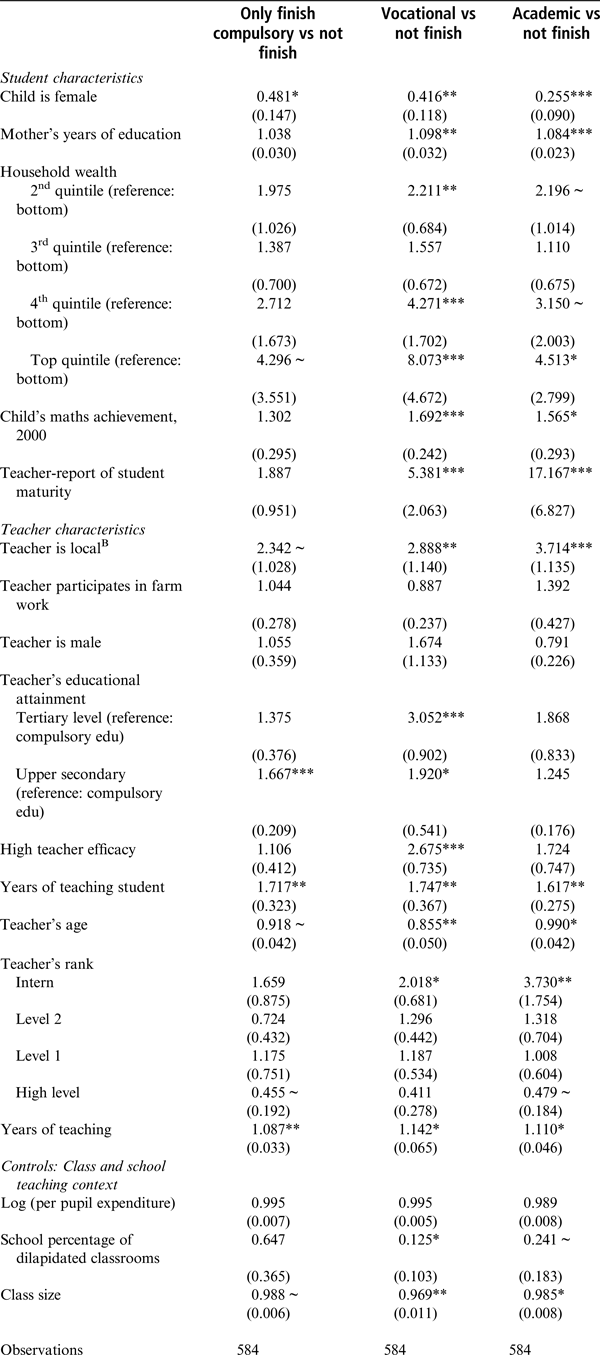
In this section we estimate multinomial logit models to investigate teacher expectations as a function of student and teacher characteristics, controlling for teaching conditions in the classroom and school.Footnote 48 We explore whether teachers hold lower educational expectations for poor students when compared with wealthier students; whether non-local educators hold lower expectations for rural students; and whether a teacher's professional background conditions expectations. Table 3 displays relative risk ratiosFootnote 49 for the statistically preferred model.Footnote 50
Multinomial Logit Estimates of Teacher Expectations
Note: ~p < 0.10, *p < 0.05, **p < 0.01, ***p < 0.001
Robust Standard errors, clustering at the teacher level, are applied for all models
Pseudo R2 = 0.17
Log pseudo likelihood = −507.85
Source: GSCF 2000
The results confirm that student characteristics, such as gender, family wealth and academic performance, as well as teacher assessment of student maturity, are associated with teacher expectations for students. First, teachers are more likely to have lower expectations for female students. The relative risk of a female being expected to not finish compulsory schooling, rather than only finish compulsory education, increases by a factor of two compared to those of a male. Similarly, compared to a male, the relative risk that a teacher expects a student to not finish compulsory schooling compared to post-compulsory vocational enrolment increases by a factor of 2.4 for a female. The gender bias in teacher expectations is even more pronounced when examining the risk that a teacher expected a student to not finish compulsory schooling rather than post-compulsory academic enrolment – the relative risk of a female student compared to a male is nearly four times greater. Second, our findings also suggest teachers are more likely to hold lower educational expectations for poor students. For example, compared to a poor child, the relative likelihood of a teacher expecting a wealthy child in the highest income quintile to enrol in post-compulsory academic schooling compared to not finish compulsory education increases by a factor of 4.5. For a child in the top household quintile, the relative likelihood of having the teacher expect the child to enter post-compulsory vocational track than not finish compulsory education are greater by a factor of eight compared with a child in the bottom quintile. Moreover, our analyses reveals that an additional dimension of social origin, mother's education, to have a small, but significant, influence on teacher expectations. Each additional year of schooling that a student's mother has is associated with higher expectations. For example, the relative likelihood of a teacher expecting a student to enrol in post-compulsory academic education compared with not completing compulsory education increases by eight per cent for every additional year of education attained by the student's mother.
Not surprisingly, findings in Table 3 indicate that academic achievement is associated with teacher expectations. Improving the student's maths score by one standard deviation increases the relative likelihood of being expected to enrol in post-compulsory education rather than not finish compulsory schooling by 60 per cent. Finally, a teacher's evaluation of a child's non-cognitive behaviour also conditions teacher expectations for students. Compared to an “immature” child, the relative likelihood of a teacher expecting a “mature” child to enrol in post-compulsory academic schooling rather than not finish compulsory education increases by a factor of 17. Moreover, compared to an “immature” child, the relative likelihood of a “mature” student being expected to enrol in post-compulsory vocational education compared to the reference expectation is greater by a factor of five. These findings highlight the numerous factors that influence the formation of teacher expectations.
The results also show that teacher characteristics are associated with teacher expectations. Findings confirm an association between teachers’ connection to the community and their expectations towards rural students. Compared to a non-local teacher whose native birth place is not the village in which he or she teaches, the relative likelihood of a local teacher expecting students to enrol in post-compulsory vocational schooling, rather than not finish compulsory education, increases by a factor of nearly three. The relative likelihood of a local teacher expecting students to enrol in post-compulsory academic education, rather than not finishing compulsory schooling, increases by a factor of 3.7 compared to a non-local teacher. Two key findings also emerge from the investigation of educator's professional experience and skill. First, although not consistently significant at conventional statistical levels, teacher ranking exhibits the following trend: compared to the lowest ranked teachers, higher ranked teachers are more likely to expect students to not finish compulsory schooling rather than attain higher schooling levels. Second, compared to low-efficacy educators, the relative risk of educators with high personal efficacy expecting students to enrol in post-compulsory vocational schooling rather than not finish compulsory education increases by a factor of 2.7.
Lastly, each additional year that an educator teaches the same student is associated with higher expectations. For example, an additional year between teacher and student increases by a factor of 1.6 the relative risk of the teacher expecting the youth to enrol in post-compulsory academic education, rather than not finish compulsory schooling. The relative risk is greater, 1.7 and 1.75, respectively, when comparing the relative risk that a teacher who teaches the same student for an additional year expects the youth to only finish compulsory education or enrol in post-compulsory vocational schooling, respectively, compared to not finish compulsory education. The controls for classroom and school characteristics that are correlated with teacher expectations, such as class size and our two measures of school quality, do not appear to shape teacher expectations in important ways. Although class size and the school percentage of dilapidated classrooms were statistically significant, a class increase of one student and standard deviation increase in the percentage dilapidated classroom, would not significantly change the relative risk of teacher expectation.
In summary, our analyses indicate that teacher expectations for rural students are conditioned not only by student characteristics, but by teacher characteristics as well. The teachers of poor students, female students, low performing students and students who lack maturity have lower expectations, and their students may be disadvantaged as a result. Just as important, we find that teachers’ own background characteristics condition their expectations for students, with non-local teachers, teachers of higher professional rank, and teachers with lower efficacy reporting lower educational expectations for students. In this way, although teachers hold generally high expectations for rural students overall, all rural students do not equally benefit from these generally high teacher expectations.
How accurate are teacher expectations for rural students?
In the final section of this paper, we utilize students’ educational attainment seven years later in 2007 to investigate the predictive accuracy of teacher expectations and particularly whether teachers underestimate rural students’ potential. In 2007, nearly 50 per cent of students had enrolled in post-compulsory education, 33 per cent of students had only finished compulsory schooling, and 20 per cent had not completed compulsory education.
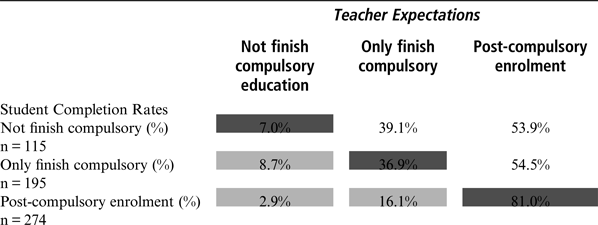
Table 4 presents early teacher expectations (2000) tabulated by student educational attainment (2007). The percentage of students in each category whose attainment was accurately predicted by their teachers’ early expectations for them is visible diagonally in the dark grey-shaded area of the table. Teachers generally exhibited a great deal of accuracy or tended to overestimate in forming educational expectations. A high percentage of student’ educational attainment was accurately predicted by their primary school teachers’ expectations with 52 per cent of students’ attainment matching their teacher's early expectations.Footnote 51 Among students who did not finish compulsory education, only seven per cent of students’ teachers accurately predicted the relatively low attainment while nearly 37 per cent and 81 per cent of students’ teachers accurately predicted compulsory education and post-compulsory education, respectively. Interestingly, Table 4 also highlights the extent that students’ early teachers overestimated their educational attainment in the white shaded area; approximately 35 per cent of students’ educational attainment was overestimated.Footnote 52 For example, among the students who failed to complete compulsory education, 93 per cent of teachers overestimated their attainment, with 39.1 per cent of teachers expecting them to at least complete compulsory education. Similarly, among the students who only finished compulsory education, just over one half of their early teachers overestimated their future educational attainment by expecting them to complete post-compulsory education. Only a small percentage of rural students’ educational attainment, displayed in the light grey-shaded area, was underestimated by their early teachers – approximately 13 per cent.Footnote 53 Among students who only finished compulsory, just 8.7 per cent of their teachers underestimated. For students who enrolled in post-compulsory schooling, 19 per cent of their teachers under-estimated attainment. In summary, Table 4 yields two noteworthy results. First, the majority of students, 52 per cent, had their educational attainment accurately predicted by their teacher's early expectations. Next, among the students whose attainment was not accurately predicted by their early teachers, more students’ educational attainment was overestimated than underestimated.
Teacher Expectations (2000) by Student Educational Attainment in 2007 (n = 584)
Source: GSCF 2000, 2007
Discussion
In this paper, we have investigated an unexplored, but critical dimension of rural teacher quality: teacher expectations for rural students. Overall, teacher educational expectations for rural students are high with 94 per cent of students’ teacher expecting them to complete compulsory education or higher and with over half of the students’ teachers expecting them to complete some form of post-compulsory education. Just as interesting, our investigation of teacher predictive accuracy indicates that students’ educational attainment is most often accurately predicted or overestimated by their early teachers’ expectations. However, our analysis also reveals that teacher expectations are not equally high for all students, but instead are conditioned by student and teacher characteristics.
Our analysis of teacher expectations yields five particularly notable results. First, our results highlight the ways preconceived notions about students’ gender and socioeconomic background condition teacher expectations for students. We find pronounced gender bias in teacher expectations, particularly at the post-compulsory schooling level. Since the implementation of China's economic reform policies, household and village assets operate in gendered ways to promote school enrolment, with household wealth more likely to impact enrolment for females than boys.Footnote 54 The reduction of financial pressure for compulsory schooling and increased state pressure for girls to attend nine years’ schooling since 2007 minimizes financial and opportunity cost barriers for females completing compulsory schooling. However, recent trends in post-compulsory education increase the likelihood that gender remains a strong and, possibly, stronger determinant of teacher expectations. With high financial and opportunity costs associated with schooling beyond the state-mandated nine years, females are relatively disadvantaged compared to males in pursuing post-compulsory schooling. In this way, lower educational expectations held by teachers for girls are another source of disadvantage that female students must overcome to remain in school. Similarly, teachers are more likely to hold lower educational expectations for poor students, particularly at the post-compulsory schooling level. Although recent government policies to subsidize rural compulsory schooling underlie the anticipated weakening of family wealth as an expectation predictor at the compulsory education level, our findings indicate that family poverty can condition rural students’ educational experience in other ways. For instance, teachers’ long held views about “the backwardness” of the rural poor may influence their expectations regarding the academic trajectories of poor students. In addition, teacher's expectations likely reflect their belief in the inability of poor families to meet the significant costs of secondary education.
Second, compared to non-local teachers, local educators, who are more attached to the community, hold higher expectations for their students. Descriptive analyses indicate that more local teachers participate in farm work and live in their own home or their parent's home in the village. They report working in the same school for a longer period of time, which further emphasizes their commitment to the community. The familial roots of a local teacher in the community constitute a localized Chinese ethnicity, a type of social belonging that includes all those with the same native place origins and excludes all others. The significance of teacher place of origin as a factor associated with educational expectations hints that teacher expectations emerge from the interaction of “native place” backgrounds between teacher and student.Footnote 55 A plausible mechanism by which locality conditions teacher expectations is through culture-linked, teacher perceptions of student ability, behaviour and life chances.Footnote 56 As teacher expectations are based on behaviours related to cognitive performance (i.e. homework) and behaviour marginally related to performance (i.e. disruptive behaviour), local teachers plausibly judge students’ non-cognitive traits, styles and habits more favourably than non-local teachers.
Third, our analysis highlights that, compared to low-efficacy educators, an educator who reports high efficacy is more likely to expect students to enrol in post-compulsory vocational schooling, rather than not finish compulsory education.Footnote 57 This finding is consistent with research from other contexts demonstrating that teachers with a high sense of efficacy set higher expectations for students, as evidenced by more optimism and expectancy for student achievement, behaviour and improvement.Footnote 58 Since teachers’ efficacy beliefs influence the effort that teachers invest in teaching and the goals they establish, teachers with a high sense of efficacy show resilience in confronting setbacks and persistence in teaching struggling, unmotivated students.Footnote 59 Particularly as rural teachers face unmotivated students and high dropout rates, efficacy emerges as a significant teacher characteristic for future investigation.Footnote 60
Fourth, our analyses reveal that relatively few teachers – only 8 per cent – expect students to enrol in post-compulsory vocational education. This finding raises concern about the role of vocational education in transforming the rural educational experience. The low percentage of students with teachers who expect their students to complete post-compulsory vocational education highlights the culture-based hierarchy of schooling, which esteems youth who enrol in the academic track. High costs, poor infrastructure and low teacher quality may be additional factors fuelling the low proportion of teachers who expect students to enrol in vocational education.Footnote 61 While company-affiliated secondary vocational schools are generally better managed, better funded, and lead to higher employment satisfaction among vocational graduates,Footnote 62 to date this success is not widespread and may constrain teacher expectations for their students to attend vocational schools.
Finally, our analyses yield generally optimistic findings with teachers holding high expectation for rural students – expectations that overestimate attainment more often than underestimate it. However, the results also raise concerns for both the students who have had their attainment over and underestimated. First, drawing on our results to highlight the way in which student background characteristics condition early teacher expectations, we suggest that the 13 per cent of students (who had early teachers who underestimated their attainment) are more likely to be from disadvantaged backgrounds. Next, for the 35 per cent of students who had their attainment overestimated by their teachers, our findings raise questions about why these students failed to achieve the education that their early teachers expected for them. Although we cannot identify the factors that contributed to lower attainment in these analyses, we speculate that overestimation may reflect the gap between teacher beliefs about student ability to attain and the financial realities of education that faced rural families in the pre-rural relief era. In this way, both the underestimation and overestimation of a youth's attainment suggest rural students’ academic potential are not being fully realized.
Implications for Policy
For the last two decades, initiatives aimed at expanding access to rural schooling have played a key role in the state's efforts to close the education gap between rural and urban residents, and ultimately, promote social equality. As enrolment obstacles have decreased, educational policymakers have turned their attention to improving the quality of education experienced by rural youth. Our findings improve our understanding of the formation of teacher expectations, and also have significant implications for the state policies to improve rural education, particularly those policies aimed to raise teaching quality and promote vocational education. As teacher expectations condition the daily schooling experience and educational trajectories of rural students, our paper contributes new perspectives to existing policy discussions on rural educational reform. Our results confirm the benefit of local teachers to the children who are at the greatest risk of school dropout. Rural students of local teachers show a marginally significant advantage in maths achievement, as well as sizable advantages in higher student aspirations, better language scores, and consistent homework completion.Footnote 63 The significance of teacher place of origin as a factor associated with educational expectations hints that rural students may be best served by policies that encourage and assist local residents to pursue teaching as a profession. In light of these findings, policy initiatives that focus primarily on raising rural teacher quality via the recruitment of non-local personnel need to be examined more carefully. Although our data doesn't allow us to differentiate between non-local teachers with rural or urban origins, our findings raise non-locality as a salient policy issue that requires closer examination. Specifically, recent reform efforts have touted the ambitious recruitment of urban teachers and new college graduates to rural schools. While these recruitment programmes promise educators with a strong understanding of the subject they teach, little is known about how effective these teachers are in rural schools. And, since our findings suggest that non-local teachers have significantly lower educational expectations for rural teachers, policymakers should consider that there may be negative classroom consequences associated with current state policy incentives. These policies will fall short of improving rural schooling if these urban recruits pass on low educational expectations to rural students and their parents.
Our results regarding the association between teacher efficacy and teacher expectations also raise questions about the recruitment of recent college graduates as a strategy to improve rural education. While college graduates enter their classroom with a strong foundation of knowledge and the motivation to improve practice, they lack professional experience and skill as a teacher. Research from the US indicates that teachers who participate in alternative certification programmes – including Teach for America, the programme from which Teach for China is modelled – often express inadequate preparation to teach and manage a classroom, a sentiment also associated with lowered efficacy.Footnote 64 Thus, inexperienced urban graduates who enter the rural classroom through participating in non-traditional certification routes may possess low efficacy and, according to these study's findings, would be more likely to hold lower expectations for their rural students.
Based on our findings, policymakers should consider ways to enhance teacher efficacy, particularly for recent college graduates, through professional development. Novice teachers, who may arrive with “unrealistic optimism” that good teaching can overcome all obstacles to learning (i.e. poverty) but little understanding of the rural students’ lives, feel hopeless when facing reality in the rural classroom.Footnote 65 A professional development that targets efficacy would develop skills to identify and address the source of teachers' low efficacy beliefs, thus gaining self-awareness of whether they attribute successes and failures to the teachers’ ability or factors external to the teachers (such as student ability or parental support).Footnote 66 Such a programme also promises benefits for teachers of non-local and local origins.
Lastly, while the state has been investing heavily in vocational and technical education as the primary strategy to address unemployment in poor rural areas, our findings indicate a strong cultural bias that may undermine state efforts to expand this educational sector.Footnote 67 Negative stereotypes of manual labour persist in pervading Chinese society and fuel critical attitudes toward vocational schooling.Footnote 68 Empirical evidence, which document graduates of vocational schooling have lower levels of labour productivity and vocational education's higher equipment costs compared to academic schooling, also raise concern about the cost-effectiveness of state policy.Footnote 69 Our findings suggest policymakers should consider cultural attitudes, which perceive vocational schooling as a school track that reproduces social stratification for rural students, to be a formidable challenge in transforming this educational path to a promising pathway.
Conclusion
As the state heavily invests in rural education, schools will be challenged to recruit and develop teachers who are prepared to effectively teach China's rural population. It is important to note state educational reforms to raise teaching quality in rural communities are a strategic resource investment to achieve balanced rural–urban development. Outside the home, teachers are the most important influence on student learning and form the foundation of good schools. However, the state's teacher recruitment focus on strong pedagogical skills and content knowledge alone may not transform rural education. Our analysis suggests the state's well-intentioned recruitment of urban teachers and college graduates to improve rural teaching quality may actually hinder the advancement of disadvantaged students. As teachers structure daily realities in the classroom, more research needs to be conducted on the mechanism by which teacher locality origins condition beliefs and practices. Building from cultural capital research in the developed world,Footnote 70 a plausible future study is to explore the relationship, if any, between educator locality and teacher evaluation of student maturity – a variable our analysis identifies as a strong teacher expectation predictor at the post-compulsory level. This study also suggests a policy alternative to recruiting non-local teachers: developing teachers from within rural communities. Additional research needs to examine the merits and realistic possibilities of this option.
Furthermore, the trends that emerge from our analysis suggest the need for more regular attention to the role that teachers and their expectations play in conditioning rural educational opportunity and, ultimately, in achieving educational equity. While research on educational attainment and stratification in developing nations often overlooks children's agency, a child's attachment to teachers and school will have increasing importance on school persistence as the state decreases financial barriers to schooling.Footnote 71 Teacher expectations critically shape a child's relationship with teachers and comprise an important component of a student's schooling experience.Footnote 72 Thus, the mechanism by which teacher expectations effect school attainment is a research question with lasting implications on educational and, ultimately, social equality in 21st-century rural China.