The coronavirus disease 2019 (COVID-19) outbreak was declared in China on December 31, 2019, 1 and spread rapidly across the world before being declared a global pandemic on March 11, 2020. 2 The pandemic attracted widespread media coverage and its announcement coincided with a wave of stockpiling behavior in supermarkets across the globe. 3 In the United Kingdom, estimates suggest that consumers spent an extra £1.9bn in the period February 24 to March 21, compared with the same period last year and made over 80m extra shopping trips. 4 This surge in supermarket sales provoked extended media coverage of the empty shelves and stockpiling behavior seen in shoppers, 5 which arguably in itself could be a catalyst for the increase in stockpiling behavior.
One explanation for stockpiling behavior and food insecurity is the emotional contagion theory, specifically fear contagion. It argues that emotional contagion takes places in 3 stages: mimicry, feedback, and contagion, Reference Decety and Ickes6 whereby people mimic behavior which affects how they process their emotions and leads them to internalize this behavior. This “contagion of fear” can be exacerbated by media coverage as seen in the United States throughout the Ebola outbreak in 2014. Previous researchers concluded that mass media can be responsible for inducing panic in the population even in cases where the actual risk to the public is low. This demonstrates that face-to-face proximity is not needed for emotional contagion, and images and videos are also effective ways for emotions to spread. This perspective is especially relevant in the context of the COVID-19 pandemic when face-to-face contact has been drastically reduced because of repeated lockdowns, with people relying heavily on social media and online interaction. Reference De, Pandey and Pal8
Previous studies have shown how emotion, many times fueled by mass media, can spread easily on social networks, specifically on Twitter Reference Bae and Lee9 and Facebook Reference Kramer, Guillory and Hancock10 through people replicating the emotions of others as seen on social media. During the Ebola pandemic, for instance, a news video triggered tens of thousands of tweets and Internet searches related to Ebola, a pattern attributed to the panic-inducing characteristics of the original video. Reference Towers, Afzal and Bernal7 Other studies attest to a linear relationship between the emotional valence of the stimuli that Internet users are exposed to and their emotional responses. Reference Ferrara and Yang11 Public health emergencies like COVID-19 might motivate people to post emotional online content, thereby creating an emotion-induced climate of values in the society that prioritizes securing oneself and avoiding threats. Reference Steinert12 These studies attest to the power of social media to fuel emotion contagion during COVID-19 even though the extent to which it is associated with self-preservation behaviors and threat-related beliefs like hoarding and food insecurity, respectively, remains to be understood.
News media play a crucial part in reducing public concern during an outbreak, especially as a tool to avoid the health system being overwhelmed. Reference Anwar, Malik and Raees13 When used correctly, the media can minimize the public’s perception of risk; however, the growing access to a 24/7 news cycle leaves people prone to media-related anxiety, which is incongruent with actual public risk. Reference McDonnell, Nelson and Schunk14 Media richness theory argues that the effectiveness of the message will depend on the media form, with images and video considered the most effective. Reference Daft and Lengel15 Research has shown that exposure to graphic images still triggers anxiety after a traumatic event, Reference Holman, Garfin and Lubens16 and priming theory suggests that higher exposure to images and videos can evoke related thoughts in the minds of consumers. Reference Straubhaar, LaRose and Davenport17 This is of particular importance during this pandemic, as recent research suggests people are spending more time on social media 18 meaning they have had the opportunity to be exposed to more media forms that may have had an impact on their buying behavior. Placing these perspectives in the context of fear contagion theory leads us to postulate that posting and sharing images and videos of panic buying at supermarkets on social media might spread fears around the lack of availability of food, thereby fueling insecurities and hoarding tendencies aimed as self-preservation.
Previous research indicates that people have a set of societal norms that they look to for guidance on how to behave, particularly during times of uncertainty when it is easier to be influenced by these norms. Reference Sherif19,Reference FeldmanHall and Shenhav20 Studies have examined the relationship between conformity and social influence when there is a threat to mortality Reference Gailliot, Stillman and Schmeichel21 and highlight the idea that following social norms generally increases the likelihood of avoiding death. This is not to say that the media coverage of the stockpiling in United Kingdom supermarkets may have increased people’s mortality salience; however, general news coverage of the virus may have increased people’s awareness of their mortality and increased their desire for survival. In this way, it could be argued that people see stockpiling as a rational behavior during times when survival is threatened and people want to prepare for the worst-case scenario, as seen in previous studies. Reference Savage and Torgler22,Reference Sterman and Dogan23
These problems are also affected by sociodemographic variables such as age and gender, and social determinants of health like income and education. For instance, previous research has suggested that females and younger adults from lower income groups and older adults, one of the main vulnerable groups for COVID-19, are more likely to be affected by food insecurity. Reference Power, Uphoff and Stewart-Knox24–Reference Connors, Malan and Canavan28 Furthermore, those from lower income groups are less likely to resort to hoarding behaviors given their access to lesser disposable income; in contrast higher income and education might be associated with a greater propensity to hoard possibly given greater threat perceptions among this group which too has shown to influence. Reference Meadows29–Reference Micalizzi, Zambrotta and Bernstein32
Throughout the pandemic, there has been a growing need to be aware of future problems caused by the pandemic, and research suggests that the changes to the food chain may limit people’s access to healthy food. 33,Reference Timmer34 Therefore, it is important to understand what drives hoarding and panic buying during a pandemic to be able to predict how people may behave so that everyone has equal access to food and other resources. In addition, a pandemic places enormous strain on the healthcare system, and some researchers have made nutrition recommendations for the pandemic to ensure people maintain a healthy diet and avoid placing stress on the food supply chain and health-care system. Reference Naja and Hamadeh35 In this context, the extent of the twin problems of food insecurity and hoarding behavior and the influences of news and social media on these behaviors have thus far been understudied in the United Kingdom, a country with the highest COVID-19 mortality in Europe. In the context of this study, media consumption serves as an information source and takes into account various forms of media such as social media, traditional media, and websites. This is the gap in research our study seeks to address. Evidence from the above literature review allows us to formulate the following research questions:
-
RQ1: To what extent do media consumption, food insecurity perceptions, and food hoarding behaviors vary among different age groups in the United Kingdom?
-
RQ2: How do COVID-19 related food insecurity perceptions and food hoarding behaviors vary among different income groups in the United Kingdom?
-
RQ3: To what extent does exposure to online information on COVID-19 affect food insecurity perceptions and food hoarding behaviors?
Methods
We used a quantitative, nonexperimental, cross-sectional design to age and income-based differences in food insecurity perceptions and hoarding behaviors, and identify factors related to media consumption that might affect these outcomes.
Participants
Using a convenience sampling approach, we recruited 203 participants between May 22 and July 16, 2020, through advertisements on Facebook, Twitter, Reddit, online food forums, and Survey Circle. By way of inclusion criteria, participants were required to be at least 18 y of age, residing in the United Kingdom since the start of the pandemic, and to have no medical issues that affected their buying behavior during the pandemic (eg, needing to be shielded which may have impacted how participants shopped during the pandemic and may have needed to stock up on certain items). Participants were informed that their participation was voluntary and anonymous and gave their informed consent before participating.
Measures
The survey was composed of 3 different adapted scales to measure food insecurity, hoarding behavior, and media consumption. The Food Insecurity Experience Scale Survey Module (FIES-SM) 36 was used to measure food insecurity as it is designed to measure access to food, and any changes in diet. This scale was originally designed as part of a Food and Agriculture Organization of United Nations project to measure food insecurity across the world and is designed to measure food insecurity at the individual and the household level. It has widely been used as a measure of countries’ food insecurity Reference Jones37,Reference Nord, Cafiero and Viviani38 as it is the “first experience-based food insecurity measurement system” which allows for comparison across countries. 36 It was deemed a suitable measure for this study because it enables the measurement of people’s access to food during the coronavirus pandemic, and how worried they have been about accessing food during the pandemic. Selected items from this scale were chosen to build our food insecurity scale. Building on the questions consisted of a 3-item (Since the global COVID-19 pandemic was announced [March 11, 2020], has there been a time when, due to a lack of money or other resources: you have been unable to access healthy and nutritious food, your household ran out of food, you had to skip a meal), 5-point scale (Never, Rarely, Sometimes, Frequently, Very Often) (Cronbach’s a = 0.76; mean = 5.21).
The hoarding behavior scale was adapted from the Saving Inventory-Revised (SI-R) Reference Frost, Steketee and Grisham39,Reference Frost and Gross40 which was designed to measure symptoms of compulsive hoarding and the levels of distress sometimes seen in hoarders. The items in the scale aim to measure general symptoms seen in those with hoarding tendencies, such as feeling the need to acquire items and any distress associated with hoarding behaviors. The hoarding scale was included in this survey to be able to examine stockpiling behavior during the pandemic and the SI-R has again been widely used to measure hoarding behavior. Reference Mueller, Mitchell and Crosby41,Reference Landau, Iervolino and Pertusa42 Building our hoarding scale consisted of selecting appropriate items from the SI-R, which again used a 5-point scale to measure hoarding behavior (During the Covid-19 pandemic, how often have you acquired things you may not need immediately? Never, Rarely, Sometimes, Frequently, Almost Always). (Cronbach’s a = 0.69; mean = 8.39)
The final scale was adapted from the Ofcom News Consumption Surve 43 which aims to discover people’s news consumption preferences in the United Kingdom. This survey is flexible and allows for many different types of news platforms to be examined. Including this survey in the study allows for a detailed examination of which types of media people are using the most for coronavirus related news and how often they are consuming it to determine how much news they are being exposed to, and whether this affects their buying behavior. This Ofcom survey is conducted every year, and the data from it is widely used in other studies to examine people’s news consumption preferences. Reference Gulyas, O’Hara and Eilenberg44,Reference Constantinides, Dowell and Johnson45
Media consumption (used to measure people’s source of information) was measured using the following media types: word of mouth, radio (analogue/online), newspapers (print/online), television (on TV and online), governmental health websites (eg, NHS), medical websites (eg, WebMD), social media, and other. These media channels were then condensed into 3 broad categories: traditional media (radio, television, newspapers), websites (governmental health websites, medical websites), and social media. It is important to distinguish between different sources of media, as not all forms of media will have the same effect on people’s food insecurity and hoarding behaviors.
Two word association questions were included at the end of the survey to determine the priming effects of the media on people’s perceptions of the words “food shopping” and “supermarket.” Participants were shown a list of words such as “rationing” and “empty shelves” and asked to select which words (if any) they associated with “food shopping” and “supermarket.” The aim of these questions was to create a word index based on how many words participants selected, with a higher score indicating that they had more negative perceptions of “supermarket” and “food shopping.” To determine the priming effects of the word association, a “supermarket” (M = 2.52; SD = 1.25) and “food shopping” (M = 1.5; SD = 0.80) index was calculated by adding together the number of words each participant selected, with higher scores indicating more negative associations with these words. The online survey platform Qualtrics was used to implement the survey. Ethical approval for the study was granted by the faculty ethics committee at a university in the United Kingdom.
Analysis
We performed simple descriptive statistics to generate a profile of the participants. Age- and income-based comparisons were performed using independent t-test and 1-way analysis of variance (ANOVA). Factors associated with food insecurity perceptions and hoarding behaviors were identified through linear regression modeling using the stepwise method to generate the most parsimonious model while controlling for age, gender, income, and education. Statistical significance was set at P < 0.05 level for all tests. All data were then analyzed using SPSS v.26.
Results
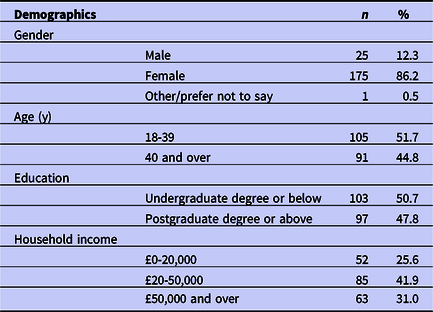
Frequency statistics for the participants are shown in Table 1. Frequency statistics were also carried out for news sources for COVID-19 with television, government health websites, and social media among the most popular. A food insecurity score was calculated by aggregating scores on all items related to the FIES-SM scale (M = 1.70; SD = 0.75), and a hoarding score was also calculated by aggregating scores on all items from the questions related to the SI-R scale (M = 2.08; SD = 0.61).
Sociodemographic profile of survey participants

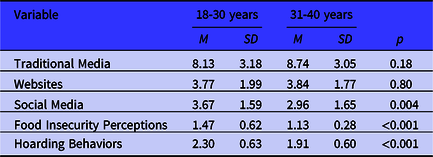
In response to RQ1, we found no age-based differences in use of traditional media and medical and health websites (Table 2). However, social media use among 18- to 39-y-old participants was significantly higher than 40+-y-old participants. We also found that food insecurity perceptions and hoarding behaviors among the younger age group were significantly higher than the older age group.
Age-based comparison of media consumption, food insecurity, and hoarding behaviors

In response to RQ2, we found no significant income-based differences in the use of traditional media, websites, and social media, or food hoarding behaviors (Table 3). Food insecurity was the only variable that demonstrated a significant difference between income groups at the P < 0.05 level. Tukey’s post-hoc analyses revealed that the lowest income group of £0-20,000 significantly differed from the £20-50,000 group (P = 0.03) and the >£50,000 group (P = 0.01). No significant differences were found between the £20-50,000 and >£50,000 groups.
Differences in media consumption, food insecurity perceptions and hoarding behaviors between different income groups in the United Kingdom

Abbreviation: Df, indicates degrees of freedom.
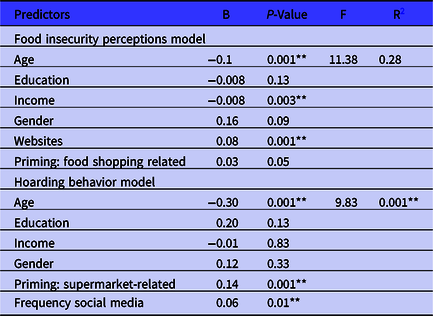
In response to RQ3, we ran a hierarchical stepwise linear regression to identify the most parsimonious model (Table 4). None of the variables entered into the regression were highly correlated (Supplementary Table 1). Exploring factors explaining food insecurity perceptions, we found that younger participants, or those who earned less were associated with higher food insecurity perceptions. Also, use of medical and health websites and priming related to food shopping was positively associated with higher food insecurity perceptions.
Sociodemographic, media consumption, and priming factors predicting food insecurity perceptions and hoarding behaviors

**significant predictors at the 0.01 level.
Exploring factors explaining food hoarding behaviors, we found that younger participants were more likely to display hoarding behavior and those with higher education were associated with higher food hoarding behaviors. Additionally, we also found that social media use and priming related to supermarkets were associated with higher food hoarding behaviors.
Discussion
Market research agencies have documented stockpiling behaviors among United Kingdom consumers in 2020 by pointing to 79 million extra shopping trips and an additional spending of £1.9 billion on groceries over the past year. 4 The aim of the present study was to investigate the influences of sociodemographic factors, with a particular emphasis on age and income, and media consumption on food insecurity perceptions and such hoarding behaviors using priming theory and emotional contagion theory. Our analyses revealed 3 important findings of relevance to the community of public health nutrition communication practitioners and researchers. Specifically, we found that younger adults reported not only significantly higher social media use, but also food insecurity perceptions and food hoarding behaviors. Furthermore, lower income groups reported significantly higher food insecurity perceptions and substantially higher food hoarding behaviors. However, age became the main observed demographic variable due to its significant findings. Last, we found that online media, both by way of websites and social media, were associated with food insecurity perceptions and food hoarding behaviors, respectively. These findings should be considered in the context of the sample which had an unequal gender balance toward females; however, other demographic variables were more equally proportioned. Below, we seek to unpack these key findings individually in the context of prior research and implications to the nutrition education community.
Our finding about greater food insecurity perceptions among younger adults is consistent with research in other high-income countries like Australia where the 18-25 age group accounted for nearly 36% of those were found to be food insecure. Reference Kent, Murray and Penrose46 In the United Kingdom, where food insecurity quadrupled due to COVID-19, adults who were unemployed were found to be at risk of food insecurity, 47 similar to income-based disparities observed in Australia as well as in our study where younger adults reported lower household incomes. Lower income increases susceptibility to food insecurity, Reference Power, Doherty and Pybus48 an undesirable relationship that might have been strengthened with the impact of COVID-19 on increased unemployment in the United Kingdom. 49
The results of the parsimonious regression suggest that higher education is associated with hoarding behavior and food insecurity. This finding supports previous research suggesting that consumers with a higher level of education are more likely to stockpile because they are more likely to show a greater risk perception of infection. Reference Wang, An and Gao31 Further research would be useful to examine how education can lead to increased hoarding behavior, and whether education would actually be a useful tool in combatting hoarding behaviors during a pandemic.
We found hoarding behaviors decreasing with increasing income; however, this association was not significant. While it would be reasonable to think that lower income impedes an individual’s financial capacity to stockpile, previous research supports this seemingly counterintuitive finding by suggesting that those who earn less are in fact more likely to hoard, Reference Wang, An and Gao50,Reference Spittlehouse, Vierck and Pearson51 with the studies suggesting further research is needed to determine whether hoarding is a consequence of financial insecurity, or if hoarding behavior leads to financial insecurity. While our study does not possess the data to draw causal linkages about the effect of income, the consistent patterns from our study and other related research clearly paints a picture of the extent of the economic burden that COVID-19 has placed on young adults and the socio-structural inequities that might have exacerbated food insecurity perceptions among lower income groups. Taken in the context of fear contagion theory, this finding suggests that those on lower incomes feel more vulnerable and have a higher tendency to display self-preservation behaviors, such as food hoarding.
The significant effect of age, however, continued to persist as younger adults reported higher hoarding behaviors. One possible explanation from correlated research reporting similar findings is that hoarding behaviors are influenced by impulsivity which is pronounced among younger age groups Reference Timpano, Rasmussen and Exner52 and can be triggered by panic. Reference Dammeyer53 Relatedly, findings about higher food insecurity hoarding behaviors among younger adults should not only be seen in the context of food shortages in supermarkets in the United Kingdom during the initial months of COVID-19, but also situated against the greater extent of social media use among this group as a possible explanation for panic. This perspective gains strength with 1 study finding 20 million mentions of “coronavirus” across social media and news sites in a single day, Reference Molla54 and other large-scale analyses of Twitter data that describe how a combination of human and automated agents were responsible for spreading manipulated content or misinformation during the initial months of the pandemic. Reference Gallotti, Valle and Castaldo55
The “infodemic” that the World Health Organization refers to constitutes not only a large-scale spread of misinformation but also an over-abundance of information in general which was diffusing at scale through social media, reaching people in various combinations of textual, visual, and audible content. Among these strands of multimedia content were pictures of empty store shelves Reference Leung, Chung and Tisdale56–Reference Wheaton, Prikhidko and Messner58 which, using emotional contagion theory, it could be argued to have caused panic and anxiety among consumers in the midst of an emergency characterized by high levels of uncertainty, leading them to stockpile food supplies. Recent research has argued that the media’s framing of the situation helped to drive stockpiling behavior which then became “self-perpetuating,” Reference Loxton, Truskett and Scarf59 for example, supermarkets introducing product restrictions could encourage people to buy extra quantities of other items and increase their perception of uncertainty. However, hoarding behavior can be seen as rational during times of crisis when there is a fear of the unknown and a need to control the situation and feel prepared. Reference Yuen, Wang and Ma60
Whereas social media is widely seen as an untrustworthy source of news, 61 it was still one of the most popular news sources for COVID-19 for those aged 18-39 y. Twitter reports of food shortages and queues in supermarkets were shared multiple times, 62 increasing people’s exposure to these events, especially if checked several times a day, as was the case in this study. Psychological distress associated with COVID-19 increases as exposure to COVID-19 related news increases, Reference Yao63 and the findings of the current study suggest that exposure to COVID-19 related news on social media can increase concerns over food insecurity and hoarding behavior, potentially due to media priming and emotional contagion. Those on lower incomes may already be feeling vulnerable during the pandemic, and may, therefore, be more susceptible to emotional contagion by means of social media, prompting them to hoard more and feel more food insecure.
The significant association of website use with food insecurity perceptions which might be explained by the fact that government health websites were among the most commonly used sources of media. This is supported by earlier research showing that visits to NHS sites hit a peak of 22.5 million visits in March 2020. 18 Our findings suggest that people might be seeking factual information about various aspects of COVID-19 such as symptoms, and guidelines related to social distancing and self-isolation, all of which can be sourced from the NHS website. The lack of opinionated or user-generated content on government websites makes it less likely for these informational sources to trigger and diffuse emotional responses. As such, the role of governmental websites such as the NHS is to provide information on a “need-to-know” basis with the aim being to supply authentic information as opposed to eliciting emotional reactions or inducing panic. Therefore, use of these fact-based websites may prove an effective way to stop emotional and fear contagion through media consumption. This approach has been suggested as the best way to manage psychological distress from repeated media exposure to COVID-19 related news, as it allows people to access appropriate and critical information about the virus without overloading themselves. Reference Garfin, Silver and Holman64 Television was the main news source used, and research suggests that many people rely on television as they perceive it to be more trustworthy than other news sources, such as social media. 61
Our arguments about websites and social media may be considered in view of the hyper-linked media systems where all forms of media seamlessly blend into each other. Such a complex informational ecosystem is cohabited by individual and institutional sources of amplification of risk, Reference Vijaykumar, Jin and Nowak65 with each actor and channel contributing to emotional contagion of outbreak news in different ways as was seen during the Ebola crisis. Reference Towers, Afzal and Bernal7 Given that social media use was highest among 18-39 y olds, and this group had higher levels of food insecurity, this contributes to the idea that emotional contagion through social media was at play here, leading to these higher levels of food insecurity and hoarding behavior among this age group. It is important to note that not all forms of social media may lead to information overload, and some forms of social media have been used to provide support to others during the pandemic, such as Facebook. Hundreds of Facebook community support groups were set up in March Reference Booth66 helping to build solidarity in local communities and provide support for vulnerable people. This sense of community provides an important indicator of people’s desire to stockpile, and those who score higher in Honesty-Humility on the HEXACO scale are less likely to stockpile because they care about the welfare of others and the negative impact of stockpiling on the wider community. Reference Columbus67 Therefore, if people have engaged extensively in social media during the pandemic and participated in these community groups, they may be less likely to display hoarding behaviors.
Conclusion
The aim of this study was to contribute to a growing understanding of food insecurity and hoarding behaviors during pandemics by considering the role of sociodemographic differences and different forms of media. We found that both these tendencies were higher in younger and poorer income groups and identified the role of online and social media in catalyzing these behaviors. The implications of these findings are especially relevant to the nutrition education community who may target community interventions toward these vulnerable groups. Also, these findings, in concert with extant research, call for the nutrition education community to have a more concerted presence on online and social media platforms, so that communication campaigns can be geared toward alleviating panic and anxiety and providing accurate information. These efforts might be especially relevant in contexts such as the United Kingdom and the United States which are characterized by high levels of diet-related chronic conditions such as diabetes and socioeconomic disparities acting as barriers to food and nutritional diets.
Supplementary material
To view supplementary material for this article, please visit https://doi.org/10.1017/dmp.2021.315.
Acknowledgments
The data were taken from an MSc thesis submitted for an MSc Psychology degree at Northumbria University.