Introduction
There are few pictures that have received as many learned studies as Piero della Francesca’s Madonna del Parto at Monterchi: as a result, we have all the answers but not, alas, all the questions. The main problem is that as a difference from most church pictures, this one was not commissioned by any ecclesiastical authority so that there are no records about it at all. We do not even know the birth date of Piero. We know that he died on 12 October 1492 (there is an entry in the Book of the Dead in Sansepolcro).Reference Banker1 This would give his birth date as 1406, if we were to accept Vasari’s statement that he died aged 86. BankerReference Banker2 however gives good reasons to believe that he was born in 1412, a year after the recorded wedding of Benedetto, his father, and his mother, Monna Romana.3 Piero’s mother, who presumably lived in Monterchi, died in 1459 (Ref. Reference Banker1, p. 73).
Piero painted the fresco in a church on the outskirts of Monterchi and it is often believed that he did this in memory of his mother, who is supposed to have been born in the area. The church, which goes back to 1230, is variously called Santa Maria a Momentana (the latter being a creek by that name),Reference Giorni4 or Santa Maria in Silva (denoting a grove, of which more later), or San Agostino. Originally, the fresco was referred to as the Madonna delle Aspettazione del PartoReference Feudale5 (Ref. Reference Giorni4, p. 151).
The dates of the fresco are not well established in the literature, as the following list shows: Longhi 1450–1455,Reference Longhi6 Clark 1460,Reference Clark7 Battisti 1476 to 1482 or 1483,Reference Battisti8 Banker (Ref. Reference Banker2, p. 103) early 1460s. There is no question that on analysis of style it cannot be earlier than 1460, by which time his style had matured: Piero painted the fresco quickly in seven giornate, on using the same cartoon for the two angels, inverting it once. What is significant is that he left a thin coating on the more delicate areas, which he then finished a secco.Reference Maetzke9
It should be appreciated that the church was unusual in having two altars almost contiguous although it was very small, only 4 m in width. Piero painted his fresco over a pre-existing one of the Virgin and Child, which was revealed when his own was detached from the wall, although only very small fragments remain of the underlying fresco. Piero’s fresco was the altarpiece of the main altar. On the left of it (Gospel side) there was a subsidiary altar that contained, behind a wooden grill, a wooden carving of Madonna and Child that was the subject of much worship, having allegedly produced many miracles.
The Fresco
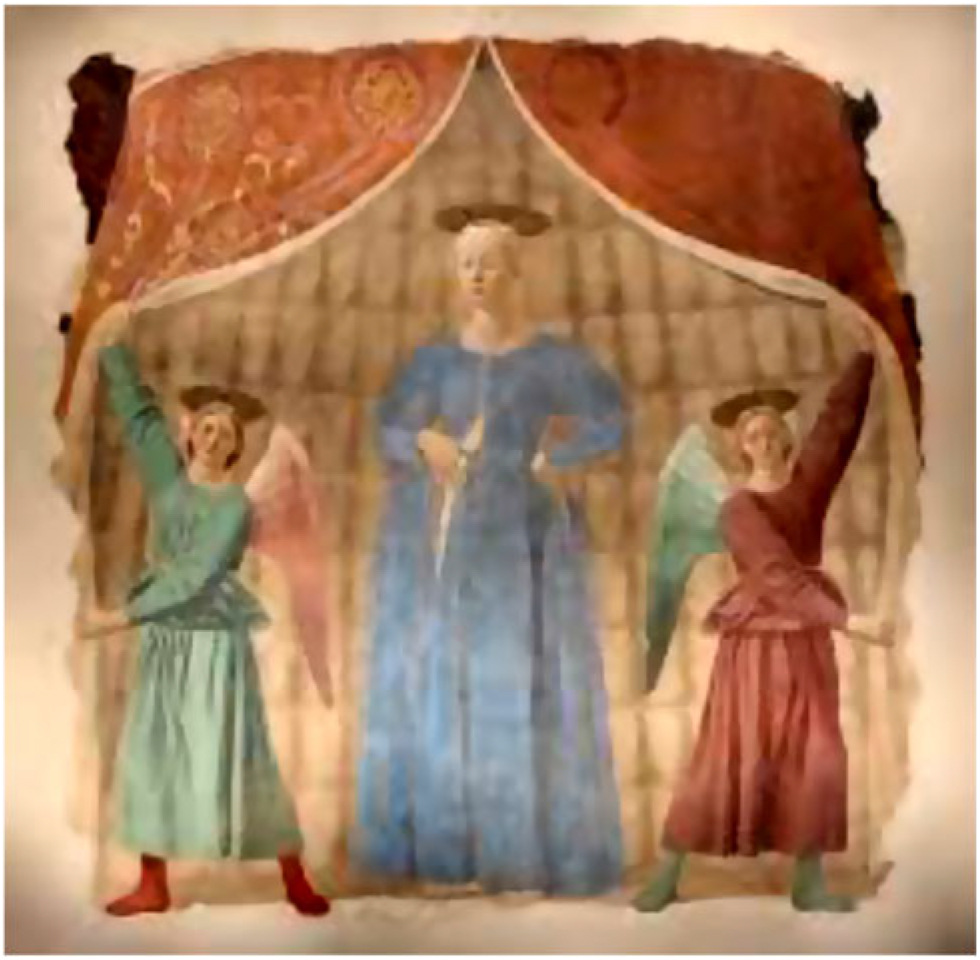
Perhaps the most notable feature of the Madonna del Parto (Figure 1) is its domestic feeling. First, the model is a young girl, as probably often seen in the streets of Monterchi in C16. Not only is she different in spirit from the more severe Madonna della Misericordia, now in the Museo Comunale di Sansepolcro, but also her dress has no attempt at richness. Not for her a sumptuous mantle painted in expensive ultramarine, but one of a practical material probably depicted in far cheaper azurite. It is true that she appears introspective, but a pregnant lady with her right hand on her abdomen is probably concentrating on the foetus’s movements. And her left arm akimbo is not in such a posture in defiance but merely to support her back, stressed by the weight she carries. Admittedly, the opening on the dress front, showing a practical white undergarment, is required for pictorial reasons, to accentuate the curvature of the abdomen, but it might signify that childbirth is imminent, although it might be a throwback to customs from a time past, as I shall later consider.
Piero della Francesca, Madonna del Parto, Museo della Madonna del Parto, Monterchi. (Wikimedia Commons.)

The two angels keep open the front of a tent, which I shall now discuss.
The Tent
Piero had used this subject before in his fresco at Arezzo in San Francesco on the Story of the True Cross. One of the scenes of this cycle is The Dream of Constantine where the Roman Emperor sees a tent in his dream, which is of the same shape as the Monterchi one. BattistiReference Battisti10 has pointed out that this motif goes back to Andrea del Castagno (1423–1457), a fresco on the wall of Villa Pandolfini in Legnaia. Martone suggests the design by Benozzo Gozzoli (1420–1497) at Pisa. He also discusses a maiolica tabernacle by Andrea della Robbia (1455–1520) in the Sansepolcro Cathedral in which two angels open the tent’s curtain, which was probably inspired by Piero’s fresco.Reference Martone11
What is important is the significance of the tent. Martone remarks that the New Tabernacle is always open, in accordance with Saint Paul (Hebrews 9:11), whereas the old one was always closed. There is thus a consensus that the tent symbolizes the all-inclusive Church, the Chiesa (Ref. Reference Battisti10, p. 529), but there is a great difference between the Arezzo and the Monterchi tents. The Arezzo one is plain both inside and out, whereas the Monterchi tent is embroidered at the top and fur-lined inside. Again, although the embroidery can only be seen well on the top left of the tent, there is a consensus that it represents pomegranates. And now the discord starts, because the pomegranate is a very ubiquitous symbol with diverse meanings in a variety of early cultures. Many in this case believe that it represents fertility, a common assumption in various traditions, because the fruit is totally filled with its seeds. But also, as in the ancient Greek world, it is taken as a sign of renewal, signifying – as the well-known story goes – Persephone, the harbinger of spring. But in Botticelli’s Madonna of the Pomegranate at the Uffizi, it has an entirely different meaning. Here the child Jesus holds a half of a pomegranate signifying the Passion, probably because the red juice of the fruit is a reminder of blood. For Battisti (Ref. Reference Battisti10, p. 530) it is for this reason a symbol of redemption. As you can see, the significance of this icon is so variable that it is difficult to know what it really means in this case, and I shall later conjecture yet another possible significance.12
The nature of the lining is even more indeterminate. Battisti (Ref. Reference Battisti10, p. 530) identifies it as ermine, symbol of the virginity of the Madonna, on account of its whiteness, although, even after the last magnificent restoration, it is grey in the fresco. More recently Maetzke (Ref. Reference Maetzke9, p. 30) suggested red squirrel skins which, if coming from the chest are white. She maintains however, as already mentioned, that the tent is a reference to the Tabernacle that the Lord had ordered Moses to build: ‘And thou shalt make curtains of goat’s hair to be a covering upon the tabernacle: eleven curtains shalt thou make’ (Exodus 26:7). So, we have a choice: ermine, red-squirrel’s white hair, goat’s hair. And we shall return later to this point with yet a new interpretation.
Before we briefly record the complex history of Piero’s fresco it will be useful to review some aspects of the Council of Trent, which is believed, probably erroneously, to have been significant as regards the cult of this image.
The Council of Trent
Opened only 28 years after Martin Luther’s 95 Wittenberg theses, it is one of the most studied Church councils, both because of its huge standing in the Counter-Reformation and for its length (1545–1563), 18 years, under five successive Popes. Because of its importance in the history of Piero’s fresco, I shall give a full quotation of the decisions reached in Session 25.Reference Waterworth13
Moreover, that the images of Christ, of the Virgin Mother of God, and of the other saints, are to be had and retained particularly in temples, and that due honour and veneration are to be given them; not that any divinity or virtue is believed to be in them, on account of which they are to be worshipped, or that anything is to be asked of them, or that trust is to be reposed in images, as was of old done by the Gentiles who placed their hopes in idols … Moreover in the invocation of saints, the veneration of relics and the sacred use of images, every superstition shall be removed. (pp.234, 235)
And a little later it is recorded that ‘[i]mages had to be approved by the bishop’ (p. 236) for which purpose annual episcopal visitations were ordained which will be very significant for the fate of La Madonna del Parto.
In understanding the results of the Council of Trent, it must be realized that, especially in matters ecclesiastical, between the aim and the action falls the custom. Even worse, new customs arise because of enthusiasts, and even iconoclasts, that interpret the decrees of the Church often beyond their letter. I shall discuss these assertions because they are significant in understanding the history of Piero’s fresco, and it must be remembered that the decrees and anathemas of the council of Trent have never been rescinded, except, after Vatican II, when they affected relations with the reformed churches.
As we have seen above, intercessionary prayer is forbidden; in the Basilica of San Agostino in Rome, however, there is a Chapel of the Madonna del Parto with a corresponding sculpture14 by Jacopo Sansovino (c. 1516) on the side of which the faithful are invited to use a printed prayer which states: ‘Alla tua protezione affidiamo tutte le mamme che ti supplicano per l’integrità della prole e per un parto felice…’.15 We shall see that this situation is important in understanding the cult of Piero’s Madonna image.
As regards inaccuracies in interpreting the results of the Council of Trent, there is a tradition in Art History, for which there appears to be no textual evidence, that supports the idea that the Council disapproved of excessive naturalism in the representation of images even to the extent that representations of pregnant Madonnas were proscribed, a question that will be of great importance to us. It is a fact that after 1600 this was the case, especially in the European countries most affected by the Reformation, which probably induced people to go beyond the requirements of Trent. On the contrary, in Spain, the bastion of the Counter-Reformation, it is enough to visit the Museum of Polychrome Sculpture at Valladolid, to view C18 examples of extreme naturalism, with extensive use of bodily parts such as nails, teeth, hair, eyelashes and so on. And around 1636 Isabel de Borbón, Philip IV’s first Queen, converted her private chapel into a Chapel of the Expectation, the central piece of which was a Madonna Platytera,16 compared with which nothing could be more naturalistic.Reference Martínez Leiva and Rodríguez Rebollo17 The Madonna Platytera is lost, probably in the Alcázar’s fire of 1734, but must be similar, if not a straight copy, to the one ordered by the Countess of Olivares, principal chambermaid of the Queen, for the Parish of Santiago de Castilleja de la Cuesta, in Seville.Reference de Carlos Varona18 It is not that the Spaniards disregarded the letter of Trento: it is that this letter never existed, of which more later.
History of the Madonna del Parto and its Hiatus, 1583–1697
The fate of the Madonna del Parto was very much linked to the episcopal visitations required by the Council of Trent. Fortunately, the records of these pastoral visits, in the Archivio Vescovile di Sansepolcro, have been transcribed verbatim by Don Bruno Giorgi.Reference Giorni19, Reference Agnoletti20 The visitations of the bishop of Sansepocro Niccolò Tornabuoni of 1563 and 1566 found both altars in order but in the report from 1568 the image of the Madonna and Child in the lateral altar is mentioned as attracting much devotion owing to its miraculous powers. The very success of this image in attracting large offerings – Giorni (Ref. Reference Giorni4, p. 159) reports 89 silver rings and many other offerings – created some problems: since 1571 the position of ‘Chaplain of the Madonna della Momentana’, that is, of the subsidiary altar, was given to friars of the neighbouring convent of San Antonio, who wanted to use the offerings for their own purposes. This was vetoed by the Monterchi magistrates who in 1580 created the ‘Opera della Madonna di Momentana’ (a sort of trust) administered by four ‘operai’, gentlemen of some standing, who had to make sure that the offerings to this altar were used for the benefit of the whole church (Ref. Reference Giorni4, p. 159).
In April 1583 (Ref. Reference Agnoletti20, p. 62) Bishop Tornabuoni called a Synod of the diocese, but most of the sessions were concerned with domestic and financial matters. It was reported, for instance, that poor clerics preferred to beg rather than steal. The only questions of doctrine were the extirpation of some forms of heretic behaviour, of which more later, and the prohibition to the friars of St Agostino to appeal to the Holy Girdle to attract rain.14 Nothing so far about the Madonna del Parto, which was a financial liability because the main altar required the wages of a chaplain and it appears possible that the offerings to this Madonna were not sufficient to cover the expenses. What is significant is that Bishop Tornabuoni, renowned because of his strict application of the Trento dictates, said nothing at the Synod about any impropriety of the Madonna del Parto.
In July 1583 (Ref. Reference Giorni19, pp. 206–207), Tornabuoni sent a deputy for the apostolic visitation of Monterchi, the bishop of Sarsina, Angelo Peruzzi, who found the main altar despoiled and disused, because the other one attracted much larger numbers of the faithful:21
In it there is a main altar, indecently adorned, since it lacks a Cross, candelabra, towels, a cloak, stool, but, as it was said, no celebration ever takes place at it because there is another altar entitled ‘to the Glorious Virgin’ towards which there is great popular devotion because the Highest God has brought about many miracles before the image of the Glorious Virgin which is located above the aforesaid altar.
In 1605, Bishop Alessandro Borghi22 (Ref. Reference Giorni19, p. 208) notes that the main altar is non-consecrated, lacking the Sacred Stone23 and refers to the image of the Glorious Pregnant Virgin as ‘pulcherrima’.
In 1623, Bishop Filippo Salviati (Ref. Reference Giorni19, p. 209) finds the image on the wall of the Pregnant Virgin painted by the ‘very illustrious Painter Piero de Franciscis’.
In 1635, Bishop Zanobi Medici (Ref. Reference Giorni19, p. 210) states that the altar without the sacred stone has an icon on the wall of the Pregnant Virgin painted by Pietro de Franciscis ‘excellent painter’.
In 1639, Bishop Dionisio Busotti (Ref. Reference Giorni19, p. 211) refers to the altar in which Mass is not celebrated which has in the wall an image of the very Glorious Pregnant Virgin from the hand of Pietro de Franciscis, ‘celebrated painter’. And in the visitation of 1697 the image is still mentioned and therefore visible and, finally, it is reported that the main altar ‘where there is the image of the most saintly Madonna painted on the wall has been found well and in order’.37 At this stage not much it is said about the subsidiary altar and it is possible that the Madonna and Child had ceased to be considered efficacious. Sometime between 1697 and 1726 the fresco was whitewashed since in this latter date the Madonna is no longer referred to but an image of Santa Lucia on its side.
In 1785, the representatives of the Monterchi Community obtained the Bishop’s permission to demolish about two thirds of the church, in order to build a cemetery. The wooden image of Madonna and Child disappeared at this stage, but the Madonna del Parto was saved, in a chapel that was adjoined to the cemetery and which was what remained of the original church. In 1888, Piero’s fresco was ‘discovered’ by an engineer from Arezzo, Vincenzo Funghini, which merely means that he recognized its forgotten importance. In 1911, the fresco was detached from the wall and in 1956 was re-established in the refitted cemetery chapel.Reference Centauro and Maetzke25 Towards the end of the 1980s the fresco was taken away for restoration to the building of a disused school in Monterchi which is now the ‘Museo de la Madonna del Parto’ (probably the only museum in the world devoted to a single picture), not without the opposition of the local people who wanted to have access to the image in a place of worship. The restoration is so magnificent that opposition to its new position is weakening.Reference Centauro and Maetzke25
We have now all the facts and we must address the reasons given for the fall into disuse of the altar containing the Madonna del Parto recorded by Bishop Peruzzi in 1583. It is worthwhile recalling that the reason adduced by the bishop is clear: the fresco, in the main altar, was within a few metres of another altar containing an image, Madonna and Child, that so attracted the faithful that probably hardly any donations were given to the main altar. Despite this, Eugenio Battisti (Ref. Reference Battisti10, p. 529) asserted that Piero’s Madonna after Trento, had become ‘unorthodox’. This hypothesis, which is the one most favoured in the literature, given the high and well-deserved standing of the late Professor Battisti, appears to be a result of the belief that the Council of Trento proscribed excessive naturalism in the depiction of images. Centauro (Ref. Reference Centauro and Maetzke25, p. 42), in fact, asserts that the fresco was no longer visible after the visitations of Bishop Tornabuini to satisfy ‘prescriptions’ of the council of Trent. Bruno Giorni26 (Ref. Reference Giorni4, p.161) however, himself a priest, could not find anything in the acts of the Council of Trent that justifies this assertion. Moreover, if an image of a pregnant Madonna had become unorthodox it is most unlikely that praise of this image, and of its painter, would have been recorded in the four visitations that followed the 1583 one. On the other hand, as Battisti claims, some carvings were sawn up, probably by enthusiasts objecting to Madonnas Platyteras.
Of course, Bishop Tornabuoni was known to be punctilious about Trent, and he could have gone beyond the letter of the Council and issued instructions to proscribe the pregnant Madonna. But Giorni records that he could not find such an episcopal decree and it is unlikely that for such an important matter of doctrine the bishop could have used merely oral instructions.
The Cult of the Virgin
It is necessary to say a few words here because some strange darkness creeps up in the literature when discussing this point. LightbownReference Lightbown27 quotes St Bernard de Clairvaux in praise of the Virgin: ‘her starry glory shines also in three things, that she was fertile without sin, pregnant without heaviness and bore a child without pain’. Of these three virtues it is certainly the third one that would most attract pregnant women praying to the Virgin, their fertility being manifest. Martone,Reference Martone and Maetzke28 however, refutes this ‘because these difficulties were not present or ceased to exist in a precise historic moment’. An extraordinary assertion when referring to a period when 10% of women died in childbirth.
As we have seen, after 1785 the rival image of Madonna and Child disappears which eventually resulted in Piero’s Madonna acquiring a very considerable following. P. Bianconi,Reference Bianconi29 writing as an eye witness, stated that
[p]regnant women worship at the picture to this day so much so that in 1954 the Mayor of Monterchi refused to lend it to an exhibition in Florence in case during its absence something might happen to a woman in labor and the consequent reaction to this.
Such was the power of the image; unusually strong even for a religious relic.
When after the fresco was restored in 1993 and it was decided to keep it in the building of the old school converted into a museum, there was considerable unrest in Monterchi because it would no longer be available for the cult. As a compromise, pregnant women were given free access to the museum. The power of the cult is so strong that a local writer reports having seen pregnant ladies approaching the image in the museum with their hair covered and with a rosary in hand.Reference Tofanelli30
Conjectures: Syncretism
Monterchi has strong roots going back to the Romans, as its name reveals: Mons Herculis,Reference Giorni31 which was originally an island in Lake Celle. As for Santa Maria a Momentana (the name of a stream), it was built on a hill called Montione, a corruption of Mons Iunonis, or Mount of Juno. And its alternative name Santa Maria in Silva indicates the presence of a grove that was probably a sacred Roman site. The connection to Juno’s hill cannot have been totally accidental because it is not uncommon for Marian churches to be built on sites of ruined temples of Juno. The first and most important example is the Basilica of Santa Maria Maggiore built in the early fifth century on the Esquilino, where there were the remains of a Temple of Juno. To this day, the remains of pagan cults are visible around Monterchi, as recently testified by a local writer describing a walk in its countryside.Reference Tofanelli30 Also, certain habits transmitted from mother to daughter are relicts of ancient rites: I have found several ladies at Monterchi who remember their mothers saying that in their time pregnant women bathed in the Momentana, hoping thus to favour their deliveries, a clear pagan habit.Reference Dini32
Old pagan rites were of course heresies at Piero’s times, or near them. In the Synod of 1583 this is one of the few points of doctrine considered: it is forbidden to immerse sick children in the Rivo di Melello, the destruction is ordered of a temple to a ‘mendacious deity’ in Melello Castle and the abolition of the immersion of tender children in its font (Ref. Reference Agnoletti20, p. 63).
We must return to the relation of the Virgin to Juno which, amongst other facts, has a theological root going back to Virgil, Eclogue 4: ‘Now returns the Maid … And o holy goddess of Childbirth Lucina be gracious of that boy birth in whom the Iron Race will begin to cease and the Golden to arise all over the world…’. This is interpreted, of course, as a pre-Christian prophecy. Moreover, Hera, Juno’s Greek antecedent, renewed her virginity every year by bathing in the sacred spring of Canathus.Reference Warner33
We here meet Lucina who has a huge relevance to the pregnant Madonnas. Of course, Lucina is an epithet for Juno, her alter ego. Whereas Juno ensures fertility, Lucina ensures easy and safe childbirth, the most important gift for pregnant women until modern times. The etymology of her name is ambiguous: light is one of its attributes34 but, despite ‘lucus a non lucendo,’ lucus is also considered a possible root, sacred groves being so important in Roman mythology. She has an antecedent in the Greek Goddess Eileithyia, who in turn goes back to Nekhbet, the Egyptian childbirth Goddess, who was in ancient Egypt the patroness of a city by the name of Nekheb; when the Greeks took over Egypt in Ptolemaic times, they renamed the city Eileithyia after their birth Goddess; and when the Romans annexed Egypt, they called it Lucina.Reference Wilkinson35 Lucina is sometimes also associated with Diana, the bringer of light, and thus with the moon.
Like other Roman deities, the memory of Lucina was not lost in Piero’s times. Lorenzo Lotto painted, around 1518, a portrait of a distinguished lady from Bergamo (now in the Accademia Carrara of that town) who was called Lucina Brembati. And he included a rebus in the night sky: a moon (luna) with the letters CI inside. The important thing is that the sitter is clearly pregnant and in great need of reassurance: she carries the skin of a weasel complete with head, on which she has her left hand, the right one on its stomach. A dead weasel was universally considered a good omen for an easy delivery.Reference Mussacchio and de Carlos Varona36 It is often said that this role of the weasel is due to the fact that it is a dangerous little animal: dead means that the danger has gone. I believe that there might be another reason, of which later. The association of Lucina with the moon makes the rebus a little more than just a clever way of giving the sitter’s name: considering the obvious worries of Lucina Brembati about her impending delivery (she was not so young), it might have also been an invocation to her namesake goddess.
How far can we expect Piero to be aware of these mythical deities? He was not a humanist, his knowledge of Latin being limited, but that he had some knowledge of Greek and Roman mythology is probable: sometime after the della Francesca house was bought in Sansepolcro in 1465, he painted a fresco of Hercules37 in an upper room, his only non-religious painting except for the diptych of the Montefeltros at the Uffizi. There is also an idea that some other mythological pictures were also produced, which later owners of the house destroyed. Although it has been contested, it is not impossible that the reason why he painted this picture is his mother’s connection with Monterchi, Mons Herculis. At that time, Ovid’s story of the birth of Hercules in the Metamorphoses was known, in which Juno/Lucina plays a prominent part.38
We can now say a few words about the iconology of Piero’s Madonna, with the already stated caveat that unambiguous iconology is rare except in very well-established subjects such as the Annunciation. So, what follows, although plausible, has to be considered as no more than conjectural. First, the pomegranate: it is a well-known symbol of Juno/Lucina. Also, Juno is often represented with a shield and a goat-skin cloak (as favoured by Roman soldiers), the latter already identified in the tent’s lining. Finally, I had already remarked that the Madonna’s dress is unlaced: ladies worshipping Juno in Roman times had to unlace their dresses to enter Juno’s temple.Reference Moyaers and Renard39 Finally, it must be remembered that the pregnant women asking for the Madonna’s intersession were more than anything else concerned with a healthy and easy delivery: Lucina was the agent for this purpose.
When discussing religious syncretism it must be remembered that the actual symbols and rites transferred are not necessarily preserved by tradition in anything like their original form; but collective memories are robust and, when preserved, often only orally, from one generation to the next, what remains is mostly no more than what for the mainstream are modes of superstitious behaviour. Whether such problems do affect a complex painting such as the Madonna del Parto, we probably shall never know, but the possibility of some form of subconscious iconology, both for the painter and for his audience, cannot be totally discounted. On the other hand, the strength of the significance of this fresco for the women of Monterchi is difficult to explain just by reference to the usual cult of the Virgin.
Acknowledgements
I am most grateful to Gloria Martínez Leiva for useful correspondence. Also, to the family of the late Don Bruno Giorni of Sansepolcro, for generously providing me with some of his books. Professor Sir Fergus Millar generously helped me with the translation of Note 21 from the Latin. I am most grateful to Professor James Adams for his generous help in establishing the full meaning of the crucial word pulcherrima. Finally, as always, I am grateful to Dr Paul Altmann for his patient help with my computer problems. I also should like to record my thanks to the librarians of the Biblioteca Comunale di Sansepolcro for their kind help. No public funds have been used in this work.
About the Author
Simon Altmann is a long-retired mathematical physicist who has worked and published for many years on philosophy, the history of art, and poetry. He has published articles on Las Meninas and The Annunciation of the Virgin Mary and his book Einstein’s Quantum Error: An Approach to Rationality has just been published.