During the 1950s and ’60s, many composers began exploring the possibilities provided by commercially available magnetic tape recording and electronically produced sound. Multiple studios were established around the world, although only a few of these—the studios in Paris, Cologne, New York, San Francisco and Milan—are included in the main narratives of early electroacoustic music.Footnote 1 This bias towards European and U.S. developments perpetuates the marginalization of long-standing sites of artistic creation and reproduction of the Western classical music tradition. In Latin America, the most successful early electroacoustic studio was hosted at the Centro Latinoamericano de Altos Estudios Musicales (henceforth CLAEM), part of the Torcuato Di Tella Institute in Buenos Aires, Argentina. During the 1960s, the Di Tella Institute accommodated three art centers that pushed the boundaries of visual arts, theater, dance, and music, promoted the creation of multimedia works, and encouraged innovative audiovisual experimentation.Footnote 2 CLAEM was the center dedicated to music. Directed by composer Alberto Ginastera (Argentina, 1916–1983), it was funded largely by the Rockefeller Foundation. CLAEM had an impressive roster of composers-in-residence, such as Olivier Messiaen, Aaron Copland, Iannis Xenakis, Luigi Dallapiccola, Mario Davidovsky, Eric Salzman, Bruno Maderna, Riccardo Malipiero, Luis de Pablo, Vladimir Ussachevsky, and Luigi Nono. The music composed at CLAEM reflected a broad spectrum of approaches, including serialism, sound-mass compositions, aleatoric and indeterminate operations, mobile forms, live improvisation, graphic notations, and notably, electronic and musique concrète techniques in the works produced at a well-equipped electroacoustic studio called the Laboratorio de música electrónica (Electronic Music Laboratory). During the decade of its operation (1962–1971), CLAEM became the training ground for more than fifty composers representing Argentina, Bolivia, Brazil, Colombia, Costa Rica, Chile, Ecuador, Guatemala, Mexico, Peru, Puerto Rico, Uruguay, and the United States.
Based on oral histories collected through interviews and informal conversations with former CLAEM composers and administrators, as well as through archival research at the Di Tella Institute Archives and the Rockefeller Archive Center, this article chronicles eight years of the Laboratorio de música electrónica’s existence (1964 – 1971). My study has two main goals: first, to provide an historical account of early Latin American electroacoustic music that grants insight into the aesthetic and technical developments that earned the laboratory at CLAEM a place in the regional and transnational world of contemporary music making; and second, to demonstrate the crucial role of locality in the adoption, articulation, and transformation of ideas about electroacoustic music. A theme that emerged as I focused on these objectives was the collaborative nature of artistic creation.Footnote 3 While this topic was not part of my initial interest, the recurrence of collaboration and interdependence became an important part of the story I tell here.
The spirit of collaboration was fostered in part by CLAEM's large institutional setting, an exception to the smaller private facilities where electroacoustic music often flourished in Latin America.Footnote 4 CLAEM's studio was modeled after the Columbia-Princeton Electronic Music Center, and, as Gordon Mumma notes, was the only studio in the region that managed to produce a significant and diverse number of works while it “imitated European and North American facilities.”Footnote 5 More than any other single institutional site, CLAEM and its studio fostered an important generation of Latin American composers with significant impact around the world. Many of the fifty-four composers from the Americas who attended CLAEM became leading figures of Latin American contemporary music.Footnote 6 Several CLAEM students left Latin America for important posts in Europe and North America, including alcides lanza (Argentina, b. 1929),Footnote 7 who worked at the Columbia-Princeton Studios before becoming director of the Digital Composition Studios at McGill University in Montreal; Mesías Maiguashca (Ecuador, b. 1938), who worked with Stockhausen in Germany and was part of the group “Feedback”; and Gabriel Brnčić (Chile, b. 1942) who played an important role in Barcelona's Fundación Phonos. Others remained in Latin America and contributed to the development of electroacoustic music in their respective countries, such as Jorge Antunes (Brazil, b. 1942), Jacqueline Nova (Colombia, 1935–1975) and Joaquín Orellana (Guatemala, b. 1930).Footnote 8 The Argentine Eduardo Kusnir (b. 1942), was also a major force for the establishment of studios in Puerto Rico and Venezuela. And the local Argentine electroacoustic music scene was enriched by the contributions of CLAEM teachers Francisco Kröpfl (Romania, b. 1931),Footnote 9 Fernando von Reichenbach (Argentina, 1931–2005), and the work of many of their students, including Ariel Martínez (Uruguay, b. 1940), José Maranzano (Argentina, b. 1940), and Luis María Serra (Argentina, b. 1942).Footnote 10
An important context for this narrative is the changing political conditions of Argentina during the 1960s. The creation of the private Di Tella Institute using the resources of the Di Tella family resonated with the modernizing and internationalizing impetus of Argentine elites in the early part of the decade, during the presidencies of Arturo Frondizi and Arturo Illia.Footnote 11 Their politics were framed by “developmentalism” (also known as modernization theory), which advocated a linear model whereby “underdeveloped” countries needed to advance through certain stages on a path of industrialization.Footnote 12 This process came to a halt in 1966 with the de facto presidency of Juan Carlos Onganía. Onganía's dictatorship may have been less physically violent than those of the mid-1970s, but it was much more actively engaged in efforts to “elevate” the moral standards of the population. Governmental censorship primarily targeted theater and the visual arts, but composers also worked in fear of repression. In fact, officials frequently closed the building on Florida Street that housed CLAEM after a controversial theater presentation, visual art exhibit, concert, or other happening.
The impact of Onganía's dictatorship and those that followed on CLAEM and its Laboratorio, however, could be understood in dramatically different ways. On one hand, despite the political turmoil, the Laboratorio reached peak activity during the second half of the 1960s. With few exceptions, the military paid little attention to the music written at CLAEM, focusing instead on more directly confrontational works by visual artists and writers. Some composers, especially those visiting from other countries, did not feel it was their place to actively engage in political dissent. On the other hand, CLAEM musicians were at times victims of military repression. The censorship of Ginastera's Bomarzo and Gabriel Brnčić’s ¡Volveremos a las montañas!. . . and, more strikingly, the arrest and torture of Brnčić shocked everyone at the center.Footnote 13 Similarly, the closing of CLAEM in 1971 was driven in part by political pressure. Thus, the dictatorship's influence on CLAEM was mixed: enabling in some ways and constraining in others. While it is beyond the scope of this article to pursue this relationship in depth, the reader should bear in mind how the violence and repression of the dictatorship affected CLAEM in palpable ways, but also how the music center managed to remain at the margins of political activity, particularly when compared to the experiences of artists working in other media. My hope is that the findings of this study will be pursued further by more dedicated work on electroacoustic music in Buenos Aires, including its reception, its politics, and its engagement with North American and European counterparts.
CLAEM and its Laboratorio de Música Electrónica
Prior to CLAEM, early producers of Latin American electroacoustic music faced multiple challenges. European and North American studios enjoyed institutional affiliations with radio stations and universities, respectively. These connections allowed access to relatively advanced equipment, which was not readily available in Latin America. Thus, the majority of attempts to create large studios were short-lived, and composers interested in exploring sound manipulation and electronic synthesis depended on their own makeshift workstations with meager equipment, such as consumer-grade Silvertone tape decks, inexpensive microphones, and homemade wave generators, filters, and modulators. More often than not, composers worked alone, or in a few cases with one or two colleagues who shared their curiosity.Footnote 14
By 1964, the year CLAEM's Laboratorio was established, the list of Argentine composers who had engaged in one way or another with electroacoustic music was fairly small, beginning with Mauricio Kagel (1931–2008), and followed by Francisco Kröpfl, Cesar Franchisena (1923–1992), Horacio Vaggione (b. 1943), and Miguel Angel Rondano (b. 1934).Footnote 15 The only large studio had been the Estudio de Fonología Musical, which Francisco Kröpfl had founded in 1958 with technical support from Fausto Maranca. As part of the Laboratorio de Acústica de la Facultad de Arquitectura at the Universidad de Buenos Aires, this space was a direct predecessor of CLAEM's Laboratorio. Footnote 16 Several noteworthy composers eventually worked there, including the Argentine Eduardo Bértola (1939–1996), Dante Grela (b. 1941), José Maranzano, and Nelly Moretto (1925–1970), and the Colombian Jacqueline Nova. The studio closed in 1973, as Kröpfl—who in the meantime had become director of the studio at CLAEM—dedicated his full attention to the newly created Centro de Investigación en Comunicación Masiva, Arte y Tecnología de la Ciudad de Buenos Aires (CICMAT). Despite the commendable efforts of the Estudio de Fonología, its activities were soon overshadowed by the scope, budget, productivity, and success of the Laboratorio de música electrónica at CLAEM.
The electroacoustic studio resonated with the pedagogical ambitions of CLAEM to arm Latin American composers with the latest knowledge in the field as well as with the modernizing impetus of the Di Tella Institute as a whole. Eventually, the Laboratorio became the main attraction for composers seeking to work at the center, and electroacoustic music became a symbol of modernity that could stand in for experimentalism itself.Footnote 17 Thus, the studio's balance of technology and artistic creativity supported the mission of the Di Tella Institute to make Buenos Aires an international center for the avant-garde.
At the time of CLAEM's initial approval, two people shaped the focus of its activities: the center's director, Alberto Ginastera, and the executive director of the institute, Enrique Oteiza. Ginastera was not interested personally in electronic music composition, but he understood that composers around the world increasingly were. Since his goal with CLAEM was to offer students the most up-to-date resources in composition, he decided that a studio should be part of it. He found an ally in Oteiza, an engineer by training, who was passionate about creating an electronic studio. Oteiza's curiosity for both contemporary music and cutting-edge technology drove him to support the project. Oteiza recalls how he pushed Ginastera to establish the studio:
When I was finishing my degree [at Columbia University], they were establishing the Electronic Studio. This was very interesting to me, as an engineer on one hand, and a twentieth-century art and music aficionado on the other. . . . Ginastera, he didn't like it at all. He would tell me, “Look Oteiza, in an orchestra, a musician might make a mistake in a note, but when you have machines, a mistake means everything goes to hell!” He looked for all sorts of excuses. And then, the only person in Buenos Aires that could handle this was [Francisco] Kröpfl, who was part of [Juan Carlos] Paz's group. And that was an obstacle.Footnote 18
According to Oteiza, Ginastera was not eager to have Kröpfl join the team, perhaps because of his closeness with composer Juan Carlos Paz, an unwavering proponent of the avant-garde and a harsh critic of Ginastera.Footnote 19 Perhaps Ginastera's misgivings were justified given that Paz would eventually direct some of his criticism at CLEAM.Footnote 20 Kröpfl, however, downplays these tensions, and claims instead that he and Mario Davidovsky (Argentina, b. 1934) were simultaneously contacted by Ginastera at the beginning of the project to put together estimates for the studio equipment costs.Footnote 21
Ginastera decided to follow Davidovsky's suggestions, and the equipment began to arrive in 1963.Footnote 22 It was all based on the Columbia-Princeton gear, which was already at least three years old, a significant period of time in an era where technical innovation in audio equipment was moving at a fast pace. An additional challenge surfaced delaying the establishment of a functioning studio: the recording equipment coming from the United States used electricity at 110-volt and 60hz, and everything in Argentina used 220-volt at 50hz. In other words, the equipment was unusable until properly adapted, and that became the main technical obstacle during the studio's first two years. Despite these problems, Ginastera reported to the Rockefeller Foundation in February 1964 that “with the donation of tape-recorders and other technical equipment, the electronic laboratory was founded [in 1963], allowing Armando Krieger (Argentina, b. 1940) to compose the first electronical [sic] work in Argentina: Contrastes for two pianos and tape.”Footnote 23
Evidently, Ginastera was attempting to impress the Rockefeller Foundation with his report—after all, it had been the Foundation that had provided all of the funding for the equipment—but Armando Krieger's composition Contrastes (the original title of the work) was by no means the first piece of its kind in Argentina. Hugh Davies's valuable Répertoire International des Musiques Electroacoustiques shows that works by Mauricio Kagel, Kröpfl, Horacio Vaggione and Cesar Franchisena predated Contrastes by several years.Footnote 24 In any case, the program notes for the premier of Contrastes indicate that Krieger had made the tape part with the help of alcides lanza using lanza's personal equipment.Footnote 25 Although both lanza and Krieger were CLAEM fellows at the time, Ginastera appears to have been stretching the facts by claiming Contrastes was composed in the Laboratorio. In fact, because the studio was not yet functional, the first concerts at CLAEM had to be taped on lanza's own Grundig recorder and with his microphones.Footnote 26 Most oral accounts point instead at Intensidad y altura (1964) by Peruvian composer Cesar Bolaños as the first electroacoustic work actually composed at CLAEM.Footnote 27
The First Electronic Work at CLAEM: Differentiating Concert and Incidental Music
Cesar Bolaños studied composition with Andrés Sas in Peru, and attended the Manhattan School of Music in New York in 1959. Between 1960 and 1963, Bolaños studied electronics at the R.C.A. (Radio Corporation of America) Institute. His previous experience helped him navigate the CLAEM studio, which at the time of his arrival still consisted mainly of disjointed audio equipment not yet adapted to the Argentine voltage. His productive two-year fellowship led to an offer to teach at the laboratory in 1965 and 1966.Footnote 28 In the following years, Bolaños collaborated with the institute's Centro de Experimentación Audiovisual, writing electronic music for the choreographies of Jorgelina Martínez D'Or and making musical collages for different events.Footnote 29 With the support of CLAEM and scholarships from the Organization of American States, Bolaños was able to stay at the center longer than any other student. His extended residency led to a highpoint in his career and a key achievement: Intensidad y altura.
Of all the electroacoustic compositions produced at CLAEM during this initial period, Intensidad y altura remains one of the most successful. Based on a poem of the same name by Peruvian writer César Vallejo, read by actor Roberto Villanueva, Bolaños made proficient use of the limited functioning equipment of the laboratory.Footnote 30 Bolaños mixed musique concrète techniques with electronically generated and processed sounds, something the majority of CLAEM pieces would do in the years to follow.Footnote 31 The first half of the piece uses the starting four lines of the poem phonetically and in mirror image, so that, for example, the last line “no hay pirámide escrita sin cogollo” (“there is no written pyramid without a core”) is recorded first as “oiogok nis atirkse edimarip ia on.” Bolaños then played the tape backwards, rendering the words intelligible but with a noticeable difference as the attack and breathing patterns were inverted.Footnote 32 For the second part of the piece, the text was recorded normally, but only fragments of it appear. The result is an intriguing, well-crafted, and touching exploration of the manipulated human voice that was well received by peers and continues to be played at festivals today.
Another reason Intensidad y altura received significant attention is that it was the first solo tape work completed at the Laboratorio. The community of composers in Argentina seemed to value autonomous works meant for concert situations more than those intended for other purposes. A report listing all compositions made at the Laboratorio through 1967 reveals the categories that composers were using to group their work. Next to the titles of the pieces, the authors of the letter—most likely Fernando von Reichenbach and/or Francisco Kröpfl—added a column titled “Destino,” which can be translated as purpose or function. The options listed were (1) for concert, (2) for a company's showroom, (3) for theater, (4) for ballet, or (5) for film.Footnote 33 With few exceptions, the pieces in the first category have been the ones regularly programmed in concerts across Latin America and have received the most attention in oral and written accounts about center in the last 50 years.
In addition to valuing autonomous works and incidental music differently, composers also made distinctions within concert works themselves. Although CLAEM composers acknowledged pieces using live electronics or mixed tape and instruments as autonomous compositions, they gave special consideration to works for solo tape.Footnote 34 Ginastera and other CLAEM composers showcased works like Bolaños's Intensidad y altura much more often than those using live electronics or mixed media.Footnote 35 One reason may have been that the fixed nature of such pieces rendered them more easily programmed in concerts than those requiring human performers. This boost in dissemination added value to self-contained works, creating a soft hierarchy. However, the relatively small number of works produced during this initial stage of the Laboratorio speaks to significant challenges yet to have been resolved.
Bozzarello at the Laboratorio de música electrónica
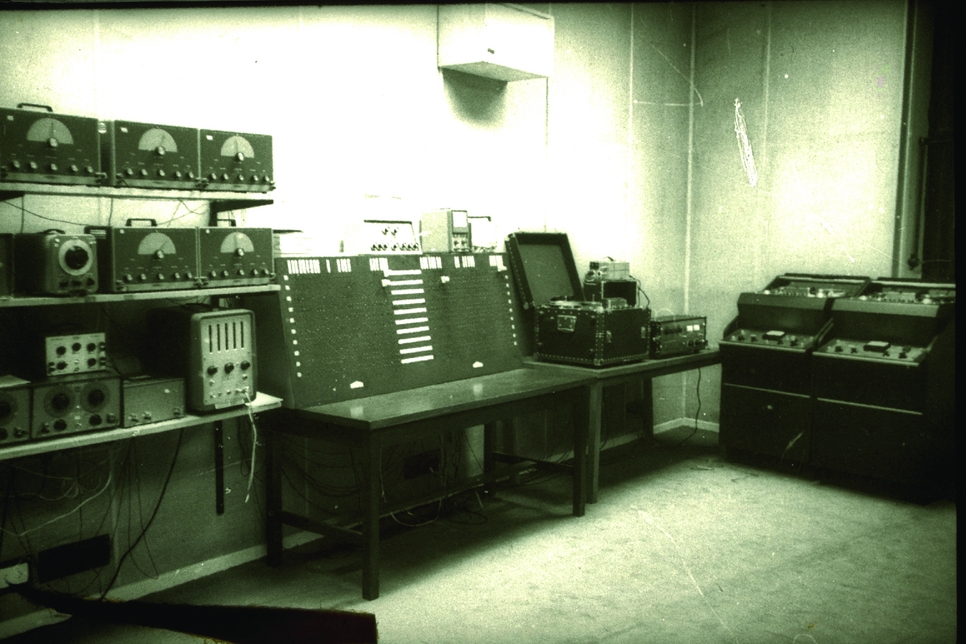
Bolaños and a few other composers overcame the challenges of the incipient laboratory mainly because they had previous experience with similar setups.Footnote 36 Most of the equipment, as in all other early electronic music studios, was not intended for music making and needed to be linked creatively to be useful for composition. On April 21, 1964, Oteiza and Ginastera hired engineer Horacio Raúl Bozzarello to design a functioning studio from the multiple machines CLAEM had acquired (see Figure 1). Despite his lack of musical knowledge, Bozzarello was effectively put in charge of the Laboratorio.Footnote 37
Laboratorio de música electrónica at CLAEM circa 1964. On the left are oscillators, noise generator, and filters; in the center is the original patch bay; and on the right are Ampex recorders. Courtesy of Mary Mac Donagh.

Bozzarello's setup was less than ideal. The equipment was placed against the walls with its components spaced far apart. This made connecting them cumbersome, and actively manipulating the equipment during recording or mixing required the help of at least one assistant.Footnote 38 These practical difficulties, combined with a general lack of neatness, worried CLAEM's director. “Since the arrival of the Engineer Bozzarello,” Ginastera wrote in a memo, “that space is a display of tangled cables and they make me feel self-conscious in front of the many Argentine and foreign visitors.”Footnote 39 Ginastera's concern reveals the Laboratorio’s importance as a showcase for guests and resident artists. As one of the most conspicuous displays of CLAEM's “modern” side, the studio's sound generators, filters, tape recorders, and machinery represented the center's commitment to contemporary music.
Other problems arose when Bozzarello was asked to teach a course titled “Introduction to Acoustics and Electronics.” The class, which was supposed to encourage students to take advantage of the studio, was widely unappreciated. Former students described it as a “fear-inducing course looking at a mess of issues that seemed impenetrable” and that were “neither interesting nor useful.”Footnote 40 The main problem stemmed from the fact that Bozzarello, an electrical engineer, was not aware of the needs of musicians nor their particular interests in the equipment. Consequently, both his setup for the studio and the classes he offered failed to promote much interest in electronic music composition.
Oteiza pressured Ginastera to find a composer to run the studio, and they tried unsuccessfully to hire Mario Davidovsky away from his position in the United States at the Columbia-Princeton studio.Footnote 41 To appease Oteiza, Ginastera turned to a series of visitors who offered short but intense courses on electronic music. Between 1964 and 1965, the guest teachers included Bruno Maderna, José Vicente Asuar, Mario Davidovsky, and Roger Sessions, who was also associated with Columbia-Princeton.Footnote 42 Also worth mentioning are the lectures given by Aaron Copland in 1963. Copland's thoughts on twentieth-century music aesthetics, which included comments about electroacoustic music, were inspiring to several of CLAEM's first fellows.
This first period of the laboratory came to an end at the beginning of 1966 with Bozzarello's departure. Although it is unclear whether he chose to leave or if he was fired, Bozzarello's courses had little to do with the few works that had been produced since the equipment had arrived, and students had been vocal about their disinterest in his classes. Bozzarello clearly struggled to understand the specific needs of composers in the newly created studio and failed to inspire much productivity. His departure, however, opened the door to a complete makeover of the laboratory led by the ingenious Fernando von Reichenbach.Footnote 43
Invention and Innovation: The Remodeled Laboratorio, 1966–1971
Fernando von Reichenbach joined CLAEM in February 1966. Often called “Ingeniero” by his coworkers, Reichenbach did not try to hide his undergraduate training in engineering. Although he never completed the final exams that would have officially conferred him the title, he proved himself an extremely creative technician, inventor, and tinkerer.Footnote 44 Assisted by a group of technical assistants, which at different times included Julio Manhart, Walter Guth, and Enrique Jorgensen, Reichenbach created a more efficient studio capable of meeting the everyday demands of the Di Tella Institute.Footnote 45
Ginastera outlined a number of goals for the team to make the studio more productive and comfortable. The first priority was remodeling Bozzarello's studio, adding new equipment and modifying existing gear. Ginastera deemed it vital to “equip the Laboratory with new instruments, many of which, according with the experience I have acquired in my visits to other Laboratories, can be made here.”Footnote 46 The second priority was to support the work of the fellowship holders. “The work of the electronic composer,” argued Ginastera in a memo to Oteiza and Reichenbach, “has to be surrounded by the maximum conditions of quietude and calm . . . and be assured of having an efficient Laboratory with immediate reaction. It is just like having a top quality musical instrument.”Footnote 47 Lastly, the team focused on improving their ability to record concerts, conferences, classes, and listening sessions at CLAEM, and to collaborate with the Centro de Experimentación Audiovisual.
Remodeling the studio proved to be a difficult and challenging task. Reichenbach had to come up with unconventional solutions, recycling materials and spare parts from existing equipment to meet the creative needs of the composers. On October 25, 1967, almost a year after they had begun, Reichenbach reported the remodeling completed. Although numerous works had been composed in the laboratory since 1964, a ceremony took place a month later on November 22 to inaugurate the fully functional studio. The improved laboratory became a matter of pride for CLAEM, and many there declared the work a breakthrough in studio design.
In a report to the Rockefeller Foundation, Oteiza proudly described some of Reichenbach's innovations:
During 1967, a period of re-organization and modification of the Laboratory was under way. . . . During this period a highly elaborate unit for centralizing operations was constructed, which has lent the Laboratory great versatility. The present distribution of the instruments in the Laboratory, coupled with the installation of the new unit, entirely constructed by Laboratory personnel, is a marked improvement on earlier arrangements, and it should be noted that the new unit itself is Mr. von Reichenbach's own design.Footnote 48
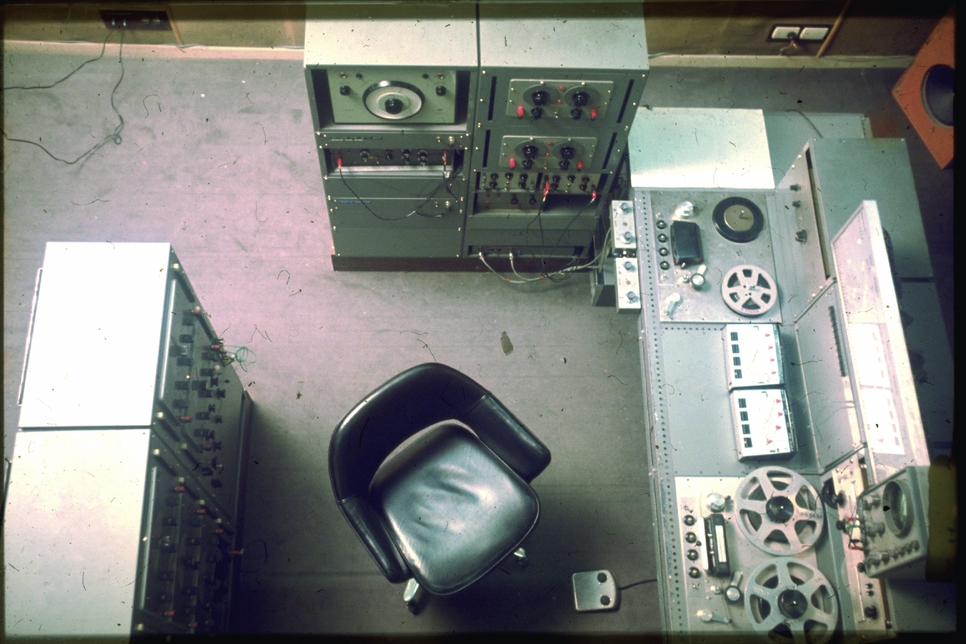
The “distribution of the instruments” Oteiza highlights can be seen in Figure 2. In contrast to the old configuration (see Figure 1), Reichenbach understood the laboratory as a performance space for composers, and as such, he designed it in an ergonomic way. Instead of being pushed against the walls, the equipment was arranged around the composer at a distance reachable from a swiveling chair with casters. This layout freed composers from the need to have an assistant with them at all times. This simple but significant reorganization made an enormous difference in the laboratory's efficiency.
Laboratorio de música electrónica at CLAEM circa 1968. Courtesy of Mary Mac Donagh.

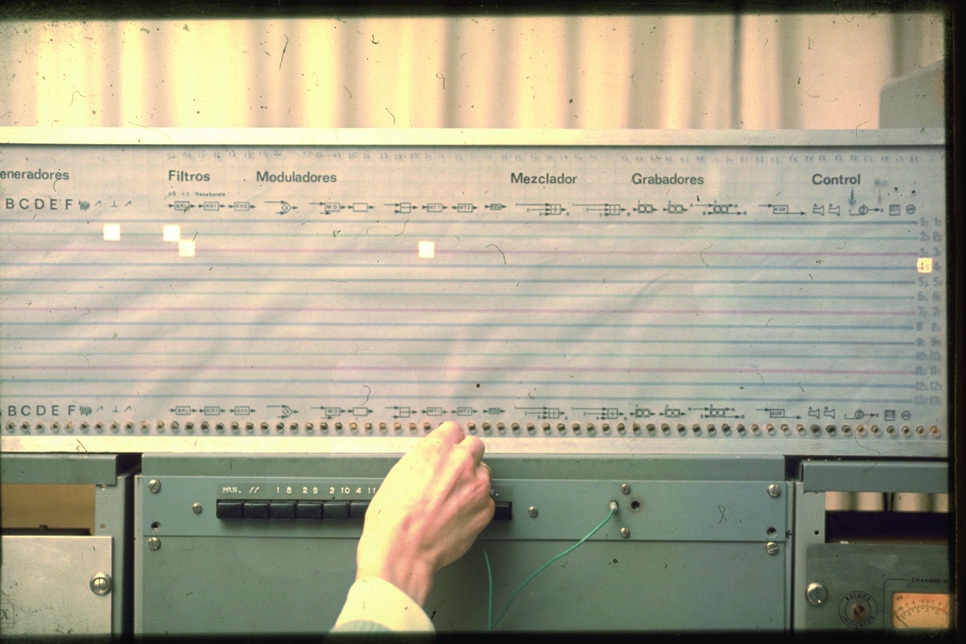
The “highly elaborate unit for centralizing operations” Oteiza mentions is Reichenbach's original panel de interconexión centralizado (centralized patch bay). The patch bay was designed to allow fast interconnections of all the equipment in the laboratory. Reichenbach recycled a telephone connection switchboard and reconfigured it to work with the audio signals from the studio. Each connection, which registered on the luminous panel, was made by touching the input/output buttons seen at the bottom of Figure 3. In this way, a composer could easily and promptly restore any connection made during a working session by using the visual guides of the panel. This setup also avoided the need to use multiple cables to connect the equipment, preventing the cluttering of the studio space that Ginastera particularly disliked.Footnote 49
Centralized patch bay. Courtesy of Mary Mac Donagh.

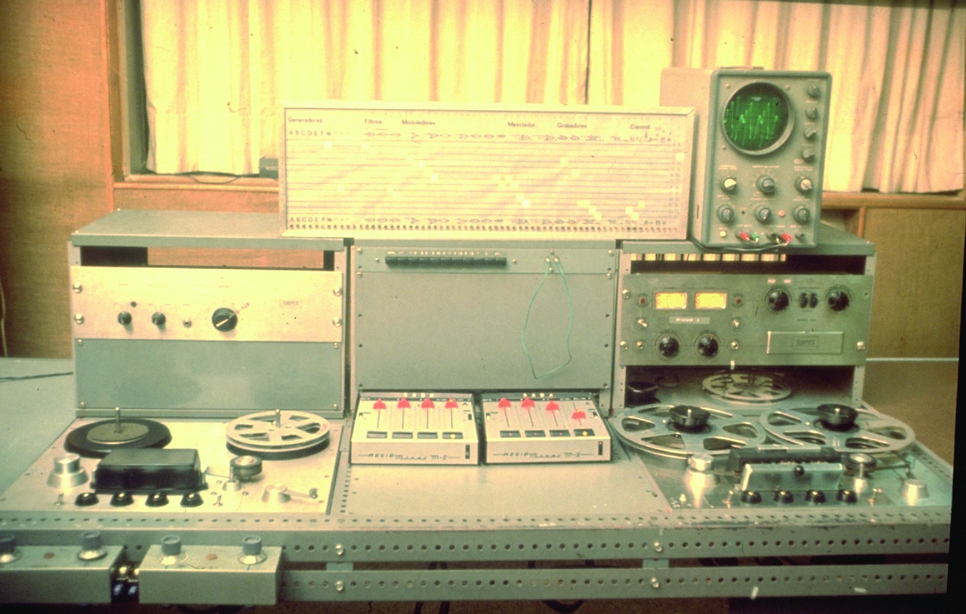
Oteiza describes these two features of the remodeled studio—ergonomics and ease of interconnection—as improvements upon the conditions of the early laboratory. Finally, Oteiza's description of a “new unit, entirely constructed by Laboratory personnel” must refer to the mixer connected to the two recorders and the patch bay in Figure 4. Thus, Reichenbach's inventiveness was fundamental to the success of this second period in the Laboratorio's history.
Front view of one side of Reichenbach's redesigned Laboratorio. Courtesy of Mary Mac Donagh.

In 1971, Aharonián asked Reichenbach about the contradiction between the common lack of resources in Latin America, and the immense possibilities that CLAEM's studio could offer. Reichenbach answered:
We started from the premise that there was nothing and [thought about] what an ideal laboratory would be like. Then we tried to figure out what we had to do to get closer to that ideal. And it is then when being inventive about how to use the available elements in a normal laboratory in a different way comes into play.Footnote 50
The spirit of resourcefulness on display in this quote was key. Reichenbach and his collaborator, Walter Guth, became experts in salvaging electronic materials and using them in unusual ways. Before Reichenbach, there had been ample funding to equip the Laboratorio, but it was only after his arrival that imaginative use of the available devices allowed for creativity to flourish. In my conversations with fellows who were in residency during this period, many noted that the equipment initially bought with Rockefeller funds was never updated, and that the absence of multitrack recorders made it difficult to prevent tape noise. Repurposing a telephone switchboard into a novel and quiet patch bay, constructing from scratch a photosensitive controller to regulate volume, and altering a Bruel & Kjaer filter into a polyphonic filter were just some of Reichenbach's attempts to overcome these challenges.Footnote 51 Reichenbach's masterful problem-solving skills emerged from a perceptive understanding of musicians’ needs, an ingenious use of space, and an inventiveness towards the limited resources available at the time.
Reichenbach–Kröpfl–Brnčić
With a talented engineer running the technical side of the laboratory, Oteiza and Ginastera turned their attention towards finding an artistic coordinator for the project. Oteiza insisted that he wanted to hire “the best person available in Argentina for the job.”Footnote 52 Ginastera's lingering reluctance to hire Francisco Kröpfl must have waned because he joined CLAEM's faculty in 1967.Footnote 53 With the highly-experienced Kröpfl in place as artistic director and Reichenbach in charge of technical matters, the Laboratorio de música electronica entered its most productive years.
The presence of Reichenbach and Kröpfl had a significant impact on course offerings. In 1966, Reichenbach and Cesar Bolaños began teaching a class entitled “Techniques for the Composition of Electronic Music.”Footnote 54 This course encouraged composers, such as Rafael Aponte-Ledée, Gabriel Brnčić, Blas Atehortúa, and Ladislao Todoroff, to work more intensely in the laboratory.Footnote 55 The crucial difference from previous classes, which had focused more on theoretical aspects of acoustics and electronics, was that the instructors demonstrated practical techniques that composers could apply in their work. At the same time, Kröpfl, who began teaching at CLAEM in 1967, covered theoretical and methodological issues of composing in an electronic studio. He guided engaged listening and analysis of important electroacoustic works, and he discussed aspects of assembly and montage that complemented the applied approach of Reichenbach and his assistants.Footnote 56
A final addition to the Laboratorio’s team happened on February 21, 1969, when Kröpfl wrote to Ginastera and asked him to hire Gabriel Brnčić officially as a part-time professor. Brnčić had a fellowship in 1965–66 and then remained at CLAEM during 1967–68 with additional funding from the Organization of American States. He was an avid user of the studio, and had begun helping students in their training.Footnote 57 Stationed inside the studio, he became an important member of the team, helping students overcome technical challenges, brainstorming new possibilities, and providing feedback with his keen musical ear.Footnote 58 Many CLAEM fellows present between 1969–1971 emphasized the importance of Brnčić’s mentorship inside the laboratory. While Kröpfl and Reichenbach provided students with important theoretical insight, Brnčić offered them valuable hands-on training.
With these improvements in place, the laboratory took on a more prominent role at CLAEM with several visiting professors emphasizing electroacoustic music composition during their time at the institute. In 1966, Iannis Xenakis gave a course that explored probability and computer-assisted composition.Footnote 59 In 1967, fellows had the opportunity to take a month-long course with Luigi Nono who had worked at the Studio di Fonologia of the RAI in Milan. The following year, students worked with Vladimir Ussachevsky, head of the Columbia-Princeton center.Footnote 60 In 1969, both Eric Salzman and Larry Austin taught courses related to electroacoustic music.Footnote 61 And in 1971, Pierre Schaeffer, founder of the Groupe de Recherches de Musique Concrète, paid a short visit to CLAEM.
With the Laboratorio de música electrónica running at full speed under Kröpfl's artistic direction, Reichenbach's technical ingenuity, Brnčić’s practical knowledge, the studio finally fulfilled its initial objectives. Taking advantage of the Di Tella Institute's support, Reichenbach's engineering creativity reached new heights in the last years of the 1960s.Footnote 62 His work both in the Laboratorio de música electrónica and in the events organized by the Center for Audiovisual Experimentation became central to the modernizing goals of the Di Tella world. He began to gain recognition among composers interested in electroacoustic music, including several of the prestigious guests at CLAEM. Josefina Schröder, Ginastera's personal secretary and right hand in anything related to administration, recounted how Vladimir Ussachevsky “was really impressed with the abilities of Mr. von Reichenbach, and told me confidentially that he considers him a genius.”Footnote 63 By 1968, the Di Tella Institute began providing Reichenbach with full support for his research agenda. In fact, CLAEM composers credited his work as one of the key ingredients in the studio's growing international recognition.Footnote 64
The Birth of “Catalina”
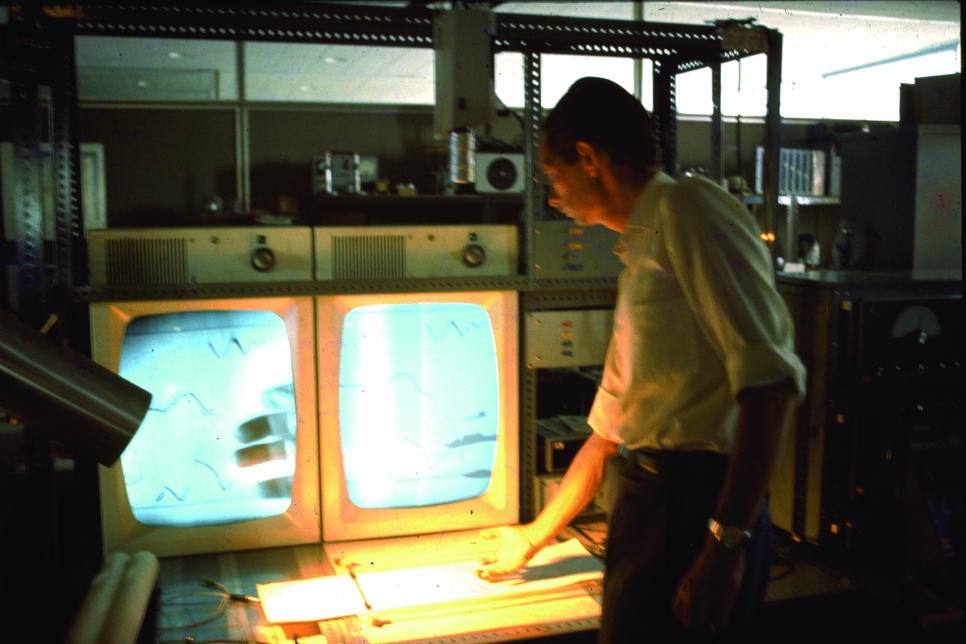
Of the novel technologies Reichenbach created, his analog graphic-to-audio converter probably received the most attention. Reichenbach's idea was to use a video camera to create a machine that could convert graphic notation into sound. He connected closed-circuit television equipment, a paper transport that moved drawn graphics across the lens of the camera, and voltmeters that followed the parameters of the score. This configuration turned the visual signal into blacks and whites, which analogically controlled the fluctuation of voltage. Those voltages then could be used to trigger generators, filters, and modulators. The name he gave this invention was the Convertidor Gráfico Analógico (Analog Graphic Converter), but everybody, Reichenbach included, called it “Catalina” (Figure 5).Footnote 65
Fernando von Reichenbach with his invention, the analog graphic converter “Catalina.” Courtesy of Mary Mac Donagh.

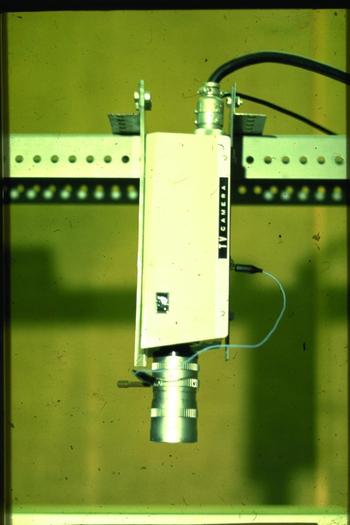
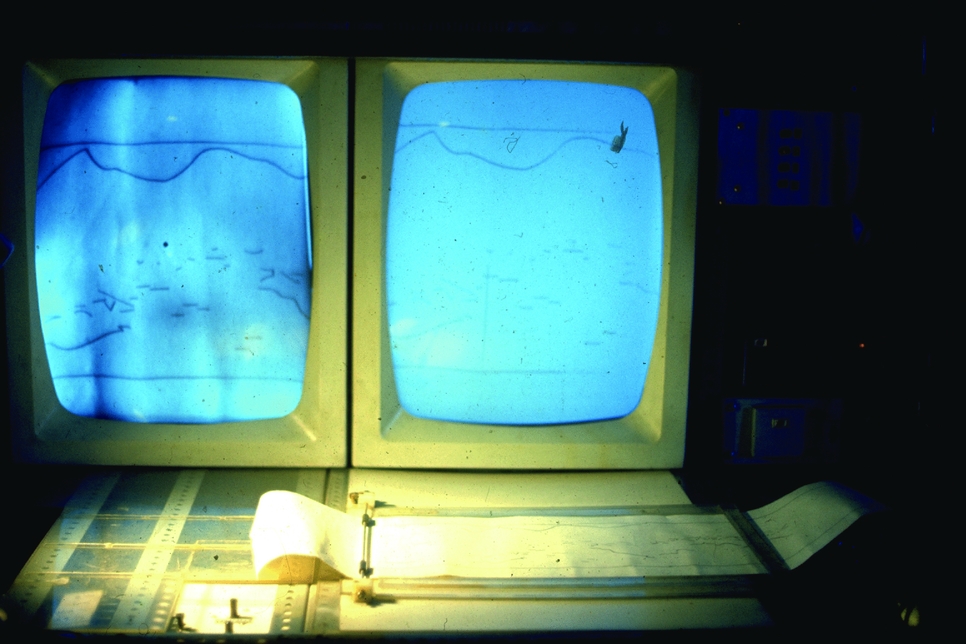
The eye of “Catalina,” as seen in Figure 6, was a TV camera mounted on top of the paper transport. Figure 7 shows the left monitor displaying the captured image in grayscale; the right monitor shows the same image only in black-and-white, which acted as a voltage controller for different sound parameters, including pitch, intensity, timbre, and temporal placement.Footnote 66
Camera of the analog graphic converter. The “Eye of Catalina.” Courtesy of Mary Mac Donagh.

The two video screens and the paper transport of the analog graphic converter. Courtesy of Mary Mac Donagh.

Reichenbach's converter was used in the creation of three solo works: Analogías paraboloides by Pedro Caryevschi (Argentina, b. 1942), Mnemon by José Ramón Maranzano, and La panadería by Eduardo Kusnir, all from 1970. It also produced an electronic version of Gabriel Brnčić’s ¡Volveremos a las montañas!. . ., and the tape parts of Maranzano's mixed media work, Mnemon II.
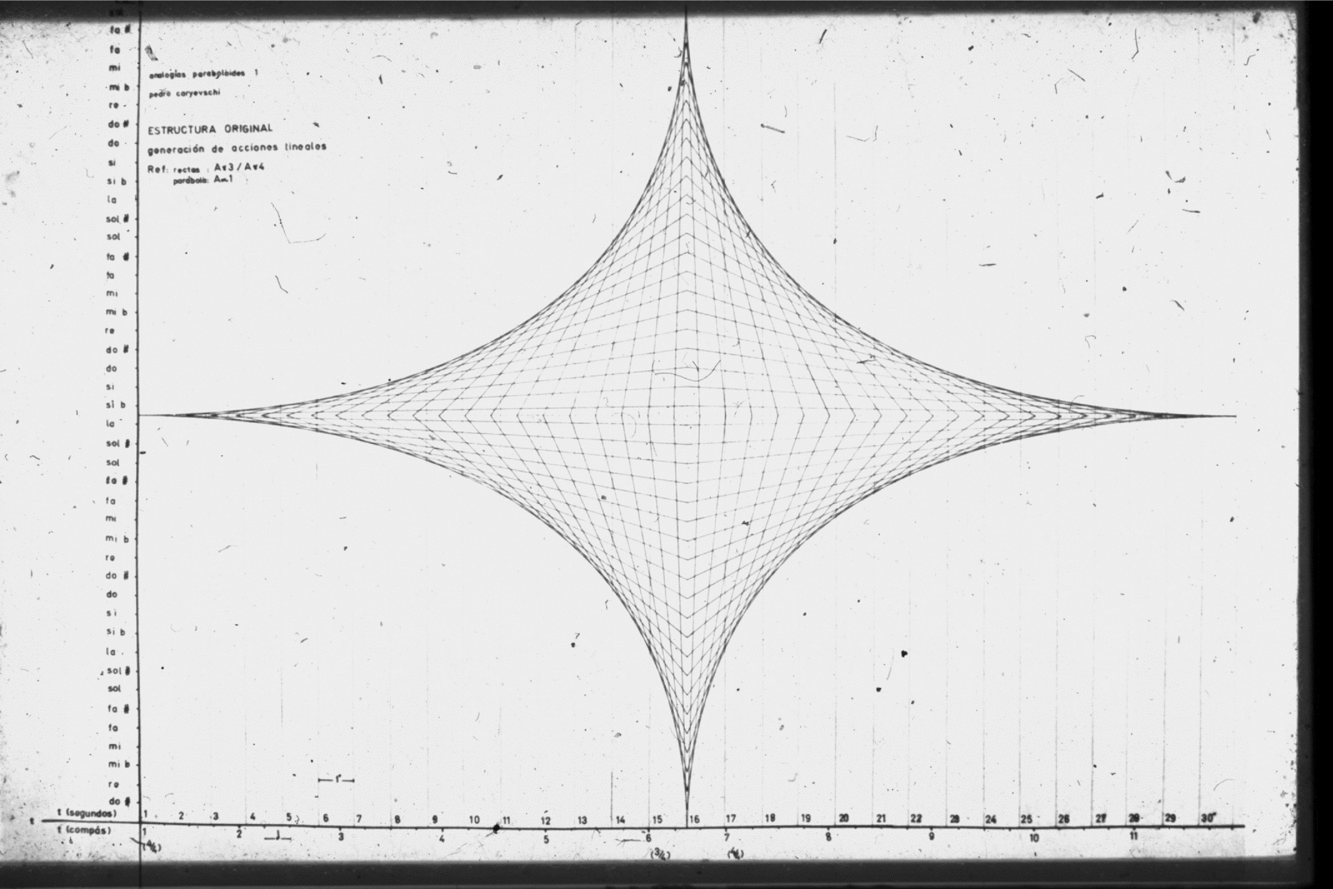
Caryevschi's composition Analogías Paraboloides exemplifies the reconciliation of music, mathematics, and science as an audible sign of the modernity advocated by the Di Tella project. For this work, Caryevschi took a geometric model (hyperbolic paraboloid), seen in Figure 8, and used Catalina to carefully produce both sine waves and sawtooth waves that followed the trajectory of each of the lines in the model. The result was a range of glissandi from slow and narrow to fast and wide. Next, the machine was used to “develop a series of variations whose structure was at the same time determined by the incremental curves of the mentioned model.”Footnote 67 Caryevschi's description of the work reveals the influence of Xenakis, who first conceptualized a curved pitch space originating from a multitude of straight lines interpreted as individual glissandi. Given the precision and the arduous labor required for this task, Caryevschi saw fit to “underline the collaboration of technicians and teachers at the Laboratorio de Música Electrónica, by dedicating this piece to them.”Footnote 68 Quite significantly, he recognized the collaborative nature of his composition, and acknowledged the support he received in its creation. This became common practice, as many composers recognized Reichenbach, Brnčić, and others as crucial parts of their creative process. Although Caryevschi did not go so far as to share authorship with his collaborators (a common practice in scientific research), the frequent mention of technical facilitators in program notes and in dedications of electronic music works reveals the extent to which members of the laboratory were exploring different (i.e., modern) ways of working together.
Labeled “Original Structure” for Analogías paraboloides, the first composition finished using the analog graphic converter. Courtesy of Mary Mac Donagh.

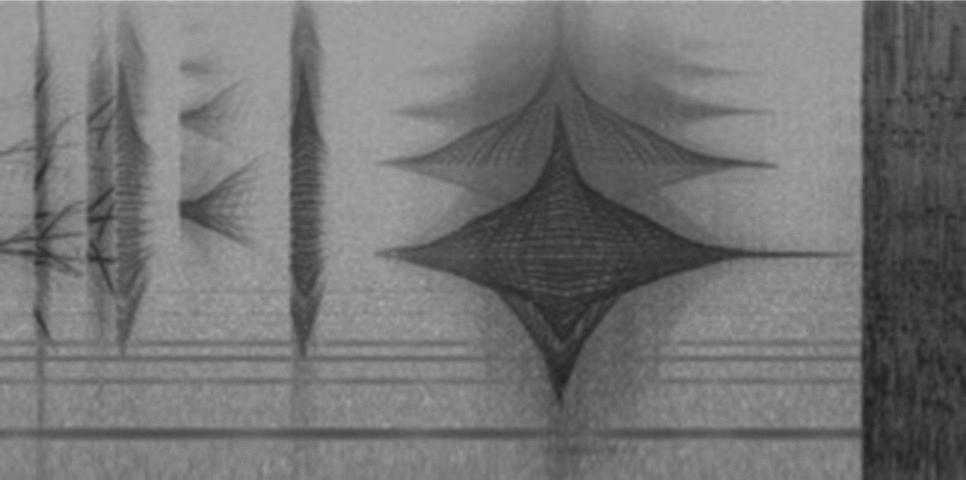
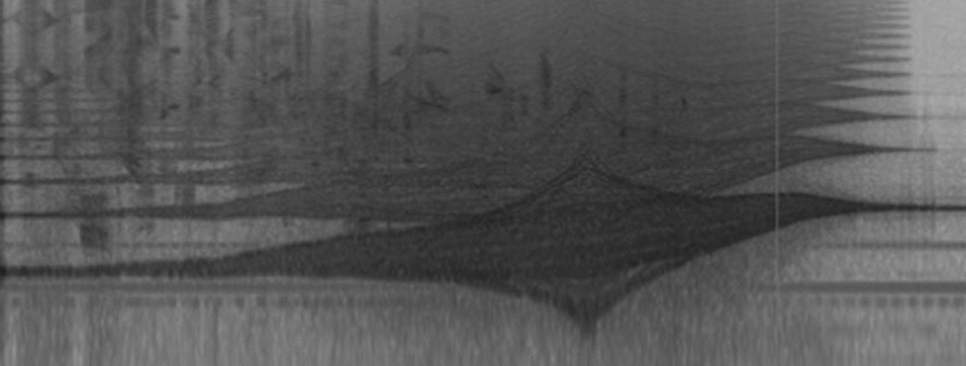
Caryevschi's Analogías Paraboloides takes advantage of Catalina's ability to control oscillators through fluctuating voltage. For example, the fragment of the work shown as a spectrogram in Figure 9 clearly illustrates how different pieces of the “original structure” were translated into sound.Footnote 69 The climax, around 2’40”, reveals the full presentation of the structure. This spectrogram, taken from the final recording of the piece, vividly reflects Caryevschi's original drawings and stands as a testament to the accuracy of Reichenbach's invention. Figure 10 shows another instance where the “original structure” can be heard at a much slower pace. Remarkably, after recording and rerecording multiple times to achieve the polyphonic effect he desired, Caryevschi and Reichenbach's team maintained low levels of noise even without the help of a multitrack recorder.
Spectrogram for Analogías paraboloides, approximately between 2’10” and 3’22”.

Material unity seen in the spectrogram for Analogías paraboloides, approximately between 7’26” and 9’ with the return of the paraboloid shaped sine waves.

José Ramón Maranzano's Mnemon was the second of the three works produced using Catalina. In Mnemon, Maranzano explores the different tones generated when two waves are played at high amplitude and in close frequency. This combination, often called difference or resultant tones, creates an illusion for the ear of a third sound in the lower frequency range (usually next to the 20hz range). Like Caryevschi's works, Mnemon is formally simple and seems more like a study exploring new effects than a structured composition. When I discussed Mnemon with former CLAEM students, most agreed that it was an uncomfortable piece to listen to, and that it ultimately did not go beyond the novelty of its psychoacoustic phenomenon. In other words, Maranzano's piece seemed more like acoustic research than a self-contained and well-crafted composition, and Mnemon's reputation suffered for failing to live up to the main objectives of the Laboratorio.
In contrast, La panadería by Eduardo Kusnir represents the most successful implementation of Catalina's potential.Footnote 70 Ariel Martínez, Uruguayan fellow at CLAEM, remembered the impression that Kusnir's work made on the French composer Pierre Schaeffer:
When he listened to the pieces he started to say some things that were so accurate and insightful that I almost fell back. He heard Kusnir's La panadería and he said, “I don't know why the things are where they are, but they are fine.” I never heard a better description of Kusnir's Panadería. It is difficult to understand how Kusnir placed the things he did where he did, but they work. They really do.Footnote 71
In La panadería, different sound gestures recur and become identifiable events, making it both very dramatic as well as humorous. A main differences between Kusnir's composition and the other two works written with Catalina was La Panadería's origins as a work written for acoustic instruments. As Kusnir remembers, “La panadería is an electronic realization—with the electronic media of the time—of a previous instrumental work that was also titled La panadería. That version was written with graphic notation. It was premiered in Cuba, and then it was performed later, around 1968, in Uruguay a little before I joined the Di Tella.”Footnote 72
When Kusnir shared this information, I was curious about his decision to transform an existing instrumental piece into an electronic work. Kusnir answered:
I was not interested in experimenting with the musical language; I wanted to experiment with sounds and timbre. And from the structural and formal point of view, La panadería was already finished. . . . Reichenbach had created Catalina—the graphic analog converter—and it could read drawings very similar to the ones I had used in the score and interpret them in sound as frequency and amplitude. So my work then was to craft the timbre. I took a long time working on timbre, something I normally do in all my works, electronic or instrumental.Footnote 73
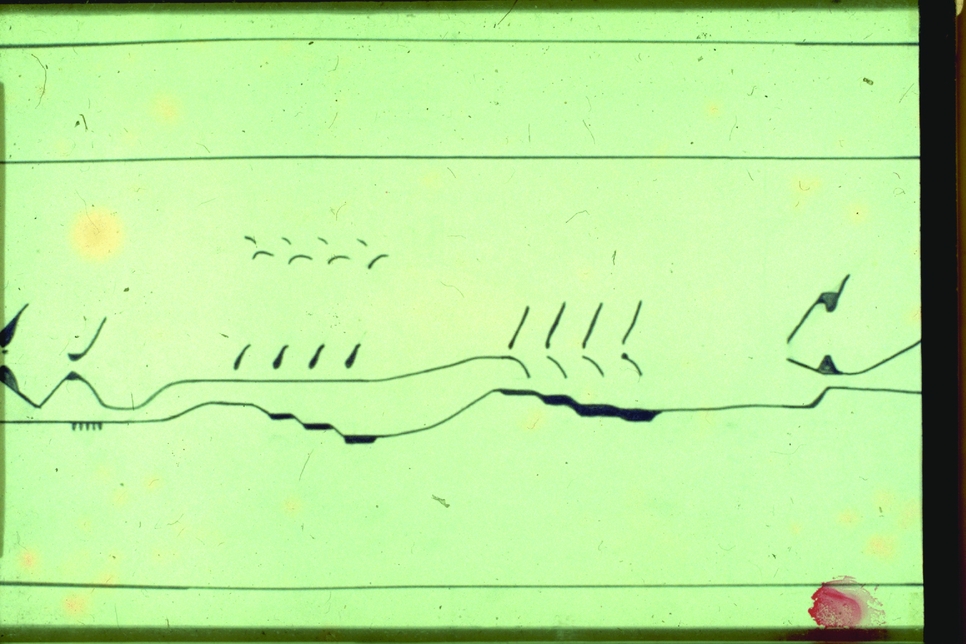
Here Kusnir points out a difference between his work and the works of Caryevschi and Maranzano. Whereas they used mostly pure sine and square waves, Kusnir had crafted multi-component timbres that listeners found more attractive. This novel approach is evident in the design of the score, a fragment of which appears in Figure 11.
Fragment of score fed to the graphic analog converter for La panadería (1970). Courtesy of Mary Mac Donagh.

The second difference lies in the piece's form. The formal plan of La panadería was, as Kusnir says, already finished. The electronic composition shared its form with its instrumental counterpart, whereas Mnemon and Analogías paraboloides struggled to combine contrasting sections into a coherent whole. Finally, a third important difference was Kusnir's musical approach. As he explains, he attempted to compose in an “instrumental” manner: “The thoughts, the discourse, the texture, the gestures are all instrumental. Even though I was not working with [traditional] instruments, those gestures, those articulations were coming from instrumental music.”Footnote 74
Thus, La panadería's success stemmed from a combination of factors. Kusnir's attention to timbre and his organization of particular gestures gave the work depth, while his musical ideas derived from orchestral instrumentation also captivated listeners. Whereas Caryevschi and Maranzano treated electronic music making as a tabula rasa—their musical ideas simply reflecting technical procedures or the effects of new technology—Kusnir thought of his piece as a new version of an existing composition. Similar to Bolaños's Intensidad y altura, which was based on Vallejo's poetic text, Kusnir's work has been received well, and in 1992 La panadería received the prestigious Euphonie d'or, recognized as one of the twenty most noteworthy works between 1970–1991 by the International Competition for Electroacoustic Music of Bourges.Footnote 75
The Studio After the Closing of CLAEM
Despite these successes, CLAEM closed its doors on November 30, 1971. The reasons for the closure were a complicated mixture of economic problems, political pressures, and a personal crisis that affected Ginastera. During its last year, the Laboratorio was the main focus of activity at the center.Footnote 76 After closing, the Laboratorio’s equipment was donated to the municipality of Buenos Aires and used to create the Centro de Investigaciones en Comunicación Masiva, Arte y Tecnología (CICMAT, Center for Research in Mass Communication, Art, and Technology) under the direction of Fernando von Reichenbach, Francisco Kröpfl, Gerardo Gandini, José Ramón Maranzano, and Gabriel Brnčić.Footnote 77 In 1976, after administrative restructuring, what remained of the studio was transferred to the Centro de Estudios Acústicos Musicales (CEAM, Center for Musical Acoustic Studies), where it remained largely unused.Footnote 78 In 1982, in the midst of these bureaucratic changes, the CEAM was renamed Laboratorio de Investigación y Producción Musical (Laboratory of Musical Research and Production, or LIPM) and placed under the direction of Francisco Kröpfl as a part of the Centro Cultural Ciudad de Buenos Aires (today known as the Centro Cultural Recoleta).Footnote 79 The history of the CICMAT, the CEAM, and the still existing LIPM are better documented than the period of the CLAEM described here, although questions remain about founding dates and the works produced in these venues.Footnote 80
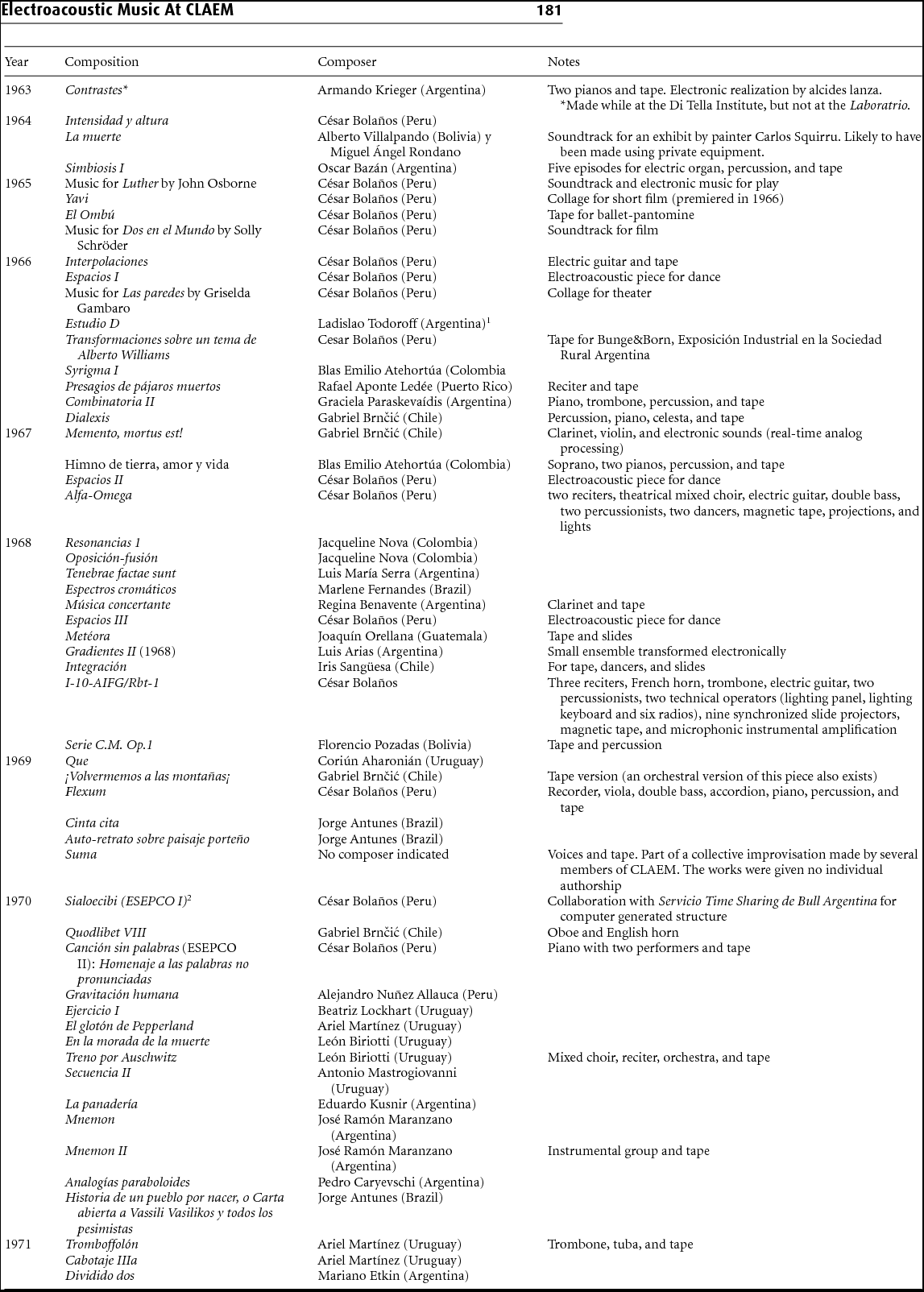
After comparing and collecting information from concert programs, oral history accounts, and the reports CLAEM administrators sent to the Rockefeller Foundation, I have compiled a list of electroacoustic works composed in the Laboratorio (Appendix 1). I am almost certain this list is incomplete, given that many works—particularly those meant to be soundtracks for exhibits, plays, or choreographies—frequently went undocumented. However, with more than fifty works, this table testifies to the impact that the Laboratorio had in early Latin American electroacoustic composition. In addition to the compositions discussed explicitly in this article, many of these pieces, such as Oposición-fusión (1968) by the Colombian Jacqueline Nova, Meteora (1968) by the Guatemalan Joaquin Orellana, Que (1969) by Coriún Aharonián, and El glotón de Pepperland (1970) by Ariel Martínez, to name only a few, became an important part of the repertoire and history of electroacoustic music across the region.Footnote 81 Despite its relatively brief and turbulent existence, any history of electroacoustic music in Argentina needs to consider the Laboratorio de música electrónica of CLAEM as a foundational institution.
As part of the broader history of CLAEM, the story of its Laboratorio de música electrónica reflects the emphasis placed on technological advancement, invention and innovation, as well as the importance of keeping up with trends in Europe and North America. During the period in which it was fully functional, the Laboratorio's dedicated staff in Buenos Aires confronted particular problems, including technical challenges, lack of funding, and professional tensions. However, they found creative solutions that transformed the studio into a productive space and enabled its success.
The international recognition of works like Intensidad y altura, La panadería, and a handful of other compositions, contributed to a local appreciation of electroacoustic music. Within the Buenos Aires art music scene of the 1960s, however, electroacoustic music was marginal and often disparaged by connoisseurs and aficionados.Footnote 82 Arguing that electronic works were closer “to industrial engineering” than to music, for example, critic García Belsunce argued that electronic music studios had “not produced in many years of experiments, a single work that can be considered music and understood as art.”Footnote 83 Foreign recognition gave important legitimacy to the activities of these composers and opened doors for greater acceptance of electroacoustic practices, even if they never became mainstream.
The role engineers played within this story, in both the laboratory's initial failure and its later success, serves as an important case study of music composition as collective action instead of individual effort. As early as 1969, Davies claimed that, “unfortunately, technicians are not usually credited, although their contribution is often equal to that of the composers, and many of them also appear as composers in their own right.”Footnote 84 The role of Fernando von Reichenbach and others in the studio, such as Gabriel Brnčić, provides a contrast to more familiar narratives about the production of electroacoustic music that emphasize isolated conditions and individual genius. In this particular case, collaboration and community allowed composers to succeed in their endeavors.
Ginastera's sustained attention to the presentation and visual appeal of the studio—its configuration, its inventions, its machinery, and its sonic results—underlines yet another important point: the Laboratorio served as both a visible and audible sign of modernity for CLAEM and the Di Tella Institute. The scientific tinge to the majority of the descriptions in this essay—labeling the studio a laboratory, referring to its musical results as “experimental,” using mathematical models or acoustic phenomena to generate works—show that the studio was truly a “modern” facet of CLAEM that resonated with larger projects seeking to turn Argentina into a center of avant-garde practice and to “internationalize” Latin American art in general.Footnote 85
The history of the Laboratorio de música electrónica at CLAEM offers another perspective on the relevance of the large studio concept in Latin America.Footnote 86 Early electroacoustic composition in Europe flourished mostly with the support of state funds, whereas private and public universities housed most studios in North America. In Latin America, however, most narratives of electronic composition credit small studio and personal workstation environments (rather than large studios) with being the most important sites of creation. Nevertheless, in its Laboratorio de música electrónica, CLAEM provided an institutional experience unique to the history of electronic music in the region, setting a fertile ground for a strong and prolific tradition of composers across the south of the continent. At this crucial time, CLAEM—located at the very heart of Buenos Aires—opened its doors for a short but influential period and became a beacon for the Latin American avant-garde.
Incomplete list of electroacoustic works composed at the Laboratorio de música electronica.