Introduction
Introduction of glyphosate-resistant (GR) soybean (1996), cotton (1997), and corn (1998) into the US marketplace (Roundup Ready®, Monsanto, St. Louis, MO) soon drastically changed the approach to weed control (Burke et al. Reference Burke, Twozler, Askew, Wilcut and Smith2005; Corbett et al. Reference Corbett, Askew, Thomas and Wilcut2004; Culpepper Reference Culpepper2006; Norsworthy et al. Reference Norsworthy, Ward, Shaw, Llewelln, Nichols, Webster, Bradely, Frisvold, Powles, Burgos, Witt and Barrett2012). Over-reliance on glyphosate caused a shift in the overall weed spectrum through extreme selection pressure, and GR biotypes of key weed species, such as horseweed [Conyza canadensis (L.) Cronq.] and Palmer amaranth, have become common in the major agronomic areas of the United States (Culpepper Reference Culpepper2006; Norsworthy et al. Reference Norsworthy, Griffith, Scott, Smith and Oliver2008; VanGessel Reference VanGessel2001). Palmer amaranth was first confirmed GR in Georgia in 2004 and is currently documented as GR in most of the major US agronomic states (Culpepper Reference Culpepper2006; Heap Reference Heap2016). Since that time, Palmer amaranth has become one of the most economically damaging weeds in the United States and dominates in-season weed management decisions where present (Price et al. Reference Price, Balkcom, Culpepper, Kelton, Nichols and Schomberg2011; Webster and Sosnoskie Reference Webster and Sosnoskie2010). The aggressive growth rate, stature, and inherent survival abilities of this weed make it extremely competitive with agronomic crops (Klingaman and Oliver Reference Klingaman and Oliver1994; Bond and Oliver Reference Bond and Oliver2006; Culpepper et al. 2006). For example, Klingaman and Oliver (Reference Klingaman and Oliver1994) reported soybean yield percentage reductions at the following Palmer amaranth densities (in plants m–1): 0.33 (17%), 0.66 (27%), 1 (32%), 2 (48%), 3.33 (64%), and 10 (68%).
Growers planted approximately 4.4 million ha of soybeans in Tennessee in 2016, making it an important crop in the state (Anonymous 2012). In 2014, 94% of the soybean hectarage in the United States was planted with herbicide-resistant soybean cultivars (USDA NASS 2014). The majority of soybeans sown in Tennessee between the late 1990s and 2015 were glyphosate-tolerant (L. Steckel, personal communication). In the past, soybean producers in Tennessee and the Mid-South have heavily relied on protoporphyrinogen IX oxidase (PPO) herbicides for control of GR Palmer amaranth (Miller and Norsworthy Reference Miller and Norsworthy2016). However, the confirmation and spread of PPO-resistant Palmer amaranth resulted in growers shifting to more glufosinate-resistant soybean 2016 (Heap Reference Heap2016; L. Steckel, personal communication). The loss of PPO herbicides eliminated effective POST herbicide options for controlling Palmer amaranth in GR soybean. In response to the increased incidence of weed resistance to glyphosate and other herbicides, seed companies have developed soybean cultivars with resistance to multiple herbicides such as glyphosate+dicamba (GDT).
Dicamba has been widely used for over 40 yr and is an effective herbicide for the control of most broadleaf weed species (Mueller et al. Reference Mueller, Wright and Remund2013; Shaner Reference Shaner2014). Dicamba is an auxin-mimicking herbicide that controls GR Palmer amaranth and other broadleaf weeds alone or in combination with other herbicides (Cahoon et al. Reference Cahoon, York, Jordan, Everman, Seagroves, Culpepper and Eure2015; Merchant et al. Reference Merchant, Sosnoskie, Culpepper, Steckel, York, Braxton and Ford2013; Samples et al. Reference Samples, Dodds, Reynolds, Dixon, Bond, Reynolds and Mills2013; York et al. 2012, Reference York, Cahoon and Oliver2015). Inman et al. (Reference Inman, Jordan, York, Jennings, Monks, Everman, Bollman, Fowler, Cole and Soteres2016) reported that glyphosate plus dicamba significantly decreased the frequency and total Palmer amaranth density when compared to glyphosate alone. Crow et al. (Reference Crow, Steckel, Mueller and Hayes2016) reported that dicamba+diflufenzopyr provided similar to or greater control of large (>20 cm) Palmer amaranth plants when compared to other single-herbicide mode-of-action (MOA) treatments in corn.
Additionally, producers have begun utilizing other management practices such as cover crops to combat multiple herbicide-resistant weed species. No-till crop production is prevalent in Tennessee, where 71% of the corn (Zea mays L.), cotton (Gossypium hirsutum L.), soybean, and wheat hectares were produced in a no-till environment in 2014 (Kenerson Reference Kenerson2014). No-tillage methods limit the cultural control methods available to producers for combating difficult herbicide-resistant weeds, such as Palmer amaranth (Price et al. Reference Price, Balkcom, Culpepper, Kelton, Nichols and Schomberg2011). However, cover crops can be implemented into no-till systems to increase the sustainability of weed control programs (Mirsky et al. Reference Mirsky, Ryan, Teasdale, Curran, Reberg-Horton, Spargo, Wells, Keene and Moyer2013; Wiggins et al. 2016a, Reference Wiggins, Hayes and Steckelb). Cereal rye (Secale cereale L.) and winter wheat are two common winter annual grass species used for cover cropping systems in the southeastern United States (Norsworthy et al. Reference Norsworthy, McClelland, Griffith, Bangarwa and Still2011; Wiggins et al. Reference Wiggins, Hayes and Steckel2016b). Winter wheat is an appealing cover crop for many producers, because it is economical; moreover, many producers already have experience growing it as a cash crop. However, winter wheat should be managed differently if it is being grown as a cover crop (SARE 2007). Crimson clover (Trifolium incarnatum L.) and hairy vetch are two winter-annual legume species that have been researched extensively as cover crops (Norsworthy et al. Reference Norsworthy, McClelland, Griffith, Bangarwa and Still2010; Reddy Reference Reddy2001). Annual legumes have been shown to reduce pressure on some winter- and summer-annual weeds similarly to winter-annual grass species (Fisk et al. Reference Fisk, Hersterman, Shrestha, Kells, Harwood, Squire and Sheaffer2001; Isik et al. Reference Isik, Ngouajio and Mennan2009). However, utilizing a cereal+legume cover crop combination can create a synergistic effect increasing cover crop biomass (Wiggins et al. Reference Wiggins, McClure, Hayes and Steckel2016a; Zotarelli et al. Reference Zotarelli, Avila, Scholberg and Alves2009). The quantity of biomass present at a given time by a cover crop directly contributes to the amount of weed suppression that can be achieved (Mirsky et al. Reference Mirsky, Ryan, Teasdale, Curran, Reberg-Horton, Spargo, Wells, Keene and Moyer2013; Norsworthy et al. Reference Norsworthy, McClelland, Griffith, Bangarwa and Still2011; Ryan et al. 2011a; Wiggins et al. Reference Wiggins, Hayes and Steckel2016b).
Cover crop termination is one of the most influential factors in determining the amount of weed suppression (Mirsky et al. Reference Mirsky, Ryan, Teasdale, Curran, Reberg-Horton, Spargo, Wells, Keene and Moyer2013). Delaying cover crop termination until at or near planting of the cash crop allows the cover crop a longer growing season, thus producing more biomass (Ashford and Reeves Reference Ashford and Reeves2003; Mirsky et al. Reference Mirsky, Curran, Mortensen, Ryan and Shumway2009, 2011; Wortman et al. Reference Wortman, Francis, Bernards, Drijber and Lindquist2012). Although chemical termination of cereal cover crop species such as cereal rye or wheat can easily be accomplished with glyphosate (Ashford and Reeves Reference Ashford and Reeves2003; Price et al. Reference Price, Arriaga, Raper, Balkcom, Komecki and Reeves2009), termination of legume cover crops with herbicides labeled for at or near cash crop planting can be more challenging (Davis Reference Davis2010; Fisk et al. Reference Fisk, Hersterman, Shrestha, Kells, Harwood, Squire and Sheaffer2001; Wiggins et al. 2016a, Reference Wiggins, Hayes and Steckelb). However, auxin herbicides such as 2,4-D or dicamba have proven to be effective herbicides to control legume cover crop species (Curran et al. Reference Curran, Wallace, Mirsky and Crockett2015; McCurdy et al. Reference McCurdy, McElroy and Flessner2013). White and Worsham (Reference White and Worsham1990) reported that dicamba provided 97% control of hairy vetch prior to planting corn in North Carolina.
Cereal+legume cover crop mixtures are becoming more common in areas where producers are utilizing cover crops to combat difficult to control weed species. The advent of GDT soybean technologies could provide producers with an effective herbicide option for terminating such cover crop mixtures near soybean planting. The ability to delay termination of cover crop mixtures used in combination with new herbicide-tolerant crop technologies could provide producers an effective means to increase sustainability of weed control systems for soybeans in no-till environments. Therefore, we conducted research to evaluate glyphosate+dicamba for terminating a wheat+hairy vetch cover crop at different timings before and after planting GDT soybean in Tennessee.
Materials and Methods
Field studies to evaluate wheat+hairy vetch termination and in-crop weed control with fomesafen and dicamba in GDT soybean systems were conducted in the growing seasons of 2015 and 2016 at the West Tennessee Research and Education Center, in Jackson, TN (35.633° N, 88.856° W). The experimental site was planted to soybeans in each of the previous site years, and both cover crops and soybeans were sown into long-term no-till environments common to western Tennessee.
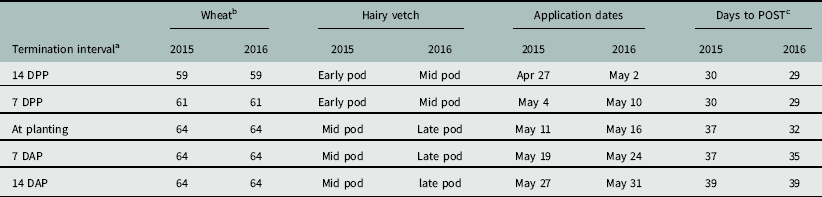
Wheat and hairy vetch cover crops (seeded at 67 and 22 kg ha–1, respectively) were drilled in September and October of 2014 and 2015, respectively, using a no-till drill, and allowed to over-winter (Table 1). An experimental, proprietary, late-four maturity group GDT soybean variety (Monsanto Co., St. Louis, MO) was sown on May 11, 2015 and May 16, 2016. Soybeans were planted 3 cm deep at a population of 346,000 seed ha–1 into the existing cover crop residue with a no-tillage planter. Individual plots consisted of two 76-cm rows that were 9.1 m long. Treatments were replicated four times in a split-plot design within a randomized complete block. The whole plot was subjected to termination timing and consisted of 14 d prior to planting (DPP), 7 DPP, at planting, 7 d after planting (DAP), and 14 DAP. The subplot was POST herbicide and consisted of a premix of glyphosate+fomesafen (1,120 and 280 g ae ha–1, respectively) (Flexstar® GT 3.5 herbicide label, Syngenta Crop Protection, LLC, Greensboro, NC) or a proprietary premix of glyphosate+the diglycolamine salt of dicamba (1,120 and 560 gaeha–1, respectively) applied when Palmer amaranth for that termination interval reached 10 cm in height. The research site was infested with nearly 100% GR Palmer amaranth (L. Steckel, unpublished data), so these treatments are referred to as fomesafen and dicamba, respectively. Termination dates and cover crop growth stage at each termination timing are presented in Table 1 for wheat and hairy vetch (Zadok et al. 1974). POST herbicide treatments were applied using a CO2-pressurized backpack sprayer calibrated to deliver 140 L ha–1 equipped with TTI110025 nozzles (TTI Turbo TeeJet Spray Tips, TeeJet Technologies, Wheaton, IL), in accordance with currently proposed nozzle requirements for using dicamba on GDT soybeans (Anonymous 2017).
Wheat and hairy vetch growth stages at 14, 7, and 0 d before and 7 and 14 d after soybean planting termination intervals at the West Tennessee Research and Education Center in Jackson, TN, in 2015 and 2016.

a Abbreviations: DPP, days prior to planting; DAP, days after planting.
b According to Zadok’s growth staging.
c Days to POST application is recorded as days after soybean planting until a POST herbicide application was triggered when Palmer amaranth in that termination interval had reached a height of 10 cm.
Cover crop biomass was collected from 0.5-m2 quadrants at each termination timing, and samples were then dried in a forced-air oven at 60 C for 48 hr. Soybean stand was counted and the count averaged over two randomly selected sections of 0.5 m per row in each plot; this count was then converted to plants ha–1. Cover crop control was visually estimated on a scale of 0 to 100%, where 0 represented no injury or control and 100 represented complete plant death at 7, 14, and 21 DAP. Control ratings for cover crops did not begin until after planting, because the authors’ previous experiences indicated that the damage induced on the cover crop from the no-till planter for the cash crop increases cover crop control. Palmer amaranth emergence and growth was monitored until it reached a height of 10 cm in a particular termination interval, and then treated with a POST herbicide. The 10 cm in height termination timing was selected, as that is the height directed by dicamba labels (Anonymous 2017). The experimental area in each site year had been a weed control research site for >10 previous years and was known to have synonymous Palmer amaranth pressure with adjacent areas. Additionally, in each site year, Palmer amaranth was noted to be emerging in these adjacent areas before the initial 14 DPP treatments were applied. Therefore, delays in Palmer amaranth emergence and growth thereafter could be attributed to the cover crop plus the herbicide applied for termination. All plots for a particular termination interval were treated at the same time. Cover crop termination interval was regressed against the number of days after soybean planting for Palmer amaranth to reach a height of 10 cm (Equation 1). The logistic model was fit using SigmaPlot (ver. 8.02; SPSS, Inc., Chicago, IL) to determine the correlation of termination interval and days until Palmer amaranth triggered a POST application.
 $$y\,{\equals}\,y0{\plus}{a \over 1}{\rm exp}\left( {{\minus}{{x\,{\minus}\,x0} \over b}} \right)$$
In this model, y0 is minimum number of days for Palmer amaranth to reach 10 cm in height, b is the slope around the inflection point, x0 half the number of days for Palmer amaranth to reach 10 cm, and a is the inflection point, or days before or after planting required to maximize the number of days for Palmer amaranth to reach 10 cm in height. Palmer amaranth control was visually assessed 7, 14, 21, and 28 d after the POST application was made (DAT). An additional evaluation was made when soybeans reached the R6 maturity stage as an end-of-season weed control rating. Days until the POST application were also recorded as DAP (Table 1). Soybeans were harvested in each year of this experiment with a small-plot combine, and yields were adjusted to a moisture content of 13%.
All data were subjected to an ANOVA using PROC GLIMMIX in SAS (ver. 9.4; SAS Institute, Cary, NC). Random effects were years, replications, and replications nested within years (Blouin et al. Reference Blouin, Webster and Bond2011; Carmer et al. Reference Carmer, Nyquist and Walker1989). Cover crop biomass, control, and soybean stands were analyzed using only termination intervals as the fixed effect, as these data were collected prior to the application of any POST treatments. Palmer amaranth control and soybean yields were analyzed using the fixed effects of termination interval, POST, and the interaction among the fixed effects. The square roots of visual estimates for cover crop and weed control were arcsine transformed, and soybean population, cover crop biomass, and yield data were log10 transformed. The transformations did not improve homogeneity of variance for any data point based on visual inspection of plotted residuals; therefore, nontransformed data were used in analyses. Type III statistics were used to test all fixed effects or interactions between the fixed effects. Least square means were calculated based on α=0.05 and utilized for mean separation. The DANDA.sas design and analysis macro collection (Saxton Reference Saxton2013) was utilized to build all PROC GLIMMIX (MMAOV) procedures, examine normality, perform data transformations, and convert mean separation to letter groupings when appropriate.
Results and Discussion
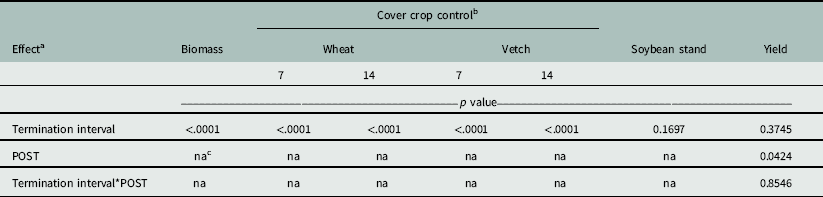
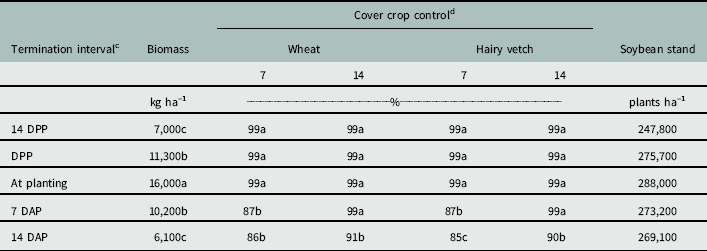
A significant effect of termination interval was detected for cover crop biomass (Tables 2 and 3). Biomass was highest when cover crops were terminated at planting, decreased with the 7 DPP and DAP timings, and again at the 14 DPP and DAP timings. Decreased biomass at the 7- and 14-DAP timings coincided with the authors’ previous experience of a no-till planter providing an effect that was similar to, but less efficacious than that of other mechanical termination methods such as a roller crimper, especially in cereal cover crops planted in a mixture with hairy vetch. The cereal+hairy vetch mixtures generally become entangled and are pressed to the ground with the planter. This effect is further explained with the cover crop control ratings. For both wheat and hairy vetch control, there was a significant main effect of termination timing 7 and 14 DAP (Tables 2 and 3). All treatments applied prior to planting provided 99% control of wheat and hairy vetch 7 DAP. Wheat or hairy vetch ranged from 85% to 87% in the 7- and 14-DAP termination timings, immediately prior to the 7-DAP termination treatment being applied. Similarly, 14-DAP control of wheat and hairy vetch was 91% and 90%, respectively, immediately prior to the 14-DAP termination treatment being applied. Data from the 21-DAP rating is not presented, as all treatments provided total control of each cover crop species. Similarly, Curran et al. (Reference Curran, Wallace, Mirsky and Crockett2015) reported that dicamba applied at 140 g ai ha–1 provided ≥90% control of hairy vetch whether applied in the fall or spring, despite using a much lower rate of dicamba than did the current research. Many other studies have documented the efficacy of dicamba on various vetch species at lower rates than used in this study, confirming the viability of this herbicide for controlling vetch species (Curran et al. Reference Curran, Wallace, Mirsky and Crockett2015; McCurdy et al. Reference McCurdy, McElroy and Flessner2013; Wolfe et al. Reference Wolfe, Neal and Harlow2016). Also, the efficacy of glyphosate for controlling wheat is well documented (Ashford and Reeves Reference Ashford and Reeves2003; Davis Reference Davis2010; Price et al. Reference Price, Arriaga, Raper, Balkcom, Komecki and Reeves2009; Reddy Reference Reddy2001). The combination of these herbicides can control a wheat+hairy vetch cover crop before or after soybean establishment at rates for use in GDT soybeans.
Main effects of termination interval, POST herbicide application, and the interaction of the main effects on wheat+hairy vetch cover crop biomass and control and soybean stand and yield.

a Termination interval refers to cover crop termination intervals of 14, 7, and 0 d prior to planting, and 7 and 14 d after planting. POST stands for POST herbicide premixes of glyphosate+fomesafen (1,120 and 280 g ae ha–1, respectively) or glyphosate+the diglycolamine salt of dicamba (1,120 and 560 g ae ha–1, respectively) applied when Palmer amaranth for that termination interval reached 10 cm in height.
b Column headings of 7 and 14 designate rating intervals of 7 and 14 d after planting soybean.
c na (not applicable) as no factorial was run.
Biomass and control of a wheat+hairy vetch cover crop, and soybean population as affected by termination intervals before and after planting soybean in Tennessee in 2015 and 2016.Footnote a,b

a Abbreviations: DPP, days prior to planting; DAP, days after planting.
b Means within a column followed by the same letter are not significantly different at p≤0.05.
c Termination intervals of –14, –7, 0, 7, and 14 designate the number of days before or after soybean planting that the termination treatment of glyphosate+dicamba (1,120 and 560 g ae ha–1, respectively) was applied.
d Column headings of 7 and 14 designate rating intervals of 7 and 14 d after planting soybean.
Significant main effects were not present for crop stand (Tables 2 and 3). However, reported least squared means for crop stand are generally low. A severe early-season infestation of three-cornered alfalfa hoppers (Spissistilus festinus Say) occurred in 2015. This caused notable stand loss across all treatments. However, stand loss was uniform across all treatments and did not cause an interaction with data for stands between site years (P=0.8369, data not shown). Means for crop stands in 2015 and 2016 were 238,200 and 303,200 plants ha–1, respectively. However, because of the aforementioned insect problem in 2015, a blanket application of a pyrethroid insecticide was made in 2016 at planting to alleviate this problem (S. Stewart, personal communication). Additionally, there was a significant main effect of POST herbicide for soybean yields (Tables 2 and 4). Pooled over all termination timings, treatments receiving a POST application of dicamba yielded 100 kg ha–1 higher than those treated with fomesafen. Although there were differences in yield among POST herbicide treatments, least squared means for each herbicide treatment was still above the 2015 average yield of 3,300 kg ha–1 for Tennessee (Anonymous 2012). Similarly, Reddy et al. (Reference Reddy, Zablotowicz, Locke and Koger2003) reported no differences in soybean stand or yield when comparing a cereal rye or crimson clover cover crop to a conventional no-till system in Mississippi.
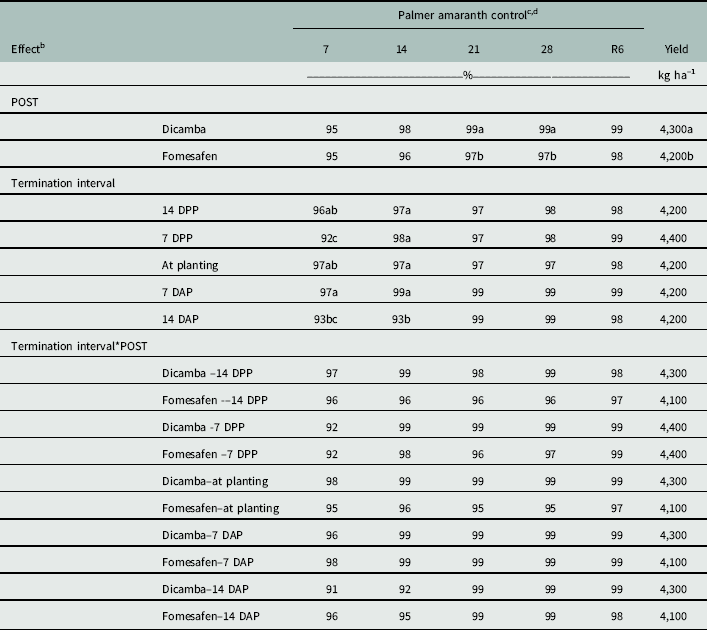
Control of Palmer amaranth and dicamba-resistant soybean yield in a wheat+hairy vetch cover crop mixture in Jackson, TN, in 2015 and 2016Footnote a .

a Abbreviations: DPP, days prior to planting; DAP, days after planting.
b Termination intervals of –14, –7, 0, 7, and 14 designate the number of days before or after soybean planting that the termination treatment of glyphosate+dicamba (1,120 and 560 g ae ha–1, respectively) was applied.
c Column headings of 7, 14, 21, and 28 designate rating intervals of 7, 14, 21, and 28 d after POST herbicide application. Column heading R6 refers to soybean growth stage of R6 and was taken as an end-of-season rating.
d Means within a column followed by the same letter are not significantly different at p≤0.05. Letters are only reflective of means within a main effect. Means followed by no letter are either not significantly different at p≤0.05, or letter separation is shown in a higher interaction.
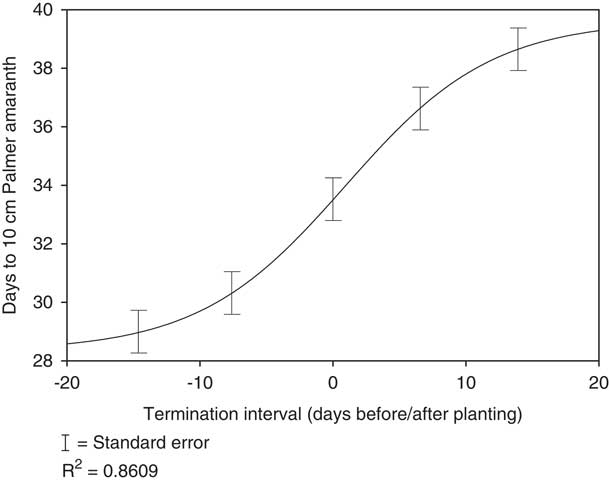
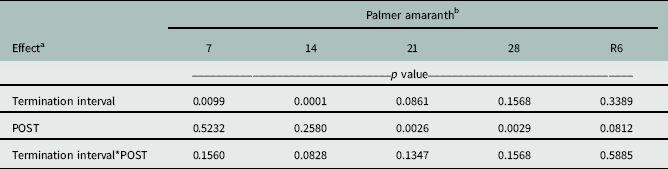
The parameters for the logistic regression of termination interval and days to 10-cm Palmer amaranth produced a model with the parameter estimates y=28.3+11.3/(1+exp(–(x–0.9)/5.5)) with an R2=0.86 (Figure 1). This would estimate that all termination treatments delayed Palmer amaranth growth to 10 cm in height by at least 28 d. The termination interval for a wheat+vetch cover crop terminated with glyphosate+dicamba to maximize the number of days for Palmer amaranth to reach 10 cm in height is 11 DAP. Similarly, Ryan et al. (Reference Ryan, Mirskey, Mortensen, Teasdale and Curran2011) reported that increased cereal rye biomass was strongly related to decreasing weed biomass. Although biomass in this study stopped increasing at cash crop planting, the effects of delayed termination with glyphosate+dicamba until after planting proved to be an effective way to increase the amount of time necessary for Palmer amaranth to reach 10 cm in height. Palmer amaranth control was significantly affected by termination interval 7 and 14 DAT (Tables 4 and 5). Control was lowest (92% to 93%) 7 DAT in 7-DPP and 14-DAP termination treatments. At this rating, differences in control among the other termination treatments were not significant, and control among these treatments ranged from 96% to 97%. Additionally, 14-DAT control from all treatments except the 14 DAP (93%) termination interval was similar (≥97%). However, these differences were transient, as differences among termination intervals were not present 21 or 28 DAT, and, pooled over POST herbicides, all treatments provided ≥97% control at these timings. There was a significant main effect of POST herbicide treatment 21 and 28 DAT. Control 21 and 28 DAT ranged from 97% to 99%, with dicamba having greater control at these ratings. Significant main effects or interactions among the main effects were not detected at the final (R6 soybean stage) rating, and all treatments provided ≥97% control of Palmer amaranth.
Termination interval of a wheat+hairy vetch cover crop effects the number of days until Palmer amaranth can reach 10 cm in height.

The main effects of cover crop termination interval, POST herbicide treatment, and the interaction among the main effects on Palmer amaranth control in Jackson, TN, in 2015 and 2016.

a Termination interval refers to cover crop termination intervals of 14, 7, and 0 d prior to planting, and 7 and 14 d after planting. POST stands for POST herbicide premixes of glyphosate+fomesafen (1,120 and 280 g ae ha–1, respectively) or glyphosate plus the diglycolamine salt of dicamba (1,120 and 560 g ae ha–1, respectively) applied when Palmer amaranth for that termination interval reached 10 cm in height.
b Column headings of 7, 14, 21, and 28 designate rating intervals of 7, 14, 21, and 28 d after POST herbicide application. Column heading R6 refers to soybean growth stage of R6 and was taken as an end-of-season rating.
Although differences in Palmer amaranth control were not apparent at the end of the season, early-season Palmer amaranth control ratings (21 and 28 DAT) followed a trend similar to that of soybean yields (Tables 1 and 4). Van Acker et al. (Reference Van Acker, Swanton and Weise1993) reported in four of six site years that the critical period of weed removal to prevent 2.5% yield loss in soybeans was ≥27 d after emergence. However, in this same study, the critical period of weed removal to prevent a 5% yield loss was ≥40 d after emergence in three of six site years. POST treatments for Palmer amaranth control were applied 29 to 39 d after planting, meaning the weed removal in this study fell in a period that could cause 2.5% to 5% yield loss. The differences in yield are thought to be attributed to early-season weed control.
Glyphosate+dicamba can be an effective tool for terminating wheat+hairy vetch cover crops when used 14 DPP to 14 DAP. Additionally, in all treatments, one effective POST herbicide application plus a cover crop was sufficient to provide ≥97% control of GR Palmer amaranth while maintaining soybean yields above the state average (Anonymous 2012). The ability to use glyphosate+dicamba shortly before or after planting for cover crop control in GDT soybeans allows producers increased flexibility in managing high-biomass cover crops for control of Palmer amaranth. However, producers should be aware of other possible pests such as insects when delaying cover crop termination until near soybean planting (L. Steckel, unpublished data). Additionally, it is well documented that including at least one other effective MOA will greatly improve the longevity of dicamba as an effective POST for Palmer amaranth (Beckie 2011; Burke et al. Reference Burke, Twozler, Askew, Wilcut and Smith2005; Culpepper Reference Culpepper2006; Inman et al. Reference Inman, Jordan, York, Jennings, Monks, Everman, Bollman, Fowler, Cole and Soteres2016; Miller and Norsworthy 2016; Price et al. Reference Price, Balkcom, Culpepper, Kelton, Nichols and Schomberg2011; Riar et al. Reference Riar, Norsworthy, Steckel, Stephenson, Eubank, Bond and Scott2013). The results suggest that with a wheat+hairy vetch cover crop terminated 14 DPP with glyphosate+dicamba, delayed Palmer amaranth growth to 10 cm in height by ≥28 DAP. Moreover, delaying cover termination until 14 DAP can correspondently delay this interval for Palmer amaranth to 38 DAP. When utilizing a wheat+hairy vetch cover crop in GDT soybean, producers should delay cover crop termination until 11 to 14 DPP and make at least one POST application of glyphosate+dicamba+an additional herbicide MOA to maximize Palmer amaranth control and soybean yields.
Acknowledgments
Funding for this research was provided by Monsanto and the Tennessee Soybean Promotion Board and is greatly appreciated by the authors.