INTRODUCTION
Spiritual well-being is one of the most important factors in any human's quality of life. The fact that a correlation between low spiritual well-being and the desire for death and thoughts about suicide is more than that in depression (McClain et al., Reference McClain, Rosenfeld and Breitbart2003) shows the importance of spiritual well-being. It allows a person to experience transcendent meaning in life (Puchalski & Romer, Reference Puchalski and Romer2000) and involves concepts of “faith” and “meaning” (Karasu, Reference Karasu1999). For terminally ill cancer patients, the meaning of their lives or meaning of their illness experience is important.
Attributed meaning to the illness experience is an affective factor in psychosocial adjustment for cancer patients. Stanton et al. (Reference Stanton, Danoff-Burg and Huggins2002) found that patients with breast cancer who found positive meaning in their illness were psychologically adaptive. Tomich and Helgeson (Reference Tomich and Helgeson2002) demonstrated that the ability to successfully reconstitute a meaning of life following diagnosis of cancer has been associated with general measures of psychological adjustment. These studies are based on the meaning-making coping theories such as the “Theory of Cognitive Adaptation” (Taylor, Reference Taylor1983) or the “Transactional Model of Stress and Coping” (Park & Folkman, Reference Park and Folkman1997), in which, when people find meanings in a stressful life event and recognize it as important, they can cope with it. Taylor (Reference Taylor2000) showed that breast cancer survivors became adaptive psychologically when they found positive meanings in their illness experience. Though patients were shocked at the diagnosis, they found positive meanings and experienced psychological positive transformation. This transformation processes included four phases; encountering darkness, converting darkness, encountering light, reflecting light.
Though Taylor (2000) investigated the positive transformation type of cancer survivors whose psychological status changed from negative to positive and the kinds of meanings for them, it was not clear what other transformation types there were, what kinds of meanings terminally ill cancer patients attributed to the cancer experience, and patients who attributed positive meanings were adaptive in spiritual well-being. Because there were some differences in views for good death between Western culture and Japan (Hirai et al., Reference Hirai, Miyashita and Morita2006), for example, autonomy in decision making, we expected that there were other kinds of transformation types or meanings for Japanese patients. The present study investigated (1) what types of transformation terminally ill cancer patients experienced, (2) what kind of meanings terminally ill cancer patients attributed to the illness experience, and (3) patients who attributed positive meaning to the illness achieved the high spiritual well-being.
METHOD
Sample
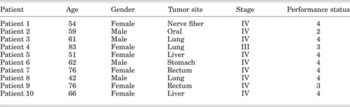
The participants were cancer patients from the palliative care unit of two general hospitals (Table 1). The inclusion criteria for this study were patients with advanced-stage cancer III /IV, without cognitive impairment, and 20 years of age or older. During the 3-month study period, 10 patients were recruited. To assess their performance status, we used the Eastern Cooperative Oncology Group performance status scale Oken et al. (Reference Oken, Creech and Tormey1982).
Patients' background

Measures
To measure the state of spiritual well-being and subjects' psychological state, we used the Japanese version of the Functional Assessment of Chronic Illness Therapy—Spiritual Well-Being Scale (FACIT-Sp; Peterman et al., Reference Peterman, Fitchett and Brady2002). The validity and reliability of the Japanese version of the FACIT-Sp is well established (Noguchi et al., Reference Noguchi, Ono and Morita2004). The range of the α reliability score was from .81 to .91. The standard mean score for the normal population is 32. High scores mean high levels of spiritual well-being. Anxiety and depression were also measured using the Japanese version of the Hospital Anxiety and Depression Scale (HADS; Kitamura, Reference Kitamura1993; Zigmond & Snaith, Reference Zigmond and Snaith1983). High scores mean high anxiety and depression. The cut-off point of the HADS is 10/11 and patients scoring over 11 may have some problems.
Procedure
The interviewer was a clinical psychologist, and all interviews were conducted individually. St. Mary's College ethical board permitted this study. The interviews were based on the questions reported in Taylor's (2000) study with breast cancer patients and typically lasted half an hour. Each semistructured interview involved two questions: “Please recall how your mood or psychological status has changed from the diagnosis until now.” and “What does having cancer mean to you?” It was an open-ended question, and the patients were permitted to talk freely. The interviews were written down. We did not record the interviews because most of the patients did not want to be recorded. The interview session was only one time because patients at this period in these hospices were in very advanced stages and we estimated that it would be impossible to meet all participants two times. We met 10 patients because we wanted to know the tendency as a very preliminary study.
Data Analysis
As a quantitative analysis to find transformation types and kinds of meanings, for initial coding, the transcribed interviews of each subject were analyzed line by line, and any contents that were considered to be related to meanings were extracted. The extracted codes were classified, codes with a common meaning were categorized together, and categories and subcategories were formed and integrated. Joint analytical meetings of investigators were held on some occasions for this purpose. Strategies for increasing the trustworthiness of the data and analysis included having the investigator conduct all interviews and analysis, concurrent data collection, and analysis until data were saturated. Two researchers coded and categorized. The investigator also obtained feedback and validation about the methods and preliminary analysis from a nurse researcher expert in qualitative approaches. The FACIT-Sp and HADS scores were used to examine what kinds of meanings terminally ill cancer patients attributed to the illness. Patients were separated into two groups by the median of the FACIT-Sp scores.
RESULTS
Types of Transformation
We extracted three types of transformation. One is the “group with a peaceful mind.” Patient 4 felt dislike of cancer when she was diagnosed; however, she changed her mind such that she followed her sons' advice and preferred to let matters take their course. Patient 7 was an elderly women and she remembered her young, good days and was satisfied with them. Patient 9 lost her will to live when she was diagnosed; however, she encountered art or other patients' efforts, found meanings to live, and changed positively. These patients' mood was peaceful.
The second was the “group with positive attitude and uneasy feelings.” Patient 5 was much surprised when she was diagnosed, and recognized others' kindness slowly. However, she suffered from the discrepancy between her self-image and the present status. Patient 1 had not considered her illness serious at first; however, her physical strength suddenly decreased. She almost accepted her present status, but she was very sorry simultaneously. These patients felt both good and bad mood psychologically.
The third group was the “group with uneasy feelings.” Patients in this group had expectation for cure of their cancer; however, their physical conditions were serious and they felt anxiety, regret, sorrow, worry, or pain.
Meanings of Cancer
The answers obtained to the question, “What does having cancer mean to you?” were then grouped into five categories.
Positive Meaning
Patient 9 lost her will to live when she was diagnosed. However, she had been touched by the beauty of music and art, and had encountered other patients who made an effort to live. She found positive meaning such as “I learned many things here. Transcendent powers may guide me here” (recognition of transcendence). Patient 5, Patient 6, and Patient 9 recognized kindness of others after becoming ill and became compassionate towards them (profound appreciation toward others) and had wished to do something to return the kindness to other people (wish to do based on illness). Patient 2 suffered from side effects as a result of long-term medical treatment, but he praised himself for coping with medical treatments (increased self-respect). Some patients reflected upon their unconcern about their condition and appreciated their health (healthy perspective about self).
Natural Acceptance
Patient 4 and Patient 7 said, “I do not dwell on matters seriously.” Patient 7 was an old woman and satisfied with her life. She said, “I let things take their course.” She thought that her illness was one of many life events and accepted it naturally. Patient 4 had a lot of family support and had no worries such as economy or family problems. These patients stopped controlling everything and left matters to take their own course.
Negative Acceptance
Patient 1 said, “There is no way for me to control the disease.” She could not move any more and felt helpless; thus she made an effort to let go of her control over almost all things. Patient 8 wanted to do many things such as travel and volunteer work; however, he had to give up his dreams. Thus he accepted the present states negatively. And, Patient 10 said sadly that “I tried to take much complementary medicine; however, I could not do anything effectively. Now, I think that I should let the matter take its course.”
Search for Meaning
Patient 2, Patient 3, Patient 5, and Patient 8 asked why they had gotten cancer. Some of them reasoned that the illness was caused by “blasphemy” or “karma.”
Regret and Sorrow
Some patients felt that their way of living had changed unexpectedly and unintentionally. They either wanted to do something or had many things left to do. They experienced profound regret. Some patients experienced sorrow for other reasons. One patient said, “I am very sorry that I cannot play my role.”
Relationship between Spiritual Well-being and Positive Meaning
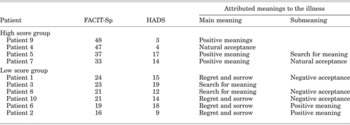
Table 2 shows both the FACIT-Sp scores and attributed meanings to illness in addition to HADS. We can classify patients into two groups based on the mean FACIT-Sp score (32) for the normal population. Patients over the mean score constituted the high spiritual well-being group and those below the mean score constituted the low spiritual well-being group. Observing main attributed meanings to the illness, patients in the high spiritual well-being group attributed positive meanings or a natural acceptance to the illness. On the other hand, those in the low spiritual well-being group attributed “regret and sorrow,” and “search for meaning” to the illness.
Attributed meaning of high and low spiritual well-being groups separated by the standardized means of FACIT-Sp score (32)

DISCUSSION
Types of Transformation
Three types of transformation of “group with a peaceful mind,” “group with positive attitude and uneasy feelings,” and “group with uneasy feelings,” were extracted. The type “group with peaceful mind” is similar to “positive transformation” in Taylor (Reference Taylor2000) in the point that patients were adaptive. And these three types of transformation accord with a study for cancer survivors (Carpenter et al., Reference Carpenter, Brockopp and Andykowski1999). They also extracted three types of transformation: positive transformation; minimal transformation, in which patients felt some self-transformation; and feeling stuck, in which patients wanted to change, but they could not. These results suggest that there are similarities in transformation types both in cancer survivors and terminally ill cancer patients.
Moreover, as for trigger of positive transformation, Patient 9 conspicuously changed from a negative psychological status to a positive one by encountering good art and other patients' effort. As Compton (Reference Compton2005) demonstrated that aesthetic sense is important for increasing humans' well-being, good music promoted the positive transformation. Although Coward (Reference Coward2003) demonstrated an intervention to facilitate self-transcendence, we need to clarify factors of triggers of transformation much more in order to develop suitable interventions to support patients in the “group with uneasy feelings.”
Meaning of Cancer
There were five kinds of attributed meanings (positive meaning, natural acceptance, negative acceptance, search for meaning, and regret and sorrow). Moreover, in the positive meaning, there were subcategories (recognition of transcendence, appreciation toward others, increased self-respect, healthy perspective about self, wish to do based on illness).
About positive meaning, “recognition of transcendence” in the present study accorded with “intensified spiritual awareness” in Taylor (Reference Taylor2000), though there is a difference between Japanese and Americans; American participants referred to God as spiritual awareness in Taylor, whereas Japanese patients referred to transcendent power such as immense respect for nature more than a specific God (Ama, Reference Ama2006). Recognition of transcendence of Patient 9 is similar to results of a previous study that as many as 50% of cancer patients report becoming “more religious” or that “illness has strengthened their faith (Brady et al., Reference Brady, Peterman and Fitchett1999).” Because the number of participants was too small, we need to increase the number of participants and examine how many patients experience recognition of transcendence or religious matters and how its recognition functions in psychological adjustment.
“Natural acceptance” may be related to the Japanese Zen way of thinking (Yanagida, Reference Yanagida2005). People know that death strikes suddenly and mercilessly; thus, they live life to the fullest every day. They wish to lead a good life and welcome a peaceful death. According to Kohli and Dalal (Reference Kohli and Dalal1998), cancer patients in Allahabad, India, or Hindu women attributed their illness to metaphysical beliefs—fate, God's will, karma. Belief that God's will had caused their cancer was associated with a lack of perceived controllability over their illness; however, it was also associated with stronger feelings of recovery for cancer. Although an attribution of beyond my control may be considered undesirable in cultures where people are encouraged to take control over their illness, in other cultures the same attribution may be seen in a more positive light (MacLachlan, Reference MacLachlan2006). In Japanese culture, natural acceptance as a way of thinking in which patients let matters take their course naturally may be psychologically adaptive.
Moreover, we may be able to add a concept of “natural acceptance” to previous studies' categories (global meaning, appraised meaning, search for meaning, and meaning as outcome) by Park and Folkman (Reference Park and Folkman1997) and Lee et al. (Reference Lee, Cohen and Edgar2004).
Relationships between Positive Meaning and Spiritual Well-being
Patients who found “positive meaning” achieved high spiritual well-being. In addition to the previous studies that showed that meaning related to the distress level of cancer survivors (Jim & Anderson, Reference Jim and Andersen2007), we suggest that positive attributed meaning to the illness relates to the high levels of spiritual well-being of terminally ill cancer patients. Though Park (Reference Park2007) explained the pathway between spirituality and health (physical function and well-being) in the meaning schema, we will show a pathway between kinds of attributed meaning to the illness and the spiritual well-being of terminally ill cancer patients empirically.
Moreover, patients who found “natural acceptance” also achieved high spiritual well-being. This attitude may relate to a concept of “mindfulness.” Mindfulness is the awareness that emerges through paying attention on purpose, in the present moment, without judgment of things as they are (Williams et al., Reference Williams, Teasdale and Segal2007). Because there are few studies about this therapy for terminally ill cancer patients or Japanese patients, we will examine characteristics of relationships between mindfulness psychotherapy and natural acceptance.
Clinical Implication and Limitation
There are some interventions on spiritual well-being such as listening to patients' personal stories (O'Connor & Wicker, Reference O'Connor and Wicker1995), meaning-centered group psychotherapy (Breitbart, Reference Breitbart2002), meaning-making interventions (Lee et al, Reference Lee, Cohen and Edgar2006), and the short-term life review (Ando et al., Reference Ando, Morita and Okamoto2008). However, there are few interventions tailored to kinds of attributed meanings to the illness. Following a suggestion by Tang et al. (Reference Tang, Lee and Chan2007) that meaning-searching process brings growth and transformation through the cancer experience, we need to examine relationships between meaning-making processes and spiritual well-being, clarifying the differences among cultures.
Lastly, as the number of participants was too small, we can not generalize results of the present study. A study to increase more participants will be promising.