Paratuberculosis, caused by Mycobacterium avium subsp. paratuberculosis (MAP) is a chronic enteric infection primarily of ruminants (McAloon et al., Reference McAloon, Roche, Ritter, Barkema, Whyte, More, O'Grady, Green and Doherty2019) causing significant economic losses (Bates et al., Reference Bates, O'Brien, Liggett and Griffin2018). Current means to reduce the on-farm prevalence is by minimizing the calves' exposure to MAP (Fecteau, Reference Fecteau2017). This approach is expensive and requires a long time to show results: paratuberculosis was eradicated from a goat farm after 19 years of intensive control measures but seemingly this was not achieved thus far in a cattle herd (McAloon et al., Reference McAloon, Roche, Ritter, Barkema, Whyte, More, O'Grady, Green and Doherty2019). The usefulness of vaccines is limited due to their inability to prevent infection (McAloon et al., Reference McAloon, Roche, Ritter, Barkema, Whyte, More, O'Grady, Green and Doherty2019). Consequently, new methods to deal with the disease should be explored. Our research studied one such new approach, namely the assessment of the impact of the introduction of live Mycobacterium vaccae on the herd prevalence of paratuberculosis.
Mycobacterium vaccae is a fast-growing member of the Mycobacteriaceae. Its immunomodulatory and immunotherapeutic capabilities were evaluated in humans and animals and it has been categorized as ‘Generally Considered Safe’ (Matthews and Jenks, Reference Matthews and Jenks2013). The beneficial effects of M. vaccae, based primarily on the stimulation of the cellular component of the immune system, on mycobacterial infections (Zheng et al., Reference Zheng, Chen, Liu, Li, Liu, Zheng, Liu, Dong, Sun, Zhu, Yang, Zhang and Jin2017), allergies and other conditions was reported (Elad et al., Reference Elad, Leitner, Krifucks, Blum, Brenner and Weisbelith2019). Moreover, the microorganism was found to have neurotropic, stress reducing, activities (Loupy et al., Reference Loupy, Arnold, Hassell, Lieb, Milton, Cler, Fox, Siebler, Schmidt, Noronha, Day and Lowry2019). The safety and immunological efficacy of the administration of inactivated M. vaccae, in preventing and treating human tuberculosis was recently confirmed (Zhu et al., Reference Zhu, Dockrell, Ottenhoff, Evans and Zhang2018).
In the quasi-totality of reports, M. vaccae was used in an inactivated form. In a previous publication (Elad et al., Reference Elad, Leitner, Krifucks, Blum, Brenner and Weisbelith2019) we reported the safety of administering live M. vaccae to new-born heifers. The objective of the current investigation was to apply the conclusions of that study on a large scale to assess the long-term impact of the microorganism's introduction on the prevalence of paratuberculosis in a dairy herd as assessed by milk ELISA and faecal qPCR. To the best of our knowledge, no similar investigations have been reported thus far.
Materials and methods
Experimental design
In a previous publication (Elad et al., Reference Elad, Leitner, Krifucks, Blum, Brenner and Weisbelith2019) we have shown that some of the heifers treated with live M. vaccae shed the microorganism for an undetermined period and transmitted it to other animals in their vicinity. Thus, in the current research, a classical case−control study was not possible since there could be no certainty that control animals would not be exposed to the microorganism. Consequently, a before-after model was implemented, in which the test group was compared to similar groups of untreated cows in the same dairy, at different times. This approach is inherently weaker than the one based on a case−control model since time-dependent confounding factors may impact the outcome of the experiment. Since the herd prevalence of paratuberculosis is extensively influenced by management practices, changes in these routines were noted.
Management
The experiment (permits 020_b8961 and 020_b11460 of the Ethical Committee of the Israeli Veterinary Services) was conducted on a dairy farm with about 350–390 Israeli-Holstein milking cows, kept in open barns. There was no dedicated calving area. Calves were removed from the dams as soon as the calving was noticed and housed in open, ground-dwelling sheds until about 50 d of age. Subsequently they were united into age-dependent, adjacent, groups, divided by corrals. Since the latter were in bad repair, weaned heifers could roam around the farm and mingle with the adult cows (online Supplementary Figure S1).
Several management changes were made during the period investigated. Starting mid-2014, Ruter (ACAI Nutricion Animal, Argentina) was added to neonate heifers' feed to achieve early weaning. In addition, feeding with surplus milk was supplanted by milk replacer. For adult cows, the ventilation system, of essential importance in the Israeli summer, was improved in 2013 and 2018. Moreover, prior to 2013, only cows with clinical paratuberculosis were removed from the herd. Thereafter, mELISA-positive animals were removed before the onset of diarrhoea, albeit irregularly due to economic considerations (as demonstrated by the fact that positive cows, including highly positive ones, were tested in consecutive years).
Treatment
Starting November 2014, each heifer was given a dose of 1010 colony forming units of live M. vaccae, strain NCTC 10916, per gavage within the first 24 h after birth and a second dose 2 weeks later, as previously described (Elad et al., Reference Elad, Leitner, Krifucks, Blum, Brenner and Weisbelith2019).
Sampling and testing
Samples for the mELISA test were submitted yearly to the National Service for Udder Health & Milk Quality (NSUHMQ) of the Israel Dairy Board (ISO 17025 accredited). Samples were tested with the ID Screen kit (IdVet, France) and interpreted by the manufacturer's recommendations: positive for scores equal to or higher than 0.3. In addition, cows were classified as ‘highly positive’ if the score was above (the arbitrarily defined) value of 1. The laboratory technical personnel were not informed that the samples were part of an experiment.
The age of the tested animals may impact paratuberculosis mELISA results (the older the cows the more likely it is to have detectable antibody titres). Similarly, high replacement rates could lead to a reduction of positivity rates. Thus, the age statistics and replacement rates were noted and are presented in Table 1.
Number and age of cows sampled for milk ELISA and the test's results, 2012–2018

Av, average; sd, standard deviation.
a Tested February 2019.
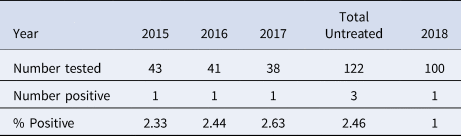
For qPCR, rectal faecal samples were taken from about 50% of cows reaching 3 years of age during 2015, 2016 and 2017. These samples served as negative controls. One hundred samples (100%) were taken from the treated cows that reached the age of 3 years in 2018. Thus, a comparable number of control animals (n = 122) and test animals (n = 100) was obtained.
Samples were kept at −18°C until examined. They were tested with the LSI VetMAX kit (Thermo Fisher Scientific, US) and interpreted by the manufacturer's recommendations.
Three (2 control and 1 test) of the four positive cows were still on the farm at the end of 2019. Duplicate feacal samples, taken 7 d apart, were checked by qPCR.
Results
mELISA results
The rate of positive cows decreased from 6.1% in 2014 to 0% in 2017, a value that remained unchanged in 2018 (checked in February 2019) (Table 1). In February 2020, one treated cow, persistently qPCR positive (see below) was found to be mELISA positive. It is noteworthy that the average age in 2017 and 2018 increased slightly relative to the previous years, a fact that makes the test more sensitive. Replacement rates did not differ from previous years during either 2015 or 2016, the years of the most drastic decline in positive cow rates.
Highly positive cow rates declined relatively faster (Table 1). In fact, while relatively stable at 2–3% before the introduction of M. vaccae (2012–2014), a drop of more than 90% (from 3.04% to 0.3%) was observed in 2015 and to 0% in 2016.
qPCR results
Three out of 122 control animals and 1 out of 100 treated animals (2.46% and 1% respectively) were found to be qPCR positive (Table 2). All 4 cows were mELISA negative. Of the faecal samples examined in October 2019, the 2 control cows turned negative while, interestingly, the test cow continued shedding MAP. It converted to be mELISA positive when the herd was tested in February 2020.
Results of faecal qPCR of 3 years old cows. 2015−2017: untreated, 2018: treated

Discussion
Immunomodulating the host's defensive mechanisms to control infectious diseases has been suggested (Hancock et al., Reference Hancock, Nijnik and Philpott2012). M. vaccae seems to be an ideal candidate for this task in general and for paratuberculosis in particular (Elad et al., Reference Elad, Leitner, Krifucks, Blum, Brenner and Weisbelith2019). Our objective was to assess the impact of the introduction of live M. vaccae to a dairy farm on the prevalence of paratuberculosis. Its planned endpoint was the total replacement of the cows in the herd by treated animals. Unexpectedly, anti-MAP antibody prevalence decreased to zero in the third year after the experiment's onset, remaining unchanged thereafter. This, to the best of our knowledge, is unprecedented (McAloon et al., Reference McAloon, Roche, Ritter, Barkema, Whyte, More, O'Grady, Green and Doherty2019). Although some of this reduction may result from changes in the cow removal policy, its pace (3 years) and extent (0% prevalence) suggests that other factors were involved since we are not aware of achieving a similar outcome with management alone. Neither it is likely that time-dependent confounding factors, inherent to the before−after experimental design, could have had a such profound influence on the results. Thus, it is, at least, plausible that the introduction of M. vaccae contributed to the results observed in this study.
A live vaccine based on a leuD MAP mutant was able to induce protective immunity against paratuberculosis in goats (Faisal et al., Reference Faisal, Chen, Yan, Chen, Useh, Yan, Guo, Wang, Glaser, McDonough, Singh, Davis, Akey and Chang2013). A similar action by M. vaccae is conceivable.
Interestingly, the decline in prevalence was observed in adult cows as soon as 8 months after the experiment's outset. This is especially intriguing since M. vaccae was not directly administered to these animals. They were, however, probably exposed to the microorganism following their direct contact with the M. vaccae shedding heifers roaming the farm. Thus, paradoxically, a circumstance that would normally expose the heifers to MAP infection, had the opposite effect. Another interesting result of this study is the rate of decline in the prevalence of mELISA-positive animals. Although mELISA antibody titres of individual animals may vary in time, when considered at the herd level our results are of significance. In 2015 and 2016 the prevalence of mELISA positive cows was reduced by 65.7 and 86% respectively, while replacement rates for the same years were 26 and 32%. Thus, even assuming the unlikely event that all the cows that were removed were mELISA positive, some others had to undergo a reversion from positive to negative. M. vaccae is known to have immunomodulatory capabilities (Zheng et al., Reference Zheng, Chen, Liu, Li, Liu, Zheng, Liu, Dong, Sun, Zhu, Yang, Zhang and Jin2017) targeted especially at the cellular component of the immune system. In paratuberculosis, the cellular (protective) and humoral (unprotective) immune reactions are inversely proportional (Cocito et al., Reference Cocito, Gilot, Coene, de Kesel, Poupart and Vannuffel1994). Thus, if adult cows were indirectly exposed to the microorganism, their cellular immunity might have been stimulated leading to a decrease in antibody titres.
Differences of shedding are less manifest than the ones of the mELISA due to the relatively low number of positive animals: positivity was 1% in treated animals vs. 2.6% in the control group. MAP shedding may precede the humoral reaction (Fecteau, Reference Fecteau2017), thus the fact that cows were qPCR positive does not contradict the negative result for mELISA. The fact that two control animals stopped shedding MAP underscores the possibility of the immunotherapeutic activity of M. vaccae. The persistent MAP shedding by one test animal, becoming mELISA positive in 2020, remains unexplained but may be due to some individual deficiency.
In conclusion, the introduction of M. vaccae to a dairy farm led to the reduction of cows positive at the milk ELISA antibody titre to Mycobacterium avium subsp. paratuberculosis from 6 to 0% in 3 years, remaining unchanged for the following 2 years. The pathogen's shedding was reduced from 2.46 to 1%. The pace and extent of the decline cannot be explained by the limited management changes implemented on the test farm. Indeed, there was no dedicated calving area and young, susceptible, heifers were in direct contact with shedding cows, two mainstays of paratuberculosis control programs. Thus, we believe that the results observed may be attributed to the immunomodulatory and immunotherapeutic activity of M. vaccae. The direct contact between heifers and cows might have been essential in achieving the results hereby reported. The materials and methods used in this study are straightforward, inexpensive and, under the conditions described, safe. Carl Sagan is quoted to have said that ‘Extraordinary claims require extraordinary evidence’. We believe that our results match the first part of the quote. For the second part, further research to confirm or disprove our findings are warranted as are the assessment of the mechanisms by which M. vaccae interferes with the pathogenesis of paratuberculosis, leading to a novel approach with a potential to control the disease.
Supplementary material
The supplementary material for this article can be found at https://doi.org/10.1017/S0022029920000278.
Acknowledgements
We are grateful to Mr. Koren Sagi, Mr. Menashe Shoham and Mr. Shamai Zur for their invaluable technical contribution to this study. The authors declare no conflict of interest. This research was partially supported by the Israeli Dairy Board, grant no. 045-0291-17.