Introduction
Zinc-rich spinel [(Zn,Fe,Mg)Al2O4] is a relatively common mineral, found in various geological settings and rock types, whereas zinc-rich chromite is rare. In this investigation, we use the term zinc-rich chromite to refer empirically to spinel that contains more that 35.0 wt.% Cr2O3 and more than 1.0 wt.% ZnO. Wylie et al. (Reference Wylie, Candela and Burke1987) noted that Zn-rich chromite is unusual enough to be reported whenever found in nature. Zinc-rich chromite, containing up to 2.62 wt.% ZnO, was first reported in chromite ores by Donath (Reference Donath1931) from Ramberget, Norway and named subsequently as a new mineral ‘donathite’ by Seeliger and Mücke (Reference Seeliger and Mücke1969). This name was later discredited by the International Mineralogical Association (Burns et al., Reference Burns, Hawthorne, Libowitzky, Bordes and Ewing1997). Electron probe microanalyses (EPMA) of samples with similar physical properties from the same region by Moore (Reference Moore1977) demonstrated that the chromite reported by Donath (Reference Donath1931) contains <0.3 wt.% ZnO and is therefore, not unusual. Some of the earliest reported and well-studied zinc-rich chromite containing more than a few wt.% ZnO originate from the ‘chromite dike’, i.e. serpentinised ultramafites, skarn and pelitic schist adjacent to the ore zones in the Outokumpu mine, Finland (Thayer et al., Reference Thayer, Milton, Dinnin and Rose1964; Knorring et al., Reference Knorring, Condliffe and Tong1986; Wylie et al., Reference Wylie, Candela and Burke1987; Weiser and Hirdes, Reference Weiser and Hirdes1997; Weiser et al., Reference Weiser, Kojonen and Lodziak2008). The highest amount of ZnO (19.06 wt.%) in the zinc-rich chromite of Outokumpu was described from the pelitic schist by Wylie et al. (Reference Wylie, Candela and Burke1987). Zinc-bearing and zinc-rich chromite have been described as inclusions in natural diamonds (Meyer and Boyd, Reference Meyer and Boyd1972; Moorbath et al., Reference Moorbath, Taylor and Jones1986; Griffin et al., Reference Griffin, Sobolev, Ryan, Pokhilenko, Win and Yefimova1993; Taylor et al., Reference Taylor, Anand, Promprated, Floss and Sobolev2003; Donnelly et al., Reference Donnelly, Stachel, Creighton, Muehlenbachs and Whiteford2007) and in meteorites (Bunch et al., Reference Bunch, Keil and Huss1972; Chikami et al., Reference Chikami, Miyamoto and Takeda1999). However, Zn-bearing and zinc-rich chromite have been described more commonly from metasomatised/serpentinised mafic–-ultramafic rocks with/without associated magmatic/hydrothermal sulfide mineralisation (Groves et al., Reference Groves, Barrett, Binns and McQueen1977, Reference Groves, Barret and Brotherton1983; Bevan and Mallinson, Reference Bevan and Mallinson1980; Donaldson and Bromley, Reference Donaldson and Bromley1981; Wylie et al., Reference Wylie, Candela and Burke1987; Pan and Fleet, Reference Pan and Fleet1989, Reference Pan and Fleet1991; Zakrzewski, Reference Zakrzewski1989; Béziat and Monchoux, Reference Béziat and Monchoux1991; Béziat et al., Reference Béziat, Joron and Monchoux1993; Liipo et al., Reference Liipo, Vuollo, Nykanen and Piirainen1995; Gahlan and Arai, Reference Gahlan and Arai2007; Singh and Singh, Reference Singh and Singh2013; Schulze et al., Reference Schulze, Flemming, Shepherd and Helmstaedt2014; Fanlo et al., Reference Fanlo, Gervilla, Colás and Subías2015; Matsumoto et al., Reference Matsumoto, Arai and Miura2017). Béziat and Monchoux (Reference Béziat and Monchoux1991) reported 27.16 wt.% ZnO in chromium-rich spinel containing 26.48 wt.% Cr2O3 in association with Au-bearing As−S mineralisation from metasomatised mafic rocks in the Salsigne district gold deposit, Montagne Noire, France. The Cr2O3 content in the grain containing the highest ZnO is much lower than typical chromite (<35.0 wt.% Cr2O3). Chromite grains containing >35.0 wt.% Cr2O3 in their investigation contains a maximum of 6.28 wt.% ZnO. Among other metasomatised rocks, zinc-rich chromite is described from calcsilicate skarns e.g.: Outokumpu (Knorring et al., Reference Knorring, Condliffe and Tong1986); Hemlo area, Ontario Canada (Pan and Fleet, Reference Pan and Fleet1989); and the Bandihalli Supracrustal belt, Dharwar craton, India (Taguchi et al., Reference Taguchi, Satish-Kumar, Hokada and Jayananda2012). These skarns are interpreted to be metasomatised ultramafic rocks. Zinc-rich chromite in other igneous rocks or in their altered equivalents is rare. Wagner and Velde (Reference Wagner and Velde1985) described zinc-rich chromite (with 8.74 wt.% ZnO) in peralkaline minette from the Aosta valley, Italy. Apart from mafic–ultramafic settings and igneous rocks, detrital zinc-rich chromite has been described from sedimentary environments, such as in the radioactive quartz-pebble conglomerate of the Witwatersrand, South Africa (Eales and Reynolds, Reference Eales and Reynolds1983; referred to in Weiser and Hirdes, Reference Weiser and Hirdes1997), and Tarkwa, Ghana (Weiser and Hirdes, Reference Weiser and Hirdes1997); in quartzite in the Ferreira-Ficalho Thrust Fault, South Portugal (Figueiras and Waerenborgh, Reference Figueiras and Waerenborgh1997); in Ni-laterite, east Vermion, Edessa and Olympos, northern Greece (Economou-Eliopoulos, Reference Economou-Eliopoulos2003); from the Guaniamo river diamondiferous placer, Venezuela (Johan and Ohnenstetter, Reference Johan and Ohnenstetter2010); from contact-metamorphosed sedimentary rocks, Nagasawa, SW Japan (Matsumoto et al., Reference Matsumoto, Arai and Miura2017); and from fuchsitic metasedimentary rocks, Jack Hills, Western Australia (Staddon et al., Reference Staddon, Parkinson, Cavosie, Elliott, Valley, Fournelle, Kemp and Shirey2021). The zinc-rich chromite in Tarkwa, Ghana contains 19.42 wt.% ZnO, whereas that from Venezuela contains up to 30.82 wt.% and is described as ‘zincochromite’ (ZnCr2O4, a phase first described by Nesterov and Rumyantseva, Reference Nesterov and Rumyantseva1987).
From the above discussion it is apparent that reports on zinc-rich chromite in sedimentary environments are rare and none have been reported previously from India. In this study we describe detrital zinc-rich chromite, containing up to ~15 wt.% ZnO from radioactive quartz-pebble conglomerate overlying Archaean granitic basement from eastern India. We also discuss the possible source and origin of this unusually Zn-rich chromite in the conglomerate.
Geological background
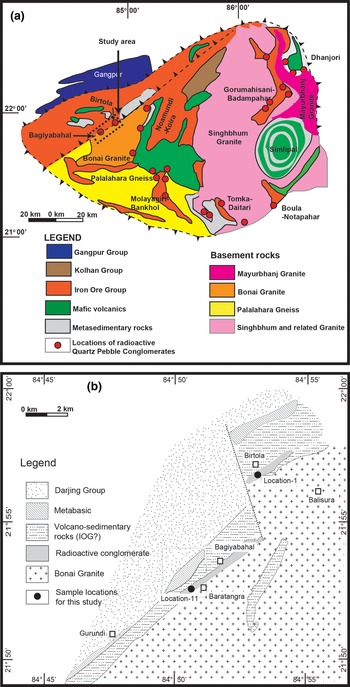
The Singhbhum Craton (Fig. 1) in eastern India is a granite–greenstone terrain. The Palaeoarchean tonalite−trondhjemite−granodiorite−granite consists of the Older Metamorphic Tonalite Gneisses and the Singhbhum granitoid complex (3.45–3.29 Ga; Moorbath et al., 1986a; Goswami et al., Reference Goswami, Mishra, Wiedenbeck, Ray and Saha1995; Mishra et al., Reference Mishra, Deomurari, Wiedenbeck, Goswami, Ray and Saha1999; Acharyya et al., Reference Acharyya, Gupta and Orihashi2010; Tait et al., Reference Tait, Zimmermann, Miyazaki, Presnyakov, Chang, Mukhopadhyay and Sergeev2011; Upadhyay et al., Reference Upadhyay, Chattopadhyay and Mezger2019; Nelson et al., Reference Nelson, Bhattacharya, Thern and Altermann2014; Upadhyay et al., Reference Upadhyay, Chattopadhyay, Kooijman, Mezger and Berndt2014; Dey et al., Reference Dey, Topno, Liu and Zong2017; Olierook et al., Reference Olierook, Clark, Reddy, Mazumder, Jourdan and Evans2019; Pandey et al., Reference Pandey, Mezger, Ranjan, Upadhyay, Villa, Nägler and Vollstaedt2019). The Palaeoarchean–Mesoarchean greenstone belts contain the Iron Ore Group comprising low-grade volcano-sedimentary rocks (Saha, Reference Saha1994; Mukhopadhyay et al., Reference Mukhopadhyay, Beukes, Armstrong, Zimmermann, Ghosh and Medda2008). The Older Metamorphic Group consisits of high-grade supracrustals of ortho-amphibolites, para-amphibolites, pelitic schists and quartzites. Relatively smaller granitoid bodies, namely the Mayurbhang granite and Bonai granite occur, respectively, on the east and west of the main Singhbhum granite province. Palaeoproterozoic volcano-sedimentary basins such as the Dhanjori, Simlipal and Jagannathpur rim the Archaean craton (Fig. 1a).
(a) Geological map of the eastern Indian craton (after Saha, Reference Saha1994). The locations of radioactive conglomerate are provided by the Atomic Minerals Directorate for Exploration and Research. The study area around Birtola and Bagiyabahal is located on the west of the Bonai granite (marked by a dashed rectangular box). (b) Geological map around the study area (modified after Kumar et al., Reference Kumar, Birua, Pande, Nath, Babu and Pandit2009) with the sample locations.

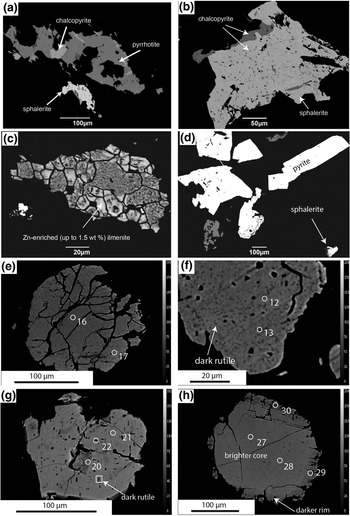
The quartz-pebble conglomerates described in this contribution are from the Birtola and Bagiyabahal areas located on the western margin of the Bonai granite. The study area generally comprises a thick volcano-sedimentary sequence that overlies the basement granite and underlies scree deposits (Fig. 1b). Two phases of granite magmatism at 3369 ± 57 and 3163 ± 126 Ma (Sengupta et al., Reference Sengupta, Paul, de Laeter, McNaughton, Bandopadhyay and de Smeth1991) comprise the Bonai pluton. The volcano-sedimentary sequence consists of multiple metasedimentary and metavolcanic units. The metasedimentary rocks are represented by intercalated metaconglomerate and quartzite horizons. Sedimentary structure and facies analyses suggest that the conglomerates represent channel thalweg deposits overlying fluvial bounding surfaces. Some of the intercalated ultramafic volcanic rocks are komatiitic containing serpentinised forsteritic olivine. The komatiite contains disseminated chromite, pentlandite, Co-pentlandite and Ni-pyrrhotite. The chromite grains (>35.0 wt.% Cr2O3) have low values of Mg# (0.01 to 0.17; average: 0.04; n = 50) [Mg/(Mg + Fe2+)], moderate to high values of Cr# (0.51 to 0.88; average: 0.74; n = 50) [(Cr/(Cr + Al)], low YFe (0.11 to 0.49; average: 0.22; n = 50) [Fe3+/(Fe3++Al + Cr)], contain variable TiO2 (0.23 to 5.99 wt.%; average: 2.41) and MnO (0.53 to 2.81 wt.%; average 1.642) and up to 1.25 wt.% ZnO (unpublished data) and are compositionally similar to chromite in komatiite metamorphosed at greenschist facies (Barnes and Roeder, Reference Barnes and Roeder2001). In places, sulfide veinlets consisting of chalcopyrite−sphalerite−pyrrhotite−quartz ± biotite ± chlorite occur in the ultramafic rocks (Fig. 3a,b). Sphalerite grains occasionally contain blebs of chalcopyrite, a texture commonly known as chalcopyrite disease (Fig. 3b).
Analytical methods
Back-scattered electron (BSE) images of the samples and semi-quantitative analyses of the minerals were obtained using a JEOL JSM 6490 Scanning Electron Microscope (SEM) hosted at the Department of Geology and Geophysics, Indian Institute of Technology (IIT), Kharagpur. The major element compositions of chromite were determined at the same institute using a Cameca SX 100 electron microprobe equipped with four wavelength dispersive spectrometers with an acceleration voltage of 15 kV and beam current of 20 nA with 1 μm beam size. The dwell times were set at 10 s for the peak and 5 s on the background. The following reference materials and emission lines were used: CrKα (Cr2O3), AlKα (Al2O3), FeKα (hematite), ZnKα (sphalerite), TiKα (rutile), MgKα (MgO), MnKα (rhodonite) and SiKα (orthoclase).
Sample description, texture and geochemistry of zinc-rich chromite.
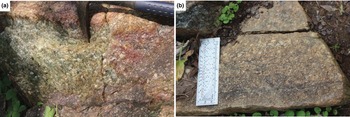
Samples were collected from conglomerates from two locations, Birtola (Location 1: 21°56′51.80″N 84°52′51.50″E) and from the Bagiyabahal area (Location 11: 21°52′59.00″N 84°50′54.80″E) (Fig. 1b). The mineralogy of the conglomerate and other rocks were investigated using standard polished thin sections with a petrographic optical microscope, scanning electron microscope and electron microprobe. The conglomerates are polymictic and matrix-supported (Fig. 2). The pebbles, up to ~1.5 cm in diameter, are represented predominantly by coarse-grained clasts derived from a quartz vein with minor clasts of fine-grained chert and quartzite. The clasts are stretched and fractured in places implying post-depositional deformation of the conglomerates. The matrix is composed of quartz, chlorite, sericite and the following heavy minerals: uraninite, zircon, chromite, ilmenite, rutile, apatite, monazite, xenotime, pyrite and zircon (Kumar et al., Reference Kumar, Birua, Pande, Nath, Babu and Pandit2009). Uraninite, zircon and chromite are well-rounded and detrital, similar to other Late Archaean to Palaeoproterozoic quartz-pebble conglomerate-hosted uranium mineralisation. Previous studies report up to 0.039 wt.% U3O8 (Kumar et al., Reference Kumar, Birua, Pande, Nath, Babu and Pandit2009) and 100 ppb to 2.25 ppm Au in the radioactive conglomerates (Jana et al., Reference Jana, Sarkar, Kumar, Kumar, Yadav and Kumar2016). Both well-rounded and sub-rounded to angular zircons are present; the latter exhibit evidence for fluid-induced alteration to quartz and xenotime. The rims of Fe-oxides and Fe-hydroxides can be enriched in Cu in places. Disseminated ilmenite grains are commonly brecciated and are enriched in Zn along the grain boundaries (Fig. 3c), containing up to 1.5 wt.% ZnO (SEM-energy-dispersive spectroscopy (EDS) data). Both sub-rounded, possibly detrital, and euhedral authigenic pyrite are also present. Sparse, angular sphalerite is occurs in association with authigenic pyrite (Fig. 3d). These textural features suggest that the conglomerate was subjected to fluid-induced modification.
Field photograph of radioactive conglomerates. Samples in (a) and (b) are from Location 1 and Location 11, respectively.

Back-scattered electron images of different minerals from the sulfide vein in ultramafic rock (a and b) and conglomerate (c to h). (a, b) Sulfide minerals from the sphalerite-bearing sulfide veins seen in the mafic-ultramafic rocks; note sphalerite contains chalcopyrite (darker spots) blebs. (c) Ilmenite with localised Zn enrichment. (d) Sphalerite in association with well-developed angular grains of pyrite. (e–h) Well-rounded variably fractured zinc-rich chromite in conglomerate. Some grains are clean and nearly homogeneous (e and h) whereas some are heterogeneous (f and g) and contain spherical (f) or lamellar (g) rutile inclusions (exsolutions?). The grain in (h) has a darker rim that is enriched in Zn and Al and depleted in Fe and Cr. The numerals on figures refer to spot numbers in Table 1. Chromite grains in (e) and (f) are from Location 1 whereas those in (g) and (h) are from Location 11. See text for discussion.

Chromite, 5−6 grains within the scale of a thin section (including the pebbles and matrix), are present as disseminated grains in the matrix of the conglomerates. Most chromite grains are well-rounded with a diameter of up to ~200 μm (Fig. 3). Some grains are extensively fractured. Two different types of grains are present (Fig. 3). One type appears clean and has nearly homogeneous grey shades in BSE images (Fig. 3e and h). The other type has variation in grey shades in BSE images with darker sub-rounded disseminated spots or oriented darker lamellar inclusions (Fig. 3f and g). Some grains have patchy darker rims compared to the cores (Fig. 3h).
Compositions of zinc-rich chromite are given in Table 1. In general, chromite is poor in Mg with a very low Mg# (0 to 0.02; average 0.01; n = 26), the highest MgO content is 0.19 wt.%. The Cr2O3, Al2O3 and FeO content are strongly variable and range between 35.86 and 51.08 wt.%, 5.97 and 20.14 wt.% and 21.26 and 35.06 wt.% respectively. Overall, they have moderate values of Cr# (0.54 to 0.79; average: 0.68; n = 26) and low YFe (0.03 to 0.16; average: 0.10). The MnO content of most chromite grains ranges between 0.18 to 0.56 wt.%; two spots had 2.25 and 2.55 wt.% MnO. Vanadium and Ti were detected in all grains and the V2O3 and TiO2 contents range from 0.12 to 0.29 wt.% and 0.33 to 3.53 wt.% respectively. The actual compositions of the circular and lamellar spots (darker in BSE) in chromite could not be obtained due to their small size. However, higher TiO2 contents were noted from these dark spots (in SEM-EDS and EPMA). One such dark lamellum analysed gave 70.03.wt.%, 6.03 wt.%, 13.97 wt.%, 4.91 wt.% and 3.34 wt.% of TiO2, FeO, Cr2O3, Al2O3 and ZnO respectively. On the basis of this observation and data, sub-rounded and lamellar dark spots are considered to be rutile. All the chromite grains analysed are very rich in Zn, the ZnO concentrations range between 7.11 and 15.51 wt.%. In the partially-zoned (in BSE) zinc-rich chromite grain (Fig. 3h) the rim is enriched in Zn and Al and depleted in Fe and Cr; the core contains 7.10, 15.56, 35.43, 39.50 wt.% and the rim contains 15.51, 19.24, 25.25 and 38.01 wt.% of ZnO, Al2O3, FeO and Cr2O3 respectively. The core is slightly more enriched in Ti than the altered rim (0.47 wt.% and 0.26 wt.% TiO2 at the core and rim respectively).
Representative compositions (wt.%) of zinc-rich chromite.

The formula of chromite was calculated on the basis of 32 oxygens. The Fe3+ and Fe2+ contents were calculated based on stoichiometry. In general, Zn-rich grains are also rich in Al, but depleted in Cr and Fe2+. This is demonstrated by a strong positive correlation between Al and Zn, strong negative correlation between Al and Cr, and between Zn and Fe+2 (Fig. 4a−c), and moderate negative correlation between Al and Fe3+ (not shown). Zinc also has a moderate negative correlation with Mn, however it is not as strong as the correlation between Zn and Fe2+ (Fig. 4d). There is no discernible correlation between Mg and Zn (not shown). Titanium has a discernible negative correlation with Al and Zn (Fig. 4e,f). The compositions of zinc-rich chromite are plotted in ZnO vs. MnO and MgO vs. ZnO + MnO diagrams for comparison with Zn-rich chromites found in different host rocks/minerals (Arai and Ishimaru, Reference Arai and Ishimaru2011) (Fig. 4g,h). It is evident from this diagram that although the Zn-rich chromites analysed in this work are most similar to those found in altered/metamorphosed peridotites, although they are depleted in MgO and MnO compared to such chromite.
Binary atoms per formula unit (apfu) and oxide distribution diagrams. Note the strong positive correlation between Zn and Al, negative correlation between Al and Cr, and between Zn and Fe2+. Zn also has a moderate negative correlation with Mn. Titanium has a negative correlation (excepting those with high Ti values; due to mixed analyses) with Zn (e) and Al (f). The chromites investigated are most similar to zinc-rich chromite in altered/metamorphosed peridotite although they contain much less MnO and MgO compared to such chromite. The fields drawn are based on data presented in Arai and Ishimaru (Reference Arai and Ishimaru2011) for spinel containing >1.0 wt. % ZnO.

Discussion
The chromite is designated as zinc-rich chromite on the basis of >1.0 wt.% ZnO and >35.0 wt.% Cr2O3 (cf. Arai and Ishimaru, Reference Arai and Ishimaru2011). To our knowledge, this is the first reported occurrence of zinc-rich chromite having such high concentrations of ZnO from India and the third reported global occurrence of detrital zinc-rich chromite found in radioactive quartz-pebble conglomerates, known for elevated U and Au concentrations.
The strong negative correlation between Zn and Fe2+, Al and Cr, and Al and Fe3+, and strong positive correlation between Zn and Al, suggest that Zn substitutes predominantly for Fe2+ whereas Al substitutes for Cr and Fe3+ in the chromite structure. Albeit rare, on the basis of Zn and Al enrichment at the rim compared to the core of some grains, it is suggested that this substitution took place during a overprinting process resulting in partial transformation of (Fe)(Cr,Al,Fe3+)2O4 to ZnAl2O4, the latter still containing significant amounts of Fe and Cr due to incomplete substitution. A very low content of Mg and no discernible correlation between Mg and Zn suggest that the chromite was inherently low in Mg. It is suggested that the pristine chromite was Mg-poor and Fe-rich and contained some Fe3+. A negative correlation between Mn and Zn indicates that Mn was inherent to pre-existing chromite prior to Zn enrichment. Depletion of Ti in the altered rim and discernible negative correlation of Ti with Al and Zn is suggestive of the primary nature of Ti in chromite and existence of Ti-rich chromite prior to Zn enrichment. Haggerty (Reference Haggerty1972) proposed that Ti enters into Cr-rich spinel by a coupled substitution, Ti4++Fe2+ → 2Cr3+. In a study of exsolved rutile in chromite, Mitra and Samanta (Reference Mitra and Samanta1996) suggested that oxidation of chromite at high temperature and pressure (750°C and 5.7 kb) during the uplift of the host rock, results in exsolution of Ti (due to oxidation of Fe2+ to Fe3+ and consequent charge imbalance) from chromite and formation of rutile exsolution. Considering the high temperature and pressure of formation of rutile lamella in chromite, it is suggested that the exsolution lamella/blebs of rutile in some of the zinc-rich chromite investigated were produced at the provenance prior to their deposition in the conglomerates. Consequently, the presence of both chromite lacking inclusions and chromite with rutile exsolution in the same conglomerate can be best explained by derivation of chromite from multiple sources.
The above discussion suggests that the original chromite (prior to Zn enrichment) was Mg-poor, Fe-rich and contained substantial amounts of Ti, Mn and Fe3+. One possible provenance of such chromite might be komatiite. Komatiites, containing accessory chromite, are known from Archaean greenstone sequences located on the western part of Singhbhum craton (Chaudhuri et al., Reference Chaudhuri, Satish-Kumar, Mazumder and Biswas2017; Mondal et al., Reference Mondal, Das, Banerjee and Reisberg2019; Bachhar et al., Reference Bachhar, Saha, Santosh, Liu, Kwon, Banerjee, Patranabis-Deb and Deb2021), wherein chromite in serpentinised komatiite is reported to be Mg-poor (1.24 wt.% MgO) and Fe-rich (32.56 wt.% FeO) (Bachhar et al., Reference Bachhar, Saha, Santosh, Liu, Kwon, Banerjee, Patranabis-Deb and Deb2021). However, to our knowledge, there is no published literature on the geochemistry of chromite from the study area located on the western part of the Singhbhum craton. During this investigation we have found accessory chromite in komatiite overlying the conglomerate investigated. Interestingly, this chromite is Mg-poor, Fe-rich and contains variable proportions of Fe3+, Ti and Mn (Section “Geological Background”) similar to the inferred composition of the pristine chromite prior to Zn enrichment. Modification of compositionally similar chromite via the substitution mechanism that we have proposed above [Zn → (Fe2+ + Mn); Al → (Cr + Fe3+)] can lead to the formation of zinc-rich chromite in the conglomerate. However, as this komatiite occurs above the conglomerate it cannot be the source of the chromite in the conglomerate. We hypothesise that similar, but older komatiites from the greenstone sequences (Iron Ore Group) in the western margin of the Singhbhum craton are the potential source. Note that a komatiitic source for detrital chromite has been proposed for the Witwatersrand conglomerate (Barnes and Roeder, Reference Barnes and Roeder2001).
The origin of zinc-rich chromite is contentious. It has been suggested that crystallisation of Zn-bearing or zinc-rich chromite from, or by, interaction with sulfide melts related to sulfide mineralisation at the magmatic stage (Czamanske et al., Reference Czamanske, Himmelberg and Goff1976; Groves et al., Reference Groves, Barrett, Binns and McQueen1977, Reference Groves, Barret and Brotherton1983; Donaldson and Bromley, Reference Donaldson and Bromley1981; Liipo et al., Reference Liipo, Vuollo, Nykanen and Piirainen1995; Weiser and Hirdes, Reference Weiser and Hirdes1997). However, others suggest that zinc-rich chromite forms by hydrothermal/metamorphic fluid-induced alteration of pre-existing chromite (Knorring et al., Reference Knorring, Condliffe and Tong1986; Wylie et al., Reference Wylie, Candela and Burke1987; Pan and Fleet, Reference Pan and Fleet1989, Reference Pan and Fleet1991; Béziat and Monchoux, Reference Béziat and Monchoux1991; Béziat et al., Reference Béziat, Joron and Monchoux1993; Jurković and Jakšić, Reference Jurković and Jakšić1994; Challis et al., Reference Challis, Grapes and Palmer1995; Gahlan and Arai, Reference Gahlan and Arai2007; Johan and Ohnenstetter, Reference Johan and Ohnenstetter2010; Taguchi et al., Reference Taguchi, Satish-Kumar, Hokada and Jayananda2012; Singh and Singh, Reference Singh and Singh2013; Schulze et al., Reference Schulze, Flemming, Shepherd and Helmstaedt2014; Fanlo et al., Reference Fanlo, Gervilla, Colás and Subías2015). For detrital zinc-rich chromite, Zn enrichment has been proposed to have taken place at the provenance site prior to deposition in the sedimentary rock by Weiser and Hirdes (Reference Weiser and Hirdes1997) and Johan and Ohnenstetter (Reference Johan and Ohnenstetter2010) for conglomerate at Tarkwa, Ghana and the Guaniamo river and diamondiferous placer, Venezuela. In contrast, some other studies (Economou-Eliopoulos, Reference Economou-Eliopoulos2003; Matsumoto et al., Reference Matsumoto, Arai and Miura2017; Staddon et al., Reference Staddon, Parkinson, Cavosie, Elliott, Valley, Fournelle, Kemp and Shirey2021) suggested Zn enrichment of chromite after deposition in the sedimentary rock such as those in Ni-laterite, northern Greece, metasedimentary rocks, Nagasawa, SW Japan and fuchsite-bearing metasedimentary rocks in Jack Hills, Western Australia. Proposed fluids for the post-depositional modification of chromite are diverse. Economou-Eliopoulos (Reference Economou-Eliopoulos2003) envisaged that Zn enrichment was caused by diagenetic fluid. Modification by metamorphic fluid and hydrothermal fluid triggered by contact metamorphism have been proposed, respectively, for Jack Hill and Nagasawa (Matsumoto et al., Reference Matsumoto, Arai and Miura2017; Staddon et al., Reference Staddon, Parkinson, Cavosie, Elliott, Valley, Fournelle, Kemp and Shirey2021). Whether the Zn enrichment of the chromite investigated here took place at the provenance site or at the depositional site remains unresolved. So far, there are no reported occurrences of zinc-rich chromite (similar in composition to those in the studied conglomerate), in any igneous rock from the study area or anywhere from the eastern Indian shield. This restricts us from proposing or discarding possible pre-sedimentation Zn enrichment at the provenance site. However, fluid-induced modification of conglomerate, the presence of authigenic sphalerite and localised Zn enrichment of fractured ilmenite in the conglomerate, and the presence of sphalerite−chalcopyrite−pyrrhotite-bearing sulfide veins in rocks stratigraphically overlying conglomerates are some of the evidence for interaction of fluid with a conglomerate matrix causing fluid-assisted Zn introduction/re-distribution in the conglomerate and associated rocks postdating the deposition of chromite in the conglomerate. Therefore, post-sedimentation modification of chromite to zinc-rich chromite by metamorphic or hydrothermal fluids at the depositional site cannot be ruled out either. Further study is warranted to confirm the provenance, mechanism and timing of Zn enrichment of chromite.
Acknowledgements
The officials and staff members of the Atomic Minerals Directorate for Exploration and Research (AMD) are thanked for extending all logistic support during the field work. Saptarshi Sinha helped with EPMA at the Indian Institute of Technology, Kharagpur and is acknowledged. Detailed review and constructive suggestions from Shoji Arai and one anonymous reviewer helped to improve the manuscript. This study was supported financially by the Board of Research in Nuclear Sciences, Department of Atomic Energy, Govt. of India through a research grant to DCP (36(5)/14/04/2018-BRNS/36004).