1. Introduction
Several platform carbonate sequences that formed in the Tethyan realm have experienced the entire tectonic spectrum of the Wilson cycle, from rifting to collision, and have exerted fundamental control on the architecture of the Alpine orogeny. Therefore, any tectonic interpretation of the regional setting is critically dependent on knowing the provenance, the age and the tectonometamorphic evolution of the carbonate sequences. The challenge lies in retrieving this crucial information from monotonous carbonate rocks using radiometric techniques. That is because, detrital zircons and mineral phases, which can be used for provenance analysis and dating of metamorphism, respectively, are lacking or are very rare in platform carbonate rocks. The mildly metamorphosed Tethyan platform carbonates of the Tripolitza Unit (TPU) can be regarded as a case example where radiometric analyses have been successfully performed.
The TPU belongs to the Alpine nappe stack of the External Hellenides and consists of Triassic to Eocene platform carbonates succeeded by Eocene/Oligocene flysch (Creutzburg & Seidel, Reference Creutzburg and Seidel1975; Bonneau & Karakitsios, Reference Bonneau and Karakitsios1979; Fytrolakis & Antoniou, Reference Fytrolakis and Antoniou1998; Zambetakis-Lekkas et al. Reference Zambetakis-Lekkas, Pomoni-Papaioannou and Alexopoulos1998). The carbonate platform is considered to be part of the northern passive margin of the Mesozoic ocean situated between the Pindos basin in the north and the Neotethyan realm in the south (e.g. Robertson, Reference Robertson, Robertson and Mountrakis2006, Reference Robertson2012; Stampfli & Kozur, Reference Stampfli, Kozur, Gee and Stephenson2006). During Alpine subduction and collision, the rocks of the TPU were deformed and metamorphosed (Klein et al. Reference Klein, Craddock and Zulauf2012, and references therein).
Although the TPU is a major component of the External Hellenides extending along strike over 600 km, our knowledge about its provenance, age, metamorphism and tectonic evolution is still poor: (1) The provenance and Mesozoic/early Cenozoic position of the TPU platform is only poorly constrained because detrital zircons have not been found in the (meta)carbonates so far. (2) The depositional age of large parts of the (meta)carbonates is unknown, as fossils are either lacking or are destroyed by deformation and metamorphism. (3) The age and type of Alpine metamorphism have yet not been determined because of the lack of metamorphic index minerals and mineral phases, which can be used for radiometric age dating. (4) The kinematics during the emplacement of the TPU on top of the deeper nappes (thrust nappe emplacement vs. extensional detachment) is still intensely disputed (e.g. Fassoulas et al. Reference Fassoulas, Kilias and Mountrakis1994; Jolivet et al. Reference Jolivet, Goffé, Monié, Truffert-Luxey, Patriat and Bonneau1996; Zulauf et al. Reference Zulauf, Kowalczyk, Petschick, Schwanz and Krahl2002; Chatzaras et al. Reference Chatzaras, Xypolias and Doutsos2006; van Hinsbergen & Meulenkamp, Reference van Hinsbergen and Meulenkamp2006; Xypolias & Kokkalas, Reference Xypolias and Kokkalas2006; Klein et al. Reference Klein, Reichhardt, Klinger, Grigull, Wostal and Zulauf2008, Reference Klein, Craddock and Zulauf2012; Craddock et al. Reference Craddock, Klein, Kowalczyk and Zulauf2009; Papanikolaou & Vassilakis, Reference Papanikolaou and Vassilakis2010; Ring & Yngwe, Reference Ring and Yngwe2018, Grasemann et al. Reference Grasemann, Schneider and Rogowitz2019). (5) The age of the post-metamorphic brittle deformation of the Tripolitza rocks is largely unknown.
In this study, we seek to shed light on these issues and challenges using a spectrum of analytical techniques coupled with field data. The youngest limy beds of the TPU are Upper Eocene black (meta)limestones, which include Nummulites and other large benthic foraminifera (LBF) in rock-forming amounts. As the chemical and isotopic composition of foraminiferal tests reflects the physicochemical properties of the seawater, it can be used as so-called proxies. For this reason, Nummulites and nummulitids have been used increasingly in geochemical studies (e.g. Wefer & Berger Reference Wefer and Berger1980; Purton & Brasier Reference Purton and Brasier1999; Evans et al. Reference Evans, Müller, Oron and Renema2013, Reference Evans, Sagoo, Renema, Cotton, Müller, Todd, Saraswati, Stassen, Ziegler, Pearson, Valdes and Affek2018). The calcite of the test may include uranium as trace element, and the U/Ca ratios can be used as a proxy for seawater uranium (Russell et al. Reference Russell, Emerson, Nelson, Erez and Lea1994) and carbonate ion concentration (Raitzsch et al. Reference Raitzsch, Kuhnert, Hathorne, Groeneveld and Bickert2011; Keul et al. Reference Keul, Langer, De Nooijer, Nehrke, Reichart and Bijma2013). The U/Ca ratio of foraminiferal coatings may serve as an ocean redox chemistry proxy (Boiteau et al. Reference Boiteau, Greaves and Elderfield2012).
Apart from nummulitids, the middle-upper Eocene carbonates of the Neotethys realm contain orthophragminids, alveolinids and rotaliids, which have been frequently used for biostratigraphic studies (e.g. Schaub Reference Schaub1981; Serra-Kiel et al. Reference Serra-Kiel, Hottinger, Caus, Drobne, Ferrandez and Jauhri1998; BouDagher-Fadel, Reference BouDagher-Fadel2008; Less et al, Reference Less, Özcan, Papazzoni and Stockar2008; Özcan et al. Reference Özcan, Less, Okay, Báldi-Beke, Kollányi and Yilmaz2010, Reference Özcan, Ali, Hanif, Hashmi and Khan2016a, Reference Özcan, Saraswati, Hanif and Ali2016b; Cotton & Pearson, Reference Cotton and Pearson2011; Papazzoni et al. Reference Papazzoni, Ćosović, Briguglio and Drobne2017; Özcan et al. Reference Özcan, Yücel, Erbay, Less, Kaygili, Ali and Hanif2019, and references therein). Such microfossils have also been found in the studied samples and could be used for constraining the biostratigraphic age of the black (meta)limestones, which will be compared with the U-Pb age obtained from calcite fibres of the Nummulite tests. As U4+ has been shown to replace Ca2+ in the calcite lattice (Kelly et al. Reference Kelly, Newville, Cheng, Kemner, Sutton, Fenter, Sturchio and Spötl2003, Reference Kelly, Rasbury, Chattopadhyay, Kropf and Kemner2006), the age of calcite formation can be dated using the U-Pb method (e.g. Jahn et al. Reference Jahn, Bertrand-Sarfati, Morin and Mace1990; Jahn & Cuvellier, Reference Jahn and Cuvellier1994; Smith et al. Reference Smith, Brand and Farquhar1994; Israelson et al. Reference Israelson, Halliday and Buchardt1996; Richards et al. Reference Richards, Bottrell, Cliff, Strohle and Rowe1998; Sturchio et al. Reference Sturchio, Antonio, Soderholm, Sutton and Brannon1998; Rasbury & Cole, Reference Rasbury and Cole2009; Godeau et al. Reference Godeau, Deschamps, Guihou, Leonide, Tendil and Gerdes2018).
The U-Pb data of Nummulite calcite are less distinct because of the following reasons. (1) It is possible that in biomineralization uranium is preferentially concentrated during the transport of dissolved inorganic carbon (DIC). As foraminifers uptake DIC, uranyl–DIC complexes may also be incorporated with calcifying fluid as part of this process (Weremeichik et al. Reference Weremeichik, Gabitov, Thien and Sadekov2017). In this case, the U-Pb age of the calcite would reflect the age of the foraminifer. (2) The primary calcite of the Nummulite test is replaced by secondary calcite during diagenesis revealing that the U-Pb age yields the time of diagenesis. (3) In cases of metamorphic rocks, primary calcite could have been replaced by secondary calcite during the metamorphic overprint. Thus, the U-Pb age reflects the time of metamorphism.
While both a low-Mg and high-Mg original mineralogy of the Nummulites has been argued for, recent geochemical and spectroscopic analysis of exceptionally well-preserved Eocene samples from globally distributed locations has demonstrated that, like their modern relatives, these foraminifera were originally made of high-Mg calcite (Evans et al. Reference Evans, Müller, Oron and Renema2013; Cotton et al. Reference Cotton, Evans and Beavington-Penney2020). The instability of high-Mg calcite means that these foraminifera readily change to low-Mg calcite during (early) diagenesis, which holds particularly for carbonates affected by metamorphism. In order to determine if the calcite of the Nummulites tests utilized here are of primary or secondary origin, we carried out geochemical and electron backscattered diffraction analyses (EBSD) analyses. As the large uranyl ion does not rapidly diffuse out of the calcite lattice, it could be retained during replacement, meaning that U-Pb dating of secondary calcite derived from primary calcite should be possible (Kelly et al. Reference Kelly, Newville, Cheng, Kemner, Sutton, Fenter, Sturchio and Spötl2003; Reference Kelly, Rasbury, Chattopadhyay, Kropf and Kemner2006). However, Pb loss may occur during ‘recrystallization’ (Smith et al. Reference Smith, Brand and Farquhar1994).
In recent years, U-Pb dating of calcite mineralization, using the laser ablation inductively coupled plasma mass spectrometry technique (LA-ICP-MS), turned out as a novel approach in obtaining precise ages of calcite-bearing faults and veins (Rittner & Müller, Reference Rittner and Müller2011; Coogan et al. Reference Coogan, Parrish and Roberts2016; Ring & Gerdes, Reference Ring and Gerdes2016; Roberts & Walker, Reference Roberts and Walker2016; Burisch et al. Reference Burisch, Gerdes, Walter, Neumann, Fettel and Markl2017; Nuriel et al. Reference Nuriel, Weinberger, Kylander-Clark, Hacker and Craddock2017; Hansman et al. Reference Hansman, Albert, Gerdes and Ring2018). Thus, apart from dating the Nummulite tests, we applied this method also to calcite, which precipitated in tectonic veins of the (meta)carbonates of the TPU.
Finally, syn-kinematic white mica that grew in a ductile shear zone of the basal marbles of the TPU allow us to constrain the type and age of metamorphism using the Si content in white mica and the Rb-Sr method of dating, respectively. The deformation mechanisms in calcite and the kinematics during shearing were revealed using microscopic and EBSD data. EBSD data have further been obtained from calcite fibres of Nummulite tests to unravel their origin (pristine or diagenetic).
The new results presented in this contribution shed light on the age of deposition, diagenesis, metamorphism and brittle deformation of TPU rocks and thus help to improve our understanding of the Alpine geodynamic evolution of the External Hellenides.
2. Geological setting
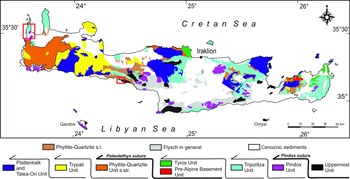
The TPU is exposed on Crete (Fig. 1) as well as on the Peloponnesus, Kythira and Rhodes. It consists of late Triassic to late Eocene neritic (meta)limestones and dolomites, which are overlain by late Eocene (Priabonian) to Oligocene flysch (Renz, Reference Renz1913, Reference Renz1955; Creutzburg & Seidel, Reference Creutzburg and Seidel1975; Thorbecke, Reference Thorbecke1976; Tsaila-Monopolis, Reference Tsaila-Monopolis1977; Seidel & Wachendorf, Reference Seidel, Wachendorf and Jacobshagen1986; Manutsoglu et al. Reference Manutsoglu, Mertmann and Jacobshagen1993; Zambetakis-Lekkas et al. Reference Zambetakis-Lekkas, Pomoni-Papaioannou and Alexopoulos1998). Some of the (meta)carbonates at the base of the TPU show a Ladinian-Carnian fauna (Haude, Reference Haude1989), which predates the age of the youngest sediments of the Permian to Triassic Tyros Unit underneath. Apart from the Tyros Unit, the rocks of the TPU have been thrust on top of Neogene sediments (Kokkalas and Doutsos, Reference Kokkalas and Doutsos2001; Klein et al. Reference Klein, Craddock and Zulauf2012). In Crete and the Peloponnesus, the thrust contact may cut considerably down-section until the Plattenkalk Unit, which is the structurally deepest constituent of the Cretan nappe stack (Fig. 1). The TPU itself is tectonically overlain by the Triassic to Paleogene rocks of the Pindos and the Uppermost Unit (Fig. 1). Both the Tripolitza limestone and flysch underwent Alpine deformation and metamorphism. Conodont alteration (Epstein et al. 1977, as cited in Bonneau, Reference Bonneau1984), illite crystallinity (IC) (Feldhoff et al. Reference Feldhoff, Lücke and Richter1991; Klein et al. Reference Klein, Craddock and Zulauf2012), vitrinite reflectance (Feldhoff et al. Reference Feldhoff, Theye and Richter1993), and CM geothermometry (Rahl et al. Reference Rahl, Anderson, Brandon and Fassoulas2005) of Tripolitza (meta)limestones indicate metamorphism of very low grade to lower epizone (T = 240–320 °C). Fission-track dating of apatite of the TPU yielded 17.5 ±2.5 Ma (Thomson et al. Reference Thomson, Stöckhert and Brix1999) and 15–17 Ma (Rahl et al. Reference Rahl, Anderson, Brandon and Fassoulas2005).
Geological map of Crete (modified after Zulauf et al. Reference Zulauf, Dörr, Marko and Krahl2018, and references therein) showing study areas at the southern and western coast of Crete (red insets).

3. Methods
The tectonic structures and the deformation microstructures as well as the type, structure and alteration of microfossils (largely Nummulites) of the Tripolitza rocks were analysed using a petrographic microscope. Three samples were collected in the Falasarna area of NW Crete, and five samples were collected in the Damnoni area east of Plakias. Those samples, which were investigated and described in detail are listed in Table S3 Supplement. Constituent minerals have further been determined from all of the analysed samples using semi-quantitative X-ray powder diffraction (XRD). Dry samples were pulverized dry in an agate mortar and 0.5 g of each sample measured using a Panalytical X’Pert Pro diffractometer. Evaluation of the data was performed using the software X’Pert HighScore Plus and MacDiff to obtain semi-quantitative mineral contents of the studied samples.
To reveal the crystallographic preferred orientation (CPO) of calcite fibres in Nummulite tests and of calcite crystals of ductile shear zones, the samples were examined using EBSD analysis. After performing petrographic analyses, thin sections were embedded in epoxy resin and then polished with colloidal silica on a vibratory polisher (SYTON method). Thin sections were coated with a thin layer of carbon and surrounded with a thin copper band in order to minimize ionic charging. EBSD analyses were conducted using a JEOL JSM 6490 scanning electron microscope (SEM) at Goethe University Frankfurt a.M. equipped with a HKL Nordlys EBSD detector. Acceleration voltage for the measurements was 15 kV, beam current was ∼8 nA, and the working distance is between 17 and 20 mm. EBSD patterns were indexed using the HKL Technology CHANNEL 5 software (Schmidt & Olesen Reference Schmidt and Olesen1989). Only EBSD measurements with a mean angular deviation (MAD) of <1.3 were accepted and recorded. Maps were generated using a step size of 0.5 µm.
EBSD analysis of the basal TPU mylonite was performed on SYTON polished and carbon-coated rock specimens (same face as thin sections) using a Leo (Zeiss) Gemini 1530 SEM equipped with a thermionic emission gun (Schottky emitter) and forescatter electron (FSE) detector at the University of Bayreuth. Acceleration voltage was 20 kV, the beam current was about 4 nA and the working distance was 20 mm. The EBSD camera and software as well as analytical conditions for EBSD patterns were the same as above. Calculated misorientation angles are minimum angles. Only calcite was analysed.
For Rb-Sr dating, Rb and Sr concentrations of white mica were determined by isotope dilution using mixed 87Rb–84Sr spikes. Rb and Sr isotope ratios were determined on a VG-Sector 54 multicollector Thermal Ionization Mass Spectrometry (TIMS) instrument (GeoForschungsZentrum, Potsdam) in dynamic mode. The value obtained for 87Sr/86Sr of the National Bureau of Standards (NBS) Standard Reference Material (SRM) 987 was 0.710268 ±0.000015 (n = 19). The observed ratios of Rb analyses were corrected for 0.25% per amu mass fractionation. Total procedural blanks were consistently <0.15 ng for both Rb and Sr. Due to highly variable blank values, no useful blank correction was applicable. Isochron parameters were calculated using the Isoplot/Ex program of Ludwig (Reference Ludwig1999). Standard errors, as derived from replicate analyses of spiked white mica samples of ±0.005% for 87Sr/86Sr ratios and of ±1.5% for Rb-Sr ratios were applied in isochron age calculations. Individual analytical errors were generally smaller than these values.
Prerequisites to obtain robust U-Pb ages of calcite and carbonates are (1) a closed isotopic system, (2) a homogeneous initial ('common') Pb composition, and (3) a sufficient spread in U-Pb data points on Tera-Wasserburg concordia or on isochron plots. Because of low U and radiogenic Pb concentrations in carbonates, large spot sizes are required during U-Pb LA-ICP-MS analysis.
Uranium-Pb ages of calcite were acquired in situ in polished thin sections using a ThermoScientific Element XR ICP-MS that is coupled to a RESOlution (Resonetics) 193 nm ArF Excimer laser (CompexPro 102, Coherent) equipped with a two-volume ablation cell (Laurin Technic, Australia). Analytical details are summarized in Supplemantary Table S1a. Raw data were corrected offline using an in-house MS Excel©spread sheet program (Gerdes & Zeh, Reference Gerdes and Zeh2009). The U-Pb data of calcite are plotted in Tera-Wasserburg diagrams.
Microprobe analyses of white mica were performed using a JEOL electron microprobe (JXA-8200) at the Mineralogical Department of Erlangen University. Calibration was carried out using natural and synthetic oxide and metallic standards from P&H Developments Ltd. The acceleration voltage has been set to 15 kV. Measurements were acquired utilizing a defocused electron beam of ca. 6 µm diameter and relatively low beam currents of ca. 10 nA in order to mitigate thermal heating and potential destruction of the polished white mica surfaces. Counting times were 20 sec. (peak intensity) and 10 sec. (upper and lower background intensities), respectively. ZAF corrections were applied.
Spatially resolved trace element analysis of the nummulitic limestone was performed by laser ablation ICP-MS in the FIERCE laboratory, Goethe-Universität Frankfurt, in order to assess the geochemical preservation of these sediments. The hardware set-up was the same as that described in relation to the U-Pb dating above. For trace element analysis, ablation took place in a He atmosphere with 950 ml/min Ar admixed into the inner volume ablation cell, with 4 ml/min N2 used as an additional diatomic gas to improve sensitivity, added downstream of the ablation cell. To maximize vertical spatial resolution, thin sections containing Nummulites, calcite matrix and calcite veins were analysed via slow depth profiling using a beam diameter of 44 µm and a laser repetition rate of 2 Hz. A ‘squid’ signal smoothing device was used to avoid spectral skew under these ablation conditions (Müller et al. Reference Müller, Shelley, Miller and Broude2009). The ICP-MS was run in ‘triple’ collection mode, with automatic switching between counting, analogue and Faraday cup detection methods. The instrument was equipped with a Ni jet sample cone and Ni H skimmer cone and tuned for maximum sensitivity whilst ensuring robust plasma conditions (Fietzke & Frische, Reference Fietzke and Frische2016) with 1300 W RF power, by ensuring Th/U was between 0.95 and 1.00, ThO+/Th+ <0.5% and Ca2+/Ca+ (m/z 22/44) below 2%. The monitored masses were 11B, 23Na, 24Mg, 25Mg, 27Al, 55Mn, 56Fe, 66Zn, 88Sr, 89Y, 138Ba, 146Nd and 238U. The ICP-MS was run in medium resolution to resolve the polyatomic interferences on 27Al, 55Mn and 56Fe.
Data reduction followed standard procedures using an in-house Matlab script (Longerich et al. Reference Longerich, Jackson and Günther1996; Evans & Müller, Reference Evans and Müller2018), using 44Ca as the internal standard and NIST SRM612 as the calibration standard, except in the case of Mg, for which NIST SRM610 was used because it has a [Mg] much closer to that of the samples and is more homogenous with respect to this element (Evans & Müller, Reference Evans and Müller2018). We use the preferred NIST values of Jochum et al. (Reference Jochum, Weis, Stoll, Kuzmin, Yang, Raczek, Jacob, Stracke, Birbaum, Frick, Günther and Enzweiler2011) in all cases except for Mg, as discussed in detail elsewhere (Evans & Müller, Reference Evans and Müller2018). In order to assess accuracy and precision of the trace element data, five different carbonate and glass standards were ablated in the same session as the samples using identical ablation and plasma conditions. Specifically, the carbonate nano pellet standards JCp, JCt and MACS-3 (Garbe-Schönberg & Müller Reference Garbe-Schönberg and Müller2014) and the MPI-DING glasses GOR132-G and GOR128-G (Jochum et al. Reference Jochum, Stoll, Herwig, Willbold, Hofmann and Amini2006) were analysed 2–5 times each. Because we are interested in the broad trace element composition of the samples discussed here rather than obtaining the most precise and accurate results possible for any single trace element, we report accuracy based on the mean measured values compared to the reported values from all five standards, as this avoids bias associated with the reported value of any individual standard (Evans & Müller, Reference Evans and Müller2018). Determined in this way, accuracy was <1% for Mg/Ca, Al/Ca, Sr/Ca, and U/Ca, <5% for B/Ca, Na/Ca, Fe/Ca, Y/Ca, and Nd/Ca, and <10% for Ba/Ca. Mn/Ca and Zn/Ca accuracy strongly depends on concentration. Mn/Ca accuracy was <1% based on JCp, GOR-132G and GOR128-G (Mn/Ca = 1–22 mmol/mol) but substantially worse (∼100%) at concentrations an order of magnitude lower than this (JCt and MACS-3 Mn/Ca = ∼4–10 µmol/mol), although we note that the issue may equally be the extent to which the Mn concentration of these standards is well characterized. Similarly, Zn/Ca accuracy was 19% based on JCp, GOR132-G and GOR128-G (Zn/Ca = 0.2–1.0 mmol/mol) but much less favourable in the case of JCt and MACS-3 (100–300%, Zn/Ca = 5–8 µmol/mol).
Precision is reported based on the 2SD of repeat measurements of the standard that has a given logarithm of the trace element/Ca ratio closest to that of the logarithm of the sample ratios, on an element-specific basis, as precision strongly depends on the intensity of the ion beam. Assessed in this way, precision was <5% for Mg/Ca, Mn/Ca, Sr/Ca, Y/Ca, and Nd/Ca, <10% for Na/Ca and U/Ca, and <20% for B/Ca, Al/Ca, Fe/Ca, and Ba/Ca. Given the very low Zn/Ca ratios of the samples (∼4 µmol/mol), precision assessed using JCt was poor (∼250%), although we stress that we do not assign meaning to the specific details of these measurements (see Sec. 4.1.3). All data described here are given in Supplementary Table S2.
4. Results
4.a. Nummulite-bearing olistolith of Tripolitza wildflysch (Damnoni Bay, central Crete)
4.a.1. Composition, biostratigraphic age constraints, structure and deformation microfabrics
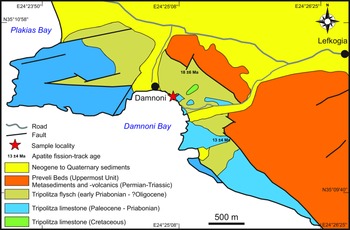
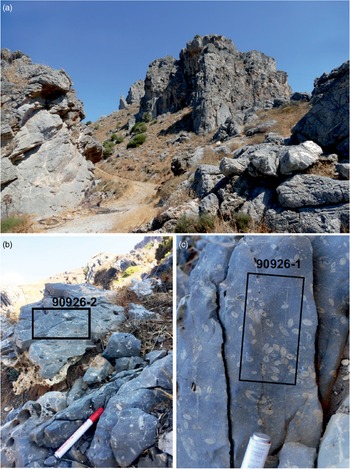
The dark Nummulite-bearing (meta)limestone was collected from a large olistolith embedded in Tripolitza wildflysch at Damnoni Bay (Figs. 2, 3a; Supplementary Table S3). Apart from this type, there are also large olistoliths, which consist of Hippuritoida-bearing Upper Cretaceous (meta)limestone also derived from the upper part of the TPU (meta)carbonates (Fig. 2; Karakitsios, Reference Karakitsios1982).
Geological map of study area at Damnoni Bay of central Crete (after Karakitsios, Reference Karakitsios1982, and new mapping). Apatite fission-track ages after Thomson et al. (Reference Thomson, Stöckhert and Brix1999).

Macroscopic views of investigated rocks exposed at the eastern part of Damnoni beach (35°10'23"N, 24°25'05"E). (a) Large olistoliths of Tripolitza limestone embedded in Tripolitza flysch. View is towards the W. (b) Olistolith of dark Nummulite limestone in the foreground. Light olistoliths in the background consist of Rudist-bearing limestone. View is towards the W. (c) Close-up view of the dark Nummulite limestone showing various kinds and sections of Nummulites and of veins filled with calcite. Samples 90926-1 and 90926-2 were collected at this site.

XRD analyses of the dark (meta)limestone revealed calcite as the most important phase. Illite and/or white mica have not been found in the 10 Å domain. The amount of phyllosilicates is <5%. Nummulites and other LBF are up to 2 cm in size and are best visible on weathered surfaces. Their distribution is not homogeneous throughout the dark (meta)limestone. In some parts the amount of LBF is very high, whereas in other parts the rock is dominated by the black fine-grained limy matrix with only few LBF disseminated therein (Fig. 3b, c). This distribution of LBF, together with the weak shape-preferred orientation of the Nummulite tests, reflects bedding.
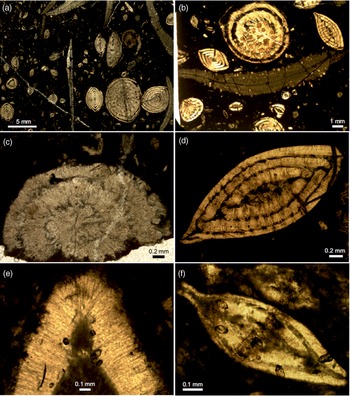
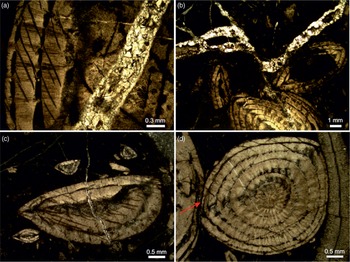
Microscopic analyses revealed that apart from the LBF, there are also numerous small foraminifers embedded in the black limy matrix (Fig. 4a, b). The size of these foraminifers varies gradually. Using the classification of Dunham (Reference Dunham and Ham1962), the black (meta)limestone turned out to be a bioclast (meta)wackestone to (meta)packstone. Apart from a large number of reticulate nummulitids, there are ?lepidocyclinids, orthophragminids and operculinids, some of which may belong to Heterostegina (see also Özcan et al. Reference Özcan, Ali, Hanif, Hashmi and Khan2016a, Reference Özcan, Saraswati, Hanif and Ali2016b). The presence of Pellatispira madaraszi (Fig. 4c), which appears at latest Bartonian and persists in the Priabonian (Özcan et al. Reference Özcan, Yücel, Erbay, Less, Kaygili, Ali and Hanif2019), constrains the age of the rock.
Microphotographs of black Nummulite-bearing marble; parallel polarizers. (a) Overview screen of bioclast nummulitidae lepidocyclinidae (meta)wackestone; younger fractures are filled with calcite (sample 190926-1c). (b) Various sections through Nummulite tests (sample 190926-1b). (c) Pellatispira madaraszi Hantken 1876 (latest Bartonian to Priabonian) (sample 190926-1b). (d) Well preserved shape and calcite fibres of Nummulite test (sample 190926-1b). (e) Test of Nummulite showing radial calcite fibres and tiny inclusions of heavy minerals (probably zircon, which are partly euhedral (sample 190926-1). (f) Nummulite test with inclusions of heavy minerals, largely euhedral zircons (sample 190926-1).

Most of the Nummulites are unspoiled concerning their shape. Pieces of fractured and broken Nummulites are rare but may be enriched in distinct domains. The tests of the Nummulites consist of radial calcite fibres, which are up to 0.5 mm long and 10–15 µm in diameter (Fig. 4d, e). Some of the Nummulites’ tests include heavy minerals, which are up to 50 µm in size (Fig. 4e, f). The majority of these heavy minerals are colourless and euhedral with a shape that fits well to that of zircon.
Alpine deformation under very low-grade metamorphic conditions was polyphase and accommodated by fracturing and solution-precipitation creep. There is no evidence for dislocation creep and related recrystallization of calcite. The calcite veins of the dark (meta)limestone are up to 1 mm wide. Most of them are syntaxial veins, where calcite grains grew from the margins towards the centre of the vein (Fig. 5a). For this reason, the size of the calcite crystals is commonly much smaller along the margins (up to 50 µm) compared to the central part (coarse blocky grains up to 0.5 mm). Some veins are displaced along younger shear fractures or are cut by younger veins (Fig. 5b). Antitaxial calcite veins are rare (Fig. 5c). In cases where the calcite veins cut through Nummulites, their attitude can be deflected by the calcite fibres of the Nummulite tests, which acted as a mechanical anisotropy (Fig. 5c). The strong and anisotropic behaviour of the test fibres is also indicated by their twinning (Fig. 5a). Large calcite grains of the veins show straight, thin deformation twins, which belong to type 1 twins according to the classification of Burkhard (Reference Burkhard1993). Evidence for pressure solution is present in the form of stylolites and strain caps, which are particularly well developed where Nummulites are abutting (Fig. 5d).
Microphotographs of black Nummulite-bearing marble showing deformation microfabrics of calcite; all under parallel polarizers. (a) Syntaxial calcite vein filled with small grains along the margins and larger blocky grains in the centre. Note that large crystals are twinned. The dark hatching in the Nummulite test (left-hand side) might represent calcite twins (sample 190926-1). (b) Thick vein of calcite includes fragments of wall rock and is displaced by younger discrete shear plane (sample 190926-1c). (c) The attitude of an antitaxial calcite vein (with a median line) is affected by the mechanical anisotropy of the Nummulite-test fibres (sample 190926-1a). (d) Close-up view of Fig. 4a. Evidence for pressure solution at the contact between two Nummulites indicated by red arrow (sample 190926-1c).

4.a.2. Texture of Nummulite calcite based on EBSD analysis
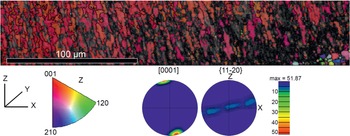
EBSD analyses have been carried out on the tests of large Nummulites of sample 190926-1, which consist of radial calcite fibres as described above. One analysed section of fibres is depicted in the upper part of Fig. 6. The fibres show similar colours, which do not vary along the axes of the fibres. When plotting the EBSD data of the fibres in an equal-area net, they show a strong alignment of crystallographic <c>axes ([0001]) parallel to the long axis of the fibres, whereas other {11–20} result in a girdle that is perpendicular to [0001] (Fig. 6).
Results of EBSD analyses of calcite fibres belonging to test of Nummulite (sample 190926-1). The fibres display a strong crystallographic preferred orientation, which correlates well with the direction of the fibres. The [0001] direction is parallel to the long axes of the fibres.

4.a.3. Chemical composition of calcite of Nummulite test and veins
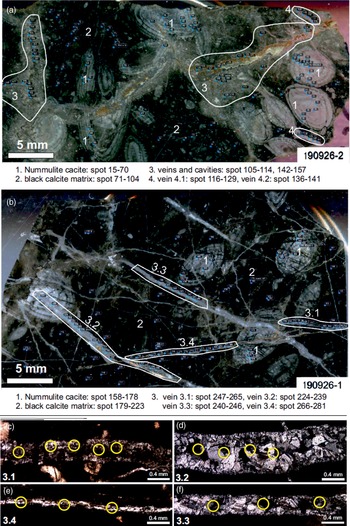
In total, nine foraminifera from three different thin sections of samples 190926-1 and 190926-2 were analysed 3–5 times, respectively (32 analyses in total). In two of these thin sections, five calcite veins that cross-cut the foraminifera were analysed for comparison (all data presented here are given in Supplementary Table S2, and location of analysed samples is shown in Fig. 2 and is listed in Supplementary Table S3. Despite the observation that the foraminifera retain even some fine details of the morphological microstructure and the crystallographic orientation of their tests, the composition of these specimens is characterized by almost complete diagenetic overprinting. This is most obvious in their Mg/Ca and Sr/Ca ratios (20.0 ±2.3 and 0.73 ±0.65 mmol/mol, respectively; 2SD variability between specimens), which are characteristic of complete ‘recrystallization’ of the original high-Mg calcite of Nummulites, as discussed in detail in Cotton et al. (Reference Cotton, Evans and Beavington-Penney2020); pristine modern nearest living relatives and exceptionally preserved Eocene Nummulites have Mg/Ca ratios of 80–160 mmol/mol and Sr/Ca ratios of 1.8–2.6 mmol/mol. This diagenetic loss of trace elements that substitute for both Ca and CO3 in the crystal lattice is also clearly visible in the B/Ca ratios of these specimens (19.5 ±6.6 µmol/mol), Na/Ca (0.65 ±0.32 mmol/mol), Zn/Ca (0.5 ±0.5 µmol/mol) and Ba/Ca (1.3 ±0.9 µmol/mol), all of which are reduced by a factor of ∼2–20 compared to pristine modern and well-preserved fossil material (see Evans et al. Reference Evans, Müller, Oron and Renema2013, Reference Evans, Sagoo, Renema, Cotton, Müller, Todd, Saraswati, Stassen, Ziegler, Pearson, Valdes and Affek2018; Hauzer et al. Reference Hauzer, Evans, Müller, Rosenthal and Erez2018; Cotton et al. Reference Cotton, Evans and Beavington-Penney2020). The exception to this diagenetic loss is U/Ca, which is ∼5 times higher than in modern nearest living relatives. The lowest concentration proxy trace element (Zn) and elements that are indicative of sediment contamination (Al) or early-stage overgrowths (Mn, Y and Nd) are also present at element/Ca ratios 1–10 times lower than pristine material.
In addition, the comparative analyses of the calcite veins present in the same sections show that the composition of the foraminifera and vein calcite is very similar. While very broad correlations between element/Ca ratios in calcite may be expected because these are governed to a large degree by compatibility, the very similar Na, Mg, Al, Zn, Y, Nd and U/Ca ratios, with the veins being characterized by ±50% of the foraminifera values, strongly support the notion that the composition of these Nummulites is explicably through extensive diagenetic replacement. Of the higher concentration trace elements in calcite, only Sr/Ca and Ba/Ca remain substantially elevated in the foraminifera compared to that of the calcite veins (Sr/Ca = 0.72 ±0.22 and 0.19 ±0.07 mmol/mol in the foraminifera and veins, respectively, Ba/Ca = 1.3 ±0.3 and 0.5 ±0.7 µmol/mol, respectively; uncertainties on mean values are 2SE).
4.a.4. U-Pb ages of calcite included in Nummulite tests and in veins
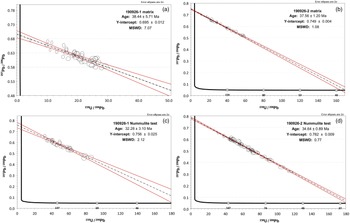
Calcite of the dark limy matrix (Fig. 7a,b) yielded U-Pb ages at 38.4 ±5.7 Ma and 37.6 ±1.2 Ma (Fig. 8a, b; Supplementary Table S1b). These late Eocene ages should reflect the age of deposition. The calcite fibres of the Nummulite tests yielded younger U-Pb ages at 32.3 ±3.1 Ma and 34.6 ±0.9 Ma, which are straddling the Eocene/Oligocene boundary (Fig. 8c, d). These ages could be related to the diagenetic overprint.
Microphotographs of black Nummulite-bearing marble showing the areas used for U-Pb dating of calcite and for trace element analyses; parallel polarizers. (a) Sample 190926-2. (b) Sample 190926-1. (c) Close-up view of syntaxial vein 3.1. (d) Close-up view of syntaxial vein 3.2. (e) Close-up view of vein 3.4. (f) Close-up view of syntaxial vein 3.3. Analysed spots are indicated by yellow circles.

U-Pb data of matrix calcite (a, b) and of Nummulite test (c, d) of Nummulite-bearing (meta)limestone plotted in Tera-Wasserburg diagrams showing 207Pb/206Pb versus 238U/206Pb. Data points are indicated as 2σ error ellipses. Sample numbers are indicated (see also Fig. 7).

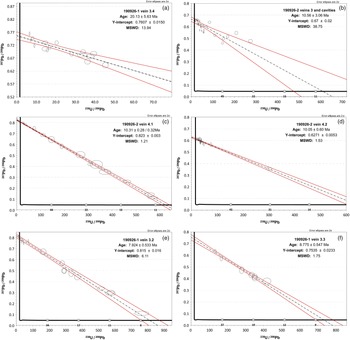
U-Pb dating of vein calcite (Fig. 7) revealed at least three generations of veins, which are different in age even when considering the uncertainties. The oldest generation of veins (vein 3.4, sample 190926-1, Fig. 7b,e) yielded 20.1 ±5.6 Ma (Fig. 9a; Supplementary Table S1b). Although this early Miocene age has a large uncertainty, it is clearly younger than the ages mentioned above. Secondary calcite fillings of cavities as well as veins 4.1 and 4.2 of sample 190926-2 (Fig. 7a) yielded U-Pb ages at 10.6 ±3.1 Ma, 10.3 ±0.3 Ma and 10.1 ±0.6 Ma (Fig. 9b–d). The youngest generation of veins (veins 3.2 and 3.3 of sample 190926-1, Fig. 7b, d, f) has been dated at 7.9 ±0.5 Ma and 8.8 ±0.5 Ma, respectively (Fig. 9e, f; Supplementary Table S1b).
U-Pb data of calcite formed in veins and cavities of Nummulite-bearing (meta)limestone plotted in Tera-Wasserburg diagrams showing 207Pb/206Pb versus 238U/206Pb ratios. Data points are indicated as 2σ error ellipses. Sample locations and number of veins are indicated (see also Fig. 7).

4.b. Mylonitic shear zone of basal Tripolitza Unit (Falasarna, western Crete)
4.b.1. Structure and microfabrics
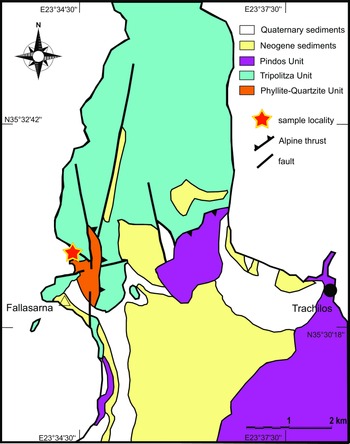
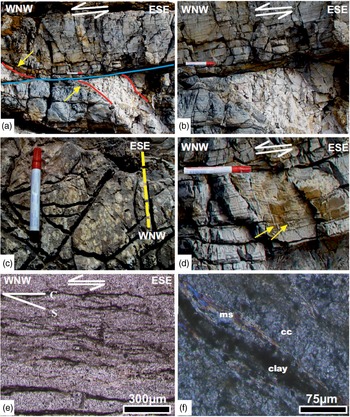
A ductile top-to-the WNW shear zone, which cuts through the basal part of Tripolitza marble, was recognized at the western coast of Crete, ca. 1 km north of the ancient Roman harbour Falasarna (sample 020414/7-2, Fig. 10). The shear zone is generally subhorizontal or locally shallowly dipping (Fig. 11a). The shear planes display a distinct WNW-ESE trending stretching lineation defined by elongated calcite aggregates (Figs. 11c; 9a in Klein et al. Reference Klein, Craddock and Zulauf2012). The drag of a sheared calcite vein and displaced thin calcite veins indicate a top-to-the WNW sense of shear (Fig. 11b,d). Microscopic analysis revealed that the calcite marble is pervasively recrystallized and affected by solution-precipitation creep, which led to dark stylolitic seams. During subsequent ductile deformation, these seams were rearranged and transformed into poorly defined SC fabrics, which seem to verify the macroscopic top-to-the WNW sense of shear (Fig. 11e). The same sense of shear is indicated by asymmetric pressure shadows of calcite behind rigid clasts of albite. Apart from clay and heavy minerals in the dark seams, there is white mica, the long axis of which is aligned parallel to the main stretching direction. As such type of mica has not been observed in the wall rock, a synkinematic growth during ductile shearing is assumed (Fig. 11f).
Geological map of study area north of Falasarna in NW Crete (after IGME).

Ductile shear zone in Tripolitza marble exposed north of Falasarna in NW Crete (sample 020414/7-2). (a) Mylonitic foliation of shear zone largely subparallel to bedding (XZ-section); drag of sheared calcite vein (see yellow arrows) indicates top-to-the WNW shearing. (b) Detail of (a) showing the contact between vein and marble; sample with white mica shown in (e, f) was collected from the brownish foliated mylonite along the contact; (c) Mylonitic shear plane displaying WNW-ESE trending stretching lineation portrayed by elongated light calcite fragments. (d) Displacement of calcite veins along the mylonitic foliation (yellow arrows) indicates top-to-the WNW sense of shar. (e) Microphotograph (XZ-section) of calcite mylonite. Due to shearing, the dark stylolitic seams were changed into an SC fabric, which indicates top-to-the WNW sense of shear. (f) Synkinematic white mica (ms) besides clay minerals aligned subparallel to the mylonitic foliation of the shear zone. Matrix consists of recrystallized calcite (cc).

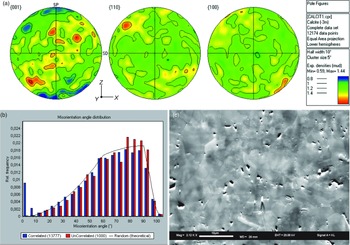
EBSD analysis of mylonitic marble revealed an asymmetric distribution of the calcite <c>axes ([0001]) in XZ sections (Fig. 12a). This asymmetric fabric should result from non-coaxial deformation consistent with the top-to-the WNW shearing described above. However, the texture is weak and not clearly related to a particular intracrystalline slip system of calcite such as r- and f-gliding (e.g. De Bresser & Spiers, Reference De Bresser and Spiers1997). Apart from a distinct amount of subgrain boundaries, most of the calcite boundaries are high angle and thus grain boundaries (Fig. 12b). The presence of subgrains reflects dislocation creep as deformation mechanism. The weak CPO of calcite can be explained by two possible scenarios: (1) overprint of a preexisting statically equilibrated fabric by mylonitic shearing, or (2) overprint of a preexisting CPO of calcite (which resulted from mylonitic shearing) by grain-boundary sliding (GBS) and grain rotation. The second scenario is more appropriate, as mylonitic shearing leads to grain size reduction, which supports GBS and thus the weakening of the older CPO. Notable microstructural criteria indicative for GBS are small (<10 µm) equant grains lacking a strong CPO (e.g. Bestmann & Prior, Reference Bestmann and Prior2003). Both GBS and dislocation creep, in form of subgrain formation, are fully compatible with the epizonal metamorphic conditions (ca. 310°C) obtained for the Tripolitza rocks exposed near Falasarna (Klein et al. Reference Klein, Craddock and Zulauf2012). Further details about the kinematics and deformation microfabrics of this shear zone are reported in Klein et al. (Reference Klein, Zulauf, Craddock and Glodny2006, Reference Klein, Craddock and Zulauf2012).
Microstructure and EBSD data of calcite of mylonitic shear zone (Falasarna, sample 020414/7-2). (a) Distribution of crystallographic axes of calcite shown in equal-area upper-hemisphere projection. Asymmetry of texture suggests a dextral sense of shear, which means top-top-the WNW in the field. (b) Misorientation data of calcite mylonite. (c) Scanning Electron Microscopy image of deformed calcite of mylonite (sample section: width 52 µm, height 39 µm, scale 10 µm). For further explanation, see text.

Bent twin lamellae or twinned twins in larger calcite crystals suggest temperatures >200 °C (Burkhard, Reference Burkhard1993; Ferrill et al. Reference Ferrill, Morris, Evans, Burkhard, Groshong and Onasch2004) during deformation stages, which postdate the metamorphic peak.
4.b.2. Rb-Sr dating and microprobe analysis of white mica
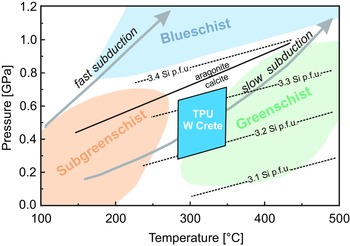
The sample for Rb-Sr dating and microprobe analysis of white mica (020414/7-2) was collected from the ductile shear zone described above. The chemical analysis suggests the white mica to be phengitic in composition with an Si content between 3.2 and 3.3. p.f.u. (Supplementary Table S4). Applying the phengite barometer of Massonne & Schreyer (Reference Massonne and Schreyer1987) and Massonne & Szpurka (Reference Massonne and Szpurka1997) for a metamorphic temperature of 300–350 °C (see above), these Si values reveal a minimum pressure of 0.2–0.6 GPa (Fig. 13).
Pressure-temperature data of Tripolitza rocks exposed north of Falasarna. Temperature based on illite crystallinity and deformation microfabrics of calcite. Minimum pressure based on Si content of white mica. Si values of white mica, after Massonne and Schreyer (Reference Massonne and Schreyer1987).

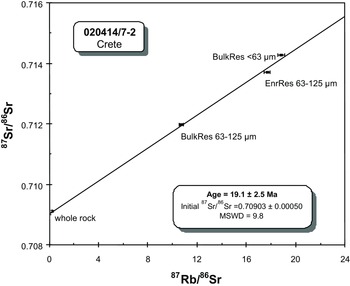
The separation of white micas was difficult because of their small amount and small grain size. A separation of pure white micas was not possible. Parts of the sample were solved in acetic acid. The residuum was treated with hydrochloric acid for ca. 30 min. From this residuum, three samples were prepared: (1) bulk residuum, sieve fraction 63–125 µm, (2) bulk residuum <63 µm, and (3) residuum of sieve fraction 63–125 µm, enriched in white mica. The Rb-Sr data of the different fractions are plotted in Fig. 14 in addition to the Rb-Sr whole-rock data. A well-defined isochrone (MSWD <2.5) is not observed. This indicates initial Sr inhomogeneity of the sample. Uncertainties due to the leaching procedure are not probable as the acids used for leaching do not affect white mica. Nevertheless, the resulting age of 19.1 ±2.5 Ma (Fig. 14) should be considered as a value that is geologically significant.
Rb-Sr data of white mica separated from ductile shear zone in Tripolitza marble N of Falasarna (sample 020414/7-2). Different size fractions in addition to whole-rock data are plotted in the isochrone diagram.

5. Discussion
5.a. Deposition and diagenesis of Nummulite-bearing limestone olistolith
The dark Nummulite-bearing (meta)limestone exposed at Damnoni Bay is characteristic for the uppermost and youngest limy sequence of the TPU carbonate platform. In the Artemision Mountains of central Greece, similar thick-bedded dark Nummulite-bearing limestones are resting on top of rudist-bearing Upper Cretaceous limestones and are overlain by TPU flysch (Renz, Reference Renz1913). This sequence is compatible with the fact that the TPU wildflysch of the Damnoni area includes olistoliths of both Nummulite- and rudist-bearing (meta)limestones. The age of the platform (meta)carbonates of the TPU exposed in the Sellia area should range from the Paleocene to the Priabonian (Karakitsios, Reference Karakitsios1982). Taking also data from the western Peloponnesus into account, the age of the subsequent Tripolitza flysch ranges from the early Priabonian to the late Oligocene/early Miocene (Fig. 15; Richter, Reference Richter1976; Karakitsios, Reference Karakitsios1982; Fytrolakis & Antoniou, Reference Fytrolakis and Antoniou1998).
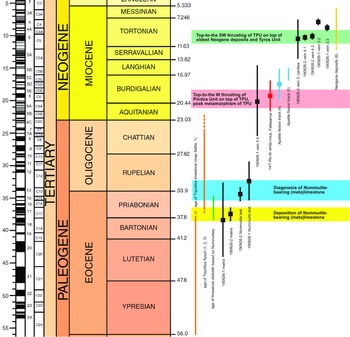
U-Pb calcite ages (black bars, this study) obtained from Nummulite test, matrix and veins of black Nummulite-bearing (meta)limestone olistolith, Rb-Sr age of synkinematic white mica (red bar, this study), and biostratigraphic age range of Nummulite limestone (green bar, this study), plotted besides age of Tripolitza (meta)carbonates and flysch (orange bars), fission-track ages of apatite (blue bars) and age of Neogene deposits (yellow bar). TPU = Tripolitza Unit. Reference keys: 1: Karakitsios, Reference Karakitsios1982; 2: Richter, Reference Richter1976; 3: Fytrolakis and Antoniou, Reference Fytrolakis and Antoniou1998; 4: Thomson et al. Reference Thomson, Stöckhert and Brix1999; 5: Rahl et al. Reference Rahl, Anderson, Brandon and Fassoulas2005; 6: Postma and Drinia, Reference Postma and Drinia1993.

The presence of Pellatispira madaraszi in the Nummulite-bearing (meta)limestone suggests a latest Bartonian to late Priabonian age (Özcan et al. Reference Özcan, Yücel, Erbay, Less, Kaygili, Ali and Hanif2019), which is in line with the age range mentioned above. Moreover, the U-Pb calcite ages of the fine-grained dark matrix (38.4 ±5.7 Ma and 37.6 ±1.2 Ma) should reflect the age of deposition at the Bartonian/Priabonian boundary (Fig. 15), which corresponds to a major faunal turnover in the Tethyan shallow marine ecosystems. Some new foraminiferal taxa, such as Heterostegina, appear for the first time, while major groups of large Nummulites and alveolinids disappear during Bartonian and early Priabonian (Özcan et al. Reference Özcan, Ali, Hanif, Hashmi and Khan2016a, Reference Özcan, Saraswati, Hanif and Ali2016b). The large uncertainty of one of the above listed U-Pb matrix ages is probably related to the mixing of calcite crystals of different generations.
The younger U-Pb calcite ages (32.3 ±3.1 Ma and 34.6 ±0.9 Ma) obtained from fibres of the Nummulite tests reflect replacement of fibre calcite during late Priabonian/early Rupelian diagenesis (Fig. 15), which is in line with our trace element geochemical data. The chemical composition of the calcite fibres of the Nummulite test is not compatible with that of original fibres and thus must have changed during diagenesis. Against this background, the presence of the fibres as largely intact single crystals (as indicated by EBSD data, Fig. 6) is surprising and needs further investigations.
The period between the sedimentation of the dark (meta)limestone (Nummulite origin) and the change in composition of the Nummulite test was ca. 4 m.y. (Fig. 15). The replacement of the Nummulite calcite occurred at the Eocene/Oligocene boundary after the deposition of the first TPU flysch. This replacement should belong to a second phase of diagenesis. A first phase of diagenesis must have led to the consolidation of the dark (meta)limestone, while it was part of the carbonate platform. This first phase of diagenesis and consolidation was required for its removal and deposition as a large olistolith within the Tripolitza wildflysch.
The dark colour of the Nummulite-bearing (meta)limestone results from a relatively large amount of organic material, which indicates deposition under euxinic conditions. Such euxinic depositional environments occur when biological, physiographical or tectonic influences cause isolation of parts of the sea in which free access to the open ocean is restricted and varying degrees of stagnation of the bottom waters ensues (Krumbein & Sloss, Reference Krumbein and Sloss1963). Commonly euxinic bodies of water have an oxic, highly productive, thin surface layer, and have anoxic, sulfidic bottom water. Under these conditions, sediments are deposited in an anaerobic-reducing environment and are characterized by high organic content, presence of hydrogen sulfide and lack of a bottom fauna (Pettijohn, Reference Pettijohn1957). Uranium is a redox-sensitive element, which exhibits conservative behaviour in oxygenated water and exists in the dissolved oxycation (UO2 2+) form but is reduced and becomes insoluble under anoxic conditions (Dang et al. Reference Dang, Evans, Wang, Omanović, El Houssainy, Lenoble, Mullot, Mounier and Garnier2018, and references therein). In the present case of the dark (meta)limestone, U was fixed during its deposition under euxinic conditions. This U is prone for U-Pb dating of the deposition of the sediment using the calcite of the matrix. The presence of benthic foraminifera reveals that the boundary between oxidized and anoxic conditions was situated within the soft limy sediment. In the deeper anoxic parts, U became insoluble and was fixed. This fixed U could be dissolved after the conditions within the sediment had changed from anoxic to oxidized. Such a change should have occurred not only during the second phase of diagenesis (after the deposition of the wildflysch) but also during the different phases of vein formation. During each of these events, U that was initially fixed in the limy sediment could be removed via fluid phase replacing Ca during subsequent secondary calcite precipitation.
5.b. Early Miocene subduction/collision of the Tripolitza Unit
As metamorphic index minerals are largely lacking in the carbonaceous lithology of the TPU, the temperature and pressure related to metamorphism are only poorly constrained. Nevertheless, there is a clear decrease in metamorphic temperature from the basal to the upper parts of the TPU. Average temperatures calculated from deconvoluted Raman spectra of carbonaceous material (CM) range from 286 to 351 °C (Klein et al. Reference Klein, Craddock and Zulauf2012). As CM is unlikely to change during retrogression of the host rock, these values can be regarded as minimum peak temperatures. The samples investigated in the present study reflect the minimum and the maximum values listed above.
The dark Nummulite-bearing (meta)limestone shows the lowest grade of metamorphism. It belongs to the youngest beds of the TPU carbonates and underwent deformation and metamorphism after being embedded as olistolith within the Tripolitza wildflysch. The Tripolitza flysch shows IC values at the diagenesis/anchizone transition (Klein et al. Reference Klein, Craddock and Zulauf2012) corresponding to T = 240 ±15 °C (Mullis et al. Reference Mullis, Ferreiro-Mählmann and Wolf2017). This low temperature is compatible with the entirely brittle deformation of the black (meta)limestone and with the type 1 twins found in calcite of all generations of veins. Type 1 twins result from deformation at T <200 °C (Burkhard, Reference Burkhard1993).
The mylonitic Tripolitza marble exposed north of Falasarna shows the highest grade of metamorphism of the TPU. The IC values in this area reflect epizonal conditions (Klein et al. Reference Klein, Craddock and Zulauf2012) corresponding to T >280 °C (Ferreiro Mählmann, Reference Ferreiro Mählmann2001). The growth of phengitic white mica and the calcite deformation microfabrics in the top-to-the WNW shear zone, which indicate recrystallization by subgrain rotation, suggest T = ca. 310 °C (Fig. 13). Based on the Si content of the white mica, this temperature should be related to a minimum pressure of 0.3 GPa, which indicates a relatively low geothermal gradient most likely associated with slow subduction and/or collision (Fig. 13).
As the white mica of the Falasarna shear zone developed below the closure temperature of the Rb-Sr isotopic system of white mica, which is >500 °C (e.g. Freeman et al. Reference Freeman, Inger, Butler and Cliff1997; Glodny et al. Reference Glodny, Kühn and Austrheim2008), the Rb-Sr age of the white mica (19.1 ±2.5 Ma) should reflect the age of metamorphism of the TPU. Moreover, as the white mica grew syn-kinematically during ductile top-to-the WNW shearing, the Rb-Sr age should also date the shearing event.
It is difficult to determine the age of metamorphism of the anchimetamorphic TPU rocks deformed under brittle conditions. In the case of the dark Nummulite-bearing (meta)limestone, the oldest generation of calcite veins (vein I) should have formed during the peak of metamorphism as is indicated by its U-Pb age of 20 ±6 Ma. Although this age has a large uncertainty and MSWD, its mean value is compatible with the Rb-Sr age of white mica listed above (Fig. 15). As these oldest veins are very thin, the large MSWD of the U-Pb age is probably related to mixed sampling of calcite crystals of different generations during ablation. The low number of these early veins, compared to that of the younger veins, is probably related to the difference in metamorphic grade during vein formation. The early veins were formed under peak metamorphic conditions, which in the case of the Tripolitza flysch and thus of the Nummulite-bearing (meta)limestone olistolith, imply T = ca. 240 °C. Although this temperature is much lower than that inferred for the deformation of the Falasarna shear zone, it is sufficient to induce ductile deformation in fine-grained limestone by solution-precipitation creep and GBS, whereas fracturing was reduced. The younger veins (ca. 8–10 Ma), on the other hand, formed at T <100° C and thus under fully brittle conditions (see below). As the deformation during the top-to-the WNW shearing was largely ductile, the related ESE-WNW directed shortening is hardly documented by the twinning strain in the TPU (Klein et al. Reference Klein, Craddock and Zulauf2012), which, however, is widespread in the non-metamorphic Pindos rocks.
Top-to-the WNW thrusting of the TPU is compatible with the west-vergent folding of the Pindos Unit, which is well documented, for example, in the Cretaceous limestone-chert sequence along the southern coast of central Crete at Ag. Pavlos (e.g. Craddock et al. Reference Craddock, Klein, Kowalczyk and Zulauf2009: Fig. 3b, c). For this reason, it is assumed that the WNW-directed shearing led to the emplacement of the Pindos nappe over the TPU. This thrusting event occurred during the early Miocene (ca. 19 Ma) and led to a pressure dominated metamorphic overprint of the Tripolitza rocks up to conditions of the epizone (T = ca. 320 °C at Pmin = 0.3 GPa). Thrusting could have occurred in a subduction or collisional setting. The top-to-the west kinematics during collision of Pindos and TPU was active already during the Eocene when the Uppermost Unit was thrust on top of the Pindos Unit (Zulauf et al. in prep.).
5.c. Late Miocene emplacement of the Tripolitza nappe
The U-Pb ages obtained from the younger calcite veins can be separated into two generations both with a late Miocene (Tortonian) age. The older generation developed at ca. 10–11 Ma, which are slightly younger than U-Pb calcite ages reported from the nappe contact between TPU/Pindos Unit and the lower nappes (12–13 Ma, Ring et al. Reference Ring, Fassoulas, Uysal, Bolhar, Tong and Todd2022). The younger generation was formed between 7 and 9 Ma (Fig. 15). Low-temperature geochronological data suggest that the opening of these veins should have occurred at T <120°C. Apatite fission-track ages and U-He zircon data yielded cooling below ca. 120 °C at 15–17 Ma (Rahl et al. Reference Rahl, Anderson, Brandon and Fassoulas2005). These data are consistent with an apatite fission-track age of metatuffite (18 ±3 Ma, Thomson et al. Reference Thomson, Stöckhert and Brix1999), which is intercalated in Tripolitza (meta)limestones. A similar apatite fission-track age (18 ±6 Ma) yielded a quartzite collected 500 m north of the black Nummulite-bearing (meta)limestone olistolith, and an even younger age of 13 ±4 Ma was obtained from a sandstone (Fig. 2, Thomson et al. Reference Thomson, Stöckhert and Brix1999). However, the quartzite and the sandstone have been attributed to the Uppermost Unit by Thomson et al. (Reference Thomson, Stöckhert and Brix1999), although the fission-track ages in the Uppermost Unit are much higher (>30 Ma) and sandstones have yet no been described from this unit. According to map Sellia (Karakitsios, Reference Karakitsios1982) and to our new mapping results of this area, both rocks belong to the Tripolitza flysch, which is compatible with their young fission-track ages.
The brittle deformation between 10 and 7 Ma at T <120 °C, documented in the dark Nummulite-bearing (meta)limestone, should be related to the emplacement of the Tripolitza nappe on top of the lower Units. This conclusion is in line with a Tortonian to late Miocene age of thrusting of the TPU exposed on the Peloponnesus (Kowalczyk et al. Reference Kowalczyk, Richter, Risch and Winter1977) and with top-to-the S thrusting of TPU rocks over Neogene conglomerates in eastern Crete (Kokkalas and Doutsos, Reference Kokkalas and Doutsos2001; Klein et al. Reference Klein, Craddock and Zulauf2012). Sedimentation of the Neogene deposits should have started between 15 and 10 Ma (Kopp & Richter, Reference Kopp and Richter1983; Fortuin & Peters, Reference Fortuin and Peters1984; Postma & Drinia, Reference Postma and Drinia1993). The oldest robust ages of these deposits are ca. 11 Ma (Fassoulas, Reference Fassoulas2001; Ring et al. Reference Ring, Brachert and Fassoulas2001; van Hinsbergen & Meulenkamp, Reference van Hinsbergen and Meulenkamp2006; Zachariasse et al. Reference Zachariasse, Van Hinsbergen and Fortuin2011). As the components of these early Neogene sediments are derived only from the Upper nappes (Zachariasse et al. Reference Zachariasse, Van Hinsbergen and Fortuin2011), the lower Units (Plattenkalk, Phyllite-Quartzite s.str., Pre-Alpine Basement, and Tyros Unit) were below sea level during their deposition and probably also during the emplacement of the Tripolitza nappe. The cooling history of the lower nappes is well constrained. (1) K-Ar and 39Ar-40Ar ages of white mica obtained from phyllites of the Phyllite-Quartzite Unit s.str. of central and western Crete range from 24 to 19 Ma regarded as the time of HP-LT metamorphism (Seidel et al. Reference Seidel, Kreuzer and Harre1982; Jolivet et al. Reference Jolivet, Goffé, Monié, Truffert-Luxey, Patriat and Bonneau1996; Ring et al. Reference Ring, Fassoulas, Uysal, Bolhar, Tong and Todd2022). (2) Fission-track ages of zircon yielded an arithmetic mean sample age at 18.6 ±1.9 Ma suggesting cooling below ca. 270 °C at this time (Thomson et al. Reference Thomson, Stöckhert and Brix1998). (3) Zircon (U-Th)/He (ZHe) data, obtained from rocks of the Tyros Unit of eastern Crete, suggest cooling <ca. 200 °C at 15 ±1 Ma (Grasemann et al. Reference Grasemann, Schneider and Rogowitz2019). (4) Fission-track dating of apatite yielded an arithmetic mean sample age at 15.0 ±1.7 Ma (Thomson et al. Reference Thomson, Stöckhert and Brix1998) and ages ranging from 9 to 12 Ma, Rahl et al. Reference Rahl, Anderson, Brandon and Fassoulas2005). Thus, the TPU rocks reached the upper brittle structural level (T < ca. 100 °C) earlier than, or coeval with, the deeper nappes.
Tripolitza samples from Falasarna area show slightly inclined shortening along a NE-SW trending axis resulting from layer-parallel shortening during SW-vergent recumbent folding, which postdates the ductile top-to-the WNW movements (Klein et al. Reference Klein, Craddock and Zulauf2012). The same holds for the Tripolitza flysch and the Pindos limestones. These rocks underwent subhorizontal NE-SW layer-parallel shortening, which is consistent with SW-vergent recumbent folding in the Platanos area (Klein et al. Reference Klein, Craddock and Zulauf2012). It is possible that after the peak of metamorphism was attained, the shortening direction in the TPU rotated continuously anticlockwise (with respect to the present coordinate system) until the N-S direction was reached. The structural data collected at the contact TPU/PQU s.l. are compatible with N-S contraction and consistently indicate southward directed movement of the TPU (Kokkalas and Doutsos, Reference Kokkalas and Doutsos2001; Klein et al. Reference Klein, Craddock and Zulauf2012, Kneuker et al. Reference Kneuker, Dörr, Petschick and Zulauf2015; Ring & Yngwe, Reference Ring and Yngwe2018). Kinematic data from the violet slates of the Tyros Unit in eastern Crete near the contact to the TPU suggest top-to-the N kinematics (Grasemann et al. Reference Grasemann, Schneider and Rogowitz2019). However, as similar top-to-the N movements have been documented from rocks of the Phyllite-Quartzite Unit s.str. of eastern Crete, which partly reactivate pre-existing top-to-the S shear zones (Zulauf et al. Reference Zulauf, Kowalczyk, Petschick, Schwanz and Krahl2002), and from the contact between the Phyllite-Quarzite s.str. and the Talea-Ori Unit (Seybold et al. Reference Seybold, Trepmann and Janots2018), these movements should be related to the exhumation of the deeper nappes as suggested by Jolivet et al. (Reference Jolivet, Goffé, Monié, Truffert-Luxey, Patriat and Bonneau1996).
The available low-temperature geochronological data suggest that the emplacement of the TPU (including the remains of its hanging nappes, Pindos and Uppermost Unit) did not cause heating of the deeper nappes to T >100°C. This conclusion is in line with a thickness of only 270 m for a stratigraphically complete section of the TPU carbonate platform in central Crete (Zambetakis-Lekkas et al. Reference Zambetakis-Lekkas, Pomoni-Papaioannou and Alexopoulos1998). The nappe emplacement of the TPU was coeval with the development of the curvature of the Hellenic arc at ca. 10 Ma (Marsellos et al. Reference Marsellos, Kidd and Garver2010, Ring & Yngwe, Reference Ring and Yngwe2018).
Based on the records of the Neogene sediments, the late Neogene tectonic evolution is characterized by normal faulting and oblique sinistral strike-slip, the latter occurring mainly in eastern Crete (ten Veen & Meijer Reference ten Veen and Meijer1998; ten Veen & Postma Reference ten Veen and Postma1999; Kokkalas and Doutsos, Reference Kokkalas and Doutsos2001). Furthermore, younger block rotations affected Crete and caused differences up to several tens of degrees between the orientations of fault-bound blocks (Duermeijer et al. Reference Duermeijer, Krijgsman, Langereis and ten Veen1998).
The main principal shortening direction (ϵ1) in the TPU, based on the calcite twinning strain, is trending N-S. One sub-maximum is vertical and a further one is directed NW-SE (Klein et al. Reference Klein, Craddock and Zulauf2012: Fig. 4b). Evidence for E-W shortening, which is well recorded in the Pindos rocks, is lacking in the TPU. The lack of evidence of E-W shortening strain in the TPU, portrayed by twinning in calcite, is related to the rheological condition during this event. E-W shortening occurred at ca. 19 Ma when the TPU rocks underwent peak metamorphism. Under these conditions (ca. 240–ca. 320 °C), the rocks of the TPU were deformed by solution-precipitation creep, subgrain rotation recrystallization and GBS, whereas vein formation and twinning of calcite were less relevant. The Pindos Unit, on the other hand, was situated at upper structural levels, where brittle deformation and twinning of calcite were dominant during the E-W shortening event.
The SW-vergent folding of the TPU in the Falasarna area is coeval with top-to-the S thrusting in eastern Crete. This deviation in shortening direction is also documented by the main stretching lineation in the Phyllite-Quarzite Unit s.l., which is trending NNE-SSW in western Crete but NNW-SSE in eastern Crete. This deviation is related to the late Miocene formation of the Hellenic arc. The youngest U-Pb calcite ages obtained from veins of the dark Nummulite limestone (7–9 Ma) could reflect crustal extension.
6. Conclusions
-
Dark limestone, which is rich in organic material, is particularly prone for U-Pb calcite dating because U was fixed during its deposition under euxinic conditions. The integration of paleontological records with U-Pb calcite ages obtained from the limy matrix, foraminifers and tectonic veins of such black limestones allows constraining their complete development from sedimentation via diagenesis and burial to exhumation.
-
The Upper Nappes of Crete have been stacked together by thin-skinned E-W shortening. Evidence for E-W shortening is poorly preserved in the TPU, where faults and folds are typically absent or obscured by karst. The early Miocene (19 ±2.5 Ma) top-to-the WSW shearing in the Falasarna outcrop is therefore of special importance.
-
The emplacement of the TPU on top of late Miocene sediments and the lower nappes occurred during Tortonian (10–11 Ma) southward thrusting under brittle conditions. The related N-S shortening is well documented by calcite twinning strain.
-
The variation in metamorphic degree within the TPU rocks cannot be explained solely by the TPU thickness but is also related to different depths during subduction/collision.
-
The pseudomorphic replacement of single-crystal test fibres of Nummulites during late Priabonian/early Rupelian (ca. 35 Ma) diagenesis is an unexpected result and requires additional investigations.
-
The upper and lower nappes of Crete differ significantly in the direction of tectonic shortening. Reconstructions of the Alpine geodynamic evolution in the Eastern Mediterranean should take into account the Miocene anticlockwise 90° rotation of the shortening direction as recorded in the TPU rocks.
Supplementary material
The supplementary material for this article can be found at https://doi.org/10.1017/S0016756823000377
Acknowledgements
The authors acknowledge discussions concerning literature and outcrops with G. Kowalczyk and J. Krahl. The authors also thank M. Bestmann (PhD) for special discussions related to the EBSD analysis of calcite. The paper was significantly improved by the constructive reviews by B. Grasemann and S. Kokkalas, which are gratefully acknowledged. This study was supported by a grant of Deutsche Forschungsgemeinschaft (DFG Zu 74-34). This paper is FIERCE contribution no. 128. FIERCE is financially supported by the Wilhelm and Else Heraeus Foundation and by the Deutsche Forschungsgemeinschaft, which is gratefully acknowledged.