


Introduction
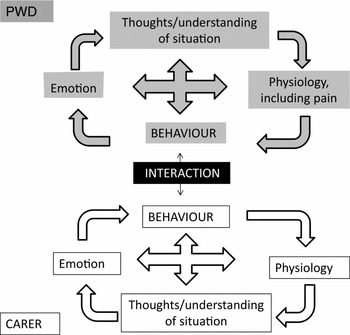
A number of years ago I was involved in the development of the Cognitive Therapy Scale – Revised, taking a particular interest in mechanisms of change and change techniques (Blackburn et al. Reference Blackburn, James, Milne, Baker, Standart, Garland and Reichelt2001; James & Barton, Reference James and Barton2004). I became especially interested in questioning styles, because questions and discourse are the ‘tools’ for both our therapy and supervision (James et al. Reference James, Milne and Morse2008). In simple CBT terms, I was attentive to how therapists used their communication skills to move clients around the ‘hot-cross bun’ cycle (i.e. the thoughts-feelings-physiology-behaviour conceptualization), including how effective the therapists were at highlighting people's dysfunctional cycles and then moving their clients towards more virtuous ones (Beck, Reference Beck1976). When using the hot-cross bun template there is emphasis on ensuring that the client is socialized to the cycle, and over time making sure the features of the cycle become internalized through the use of teaching, charts, tables, behavioural tasks, etc. Via the correct usage of the cycle the client is helped to disengage from their automatic thoughts, biases and assumptions and assisted to reflect more slowly and objectively on their circumstances. Such socialization and internalizing makes a number of assumptions about the client's abilities to engage in therapy, in particular it requires the client to be able to remember the contents of the material within and between sessions (Safran & Segal, Reference Safran and Segal1990). Unfortunately, many people with dementia (PWD) tend to struggle with the latter and therefore they have difficulties generalizing lessons learned in sessions to everyday situations. The situation is even more problematic when working with people with moderate to severe dementia, and in such circumstances it is often the carers who benefit from being socialized to the hot-cross bun framework in relation to their own experiences and the experiences of the PWD (Marriott et al. Reference Marriott, Donaldson, Tarrier and Burns2000; James, Reference James2010; see Fig. 2). The current paper uses the hot-cross bun cycle as one of its underlying frameworks, and discusses how to move PWD and carers from dysfunctional cycles of interaction towards more functional ones.
The main focus of the paper relates to clients displaying problematic behaviours, often referred to as ‘challenging behaviours’ (aggression, shouting, sexual disinhibition). It is often difficult to treat such clients because there are frequently physical, social, neurological, mental health and pharmacological issues to be dealt with, which could be occurring singularly or in combination and may be impacting negatively on an individual's wellbeing. Owing to major practical and ethical problems with the use of medication in this area, recent guidelines promote the use of non-pharmacological interventions (Banerjee, Reference Banerjee2009). This paper outlines some of these interventions, and how CBT has assisted in providing helpful perspectives. An examination of the mechanisms of change underpinning many of the effective CBT-informed interventions demonstrates the critical role of ‘effective’ carer communication. The notion of ‘effectiveness’ is explored and illustrated in this article from the perspective of carers and PWD. From such analyses, use of case material and research, it is argued that a good argument can be made for the judicious use of lying and deception in some circumstances when less controversial strategies have failed. Prior to discussing the specifics of working with someone with dementia, I think it is worth looking at the nature of the presentations seen when working with older people in general. This will help to illustrate the diversity of the population, but also give an idea of the way CBT may be used when working with the various presentations.
Complex needs and presentations
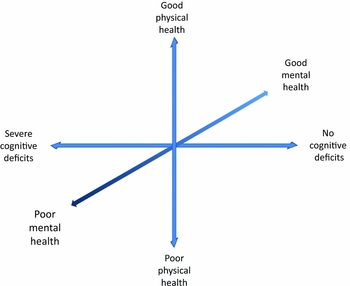
Figure 1 maps out a range of conditions in a 3D model. It attempts to capture the diversity of older people's presentations along three different continua; an axis of good to poor physical health, an axis of good to poor cognitive health, and one for good to poor mental health. While this model does not entirely account for the variations in symptoms within individuals, it helps to focus attention on a number of contributing factors.
Three-dimensional framework of health presentations.

The complexity of the diagram can be reduced by demonstrating the core features within a grid (see Table 1). In this grid we can see that there are eight broad groupings of presentation, each cell requiring a different treatment.
Grid outlining the eight cells of the three axes model (James & Fossey, Reference James, Fossey, Jacoby, Oppenheimer, Dening and Thomas2013)

It is worth noting that the table is a simplified representation because it does not portray the variability implied by the three intersecting continua. However, the table helpfully demonstrates the types of presentations one finds routinely when working with older people, from the least impaired clients (cell 1) to the most impaired clients (cell 8). As one might expect, the needs of people within each cell will differ greatly, as will the mechanisms of providing CBT support. Indeed, those who are not experiencing a problematic disorder will not require specific clinical treatments, but active steps will be required to ensure they do not develop distress (see James et al. Reference James, Kendell and Reichelt1999). This is an important point as it suggests that psychosocial input should be both preventative as well as reactive. Thus, even for clients in cell 1, therapists should be encouraged to provide opportunities for them to meet the basic needs of companionship and social activities to prevent the clients developing low affect. Similar requirements will be needed for those in cell 2, although these clients may require additional physical help to allow them to access such activities. Those in the other cells will require additional specialist input depending on their mental and physical health needs. The people in the right-hand cells (cells 5–8) will have the additional difficulties of cognitive problems, requiring trained staff to act on their behalf to ensure their needs are met (James & Fossey, Reference James, Fossey, Jacoby, Oppenheimer, Dening and Thomas2013). Owing to the great diversity of presentations, those providing psychological support should ideally be trained in a diverse range of interventions and management strategies (e.g. cognitive stimulation therapy; Spector et al. Reference Spector, Thorgrimsen, Woods and Orrell2006).
It is important to recognize that the axes in Figure 1 are not independent of one another, and a change on one may produce changes on others. As such, people can move between the cells, becoming better or worse with respect to a certain condition. For example, take Mary, who was referred to clinical services because of her physical aggression, poor mobility, and cognitive impairment (cell 8). Following successful treatment of the arthritis in her knees, she became more independent, her behaviour improved significantly, and she was reclassified to cell 5. In Mary's case, the two latter features were both ‘reversible’ conditions, whereas her dementia was not significantly impacted by the changes. In this case, her cognitive impairment was seen as an ‘irreversible’ feature.
In many respects, the work of the therapist is to determine what aspects of a resident's presentation are reversible, and then use the correct techniques and skills to reverse them. By contrast, the irreversible conditions often require effective management strategies (staff support/education, specialist equipment, etc.).
This section has demonstrated that many features will be impacting on the older person and, owing to the complexities of certain presentations, one may incorrectly think that some clients could not possibly benefit from CBT. However, this would be a mistake because CBT will be relevant, whatever the status of the clients, as long as the clients are thinking and attempting to use reason to make sense of their experiences. Indeed, the fact that CBT conceptualizations track cognitions helps us understand the interconnections between people's moment-to-moment thinking, feelings and actions, including displays of unusual or problematic behaviours. Such problematic behaviours are often given the label challenging behaviours or ‘behaviours that challenge’.
Many challenging behaviours are products of ‘cognitive overloading’ on the part of PWD. I have previously argued that PWD often need to think ‘consciously’ a higher percentage of time compared to those without dementia, who spend more time in ‘automatic’ mode. This is because lots of ordinary everyday situations become novel or confusing (James, Reference James2011). Thus in an attempt to recognize the ‘what, why, where, who’ of their current situation, PWD engage in constant problem-solving and coping strategies in order to resolve their confusion. Unfortunately, due to the degraded information they have access to, they may come up with interpretations and solutions that other people find challenging (excessive questions, seeking of reassurance, avoidance, searching/wandering, becoming overly assertive, seeking immediate answers, etc.).
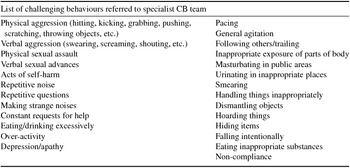
Table 2 outlines a list of challenging behaviours taken from an audit of the referrals from Newcastle Challenging Behaviour Service (James, Reference James2011). These actions can be highly problematic because they may lead to admission to mental health wards, a move into care, transfers between care homes and problematic relationships with carers. The remainder of the paper will focus on the treatment of such actions. From our recognition of the important role thoughts play in triggering challenging behaviours, I will show how we can develop communication strategies that promote styles of thinking in PWD which foster wellbeing rather than conflict or confrontation.
List of challenging behaviours from the Newcastle audit (James, Reference James2011)

Formulation-led interventions
Guidance on the treatment of challenging behaviours has stressed the importance of using non-pharmacological treatments prior to the use of tranquillizers and sedatives (All-Party Parliamentary Group on Dementia, 2008). In the past the latter approaches, in the forms of antipsychotics and benzodiazepines, were over-utilized, leading to premature deaths and other highly problematic side-effects (Banerjee, Reference Banerjee2009). The British Psychological Society (BPS; Brechin et al. Reference Brechin, Murphy, James and Codner2013) have produced one of the most comprehensive set of treatment guidelines, and used a stepped-care approach to illustrate an escalation in stages of management based on presentation and risk issues.
At the top of the BPS treatment pyramid is the use of bespoke treatments guided by biopsychosocial formulations. A number of these formulation-led approaches are informed by CBT principles.
For example, the Roseberry Park conceptualization (RP; Dexter-Smith, Reference Dexter-Smith2007, Reference Dexter-Smith2010) is a straightforward diathesis stress model, collecting information about early history and life experiences, as well as details of the ‘here and now’ via a hot-cross bun cycle. The model makes explicit that environmental features and interpersonal processes influence clients’ behaviour. The Roseberry Park model is well explained in terms of structural and process features in a series of articles (Dexter-Smith, Reference Dexter-Smith2010; Dexter-Smith et al. Reference Dexter-Smith, Hopper and Sharpe2010; Craven-Staines et al. Reference Craven-Staines, Dexter-Smith and Li2010), noting that often in dementia one starts from the hot-cross bun cycle and works one's way backwards to the more distal features (core beliefs, early history, etc.). Another interesting tool with respect to the Roseberry Park model is the development of ABC assessment charts which incorporate the hot-cross bun cycle.
An alternative conceptualization is the Newcastle model. It has been used in a randomized control trial study and makes use of CBT's cognitive triads, and highlights the role of the hot-cross bun conceptualization (Fig. 2) (Fossey et al. Reference Fossey, Ballard, Juszczak, James, Alder, Jacoby and Howard2006; Fossey & James, Reference Fossey and James2007).
Interactions of carer and people with dementia (PWD) cycles.

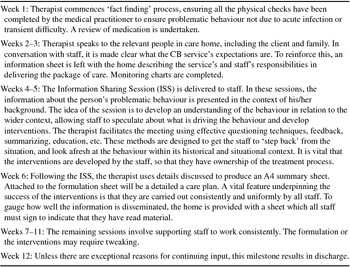
Support for this representation outlined in Figure 2 is provided by an audit of the care plans produced from the Newcastle Challenging Behaviour team (James, Reference James2011). It showed that the key mechanism of change underpinning the team's success was invariably an improvement in carer–resident interaction. Such findings further support the view that the key agent of change in this work is the carer. Indeed, while a comprehensive assessment and formulation is undertaken for the PWD, it is the carers who are required to initiate changes in their interactions with the client. More specifically, through a 12-week programme (see Table 3), care home staff are taught how to communicate and interact better. Working with colleagues from Newcastle Local Authorities and Northumbria Universities we are currently developing a training programme that provides guidance on effective carer interactions. As with many features of good CBT techniques, our guidance emphasizes the need to reduce high levels of emotional thinking, helping the carer to reflect from a position that engages problem-solving skills. The guidance currently being developed is briefly discussed under the label Communication and Interaction Therapy (CAIT), and its five key concepts are outlined below.
Typical 12-week Newcastle model protocol delivered by a CB therapist

CAIT
CAIT is being developed for care home and ward settings for the treatment of challenging behaviour, but has not yet been trialled in a controlled study. However, a number of its key features have been used previously (James, Reference James2011). Four of these features [(a)-(d) below] are described below.
(a) ‘Communicate in the moment, based on biography and context’ (CIMBBC). CIMBCC is based on two broad concepts, ‘communicating in the moment’ and ‘biography’. The communicating in the moment principle forms the basis of many ‘customer service’ training programmes, whereby sales teams are taught how to interact in a focused, informative and courteous manner. The retail staff may only be speaking with the customer for less than 30 s, but during these ‘moments’ of contact the customer is made to feel special and worthy of a focused period of attention. Transferred to a 24-h care setting, good staff are taught to interact with the PWD, who may be disorientated in time and place, in a way that leaves the person feeling reassured and empowered. However, on some occasions the PWD may be feeling particularly distressed, and even when being dealt with in a civil manner this may not be sufficient to reduce his/her agitation. In such circumstances the ‘biography and context’ element should be used, whereby communication is targeted to the specific needs of the person in the situation. This requires the carer to employ bespoke knowledge of the PWD. When this knowledge is used appropriately, it has a better chance of reducing the agitation. For example, knowing ‘Bob’ is a big fan of Liverpool FC provides a topic to engage him in when he starts to get agitated immediately after the daily farewell and departure of his wife. Further, knowing ‘Joan’ likes listening to the Elvis Presley in her room provides a means of getting her to rest for a while from her pacing up and down the corridor. The true skill of the staff is being able to combine the background information within a dialogue that moves the resident away from a potentially problematic behaviour to one that is less risky and more functional. The examples given above highlight the relevance of employing quality interactions and training staff in developing good negotiation skills.
(b) Negotiating stop/start scenarios (SSS). The majority of challenging behaviours require some form of carer interaction in the form of an intervention. The intervention is necessary because by identifying a behaviour as a ‘problem’ it requires dealing with it in some manner (e.g. preventing someone hitting out; asking someone to get out of a heavily soiled bed). Thus in many situations the carer is required to intervene to resolve the problem and minimize any perceived risk. In such scenarios, the carer is often required to act persuasively to get the PWD to either stop some problematic behaviour (e.g. to stop: going into someone's room; attempting to leave the building; hitting out) or to start a behaviour aimed at enhancing the person's wellbeing (e.g. to start: taking medication; drinking water; washing and dressing). Such interactions are referred to as SSS (James & Hope, Reference James and Hope2013), and we believe that the essence of dealing well with challenging behaviours is the ability of carers to intervene appropriately with SSS. The common SSS when caring for someone with dementia include:
-
• Getting someone up in the morning.
-
• Helping someone go to the toilet.
-
• Helping someone engage in self-care activities.
-
• Encouraging someone to take medication.
-
• Asking someone to go to bed.
-
• Asking someone to leave someone else's room.
-
• Asking someone to stop shouting.
-
• Preventing someone from leaving the building.
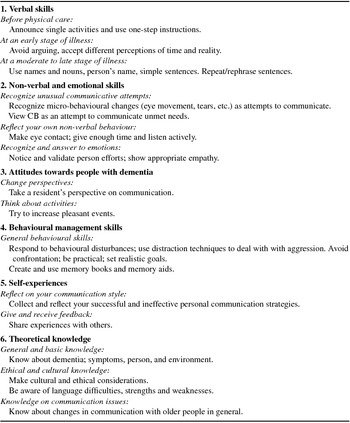
When working clinically, we find the above list helpful because it contradicts the carers’ frequent statements that the behaviours ‘have no patterns, and come out of the blue!’ In most situations such claims are incorrect because the challenging behaviour is a direct consequence of a SSS. Hence, by training staff to improve their negotiation skills around SSS the frequency of problematic behaviours would reduce markedly. It is suggested that training carers to communicate effectively around these common daily activities is essential to delivering good dementia care. Eggenberger et al.'s recent review on training staff to communicate with PWD is particularly helpful with respect to such interventions (Levy-Storms, Reference Levy-Storms2008; Eggenberger et al. Reference Eggenberger, Heimerl and Bennett2013). Table 4 presents some of the items in Eggenberger et al.'s guidelines.
Eggenberger's Communication Skills in Dementia Care – a shortened version (Eggenberger et al. Reference Eggenberger, Heimerl and Bennett2013)

(c) Frames of reference. Like all of us, PWD come to a situation with their own experiences. This includes things like personal culture, history, gender, social influences, etc. Communication theorists (Levinson, Reference Levinson2003) describe these details as ‘the field of experience’ or ‘the frame of reference’ that people bring to each situation they encounter. Most of the time when people are talking to each other their fields of experience overlap because they have things in common, which permits efficient communication. Occasionally, individuals’ fields of experience do not overlap well, and this can cause difficulties in negotiating meaning and communicating effectively. For example, confusion may occur when two people from two diverse cultures are trying to communicate, using different languages (Levinson, Reference Levinson2003). Problems may also occur when communicating with someone who is experiencing distress (depression, anxiety) or cognitive impairment, such as in dementia. In the case of depression, communication can be difficult because the incoming information is filtered and distorted by cognitive biases, a tendency to access negative memories, etc. In the case of someone with dementia there may be delays in processing speeds and memory problems (e.g. time-shifts), and thus the communicators’ frames of reference may be out of synchrony with current reality. A further lack of synchrony may be caused by the PWD coming to the situation using both degraded information and poor insight to his/her disadvantages.
Consider ‘John’, he has Alzheimer's disease and has been living in a care home for 5 years. During the last 2 months he has been misperceiving his surroundings as a hotel, and is becoming more and more frustrated with staff during his conversations with them. Indeed, he is constantly complaining to the staff that he has not got any money to pay his hotel bills. He is also unable to understand why they will not let him leave the building by himself.
In this example, the fields of experience of John and the staff do not match. Ideally, one could cue John into sharing the current reality via prompts and reality orientation techniques (Woods et al. Reference Woods, Spector, Jones, Orrell and Davies2005). For example, one could regularly sit down with John and remind him where he is and what he is doing there. Further, one could improve the signage in the building, helping to orientate residents better to their present surroundings. If the cues are successful, John could once again achieve communication synchrony and recognize his situation and surroundings and become less agitated. The latter methodology outlines the principles underpinning Reality Orientation Therapy (Woods et al. Reference Woods, Spector, Jones, Orrell and Davies2005), which operates via the philosophy of trying to cue PWD to our reality. That is, a reality in which they could converse with other residents and staff about current affairs because everyone would be sharing a common field of experience. However, on occasions people cannot be shifted from their belief systems relating to where, when and who they are. Typical examples include older women who believe they have a child or member or their family (mother, partner) waiting for them at home, or retired men residing in care who believe they need to get to work. Such problems should not be confused with psychosis, rather they relate to memory errors whereby outdated memory scripts are reactivated erroneously. Typically the phenomenon is referred to as being ‘time-shifted’, but was previously described by the term ‘reminiscing disorientation’ by Jones & Burns (Reference Jones, Burns, Jones and Miesen1992). In the mid to later stages of dementia time-shifting becomes more common, and the use of reality reorientation and cueing strategies are less effective. Indeed, on an increasing number of occasions one may no longer be able to convince the PWD that their views are incorrect. Ironically, when you trying to convince them of the truth the may call you a liar, and this may undermine the trust you are fighting hard to maintain and nurture. On such occasions we may be required to overlook our own reality and enter the ‘world’ of the PWD.
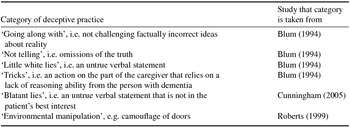
(d) Entering the world of PWD via therapeutic lying. When teaching carers about developing communicating skills with PWD, we train them to be able to ‘enter a person's current reality’ and, if necessary, communicate with them in their reality rather than orientating them to ours. The need to do this is common when working with PWD because they can become ‘time-shifted’. In this state they reactivate previous life-scripts and start to think and behave consistently with respect to their time-shifted beliefs. So they may think they are in their 30s and have young children at school, or they are still in full-time employment as a cleaner, housewife, teacher or General Practitioner. Once such memory scripts have been retrieved sometimes it can be extremely difficult to move people out of these time-frames. On such occasions the carers need to employ skilful communication strategies, which may necessitate ‘entering the person's world’. This involves gaining skills in being able to assess PWD's current cognitions, and then interacting in ways consistent with their belief systems. Such strategies, aim to prevent the triggering of negative emotional states and behaviours, by preserving the person's view of the world using belief-congruent statements. Such a strategy would be an example of a therapeutic lie. In the case of John this would mean recognizing that he is out of synchrony with respect to the current ‘accepted’ reality (i.e. he is not orientated to time and place), and therefore he may need to be communicated with as if he truly is a resident in a hotel. While this may seem sensible in some respects, it has major ethical implications because it raises the issue of the use of clinical deception, because in this scenario the carer would be intentionally ‘going along’ with an untruth (Blum, 1994). Blum has discussed such issues under the heading of lies, and his taxonomy is presented, along with other categories of lying in Table 5.
Blum's and associated taxonomies of lying

Blum (1994) found that family members of PWD considered ‘outright lies’ to be distinct from other forms of deception (‘going along’, ‘little white lies’, ‘not telling’, and ‘tricks’). Cunningham (2005) found that professional carers used euphemistic expressions (e.g. ‘little white lies’ and ‘bending the truth’) to reduce the inner conflicts associated with lying. In Newcastle, we began to examine the use of lying by carer staff in 2003, and have since conducted a number of studies on the topic (James et al. Reference James, Powell, Smith and Fairbairn2003, Reference James, Wood-Mitchell, Waterworth, Mackenzie and Cunningham2006; Wood-Mitchell et al. Reference Wood-Mitchell, James, Waterworth and Swann2008; Elvish et al. Reference Elvish, James and Milne2010; Day et al. Reference Day, James, Meyer and Lee2011; Culley et al. Reference Culley, Barber, Hope and James2013). Some of the key findings are outlined below.
-
• In a survey of 112 professional carers and therapists, 98% of people admitted to telling lies to PWD.
-
• 93% of participants thought lying could be beneficial.
-
• 88% of participants acknowledged lies could be problematic.
-
• 85% of participants wanted guidelines on the use of lies in dementia care.
-
• A number of studies have endorsed the view that lies should only be told in the best interests of PWD.
-
• PWD acknowledge the potential benefits and problems of lying.
-
• People consider this is an important topic for debate because, whatever one thinks about the topic, lying is endemic in our care services.
A recent study on this topic examined the views of PWD (Day et al. Reference Day, James, Meyer and Lee2011). From this project it was recommended that carers should adopt a ‘cautious’ approach when utilizing lies and deception. Most participants considered it to be more acceptable to use lying during the later stages of their dementia, because the benefits (a reduction of truth-related distress) were considered to outweigh the detractions (e.g. negative impact on personhood and self-esteem). However, several participants considered lying to be unacceptable under any circumstances. This topic remains highly controversial, and a national debate is currently taking place hosted by the Mental Health Foundation (MHF) and funded by the Joseph Rowntree Trust. MHF have commissioned a standing panel of professionals, carers, and PWD to discuss the topic with invited speakers. The speakers are regarded as having expertise with respect to some aspect of the topics of ‘deception’ or ‘misperceptions’ in dementia care. Some speakers raised fears about safeguarding the needs of vulnerable adults, and many voiced concerns about the undermining of trust. By contrast, other speakers reflected on the fact the telling the truth was also problematic and was often perceived by PWD as a lie and thus often led to the loss of trust.
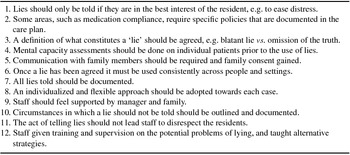
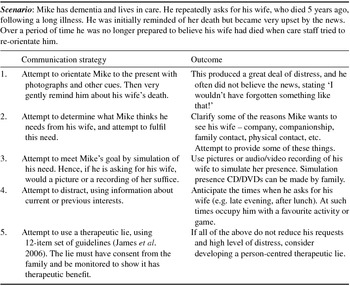
In response to carers’ requests for guidelines a 12-item set of guidelines was produced. (James et al. Reference James, Wood-Mitchell, Waterworth, Mackenzie and Cunningham2006; Culley et al. Reference Culley, Barber, Hope and James2013, Table 6). One of the most controversial items is a suggestion that staff should be trained in the use of lies (e.g. choosing an appropriate lie, or how to document a lie, etc.). In part fulfilment of this, Mackenzie and colleagues (Mackenzie & James, Reference Mackenzie and James2010) have produced a five-stage set of recommendations, and illustrated the various communication stages in a training DVD. Mackenzie outlines her steps in the example of ‘Mike’ in Table 7.
Guidelines for therapeutic lies (James et al. Reference James, Wood-Mitchell, Waterworth, Mackenzie and Cunningham2006)

‘Mike’ – communication and the use of therapeutic lies

In this situation Mike does not share the same field of reference as the staff because he is fixed in his ‘time-shifted’ belief that his wife is still alive. Thus he is becoming angry and confused because he is convinced that the staff are lying to him (when they are actually telling the truth!). He is convinced his own version of events is correct and is starting to generate theories about why the staff are lying to him (e.g. ‘Are staff frightened to tell me that my wife has abandoned me, or that she's found another man?’).
During the course of this article, we have presented a number of different perspectives and ideas. The following case study (‘George’) attempts to demonstrate how the various concepts can be used together to inform treatment. As one will see, at the heart of our understanding of George's predicament is the hot-cross bun conceptualization, which highlights how his time-shifted thoughts and beliefs are driving his emotions and physiology both in the ‘challenging’ and ‘treated’ phases of his presentation.
Case study: ‘George’
George is in his 70s, has vascular dementia, and has lived in a care home for the last 4 years. He has arthritis, cardiac and bladder problems, the latter making him prone to infections. He has severe frontal lobe deficits and as a result he has very limited social skills. He is extremely impulsive and resorts to physical aggression in an attempt to meet his needs. Often, if staff do not do what he asks immediately he lashes out. Nearly all the staff on the care home are frightened of him because of his aggression. A very typical scenario would be witnessing George at about 6.00 a.m. marching down the corridor of the home, asking staff to open the door so he can get to work. He is as regular as clockwork – swearing and telling staff to open the door for him as ‘he had to get to his work’.
In the initial stages, we were able to re-orientate George to the reality of his situation. To do this, we used a life-story scrapbook. This contained photographs of retirement and paper clippings of the closure of the shipyard in which he worked. However, over time the reality orientation techniques started to fail. We realized this when he became more and more forceful in his attempts to leave. One of the nurses lost her front teeth when trying to tell him he was in retired and now living in care. He threw away the scrapbook and wanted to know why we were trying to trick him.
In attempting to understand the needs that were driving the behaviour, we produced a formulation, containing information about his life story, physical and mental health, personality, environment, cognitive status, medication. In addition to speaking to him and the care staff, we obtained information from his family. Via behavioural charts we were able to undertake a functional analysis informed by the hot-cross conceptualization. Using this bespoke biopsychosocial formulation, as recommended in the BPS's stepped-care approach, we were eventually able to find the reasons for his aggression. It appears that had been a labourer in a shipyard and the men were only employed on a daily basis. He had to be one of the first men to get to the site as only the first 20 men would get work for the day. It is therefore understandable why he was so anxious to get there and why he got so angry with the staff on the ward who, as he saw it, were stopping him. Based on the information, and our failure to re-orientate George, we had to think about what else we could do to keep both him and the carers safe. Experience informed us to progress through Mackenzie's five steps:
-
1. Reorientation. This had been used previously, but was no longer effective.
-
2. Try to meet George's need. In this instance we could not meet his need. We were unable to let him go to work. He no longer had a job. Therefore we had to look at the next best strategy.
-
3. Substitute or simulate the need. Why did George want to go to work? If he said it was to get some money, could we show him his wallet with enough money in it. Or was his drive to see his mates at the yard? In this case, we were unable to find a way of either substituting or simulating his need.
-
4. Distraction. We knew George got agitated at a certain time of the day, so we tried to pre-empt any difficulties using distraction. As his agitation grew from 5.30 a.m. onwards, we had to start the distraction techniques about 5.00 a.m. This is where we really needed to know details about George's likes and dislikes (music, food, watching films or sporting events, etc.) in order to determine what methods to use to distract. Unfortunately, distraction did not work and we were left to consider the use of a therapeutic lie.
-
5. Enter his world and use non-confrontational methods. These methods are used as an approach of last resort. However, in this case it was an effective strategy. It was agreed by staff and family to say to George: ‘You don't have to go to work today as it's Trades fortnight when all the yards on the Tyne close for two weeks. Why don't you got back to bed, and I’ll bring you a mug of tea.’ It was important that the effect of this intervention was monitored and reviewed regularly, and that the technique was used consistently by all staff, family and friends. It was also important that the lie conformed to ‘communicating in the moment principles’. Indeed, it needed to be tailored to George's past, and said to him in a courteous and convincing manner. It was relevant to note that one of the staff was not keen to use lies and initially was reluctant to do so without further guidance from his line manager. Following a wide-ranging discussion with the manager and staff, it was agreed that in the present context the lie should be seen as a treatment strategy, one that had been appropriately formulated and care planned. As such it had the same status as a medication or psychosocial regimen, both of which all staff would be expected to engage with and use.
This case has attempted to illustrate the concept of ‘communicating in the moment’, SSS, and the importance of the staff being aware of the notion of ‘field of experience’. It has also shown the steps and logic underpinning a care plan have called for the consistent use of a therapeutic lie.
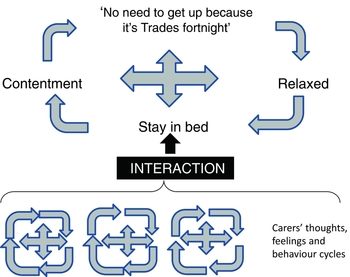
Figure 3 presents a set of interactive cycles demonstrating George's experiences at the end of an effective formulation-led treatment programme. Prior to this virtuous cycle, his aggressive behaviour was being fuelled by anger, physiological arousal and thoughts of needing ‘at all costs’ to get out of the building to get to work. I have represented the staff's interactions as multiple cycles in keeping with their individual perspectives and behaviours. It is relevant to state that one of the key aims of the formulation-led programme was to help the staff determine collectively the potential reasons for George's behaviour, and then mutually agree a plan of interaction. It is during the collaborative meeting with the staff, which Newcastle Challenging Behaviour Team call the Information Sharing Session (see Table 3), that the consensus and care planning is achieved. Within such meetings it is highlighted that any actions or communication that has been agreed must be carried out consistently by all staff, monitored and tweaked where necessary. In such cases the staff's individual cycles should become similar to each other, resulting in the desired consistency in approach.
George's virtuous hot-cross bun cycle.

Conclusion
Older people's health difficulties may occur in many domains as illustrated in the final case study. George's situation highlighted how CBT principles can be used to help understand the experiences of a man who was coping with his situation via physical aggression. The aggression was one of the few coping strategies he had available now that his abilities and confidence in his reasoning and communication skills had diminished. Prior to understanding the reasons for his anger, staff had responded to his behaviour with an inconsistent array of fear, anxiety, and ‘firm handedness’. The structure provided by a CBT-informed conceptualization facilitated an understanding of the behaviour and reduced the ‘emotional thinking’ of staff sufficiently to allow them to develop potential solutions. Similar to the majority of management strategies in this area, the solutions involved engaging with George differently (meeting his needs, distraction, etc.). In this particular case, it was recognized that carers needed to ‘enter his world’ and knowingly and consistently lie to him. In this paper I have given a rationale about how the latter strategy was arrived at. I have described deception as a communication tool, and emphasized that lying is only one of the tools carers need to develop as part of their negotiating skills around SSS. Currently, with colleagues in other parts of the UK, we are developing an approach known as Communication and Interactive Therapy (CAIT), which attempts to improve communication skills in carers. In Newcastle we ran our first CAIT groups in autumn 2014, and within these workshops we taught care staff to become better negotiators. This included teaching them to lie more effectively to their residents, but always in their residents’ best interests.
Declaration of Interest
None.
-
• CBT principles can be applied to the assessment and treatment of people with dementia, and are useful for conceptualizing agitation in this client group.
-
• Despite the existence of numerous psychosocial treatments designed for people with dementia (reminiscence, reality orientation, etc.), some of the most effective approaches for resolving challenging behaviours are the use of basic communication and interaction strategies. In this paper the latter strategies are described within a programme called Communication and Interaction Therapy (CAIT).
-
• When memory impairment results in people believing they are living in an earlier period of their lives, it is often appropriate not to challenge their cognitive error. Further, in some circumstances it is apposite to actively ‘go along’ with the person with dementia's misconceptions. Such deceptions are referred to as therapeutic lies, and guidelines for their use are presented in the article.




Comments
No Comments have been published for this article.