In 1964, von Armin and Engel reported clinical observations of six children with infantile hypercalcemia, a developmental disorder that we now know as Williams syndrome. The authors noted that, despite suffering from severe mental retardation, the children possessed “an unusual command of language” (p. 367). Forty years of research has done little to change this characterization of Williams syndrome. More recently, for example, Bellugi, Lichtenberger, Jones, Lai, and St. George (2000, p. 12) stated that “the general cognitive impairment seen in adolescents and adults with Williams syndrome stands in stark contrast to their relative strength in language, their facility and ease in using sentences with complex syntax, not generally characteristic of other mentally retarded groups.”
The potential theoretical importance of Williams syndrome has not been lost on researchers. In particular, the disorder has been widely cited as evidence for the “modularity” of language. However, the idea that individuals with Williams syndrome have a “preserved” or “normally developing” language module has been challenged by researchers arguing that the language acquisition process in Williams syndrome is subtly different to that found in typical development. In fact, the evidence to support all of these claims is somewhat less clear cut than is often portrayed. Key findings have not always been replicated, and results are often dependent on factors such as the choice of control group or comparison measure. The aim of this paper, therefore, is to provide a critical review of empirical findings concerning language in Williams syndrome and to consider their implications for theories of language development.
The paper begins with a brief overview of Williams syndrome, followed by an introduction to the theoretical background and consideration of a number of important conceptual and methodological issues. The main body of the review is then divided into sections looking at studies of phonological, lexical–semantic, grammatical, and pragmatic skills in Williams syndrome. The paper concludes with a discussion of the theoretical implications and directions for future research.
Williams Syndrome
Williams syndrome is a rare genetic disorder. Its prevalence is often quoted as being around 1 in 20,000 live births (Morris, Demsey, Leonard, Dilts, & Blackburn, 1988), although a more recent study revised this estimate to 1 in 7,500 (Strømme, Bjørnstad, & Ramstad, 2002). The genetic cause of Williams syndrome has been traced to a submicroscopic deletion of about 25 genes in the 7q11.23 region of chromosome 7 (Ewart et al., 1993; see Donnai & Karmiloff-Smith, 2000). This deletion includes the gene ELN, which codes for the protein elastin (Lowery et al., 1995) and a fluorescent in situ hybridization test for the deletion of ELN is now routinely used to confirm clinical diagnoses. In isolation, the deletion of ELN is directly linked to the cardiac anomalies associated with Williams syndrome (see below), but does not appear to have any effects on cognitive development (Gray, Karmiloff-Smith, Funnell, & Tassabehji, 2006).
Clinical presentation
The syndrome was first recognized on the basis of medical and physical features, including cardiac anomalies and hypercalemia (excessive blood calcium levels), which occurred in association with developmental delay and an unusual “elfin” facial profile (Bongiovanni, Eberlein, & Jones, 1957; Joseph & Parrott, 1958; Williams, Barratt-Boyes, & Lowe, 1961; see Morris, 2006; Semel & Rosner, 2003, for recent reviews). Perhaps the most common feature of Williams syndrome, however, is an abnormal reaction to certain sounds (Levitin, Cole, Lincoln, & Bellugi, 2005; Marriage, 1996; van Borsel, Curfs, & Fryns, 1997). This is typically referred to as “auditory hyperacusis,” although, in fact, very few individuals with Williams syndrome show enhanced ability to detect low amplitude sounds (Levitin et al., 2005). People with Williams syndrome are often described as being extremely friendly or “hypersociable” (e.g., Doyle, Bellugi, Korenberg, & Graham, 2004; Jones et al., 2000), and show enhanced emotional empathy relative to individuals with other learning disabilities (Tager-Flusberg & Sullivan, 2000). However, their performance on social reasoning tasks is no better than predicted by mental age (Tager-Flusberg & Sullivan, 2000).
Neurophysiology
Overall brain volume is reduced in Williams syndrome. However, when overall volume is controlled for, imaging studies have identified specific reductions in parietal regions (Eckert et al., 2005), the corpus callosum (Schmitt et al., 2001), and brainstem (Reiss et al., 2000), but a relatively large auditory area (Holinger et al., 2005) and cerebellum (Jones et al., 2002). Recent studies have also identified increased cortical gyrification and complexity (Schmitt et al., 2002; Thompson et al., 2005) and abnormal hippocampal shape (Meyer-Lindenberg et al., 2005). In addition, there is evidence for atypical neuron size and packing (Galaburda & Bellugi, 2000; Galaburda et al., 2002).
Overall and nonverbal cognition
The majority of individuals with Williams syndrome are classified as having mild to moderate mental retardation (e.g., Arnold, Yule, & Martin, 1985; Howlin, Davies, & Udwin, 1998; Mervis, Morris, Bertrand, & Robinson, 1999; Udwin, Yule, & Martin, 1987). Studies typically show a significant advantage for verbal IQ over performance IQ (Grant et al., 1997; Howlin et al., 1998; Levy & Bechar 2003; Udwin & Yule 1990; see also Udwin & Yule, 1991) or a nonsignificant trend in this direction (Dall'Oglio & Milani, 1995; Pagon, Bennett, LaVeck, Stewart, & Johnson, 1987). However, the magnitude of this dissociation is relatively small (cf. Seashore, 1951). For example, in the largest study to date, Howlin et al. (1998) reported mean verbal and performance IQs in adults with Williams syndrome of 64.5 and 60.8, respectively.
The verbal IQ advantage is driven, at least in part, by exceptionally poor performance on visuospatial construction subtests, in which participants are required to reconstruct a two-dimensional pattern using colored blocks (see Farran & Jarrold, 2003). Indeed, a number of studies have shown that visuospatial skills in general are extremely poor in Williams syndrome. For example, Farran, Jarrold, and Gathercole (2001, 2003) have reported that performance on visuospatial construction and mental rotation tasks is significantly poorer than on the Ravens Colored Progressive Matrices, a measure of nonverbal reasoning (Raven, 1993). Similarly, Mervis and colleagues have noted that standard scores for the spatial cluster of the Differential Abilities Scale (Elliot, 1990) are much poorer than for verbal or nonverbal scales (Mervis, Robinson, Rowe, Becerra, & Klein-Tasman, 2003), and that these selective visuospatial difficulties are both highly specific and virtually universal to Williams syndrome (Mervis et al., 2000). Difficulties with numerical cognition are also frequently noted (Ansari et al., 2003; Udwin, Davies, & Howlin, 1996), and there is some evidence that, like visuospatial skills, numerical abilities are poorer than predicted by overall cognition (Paterson, Girelli, Butterworth, & Karmiloff-Smith, 2006).
Theoretical Perspectives
The potential theoretical importance of Williams syndrome was first highlighted by the work of Bellugi and colleagues (e.g., Bellugi, Marks, Bihrle, & Sabo, 1988; see also Bellugi, Lichtenberger, Mills, Galaburda, & Korenberg, 1999). According to the traditional Piagetian view, language acquisition is predicated on cognitive development (see, e.g., Piaget, 1963; Shaffer & Ehri, 1980; Sinclair de Zwart, 1967). However, Bellugi et al. (1988) argued that Williams syndrome directly challenges this account. In particular, they reported the cases of three children with Williams syndrome, who produced language that was “complex in terms of morphological and syntactic structures” (p. 183) despite the fact that they lacked the supposed cognitive prerequisites as measured by performance on Piagetian conservation and seriation tasks. Since this pioneering work, Williams syndrome has frequently been cited as evidence that language is independent of cognition or “modular” (see Anderson, 1998; Bickerton, 1997; Piatelli-Palmarini, 2001; Pinker, 1994, 1999; Rondal, 1994; Temple & Clahsen, 2002).
The principles of modularity were outlined by Fodor (1983, 2000), who argued that there are two main types of cognitive systems: nonmodular central processing systems and specialized modules that have evolved to handle specific types of information. Following Chomsky (1965, 1988), Fodor claimed that human language fits this definition of a module. The most important characteristic of modules is their impenetrability to general knowledge and input from other modules, termed “information encapsulation.” If, as Bellugi and colleagues have argued, language is preserved or develops normally in Williams syndrome in the face of intellectual delay, this can be taken as strong evidence for information encapsulation and, hence, for the modularity of language (cf. Moscovitch & Umilta, 1990).
An important issue here is the level or “granularity” at which modularity applies to language (see Levy, 1996; Thomas & Karmiloff-Smith, 2005). Fodor (1983) implied that the language system in its broadest sense is modular. However, linguists often apply a narrower definition of “language,” which includes only the abstract computational mechanisms involved in syntax, morphology, and phonology (see, e.g., Hauser, Chomsky, & Fitch, 2002). According to Chomsky (1980), only these computational aspects of language could be considered to be modular. Other researchers have gone further, suggesting that modularity applies to specific aspects of grammar such as morphosyntactic rules (see, e.g., Pinker, 1999). Indeed, this confusion is reflected in the literature on Williams syndrome. For example, Anderson (1998) suggested that Williams syndrome may represent “a classic case in which [the language acquisition] module has been spared from the general brain damage caused by the genetic disorder” (p. 168), but also conceded that “selective sparing might take place … at a finer grain than the entire linguistic system” (p. 169).
Critics of this modular approach to language have argued that it ignores the process of development (Karmiloff-Smith, 1992; Thomas, 2005a), and should not, therefore, be applied to disorders such as Williams syndrome, which are fundamentally developmental in nature (see Abbeduto, Evans, & Dolan, 2001; Bishop, 1997; Karmiloff-Smith, 1998). According to the alternative “neuroconstructivist” perspective, linguistic capabilities in Williams syndrome should not be framed in terms of intact (or normally developed) modules but rather as the product of altered constraints on cognitive and linguistic development (see, e.g., Karmiloff-Smith, 1998; Karmiloff-Smith, Scerif, & Thomas, 2002). The clearest evidence for atypical constraints on language development is likely to come from studies of early language and its precursors in infancy, before compensatory processes can mask the underlying difficulties (Karmiloff-Smith & Thomas, 2003). However, even when individuals are able to compensate for their original difficulties, residual abnormalities may be revealed by closer inspection of the language profile or the factors affecting performance on particular tasks (Thomas, 2005b).
Thomas and Karmiloff-Smith (2003) reviewed a large body of evidence from studies of Williams syndrome and put forward a suite of hypotheses falling under the umbrella of an “imbalance” between phonological and semantic processing. Most prominent among these were the suggestion that language is overreliant on phonological short-term memory (cf. Grant et al., 1997; Karmiloff & Karmiloff-Smith, 2001; Mervis et al., 1999; Vicari, Carlesimo, Brizzolara, & Pezzini, 1996) and the claim that lexical-semantic processing is somehow impaired or atypical (cf. Rossen, Klima, Bellugi, Bihrle, & Jones, 1996; Temple, Almazan, & Sherwood, 2002). These hypotheses were contrasted with what Thomas and Karmiloff-Smith (2003) termed the “conservative hypothesis.” This is effectively a null hypothesis representing the view that the language acquisition process is delayed but not fundamentally altered in Williams syndrome (cf. Tager-Flusberg, Plesa-Skwerer, Faja, & Joseph, 2003). According to this view, any unique characteristics of language in Williams syndrome are indirect consequences of other nonlinguistic aspects of the disorder such as a strong desire for social interaction and impaired visuospatial cognition.
Methodological Issues
The aim of this review is to evaluate the empirical evidence relevant to the modular or neuroconstructivist accounts of language in Williams syndrome. Unfortunately, many studies have not reported any statistical analyses of their data, and sometimes have not even provided descriptive data. A number of studies have only included data from individuals with Williams syndrome without reference to relevant comparison data, and some frequently cited studies have not, in fact, ever been published. Other studies have simply looked at age-equivalent or mental age scores across standardized tests, under the assumption that significant differences in performance are necessarily an indication of an uneven cognitive or linguistic profile. In fact, as Mervis and Klein-Tasman (2004; see also Bishop, 1997) have forcefully argued, there are a number of psychometric reasons why this assumption is false. This review is therefore restricted to published quantitative data that allow one to compare results across studies and address the theoretical issues discussed above. However, even within these studies, a wide range of methodologies have been adopted, often resulting in apparently conflicting findings. Before reviewing the empirical evidence, it is, therefore, important to first consider a number of methodological points.
Williams syndrome group characteristics
The first issue concerns the nature of the Williams syndrome group. Many of the studies reviewed in this paper have only included a small sample of individuals with Williams syndrome. The problem here is that in genetic disorders, the phenotypic expression is not just the product of the genetic anomaly. Rather, it is the product of an individual's entire genetic endowment, combined with their environment, and the complex interaction between the two (Plomin & Rende, 1991). On top of this genuine individual variation, performance on a particular test at a particular time is an imperfect measure of the underlying competence, so there is also a substantial degree of noise in behavioral data (Bishop, 1997). This is nicely illustrated in a recent study by Porter and Coltheart (2005), who reported that individuals with Williams syndrome (N = 39; age range = 5–44 years) showed marked individual variation in their cognitive strengths and weaknesses as measured by performance on various subtests of the Woodcock Johnson test battery (Woodcock & Johnson, 1990). In the light of such findings, case studies and studies of small groups of individuals with Williams syndrome should be treated with caution.
A further point to consider is the age range of the Williams syndrome group. In theory, it is possible that the cognitive profile in Williams syndrome is different at different ages (see, e.g., Jarrold, Baddeley, & Hewes, 1998). Unfortunately, however, practical issues involved in recruitment mean that large samples of individuals with Williams syndrome are often heterogeneous in terms of age and developmental level, and this can potentially obscure developmental changes in the cognitive profile (Porter & Coltheart, 2005). When evaluating the studies reviewed in this paper, it is, therefore, important to consider not only the size of groups tested but also the age range of the participants.
Comparison data
The second main methodological issue concerns the source of the comparison data. The majority of studies reviewed in this paper have employed a matched control design. The logic here is that, if groups are matched on one measure but not another, this suggests a selective strength or weakness (although see Strauss, 2001). However, the choice of comparison group may be critical. Typically developing children obviously provide the benchmark for “normal” cognitive profiles, but matching groups on any measure of ability introduces potentially confounding group differences in both age and IQ (Jarrold & Brock, 2004; Mervis & Klein-Tasman, 2004). Moreover, some studies have recruited typically developing control groups whose chronological ages match the mental ages of the Williams syndrome group under the assumption that groups will be matched on mental age. Unfortunately, mental age measures are not always particularly accurate and, consequently, groups may not, in fact, be particularly closely matched (Bishop, 1997).
An alternative approach is to include a control group of individuals with other forms of learning difficulties, who are matched to the Williams syndrome group for both age and ability (and therefore IQ). Often, these controls all have some other specific developmental disorder such as Down syndrome, or less commonly, fragile X or Prader–Willi syndrome. The concern here is that any group differences could reflect patterns of strengths and weaknesses in the comparison group as much as in the Williams syndrome group. Other studies have therefore included a group of individuals with learning disabilities of heterogeneous origin. In theory, any syndrome-specific profiles in the control group will average out, but the makeup of the group is often opaque so comparison across studies is difficult.
In sum, there is no obvious best practice when recruiting control groups. As such, one can really only gain an accurate assessment of language in Williams syndrome via the deployment of multiple comparison groups (cf. Burack, Iarocci, Flanagan, & Bowler, 2004). Unfortunately, few studies have done this, so one aim of this review is to bring together studies employing various different control groups in order to get an idea of the “big picture.” With these methodological considerations in mind, I begin the review of language in Williams syndrome by looking at phonology.
Phonology
Phonology refers to the processing of the sound system of a language, and is often considered to be a relative strength in Williams syndrome. In particular, it has been widely argued that phonological short-term memory skills represent a “peak ability” (cf. Mervis et al., 1999, 2003). Studies have also investigated whether phonological processing mechanisms develop atypically, with claims of a reduced influence of long-term phonological and semantic knowledge on phonological short-term memory.
Speech perception
At the age of 7–8 months, typically developing children learning English appear to primarily segment the stream of incoming speech on the basis of prosodic cues, showing greater sensitivity to strong–weak words (e.g., “candle”) than to weak–strong words (e.g., “guitar”). By the age of 10–11 months, other cues such as the co-occurrence of syllables and phonemes in words become more prominent, enabling children to identify weak–strong words (Jusczyk, Houston, & Newsome 1999; Mattys & Jusczyk, 2001). However, Nazzi, Paterson, and Karmiloff-Smith (2003) found that much older children with Williams syndrome (N = 17; 15–48 months) appeared to remain dependent on prosodic cues, showing a familiarity effect to strong–weak words but not to weak–strong words. This finding suggests that the early development of phonological speech perception in Williams syndrome is severely delayed. By contrast, Böhning, Campbell, and Karmiloff-Smith (2002) reported that older children and adults with Williams syndrome (N = 13; 10–51 years) performed as well as age-matched controls when required to repeat verb–consonant–verb (VCV) syllables that were presented auditorily, despite the fact that neither group was at ceiling on this task. Clearly, further research is required to determine the developmental trajectory of phonological speech perception in Williams syndrome.
Speech production
Two small-scale observational studies of toddlers with Williams syndrome have investigated early speech production in relation to motor development. In typical development, at approximately the same time that canonical (i.e., repetitive) babbling is first observed, toddlers also demonstrate rhythmic hand banging (Locke, 1993). This co-occurrence is assumed to signify the development of rhythmic motor control required for both activities (Ejiri & Masataka, 2001). Mervis and Bertrand (1997) reported data from two children with Williams syndrome for whom the onset of both behaviors occurred within the same month (at either 7 or 8 months). Similar results were reported by Masataka (2001), who followed eight children with Williams syndrome from the age of 6 months, and noted that the onset of rhythmic banging preceded canonical babbling by between 0 and 8 months. In addition, there were significant correlations between onsets of banging, babbling, and first words, but no significant correlations between these measures and any other measures of motor control. The available evidence therefore indicates a normal relationship between speech production and motor development.
Clinical reports suggest that older individuals with Williams syndrome have good speech, although they may have occasional problems with difficult multisyllabic words (Semel & Rosner, 2003). Udwin and Yule (1990) reported that 84% of children with Williams syndrome (N = 43; 6–16 years) had fluid, intelligent speech. Moreover, when 20 of these children were compared with learning disabled controls matched on age and verbal IQ, they produced a significantly greater percentage of utterances that were complete and intelligible. Studies using parental questionnaires have also concluded that speech quality is significantly better among individuals with Williams syndrome than among age- and nonverbal ability-matched individuals with nonspecific developmental disabilities (Gosch, Städing, & Pankau, 1994; N = 25; 4–10 years) or age-matched individuals with Down syndrome (Laws & Bishop, 2004a; N = 19; 6–25 years).
Phonological short-term memory
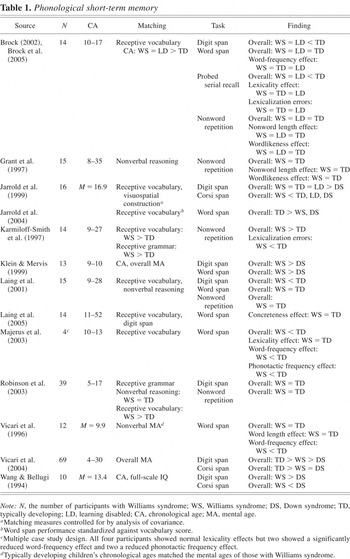
Most studies of phonology in Williams syndrome have looked at performance on phonological short-term memory tasks such as immediate serial recall (digit and word span) or immediate repetition of polysyllabic nonwords (nonword repetition). As Table 1 demonstrates, individuals with Williams syndrome consistently perform better on digit and word span tasks than individuals with Down syndrome (Jarrold, Baddeley, & Hewes, 1999; Klein & Mervis, 1999; Vicari et al., 2004; Wang & Bellugi, 1994), despite similar or poorer performance on analogous visuospatial memory tasks (Corsi span). However, Down syndrome is associated with severe deficits in phonological short-term memory (see, e.g., Brock & Jarrold, 2005), so it may be unwise to treat these findings as evidence for phonological short-term memory strengths in Williams syndrome. Indeed, the other studies summarized in Table 1 show that individuals with Williams syndrome perform no better than (and sometimes worse than) typically developing or learning disabled controls matched on overall mental age, nonverbal ability, or receptive vocabulary knowledge (Brock, 2002; Brock, McCormack, & Boucher, 2005; Jarrold, Cowan, Hewes, & Riby, 2004; Laing, Hulme, Grant, & Karmiloff-Smith, 2001; Majerus, Barisnikov, Vuillemin, Poncelet, & van der Linden, 2003; Robinson, Mervis, & Robinson, 2003; Vicari et al., 1996, 2004).
Phonological short-term memory

Performance on these tasks is, in fact, jointly determined by phonological short-term memory and by long-term memory for word meaning and phonological structure (see, e.g., Majerus & van der Linden, 2003). Studies looking in more detail at phonological short-term memory have consistently failed to find evidence for atypical effects of “phonological” factors in Williams syndrome such as word or nonword length and phonological similarity (Brock, 2002; Grant et al., 1997; Laing et al., 2005; Vicari et al., 1996). In contrast, a number of studies have reported evidence for reduced effects of long-term word knowledge. Most prominently, Vicari et al. (1996) observed a reduced effect of word frequency in Williams syndrome, leading the authors to propose that individuals with Williams syndrome are “hyperphonological,” relying excessively on phonological coding. Complementary results were reported by Majerus et al. (2003), who noted reduced effects of word frequency, lexical status, and phonotactic frequency (the frequency of phoneme combinations in the native language) on the performance of some individuals with Williams syndrome. Similar conclusions were also reached by Karmiloff-Smith et al. (1997), who observed that individuals with Williams syndrome were less likely to misrepeat nonwords as similar-sounding real words, suggesting a reduced interfering effect of lexical knowledge. However, Brock et al. (2005) noted a number of confounds in these studies. For example, the magnitude of these effects is influenced by participants' familiarity with the stimuli (cf. Hulme, Maughan, & Brown, 1991) and by their level of overall performance (cf. Logie, Della Salla, Laiacona, Chambers, & Wynn, 1996). When these factors were controlled for, individuals with Williams syndrome demonstrated entirely normal effects of lexical knowledge on phonological short-term memory (see also Brock, 2002; Grant et al., 1997; Laing et al., 2005).
Phonological fluency and awareness
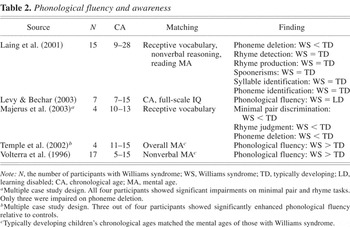
Table 2 summarizes the performance of individuals with Williams syndrome on more explicit measures of phonological knowledge. In phonological fluency tasks, participants are required to think of as many words as they can that begin with a specified letter. Volterra, Capirci, Pezzini, Sabbadini, and Vicari (1996; see also Temple et al., 2002) reported that children with Williams syndrome outperformed controls on such a task, although the authors suggested that this finding was probably artifactual given group differences in age and phonological instruction at school. This view is supported by a more recent study by Levy and Bechar (2003), who found that children with Williams syndrome and learning disabled controls matched on age as well as IQ performed comparably on a test of phonological fluency.
Phonological fluency and awareness

Table 2 also summarizes two studies looking at performance on tests of phonological awareness such as rhyme detection (identifying word pairs that rhyme) and phoneme deletion (deleting the initial sound from a word). Individuals with Williams syndrome actually perform worse than reading ability- or vocabulary-matched typically developing controls on such measures (Laing et al., 2001; Majerus et al., 2003). It is, however, unclear whether these findings indicate a genuine phonological deficit or simply reflect difficulties with the conceptual demands of these particular tasks (cf. Morton & Frith, 1993).
Summary
Compared to other groups with developmental delay, individuals with Williams syndrome appear to have relatively good speech production. Moreover, their phonological short-term memory capabilities are better than those of individuals with Down syndrome, although there is little consistent evidence for similar strengths relative to well-matched typically developing children or individuals with other forms of learning disability. There is also little compelling evidence that phonological skills are in any way atypical. Having said this, young children with Williams syndrome appear to have difficulty segmenting the speech stream and this intriguing finding clearly demands further investigation. In addition, very little is known about the effect of unusual auditory perception (hyperacusis) on speech processing (Majerus, 2004; although see Elsabbagh, Cohen, Cohen, Rosen, & Karmiloff-Smith, 2006).
Lexical Semantics
Lexical semantics refers to knowledge of the meaning of individual words. Vocabulary knowledge is often described as a peak ability and, superficially at least, provides some of the best evidence for linguistic strengths in Williams syndrome. A number of authors have also remarked upon the use of unusual or low-frequency words in the everyday conversation of individuals with Williams syndrome (Bellugi et al., 1988; Rossen et al., 1996; Udwin et al., 1987; Udwin & Yule, 1990). These and other findings have led to the suggestion that lexical-semantic processing is impaired or is somehow atypical (see Rossen et al., 1996; Temple et al., 2002; Thomas & Karmiloff-Smith, 2003).
Vocabulary knowledge in young children
The acquisition of first words is severely delayed in Williams syndrome. For example, Mervis et al. (2003) reported that, whereas typically developing children acquire a 10-word vocabulary by around 12–13 months (Fenson et al., 1993), this milestone is delayed on average until 28 months in Williams syndrome (N = 13). However, attempts to quantify early linguistic competence suggest that the delay is no greater than one would predict on the basis of global cognitive delay. For example, Paterson, Brown, Gsödl, Johnson, and Karmiloff-Smith (1999) found that toddlers with Williams syndrome or Down syndrome, and typically developing children matched on mental age demonstrated comparable receptive vocabulary knowledge as indexed by their tendency to look at a named object.
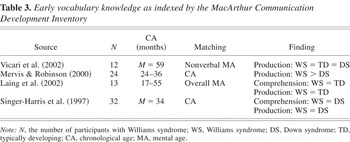
Complementary findings come from studies using the MacArthur Communication Development Inventory (MCDI; Fenson et al., 1993), a questionnaire measure of early linguistic competence (see Table 3). Lexical knowledge is assessed by asking parents to complete a checklist indicating words that their child understands or produces. Singer-Harris, Bellugi, Bates, Jones, and Rossen (1997) noted that age-matched toddlers with Williams syndrome and Down syndrome produced and understood similar numbers of words, although this finding is problematic because children who were at ceiling on this measure were excluded from the analysis (Mervis & Robinson, 2000). Subsequently, Mervis and Robinson (2000) reported slightly larger vocabularies in Williams syndrome. However, when matching is undertaken on the basis of mental age, studies have reported comparable vocabulary knowledge in children with Williams syndrome, children with Down syndrome, and typically developing children (Laing et al., 2002; Vicari, Caselli, Gagliardi, Tonucci, & Volterra, 2002). Singer-Harris et al. (1997) also used normative data from typically developing children to directly compare comprehension and production. Interestingly, children with Williams syndrome produced significantly more words than one would predict on the basis of their comprehension, although a similar trend was also found in the Down syndrome group.
Early vocabulary knowledge as indexed by the MacArthur Communication Development Inventory

Factors influencing vocabulary acquisition
Typically developing children are able to use multiple cues to determine the meanings of words (see, e.g., Bloom, 2000). For example, they often infer that when an adult names an object, it refers to the object that they are attending to rather than any other (e.g., Baldwin, 1991). Györi, Lukács, and Pléh (2004) reported that 12 out of 14 individuals with Williams syndrome (9–22 years) were able to use the direction of the experimenter's eye gaze to determine which of two novel objects had been named. However, two studies suggest that younger children with Williams syndrome have difficulty achieving “joint attention.” Laing et al. (2002) reported that, compared with mental age matched typically developing controls, toddlers with Williams syndrome (N = 13; 17–55 months) were poorer at initiating joint attention, either by making eye contact between the tester and a toy or by pointing. The Williams syndrome group also showed fewer points to animated dolls and were less able to follow the experimenter's points. Similarly, Mervis and Bertrand (1997) found that children with Williams syndrome (N = 8) were unable to respond appropriately to pointing gestures from adults and, unlike typically developing infants (cf. Messer, 1994), did not use pointing before they labeled objects verbally. However, the authors noted that the caregivers of toddlers with Williams syndrome often compensated for their children's difficulties by establishing shared attention in another way, either by physically touching the object before naming it or by simply naming an object that the child was already attending to.
Other studies of Williams syndrome have looked at the relationship between vocabulary acquisition and cognitive development. In typically developing children, there is a rapid increase in the rate of vocabulary learning at around 18 months (Nelson, 1973; although see Ganger & Brent, 2004). It has been suggested that this “vocabulary spurt” is accompanied by fundamental changes in cognitive processes underlying word learning (Nazzi & Bertoncini, 2003). For example, by the age of approximately 18 months, children can deduce that a novel word refers to an object for which they do not already have a name, so-called “fast mapping” (Mervis & Bertrand, 1994). They also begin to show “spontaneous exhaustive sorting,” organizing objects by category membership when asked to “fix them up” (Gopnik & Meltzoff, 1987). Finally, by 20 months of age, typically developing children are able to form name-based categories, inferring that visually dissimilar novel objects go together if they are given the same name (Nazzi & Gopnik, 2001). However, Mervis and Bertrand (1997) noted that six of seven toddlers demonstrated neither fast mapping nor spontaneous exhaustive sorting until after the onset of their vocabulary spurt (defined as an increase of at least 10 new words every two weeks). Similarly, Nazzi and Karmiloff-Smith (2005; see also Nazzi, Gopnik, & Karmiloff-Smith, 2005) noted that children with Williams syndrome (N = 12; 33–82 months) were unable to form name-based categories, despite having expressive vocabularies that were much larger than those of typically developing 20-month-olds.
These findings have been interpreted as evidence for atypical language acquisition processes in Williams syndrome. Given that there are multiple cues to word meaning (Bloom, 2000), such a view appears overstated, although there may be a subtle shift in the balance of factors that determine vocabulary acquisition in Williams syndrome. More importantly, these findings clearly challenge any strong claims based on data from typically developing children that there are necessary conditions for vocabulary development.
Vocabulary knowledge in older children and adults
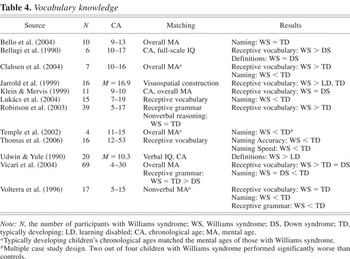
Table 4 shows the performance of older children and adults on various measures of vocabulary knowledge. On receptive vocabulary tests, participants are presented with sets of four pictures, and are required to indicate which picture corresponds to a spoken word. Studies using a range of control groups have almost universally found that individuals with Williams syndrome perform better on such tasks than would be expected on the basis of overall mental age, nonverbal reasoning abilities, or visuospatial construction skills (Bellugi, Bihrle, Jernigan, Trauner, & Doherty, 1990; Clahsen, Ring, & Temple, 2004; Jarrold et al., 1999; Robinson et al., 2003; Vicari et al., 2004; although see Klein & Mervis, 1999; Volterra et al., 1996). This vocabulary advantage is nicely illustrated by data collected by Brock, Jarrold, Farran, and Laws (2006), who tested large groups of typically developing and learning disabled children to map out the developmental relationship between receptive vocabulary, age, and nonverbal reasoning ability. They were then able to show that the receptive vocabulary knowledge of adolescents with Williams syndrome (N = 21; 10–17 years) was better than predicted by their chronological age and nonverbal ability. In contrast, individuals with Down syndrome had significantly poorer receptive vocabulary scores than predicted.
Vocabulary knowledge

It is noticeable, however, that this vocabulary advantage is less clear cut on other measures of lexical knowledge. For example, although Udwin and Yule (1990) found that children with Williams syndrome were better able than controls to give definitions for words, Bellugi et al. (1990) found no group differences. More compelling are the findings from naming tasks in which participants are simply asked to provide the names of depicted objects or actions. Individuals with Williams syndrome perform no better than mental age matched controls (Bello, Capirci, & Volterra, 2004) and consistently perform worse than on receptive vocabulary tests (Clahsen et al., 2004; Lukács, Pléh, & Racsmány, 2004; Thomas et al., 2006; Vicari et al., 2004; Volterra et al., 1996).
One possibility is that receptive vocabulary tests overestimate genuine word knowledge in Williams syndrome (Temple et al., 2002). Indeed, in a recent study, Clahsen et al. (2004) found that children with Williams syndrome outperformed controls on a traditional receptive vocabulary test but performed worse than controls on a modified vocabulary test in which the target and distracters on each trial were drawn from the same semantic category and more fine-grained semantic knowledge was therefore required. It is noteworthy, however, that receptive vocabulary tests also appear to be relatively insensitive to language difficulties in other disorders such as Down syndrome, specific language impairment, and dyslexia (Laws & Bishop, 2004b; Snowling, van Wagtendonk, & Stafford, 1988), although vocabulary knowledge is not usually better than predicted by mental age.
Vocabulary acquisition and phonological short-term memory
Work by Baddeley and colleagues (see, e.g., Baddeley, Gathercole, & Papagno, 1998) shows that phonological short-term memory is highly correlated with receptive vocabulary knowledge in children, and appears to play a critical role in the learning of phonological word forms. One suggestion, therefore, has been that children with Williams syndrome rely excessively on phonological short-term memory during language acquisition (Grant et al., 1997; Mervis et al., 1999, 2003; Vicari et al., 1996). This could not only explain why receptive vocabulary is a relative strength but would also be consistent with the view that the meanings of word are less well understood. However, as noted earlier, claims that phonological short-term memory is particularly strong in Williams syndrome appear to be without foundation.
There is, in fact, relatively little direct evidence for an unusual relationship between vocabulary knowledge and phonological short-term memory in Williams syndrome. Barisnikov, van der Linden, and Poncelet (1996) reported the case of CS, a 20-year-old woman with Williams syndrome, who performed as well as age-matched controls on a nonword learning task that patients with acquired phonological short-term memory impairments are unable to complete (cf. Baddeley, Papagno, & Vallar, 1988). Subsequently, Grant et al. (1997) reported that the pattern of correlations between receptive vocabulary knowledge and nonword repetition in individuals with Williams syndrome (N = 17; 8–35 years) was reminiscent of that found in typically developing 4-year-olds who were argued to rely heavily on phonological short-term memory to learn words (Gathercole, 1995). However, Brock (2002; N = 14; 10–17 years) failed to replicate this finding, and noted that comparing correlational patterns in typically developing and developmentally delayed groups is problematic given the very different age ranges.
Semantic fluency
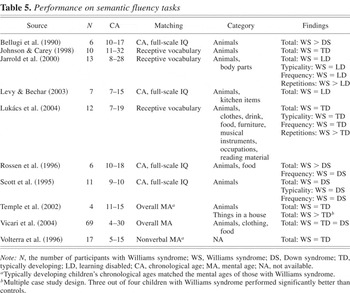
Motivated by observations of unusual word use of people with Williams syndrome, Bellugi et al. (1990) investigated lexical-semantic processing by means of a semantic fluency task. When asked to provide as many examples as they could of a given category (in this case, animals), children with Williams syndrome produced more responses than children with Down syndrome. The authors also noted that children with Williams syndrome gave more atypical responses. This finding has been widely cited but, although a number of examples were given (e.g., “chihuahua,” “ibex”), the authors did not include any formal analyses of the frequency or typicality of responses. Moreover, as Table 5 shows, most subsequent studies have found comparable levels of overall performance in individuals with Williams syndrome and, where reported, there is no evidence for group differences in the typicality or frequency of responses (Jarrold, Hartley, Phillips, & Baddeley, 2000; Johnson & Carey, 1998; Levy & Bechar, 2003; Lukács et al., 2004; Rossen et al., 1996; Scott et al., 1995; Volterra et al., 1996). Interestingly, individuals with Williams syndrome appear to produce more repetitions than controls (Jarrold et al., 2000; Lukács et al., 2004), indicating that they may have difficulties monitoring or inhibiting previous responses. If anything, this highlights the difficulty of using a task with clear strategic and executive components as a measure of underlying semantic processing (see Jarrold et al., 2000).
Performance on semantic fluency tasks

Homonym processing
A second study widely cited as evidence for atypical semantic processing in Williams syndrome was conducted by Rossen et al. (1996), who investigated processing of ambiguous words. Participants were presented with three words: a target homonym (e.g., “bank”) and two words related to its two different meanings (e.g., “money” and “river”). They were then asked to decide which two words went together. Compared with typically developing controls, children with Williams syndrome (N = 6; 10–18 years) showed a reduced bias toward pairing the homonym with its more common associate. The authors interpreted this finding in terms of atypical activation of items in the lexicon. However, group-matching procedures are unclear, and it is possible that the children with Williams syndrome simply had greater knowledge of the alternative meanings (cf. Norbury, 2005). Indeed, Rossen et al. reported that, when asked for definitions of the words and then prompted for a second meaning, the children with Williams syndrome were more able than controls to produce the second definition.
Semantic priming
Neville, Mills, and Bellugi (1994) investigated semantic processing in Williams syndrome using event-related potentials (ERPs). Participants heard or read sentences that were either congruent or contained an anomalous final word. Compared with normative data from typically developing individuals, those with Williams syndrome (N = 7; 10–20 years) showed increased late positive ERP responses to auditorily presented words that were congruent with the preceding sentence. In all other conditions, their ERPs were apparently normal. The authors interpreted their results as evidence for increased semantic priming in the auditory modality. Unfortunately, however, no formal statistical analyses were reported, so it is difficult to be sure how reliable these findings are and, to this author's knowledge, no published studies have attempted to replicate these findings. In a subsequent behavioral study, Tyler et al. (1997) reported that individuals with Williams syndrome (N = 12; 14–30 years) showed normal semantic priming effects. Responses were significantly faster to words that were preceded by a functionally related word (e.g., “sweater, warm”) or a categorically related word (e.g., “mouse, hamster”) than they were when the preceding word was unrelated.
Summary
Research on semantic knowledge and processing in Williams syndrome paints a somewhat confusing picture. Overall, the available evidence suggests that young children with Williams syndrome have vocabularies that are no better or worse than one would expect based on their nonverbal abilities. By adolescence, however, performance on receptive vocabulary tests is a definite strength. Although this provides the first evidence consistent with claims that language in Williams syndrome is relatively good, it is important to note that this advantage is not found on other measures of vocabulary knowledge. Researchers have attempted to explain why naming abilities are relatively poor but, arguably, a more pertinent (and still unanswered) question is why receptive vocabulary is a strength.
Studies of young children with Williams suggest that they have difficulty achieving joint attention and are unaware of various principles of word use and category membership. Consequently, they may have to rely more heavily on other cues to word meaning. However, studies of semantic processing in older individuals has failed to find convincing evidence of any residual abnormalities resulting from compensatory strategies. This, of course, leaves unexplained why so many authors have remarked upon unusual word usage in everyday conversations. One suggestion that deserves further investigation is that unusual words are a pragmatic device, used by individuals with Williams syndrome as a tool to gain attention and mediate social interactions (Thomas et al., 2006).
Grammatical Abilities
Grammatical abilities can be broadly divided into syntax and morphology. Syntax refers to the rules of the language system that specify the combination of words in sentences, whereas morphology denotes the use of grammatical affixes that mark, for example, tense, number, and (in some languages) gender. Individuals with Williams syndrome are often described as having “perfect” syntax and morphology (e.g., Bickerton, 1997; Piatelli-Palmarini, 2001; Pinker, 1999). However, such claims are less remarkable when one considers that typically developing children have mastered most syntactic structures by the age of 3 to 4 years (cf. Crain & Pietroski, 2002; Pinker, 1994) and that, by adolescence, most individuals with Williams syndrome have mental ages well above this level (cf. Karmiloff-Smith, 1998). Critical to this debate, then, are studies looking at the emergence of grammatical competence in young children with Williams syndrome and studies of more complex syntax in older individuals with Williams syndrome. A further issue addressed in this section is whether or not syntax and morphology are acquired normally. In particular, it has been suggested that superficially good grammatical abilities in Williams syndrome may be a consequence of good auditory memory and rote learning as opposed to intact grammatical skills (e.g., Karmiloff & Karmiloff-Smith, 2001; Karmiloff-Smith et al., 1997).
Early grammatical development
Surprisingly few studies have looked at early grammatical development in Williams syndrome. Of these, most have used the Words and Sentences Scale of the MCDI (Fenson et al., 1993), which assesses the grammatical complexity of children's utterances by asking parents to indicate which of two phrases best resembles their child's output (e.g., “Medicine, no!” or “I don't want any medicine”). The most comprehensive of these studies was conducted by Vicari et al. (2002), who tested 12 Italian-speaking children with Williams syndrome (mean age = 4.9 years), 12 younger typically developing children, and 12 slightly older children with Down syndrome. The three groups were matched on nonverbal mental age and, according to the MCDI, had comparable vocabularies. However, the children with Williams syndrome and the typically developing controls produced utterances of comparable complexity, whereas individuals with Down syndrome produced somewhat simpler utterances. These findings were corroborated by a number of laboratory-based measures of grammatical competence including estimated mean length of utterances, verbal comprehension, and repetition of sentences.
Comparable results have been reported in studies of English-speaking children. Singer-Harris et al. (1997) used normative data for the MCDI to show that children with Williams syndrome (N = 27; mean age = 45 months) demonstrated a normal relationship between the number of different words they used and the complexity of sentences they produced. In contrast, the grammatical complexity of children with Down syndrome was much poorer than predicted by their lexical repertoire. Similar results were also reported by Mervis et al. (2003), who followed 22 children with Williams syndrome longitudinally, starting on average at 26 months. Finally, Mervis et al. (1999) coded the utterances of 39 2- to 12-year-olds with Williams syndrome using the Index of Productive Syntax (Scarborough, 1990). In contrast to children with Down syndrome, fragile X, or autism (Scarborough, Rescorla, Tager-Flusberg, Fowler, & Sudhalter, 1991), those with Williams syndrome showed a normal relationship between syntactic complexity and mean length of utterances.
In sum, the available evidence suggests that, in contrast to other developmental disorders, the early stages of language development in Williams syndrome are characterized by a normal relationship between grammatical complexity, vocabulary knowledge and mental age. However, there is no evidence that syntax emerges any earlier than would be predicted on the basis of general cognitive and lexical development.
Comprehension of grammar
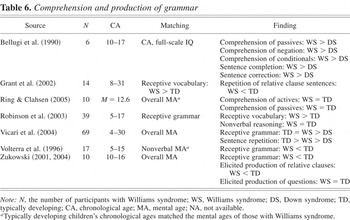
A number of studies have shown that adolescents and adults with Williams syndrome perform at or close to ceiling on tests evaluating the comprehension of syntactic structures such as binding (e.g., “Is Mowgli tickling himself?”) and passives (e.g., “The teddy is mended by the girl”; Bellugi et al., 1990; Clahsen & Almazan, 1998; Ring & Clahsen, 2005; see Table 6). This is in stark contrast to the performance of individuals with Down syndrome. However, where studies have included typically developing children of similar mental age to those with Williams syndrome, these controls have also been close to ceiling on these tests. It is therefore difficult to draw any firm conclusions from these studies regarding grammatical strengths or weaknesses in Williams syndrome.
Comprehension and production of grammar

A number of studies have looked at performance on the Test for Reception of Grammar (TROG; Bishop, 1989) or the Grammar Comprehension Test (Rustioni, 1994; see Table 6), in which participants are presented with four pictures and are simply required to point to the one that corresponds to a spoken phrase. Despite the absence of ceiling effects, performance is still no better (and sometimes poorer) than predicted by nonverbal or overall mental age and is significantly poorer than receptive vocabulary knowledge (Robinson et al., 2003; Vicari et al., 2004; Volterra et al., 1996; Zukowski, 2001). Nevertheless, individuals with Williams syndrome again outperform those with Down syndrome (Vicari et al., 2004).
Karmiloff-Smith et al. (1997) suggested that individuals with Williams syndrome had particular difficulties with blocks of the TROG testing complex embedded clauses. However, these items are also most difficult for typically developing children (Bishop, 1989). Indeed, Phillips, Jarrold, Baddeley, Grant, and Karmiloff-Smith (2004) found that individuals with Williams syndrome (N = 32; 8–38 years) performed no worse than typically developing children and learning disabled controls on these blocks of the TROG despite being matched on overall performance.
Some authors have argued that tests such as the TROG underestimate grammatical comprehension in Williams syndrome because performance is influenced by other factors such as word-retrieval and memory capabilities (e.g., Clahsen & Almazan, 1998; Schaner-Wolles, 2004). Karmiloff-Smith et al. (1998) attempted to address these concerns using an “on-line” test of syntactic processing in which participants were asked to simply monitor spoken sentences for a target word. Like adult controls, individuals with Williams syndrome (N = 8; 15–35 years) showed slower reaction times when the target word was preceded by a violation of word order (e.g., “new the test”) or auxiliary markers (e.g., “was have the milk”). However, only the control adults were sensitive to violations of subcategory structure (e.g., “struggle the dog”). Although this study highlights the potential utility of on-line tests of grammatical competence, few conclusions can be drawn because it is unclear whether language- or mental age matched controls would show the same pattern of performance.
Productive grammar
Productive grammar is often evaluated by asking participants to repeat sentences that vary in syntactic complexity. Grant, Valian, and Karmiloff-Smith (2002) found that individuals with Williams syndrome performed worse than typically developing 6-year-olds when required to repeat complex relative clause sentences, despite having higher receptive vocabulary scores. Subsequently, Vicari et al. (2004) reported that individuals with Williams syndrome performed more poorly than mental age matched typically developing controls on a sentence repetition task, although both groups outperformed individuals with Down syndrome. Unfortunately, in these studies, it is difficult to rule out the possibility that poor performance is a consequence of verbal memory difficulties rather than a specific syntactic deficit.
Volterra et al. (1996) used a sentence repetition test with 17 Italian children (5–15 years). Only 9 were able to complete the task, but these children produced a number of unusual syntactic and morphological errors. Similar findings were reported by Capirci, Sabbadini, and Volterra (1996) in a case study of a young Italian girl with Williams syndrome. No quantitative analyses were reported in either study, but the authors noted that the errors were unlike those produced by younger typically developing children. Consequently, these two studies have frequently been cited as prime evidence that language does not develop normally in Williams syndrome. Given their potential theoretical importance, it is surprising that they have not been followed up in studies with larger groups of individuals with Williams syndrome and other comparison groups.
Finally, Zukowski (2004) investigated productive syntax in two studies using scenarios designed to elicit the relevant syntactic structures. Relative clause production was evaluated by requiring participants to identify one of two similar objects (e.g., “the cow that the boy is pointing to”). Children with Williams syndrome made more errors than mental age matched typically developing controls. However, 9 of the 10 participants were able to produce at least one correct relative clause sentence, suggesting that the structures were in their grammatical repertoire but their implementation was often disrupted. In the second study, Zukowski (2004) prompted participants to conduct a telephone interview with a pretend celebrity. Children with Williams syndrome and typically developing controls were able to ask affirmative questions, but showed similarly poor overall performance when prompted to ask negative questions. Moreover, error patterns for negative questions were similar across groups. For example, both groups made auxiliary-doubling errors (e.g., “Who did you didn't invite to the party?”) but never doubled the wh- phrase (e.g., “Who didn't you invite who to the party?”). Zukowski (2004) noted that, because there are few naturally occurring situations requiring such negative questions, neither correct nor erroneous responses could have been learned by rote. This, she argued, provided evidence that syntax develops normally in Williams syndrome and is not excessively reliant on rote learning (cf. Karmiloff & Karmiloff-Smith, 2001).
Production of grammatical gender
The idea that individuals with Williams syndrome have “intact” language was challenged by Karmiloff-Smith et al. (1997) in a study of French gender assignment. Cues to the gender of known and unknown objects were provided by the article (un or une) or the phonological endings of words (e.g., words ending in -in are typically masculine whereas those ending in -ine are usually feminine). Participants were prompted to produce the definite article and color adjective (both of which are marked for gender) and, across all conditions, individuals with Williams syndrome (N = 14; 9–27 years) performed worse than typically developing controls, despite having higher scores for vocabulary and grammatical comprehension. Their difficulties were particularly marked on novel objects, leading Karmiloff-Smith et al. (1997) to suggest that, unlike typically developing children, they have difficulty extracting the underlying morphological system and rely on rote learning of article/noun pairs. However, the authors also noted that difficulties may arise because phonological cues are not completely reliable (see also Clahsen & Almazan, 1998). To address this issue, Levy and Hermon (2003) conducted similar studies in Hebrew, in which gender marking is more regular than in French. Unfortunately, neither participants with Williams syndrome nor controls were able to comply with task demands.
Regular and irregular morphology
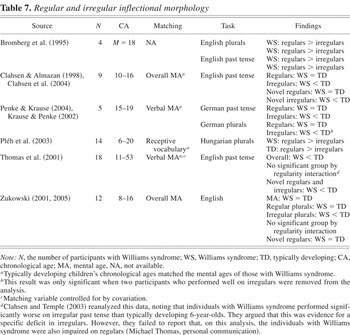
Most studies of morphology in Williams syndrome have focused on the distinction between regular and irregular morphology, typically by asking participants to complete sentences such as “Every day I go to the park. Yesterday I …” According to current linguistic theories (e.g., Pinker & Ullman, 2002), regular morphology involves the use of rules (e.g., add the -ed suffix to create the past tense of a verb), whereas irregular morphology (e.g., the past tense of “go” is “went”) requires the use of specific lexical knowledge. Table 7 summarizes studies of regular and irregular morphology in Williams syndrome. A first key point to note is that individuals with Williams syndrome have never been found to perform significantly better than mental age matched controls, either on regulars or irregulars. Some studies have found that they perform better on regulars than irregulars (Bromberg, Ullman, Marcus, Kelly, & Levine, 1995; Clahsen et al., 2004; Pléh, Lukács, & Racsmány, 2003) or show significant impairments relative to controls on irregulars but not on regulars (Clahsen & Almazan, 1998; Penke & Krause, 2004; Zukowski, 2005), suggesting a dissociation between intact rule use and impaired lexical knowledge (e.g., Clahsen & Almazan, 1998; Pinker, 1999). However, studies large enough to employ mixed designs have found no evidence for an interaction between group and regularity (Thomas et al., 2001; Zukowski, 2005). Moreover, all of the studies in Table 7 are subject to ceiling effects, with almost all participants performing at or close to 100% on regulars. Significant group differences for regulars are thus virtually impossible, so it is inappropriate to talk of selective impairments for irregulars (or, alternatively, to rule out this possibility; see Bishop, 1997; Strauss, 2001). Further research with younger participants whose performance is not subject to ceiling effects is the only way to address this issue.
Regular and irregular inflectional morphology

A number of these studies have also looked at the ability to apply morphological rules to novel words, but the results have been extremely varied. In their past tense studies, Clahsen and colleagues (Clahsen & Almazan, 1998; Clahsen et al., 2004) reported that, when confronted with novel verbs that rhymed with existing irregulars (e.g., “crive,” which rhymes with “drive”), children with Williams syndrome were significantly more likely than controls to regularize the past tense, suggesting a tendency to over apply morphological rules. Thomas et al. (2001) attempted to replicate these findings but found that, rather than overregularizing the novel verbs, individuals with Williams syndrome tended to leave novel verbs unmarked. Finally, Zukowski (2005) found no significant group differences in the ability to produce plurals for novel “regular” nouns.
Spatial grammar
The contrast between the language abilities of individuals with Williams syndrome and their visuospatial construction skills is often portrayed as evidence for a dissociation between language and cognition. However, visuospatial deficits in Williams syndrome appear to be mirrored by specific difficulties with grammatical constructs involving spatial or relational terms. For example, Lukács et al. (2004) found that Hungarian children with Williams syndrome (N = 12; 7–19 years) performed worse than typically developing controls on a test of spatial morphology, despite outperforming controls on nonspatial morphology. Similarly, Landau and Zukowski (2003) asked individuals with Williams syndrome (N = 12; 7–14 years) and mental age matched controls to describe a series of brief video scenes involving moving objects such as a cup jumping onto a frog's head. Although there were no reliable group differences in describing the type of motion (e.g., “fall,” “hop”), individuals with Williams syndrome were more likely to omit the ground object and had more difficulty describing the path of the figure object.
Phillips et al. (2004) found that individuals with Williams syndrome (N = 32; 8–38 years) made more errors than typically developing and learning disabled controls on blocks of the TROG involving spatial terms, despite being matched on overall performance. In a follow-up experiment, these authors used a modified version of the TROG containing many more spatial terms. The groups were closely matched on nonspatial terms, but individuals with Williams syndrome showed significantly poorer comprehension of spatial items. Intriguingly, however, those with Williams syndrome also had difficulties on nonspatial items that involved comparatives (e.g., “The frog is darker than the hen”). Phillips et al. (2004) therefore suggested that difficulties with spatial terms and with nonspatial comparatives may reflect an underlying difficulty in mapping language onto mental models.
Summary
The grammatical skills of individuals with Williams syndrome have received a great deal of attention in recent years, perhaps because supposed strengths and weaknesses in syntax and morphology speak most directly to modular theories of language. However, although there is evidence that individuals with Williams syndrome have better grammatical comprehension skills than those with Down syndrome, comparison with data from typically developing children indicates that their grammatical abilities are no better than one would predict on the basis of overall cognitive abilities (at any stage of development). This is true whether one considers composite measures of grammatical abilities such as the TROG or focuses only on specific tests of syntax or morphological rules. As such, there really is no basis for citing Williams syndrome as evidence for the modularity of syntax or morphology. Indeed, far from showing that language and general cognition can develop independently, the evidence for parallel deficits in visuospatial cognition and language arguably demonstrate the precise opposite.
In general, there is also very little evidence that syntax or morphology develop atypically. Studies of young children with Williams syndrome suggest a normal relationship between sentence complexity and both lexical repertoire and mean length of utterance. There is also little firm evidence to support the claim that individuals with Williams syndrome rely excessively on rote learning when acquiring grammatical structures. Having said that, there are reports that Italian children with Williams syndrome produce grammatical errors that are extremely rare in typical development, and these findings clearly demand further investigation.
Pragmatics
The final linguistic domain considered in this review is pragmatics, which can be broadly defined as the use of language within a social context. Included under the umbrella of pragmatics are, for example, the ability to work out what a communicative partner knows or needs to know, knowledge and adherence to rules of conversational engagement, and the ability to communicate nonverbally. In their seminal paper, von Arnim and Engel (1964) reported remarkably good pragmatic skills among children with Williams syndrome. Similarly, Karmiloff-Smith, Klima, Bellugi, Grant, and Baron-Cohen (1995) noted that individuals with Williams syndrome performed relatively well on tests of pragmatic skills. However, other researchers have noted an “old-fashioned and formal style of speech,” a tendency to talk incessantly about irrelevant topics and ask persistent questions, poor turn taking and topic maintenance, and failure to provide adequate information in responses (Meyerson & Frank, 1987; Semel & Rosner, 2003; Stojanovik, Perkins, & Howard, 2001; Udwin et al., 1987).
Conversational and narrative skills
In a recent study, Laws and Bishop (2004a) gave the Children's Communication Checklist (CCC; Bishop, 1998) to the parents of 19 children and young adults with Williams syndrome (6–25 years). Pragmatic skills were reported to be much poorer than in a comparison group of younger typically developing children, despite the fact that both groups were rated as having similar syntactic abilities. In fact, inspection of standardized scores revealed significant impairments on all five of the pragmatic subscales of the CCC: coherence, stereotyped conversation, inappropriate initiation, conversational context, and development of conversational rapport. Moreover, when compared to individuals with Down syndrome or specific language impairment, those with Williams syndrome showed significantly better syntax but significantly greater impairments on the stereotyped conversation and inappropriate initiation subscales.
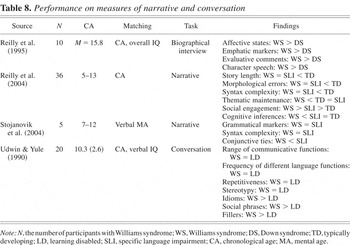
Similar pragmatic anomalies have been noted in laboratory-based studies looking at language production either during conversations or during narrative tasks, in which participants are required to describe a story presented in a picture book (see Table 8). Two studies (Reilly, Losh, Bellugi, & Wulfeck, 2004; Stojanovik, Perkins, & Howard, 2004) have found that, when compared with children with specific language impairment, those with Williams syndrome are impaired on measures of narrative and integration: this despite having similar structural language. Another consistent finding is that children with Williams syndrome make fewer inferences of motivations and mental states than controls (Reilly et al., 2004) but make greater use of social engagement devices and inferences of emotions (Reilly, Harrison, & Klima, 1995; Reilly et al., 2004; see also Jones et al., 2000).
Performance on measures of narrative and conversation

Udwin and Yule (1990) argued that a substantial minority of individuals with Williams syndrome can be classified as producing “cocktail party speech,” a term often used to describe children with spina bifida and hydrocephalus (Swisher & Pinkser, 1971). Criteria for cocktail party speech includes fluent speech, an overfamiliar manner, and a tendency to introduce irrelevant personal experiences, use social phrases, fillers, or commit perseverations to a noticeable degree. In a sample of 43 children with Williams syndrome (6–16 years), Udwin and Yule (1990) reported that around 30% met these criteria, a similar percentage to that found in children with hydrocephalus (Anderson & Spain, 1977). Moreover, compared with children with other forms of developmental disorder, those with Williams syndrome were more likely to fulfill these criteria (see Table 8).
Comprehension of figurative language
Understanding figurative or nonliteral language can be considered a pragmatic skill because it requires an appreciation of the context in which an utterance is made (see, e.g., Norbury, 2004). Semel and Rosner (2003) suggested that many children with Williams syndrome are able to appreciate and use analogies, metaphors, similes, and idioms. Unfortunately, only one study of figurative language comprehension in Williams syndrome has included relevant comparison data: Sullivan, Winner, and Tager-Flusberg (2003) compared 16 children with Williams syndrome (8–17 years), Prader–Willi syndrome, or nonspecific learning difficulties. Groups were matched on chronological age, and had similar receptive vocabulary and nonverbal abilities. Participants heard stories in which the protagonist made a false statement, but few children in any group were able to differentiate between lies and jokes, with almost all false statements considered to be lies. Of greater interest, children with Williams syndrome made significantly fewer references to mental states in justifying their responses. They also showed a trend toward poorer performance on second-order knowledge questions (e.g., “Does Frank know that his grandfather knows that he did not clean up the dishes?”). These findings are clearly preliminary, and there could be several explanations for poor performance on these linguistically demanding tasks. Nevertheless, they appear to provide further evidence for pragmatic difficulties associated with Williams syndrome.
Gestures and body language
Children with Williams syndrome are described as being sensitive to nonverbal cues such as gestures, facial expressions, and body language. They are also reported to give frequent nonverbal feedback such as smiling, nodding the head, and using gestures to express their reactions (Semel & Rosner, 2003). Again, however, few studies have actually looked directly at the use of gestures in Williams syndrome. Singer-Harris et al. (1997) reported that young children with Williams syndrome produced significantly fewer gestures than those with Down syndrome, despite having similar oral vocabularies (N = 32; mean age = 34 months). In contrast, Bello et al. (2004) reported that slightly older children with Williams syndrome (N = 10; 9–13 years) made more use of gestures during a picture-naming task than either chronological- or mental age matched typically developing children.
Summary
Compared with other aspects of language, there has been relatively little research on pragmatics in Williams syndrome, so the conclusions reached here are necessarily tentative. Nevertheless, there is converging evidence suggesting that children with Williams syndrome exhibit a number of pragmatic anomalies during conversational interactions. As noted earlier, individuals with Williams syndrome are often described as being extremely sociable and affectionate, and social communication is clearly important for them. This is perhaps reflected, not only in the amount of speech produced, but also in the excessive use of evaluative and emotional terms and engagement devices. Individuals with Williams also appear to have difficulties understanding the informational requirements of their conversational partner. This may reflect greater difficulties in more “cognitive” social situations (cf. Tager-Flusberg & Sullivan, 2000). Indeed, studies reviewed in this section also point to relative difficulties in inferring mental states, both during narrative tasks and when interpreting nonliteral language.
In some ways, the pragmatic difficulties of individuals with Williams syndrome are reminiscent of those encountered by people with individuals with autism (see, e.g., Lord & Paul, 1997). However, although there are interesting parallels between autism and Williams syndrome, it is clear that most individuals with Williams syndrome are not autistic, and it is important to point out that there is currently no evidence for specific impairments in social cognition in Williams syndrome. Nevertheless, further research is clearly required into the links between the pragmatic skills and social cognition of people with Williams syndrome.
General Discussion
Summary
Williams syndrome has played an important role in theoretical debates concerning language and language development. Unfortunately, as this review has illustrated, the empirical evidence to support many of the claims made about Williams syndrome is less than straightforward. Having said this, it is still possible to draw a number of relatively definitive conclusions about language development in Williams syndrome.
Looking first at early language development, it is certainly true to say that the emergence of language is severely delayed, but there is no evidence to suggest that this delay is any greater than expected on the basis of general cognitive delay. Moreover, the available evidence suggests that grammatical development proceeds in accordance with lexical development, a contrast to the relative delay in the emergence of complex grammar in Down syndrome. There is, nevertheless, some evidence to suggest that early language development is not entirely normal. Infants with Williams syndrome are able to acquire vocabulary despite deficits in joint attention and without possessing supposedly necessary category-based reasoning abilities. In addition, there is some tentative evidence that infants with Williams syndrome have difficulties with aspects of speech discrimination, and that young Italian children with Williams syndrome make somewhat atypical syntactic and morphological errors.
Studies of adolescents and adults with Williams syndrome reveal a similar pattern of overall performance to that found earlier in development. Individuals with Williams syndrome consistently outperform controls with Down syndrome on tests of phonology and syntax. However, studies with typically developing or learning disabled controls suggest that language as a whole in Williams syndrome is broadly in line with overall or nonverbal mental age. There are, however, a number of exceptions to this general rule of “normal” mental age-appropriate language. First, across studies with different control groups and matching measures, individuals with Williams syndrome consistently outperform controls on receptive vocabulary tests. Second, comprehension and production of spatial language is extremely poor. Third, pragmatic skills are unusual: individuals with Williams syndrome are often verbose, make excessive use of evaluative language, have difficulties providing the correct amount of information, and appear to find nonliteral language problematic.
Theoretical implications
The supposed linguistic strengths of individuals with Williams syndrome have often been used as evidence for the modularity of language. However, as the summary above suggests, there is actually very little evidence to show that language is even a relative strength. The single exception here is receptive vocabulary knowledge, but it is important to recognize that this finding is inconsistent with any modular account of language: either all language abilities should be relatively good, or computational aspects (syntax, phonology but not vocabulary) should be preserved. It has also been argued that Williams syndrome is characterized by modular preservation of morphological and syntactic rules. However, individuals with Williams syndrome have never been found to perform better than typically developing controls of comparable mental age on any tests of syntax or morphology, nor is there any convincing evidence for a dissociation between lexical and rule-based grammar. In sum, there is precisely no sustainable evidence for a “preserved” language module in Williams syndrome at any level of specificity or “granularity.” Until such evidence is uncovered, researchers should refrain from citing Williams syndrome as evidence for the modularity of language.
In contrast to modular accounts, neuroconstructivists have attempted to explain apparent linguistic strengths in Williams syndrome in terms of atypical constraints on development as opposed to selectively preserved modules. The absence of any evidence for such linguistic strengths means that this account requires some revision. Nevertheless, it is, of course, still possible that language abilities in Williams syndrome develop in an atypical fashion without being particularly strong. As noted above, there is some evidence for atypical early language development, especially from studies looking at joint attention and category-based reasoning abilities. However, there is little evidence that the “end state” of language development is abnormal. In particular, there is scant support for Thomas and Karmiloff-Smith's (2003) “phonology–semantics imbalance” hypothesis in any of its guises. Instead, the available evidence appears to be broadly consistent with the “conservative hypothesis.” In other words, any unusual characteristics of language such as poor spatial language and pragmatic difficulties can be explained as indirect consequences of other nonlinguistic features of the disorder.
Somewhat remarkably then, despite gross abnormalities of brain structure, severe delays in language acquisition, and possible abnormalities of early language development, the end state of language in Williams syndrome (at least in the narrow sense) appears to be relatively normal. Seen in this light, the significance of Williams syndrome is not that it demonstrates how language can develop independently of cognition, or that it provides an example of a radical departure from normal language development. Rather, Williams syndrome illustrates quite how robust the language acquisition process is. In any complex system (including language), robustness is achieved through redundancy, ensuring that subtle malfunctioning of a component is not catastrophic for the system (Kauffman, 1995). Thus, for example, the fact that there are multiple cues to word meaning (cf. Bloom, 2000) means that, even if young children with Williams syndrome appear unable to use one or more of these cues, this does not prevent them acquiring language.
Although this view of language development in Williams syndrome differs from both the modular and neuroconstructivist accounts, it is perhaps consistent with a compromise proposal recently put forward by Thomas and Richardson (2006) that unites these two perspectives. These authors suggested that the emergence of the modular language system in adults is the product of development (cf. Karmiloff-Smith, 1992). However, they conceded the possibility that the constraints guiding emergence may not be fundamentally altered by the kinds of genetic mutations found in developmental disorders such as Williams syndrome (cf. Temple & Clahsen, 2002).
Directions for future research
Throughout this paper I have suggested a number of potentially interesting avenues for future research, investigating specific issues for which the available data are not yet conclusive. For instance, further research is warranted into issues related to the development of speech perception and the possible effects of atypical auditory perception (“hyperacusis”) and the emergence of syntax. Perhaps most importantly, the development of pragmatic skills in Williams syndrome remains far from understood.
I have also pointed out a number of methodological pitfalls that future studies should attempt to avoid. These include, for example, concerns with ceiling effects, small sample sizes, broad age ranges, and reliance on mental age scores. Many of these difficulties stem from practical considerations involved in conducting research in a relatively rare disorder. However, given the increasing awareness of Williams syndrome among practitioners and the consequent greater availability of participants, these methodological concerns should now be easier to avoid. In addition, the use of statistical approaches such as “developmental regression” (see Jarrold & Brock, 2004; Karmiloff-Smith et al., 2004) can, in theory, allow the researcher to test relatively heterogeneous groups and at the same time determine the extent to which factors such as age and overall ability contribute to task performance.
More generally, a recurring theme in this paper has been the need for research directly comparing different developmental disorders. Many studies have compared individuals with Williams syndrome and Down syndrome, but an obvious and important question that remains unanswered is why language (narrowly defined) appears to develop relatively normally in Williams syndrome but is severely impaired in Down syndrome. These group differences are particularly salient in studies of phonology and syntax, although it is unclear whether there is any causal relationship between these two areas of difficulty (Jarrold, Purser, & Brock, 2006). Addressing these issues should provide important insights into the factors influencing both typical and atypical language development.
Researchers have tended to look for differences between developmental disorders, but similarities may also be informative (Bishop, 1997). Earlier, I touched upon similarities between the pragmatic difficulties faced by individuals with Williams syndrome and those associated with autism. Other researchers have argued that, like individuals with Williams syndrome, those with nonverbal learning disability (Karmiloff-Smith & Thomas, 2003; see Rourke, 1987), Velocardiofacial/Di George syndrome (Bearden, Wang, & Simon, 2002), and fragile X syndrome (see, e.g., Cornish, Munir, & Cross, 1999) also show a dissociation between language and visuospatial cognition. Future research looking at the correspondences as well as subtle differences between these different syndromes (cf. Scerif, Cornish, Wilding, Driver, & Karmiloff-Smith, 2004) may help tease apart the causal factors that lead to comparable behavioral manifestations of very different genetic and neurological abnormalities.
A final issue that has not really been touched upon thus far is the nature of individual differences within Williams syndrome. As Dykens (1995, p. 523) has pointed out, the behavioral consequences of genetic abnormalities are probabilistic and simply represent “the heightened probability or likelihood that people with a given syndrome will exhibit certain behavioral and developmental sequelae relative to those without the syndrome.” Much of the individual variation in cognitive and linguistic studies is genuine noise, representing random fluctuations in, for example, attention, motivation, or knowledge of particular stimuli that are being used at a particular time. However, there is also likely to be genuine individual variation, not just in overall performance across tasks but in relative strengths and weaknesses across domains (cf. Porter & Coltheart, 2005). By ignoring individual variation, one passes up on the opportunity to investigate why some individuals with Williams syndrome show a particular profile of abilities, whereas others with the same deletion do not. Put another way, the fact that an individual has Williams syndrome needs to be treated as but one of a number of factors that may or may not influence their performance on the particular measure of interest.
Conclusions
To conclude, it appears that many of the claims made concerning language abilities in Williams syndrome have been somewhat overstated. There is currently little evidence for selective preservation of linguistic skills in Williams syndrome. Similarly, claims of unusual patterns of linguistic strengths and weaknesses in older children and adults appear to be largely without foundation, although studies of young children with Williams syndrome provide some tentative evidence for atypical language acquisition processes. Nevertheless, Williams syndrome remains a fascinating condition that can provide important insights into the processes of language and cognitive development, particularly when seen in the broader context of other developmental disorders.