INTRODUCTION
While great strides have been made in the diagnosis and treatment of breast and other cancers, progress in symptom management has lagged. Patients with breast cancer commonly experience a range of physical and emotional symptoms, even after treatment has ended. Of all these symptoms, insomnia is particularly prevalent and persistent. In a longitudinal study of 962 diverse patients with nonmetastatic cancer, more than half of all patients (59%) reported symptoms of insomnia at diagnosis. When assessed 18 months later, the prevalence of insomnia symptoms remained high (36%), and women with breast cancer were among those reporting the most sleep disturbances (Savard et al., Reference Savard, Ivers and Villa2011). A review of studies assessing sleep in women with breast cancer undergoing chemotherapy found that sleep was disturbed across the entire trajectory of treatment (Enderlin et al., Reference Enderlin, Coleman and Cole2010). We recently found insomnia symptoms in 50% of women with breast cancer currently taking aromatase inhibitors, with 19% exceeding a validated threshold for clinically significant insomnia (Desai et al., Reference Desai, Mao and Su2013). As such, insomnia represents an underrecognized and inadequately treated symptom that can significantly affect quality of life for these patients (Savard & Morin, Reference Savard and Morin2001; van Nes et al., Reference van Nes, Fontein and Hille2012).
There is increasing recognition that most women with breast cancer and insomnia experience such concurrent symptoms as fatigue, depression, anxiety, and pain. These groupings of symptoms have been referred to as “symptom clusters,” with a cluster defined as “two or more symptoms that are related to each other and that occur together” (Kim et al., Reference Kim, McGuire and Tulman2005). The cluster of insomnia, fatigue, depression, and pain has emerged in many studies (Cleeland et al., Reference Cleeland, Mendoza and Wang2000; Chen & Tseng, Reference Chen and Tseng2006), and this cluster has been the focus of considerable investigation (Hoffman et al., Reference Hoffman, Given and von Eye2007). The relative impact of anxiety in this symptom cluster is less clear, with some suggesting that anxiety is highest prior to chemotherapy but then tapers off at the time when depression, fatigue, pain, and sleep disturbance worsen (Sanford et al., Reference Sanford, Beaumont and Butt2014). Clusters of symptoms may be synergistic, magnifying their impact on functional status over and above the impact of any single symptom (Dodd et al., Reference Dodd, Miaskowski and Paul2001). Symptom clusters clearly present a challenge for patients and providers, as the methods of treatment need to be: (1) effective for more than one symptom and (2) not overly burdensome in terms of patient or provider resources.
The reasons why certain symptoms tend to cluster together are not yet understood but likely involve a combination of biological and psychological factors. Miller and coworkers (Reference Miller, Ancoli-Israel and Bower2008) describe some of the hypothesized neuroendocrine and immune mechanisms of cancer-related behavioral comorbidities. To begin with, the cancer diagnosis and its treatment activate inflammation through tissue damage/destruction and/or psychological stress. This can lead to behavioral changes and an increase in proinflammatory cytokines, which can then disrupt the sleep–wake cycle, causing disruption of the neuroendocrine system and the hypothalamic–pituitary–adrenal axis. These changes then impact the central nervous system pathways that regulate behavior, which can produce the pathophysiological changes that underlie fatigue and impaired sleep, as well as depression and cognitive dysfunction. Understanding exactly how these processes interact is an area of great research interest and clinical importance.
There is reason to believe that insomnia may be a particular driving force within this symptom cluster. Some evidence suggests that cancer-related fatigue may in part be attributable to poor sleep rather than being a direct consequence of cancer and its treatment (Hoffman et al., Reference Hoffman, Given and von Eye2007). The opposite may also be true, in that fatigue may promote anxiety and maladaptive coping mechanisms that may increase the risk of developing insomnia. In a recent study that examined anxiety, depression, insomnia, fatigue, and pain over an 18-month period in mixed cancer patients, fatigue predicted depression, insomnia, and pain at subsequent timepoints, indicating that fatigue was the most contributive predictor over time (Trudel-Fitzgerald et al., Reference Trudel-Fitzgerald, Savard and Ivers2013). Along similar lines, insomnia has been shown to contribute to affective dysregulation, with depressed or irritable mood reported as common daytime consequences (Benca, Reference Benca2001). Insomnia can also affect pain perception, with pain rated more highly following a night of poor compared to good sleep (Smith & Haythornthwaite, Reference Smith and Haythornthwaite2004). Patients who report greater symptom comorbidity and symptom burden have decreased overall quality of life and are among those who struggle most to regain functional capacity (Kenne Sarenmalm et al., Reference Kenne Sarenmalm, Browall and Gaston-Johansson2014).
Our study examined insomnia in the context of breast cancer, both as an independent symptom and as a component of a symptom cluster that includes depression, anxiety, fatigue, and pain. While most symptom cluster studies have typically assessed each symptom with an individual self-report item, our study utilized validated measures for each symptom. The goal of these analyses was to further our understanding of the multiple ways in which insomnia plays a role in the cancer symptom experience and to identify the risk factors for insomnia.
METHODS
Participants were part of a cross-sectional survey study (Wellness After Breast Cancer) among breast cancer patients receiving care at the Rena Rowan Breast Cancer Center of the Abramson Cancer Center of the University of Pennsylvania (Philadelphia) (Brown et al., Reference Brown, Mao and Stricker2014). Potential participants included postmenopausal women with a history of histologically confirmed stage 0–III hormone-receptor-positive breast cancer who were currently taking a third-generation aromatase inhibitor (anastrozole, letrozole, or exemestane), and who had completed chemotherapy or radiotherapy at least one month prior to enrollment. Participants were identified by screening electronic medical records after obtaining permission from the treating oncologists, and then approaching potential study subjects for enrollment at their regular follow-up appointments. Informed consent was obtained, and then each participant was asked to complete a survey either in the clinic or at home, in which case they were provided with a stamped/addressed envelope in which to return the survey. The study was approved by the Institutional Review Board of the University of Pennsylvania and the Scientific Review and Monitoring Committee of the Abramson Cancer Center. All the procedures performed involving human participants were in accordance with the ethical standards of the institutional and/or national research committee and with the 1964 Helsinki Declaration and its later amendments or comparable ethical standards.
Questionnaires
The survey collected demographic and treatment-related information as well as the results of validated measures of common symptoms.
Insomnia Severity Index (ISI) (Bastien et al., Reference Bastien, Vallieres and Morin2001 )
This is a seven-item self-report questionnaire that assesses overall severity of insomnia. Each item is rated on a 0- to 4-point scale, so that the total possible score ranges from 0 to 28. The instrument has been validated in studies among insomnia subjects being evaluated at a sleep-disorder center, in a randomized trial looking at changes in the index, and in patients with cancer (Savard et al., Reference Savard, Savard and Simard2005).
Brief Fatigue Inventory (BFI) (Mendoza et al., Reference Mendoza, Wang and Cleland1999 )
The BFI is a brief self-report measure used to assess the severity and impact of cancer-related fatigue. It includes nine items, each of which involves providing ratings on a 10-point Likert-type scale. The items are summed to yield a total global fatigue score. The BFI has demonstrated reliability ranging from α = 0.82 to 0.97. It is commonly employed as a measure of fatigue in cancer symptom research.
Brief Pain Inventory (BPI) (Cleeland & Ryan, Reference Cleeland and Ryan1994 )
The BPI is commonly employed as a brief self-report measure of pain. The short form of the BPI utilized in our study includes 15 items that are rated on a 10-point Likert-type scale. The items yield scores for overall pain severity and for functional interference of pain. It has demonstrated reliability ranging from α = 0.77 to 0.91. The BPI has been used extensively to study pain in patients with cancer.
Hospital Anxiety and Depression Scale (HADS) (Zigmond & Snaith, Reference Zigmond and Snaith1983 )
The HADS is a 14-item scale for assessing depressive and anxious symptoms in medical patients. It places less emphasis on somatic symptoms in order to reduce possible confounding in this population. The HADS has been validated in cancer populations and found to be useful in both research and clinical settings (Carroll et al., Reference Carroll, Kathol and Noyes1993; Osborne et al., Reference Osborne, Elsworth and Sprangers2004).
Statistical Analysis
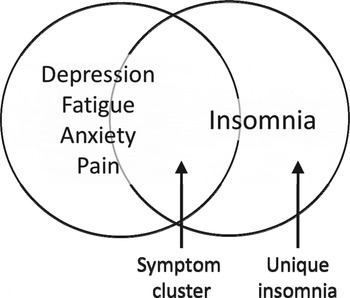
Rather than only treating insomnia severity as a homogeneous trait, we partitioned insomnia into two independent quantitative components, as depicted in Figure 1. The first component was total score on the ISI as a measure of overall insomnia severity. The second represented variability in insomnia that clusters together with fatigue, depression, anxiety, and pain. A factor analysis was conducted on the ISI, BFI, BPI severity, and HADS depression and anxiety scores using the SAS Proc FACTOR procedure, and a factor score was created for each individual. This factor score represents an index of the degree to which an individual is “high” or “low” on a factor, where being rated high is indicative of having high ratings on all symptoms in the cluster. This factor score was used as the second quantitative component. The third component was then created to represent “insomnia only,” which is independent of the other symptoms (i.e., not part of the symptom cluster). This measure was created using a regression analysis with the SAS Proc REGRESSION procedure, in which the dependent variable was ISI score and the independent variable factor score. The residual scores for each individual, which represent variation in overall insomnia severity not accounted for by factor score, were then retained. These residual scores provide a quantitative measure of insomnia severity that is statistically independent of factor score. Thus, there were three quantitative insomnia measures: (1) overall insomnia severity (total ISI score); (2) severity of insomnia that clusters with other symptoms (I–SC); and (3) severity of insomnia that is unique (I–U). The proportion of variance in insomnia severity captured by the components of insomnia severity was then computed.
Conceptual model for taking overall insomnia severity and partitioning variance into a component that is part of the symptom cluster with depression, anxiety, fatigue, and pain, and a component that is specific to insomnia.

Finally, in order to begin to understand the differences among these measures of insomnia, their correlations with demographic (age, body–mass index [BMI], ethnicity, education level, employment status) and disease (stage of cancer, time since cancer diagnosis, previous chemotherapy treatment) characteristics were examined. Multivariate general linear models were utilized with each of the three insomnia measures.
RESULTS
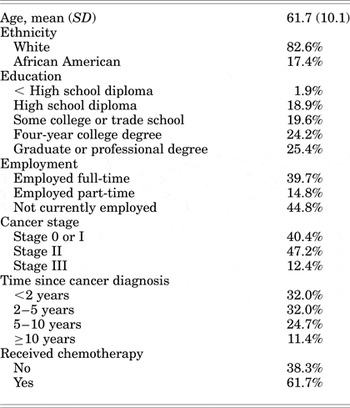
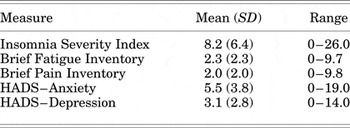
The total sample included 413 female participants, who had a mean age of 61.7 (SD = 10.1) years. Descriptive statistics for the sample and for each symptom measure are presented in Tables 1 and 2, respectively.
Demographic and clinical descriptors

Descriptive statistics for symptom measures

In terms of overall insomnia severity, the mean score on the ISI was 8.2, which is within the range for mild insomnia symptoms. The distribution of scores by category of severity was as follows: 49.9% no symptoms, 31.5% mild symptoms, 16.2% moderate symptoms, and 2.4% severe symptoms. Half the sample (51.1%) had at least mild symptoms of insomnia. On the individual items of the ISI, moderate or worse symptoms were reported by 30.2% for difficulty in falling asleep, 41.6% for difficulty in staying asleep, and 31.2% for problems with waking up too early.
In the factor analysis, a one-factor solution provided the best fit to the data, with an eigenvalue of 4.5 (the next highest eigenvalue = 0.3). This solution was statistically significant compared to a model with no common factors (χ2(10) = 555.6, p < 0.0001) and to a model with more than one factor (χ2(5) = 45.0, p < 0.0001). The factor loadings for each scale were: ISI = 0.67, BFI = 0.81, BPI = 0.56, HADS–Anxiety = 0.63, HADS–Depression = 0.78. This indicates that all of the symptoms contributed significantly to the factor, with depression and fatigue carrying the most weight and pain the least. The factor score accounted for 53.3% of the variance in ISI total score.
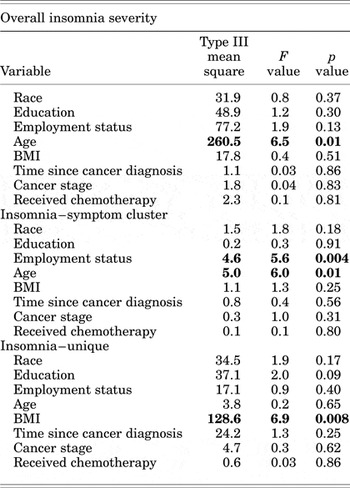
In the multivariate risk models, only age was significantly associated with overall insomnia severity (F(1,391) = 6.49, p = 0.011), where higher age was associated with lower insomnia severity (see Table 3). For I–SC, employment status and age were statistically significant. The direction of the age effect was the same as for overall insomnia severity, with those who were unemployed having higher overall factor scores than those employed part- or full-time. For I–U, the BMI was statistically significant (F(1,391) = 6.92, p = 0.009), with higher BMI ratings associated with lower symptom cluster severity. No clinical variables were associated with any of the insomnia measures.
Results of multivariate models examining factors associated with each of the symptom measures

BMI = body–mass index.
DISCUSSION
This study sought to examine whether insomnia in women with breast cancer could be better understood as part of a symptom cluster together with pain, depression, fatigue, and pain, or as a unique symptom in and of itself. We found that insomnia was not only prevalent in this sample, but that there were different patterns of association between demographic factors and each of these insomnia measures, suggesting that they have distinct profiles and mechanisms. Insomnia is a heterogeneous clinical problem, and these results suggest that there are different underlying dimensions of insomnia that may warrant different approaches to clinical management.
Consistent with prior studies, there was strong evidence that insomnia, depression, fatigue, anxiety, and pain tend to cluster together, with a one-factor solution providing the best fit to the data. Chen and Tseng (Reference Chen and Tseng2006) examined a broader range of symptoms using a symptom inventory and found evidence for three symptom clusters. The first factor they uncovered is most similar to the one examined in our study and loaded on the symptoms of pain, fatigue, sleep disturbance, lack of appetite, and drowsiness, which they termed a “sickness symptom cluster.” Similarly, Hoffman and colleagues (Reference Hoffman, Given and von Eye2007) found that pain, fatigue, and insomnia symptoms formed a single symptom cluster in lung cancer patients. Our study utilized validated scales for each of the symptoms, compared to earlier studies that mostly utilized single items to assess each symptom. This provided a more robust assessment of each of the symptoms and further strengthened the evidence in support of this symptom cluster in our breast cancer sample.
The second goal of our study undertook to subcategorize insomnia symptoms into the “common” aspects shared with other symptoms and the “unique” portion that is specific to insomnia. A combination of factor analysis and linear regression was employed to partition the variance in insomnia severity in this fashion. Just over half of the variance in insomnia severity was associated with the symptom cluster, with the remaining variance being unique to insomnia. This novel approach has the potential to take into account the heterogeneous nature of insomnia (or other symptoms) and begin to disentangle the various sources of variance.
IMPLICATIONS OF STUDY RESULTS
If it is indeed the case that these symptoms have both shared and unique components, there are a number of implications for symptom science research. First, studies on the mechanisms of these symptoms should focus on the entire cluster as well as employing the traditional focus on individual symptoms. Cognitive Behavior Therapy for Insomnia (CBT–I) has demonstrated efficacy for treating sleep disturbances, and research is now beginning to support its effectiveness in also improving comorbid symptomatology. In a trial comparing CBT–I to mindfulness-based cancer recovery in a heterogeneous sample of 111 cancer survivors, CBT–I significantly ameliorated insomnia and also decreased mood disturbances and overall symptoms of stress (Garland et al., Reference Garland, Carlson and Stephens2014). This pattern was also demonstrated in a secondary analysis by Flemming and colleagues (Reference Fleming, Randell and Harvey2014) of a randomized controlled trial of CBT–I in 113 cancer patients. They found significant reductions in insomnia, as well as improved fatigue and depression outcomes. Similarly, a recent analysis of data from a trial comparing CBT–I with armodafinil, a wakefulness-promoting medication, showed that improved insomnia in the CBT–I group, but not with armodafinil, was directly responsible for improving cancer-related fatigue (Heckler et al., Reference Heckler, Garland and Peoples2015). These results are compelling and suggest that it may be possible to intervene in ways so as to target the entire symptom cluster and simultaneously alleviate symptom distress in multiple areas. Conversely, other treatment approaches may be needed to address aspects of symptoms that are independent of the cluster (i.e., unique components). Overall, provision of comprehensive and/or targeted interventions could reduce the burden on the patient and promote better resource allocation for healthcare systems.
Furthermore, study designs and analytic methods such as those employed in our study can be used to identify unique patterns of individual symptoms versus symptom clusters. We found differing relationships among demographic variables and the insomnia components, with age, BMI, and employment status each being associated with at least one measure. Of note, the patterns were different for each insomnia measure. These factors have been shown to be associated with insomnia in past studies, but those studies only focused on overall insomnia severity and not on the different components. It was surprising that greater age was associated with lower insomnia severity in terms of both overall scores and the symptom cluster, given that this relationship usually runs in the opposite direction. This may be a reflection of sample selection bias and the relatively older age of our sample.
LIMITATIONS OF THE STUDY
There are several limitations of our study that need to be taken into consideration. The sample was relatively homogeneous in terms of gender, type of cancer, and treatments received. This is a strength of the study in that it reduced the potential impact of confounding factors, but it is also a weakness with respect to generalizability. It will be important to determine whether this pattern holds up in other cancer and noncancer populations. Further, while these analyses examined the factors associated with each of the insomnia measures, the parent study was not designed for this purpose, and only demographic and clinical factors were assessed. It will be important to conduct more in-depth studies that assess a wider variety of biological, psychological, and social factors in order to better understand these symptom dimensions.
CONCLUSIONS
In summary, insomnia is highly prevalent in patients with breast cancer, and approximately half of the insomnia burden in this population is accounted for by the cluster of depression, anxiety, pain, and fatigue, while the other half is unique to insomnia. This suggests that insomnia is likely driven by both shared and unique mechanisms. This is supported by the fact that each of the insomnia measures was associated with a different pattern of risk factors. Future studies are needed to tease out these different pathways that lead to increased symptom burden in order to further our understanding of symptom science and develop effective interventions. Given that half of the variance in insomnia severity was specific to insomnia, optimal treatment will likely need to address both the unique and shared components.
ACKNOWLEDGMENTS
Funding support was provided through grants NIH/NCI R01CA158243 and K23 NR014885.
CONFLICTS OF INTEREST
The authors hereby certify that they have no conflicts of interest to declare.