Previous researchers have assessed whether men have greater socioeconomic attainment after military service and produced findings that appear to vary by period. For example, veterans earned more and worked in jobs with higher status than comparable nonveterans if they served during World War II (Teachman and Tedrow Reference Teachman and Tedrow2004). However, they earned less if they joined the armed forces during the Vietnam War (Angrist Reference Angrist1990). Such differences may stem from one or a combination of three reasons. First, they may stem from change in selection. People have joined the military due to processes that have shifted across periods (Flynn Reference Flynn1993; Rostker Reference Rostker2006), likely leading them to have different preservice characteristics and therefore postservice outcomes relative to those who did not serve. Second, the various associations may reflect changes in treatment. Service members have had particular experiences while in the military that altered over time and that may have shaped their later lives (MacLean Reference MacLean2010). Third, the apparent changes may signal shifts in mediation. Veterans had different levels of success relative to nonveterans after their service, which may have depended on the economic, educational, and political context to which they returned (Altschuler and Blumin Reference Altschuler and Blumin2009). Yet apparently no researchers have explored these possibilities explicitly, comparing how veterans fare if they served in one or another era directly.
Some observers have suggested that people experience upward mobility after they serve in the armed forces in ways that vary across societies (Levy Reference Levy2007). We apply a theory of generations to test whether and how the relative socioeconomic attainment of veterans and nonveterans may have been modified within a society, the United States, by historical context. The results suggest that men may have seen negative or positive consequences of service and thus, potentially, upward or downward mobility depending on the eras during which they came of age.
Since at least the 1920s, scholars have recognized that apparent social change may stem from how the early lives of the members of one generation or cohort differ from those of others (Mannheim [1927] Reference Mannheim and Mannheim1952). According to this theory, people experience life events when they are young in historical contexts that affect their later life trajectories. As an example of this view, scholars have assessed how women have increasingly closed the gap in earnings with men. They have demonstrated that this increase was not spread evenly across all women, but rather reflects how those born later in the twentieth century have had comparatively greater socioeconomic success than those born earlier (Campbell and Pearlman Reference Campbell and Pearlman2013). In conceptually similar work, scholars have demonstrated that workers who came of age during the economic expansion of the late 1960s and early 1970s have had more success throughout their lives than those who grew up either earlier or later (Chauvel and Schröder Reference Chauvel and Schröder2014).
This article combines these two strands of research, the first regarding veterans and the second regarding generations. It does not assess group differences within veteran cohorts, which have been evaluated elsewhere (Browning et al. Reference Browning, Lopreato and Poston1973; Lopreato and Poston Reference Lopreato and Poston1977; Teachman and Tedrow Reference Teachman and Tedrow2004, Reference Teachman and Tedrow2007). Nor does it adopt a model of generations that looks at shared attitudes and behavior of people born in particular eras (Strauss and Howe Reference Strauss and Howe1991, Reference Strauss and Howe1997). Rather it focuses on how the relative position of veterans on average has changed across cohorts. It uses data from the 1971–2013 Current Population Surveys (CPSs) to assess the socioeconomic attainment of men who grew up in years that would have made them eligible to serve in the decades ranging from before World War II to the contemporary era. The results suggest that the concept of generations can be usefully applied to the study of socioeconomic success among veterans and more broadly.
The article proceeds in the following fashion. It begins by describing the theory of generations, which suggests that the members of cohorts differ from each other in ways that have consequences for outcomes throughout the life course (Mannheim [1927] Reference Mannheim and Mannheim1952; Ryder Reference Ryder1965). Next, it outlines how this theory may be applied to veterans. It contrasts this theory with those that are more commonly applied to veterans, the turning point and cumulative advantage hypotheses (Elder et al. Reference Elder, Gimbel and Ivie1991; Sampson and Laub Reference Sampson and Laub1996), which describe how outcomes may vary not by cohort but by preservice characteristics and age. It then reviews previous research regarding socioeconomic attainment after military service and uses this theory and research to derive hypotheses regarding how the gaps between veterans and nonveterans may vary historically. It then describes the data and methods and follows by presenting the results and concludes by discussing how this approach may be applied more broadly to other groups.
The Theory of Generations
Scholars have described the historical importance of generations according to two theoretical perspectives (Jaeger Reference Jaeger1985). First, some have argued that people’s lives are shaped by the years in which they were born in ways that follow regular patterns or cycles (ibid.; Strauss and Howe Reference Strauss and Howe1991, Reference Strauss and Howe1997). This view sees generational membership as uniform and deterministic. Second, others have suggested that people’s lives are imprinted by the historical experiences they share with others who are born at the same time, but that this process is not determined by a fixed order and may be modified by class and other social characteristics (e.g., Mannheim [1927] Reference Mannheim and Mannheim1952; Tremmel Reference Tremmel2010). This view conceives of generational membership as interacting with other social characteristics and therefore not deterministic but rather probabilistic.
According to the first view, people share beliefs and behave in similar ways as their generational peers in ways that are not random. Members of different cohorts share a particular character derived from a universal ebb and flow that leads them to hold different attitudes and beliefs. In the United States, they belong to generations stretching from the Puritan generation, born in the late sixteenth and early seventeenth century, through the Boomer generation, born in the 1940s and the 1960s (Strauss and Howe Reference Strauss and Howe1991). More recently, scholars have focused on the members of the Millennial generation, born between the late 1980s and early 2000s, describing their different experiences at work and in school are shaped by their generational membership (Beinhoff Reference Beinhoff2011; Howe et al. Reference Howe, Strauss and Nadler2008).
This article builds on the second approach to the theory of generations, which argues that people’s lives are shaped by different historical contexts, and that these characteristics may intersect with other qualities, such as, in this case, veteran status. For almost a century, sociologists have argued that the transition from one generation to the next produces social change (Mannheim [1927] Reference Mannheim and Mannheim1952). According to this theory, people belong to generations based on their birth years, which determine their locations both socially and historically. In turn, they have particular trajectories that are shaped by these locations, which determine the ages at which they experience formative events. They undergo many changes when they are young, particularly when they are in their early twenties when, on average, they tend to finish schooling, leave their families of origin, enter the labor force, and start families of their own (Tremmel Reference Tremmel2010). They may also serve in the armed forces. In addition, they belong not just to a generation but also to subsets, or “generation units,” determined by how other characteristics, such as race, gender, or veteran status, shape their historical and social experiences (Mannheim [1927] Reference Mannheim and Mannheim1952). According to the theory, then, people have different experiences that they share with others born in the same time and place, which may further be shaped by additional shared social traits.
In the 1960s, American sociologists distinguished generations from cohorts and chose to emphasize the latter (Kertzer Reference Kertzer1983; Ryder Reference Ryder1965). According to this view, generations describe positions based on family relations, such as sons and fathers. Cohorts define locations identified by the time in which people experience common events. Nevertheless, these scholars built on the theory of generations and focused on how cohorts were defined not just by the years that they were born but also by the years they passed through other events, such as educational transitions. They argued that the impact of cohort membership needed to be compared to other markers based on time, in particular age and period. According to this view, social change stems not from the movement of generations, but from cohort succession or replacement (Brooks and Bolzendahl Reference Brooks and Bolzendahl2004; Davis Reference Davis and Marsden2012). American historians and European sociologists, however, continue to use both terms, tending to prefer the term “generation” to “cohort” (Chauvel and Schröder Reference Chauvel and Schröder2014; Strauss and Howe Reference Strauss and Howe1991, Reference Strauss and Howe1997; Tremmel Reference Tremmel2010). In this article, we do not assess positions based on family relationships. We therefore use the term “generation” as a synonym for “cohort,” specifically cohorts defined by eligibility to serve in the military at different historically important times.
Scholars have applied variants of the theory of generations to a wide range of outcomes, demonstrating that attitudes and behavior vary across cohorts. They have applied insights regarding how people differ based on when they were born to classic questions in stratification, such as how birth year relates to education, mobility, earnings, and employment. With respect to education, they have found that social background became increasingly important in determining whether people moved from one educational level to the next across cohorts born in the first half of the twentieth century (Mare Reference Mare1981). With respect to mobility, they have argued that cohorts born in these years benefited from structural changes in the economy, particularly the decline of farming and the rise of manufacturing, while those born later have benefited from greater social openness (Hout Reference Hout1988). According to still other work, men have become increasingly likely to retire early because of changes in policy that have led to different financial incentives based on when they were born (Henretta and Lee Reference Henretta and Lee1996).
Americans have had different average experiences if they were born in the middle of the twentieth century than if they were born earlier or later on a number of different dimensions. People are more tolerant toward others who hold unpopular positions, for example, if they were born in the late 1940s and early 1950s than people who grew up before and no less tolerant than those who grew up after them (Davis Reference Davis and Marsden2012). They are also more socially isolated if they were born in the middle than if they were born toward the beginning or the end of the twentieth century (Marsden and Sirastava Reference Marsden, Sirastava and Marsden2012). In addition, the members of these baby boom cohorts are less happy than those born later or earlier (Yang Reference Yang2008). People were more socioeconomically successful if they turned 20 in the late 1960s and early 1970s than if they attained that age before or after those years. Members of these middle cohorts entered the labor market when global economies were expanding, which led them to be more successful throughout their lives (Chauvel and Schröder Reference Chauvel and Schröder2014).
Scholars have studied not just the average experiences of cohorts but also the differing experiences of what Mannheim ([1927] Reference Mannheim and Mannheim1952) called generation units, or groups within a cohort that share particular characteristics. In this work, they have primarily examined how cohort membership affects men and women differently. Research has demonstrated that women have narrowed the gender gap in earnings over time, suggesting a period effect (Leicht Reference Leicht2008). Yet, the generations perspective suggests that this broad social change may stem not from a change over all workers but from cohort replacement. Indeed, the gap narrowed first because female members of earlier cohorts saw their earnings improve relative to those of men and then later because male members of later cohorts faced declining earnings while women did not (Campbell and Pearlman Reference Campbell and Pearlman2013). Other work has argued that there appeared to be an overall glass ceiling in engineering because women in older cohorts were at a disadvantage relative to men of their cohort, but that this gap eroded among more recent cohorts (Morgan Reference Morgan1998). These findings suggest that scholars should examine not just how social outcomes vary by cohorts but also how they may further differ within cohorts by group.
Why Veterans’ Outcomes may Vary Across Cohorts
This article extends previous research by looking at cohorts that are based on specific historical events, focusing on how the geopolitical context when people turned 18 influenced their later socioeconomic attainment and how the impact of cohort membership on outcomes varies by veteran status. Veterans present an ideal case in which to examine the role of generation units because they are divided according to clear differences across time. They may be particularly likely to be affected by the years in which they became eligible to serve in the armed forces for one or more of three reasons: selection, causation, or mediation. Their lives are likely shaped by the ways that people join the military, the types of experiences they have when they are in the armed forces, and how they are treated after their service. Yet few previous scholars have examined whether and how the relative position of veterans may vary based on their cohort membership or birth year.
With respect to selection, men entered the armed forces due to different processes, which means that they differed from nonveterans in ways that have varied across cohorts. They faced different pressures to “self-select,” which influenced whether they chose to join. Between the middle of the twentieth and the early part of the twenty-first centuries, for example, some men faced a draft, while others did not (Flynn Reference Flynn1993). The draft either compelled some to serve who did not self-select to enter, and it also pressured some to choose to enter under pressure from the draft to end up in more desired roles. All men were required to register for the draft between 1941 and 1973, facing at least the possibility that they might serve. Since 1973, the US armed forces have recruited members for an all-volunteer force (AVF) (Rostker Reference Rostker2006). In 1980, the government reinstated registration for selective service, though not the draft (ibid.). And even during the draft era, some men volunteered for service, including nearly 40 percent of the forces who served during World War II (Flynn Reference Flynn2002).
People have also encountered different enlistment standards depending on when they became eligible to serve. Even during the draft era, the armed forces excluded some men who did not meet military standards, whether physical, psychological, or cognitive. Some were channeled into civilian jobs in the defense industry, through occupational deferments. Since World War I, for example, the armed forces have administered tests to potential recruits rejecting those who fall below a certain score (Yoakum and Yerkes Reference Yoakum and Yerkes1920). Men were excluded from service during World War II primarily if they had medical or psychological problems. Others were exempt for different reasons, such as belonging to large families, but these were less numerous (Flynn Reference Flynn1993). Most soldiers, therefore, were more privileged and healthier than civilians on average before their service and likely would have earned more than nonveterans even had they not served. Indeed, men appear to have been positively selected into the military during World War II, leading veterans to appear more socioeconomically successful than their nonveteran counterparts (Angrist and Krueger Reference Angrist and Krueger1994). They appear to have been negatively selected into the armed forces during the Vietnam War, which led, at least in part, to their lower status (Teachman and Call Reference Teachman and Call1996). During this era, nonveterans often evaded service by enrolling in college (Flynn Reference Flynn1993), which would have led them to have greater socioeconomic success than comparable veterans. Over the last four decades, the armed forces have also mostly excluded men with less than a high school diploma, or with a criminal record (Sackett and Mavor Reference Sackett and Mavor2003). Thus veterans may appear relatively more or less successful in different eras due to shifting military standards.
In addition, service members have had different racial characteristics depending on era. The armed forces were segregated, excluding Black men from particular units, until the Korean War (Segal and Segal Reference Segal and Segal2004). During the early years of the AVF, Black men were disproportionately likely to join (ibid.). During the last decade, however, they were less likely to do so, with White men again disproportionately represented among recruits (authors’ calculations from Department of Defense data). Thus, soldiers have differed from civilians in ways that have changed historically, leading veterans to have outcomes that likely varied over time.
With respect to causality, members of different cohorts have different experiences while they are serving. Once in the military, service members have dramatically different types of experiences depending on whether the nation is at war or at peace. Some serve during war and are sent overseas to fight, to possibly be wounded or killed. Whether or not they are physically injured, they may face mental health symptoms from posttraumatic stress disorder or depression (Institute of Medicine 2013; Tanielian and Jaycox Reference Tanielian and Jaycox2008). Others serve during peace, and may never leave their bases in the United States. Among peacetime service members, those who are sent overseas face less danger of being injured or killed than those who deploy during wartime. Veterans of some cohorts may therefore have different socioeconomic outcomes because they had different types of experiences while in the armed forces.
Veterans may also differ from nonveterans and by cohort because the effects of service are mediated, either by public attitudes or by policy changes. When they return, veterans have faced different receptions due to changes in public opinion regarding the wars and warriors, which may, in turn, affect socioeconomic success. World War II veterans report returning to a hero’s welcome, for example, while Vietnam veterans say that they were spat on by an unwelcoming public (Lembcke Reference Lembcke1998; Severo and Milford Reference Severo and Milford1989). While scholars debate the facts regarding how veterans were received, most agree that World War II was more popular than later wars and that later veterans were likely not welcomed as warmly as were the veterans of that earlier period. More recently, veterans of the war in Iraq have faced stereotypes, but unexpectedly supportive attitudes from members of the public, who report wanting to have these men as friends, neighbors, and coworkers (MacLean and Kleykamp Reference MacLean and Kleykamp2014).
Veterans have also had different governmental benefits available to them depending on when they left the armed forces, which may also affect their socioeconomic attainment. Veterans have had access to varying levels and types of government benefits and funding based solely on the era during which they served (Severo and Milford Reference Severo and Milford1989). They first received educational benefits after World War II, under the Servicemen’s Readjustment Act of 1944, popularly known as the GI Bill (Altschuler and Blumin Reference Altschuler and Blumin2009; Mettler Reference Mettler2005). They continued to receive relatively generous funds for education if they started serving between World War II and 1955. If they joined the military after that year, they received no educational benefits (Stanley Reference Stanley2003). Starting in 1965, however, the government reinstated educational benefits for service members and made these funds available retroactively. Veterans serving between 1955 and 1965 therefore did not have governmental support for schooling available immediately. Between 1977 and 1985, they had access to the relatively less generous Veterans’ Educational Assistance Program. Indeed, during this era, they received less than 2 percent of federal funding for education, with the remainder being awarded without regard to veteran status (Moskos Reference Moskos1981). In 1985, they were again funded at the level available to those who served during World War II (Simon et al. Reference Simon, Negrusa and Warner2010). Starting in 2005, the government has again increased the funds for veterans who served after 9/11 (Kleykamp Reference Kleykamp2013).
Theories of Age-Related Change Among Veterans
While relatively little theory addresses cohort change in veterans’ outcomes, previous scholars have developed theories regarding how the relative outcomes of veterans may change based on age. In general, theorists have argued that, if veterans differ either positively or negatively from nonveterans, these differences will widen as they grow older. On the one hand, they have predicted that such men will experience service as producing cumulative disadvantage, leading to increasingly negative outcomes (MacLean Reference MacLean2010). On the other, they have speculated that time in the armed forces may provide a turning point, leading to increasingly positive outcomes (Sampson and Laub Reference Sampson and Laub1996). In elaborating both the turning point and cumulative disadvantage narratives, theorists imply that military service has consequences for veterans’ lives that persist after service and may increase as people grow older.
The theory of cumulative advantage was introduced by Merton in the 1960s and labeled the “Matthew effect” (Merton Reference Merton1968). Scholars have subsequently applied the theory to evaluate how socioeconomic outcomes vary across groups, including veterans. According to the theory, people benefit from positive experiences not just immediately, but see these benefits increase over time as they grow older. Scientists receive more credit for coauthored work, for example, if they have than if they have not previously won a Nobel prize (ibid.). Following Merton, scholars have extended the theory to describe not just benefits but also disadvantages (Dannefer Reference Dannefer2003; DiPrete and Eirich Reference DiPrete and Eirich2006). According to research in this vein, for example, people have better health when they are older if they have a college degree rather than just a high school diploma (Willson et al. Reference Willson, Shuey and Elder2007). People earn less when they find work after losing a job, suggesting a “scarring” effect of unemployment (Gangl Reference Gangl2004). To extend the theory to military service, some veterans suffer trauma if they fight in wars, after which they are more likely to be disabled and to have trouble finding work (MacLean Reference MacLean2010).
Other scholars have argued that military service can improve the trajectories of people’s lives, providing a positive turning point (Elder et al. Reference Elder, Gimbel and Ivie1991; Sampson and Laub Reference Sampson and Laub1996). During the 1940s, theorists argued that disadvantaged recruits benefit from the fact that service “knifes off” their previous experiences (Brotz and Wilson Reference Brotz and Wilson1946). According to this narrative, less privileged men leave the negative influences of their friends, family, and environment when they enter the armed forces, and later follow more positive trajectories than they would have otherwise. In the 1970s, scholars expanded this view by arguing that the armed forces did not just allow soldiers to leave behind their origins, but provided them with a “bridging environment” (Browning et al. Reference Browning, Lopreato and Poston1973; Poston Reference Poston1979). Recruits gain experience and training in the armed forces that enables those who joined with fewer preservice advantages to be more successful than they would otherwise have been in their later lives.
It is also possible, however, that even if veterans differ from nonveterans initially any gap declines over the life course or as people grow older. Veterans may experience a short-term association between service and socioeconomic success that diminishes with age, as they regress to the mean. According to this view, people experience consequences of life-altering events that do not last and become less consequential over time. Widows and widowers experience an intense negative effect, for example, immediately after their spouses die (Clausen Reference Clausen, Giele and Elder1998; Lee et al. Reference Lee, DeMaris, Bavin and Sullivan2001). They become less negatively affected with time and return to the emotional state they had before the death. By extension, the initial negative or positive effects of military service may also diminish as veterans age.
Previous Research
Relatively little previous research has explicitly examined how outcomes among veterans may vary across cohort or age. Nonetheless, the findings of at least some research suggest that gaps between veterans and nonveterans may have changed historically, as well as over people’s lives.
How Cohorts Differ
With respect to historical change, veterans appear to have been relatively privileged if they served earlier than if they served later in the twentieth century. Scholars have consistently demonstrated that veterans earned more than men who did not serve if they served during World War II, with these effects alternately attributed to signaling, selection, and postservice educational attainment. De Tray Reference De Tray1982 conducted one of the earliest examinations of this question using data derived primarily from men who served before the Vietnam War. According to this work, veterans earned more than nonveterans, not because service conveyed important skills, but rather because it served as a “signaling device” to employers, certifying that veterans could complete tasks successfully.
Subsequent researchers have called this signaling argument into question, suggesting that the positive associations may stem from selection or mediation. According to later work, World War II veterans did earn a premium relative to nonveterans in simple regressions (Angrist and Krueger Reference Angrist and Krueger1994; Small and Rosenbaum Reference Small and Rosenbaum2008; Teachman and Tedrow Reference Teachman and Tedrow2004). They had higher income and prestige than comparable nonveterans (Smith et al. Reference Smith, Marsh and Segal2012).Yet in regressions that include instrumental variables, veterans either did not differ from nonveterans or earned less, suggesting that the apparent positive association is explained not by employers’ choices but by selection into the armed forces (Angrist and Krueger Reference Angrist and Krueger1994; Small and Rosenbaum Reference Small and Rosenbaum2008). In a related vein, veterans may have earned more than nonveterans not due to their time in the military, but because they gained more years of schooling after their time in the military. Indeed, researchers have consistently demonstrated that veterans achieved more education than nonveterans in earlier years due to the GI Bill (Bound and Turner Reference Bound and Turner2002).
In contrast to men who served during World War II, Vietnam veterans appear to have had lower earnings than comparable nonveterans, though comparatively less attention has been paid to average outcomes and more to how the effects of service during this era differed by preservice characteristics such as race and education (Berger and Hirsch Reference Berger and Hirsch1985; Card Reference Card1983). Ten years after they left the military, veterans earned less than comparable nonveterans net of selection into the military (Angrist Reference Angrist1990). According to some work, employers did not value the time that some Vietnam veterans spent in the military as highly as they did time spent in the civilian labor market, at least in some occupations (Goldberg and Warner Reference Goldberg and Warner1987). According to other work, these veterans had less education than comparable nonveterans (Cohen et al. Reference Cohen, Segal and Temme1992). Despite this lower education, however, they had higher earnings (Teachman Reference Teachman2004).
Researchers have produced similar findings, concentrating on how the associations with service may vary by race and education, among veterans who served after the Vietnam War, during the volunteer era. Scholars have tended to focus on people who served during the early years of this era, making use of the rich data available from the National Longitudinal Study of Youth 1979 (Cohen et al. Reference Cohen, Segal and Temme1992; Teachman and Tedrow Reference Teachman and Tedrow2007). As a consequence, there is apparently little research examining outcomes among those who have joined the military in more recent decades.
As with Vietnam veterans, those of the early volunteer era appear to have achieved less education than their nonveteran counterparts, both because civilians have attained increasingly more education across cohorts and because veterans no longer receive more educational funding than civilians (Cohen et al. Reference Cohen, Segal and Temme1992). Yet, similar to those who served during the Vietnam era, veterans had higher earnings if they had less education and were minorities. They earned less than comparable nonveterans if they were White and more educated (Cooney et al. Reference Cooney, Segal, Segal and Falk2003; Teachman and Tedrow Reference Teachman and Tedrow2007).
Aging Effects
At least some of the conflicting findings regarding particular cohorts may stem from the fact that the relative positions of veterans and nonveterans likely change as people age. Relatively few researchers have examined this question, but some have demonstrated that an initial positive or negative association between veteran status and earnings becomes less positive or negative over time. In Germany, for example, veterans were initially at a disadvantage when they entered the labor market after World War II (Maas and Settersten Reference Maas and Settersten1999). Ten years later, however, they no longer differed from comparable nonveterans. As mentioned in the preceding text, US Vietnam veterans earned less than men who did not serve during that war 10 years after their service (Angrist Reference Angrist1990). Twenty years after their service, however, they were no longer at a disadvantage (Angrist et al. Reference Angrist, Chen and Song2011). In related findings, Teachman and Tedrow (Reference Teachman and Tedrow2007) demonstrate that veterans experience negative change in their earnings relative to those of nonveterans. Disadvantaged veterans initially experienced an earnings increase after service, which became less pronounced over time (ibid.).
Yet other research suggests that men may experience gaps based on veteran status that do not decrease but rather increase with age, which could be consistent with either the cumulative disadvantage or turning point narratives. According to this research, veterans did not differ from nonveterans when they entered the labor market after serving during the Vietnam and early volunteer eras (ibid.). Over time, however, they came to have higher earnings. More privileged veterans appeared not to differ from their nonveteran counterparts, but gradually came to be at a disadvantage.
Hypotheses
In the following analyses, we test four hypotheses drawn from the theory and research just reviewed. According to the theory of generations, people experience social change as a result of their historical context, determined by their membership in different cohorts. They also have different outcomes stemming from their social groups or generational units. We therefore predict that earnings overall and by veteran status will vary by cohort. We call this the general cohort hypothesis.
Previous researchers have also produced findings that suggest how veterans may differ across some, though not all cohorts. They have not explicitly tested how such relative success or failure varies by cohort. Yet they have produced findings that vary by cohort. According to this research, veterans experienced better outcomes than their nonveteran counterparts, for example, if they served during World War II. They appear to have done worse if they served during Vietnam than did those who stayed home. According to some research, they also suffered relative to nonveterans if they served during the early years of the AVF, the late 1970s and early 1980s. There is not enough research to predict the relative fates of those who served during interim periods and later, those who joined during the Korean War, the post-Korean era, and the later years of the AVF, the late 1980s and 1990s. Nevertheless, we expect to find that World War II veterans did better than their nonveteran counterparts, while Vietnam and early AVF veterans did worse. We label this the specific cohort hypothesis. We also expect veterans to differ from nonveterans if they served during the Korean, post-Korean, and late AVF eras, but cannot predict the direction of the difference.
According to other previous work, veterans have differed on average from nonveterans in ways that have varied over time. In some eras, for example, minorities have been more likely than whites and, in others, less likely to have joined the military. We thus anticipate that at least some of the gaps between veterans and nonveterans will be explained by race. We consider this the racial selection hypothesis.
Finally, veterans have had educational benefits available to them that have differed across different periods, sometimes more generous than those available to nonveterans and sometimes less. As a consequence, we foresee that part of any observed inequality between veterans and nonveterans will be explained by educational attainment. We call this the educational mediation hypothesis.
Data and Methods
The following analyses test whether the relative positions of veterans have changed across cohorts using data from the CPS from 1971 to 2017 accessed through the Integrated Public Use Microdata Series (Flood et al. Reference Flood, King, Ruggles and Warren2015). For more than half a century, this survey has been administered monthly to a set of approximately 60,000 households in rotating panels. The basic monthly surveys gather demographic and labor force characteristics, as well as veteran status and educational attainment, but only began including a question regarding Hispanic origin in 1971. Though many scholars have used these data to assess labor force outcomes (Lemieux Reference Lemieux2006), fewer have analyzed them to evaluate the association between those outcomes and veteran status. Some have used the survey to examine the impact of service, but tended either to focus on a particular cohort (Cohany Reference Cohany1992) or to include data from multiple cohorts without specifying how these cohorts may differ due to the historical context of the different eras of their service (Mare and Winship Reference Mare and Winship1984; Xie Reference Xie1992). The following analyses are therefore the first to draw on this long time series to compare theoretically derived cohorts at similar ages across different eras. All models are estimated on the sample of men who were in the labor force and between the ages of 25 and 64 in 1971–2013. They draw on data from men who were employed, though not self-employed, and who reported earnings greater than zero.
Variables
The dependent variable is earnings, which is based on the respondent’s report of wage and salary income over the previous calendar year. Earnings are adjusted using the Consumer Price Index with a base year of 2008, and thus the figures reflect yearly earnings in constant dollars of that year.
The primary independent variables are veteran status and cohort. Respondents are classified as veterans if they answered yes to a question that asked if they ever served in the army, navy, air force, marines, or coast guard, but are no longer serving. (Those who answered that they were currently serving are excluded from the analyses.) This question was asked only of men in the CPS until 1988, when the question was first asked of women as well. Therefore, the current analyses focus on the male respondents.
This article follows a strategy based on the theory that defines cohorts in the military context. In this environment, people are assigned to cohorts based not on general historical trends that may stem from the intersection of monotonic or categorical measures of age and period, but rather discrete changes in the geopolitical setting of service. They belong to cohorts that are externally determined by the confluence of two factors: first, how people were recruited to the armed forces, whether they first became eligible to serve, for example, during a draft or volunteer period; and second, how service members experienced their time in the military, whether they served during war or peace. Thus, they are differentiated according to whether they might have served during World War II, the Vietnam War, or the recent wars in Iraq and Afghanistan. They are assigned therefore to discrete cohorts based on historical context rather than categories derived from the intersection of measures of age and period.
The analyses use variables to measure cohort that allow one to compare veterans to similar nonveterans on the basis of their shared historical experience. They use the beginning and ending dates of wars and the draft, which both shaped the US armed forces over the last 70 years, to define cohorts. Men are assigned to military eligibility cohorts based not on their era of service, which only applies to veterans, but on birth years, which determine the years in which all men would have first become eligible to serve. The analyses test three different versions of the cohort variable: a CPS eligibility variable, a CPS service variable, and an eligibility variable based on historically defined eras. (See Appendix table A1 for more detail.)
This article presents results based on the CPS service variable, which applies information derived from veterans’ answers to survey questions to all respondents, combining the years in which veterans turned 18 with the eras in which they are most likely to report having served. (Results are similar when the models are based on the other two cohort measures and are available by request.) This measure categorizes everyone based on a combination of two variables. First, as with all three indicators, it uses the year in which the person turned 18. Second, it compares the year in which veterans turned 18 to the modal era (as defined by the CPS) during which those veterans reported most recently served in the military. It then applies the resulting potential era of service measure to all male respondents, regardless of whether or not they served, to place men based on the year in which they turned 18 into one of the following seven categories: 1925–47 (World War II), 1948–54 (Korean War), 1955–63 (post-Korean War), 1964–74 (Vietnam War), 1975–90 (early AVF), 1991–2001 (late AVF), and >2001 (Operation Enduring Freedom [OEF]/Operation Iraqi Freedom [OIF]). These last two terms are those used by the Department of Defense to refer to the wars in Afghanistan and Iraq.
The analyses also include a measure of age, as well as age squared to deal with nonlinearities in labor market outcomes. Age is specified to reflect the general finding that earnings increase more rapidly when people are younger and then less rapidly when they are older (Mincer Reference Mincer1974). In the regression models, age is started at 25 years old, the youngest age in the analysis sample, to facilitate interpretation of the coefficients.
In addition, the models include a measure of survey year, which stretches from 1971 to 2017. Following previous research (Campbell and Pearlman Reference Campbell and Pearlman2013), this variable allows for nonlinear associations with period by including 10 5-year categories: 1 = 1971–75; 2 = 1976–80; 3 = 1981–85; 4 = 1986–90; 5 = 1991–95; 6 = 1996–2000; 7 = 2001–5; 8 = 2006–10; 9 = 2011–15; and 10 = 2016–17. While the age and cohort variables are theoretically motivated, there is not a theoretical justification for the measure of period. The analyses therefore test whether results differ when period is specified with different lengths of time ranging from 1- to 5-year intervals (Vaisey and Lizardo Reference Vaisey and Lizardo2016). (See Appendix table B1 for age, period, and cohort structure of the data presented in the article.)
The analyses also incorporate measures of race and ethnicity, educational attainment, and public sector. As mentioned, people have been more or less likely to serve in the military based on their race and ethnic backgrounds, as well as their schooling. The measure of race/ethnicity has the following categories: 1 = non-Hispanic White, 2 = non-Hispanic Black, 3 = Hispanic, and 4 = non-Hispanic other. Veterans may accumulate more education after their service due to the GI Bill. The measure of educational attainment has the following categories: 1 = less than high school, 2 = high school graduate, 3 = some college, and 4 = college graduate. The models also include a measure of whether the respondent was working in the public sector or not for two reasons. First, veterans have been shown to be more likely than nonveterans to work in this sector. Second, people who work in this sector tend to have lower average earnings than those who work in the private sector.
Methods
Scholars have wrestled with how to identify age, period, and cohort since at least the 1960s (Ryder Reference Ryder1965). In data sets where these variables are linearly related, only two of the characteristics can be simultaneously identified. Researchers have therefore developed a variety of methods to address this problem (Campbell and Pearlman Reference Campbell and Pearlman2013; Chauvel Reference Chauvel2013; Luo Reference Luo2013; Marsden and Sirastava Reference Marsden, Sirastava and Marsden2012; Yang et al. Reference Yang, Fu and Land2004).
As described in the preceding text, the cohort and age variables are defined in ways that constrain them from being directly related to each other, which benefits the analyses both theoretically and methodologically. With respect to theory, the measure of cohort is based on how military service has shifted across eras. Respondents are assigned to cohorts based on the era in which they became eligible to serve in the armed forces, which varied according to the chances of conscription and wartime exposure. Age is measured by linear and quadratic variables, as described previously, to reflect the general trajectory of earnings.
These constraints also have methodological benefits, in particular with respect to the problem of age, period, and cohort. Previous researchers have observed that age, period, and cohort are collinear: knowing two of these measures allows one to know the third (Yang et al. Reference Yang, Fu and Land2004). If one knows, for example, how old a person is in a particular year or period, then one also knows the cohort to which that person belongs. Yet researchers have argued that this linear dependence can be broken by applying constraints to one or more of the variables, as in the current case (Vaisey and Lizardo Reference Vaisey and Lizardo2016). Thus, when one knows that a person belongs to a particular cohort in a particular period, for example, one does not know that person’s exact age.
To be sure, the three variables still overlap, though no longer exactly, which requires caution in interpretation. When models control for age, period, and cohort at the same time, they allow an assessment of how age is associated with earnings on average, net of the associations of cohort and period. However, they no longer describe the historical experiences of people’s lives. For example, Vietnam veterans are not the same age as World War II veterans in the same period. Therefore, the analyses present results from models with the two variables that are of theoretical interest, age, and cohort. These results are contrasted with findings from models that include all three temporal variables in Appendix table C1 and Appendix figures C1–C3.
The analyses present first the base model with age and cohort. They then test the inclusion of the theoretically motivated independent variables to see their impact on the parameters of interest, paying particular attention to the interaction between veteran status and cohort.
As mentioned previously, the analyses also test how models differ with varying widths of period, ranging from one to five years (ibid.). They allow period to vary across three sets of fours models in which period is included to see if there are differences in the parameters of interest and the substantive conclusions. These tests produce an additional 48 models. We do not present all of these models, but discuss what they tell us about the impact of the period measure on the variation in the coefficients of age and cohort in the appendix in the Supplementary Materials.
The analyses are based on generalized linear models estimated in Stata 14 (StataCorp 2015). Because the outcome measure is skewed, they use a log-link function with an inverse Gaussian distribution (Moran et al. Reference Moran, Solomon, Peisach and Martin2007). These models produce estimates that are similar to those produced by OLS regressions in which the dependent variable is logged. In the OLS regressions, however, the models estimate the mean of the logged dependent variable, which makes later interpretation difficult. In the current context, they describe the log of the mean of the untransformed dependent variable, which makes substantive interpretation more straightforward. We also estimated the models in the more traditional way, producing results that are substantively similar. (These alternative models are available by request.) Interpretive figures are produced using the “margins” and “marginsplot” commands.
Findings
In this section, we first describe our sample, and show how the distribution of veterans and nonveterans within the sample varies across cohort, as well as how the subsamples defined by military service vary according to basic demographic and educational measures. Next, we present evidence of change in earnings overall and by veteran status across periods and cohorts. We then describe models that include measures of cohort and age, introducing models including measures of selection and mediation to evaluate the extent to which changes in these factors may produce variation across generational units defined by veteran status.
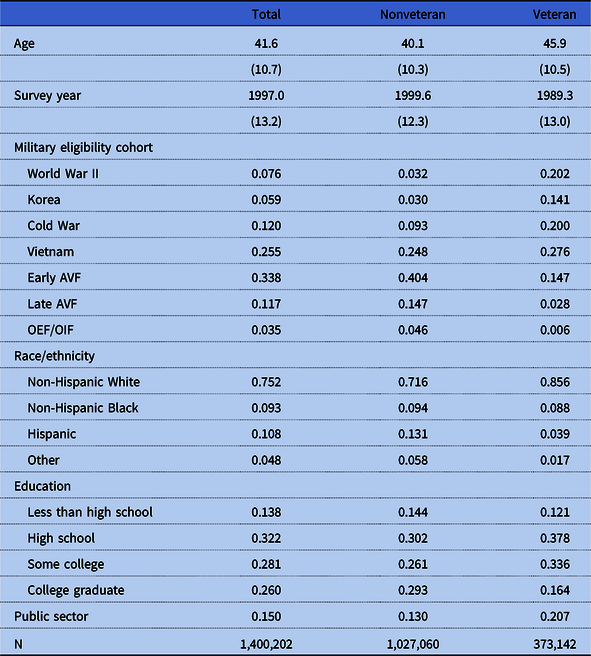
Table 1 presents descriptive statistics for the sample, which are based on weighted data and show that veterans likely differed from nonveterans across survey years at least partly due to changes in the prevalence of service across eras. Veterans were more than six times as likely as nonveterans to have been eligible to serve during World War II, more than four times as likely to have come of age during the Korean War, and two times as likely to have turned 18 during the post-Korean Cold War era. They were slightly more likely to have been eligible to serve during the Vietnam era. By contrast, they were less likely than nonveterans to have been eligible to serve in all of the postdraft eras. Nonveterans were most likely to have come of age during the early AVF period stretching from 1973 to 1990. They were more than three times as likely to have done so as were veterans. They were four times as likely to have turned 18 during the late AVF period stretching up to the beginning of the war in Afghanistan. Relatively smaller shares of both types of men became eligible to serve in the armed forces since 2001. Only 5 percent of nonveterans belonged to this cohort, compared to just under 1 percent of veterans.
Descriptive statistics

Source: CPS male respondents 25–64 years old and in the labor force, 1971–2017.
All differences between veterans and nonveterans statistically significant at the .001 level.
As shown in the table, veterans also differed from nonveterans in terms of survey year and age. On average, veterans were surveyed when they were 46 years old in 1989. Nonveterans provided data when they were four years younger, or 42, in 2000, 11 years after the veterans.
Veterans also differed from nonveterans demographically. They were more likely to be non-Hispanic White, slightly less likely to be non-Hispanic Black, and much less likely to be either Hispanic or an “other” ethnicity. In addition, they were less likely to be observed at the lowest and highest levels of education. While 14 percent of nonveterans were high school dropouts, just 12 percent of veterans were. Similarly, while 29 percent of nonveterans had graduated from college, only 16 percent of veterans had. Veterans were, accordingly, much more likely than nonveterans to have just graduated from high school or completed some college. Veterans were also more likely to work in the public sector than were nonveterans. They likely benefited from veterans’ hiring preferences for jobs in the public sector available to those who served in war zones (Mani Reference Mani2013).
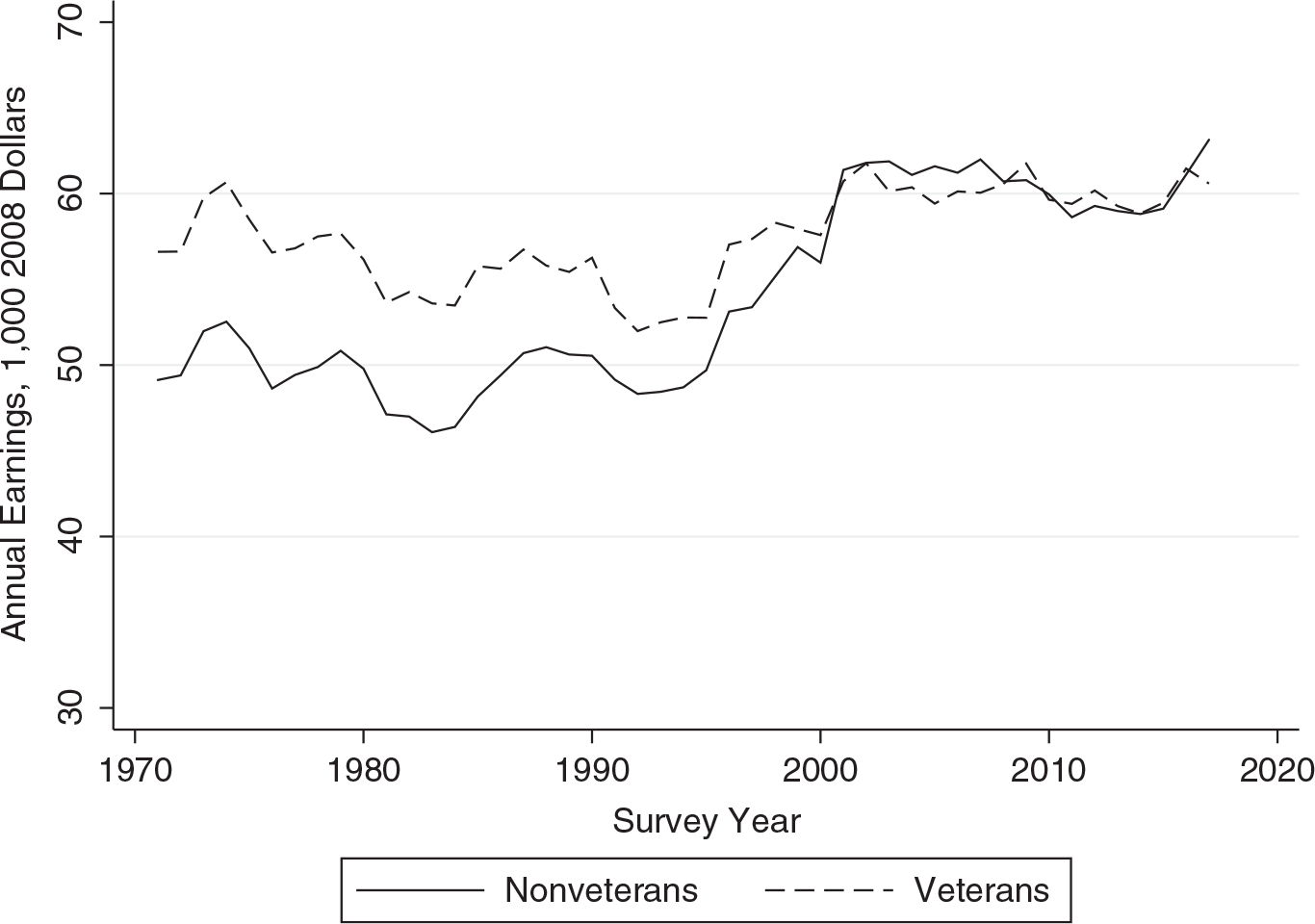
Figure 1 presents evidence of broad social change in earnings, presenting evidence of a veteran premium that persisted through the mid-1990s, but disappeared thereafter. It contains estimates of average annual earnings in the sample by survey year and veteran status, which suggest both that earnings have shifted over the period and that the relative positions of veterans and nonveterans have changed over time. Between 1971 and 1995, respondents had average annual earnings in 2008 dollars that fluctuated between slightly less than $52,000 and nearly $62,000. Over those two and a half decades, veterans earned substantially more, on average, than did nonveterans. After the mid-nineties, average earnings increased to more than $65,000. Since that time, veterans have no longer earned more or less than nonveterans.
Annual earnings by survey year and veteran status.

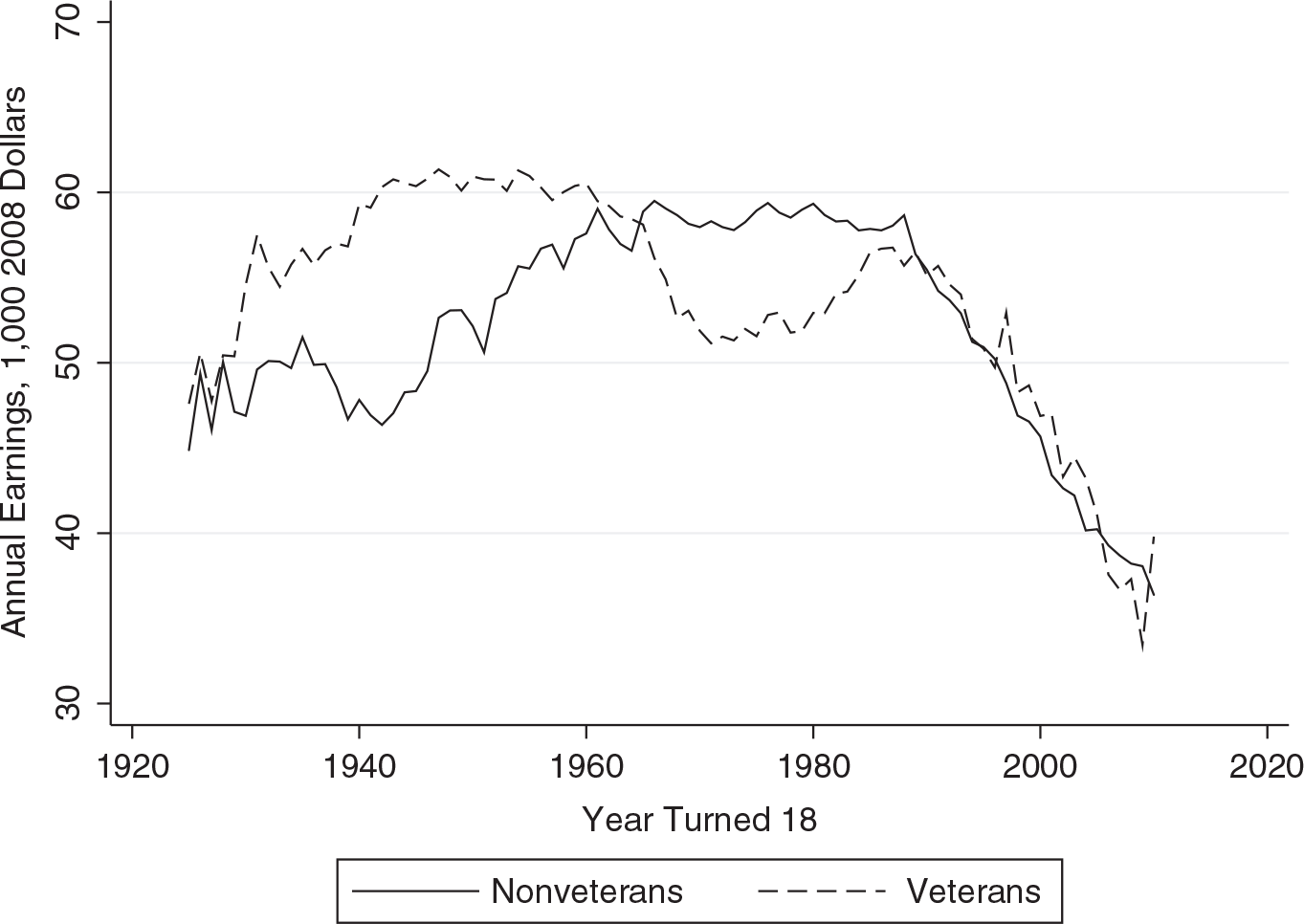
Figure 2 suggests that some of these period changes may stem from a veteran advantage among cohorts eligible to serve before Vietnam, which is consistent with the general cohort hypothesis. It presents earnings calculated by the year that men turned 18 and veteran status. Men earned more on average if they came of age in the middle than if they did so in the early or later years of the century. They earned between $58,000 and $62,000 annually if they turned 18 between 1941 and 1986. They earned less than $58,000 if they turned that age in the preceding two decades or in the following two decades. Some of these patterns stem from the different ages at which men of different cohorts were observed, which are discussed more fully in the following text. Within birth-year cohorts, however, veterans differed from nonveterans in terms of their average earnings. They earned more than nonveterans if they became eligible to serve before 1965 and after 1997. Among men who became adults between 1966 and 1986, they earned less. These men were eligible to serve during the Vietnam and early AVF eras. Thus, the findings are partially consistent with the specific cohort hypothesis.
Annual earnings by year turned 18 and veteran status.

We present the models that include the cohort and age variables because these models capture our substantive interest in whether there have been changes in the relative positions of veterans depending on when they were eligible to serve and how old they were. Our general conclusions do not differ if we also control period, but, as described in the preceding text, these models contain estimates and produce predicted earnings that cannot be interpreted literally. We present estimates and predicted earnings from these alternative models in the attached online supplement. Here, we note that when period is controlled, the absolute value of the earnings predictions vary depending on which era is chosen as the reference period, but the patterns are the same in the relative position of veterans by age and cohort.
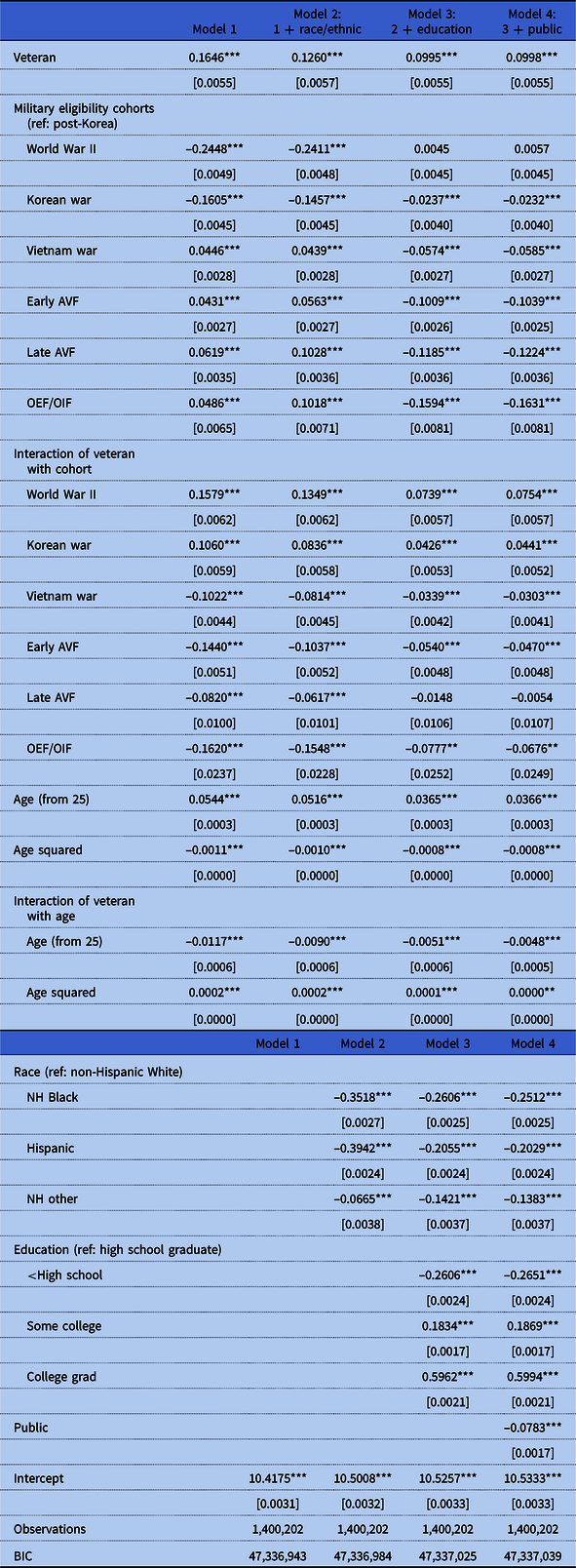
Table 2 contains coefficients from different models of the regression of earnings on veteran status by cohort and age. The first model includes a measure of cohort, veteran status, and the interaction between the two, as well as age effects, both overall and by veteran status. According to the model, veterans earned more than comparable nonveterans if they became eligible to serve before the Vietnam era. Among those who turned 18 during that war and the AVF eras, they earned less than comparable nonveterans. Veterans were at the greatest advantage relative to nonveterans among those who were eligible to serve in the 1940s and 1950s, the World War II, Korean, and post-Korean eras. These findings are consistent with both the general and specific cohort hypotheses.
Generalized linear models of association between veteran characteristics and log of earnings

Source: Current Population Survey, 1971–2017, men 25–64, non-self-employed, non-zero-earners.
Note: Standard errors in brackets. *p < 0.05; **p < 0.01; ***p < 0.001
(two-tailed tests of significance).
Net of age and cohort, veterans had higher earnings on average than nonveterans. These coefficients are reduced by the inclusion of race/ethnicity, with the positive coefficients less positive, and the negative coefficients less negative, suggesting that the differences between veterans and nonveterans are at least partially explained by racial and ethnic differences between veterans and nonveterans. Before the Vietnam War, veterans were disproportionately likely to be White, which partially explains their higher earnings, while after that war, they have been disproportionately likely to be Black. These findings are consistent with the racial selection hypothesis.
The veteran advantage is reduced even further when educational attainment is included in the model, suggesting that veterans earned more in the earlier cohorts because of their greater average educational attainment, and less in the later cohorts because of their lower educational attainment. This finding is consistent with the educational mediation hypothesis.
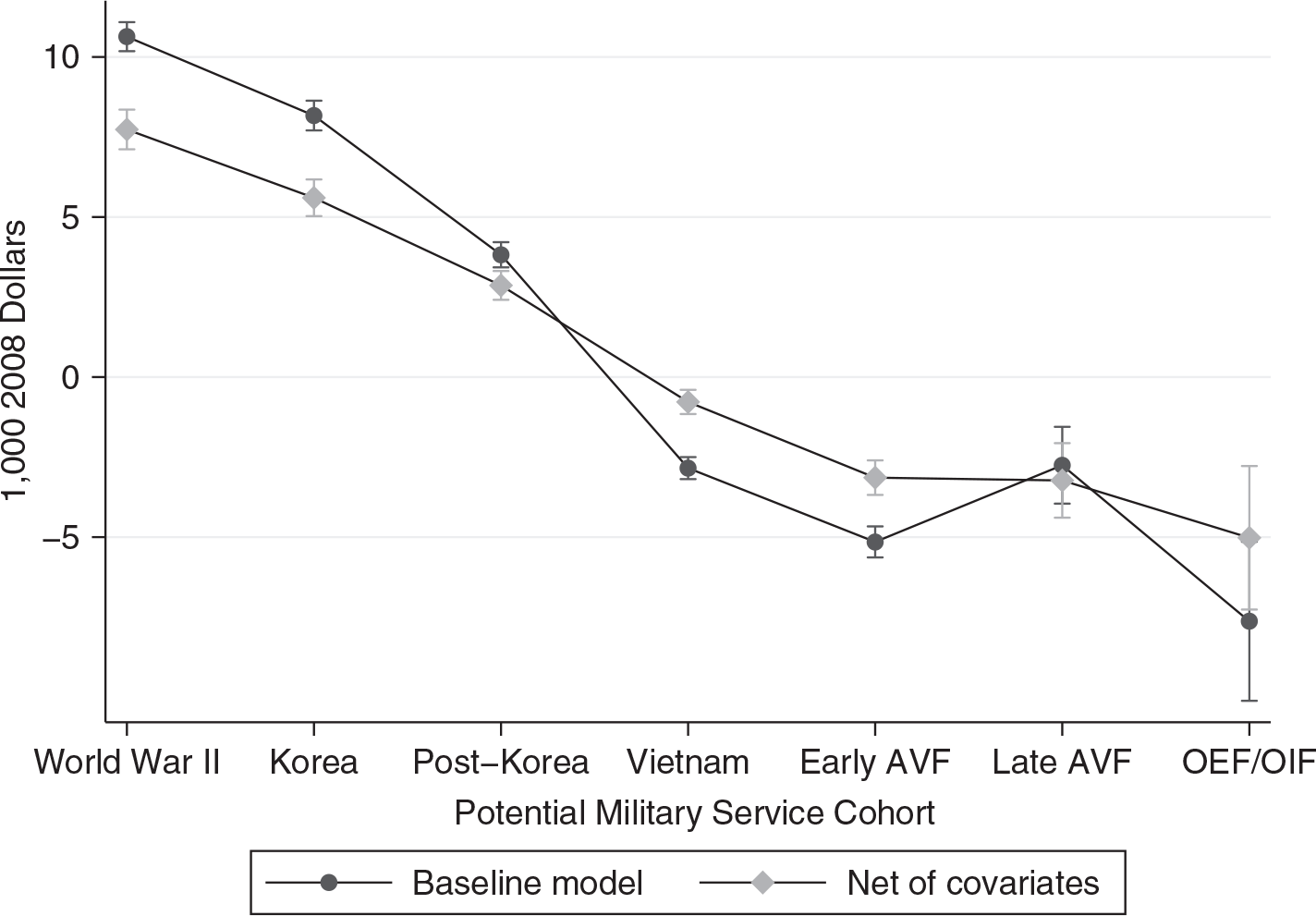
Figure 3 presents the average marginal effects with 95 percent confidence intervals by cohort in the baseline model (model 1) and in the full model net of the covariates (model 4). According to the figure, veterans earned between $2,000 and $10,000 more in 2008 dollars than did nonveterans if they served prior to the Vietnam War. World War II veterans received the biggest premium followed by those of the Korean and then post-Korean Cold War eras. By contrast, veterans in the Vietnam and early AVF cohorts earned less than did their nonveteran counterparts. As mentioned previously, at least some of these differences between veterans and nonveterans stemmed from their race/ethnicity and educational attainment. After these measures are entered into the model, members of the pre-Vietnam cohorts benefited from a smaller premium, while those of the Vietnam and early AVF suffered a smaller penalty. Among men who were eligible to serve in the late AVF and OEF/OIF eras, the coefficients are estimated imprecisely due to the relatively shorter period during which these men are observed (see Appendix B).
Average marginal effects by cohort and veteran status.

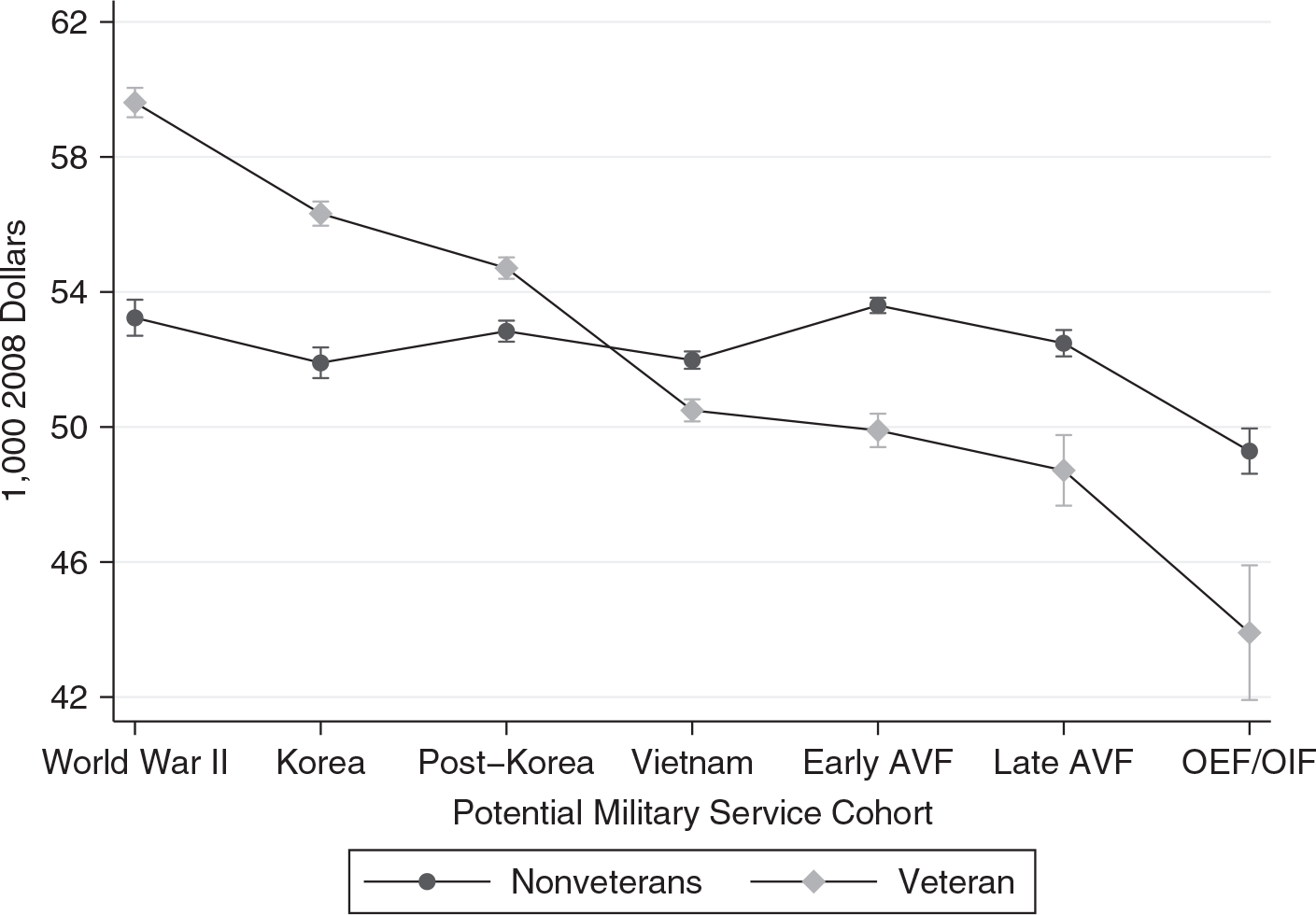
Figure 4 contains predicted earnings at representative values for veterans and nonveterans, net of age differences. The lines represent the earnings of veterans and nonveterans at the average age in the sample among non-Hispanic White, high school graduates who worked in the private sector. According to the figure, nonveterans saw their earnings fluctuate if they came of age between the World War II and early AVF eras. They saw their earnings decrease if they came of age more recently. By contrast, veterans saw their earnings decrease from their highest level in the World War II era. Thus, the veteran premium eroded both because veterans’ average earnings declined consistently and because earnings for nonveterans did so only recently.
Predicted earnings by cohort and veteran status.

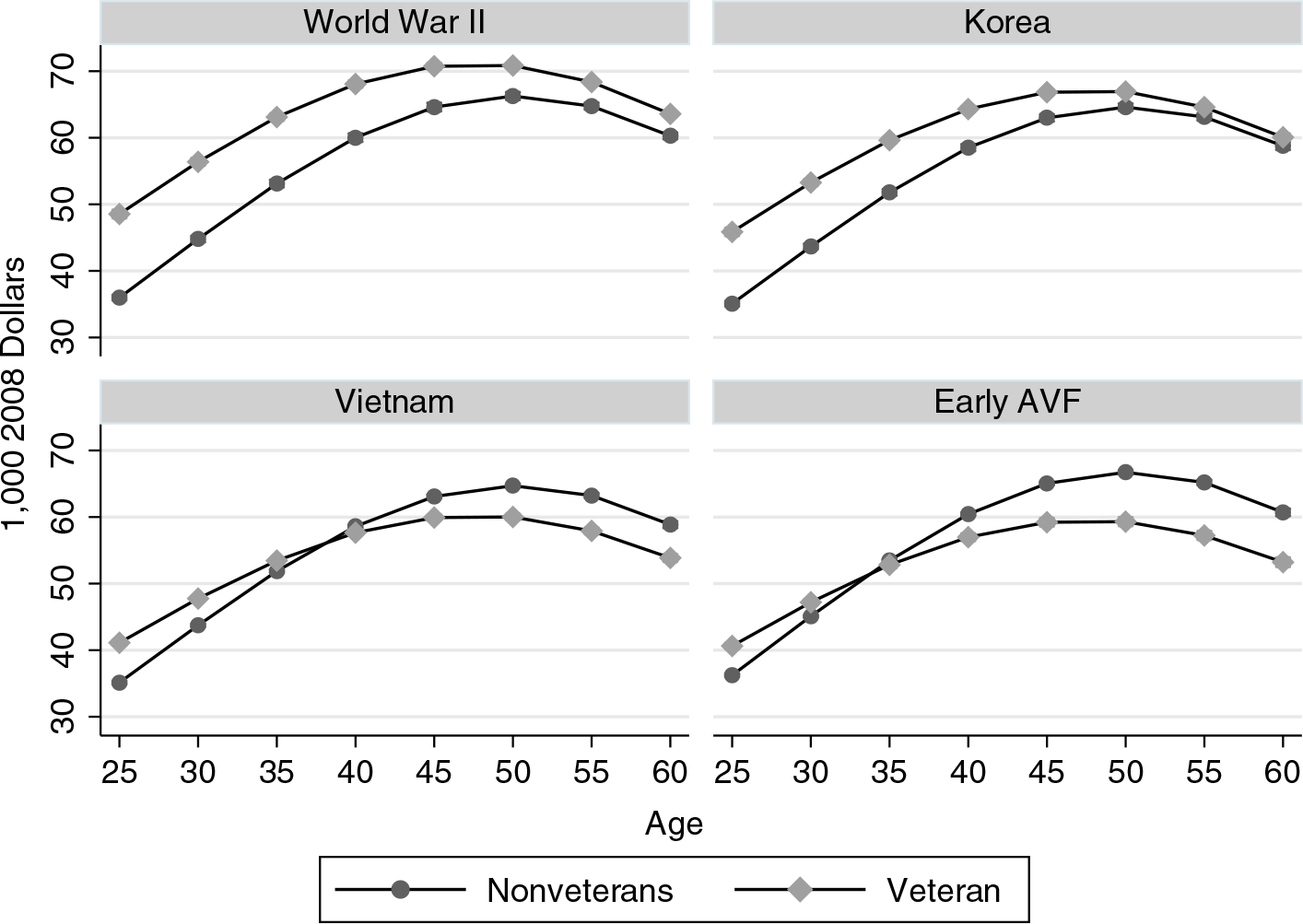
Figure 5 presents predicted earnings calculated using the same representative values as the previous figure, and produces age trajectories for selected cohorts. As shown in the models, veterans see their earnings grow more slowly than do nonveterans as they aged. Men who served in the military earned more than those who did not at all ages among the World War II and Korean cohorts, though this premium narrowed over time. With respect to the Vietnam and AVF cohorts, veterans were not at a disadvantage when they were younger, at age 25. As they grew older, however, they fell behind the nonveterans.
Predicted earnings by age, cohort, and veteran status.

Conclusion
The findings suggest that historical changes in the context of service shifted the relative position of veterans. In particular, veterans had advantages over nonveterans in the earlier cohorts, but were less privileged relative to nonveterans in the later cohorts. Veterans earned more than nonveterans if they were eligible to serve during the middle of the twentieth century, those belonging to the “greatest generation,” and the cohorts immediately after (Brokaw Reference Brokaw1998). This advantage disappeared among those who were eligible to serve starting in the Vietnam era. Regardless of cohort, veterans saw declines in their positions relative to nonveterans as both groups of men grew older.
These gaps stemmed at least partly from selection, as captured by racial differences, and mediation, as measured by educational attainment. In the earlier years, veterans were more likely than nonveterans to be White and better educated, while more recently they were more likely to be minorities and to have relatively less education. Among those who became eligible to serve during the World War II, Korean, and post-Korean eras, much of the premium earned by veterans is explained by the current measures of selection and mediation, but some remains. The apparent advantage may reflect the fact that the analyses do not include measures of all the relevant characteristics that reflect either treatment or selection. Alternatively, veterans may have benefited from some other signal that is not educational that employers rewarded.
This article has formally compared generational units defined by military service to each other across a broad array of cohorts with changing historical context. It contributes to research regarding veterans, which has until now not explicitly tested how the association of veteran status with various outcomes has changed over such a broad sweep of history. It is apparently the first such analysis that has used the same data source across all of the cohorts ranging from World War II to the contemporary era. It produced some findings that are consistent with those of previous research, as well as others that are new. Previous researchers have tended to evaluate veterans’ outcomes in particular cohorts, producing findings regarding the men who served during World War II, the Vietnam War, and the early AVF. The current analyses confirm earlier research regarding the relative advantage held by World War II veterans (Teachman and Tedrow Reference Teachman and Tedrow2004). They also confirm earlier findings that showed that veterans were at a relative disadvantage if they were eligible to serve during the Vietnam era (Angrist Reference Angrist1990). Veterans also experienced such a disadvantage if they were eligible to serve after that war, during the volunteer era.
Yet the analyses also show how socioeconomic outcomes differed for cohorts that have received less attention. According to the findings, veterans who served during the Korean and post-Korean eras had socioeconomic achievements relative to nonveterans in the middle range. They were neither as relatively successful as the men who served during World War II nor as relatively disadvantaged as those who served during the Vietnam and early AVF eras. Future researchers should apply the theory of generations to other outcomes among veterans, examining whether the current conclusions regarding cohort changes in the relative positions of veterans also apply to outcomes such as marriage, or mental and physical health.
The findings may also be consistent with a broader empirical pattern derived from the literature on generations, which has suggested that the experiences of the cohorts born in the middle of the twentieth century tended to differ from those born before or possibly after them (Chauvel and Schröder Reference Chauvel and Schröder2014; Davis Reference Davis and Marsden2012). This article focused on the features of military service that may have contributed to the relative status of veterans. It appears, however, that the gaps between those who did and did not serve also stemmed from generational trends affecting those who stayed at home. These nonveterans may have experienced increases in their socioeconomic status if they came of age during the boom years of the 1960s and 1970s that the veterans did not match.
Veterans occupied different relative positions based on both the erosion of their own position and the gains in the positions of nonveterans, which is also true of other generational units. Thus, they earned less than comparable nonveterans who came of age in the Vietnam and early AVF eras because their earnings declined while those of nonveterans increased. Nonveterans’ predicted earnings increased steadily from the World War II to the early AVF era, while those of veterans fell. More broadly, members of different generational units may see widening gaps either because the group with lower earnings sees further decline in their position or because the group with higher earnings sees an increase. Conversely, these gaps may decrease either because the group in the worse position experiences increased fortune or because the group with the better position sees a drop.
The analyses cannot fully explain these changes in the relative status of veterans because they do not have adequate or, in some cases, any measures of potential mechanisms. The CPS data have only limited measures of selection and mediation, for example, limiting the analyses to racial and educational differences between those who did and did not serve. They also do not contain direct measures of military experiences, which could capture changes in treatment. Unfortunately, we know of no data that contains such detailed measures along with as many cohorts as are included in the CPS.
Future research could use data, however, that includes such measures to compare a more limited set of cohorts. It could, for example, compare cohorts on the basis of preservice cognitive ability and health. It might also examine whether cohorts differed due to treatment by including direct measures of military training, for example, or of combat exposure. It might further assess whether the relationship between service and later lives varies by how popular the armed forces were in a given period. It could thereby directly assess whether veterans returning from more popular wars experienced more positive outcomes than those returning when military action was less popular.
The analyses also cannot ascertain whether and to what extent the findings for male veterans extend to women veterans. Women’s opportunities to serve were severely limited in both numbers and in occupational roles in early cohorts. The removal of formal limitations on numerical composition of the military and the expansion of opportunities to serve in all occupational roles among later cohorts demands attention to the changing consequences of military service for women. But understanding the changing outcomes across all the generations of women veterans involved in this study is a much more difficult enterprise. Future research might fruitfully apply the theory of generations to women veterans, but such an effort demands a source of data not currently available: one with large enough samples of women veterans, at many points in time, covering a wide range of ages. Given the relatively small samples of women veterans in survey samples and the failure of most agencies to ask women about their military experiences until the mid-to-late 1980s, no data are well-suited to this important task.
Nevertheless, the preceding analyses present a model for how the theory of generations may be applied to other groups that have been affected by identifiable historical changes. Veterans belong to generational units that have been affected by a historical context that has fluctuated discretely. Over the last 70 years, people came of age during eras that presented unique patterns regarding selection into, treatment during, and mediation after military service. Other groups may also have experienced discrete historical fluctuations, which, in turn, may have influenced the outcomes of these other generational units. Immigrants have experienced policies and attitudes that have shifted over time. Similarly, people have gone to college under different conditions, with infusions of funding from the GI Bill and the money that followed the launch of Sputnik, as well as the recent reduction in state funding for public universities. To take another example, as workers grow older, they face different types of incentives and regulations regarding retirement, with changes in rules regarding the mandatory retirement age and the shift from defined-benefit to defined-contribution plans. Similarly, people who are disabled have experienced broad changes in their rights under the Americans with Disabilities Act. Future research could apply the theory of generations to other historical defined generational units, such as immigrants, college graduates, retirees, and the disabled, assessing how their relative fates may have shifted in response to changes in their historical context.
Supplementary material
To view supplementary material for this article, please visit https://doi.org/10.1017/ssh.2020.42
Acknowledgments
Earlier versions of this article were presented at the 2014 meetings of the American Sociological Association of America, in San Francisco, CA and the 2015 meetings of the Research Committee on Social Stratification and Mobility in Tilburg, Netherlands. We are grateful for comments from Louis Chauvel, Morten Ender, Monica K. Johnson, Emily Huddart Kennedy, Katrina Leupp, Patricia McManus, Clayton Mosher, and John Robert Warren. Zachary Tindell provided research assistance on an earlier version of this paper. This research was partially funded by collaborative research grants from the National Science Foundation (NSF 1225588, 1225890, and 1225914).