Juvenile spondyloarthropathy is an umbrella term for a group of childhood rheumatic diseases that can cause chronic arthritis and extend to the axial skeleton before the age of 16. It includes enthesitis-related arthritis, undifferentiated spondyloarthritis, juvenile ankylosing spondylitis, psoriatic arthritis, reactive arthritis and arthritis associated with inflammatory bowel disease. Reference Adrovic, Barut, Sahin and Kasapcopur1,Reference Weiss and Colbert2 Cardiovascular disease is common amongst juvenile spondyloarthropathy patients and the major cause of death amongst adult patients with ankylosing spondylitis. Reference Momeni, Taylor and Tehrani3
Aortic stiffness reflects the mechanical tension and elasticity of the aortic wall. It has been a predictor of cardiovascular disease and has been shown to increase in ankylosing spondylitis patients even when controlled for traditional cardiac risk factors. Reference Moyssakis, Gialafos and Vassiliou4
Aortic stiffness evaluated with echocardiography techniques such as tissue Doppler and strain imaging has a high degree of accuracy even when compared with invasive measurements. Reference Vitarelli, Giordano and Germanò5,Reference Stefanadis, Stratos, Boudoulas, Kourouklis and Toutouzas6 The purpose of the present study is to investigate whether aortic stiffness presence in juvenile spondyloarthropathy and besides, could assessment with echocardiography predict aortic stiffness relation to the severity of juvenile spondyloarthropathy.
Material-methods
Study population
The study population comprised of 51 patients with juvenile spondyloarthropathy being followed-up at the Department of Paediatric Rheumatology outpatient clinic at Cerrahpasa Medical School, Istanbul University-Cerrahpasa, together with 21 healthy controls. The control group was made up of healthy controls of similar age and sex as the patient group. The patients in the control group had no history of any chronic disease. In addition, we selected non-obese/overweight individuals with no family history of cardiovascular disease. They were chosen from the individuals who attended to outpatient clinic for routine checks/innocent murmur/adolescence follow-up, etc. Patients with history or other evidence of congenital heart disease, any rhythm abnormalities, other chronic systemic diseases (renal and pulmonary diseases, diabetes, etc.), and those taking medications other than juvenile spondyloarthropathy therapy were excluded. Age, sex, gender, follow-up duration, family history, clinical, laboratory and radiological findings and treatment were all recorded. The same paediatric cardiologist evaluated the cardiac functions of the patients. The juvenile spondyloarthropathy diagnosis was made according to the International League of Associations for Rheumatology criteria for juvenile idiopathic arthritis (JIA). Reference Petty, Southwood and Baum7 All the patients also fulfilled the classification criterion for juvenile spondyloarthropathy. Inflammatory back pain was defined as the presence of three or more of the following: (1) improvement with exercise, (2) pain at night, (3) insidious onset and (4) no improvement with rest. Reference Sieper, Van Der Heijde and Landewé8 The juvenile Ankylosing Spondylitis Disease Activity Index was used to calculate disease activity. Reference Garrett, Jenkinson, Kennedy, Whitelock and Gaisford9 Modified Schober’s limitation was defined as 4 cm or less expansion of the column in measurements over 15 cm.
We also sub-grouped the juvenile spondyloarthropathy patients according to their medications (those on non-steroidal anti-inflammatory drugs, on conventional disease-modifying anti-rheumatic drugs and on biological disease-modifying anti-rheumatic drugs). We evaluated the aortic stiffness parameters according to the different drug treatment groups.
Echocardiographic imaging
After their informed consent had been gained, the patients were given a physical and echocardiographic examination, arterial blood pressure measurements and an ECG tracing. Before the echocardiography, blood pressure was measured at the right brachial artery using an electronic sphygmomanometer (Braun BP6200, Germany) with the patient supine. All the patients and controls were evaluated with conventional echocardiography and pulsed-wave tissue Doppler indices by the same paediatric cardiologist, who was blinded to the patient history.
Transthoracic echocardiography was performed in the Paediatric Cardiology Department using a commercially available echocardiography machine (Philips iE33, Philips Medical Systems) equipped with X5–1S MHz transducer. The echocardiographic examination was performed in the left lateral decubitus/supine position. A standard trans-thoracic echocardiogram was used in M-mode with two-dimensional Doppler flow assessments and tissue Doppler imaging. All pulsed-wave Doppler and tissue Doppler imaging parameters were measured at a sweep speed of 100 mm/s at the end of expiration, and the average of three consecutive heartbeats was recorded. All measurements were performed according to the recommendations of the American Society of Echocardiography. The left ventricular ejection and shortness fractions were calculated using the Teichholz formula. Reference Lopez, Colan and Frommelt10
Right ventricular functions were analysed with right ventricular fractional area change. Right ventricular fractional area change represents a “‘surrogate’” measurement of RV ejection fraction and is expressed as the percentage change in the right ventricular chamber area from end-diastole to end-systole. Tricuspid annular plane systolic excursion is a parameter of global right ventricular function that describes apex-to-base shortening. Reference Vitarelli, Giordano and Germanò5,Reference Dolgin11
The recommended method for the assessment of ventricular diastolic dysfunctions are mitral valve and tricuspid valve inflow measurement from Doppler scan recordings. These consist of peak early diastolic velocity (e wave), peak late diastolic velocity (a wave, atrial filling) and calculation of the e-to-a ratio for each ventricle. Tissue Doppler echocardiography was performed to measure peak early and late diastolic flow velocities (e’ and a’, respectively, cm/s) in the lateral tricuspid/mitral annulus views. In normal function, the e wave is bigger than the a wave, but with impaired relaxation, the e-to-a ratio will fall because of the increasing atrial filling wave (a wave). Reference Vitarelli, Giordano and Germanò5
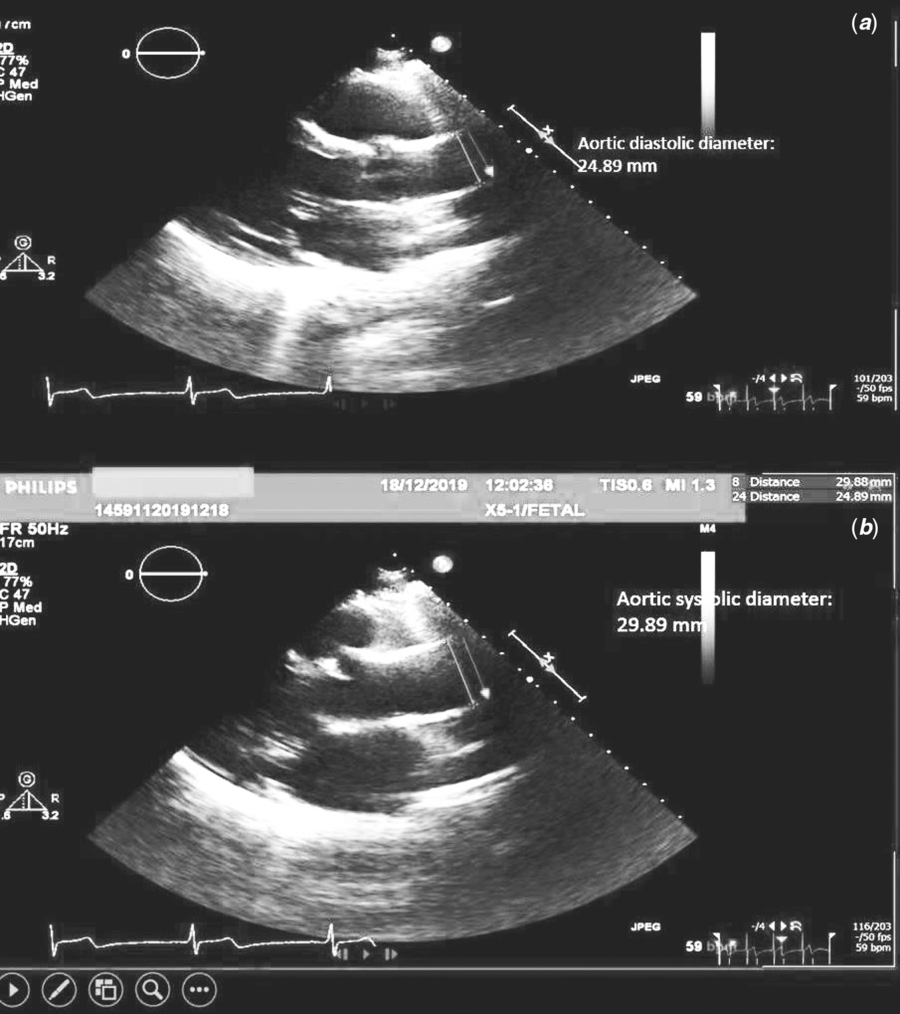
The ascending aorta was imaged at 3 cm above the aortic valve from the parasternal long-axis view. The systolic aortic diameter was measured at the point of maximal anterior motion of the ascending aorta (systole) and the diastolic aortic diameter was measured at the q wave on the ECG (end-diastole) using M-mode echocardiography. In the data analysis, the mean of three diameter measurements in sequential cardiac cycles was used. Four elastic indices of aortic stiffness, namely aortic distensibility, stiffness index, strain and elastic modulus, were calculated as
 $${\rm{Aortic}}\,{\rm{distensibility}} = {{{\rm{Aortic}}\,{\rm{strain}}} \over {{\rm{Brachial}}\,{\rm{pulse}}\,{\rm{pressure}}}}$$
 $${\rm{Stiffness}}\,{\rm{index}} = {{{\rm{ln}}\,{\rm{systolic\,blood}}\,{\rm{pressure}}/{\rm{diastolic\,blood}}\,{\rm{pressure}}} \over {{\rm{Aortic}}\,{\rm{strain}}}}$$
 $${\rm{Aortic}}\,{\rm{strain}} = {{{\rm{Aortic}}\,{\rm{systolic}}\,{\rm{diameter}} - {\rm{Aortic}}\,{\rm{diastolic}}\,{\rm{diameter}}} \over {{\rm{Aortic}}\,{\rm{diastolic}}\,{\rm{diameter}}}}$$
 $${\rm{Elastic}}\,{\mkern 1mu} {\rm{modulus}} = {\rm{ }}{{{\rm{systolic}}\,{\mkern 1mu} {\rm{blood}}{\mkern 1mu} \,{\rm{pressure}} - {\rm{diastolic}}{\mkern 1mu} \,{\rm{blood}}{\mkern 1mu} \,{\rm{pressure}}} \over {{\rm{Aortic}}{\mkern 1mu} \,{\rm{strain}}}}$$
where ln = natural logarithm (see Fig 1). Reference Bulkley and Roberts15
Measurement of aortic root diameters for calculation of stiffness parameters by transthoracic echocardiography; diastolic (a) and systolic (b) frames of images in the parasternal long-axis view of aortic root.

Statistical analysis
Statistical analysis was performed using SPSS version 21.0 (IBM, Armonk, NY). The distribution of variables was assessed by the Kolmogorov–Smirnov and Shapiro–Wilk tests. While categorical variables were given as numbers and percentages (n [%]), continuous variables were given as mean ± standard deviation (SD) or median (minimum–maximum), according to their distribution. The Student’s t-test was used to compare continuous variables with normal distribution, while those without a normal distribution were compared using the Mann–Whitney U test. Spearman’s correlation coefficient correlation analysis was performed to test the relationship between linearly related variables. A receiver operating characteristic curve analysis was performed to test diagnostic accuracy for discrimination of the target patients from controls and to determine optimal cut-off values. We performed a post hoc power analysis to confirm that the current study had adequate power (99%). In all analyses, a value of p < 0.05 was taken as statistically significant.
Results
Characteristics of the juvenile spondyloarthropathy patients and healthy controls
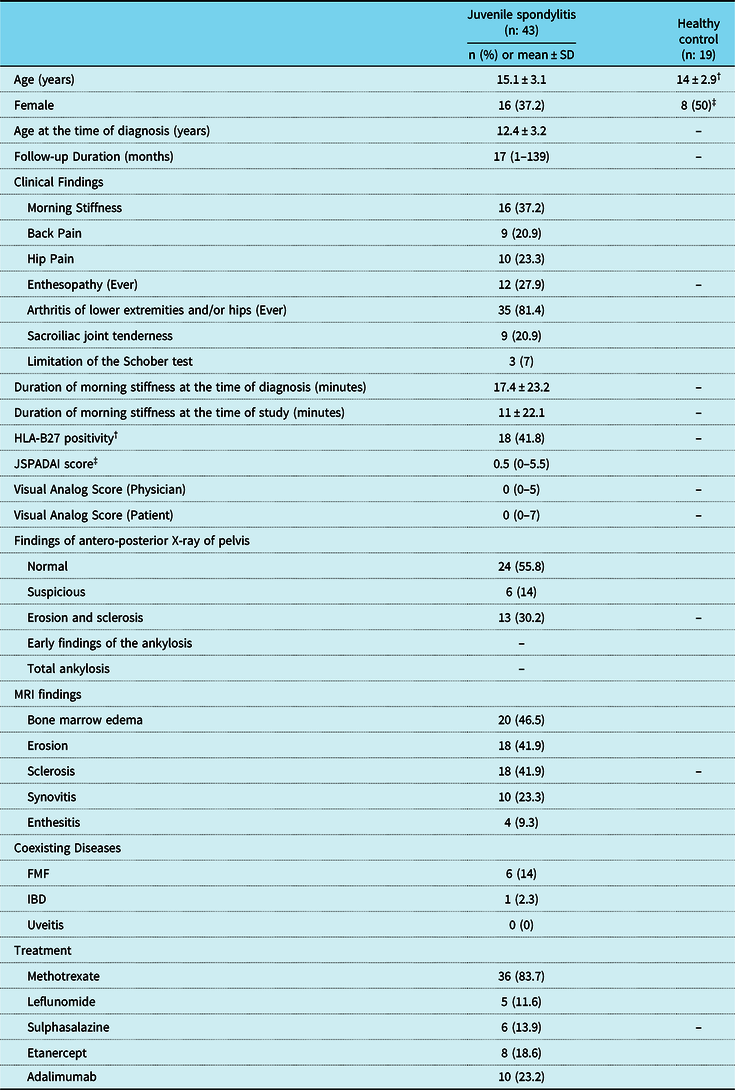
From the initial 51 juvenile spondyloarthropathy patients and 21 controls, 8 patients were excluded due to poor imaging and 2 children from the control group discontinued their participation. Thus, we finally assessed 43 patients with juvenile spondyloarthropathy and 19 controls. The mean age was 15.1 ± 3.1 years for the juvenile spondyloarthropathy patients and 14 ± 2.9 years for the control group (p > 0.05). The mean age at diagnosis was 12.4 ± 3.2 years and the median follow-up duration was 17 (1–139) months. The electrocardiogram readings were unremarkable for all the study populations with an absence of arrhythmias and conduction abnormalities. Six juvenile spondyloarthropathy patients also had a familial Mediterranean fever, and one other patient had inflammatory bowel disease. A family history of ankylosing spondylitis was detected in 18 (41.8%) of the patients. The demographic, clinical, radiologic and laboratory features of the study group are represented in Table 1.
Demographic features of patients with Juvenile spondyloarthropathy and controls

†p = 0.390. There is no significant difference between the patients and the healthy control for age (p value = 0.390).
†p = 0.276. There is no significant difference between the patients and the healthy control for sex (p value = 0.276).
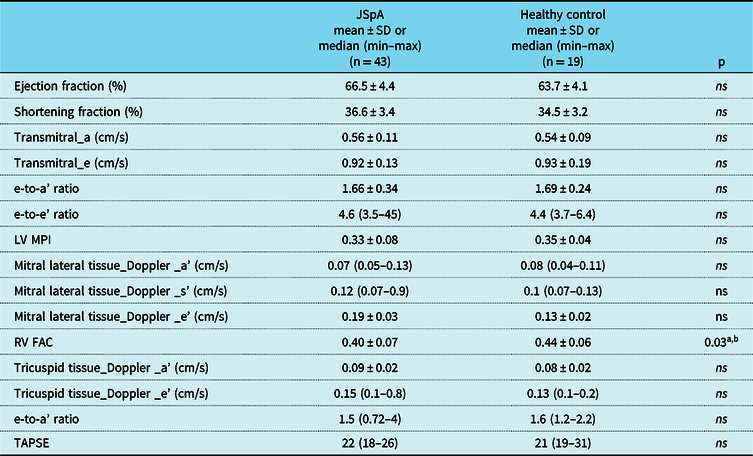
Comparison of TTE Doppler imaging findings in juvenile spondyloarthropathy patients and controls
The comparison of the M-mode echocardiographic examination of the groups is shown in Table 2. The mean change in right ventricular fractional area was significantly lower in patients with juvenile spondyloarthropathy than in controls, [40%±0.07 vs. 44%±0.06, p < 0.05].
Aortic stiffness and its associations
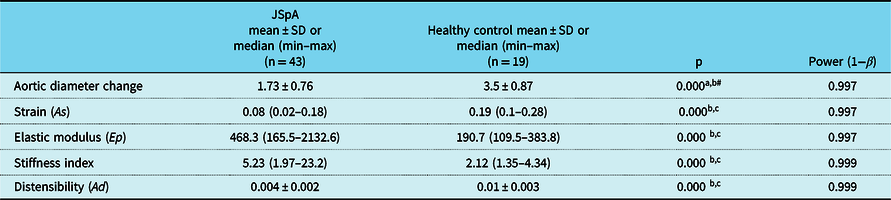
The comparison of elastic properties of the aorta between two groups is given in Table 3. Aortic stiffness and aortic distensibility were significantly lower in the juvenile spondyloarthropathy than the control group, and aortic stiffness index β was significantly higher. The aortic root diameter chance of the aorta was significantly lower amongst the juvenile spondyloarthropathy patients (Table 3).
Comparison of echocardiographic findings for juvenile spondyloarthropathy patients and control group

ns; not significant at p < 0.05.
JSpA=juvenile spondyloarthropathy; LV MPI=left ventricular myocardial performance index; RV=right ventricle; RV FAC=right ventricle fractional area change; TAPSE=tricuspid annular plane systolic excursion.
a Student’s t-tes.t
b Post hoc power analysis (1−β) = 0.50.
Comparison of patients and healthy controls for aortic stiffness parameters

JSpA=juvenile spondyloarthropathy.
a Student’s t-test.
b Post hoc power analysis (1−β) = 0.99.
c Mann–Whitney U test.
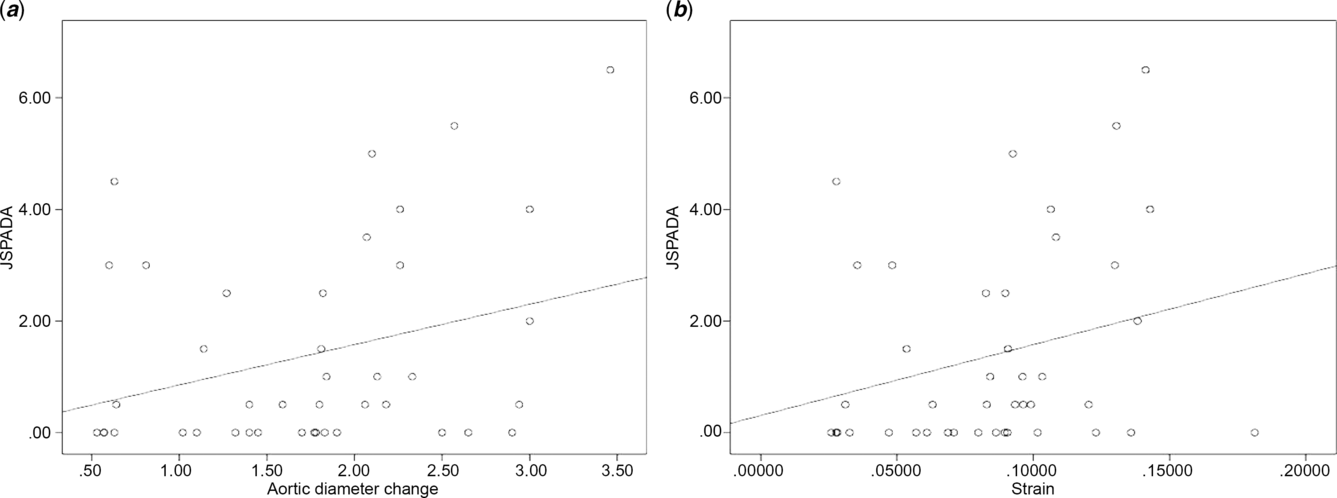
There was no correlation between the stiffness index and inflammation markers. Pearson’s correlation analysis revealed a significant correlation between the juvenile Ankylosing Spondylitis Disease Activity Index and aortic diameter change, and there was also a significant correlation between the juvenile Ankylosing Spondylitis Disease Activity Index and aortic stiffness in juvenile spondyloarthropathy patients (r = 0.320, p = 0.03), and (r = 0.320, p = 0.03, power (1–β) = 0.99, and r = 0.3104, p = 0.04, power (1–β) = 0.997, respectively) (Fig 2).
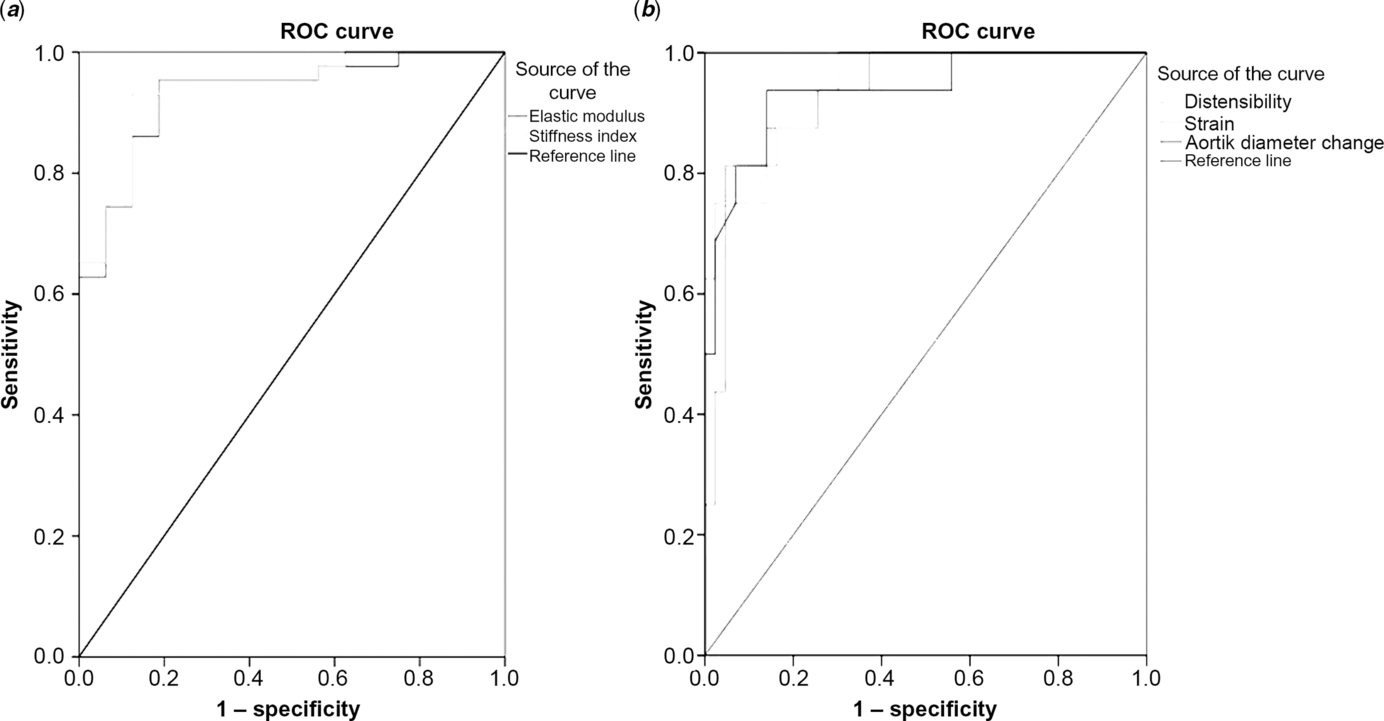
(a) Receiver operating characteristic curve analysis for elastic modulus, aortic stiffness index. Aortic Stiffness index shows the best area under the curve (0.939) to predict juvenile spondyloarthropathy patients from healthy controls over 2.77 with a sensitivity of 93% and specificity of 87%. (b) Receiver operating characteristic curve analysis for aortic distensibility (Ad), strain (As) and diameter change. Ad shows the best area under the curve under to predict juvenile spondyloarthropathy patients from healthy controls (0.930 with a sensitivity of 87% and specificity of 86%).

Receiver operating curve analysis revealed the best cut-off value of the echocardiographic stiffness parameters in the juvenile spondyloarthropathy patients and controls. A stiffness index of over 2.77 was identified with a sensitivity of 93% and specificity of 87% (area under the curve: 0.939 [95% CI: 0.8–1.00, p = 0.000]), aortic strain under 12% with a sensitivity of 87% and specificity of 83% (area under the curve: 0.943 [95% CI: 0.88–1.00, p = 0.000]) and aortic distensibility under 0.007 with a sensitivity of 87% and specificity of 86% (area under the curve: 0.930 [95% CI: 0.86–0.99, p = 0.000]) identified patients for aortic root stiffness. The area under the curves for elastic modulus, aortic diameter change were 0.930 and 0.93, respectively (Fig 3).
Correlations between the juvenile Ankylosing Spondylitis Disease Activity Index and aortic diameter change and strain (As) in juvenile spondyloarthropathy patients.

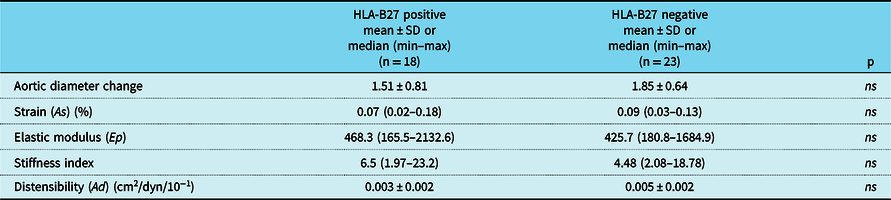
According to the HLA-B27 positivity, there were no differences in the stiffness parameters between the juvenile spondyloarthropathy patients and control group (Table 4).
Comparison of cardiac stiffness parameters for positivity of B27

ns; not significant at p < 0.05.
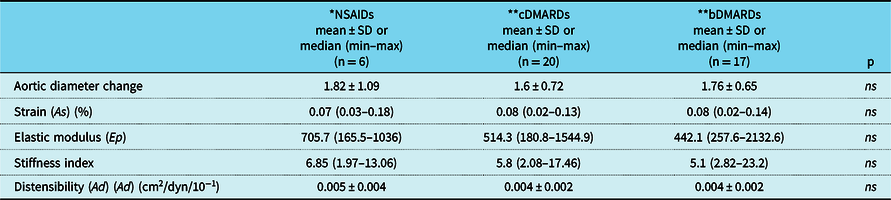
No correlations were found between arterial stiffness and disease duration. There were no significant differences amongst sub-grouped juvenile spondyloarthropathy patients according to their medications, which were on non-steroidal anti-inflammatory drugs on conventional disease-modifying and on biological disease-modifying anti-rheumatic drugs (Table 5).
Comparison of cardiac stiffness parameters according to medications

* Non-steroidal anti-inflammatory drugs.
** Conventional disease-modifying anti-rheumatic drugs.
***Biological disease-modifying anti-rheumatic drugs.
The non-steroidal anti-inflammatory drugs, conventional disease-modifying anti-rheumatic and biological disease-modifying anti-rheumatic drugs, inflammatory markers (thrombocytosis, erythrocyte sedimentation rate, C-reactive protein) associations with aortic stiffness parameters were not significant. The only association close to significance was the one with C-reactive protein (r = 0.39, p = 0.06).
Discussion
In this analysis of children and young adults with juvenile spondyloarthropathy, we used transthoracic echocardiography to derive several markers of aortic stiffness at the aortic root. We found that echocardiographic-derived aortic stiffness increased in comparison with controls, worsening with higher disease severity.
Although increased aortic stiffness in adult ankylosing spondylitis patients has been previously demonstrated, this is the first study to investigate the relationship between aortic stiffness in young patients (i.e., with juvenile spondyloarthropathy). In addition, we also studied the association of stiffness with inflammatory markers, disease duration and HLA-B27 positivity. To calculate aortic root stiffness, we used transthoracic echocardiography, which has optimal acoustic windows in young adults (in contrast to adults).
Extra-articular manifestations, such as genitourinary involvement and apical pulmonary fibrosis, which are seen in adult spondyloarthropathy patients, are uncommon amongst juveniles. Cardiac valvar abnormalities in juvenile spondyloarthropathy, however, in particular aortic insufficiency, have been reported at similar rates to those in adult SpA. Reference Stamato, Laxer and de Freitas12 A distinctive cardiac lesion is found in patients with spondyloarthropathy. This lesion is aortic regurgitation or, rarely, mitral regurgitation. Reference Sieper, Van Der Heijde and Landewé8 Dilatation and thickening of the walls of the proximal aortic root along with thickening and shortening of the aortic valve cusps have been shown in histopathological reports. Specifically, the development of a fibrous mass (or bump) below the aortic valve has been shown in patients with ankylosing spondylitis. Reference Ansari and Maron13–Reference Bergfeldt, Edhag and Rajs18
Several, mostly small-scale studies have indicated that ankylosing spondylitis is also associated with various non-atherosclerotic cardiovascular disease manifestations, and it is hypothesised that the inflammatory processes in ankylosing spondylitis affect different structures of the heart, leading to these complications. Aortitis has been well noted in the literature. Reference Nurmohamed, van der Horst-Bruinsma and Maksymowych19 Aortic regurgitation because of the inflammatory process leads to an endarteritis with tissue thickening. Previous studies reported a prevalence ranging from 1 to 10% that increased with age, disease duration, and presence of arthritis. Reference Palazzi, Salvarani, D’Angelo and Olivieri20 Two recent studies using transthoracic echocardiography reported prevalence of aortic regurgitation in 4 of 88 patients (5%) and 20 of 77 (26%) patients. Reference Yildirir, Aksoyek and Calguneri21,Reference Lange, Stapfer and Ditting22
In our study, the patient group did not exhibit aortic regurgitation. This should not be surprising given their age and the short duration of the disease. In agreement with us, a study that used transesophageal echocardiography showed thickening of the aortic and mitral valves without regurgitation in adult ankylosing spondylitis patients early in the course of their disease, without clinical cardiac symptoms. The authors of that study suggested that this subclinical change of aortic-mitral valve in early ankylosing spondylitis should be followed up for its prognostic implications. Reference Park, Sohn and Joe23 Since ankylosing spondylitis patients are 60% more likely than the general population to be hospitalised with (aortic) valve disease, it appears that aortic regurgitation might still be an important problem. Reference Szabo, Levy and Rao24
In an adult study, Ozen et al. Reference Ozen, Ozen, Unal, Tufekcioglu, Ataman and Yalcin25 evaluated aortic stiffness as a measure of cardiac disease using arterial stiffness and the associated haemodynamic changes for an independent predictor and risk factor for cardiovascular mortality and morbidity. They suggested that arterial stiffness has been directly associated with systolic hypertension, coronary artery disease, stroke, and cardiac failure. In another study, it was found that aortic stiffness was increased in ankylosing spondylitis patients. Reference Moyssakis, Gialafos and Vassiliou4 Further when the ankylosing spondylitis patients were divided into groups according to their drug treatment, the aortic stiffness index was higher in the conventional disease-modifying anti-rheumatic drugs group than in the control group. The aortic stiffness index was lowest in the anti-TNF group. Similarly, to the adult studies, in our study also, the juvenile spondyloarthropathy patients had a relatively high aortic stiffness index with, accordingly, reduction in aortic compliance. Unlike the adult studies, however, we found no difference between the drug treatment groups. This could be a conclusion of our study group’s features as adolescents mostly without any cardiovascular risk factors. Furthermore, only four of our patients had a systolic blood pressure over 95% as a known risk factor for cardiovascular disease. Therefore, aortitis possibly results in aortic root stiffness, which may precede hypertension in juvenile spondyloarthropathy patients.
Inflammatory markers are higher in ankylosing spondylitis patients. A 5-year cross-sectional study showed raised that C-reactive protein associated with an increase in arterial stiffness. Reference Berg, Semb and van der Heijde26 In another study, a positive relationship was found between arterial stiffness, disease activity and loss of function. Reference Hatipsoylu, Şengül and Kaya27 The authors demonstrated that erythrocyte sedimentation rate and C-reactive protein were mostly high in ankylosing spondylitis patients on conventional disease-modifying anti-rheumatic drugs. Aortic stiffness was also high in this group, suggests that an increase in stiffness is associated with the inflammatory process. Reference Hatipsoylu, Şengül and Kaya27 In our study, we found a similar relation with disease activity and strain. Aortic root strain was lower in juvenile spondyloarthropathy patients with high juvenile ankylosing spondylitis disease activity index scores. Disease duration may also play a role in the development of arterial stiffness. Recognising that the majority of juvenile spondyloarthropathy patients in our study did not have a long-standing disease, still, there were no correlations between arterial stiffness and disease duration. Reference Selamet Tierney, Levine and Chen28
In older patients, measures of aortic root stiffness can be limited by poor acoustic windows. Reference Morris, Orbach, Geva, Singh, Gauvreau and Lacro29 In our patient group, that was not a problem; in fact, we had optimal acoustic windows for measurements. In addition, the validity and reproducibility of the echocardiographic methods used for local assessment of arterial stiffness, such as elastic modulus, distensibility and stiffness index, are limited by their dependence on the patient’s blood pressure. Reference Westenberg, Scholte and Vaskova30–Reference Venugopal, Devaraj, Yuhanna, Shaul and Jialal32 Despite almost all of our patients with juvenile spondyloarthropathy being normotensive, they had impaired arterial stiffness parameters. This finding emphases that the significance of this study.
Increased arterial stiffness is an independent predictor of cardiovascular disease. A significant association of high-sensitivity C-reactive protein with arterial stiffness has been demonstrated. Reference Mattace-Raso, van der Cammen and van der Meer33,Reference McEniery, Spratt and Munnery34 Produced by vascular smooth muscle cells with stimulation of inflammatory cytokines, C-reactive protein plays an active role in promoting vascular inflammation and reducing endothelial function. Reference Pasceri, Willerson and Yeh35 In this study, we set the significance level p-value = 0.05 of C-reactive protein correlated to arterial stiffness. Although there was no statistically significant difference in the aortic stiffness parameters between patients neither with positive nor with negative C-reactive protein values, the observed p-value was 0.06. We did not measure high-sensitivity C-reactive protein, generally used for risk assessment of cardiovascular events, which has extended C-reactive protein detection limits even in low concentrations. Our data depend on patients’ records in files as positive or negative according to C-reactive protein level with a cut-off of 5 mg/L instead of quantitative results. To exclude this limitation, we found out 18 patients recorded as negative C-reactive protein level had 3–5 mg/L in immune assays but we could not integrate these values into statistical analysis. Therefore, we believe aortic stiffness may be related to C-reactive protein level likely as arterial stiffness.
Another study of an adult normotensive population demonstrated that an increase in systemic inflammation, by an increase in high-sensitivity C-reactive protein, is an independent predictor of future development of hypertension. Reference Nagano, Nakamura, Sato, Tanaka, Segawa and Hiramori36 The authors suggested that systemic inflammation might play a role in the pathogenesis of vascular remodeling that leads to the development of hypertension. The fact that we have normotensive patients with impaired arterial stiffness paratemeters supports the hypothesis of a role for systemic inflammation in the development of hypertension.
Limitations
Many studies showing advanced echocardiographic techniques (such as speckle tracking echocardiography) reveal systolic dysfunction even though cardiac functions are normal on conventional echocardiography. Reference Dedeoglu, Adroviç, Oztunç, Sahin, Barut and Kasapcopur37,Reference Yiu, Schouffoer and Marsan38 We could not use advanced echocardiographic techniques as this was the first study to investigate the cardiac functions and aortic stiffness in juvenile spondyloarthropathy patients, we could not easily have predicted further possible correlations. High-sensitivity C-reactive protein in addition to C-reactive protein could have been measured for subclinical inflammation as used in adult studies. Limited follow-up time of our study may not reveal the progress of cardiac functions secondary to aortic stiffness.
Conclusion
This study has shown that juvenile spondyloarthropathy patients have high aortic stiffness parameters disproportionate with their age and healthy matches. The importance of arterial stiffness in the etiopathogenesis of atherosclerosis has been clearly demonstrated. Appreciating the role of inflammation in the pathogenesis of arterial stiffness in juvenile spondyloarthropathy patients is important in understanding the complex puzzle that is the pathophysiology of arterial stiffening and, thus, important also for the future development of novel treatments for juvenile spondyloarthropathy patients.
Obviously, close follow-up with echocardiography is mandatory for possible sub-clinical cardiac dysfunction in patients with juvenile spondyloarthropathy. In addition, juvenile spondyloarthropathy patients with aortic stiffness should be managed with effective suppression of inflammation to reduce possible cardiovascular morbidity.
Acknowledgements
None.
Authors’ Contribution
RD, MY, OK take responsibility for all aspects of the reliability and freedom from bias of the data presented and their discussed interpretation. RD designed the study, planned the concept and prepared and edited the manuscript. FK, NU, FH, FO, AA, KB had roles in data acquisition and analysis. SS had a role in the literature overview and data analysis.
Financial Support
This research received no specific grant from any funding agency, commercial or not-for-profit sectors.
Conflicts of Interest
None.
Ethical Standards
The Istanbul University-Cerrahpasa Medical Faculty Institutional Review Board (04/04/2018–127814) approved the study; detailed informed consent was obtained from all patients or their parents/legally authorised representatives.