Introduction
D-cycloserine (DCS) is an antibiotic and is used for the treatment of tuberculosis and urinary tract infections. Preclinical studies suggested that DCS appears to be a partial agonist at the glycine site of the N-methyl-D-aspartate receptor (NMDAR), behaving as an agonist at low doses but as an antagonist at higher doses (Krystal et al., Reference Krystal, Petrakis, Limoncelli, Nappi, Trevisan, Pittman and D'souza2011; Newport et al., Reference Newport, Carpenter, McDonald, Potash, Tohen and Nemeroff2015; Schade & Paulus, Reference Schade and Paulus2016). Activation of NMDAR requires binding of the co-agonists glutamate and glycine, and through binding to the glycine site of NMDAR, DCS can increase NMDAR-mediated activation (Scholl et al., Reference Scholl, Günthner, Kolling, Favaron, Rushworth, Harmer and Reinecke2014). DCS has been studied as an ‘add-on’ treatment in two placebo-controlled trials in patients with resistant depression. Positive results were obtained with a higher dose of DCS (1000 mg/day) but not with a lower dose (250 mg daily) (Heresco-Levy et al., Reference Heresco-Levy, Gelfin, Bloch, Levin, Edelman, Javitt and Kremer2013, Reference Heresco-Levy, Javitt, Gelfin, Gorelik, Bar, Blanaru and Kremer2006). Furthermore, Kantrowitz, Halberstam, and Gangwisch (Reference Kantrowitz, Halberstam and Gangwisch2015) found that daily DCS (dose increasing to 1000 mg/day) prolonged the antidepressant response to ketamine in patients with treatment-resistant bipolar depression over 3 weeks.
In addition, Kim, Kushner, Yoon, Anker, and Grant (Reference Kim, Kushner, Yoon, Anker and Grant2016) and Wilhelm et al. (Reference Wilhelm, Buhlmann, Tolin, Meunier, Pearlson, Reese and Rauch2008) reported that a low dose of DCS (200–250 mg), given as a sole treatment, unexpectedly produced large improvements in depression ratings in patients undergoing exposure therapy for obsessive-compulsive disorder (OCD). The choice of low v. high dosages varies between studies but there is evidence suggesting that certain effects may be dose-dependent. For instance, it has been suggested that DCS only has positive effects on memory when administrated at low doses, since higher doses act as an NMDAR antagonist and may therefore impair or reverse this positive effect (Flood, Morley, & Lanthorn, Reference Flood, Morley and Lanthorn1992; Lanthorn, Reference Lanthorn1994; Schade & Paulus, Reference Schade and Paulus2016). In humans, the effects of NMDA modulation on memory have been little investigated, but there is emerging evidence corroborating this association. The glycine binding site of NMDAR is a target for modulating NMDA-mediated neural transmission to enhance memory (Roesler, Quevedo, Walz, Dal Pizzol, & Kapczinski, Reference Roesler, Quevedo, Walz, Dal Pizzol and Kapczinski1998). For example, Schwartz, Hashtroudi, Herting, Handerson, and Deutsch (Reference Schwartz, Hashtroudi, Herting, Handerson and Deutsch1991) used a word-retrieval task to test the effect of a glycine site agonist on memory retrieval in healthy individuals. The authors found that a glycine pro-drug significantly increased memory retrieval and decreased the latency in both young and older adults.
A novel model of antidepressant drug action has been proposed previously by our group (Harmer, Reference Harmer2010; Harmer, Goodwin, & Cowen, Reference Harmer, Goodwin and Cowen2009) which suggests that antidepressants may work by reversing the negative emotional biases in depression, which are crucial in the maintenance of this disorder. This effect is seen rapidly after antidepressant administration. For example, a single dose of the selective serotonin reuptake inhibitor (SSRI) citalopram increases the processing of positive information, such as increasing recognition of happy faces and attentional vigilance to positive stimuli (Browning, Reid, Cowen, Goodwin, & Harmer, Reference Browning, Reid, Cowen, Goodwin and Harmer2007; Harmer et al., Reference Harmer, Bhagwagar, Perrett, Völlm, Cowen and Goodwin2003a). Further, both acute and short-term administration of the antidepressants mirtazapine and citalopram have been shown to increase the recall of positive v. negative words (Arnone, Horder, Cowen, & Harmer, Reference Arnone, Horder, Cowen and Harmer2009; Harmer et al., Reference Harmer, Shelley, Cowen and Goodwin2004). However, the effects of DCS on such measures of emotional processing have not been investigated. Given the ambiguity in the results of different trials in the current literature, it is unclear whether DCS has similar antidepressant effects to conventional re-uptake blockers in acting to increase positive biases or reduce negative biases in emotional processing.
Deficit in the specificity of autobiographical memory is a cognitive marker for depression. Patients with depression have significant difficulties in recalling specific personal memories and also display overgeneralised autobiographical memory (Köhler et al., Reference Köhler, Carvalho, Alves, McIntyre, Hyphantis and Cammarota2015). Previous studies suggested that difficulties in autobiographical memory specificity contribute to the maintenance of depressive illness, through pathways such as perceiving negative social encounters, lack of social problem-solving skills, lack of self-efficacy and feeling hopeless (Hermans, Defranc, Raes, Williams, & Eelen, Reference Hermans, Defranc, Raes, Williams and Eelen2005; Young et al., Reference Young, Drevets, Dantzer, Teague, Bodurka and Savitz2016). The effect of conventional antidepressants on autobiographical memory has been little studied but an investigation in healthy volunteers found that neither sertraline nor bupropion affected cued recall of autobiographical memory (Carvalho et al., Reference Carvalho, Köhler, Cruz, Stürmer, Reichman, Barea and Chaves2006). DCS has not been previously tested in this respect but animal studies suggest that it facilitates long-term synaptic plasticity presumably through its effects on NMDAR receptors. A number of studies have also explored the potential for DCS to enhance retention and extinction learning in combination with cognitive behavioural therapy (CBT) for anxiety disorders [21.22], though results have been mixed.
Therefore, the current study was designed to assess the effects of an acute low dose of DCS (250 mg) on tasks of emotional processing and autobiographical memory in healthy volunteers. Given the finding that a single dose of the NMDAR antagonist, such as ketamine, has antidepressant effects lasting for at least 24 h, we also explored the potential for long-lasting emotional and memory effects of a single dose of DCS. Hence, all participants performed emotional processing and autobiographical memory tasks after 3 and 24 h following active drug/placebo administration. We hypothesised that DCS would enhance memory specificity and positive bias in emotional processing (specifically increase the processing of positive v. negative stimuli in tasks measuring facial expression recognition and emotional memory) compared to placebo.
Methods
Participants
Between August and December 2018, 40 healthy volunteers aged 18–40 years enrolled in this study. A power calculation was calculated to determine the sample size. A previous study with healthy volunteers found that acute antidepressant administration reduced accuracy to detect fearful faces in healthy volunteers, with an effect size of 1.09. Informed by these data, a sample size calculation for the current between-subjects design yielded n = 19 per group as the minimum sample size required to detect changes in accuracy (difference between two independent means: two-tailed, α = 0.05; power = 0.9) (Harmer et al., Reference Harmer, Shelley, Cowen and Goodwin2004). Inclusion criteria were: (1) body mass index (BMI) within the range of 19–30 kg/m2; (2) no current or past history of any psychiatric disorders, as assessed using the Structured Clinical Interview (SCID) for DSM-5; (3) no lifetime history of significant physical disease; (4) sufficiently fluent in English; (5) non- or light smoker (<5 cigarettes a day), low caffeine use (<5 cups a day) or low alcohol use (<30 units per week); (6) abstinence from any central nervous system active medication during the last 6 weeks; (7) female participants must not be pregnant, breastfeeding or planning pregnancy; (8) no current or past history of drug or alcohol dependency.
All procedures contributing to this work comply with the ethical standards of the relevant national and institutional committees on human experimentation and with the Helsinki Declaration of 1975, as revised in 2008. Ethical approval for this current study was obtained from the Central University Research Ethics Committee (CUREC) (Oxford University) and all participants gave written and verbal consent prior to participation in the study. The study was retrospectively registered on ClinicalTrials.gov (Identifier: NCT03961464).
Procedure
This was a double-blind, placebo-controlled, randomised design. All participants were required to complete baseline assessments including the Eysenck Personality Questionnaire (EPQ) (Eysenck & Eysenck, Reference Eysenck and Eysenck1975), the Spot-the-Word (STW) test to assess verbal intelligence (Baddeley, Emslie, & Nimmo-Smith, Reference Baddeley, Emslie and Nimmo-Smith1993), the Beck Depression Inventory (BDI) (Beck, Ward, Mendelson, Mock, & Erbaugh, Reference Beck, Ward, Mendelson, Mock and Erbaugh1961) and the Trait Anxiety Scale (STAI-T) (Speilberger, Gorsuch, & Lushene, Reference Speilberger, Gorsuch and Lushene1970).
Eligible participants arrived at the lab in the morning and were randomised to receive either a single dose of 250 mg DCS or placebo. Participants were required to abstain from alcohol and caffeine from 12 h before testing and fast for 2 h in the morning of the testing day. The randomisation code was generated by a member of our group who is not otherwise involved in the study. DCS is thought to have a half-life of 8–15 h (Patel et al., Reference Patel, Sharma, Patel, Patel, Shrivastav and Sanyal2011). Given that plasma peak levels for DCS are reached within 3–4 h (Scholl et al., Reference Scholl, Günthner, Kolling, Favaron, Rushworth, Harmer and Reinecke2014), all participants were tested 3 h after drug administration. During the 3 h between dosing and testing, participants were asked to stay in the testing room, but they were free to engage in an activity of their choice, e.g. reading a book, working or using their laptop.
Participants filled out the following measures before taking the active drug or placebo: Spielberger State Anxiety Inventory (STAI-S) (Spielberger & Gorsuch, Reference Spielberger and Gorsuch1983), Positive and Negative Affect Schedule (PANAS) (Watson, Clark, & Tellegen, Reference Watson, Clark and Tellegen1988), the Befindlichkeits Scale (BFS) (Von Zerssen & Bf-SR, Reference Von Zerssen and Bf-SR2011), as well as Bond-Lader Visual Analogue Scales (VAS) to assess side effects and subjective mood ratings. These questionnaires were repeated 3 h after drug administration and again at the end of the third study visit (24 h after drug administration). At 3 h after drug administration, participants completed the following tasks from the Emotional Test Battery (ETB): Facial Expression Recognition Task (FERT), Emotional Categorisation Task (ECAT), Facial Dot-Probe Task (FDOT), Emotional Recall Task (EREC) and Emotional Recognition Memory Task (EMEM), as well as an Autobiographical Memory Task (AMT) (see below) and a cognitive stress task. The whole process (study visit 2) occurred over approximately 5 h and the tasks were taken in the above order. The results of stress task will be reported in a separate paper. In order to examine longer lasting emotional effects, participants returned to the lab after 24 h and completed the FERT, EREC and AMT task once again.
Emotional Test Battery
The ETB includes several validated measures of emotional processing (Harmer D Phil et al., Reference Harmer D Phil, O'Sullivan, Favaron, Massey-Chase, Ayres, Reinecke and Cowen2009). These tasks have been described in full in previous publications (Harmer et al., Reference Harmer, Goodwin and Cowen2009; Warren, Cowen, & Harmer, Reference Warren, Cowen and Harmer2019). In brief, the tasks involved in the ETB are listed below. FERT presents individual facial expression in seven different emotions (neutral, fear, anger, sadness, disgust, happiness, surprise). Each emotional expression is conveyed with varying levels of intensity and participants are required to recognise these different emotions in stimulus faces. ECAT presents the participants with 60 personality characteristics that are categorised as either extremely disagreeable (e.g. bossy, crude, scornful) or agreeable (e.g. enthusiastic, honest, thoughtful). Participants are required to imagine themselves overhearing someone describing themselves using each of the words and to judge as quickly and accurately as possible whether they would like or dislike to be described with each of the personality words. FDOT tests attention to positive v. negative emotion using happy and fearful faces. The accuracy and the time needed to correctly identify the probe orientation were recorded. Vigilance scores were calculated for emotional pairs by subtracting reaction times in incongruent trials (i.e. the probe appears behind the neutral expression) from congruent trials (i.e. the probe appears behind the emotional expressions) as the index for attentional biases to emotional information. EREC was tested 15 min after the completion of the ECAT. Participants were asked to recall as many words they saw in the previous task as possible within 4 min. EMEM was administered after a 19 min long distraction period from ECAT, participants were presented with personality words from the ECAT and also another set of positive and negative personality words (which had not been seen before) and asked to indicate whether they classified each word from ECAT as familiar or unfamiliar.
Autobiographical Memory Task
In the Autobiographical Memory Task (Williams & Broadbent, Reference Williams and Broadbent1986; Williams et al., Reference Williams, Ellis, Tyers, Healy, Rose and Macleod1996), memory cues were presented visually on a computer screen in a fixed order, with positive, negative and neutral words appearing. Participants were exposed twice with a parallel version of AMT cue word in day 1 and day 2. All cue words (positive, negative and neutral) were matched for word imageability, emotionality and frequency. The positive words were: successful, smile, gift, relaxed, compliment, excited (day 1), and laughing, friendly, proud, helpful, enthusiastic and pleased (day 2). The negative words were: danger, mistake, angry, tears, guilty, disappointed (day 1), and argument, failure, nervous, blame, lonely, embarrassed (day 2). The neutral words were: garden, conversation, late, package, advice, look (day 1), and shop, library, make/made, walking, travelling and listening (day 2). Each word was presented only once. For each cue word, participants are required to recall an important or trivial event that occurred recently or a long time ago within 1 min, but the event should be something that happened at a particular time/day and a particular place and the event must have lasted less than 1 day. Participants were told that they should not recall the same event for more than one cue word. Also, on day 2, participants were told that the memory they recalled could not be the same as any response from day 1. Correct and incorrect examples were provided. Three practice cue words (tree, chair and car) and feedback were given. Responses were tape-recorded for subsequent coding. The memories were coded (Haddad, Williams, McTavish, & Harmer, Reference Haddad, Williams, McTavish and Harmer2009) as (1) specific memories: an event that occurred on a particular time/day and particular place; (2) extended memories: an event that lasted more than a day; (3) categorical memories: an event that occurred repeatedly; (4) semantic memories: reported something associated with the cue word rather than a memory; (5) no response (omission); (6) repeated the same response from different cue words. Extended and categorical memories were combined to form the overgeneral memory type. A second independent rater coded 20% of responses; the mean κ coefficient of reliability on specific memories was 0.97.
Statistical analyses
All analyses were performed using the IBM SPSS Software, version 21. For all tasks, any scores observed to be >3 standard deviations from the group mean were considered extreme outliers and excluded from the analysis (Thomas, Higgs, & Dourish, Reference Thomas, Higgs and Dourish2016). It was only necessary to exclude one participant due to this rule in the ECAT. The baseline measurements (age, education years, BMI, EPQ, verbal IQ, STAI-T) as well as the mood and anxiety scales administered on day 2 (BFS, STAI-S, PANAS, VAS) were analysed using independent sample t tests. Mood, anxiety and side effects scales (BFS, STAI-S, PANAS, VAS) on day 1 were analysed using repeated-measures ANOVA, with time (pre-post drug/placebo) and group condition (DCS/placebo) as within- and between-subjects factors, respectively. The data from AMT and each task of ETB were analysed using repeated-measures ANOVA with treatment group (DCS and placebo) as the between-subject factor and different within-subject factors depending on the task (FERT: facial expression; ECAT/EREC/EMEM/AMT: word valence; FDOT: facial expression and masking). Significant interactions between time and group were further examined using between-group independent sample t tests.
Results
Baseline characteristics
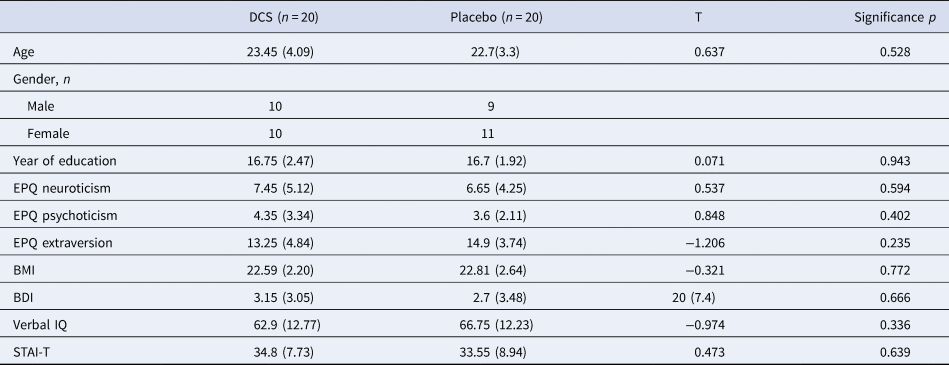
The groups were well matched in terms of age, gender, BMI, verbal IQ, STAI-T (trait anxiety), EPQ and depression symptoms (see Table 1). The groups were also comparable in their scores on the STAI-S (state anxiety), PANAS and VAS (mood levels and side effects).
Baseline demographic and baseline mood scores

EPQ, Eysenck Personality Questionnaire; BFS, Befindlichskeit Scale; BDI, Beck Depression Inventory; STAI, Spielberg State Trait Anxiety Inventory-Trait.
Changes in subjective mood
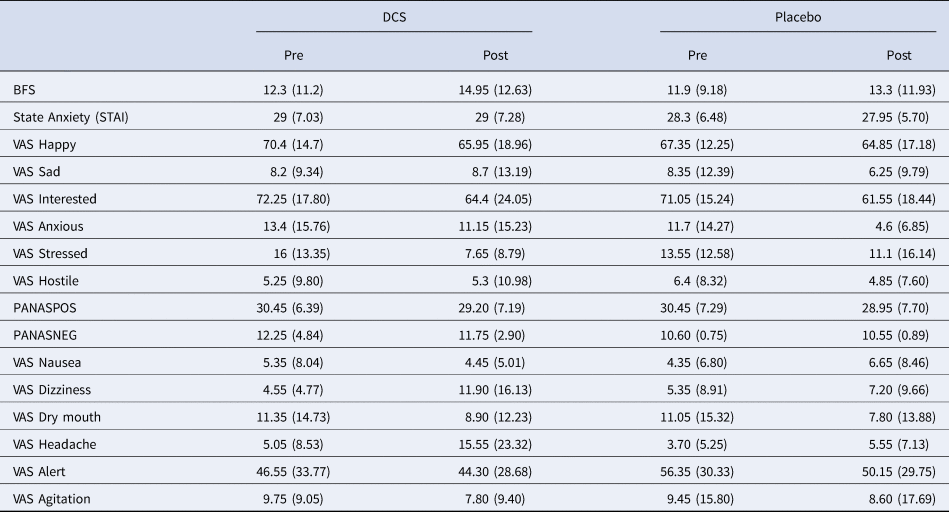
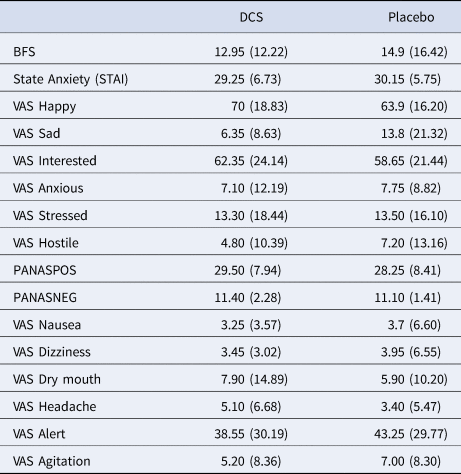
There were no significant effects of group or time by group interaction on any of the questionnaires measuring subjective mood and anxiety such as the BFS Scale, STAI-S and PANAS (all p > 0.5). There were also no significant main effects of group or time by group interactions on subjective symptoms (assessed by VAS) (all p > 0.05). A few side effects were reported, but there was no significant difference between the DCS and placebo groups (all p > 0.05) (see Table 2).
Mood, anxiety and side-effects ratings for day 1

BFS, Befindlichskeit Scale; VAS, Visual Analogue Scale; STAI, Spielberg State Trait Anxiety Inventory-State; PANAS, Positive and Negative Affect Schedule.
Facial Expression Recognition Task
There were no significant effects of DCS on facial expression recognition in terms of accuracy, misclassifications and reaction times (p values >0.2).
Emotional Categorisation Task
One participant was excluded from this analysis due to extreme reaction times (above 3 s.d. from the group mean). There was no main effect of group in the reaction times to categorise self-referent personality words [F (1,37) = 0.012, p = 0.913] or emotional valence × group interaction [F (1,37) = 3.818, p = 0.913]. However, there was a trend for a significant interaction between treatment and valence, driven by a higher proportion of positive v. negative words accurately categorised in the DCS v. placebo group [group condition × word valence: F (1,37) = 3.818, p = 0.058].
Emotional Recall Task
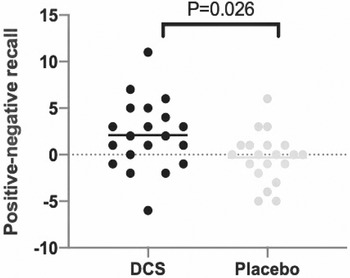
The EREC is a free recall task during which participants are required to remember as many of the positive and negative personality words from the ECAT as they can in 4 min. DCS increased the proportion of positive v. negative words accurately compared to the placebo group [F (1, 38) = 5.391, p = 0.026] (see Fig. 1).
Performance in Emotional Recall Task and comparison participants receiving DCS or placebo.a
aComparison for positive stimuli v. negative stimuli (mean number of items recalled) between participants receiving DCS and placebo.

Emotional Recognition Memory Task
EMEM includes the personality words from the ECAT and previously unseen words that participants are required to classify as familiar or unfamiliar. No significant treatment effects on word recognition accuracy or reaction times were found for this task (all p > 0.1).
Facial Dot-Probe Task
A three-factor ANOVA among treatment (DCS and placebo) × masking (mask, unmasked) × valence (happy, fear) on vigilance scores yielded no significant effect of valence, masking or treatment and no significant interactions for attentional vigilance (p values >0.2).
Autobiographical Memory Task
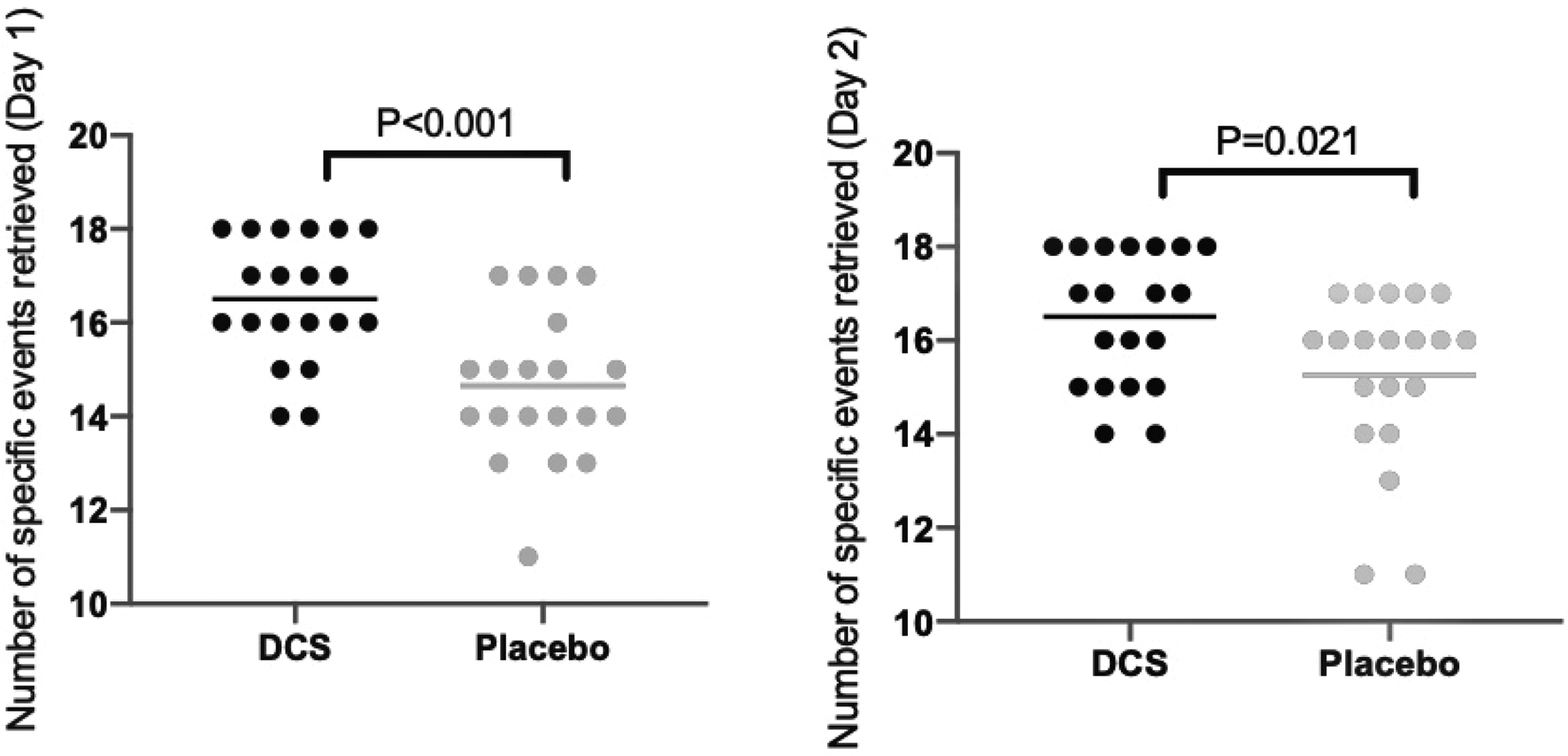
When considering autobiographic specific events, there was no significant interaction between the treatment condition and the three emotional categories [F (1,38) = 0.852, p = 0.431]. However, participants on DCS recalled more specific events overall, regardless of the condition [F (1,38) = 15.948, p < 0.001] (see Fig. 2).
Performance in Autobiographical Memory Task and comparison participants receiving DCS or placebo.a
aComparison for total specific memories (number of items retrieved) following 3 h (day 1) and 24 h (day 2) DCS or placebo administration.

Day 2
Changes in subjective mood
There were no significant effects of group on any of the questionnaires measuring subjective mood and anxiety by BFS Scale, STAI-S and Positive and PANAS on day 2 (all p > 0.05). There were also no significant effects of group on mood levels and side effects ratings as assessed by VAS (all p > 0.05) (see Table 3).
Mood, anxiety and side-effects ratings for day 2

BFS, Befindlichskeit Scale; VAS, Visual Analogue Scale; STAI, Spielberg State Trait Anxiety Inventory-State; PANAS, Positive and Negative Affect Schedule.
Facial Expression Recognition Task
There were no effects of DCS on facial expression recognition in terms of accuracy, misclassification and reaction times (p values >0.3).
Emotional Recall Task
There were no significant effects of DCS on the proportion of words recalled (p values >0.1).
Autobiographical Memory Task
Similarly to day 1, when considering autobiographical specific events, there was no significant interaction between the treatment condition and the three emotional categories [F (1,38) = 0.223, p = 0.800]. However, there was a significant main effect of treatment [F (1,38) = 5.779, p = 0.021], with participants on DCS recalling more specific events than placebo, regardless of the category (see Fig. 2).
Correlation analysis
Given that the participants showed an enhancing effect in the retrieval of more specific autobiographical memories at 2 and 24 h, correlations were conducted between total scores on these two sessions in the DCS group. A significant positive correlation was observed (Pearson correlation = 0.669, N = 20, p = 0.001).
Discussion
DCS significantly enhanced autobiographical memory specificity when compared to placebo at 3 and 24 h following treatment. DCS increased positive bias in emotional word categorisation and subsequent free recall; however, this effect did not extend to other tasks measuring emotional recognition, facial expression recognition or attentional vigilance.
Our results indicated that DCS, when likely to be acting as an NMDA receptor glycine site agonist (in the low dose used here), increases the autobiographical memory retrieval of specific events. Depression is associated with deficits in the retrieval of autobiographic memories, especially specific events (Köhler et al., Reference Köhler, Carvalho, Alves, McIntyre, Hyphantis and Cammarota2015), which has been regarded as an aberrant coping style serving to maintain the disorder (Hermans et al., Reference Hermans, Defranc, Raes, Williams and Eelen2005; Young et al., Reference Young, Drevets, Dantzer, Teague, Bodurka and Savitz2016). There is also evidence suggesting that increases in memory specificity are associated with improvement in depressive symptoms, rumination and cognitive avoidance in depressed patients (Neshat-Doost et al., Reference Neshat-Doost, Dalgleish, Yule, Kalantari, Ahmadi, Dyregrov and Jobson2013; Raes, Williams, & Hermans, Reference Raes, Williams and Hermans2009).
Importantly, the effect seen here on autobiographical memory is consistent with pre-clinical evidence suggesting that agents acting to facilitate NMDA receptor activity enhance memory. The NMDA glutamate receptor is an important component of memory formation, which is modelled by long-term potentiation in the hippocampus and amygdala (Rezvani, Reference Rezvani, Levin and Buccafusco2006). Animal studies have shown that NMDA receptors play an important role in different types of learning and memory, including spatial working memory and long-term (reference) memory (Shapiro & Caramanos, Reference Shapiro and Caramanos1990). Importantly, previous rodent studies have shown that acute administration of DCS facilitates acquisition and subsequent memory retrieval (Flood et al., Reference Flood, Morley and Lanthorn1992; Quartermain, Mower, Rafferty, Herting, & Lanthorn, Reference Quartermain, Mower, Rafferty, Herting and Lanthorn1994). Complementary studies suggest that NMDA receptor antagonists such as ketamine could result in learning and memory impairment (Morgan, Mofeez, Brandner, Bromley, & Curran, Reference Morgan, Mofeez, Brandner, Bromley and Curran2004; Rezvani, Reference Rezvani, Levin and Buccafusco2006), although this evidence remains equivocal (Zhang & Ho, Reference Zhang and Ho2016). Becker et al. (Reference Becker, Steffens, Zhao, Kendrick, Neumann, Weber and Hurlemann2017) found that the effects of ketamine on memory recognition and memory enhancement for negative information were less disrupted during encoding v. subsequent recall in healthy volunteers. Interestingly, a recent study by Radford et al. (Reference Radford, Park, Jaiswal, Pan, Knutsen, Zhang and Choi2018) found that sub-anaesthetic intravenous ketamine infusion dose-dependently enhanced fear memory retrieval, delayed fear extinction and increased fear recall in rats. However, the same dose of ketamine via intraperitoneal injection facilitated fear memory extinction after auditory fear conditioning. This study therefore suggests that the differential effects of ketamine may depend on the route and duration of administration.
Clinically, there is evidence suggesting that DCS augments response to CBT for anxiety and related disorders (Otto, Basden, Leyro, McHugh, & Hofmann, Reference Otto, Basden, Leyro, McHugh and Hofmann2007; Otto et al., Reference Otto, Tolin, Simon, Pearlson, Basden, Meunier and Pollack2010). For instance, a recent meta-analysis found that DCS is superior to placebo in augmenting the effects of CBT in patients with anxiety disorders, both at post-treatment and at follow-up (Mataix-Cols et al., Reference Mataix-Cols, De La Cruz, Monzani, Rosenfield, Andersson, Pérez-Vigil and Dunlop2017). DCS has been found to enhance extinction learning in both human and animal studies (Richardson, Ledgerwood, & Cranney, Reference Richardson, Ledgerwood and Cranney2004); therefore, it is possible that DCS enhances the CBT effects through enhancing extinction learning, which is a critical element of CBT for anxiety. There is limited evidence investigating the effects of DCS as an adjunct treatment when combined with CBT for depression. However, Wilhelm et al. (Reference Wilhelm, Buhlmann, Tolin, Meunier, Pearlson, Reese and Rauch2008) found that treatment with low-dose DCS (200–250 mg) unexpectedly produced large improvements in depression ratings in patients undergoing exposure therapy for OCD, and these effects were seen independently of improvement in OCD symptoms. A study with a similar design by Kim et al. (Reference Kim, Kushner, Yoon, Anker and Grant2016) also found an unexpected improvement in depressive symptoms in patients with OCD. As noted by Kim et al., these findings raise the intriguing possibility that low-dose DCS may display antidepressant properties. It would therefore be important for future studies to test the effects of DCS as an adjunct drug therapy when combined with CBT for depression. There are CBT approaches specifically designed to alleviate difficulties in retrieving specific autobiographical memories shown by patients with depression (McBride, Segal, Kennedy, & Gemar, Reference McBride, Segal, Kennedy and Gemar2007; Raes et al., Reference Raes, Williams and Hermans2009), and it would be worth investigating whether DCS could enhance these effects.
In this study, DCS also affected self-referential processing. DCS appears to significantly increase the categorisation and subsequent recall of positive v. negative personality words. This effect is also seen with traditional antidepressant drugs. For instance, the commonly prescribed drugs citalopram and reboxetine have both been shown to increase the relative recall of positive (v. negative) personality words, using the same task as used here (Harmer et al., Reference Harmer, Hill, Taylor, Cowen and Goodwin2003b, Reference Harmer, Shelley, Cowen and Goodwin2004; Harmer D Phil et al., Reference Harmer D Phil, O'Sullivan, Favaron, Massey-Chase, Ayres, Reinecke and Cowen2009). In addition, venlafaxine has been shown to enhance positive bias during social and emotional evaluations when administered before learning. In contrast, the NMDAR antagonist ketamine can abolish memory for previously learnt negative biases but does not produce positive affective information biases in newly-learnt information (Stuart, Butler, Munafò, Nutt, & Robinson, Reference Stuart, Butler, Munafò, Nutt and Robinson2015). It is noteworthy that recurrent negative thoughts (such as self-blame and feeling hopeless/worthless) are important cognitive markers in depression and suicidal behaviour (Grunebaum et al., Reference Grunebaum, Keilp, Li, Ellis, Burke, Oquendo and Mann2005; Northoff, Reference Northoff2007). Increasing positive self-referential processing (use of positive information for self-description) is another core therapeutic component for cognitive therapy for depression (Segal & Gemar, Reference Segal and Gemar1997; Tarrier, Reference Tarrier2010) and might be enhanced by DCS treatment.
Our study also revealed that the autobiographical memory-enhancing effect of DCS persisted for 24 h after drug administration. A number of animal experimental studies demonstrated that DCS improves memory consolidation for new learning normally 24 h after training (Goff, Reference Goff2012). For instance, a rodent study found that a single dose of DCS given within 30 min of extinction training increased the retention of fear extinction 24 h later by approximately threefold (Parnas, Weber, & Richardson, Reference Parnas, Weber and Richardson2005). Also, a rodent fear extinction model found that DCS improves memory consolidation for new learning assessed 24 h after training, but did not show any effect on learning performance during the training itself (Santini, Muller, & Quirk, Reference Santini, Muller and Quirk2001). These findings are interesting in light of a study in patients with panic disorder in which DCS produced effects on emotional neural processing 24 h after administration (Reinecke, Nickless, Browning, & Harmer, Reference Reinecke, Nickless, Browning and Harmer2018). A recent review article proposed that the reconsolidation of autobiographical memories in patients with depression may represent a novel therapeutic target, and the authors suggested that future research should explore the modulation of reconsolidation of distressing autobiographical memory following antidepressant treatment for depression (Köhler et al., Reference Köhler, Carvalho, Alves, McIntyre, Hyphantis and Cammarota2015). DCS might also be a pharmacological candidate for this approach.
It is important to specify that this memory-enhancing effect 24 h after DCS administration was only seen with the AMT and not with the memory word recall. It is possible that the personal and specific elements of the autobiographical task may have enhanced the effects of DCS (as these effects were also only seen with specific but not general memories), but future studies with different paradigms are needed to understand what are the key memory elements that are associated with these effects of DCS (e.g. personal relevance, specificity of the memory, among others).
In addition, it was previously found that an acute dose of the SSRI citalopram (20 mg) increased facial recognition of happy faces. Also, in the short-term, citalopram increases the recognition of fearful faces and increases the startle response (Browning et al., Reference Browning, Reid, Cowen, Goodwin and Harmer2007; Harmer et al., Reference Harmer, Bhagwagar, Perrett, Völlm, Cowen and Goodwin2003a), which is consistent with clinical findings suggesting that early-stage SSRI treatment may increase anxiety (Kent, Coplan, & Gorman, Reference Kent, Coplan and Gorman1998). Noradrenaline reuptake inhibitors such as reboxetine also increased the recognition of positive facial expressions and the speed of reaction time in responding to positive personality words; however, there was no significant effect on fear processing (Harmer et al., Reference Harmer, Hill, Taylor, Cowen and Goodwin2003b). Similar findings emerged using bupropion, which is an inhibitor of dopamine and noradrenaline reuptake (Walsh et al., Reference Walsh, Huneke, Brown, Browning, Cowen and Harmer2018). However, the present study revealed no significant effects of DCS similar to the above studies on either facial recognition or fear processing changes. Thus, the current study suggests that low doses of DCS, presumably acting as a glycine site agonist, did not show the broad range of positive effects on emotional processing seen with conventional antidepressants.
It is possible that the positive bias effect seen with DCS is specific to the encoding and retrieval of memory. Such an effect would be consistent with the modulation of glutamate receptors by DCS. It should be noted, however, that no significant effects were seen in the memory recognition task, although this is consistent with previous antidepressant drug studies showing that the free memory recall has higher sensitivity to antidepressant medications (Harmer, Cowen, & Goodwin, Reference Harmer, Cowen and Goodwin2011). Indeed, the lower level of difficulty of the memory recognition paradigm v. free recall may allow for less variability in performance, which would be important to detect more subtle drug effects. Further investigation is needed to clearly delineate the effects of DCS on cognitive functions relevant to depression, including different types of memory.
There are several limitations to the present study. First, the AMT was not tested at baseline before drug administration, and it is possible that baseline differences in memory performance may have existed between the groups independent of the effects of DCS. However, the baseline demographic information revealed that the treatment and control groups were well matched, which should minimise this confounding effect. Second, the significant findings within the AMT cannot exclude the possibility of a ceiling effect, as all groups recalled a high percentage of specific autobiographical memories. Third, the plasma levels of DCS were not measured, so it would be helpful for future studies to investigate if the effects of DCS vary depending on the subjects' plasma levels. Fourth, the study was powered to detect a large effect size (based on a single observed difference from a previous study) and was therefore underpowered to detect small to moderate effect sizes. Finally, this study did not examine other memory tasks, such as working and verbal memory, which could have provided a more comprehensive exploration of the memory-enhancing effects of DCS. Future studies should extend the current findings into patients with depression. It would also be helpful to examine the neural substrates of the effect of DCS on memory using functional neuroimaging. In addition, this is an experimental medicine study, which was registered retrospectively. We recognise the importance of pre-registering all interventional studies (not only clinical trials) and therefore we have registered the study prior to data analysis. We did not change the protocol after the study started.
Conclusion
To the best of our knowledge, this is the first study to provide evidence that low-dose DCS improves the retrieval of specific autobiographic memories. It also suggests that DCS increases the recall of positive v. negative words. DCS may have particular utility when combined with psychological therapies aimed at increasing specific personal memories and positive self-referential processing. The potential antidepressant-like properties of DCS are therefore worth exploring in future studies.
Supplementary material
The supplementary material for this article can be found at https://doi.org/10.1017/S0033291720001221.
Acknowledgements
We thank Shaoling Zhong for being a second independent rater for the analysis of the Autobiographical Memory Task. We thank Lucy Wright and Kate Partridge for help in data collection; Claire Williams and Ann Sharpley for help with encapsulation and randomisation; and Michael Browning, Beata Godlewska, Tarek Zghoul and Paul Harrison for medical cover.
Financial support
This study was supported by the China Scholarship Council (CSC) and the NIHR Oxford Health Biomedical Research Centre (OH BRC). The views expressed are those of the authors and not necessarily those of the NHS, the NIHR or the Department of Health.
Conflict of interest
L.C. served as a consultant to P1vital, a contract research organisation that runs industry-sponsored experimental medicine studies in academic departments. CH has received consultancy fees from P1vital Ltd., Janssen Pharmaceuticals, Sage Therapeutics, Pfizer and Lundbeck. CH also hold grant income from UCB Pharma and Janssen Pharmaceuticals. CH and PC hold grant income from a collaborative research project with Pfizer.
Ethical standards
The authors assert that all procedures contributing to this work comply with the ethical standards of the relevant national and institutional committees on human experimentation and with the Helsinki Declaration of 1975, as revised in 2008. All participants were informed of the objective of the study and gave written consent before the investigation.