Introduction
Bipolar disorder is a chronic and recurrent medical condition that has been associated with an increased risk of comorbidity with other psychiatric illnesses (substance abuse/dependence, anxiety disorders, etc.), cognitive dysfunction, functional impairment and lower quality of life (Reference McElroy, Kotwal, Malhotra, Nelson, Keck and Nemeroff1–Reference Michalak, Yatham and Lam3). It is also recognised that bipolar disorder, which affects 1–6% of the population of the United States Reference Judd and Akiskal(4,Reference Weissman, Leaf and Tischler5), is associated with a higher occurrence of general medical conditions, such as obesity and diabetes mellitus (Reference Kilbourne, Cornelius and Han6–Reference McIntyre, Konarski, Misener and Kennedy8), as well as with a higher risk of general and premature mortality from natural causes, including cardiovascular disease Reference Osby, Brandt, Correia, Ekbom and Sparén(9).
Metabolic syndrome (MetS) represents a cluster of cardiovascular risk factors occurring in association with insulin resistance and obesity. Individuals with this syndrome are at high risk of atherosclerotic cardiovascular disease and type II diabetes mellitus Reference Reilly and Rader(10).
Recent reports have shown an alarmingly high prevalence of obesity and MetS in patients with bipolar disorder (Reference Fagiolini, Frank, Scott, Turkin and Kupfer11–Reference Fiedorowicz, Palagummi, Forman-Hoffman, Miller del and Haynes18) and have demonstrated that these two factors are associated with the severity of the disorder Reference Fagiolini, Frank, Scott, Houck, Soreca and Kupfer(14,Reference Fagiolini, Kupfer, Houck, Novick and Frank19) and impaired overall functioning Reference Fagiolini, Frank, Scott, Houck, Soreca and Kupfer(14). Despite the worldwide epidemic of obesity and MetS Reference Kereiakes and Willerson(20), little is known about the prevalence of these conditions in patients with bipolar disorder in developing countries. A recent study has shown that the prevalence of MetS in a sample of Brazilian inpatients with bipolar disorder was 38.3% Reference Teixeira and Rocha(21).
The aim of the present study was to evaluate the prevalence of MetS and obesity in a sample of Brazilian outpatients with bipolar disorder.
Methods
This study was carried out as part of the Bipolar Research Program at the Institute of Psychiatry of the University of São Paulo Medical School. The study protocol was approved by the Ethics Committee of the Institute of Psychiatry, and written informed consent was obtained from all subjects enrolled in the study.
Subjects and methods
Eighty-four patients with bipolar disorder (age ≥ 18 years) were evaluated. Diagnoses were determined by trained psychiatrists according to the DSM-IV criteria and were made through application of the Structured Clinical Interview for DSM-IV.
MetS was defined according to the guidelines established in the third report of the National Cholesterol Education Program Expert Panel on Detection, Evaluation, and Treatment of High Blood Cholesterol in Adults (ATP III) (22), with minor modifications based on the American Heart Association (AHA)/National Heart, Lung and Blood Institute Scientific Statement on Diagnosis and Management of the Metabolic Syndrome Reference Grundy, Cleeman and Daniels(23). A diagnosis of MetS was made based on the identification of three or more of the following criteria: (a) Abdominal obesity: waist circumference >102 cm in men or >88 cm in women; (b) Elevated triglycerides: ≥ 150 mg/dl (or on lipid-lowering medication); (c) Reduced high-density lipoprotein cholesterol (HDL-C): <40 mg/dl in men or <50 mg/dl in women (or on lipid-lowering medication); (d) Elevated blood pressure: systolic blood pressure ≥ 130 mmHg or diastolic blood pressure ≥ 85 mmHg (or under anti-hypertensive drug treatment in a patient with a history of hypertension); (e) Elevated fasting glucose: ≥ 100 mg/dl (or under drug treatment for elevated glucose).
We also provided the frequency of MetS according to the National Health and Nutrition Examination Survey (NHANES) 1999–2000 Reference Ford, Giles and Mokdad(24) modifications, which are similar to those proposed by the AHA, except for the items given in (c), (d) and (e) as described below: (c) HDL-C: <40 mg/dl in men or <50 mg/dl in women, not influenced by the use of lipid-lowering medication; (d) Elevated blood pressure: systolic blood pressure ≥ 130 mmHg and diastolic blood pressure ≥ 85 mmHg (or under anti-hypertensive drug treatment in a patient with a history of hypertension); (e) Elevated fasting glucose: ≥110 mg/dl, (or under drug treatment for elevated glucose).
Waist circumference was measured at expiration, midway between the lower rib and the iliac crest.
Patients were tested for blood glucose, HDL-C and triglycerides (colorimetric technique) after fasting for at least 12 h.
Blood pressure was measured using auscultation and an aneroid manometer, with the patient in a sitting position. Two readings, taken at least 5 min apart, were averaged.
Body mass index (BMI) was calculated as body weight (in kg) divided by height squared (m2). Height and body weight were measured with the patients in light clothing, without jackets or shoes. Subjects were considered underweight if their BMI was <18.5 kg/m2, of normal weight if their BMI was 18.5–24.99 kg/m2, overweight if their BMI was 25–29.99 kg/m2 and obese if their BMI was >30 kg/m2.
The Young Mania Rating Scale (YMRS), the 17-item Hamilton Depression Rating Scale (HDRS) and the bipolar version of the Clinical Global Impression (CGI) scale were applied to rate severity of current mood symptoms and clinical status. A lifetime history of suicide attempts was considered to be positive if, as a result of those attempts, the patient had required medical treatment. Medications used for more than 30 days within the preceding 6 months were registered.
Statistical analysis
The statistical analysis was performed using the Statistical Package for the Social Sciences, version 14 (SPSS Inc., Chicago, IL, USA). We used Pearson's chi-squared test in order to determine whether MetS and obesity presented associations with any demographic or clinical variables. We used the Student's t-test or the Mann–Whitney test to compare continuous variables depending on the data distribution. The level of statistical significance was set at α = 0.05.
Results
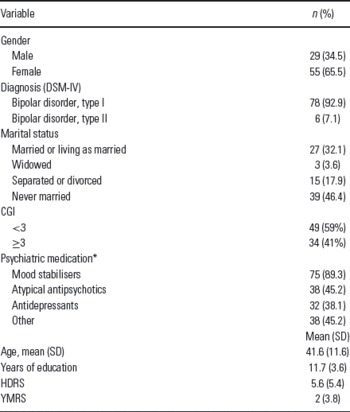
The demographic and clinical characteristics of the study sample are shown in Table 1.
Demographic and clinical characteristics of the 84 outpatients with bipolar disorder evaluated

* Medications used for more than 30 days within the preceding 6 months. CGI, Clinical Global Impression Scale; HDRS, (17-item) Hamilton Depression Rating Scale; YMRS, Young Mania Rating Scale. Medications used for more than 30 days within the preceding 6 months. CGI, Clinical Global Impression Scale; HDRS, (17-item) Hamilton Depression Rating Scale; YMRS, Young Mania Rating Scale.
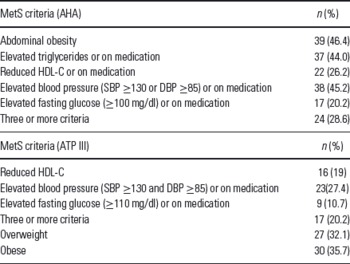
Of the 84 patients with bipolar disorder evaluated, 27 (32%) were overweight and 30 (35.7%) were obese. MetS according to the AHA modifications was identified in 24 (28.6%) patients. As can be seen in Table 2, using this modified version of the ATP III criteria, we found the following: 39 (46%) presented abdominal obesity, 37 (44%) presented hypertriglyceridemia (or were on a lipid-lowering medication), 22 (26%) presented low HDL-C (or were on a lipid-lowering medication), 38 (45%) presented arterial hypertension (or were using anti-hypertensive drugs) and 17 (20%) presented impaired fasting glucose (or were under drug treatment for elevated glucose).
Prevalence of MetS and its components, overweight status and obesity in patients with bipolar disorder (n = 84)

NCEP—ATP III, National Cholesterol Education Program Expert Panel on Detection, Evaluation, and Treatment of High Blood Cholesterol in Adults; AHA/NHLBI, American Heart Association/National Heart, Lung and Blood Institute; NHANES, National Health and Nutrition Examination Survey; HDL-C, high-density lipoprotein cholesterol; SBP, systolic blood pressure; DBP, diastolic blood pressure.
There were no statistically significant age- or gender-related differences either between the patients with MetS and those without, or between those who were obese and those who were not. Similarly, these groups did not differ in any statistically significant manner in terms of the lifetime history of suicide attempts or in terms of the score on the scales employed (HDRS, YMRS and CGI).
MetS according to the NHANES 1999–2000 study modifications was identified in 17 (20.2%) patients. Twenty-three (27.4%) patients presented arterial hypertension (or were using anti-hypertensive drugs), 16 (19%) presented low HDL-C and 9 (10.7%) presented impaired fasting glucose (or were under drug treatment for elevated glucose) (Table 2).
Discussion
The prevalence of general obesity in our sample of patients with bipolar disorder was much higher than that found in a Brazilian population survey Reference Monteiro, Conde and Popkin(25) (35.7% vs. 8.8–13%). In the United States, the prevalence of obesity was also higher in patients with bipolar disorder than in the general population Reference Fagiolini, Frank, Scott, Turkin and Kupfer(11,Reference Fiedorowicz, Palagummi, Forman-Hoffman, Miller del and Haynes18). Our data suggest that the higher prevalence of obesity among patients with bipolar disorder is a cause for concern not only in developed countries but may also apply for developing countries. In addition, similar to the results obtained in the United States Reference Fagiolini, Frank, Scott, Turkin and Kupfer(11,Reference Fagiolini, Frank, Scott, Houck, Soreca and Kupfer14), Spain Reference Garcia-Portilla, Saiz and Benabarre(13) and Italy Reference Slavi, Albert, Chiarle, Soreca, Bogetto and Maina(15), approximately half of our patients (46.4%) presented a large waist circumference, which is considered a precise estimate of visceral adiposity and is strongly associated with insulin resistance.
Nearly one-third of our sample (28.6%) met the AHA criteria for MetS, and 20.2% met the ATP III criteria. These rates are similar to those detected in the Brazilian general population (20–29.8%) (26,Reference Salaroli, Barbosa, Mill and Molina27).
To our knowledge, only Fagiolini et al. Reference Fagiolini, Frank, Scott, Houck, Soreca and Kupfer(14) have published data on the evaluation of outpatients with bipolar disorder using the AHA criteria for MetS. They found a higher percentage (40%) of patients meeting the diagnosis for MetS than we did. Van Winkel et al. Reference Van Winkel, De Hert and Eyck(17) evaluated Belgian outpatients with bipolar disorder using a modified version of the ATP III criteria, which is closer to the AHA version and includes a glycemia cut point of ≥ 100 mg/dL. They found a lower rate of MetS than we did (18.3%). These differences may reflect differences in the general population MetS prevalence rates between the United States, Belgium and Brazil, possibly due to differences in dietary habits, level of physical activity and genetic background.
The prevalence of MetS according to the more conservative ATP III criteria found in our study is lower than that reported in studies of American outpatients with bipolar disorder [30% Reference Fagiolini, Frank, Scott, Turkin and Kupfer(11), 49% Reference Cárdenas, Frye and Marusak(16), 53% Reference Fiedorowicz, Palagummi, Forman-Hoffman, Miller del and Haynes(18)] and in a sample of Turkish outpatients with bipolar disorder (32%) Reference Yumru, Savas and Kurt(12). And it was also similar to that found in Spanish outpatients with bipolar disorder (22.4%) Reference Garcia-Portilla, Saiz and Benabarre(13) and Italian outpatients and inpatients (25.3%) Reference Slavi, Albert, Chiarle, Soreca, Bogetto and Maina(15). In Brazil, Teixeira and Rocha Reference Cárdenas, Frye and Marusak(16) reported a higher prevalence of MetS (38.3%) than that reported in our study. However, their study assessed a smaller sample (N = 47) of inpatients with bipolar disorder in the psychiatric ward of a general hospital in Brazil.
The rate of hypertriglyceridemia found in the present study was similar to that reported in two studies that examined patients with bipolar disorder in the United States Reference Fagiolini, Frank, Scott, Turkin and Kupfer(11,Reference Fagiolini, Frank, Scott, Houck, Soreca and Kupfer14) (44 vs. 48 and 47%), higher than that found in the studies conducted in Spain Reference Garcia-Portilla, Saiz and Benabarre(13) (36.1%), Italy Reference Slavi, Albert, Chiarle, Soreca, Bogetto and Maina(15) (34.7%) and Belgium Reference Van Winkel, De Hert and Eyck(17) (26.7%) and lower than that found in a recent chart review of American outpatients with bipolar disorder Reference Fiedorowicz, Palagummi, Forman-Hoffman, Miller del and Haynes(18) (58%). Concerning the frequency of low HDL-C and hypertension, Fagiolini et al. Reference Fagiolini, Frank, Scott, Houck, Soreca and Kupfer(14), in the United States, found a much higher rate (45 and 55%, respectively) than we did (26 and 45%, respectively), both studies using the modified criteria based on the AHA statement. Using the conservative ATP III criteria, compared to our sample, it was found that the frequency of low HDL-C was also higher in the Spanish Reference Garcia-Portilla, Saiz and Benabarre(13), Italian Reference Slavi, Albert, Chiarle, Soreca, Bogetto and Maina(15) and American Reference Fagiolini, Frank, Scott, Turkin and Kupfer(11,Reference Fiedorowicz, Palagummi, Forman-Hoffman, Miller del and Haynes18) studies, (38.2, 32.3, 23 and 27 vs. 19%) but similar in the Belgian Reference Van Winkel, De Hert and Eyck(17) study (21.7%).
The rates of hypertension found in the Italian Reference Slavi, Albert, Chiarle, Soreca, Bogetto and Maina(15), Belgian Reference Van Winkel, De Hert and Eyck(17) and American Reference Fagiolini, Frank, Scott, Turkin and Kupfer(11,Reference Fiedorowicz, Palagummi, Forman-Hoffman, Miller del and Haynes18) studies were higher than those found in our study (40, 48.3, 39 and 68 vs. 27%). However, hypertension was less frequent in Spanish outpatients with bipolar disorder Reference Garcia-Portilla, Saiz and Benabarre(13) (20.9%) than in our sample.
Concerning the prevalence of impaired fasting glucose, we found similar rates to those observed in the American Reference Fagiolini, Frank, Scott, Turkin and Kupfer(11,Reference Fagiolini, Frank, Scott, Houck, Soreca and Kupfer14), Italian Reference Slavi, Albert, Chiarle, Soreca, Bogetto and Maina(15) and Spanish studies Reference Garcia-Portilla, Saiz and Benabarre(13) and lower rates than Van Winkel et al. Reference Van Winkel, De Hert and Eyck(17), found in Belgian outpatients no matter what cut point was used (≥ 100 mg/dl or ≥ 110 mg/dl) [20.2 vs. 19% Reference Fagiolini, Frank, Scott, Houck, Soreca and Kupfer(14) and 28.3 Reference Van Winkel, De Hert and Eyck(17) or 10.7 vs. 8% Reference Fagiolini, Frank, Scott, Turkin and Kupfer(11)) 11 Reference Slavi, Albert, Chiarle, Soreca, Bogetto and Maina(15), 12.2 Reference Yumru, Savas and Kurt(12) and 13.3% Reference Van Winkel, De Hert and Eyck(17), respectively]. In a chart review of American outpatients, Fiedorowicz et al. Reference Fiedorowicz, Palagummi, Forman-Hoffman, Miller del and Haynes(18) found a much higher frequency of hyperglycemia (30%) than we did (cut point of ≥ 110 mg/dl). Again, dietary habits, level of physical activity and ethnicity might have influenced these results.
One limitation of our study is that the sample comprised outpatients from a specialised clinic that is a referral for the most severe cases. Therefore, the patients with bipolar type II are under-represented, and it might not be possible to generalise our findings to all Brazilian patients with bipolar disorder. A causal relationship between MetS and bipolar disorder could not be established, due to the cross-sectional study design. Similarly, we were unable to evaluate the long-term impact of drug treatment.
In conclusion, our data indicate that the associations among MetS, obesity and bipolar disorder are not restricted to developed countries or severely ill inpatients. Therefore, in the interest of early detection and treatment of MetS and obesity, psychiatrists should routinely assess metabolic parameters and weight gain in patients with bipolar disorder. Monitoring lifestyle, eating habits and exercise routine in particular, should be a strategy not only for treating but also for preventing MetS and obesity in patients with bipolar disorder.
Acknowledgements
We would like to thank the nutritionist Michelle Caetano for her contributions to the production of this manuscript.
Disclosure
Karla Mathias de Almeida won the 2008 ISBD's GSK Travel Fellowship Award. Beny Lafer has research grant from CNPq (Conselho Nacional de Desenvolvimento Cientí fico e Tecnológico) and FAPESP (Fundação de Amparo à Pesquisa de São Paulo) and has been a speaker of AstraZeneca. Marcia Britto de Macedo-Soares has received financial support from Wyeth and Lilly-Boehringer to attend scientific congresses. Sheila C. Caetano has had scholarships from FAPESP and CNPq and has research grant from NARSAD, APA/AstraZeneca Young Minds in Psychiatry International Awards and CNPq. The other authors have no personal affiliations or financial relationships with any commercial interests to disclose.
Funding sources
This study received financial support from the Thompson Motta family, which had no further role in study design; in the collection, analysis and interpretation of data; in the writing of the report; and in the decision to submit the paper for publication.