The evidence: Research on general intelligence (g), genes, sex, hormones, neurochemistry, and brain imaging finally converge. Spearman's (Reference Spearman1904) and Jensen's (Reference Jensen1998) psychometric g shows 40–80% adult heritability. Brain size is largely inherited (Pennington et al. Reference Pennington, Filipek, Lefly, Chhabildas, Kennedy, Simon, Filley, Galaburda and DeFries2000; Toga & Thompson Reference Toga and Thompson2005). Retarded brains use more glucose than normal ones (Haier et al. Reference Haier, Chueh, Touchette, Lott, Buchsbaum, Macmillan, Sandman, Lacasse and Sosa1995). Jung & Haier (J&H) report positive correlations between the size of small gray brain matter areas and intelligence, and males (with greater brain structure volumes; e.g., Allen et al. Reference Allen, Damasio, Grabowski, Bruss and Zhang2003) have a slight mean g advantage and a flatter dispersion score than females do (Jackson & Rushton Reference Jackson and Rushton2006; Lynn Reference Lynn1999; Nyborg Reference Nyborg and Nyborg2003; Reference Nyborg2005). Females use slightly different gray matter areas for g-loaded tasks than males do and also use more white matter (Gur et al. Reference Gur, Turetsky, Matsui, Yan, Bilker, Hughett and Gur1999; Haier et al. 2005). All these interdependent parameters may relate to permanent androgen priming of the fetal brain and dynamic adult steroid regulation of primary abilities (Kimura & Hampson Reference Kimura and Hampson1994; Nyborg Reference Nyborg1994).
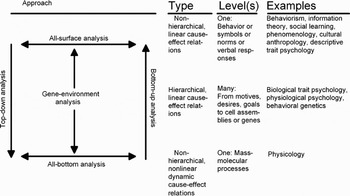
The hard problem: How do we best relate the material basis for dynamic interactions among genes, hormones, nutrition, and learning to differences in brain size, structure, and neurochemistry and g (or mind)? This is a hard problem, as 2,400 years of dualist theory gave not a clue to how a nonphysical intellect (mind) interacts with its physical brain. The problem is outlined in Figure 1 (see also Nyborg Reference Nyborg1997).
Types of analytic approaches to abilities and personality (from: Nyborg 1997).

Top-level nonhierarchical models such as behaviorism or trait psychology only scratch the surface and fail to causally integrate behavior with its material basis. Top-down and bottom-up hierarchical models operate simultaneously with material and immaterial agents at a semi-causal level, fail to reflect causal integration, and commit a category error by assuming that mental and physical agents are causally equivalent. There is a way, however, to bypass these problems: an all-bottom model.
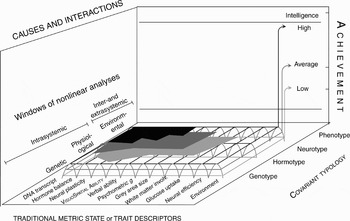
The solution: A nonlinear, dynamic, multifactor, multiplicative, multidimensional, molecular (ND4M) all-bottom model is presented in Figure 2.
A nonlinear, dynamic, multifactor, multiplicative, multidimensional, molecular (ND4M) model for the development of general intelligence, g. High intelligence is seen as a combined function of favorable gene products, moderate plasma sex hormones, low sexual differentiation, high adult neural plasticity and efficiency combined with optimal sizes in about 10 relatively small and widely distributed gray matter brain areas. The model mirrors multidimensional mass-molecular space-time-phase (x,y,z+time+phase) changes over long phylo- and shorter ontogenetic periods (modified from Nyborg 1997).

The model uses Occam's razor principle to reduce intelligence (mind), the brain, and society to physical agents interacting within a trait-covariant nonhierarchical dynamic time-space-phase framework. All agents enjoy equal causal standing as they refer to locally or globally coupled molecular mass-interactions.
Thinking is represented by the pattern of locally constrained intra-systemic coupled transport of neurotransmitters, neuro-hormones, oxygen, glucose, and so on; behavior is intra-systemic coupled transport of parts or the full body of molecular conglomerates in space-time coordinates; social interaction is the inter-systemic coupled adjustments of mass molecular events in two or more organisms; the nonsocial environment is the extra-systemic molecular constellations of relevance for survival. More details are found in Nyborg (Reference Nyborg1994).
The ND4M model maps the causal basis for genotypes, hormotypes, neurotypes, and phenotypes (Nyborg Reference Nyborg1997), and it predicts what will happen when the expression of parental genes is modified during ontogenetic development by plasma steroid hormones (themselves partly under genetic and environmental influence), and by molecular re-organization through learning. The ND4M model needs no theory and depends on only a few a priori assumptions:
1. Stereotaxic affinity: That is, each molecule has specific affinity for certain molecules enabling, say, steroid hormones to go everywhere in the body but to exert specific effects only in target organs inducing suitable receptor molecules; affinity dramatically reduces local entropy.
2. Nonlinearity: Most molecular mass-interactions are nonlinear (e.g., low hormone values exert small effects, higher values an “optimal” effect, and still higher values a neurotoxic effect); the curvi-linearity principle is generalized in the ND4M model.
3. A limited energy budget: Body development and behavior, including thinking, is costly; according to the Economy Principle (Nyborg Reference Nyborg1994, Ch. 13): “strong development or activity in one area [has to be] traded off by less development or activity in other areas” due to obligatory nutritional and intra-systemic constraints. The General Trait Covariance (GTC) model (Nyborg Reference Nyborg1994, Ch. 10) predicts, for example, that high early plasma sex hormone levels promote excessive sexual differentiation of body and behavioral development at the cost of reducing brain development relevant for the expression of g. Likewise, any deviation (up or down) from optimal DNA transcription of parental genes for g (related to other genes or to sub-optimal levels of hormones, neural plasticity, brain size, white matter involvement, glucose uptake, neural efficiency, or deficient nutrition or learning) will lower the expression of genomic g. Only if all or most metric states are at optimal levels may a genius appear (Nyborg Reference Nyborg1997).
Most things in nature are continuously distributed. The model allows for smooth transitions among structure and function. “Solid” nerve cell walls are gradually built up by coupled molecules more or less permanently “frozen” in time-space coordinates after their stereo-specificity, and part of the wall is formed by channel-proteins that dynamically regulate the transport of neurotransmitters in accordance with complex signal systems.
Testing of the GTC and ND4M models depends on our ability to simultaneously keep track of multiple molecular events. This will tax our ingenuity for some time. Luckily, we do not have to monitor the behavior of each molecule. For example, labeled coupled multiple s molecular events behind sexual differentiation are fairly easy to map. Given sex-typical plasma hormone levels, the sex-typical genotypes and phenotypes normally concur. However, if androgens are present during the 4 to 7 fetal weeks, we get a phenotypic boy whether “its” genotype is XX or XY; if receptor molecules for androgen fail to be induced, we get a phenotypic girl even if “her” karyotype is XY. Some individuals have low plasma hormones and display lower than average sexual differentiation (e.g., Nyborg Reference Nyborg1983). The GTC model predicts high g in this group, as an excessive sexual differentiation does not detract from the costly build-up of g-related brain structures. A testable consequence of this is that androgynous males and females will have higher g and larger g-related gray matter brain areas than their more sex-typed brothers and sisters.
Obviously, the above mass molecular solution is just one way for solving pertinent dualist problems in the attempt to relate soft and hard sciences. The actual testing of the GTC and ND4M models requires powerful computers and bright minds with a keen eye for sorting out the tangled web of small partial correlations among quantifiable molecular parameters such as gene products, hormones, brain size, learning-related changes in the brain, neural efficiency, and g.