Introduction
There is growing evidence that electoral institutions systematically shape the incentives of politicians to provide distributive policies (e.g. Persson and Tabellini Reference Persson and Tabellini1999, Reference Persson and Tabellini2000, Reference Persson and Tabellini2003, Reference Persson and Tabellini2004; Milesi-Ferretti et al. Reference Milesi-Ferretti, Perotti and Rostagno2002; Hallerberg and Marier Reference Hallerberg and Marier2004; McGillivray Reference McGillivray2004; Cao et al. Reference Cao, Prakash and Ward2007; Edwards and Thames Reference Edwards and Thames2007; Chang Reference Chang2008; Zahariadis Reference Zahariadis2010; Rickard Reference Rickard2012a, Reference Rickard2012b; Franchino and Mainenti Reference Franchino and Mainenti2013; see also Carey and Hix Reference Carey and Hix2013). In this article, we argue that these institutions also influence the propensity to comply with international laws. Recently, Rickard (Reference Rickard2010) found that the electoral formula (i.e. a majoritarian or proportional electoral system) affects compliance with the rules on narrowly targeted transfers of the World Trade Organization (WTO). We extend her argument further following the seminal works of Persson and Tabellini (Reference Persson and Tabellini1999, Reference Persson and Tabellini2000) and Carey and Shugart (Reference Carey and Shugart1995), and we show how electoral institutions (i.e. district magnitude and ballot structure) affect the propensity to comply with the European Union (EU) rules on the provision of state aid – a key pillar of EU competition policy.
EU governments can adopt state aid only upon notification to and approval by the European Commission. They, nevertheless, frequently implement these measures without notification, even though it is very likely that they will be detected and sanctioned. As discussed in detail in the next section, existing theories of EU compliance and implementation offer no convincing explanation of the persistence and patterns of unlawful state aid measures.
We argue that electoral institutions shape the incentives to comply because of the misalignment they may engender between the collective objectives of a government party and the individual objectives of its members in the legislature. Although the costs associated with noncompliance are likely to exceed the benefits from the perspective of the government, it may be the opposite for the individual legislators, depending on their need to build a personal reputation that is distinct from that of their parties. As electoral institutions shape these incentives and government survival depends on parliamentary support, electoral institutions should affect the propensity of governments to comply. We find that compliance improves as district magnitude increases, but it worsens with higher magnitude if either party leaders have no control over the ballot rank or other electoral rules strengthen the incentives to cultivate a personal vote. For within-country effects, we also show that electoral reforms provide evidence that is consistent with these results.
This article extends and qualifies Rickard’s (Reference Rickard2010) findings. As argued in several studies (e.g. Mansfield et al. Reference Mansfield, Milner and Rosendorff2002), due to the propensity of voters to sanction leaders who violate international rules, democratic regimes are more likely to comply than authoritarian ones. However, this argument cannot explain contrasting findings on the impact of democratic institutions (Simmons Reference Simmons2000; Dai Reference Dai2006) and, in particular, the significant differences in compliance that we find among democracies. Rickard (Reference Rickard2010) argues that the different electoral formulas operating in democratic regimes can shed light on these differences. Voters in majoritarian electoral systems may reward leaders for violating some international agreements, and this can explain lower compliance. In this article, we show that the impact of the electoral formula is also mediated by the structure of the ballot. Therefore, compliance may also be lower in proportional representation (PR) systems that include rules that heighten the need to cultivate a personal vote.
The article also innovates on several dimensions with regard to the existing research on EU compliance and implementation. In a recent comprehensive review, Treib (Reference Treib2014) concluded that the substantive focus has been predominantly on directives (rather than regulations), on transposition (rather than application and enforcement) and on positive (rather than negative) integration (i.e. prescriptive rather than proscriptive provisions). We focus here on the application and enforcement of a regulation with provisions proscribing the adoption of certain state aid measures. Treib (Reference Treib2014, 19) also noted that studies on enforcement and application have been almost exclusively qualitative. However, ours is not. Finally, the centralised features of this policy allow us to produce a sufficiently valid measure of compliance, which can otherwise be a challenge in similar studies.
The next section introduces the EU state aid policy and explains why the patterns of unlawful state aid measures are puzzling. Subsequently, we use the literature on the effects of electoral systems on public spending to develop three hypotheses on the relationship between electoral institutions and propensity to comply. Next, we present the data and the operationalisation of the variables. We finally discuss our findings and provide concluding comments.
The puzzle of unlawful state aid measures
According to EU law, a measure is considered state aid if it provides a selective, state-funded and otherwise unattainable economic advantage to a company, a group of companies, an economic sector or a geographical area. For instance, state aid may take the form of debt write-offs or soft loans for rescuing companies in difficulty, tax exemptions or direct grants for groups of companies or economic sectors and interest subsidies for developing business and regional infrastructures. Article 107 of the Treaty on the Functioning of the European Union (TFEU) states that any aid that distorts or threatens to distort competition is incompatible with the internal market. Then, it lists the measures that either are or may be compatible. Article 108 of the TFEU specifies that a government can adopt a new measure only upon notification to and approval by the Commission (or, exceptionally, by a unanimous Council). Finally, Council Regulation 659/1999 stipulates that, upon notification, the supranational executive must proceed to a preliminary investigation and decide within two months whether the measure constitutes aid and whether to approve it. If the Commission has doubts about its compatibility, it proceeds to a formal investigation and it must decide within 18 months whether the measure constitutes aid and, then, whether to approve, conditionally approve or reject the proposed programme.
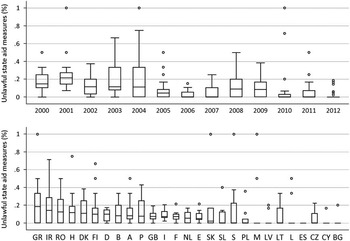
In addition to new aid, the Commission can investigate any aid put into effect without notification – that is, unlawful aid measures. Between 2000 and 2012, it has uncovered 419 of such measures. In other words, 11 out of 100 measures that are implemented in any given year are unlawful. Figure 1 shows the proportions of these measures over the total number of aid measures across time and countries.
Proportion of unlawful state aid measures in European Union (EU) countries Note: A=Austria; B=Belgium; BG=Bulgaria; CY=Cyprus; CZ=Czech Republic; D=Germany; DK=Denmark; E=Spain; ES=Estonia; F=France; FI=Finland; GB=Britain; GR=Greece; H=Hungary; I=Italy; IR=Ireland; L=Luxembourg; LT=Lithuania; LV=Latvia; M=Malta; NL=Netherlands; P=Portugal; PL=Poland; RO=Romania; S=Sweden; SK=Slovakia; SL=Slovenia. Source: Personal computation of the information available on the official website of the EU Commission; see section on Data and variables.

Existing theories fall short in explaining these patterns. Consider the main determinants of compliance recently identified by Treib (Reference Treib2014).Footnote 1 EU-level factors such as the discretion granted to national administrations are irrelevant because they vary only across policies. The number of domestic veto players is meaningful only in case of transposition, which requires the adoption of national legal measures. The misfit between supranational policy objectives and preexisting domestic legacies is larger for new member states, but 10 of these countries display the best compliance records – they are clustered at the right end of Figure 1. These cross-country patterns also do not reflect distinct cultures of compliance (cf. Falkner et al. Reference Falkner, Treib, Hartlapp and Leiber2005, Reference Falkner, Hartlapp and Treib2007, Reference Falkner, Treib and Holzleithner2008). Denmark and Finland, where a diffused respect for the rule of law would suggest observance, have a surprisingly high propensity to adopt unlawful measures (but Sweden does not). Compliance is higher in all the countries belonging to the so-called world of domestic politics where political interference should indicate otherwise. Greece, Portugal, France and Luxembourg cover the complete spectrum in Figure 1, despite the fact that they belong to the same world of compliance. Finally, a cluster of states that should display serious shortcomings in enforcement and application include both the most compliant countries (Czech Republic, Slovenia and Slovakia) and the worst offenders (Ireland and Hungary).
Other important determinants highlighted by Treib (Reference Treib2014), such as the ideological orientation of the incumbent government and the administrative capabilities of a country, only partially explain these patterns, as it will be shown below. In addition, there is no longitudinal trend or detectable fluctuations associated with the business cycle.
The persistence of the phenomenon and its country variation is, therefore, puzzling, because it is very likely that any measure that is implemented without notification will be detected sooner or later. The Commission can investigate any alleged unlawful aid of its own initiative or upon a third-party compliant. Interested parties can lodge a complaint online against alleged unlawful measures without their identity being disclosed. They can also bring direct action before their national courts, which must assess the case regardless of the existence of any parallel supranational procedure. Once a suspicious measure has been detected, the Commission can demand suspension and provisional recovery of the aid until it has decided on its compatibility. Moreover, if a measure turns out to be incompatible, it would order a recovery of the funds, including the accrued payable interests. Thus, governments will very likely face the embarrassment of having to recover the aid. Why does then noncompliance persist over time? What explains these patterns?
Geographically targeted measures, electoral systems and compliance
Geographically targeted measures and electoral institutions
Our point of departure is Persson and Tabellini’s (Reference Persson and Tabellini1999, Reference Persson and Tabellini2000) seminal model of competition between two office-seeking parties, which offer a district-specific transfer and a public good to the electorate. These scholars show that, in equilibrium, spending on district-specific transfers is higher and on the public good lower in a polity with three districts than in one with a single district. In the former case, the chance of reelection is maximised if spending is shifted from the public good to transfers in favour of marginal districts.Footnote 2 Early evidence has not been encouraging,Footnote 3 but later studies have shown more promise. For instance, Chang (Reference Chang2008) reported slightly higher district-specific spending, close to elections, in countries with a single veto player and single-member electoral districts. Rickard (Reference Rickard2012a) reported higher spending on subsidies in countries with majoritarian or mixed-member majoritarian electoral systems. In the more specific case of subsidies for the manufacturing sector, Rickard (Reference Rickard2012b) found more spending in majoritarian systems when manufacturing employment is geographically concentrated and the opposite when employment is diffuse. Many of these works solely distinguish, with some coding differences, between single-member district and other systems (e.g. Persson and Tabellini Reference Persson and Tabellini2003, Reference Persson and Tabellini2004; Cao et al. Reference Cao, Prakash and Ward2007; Chang Reference Chang2008; cf. Rickard Reference Rickard2012a, Reference Rickard2012b), ignoring the considerable heterogeneity of the latter group. After all, the model of Persson and Tabellini (Reference Persson and Tabellini1999, Reference Persson and Tabellini2000) suggests that district magnitude should drive district-specific spending.
District magnitude, as well as ballot structure, matter because they may “undermine to varying degrees the alignment of […] collective goals [i.e. maximizing party seats in the legislature] and the individual goals of candidates and legislators [i.e. (re)election]” (Shugart Reference Shugart, Valdini and Suominen2013, 818). These features specify how seats are allocated among candidates within parties and affect the incentives of candidates to develop personal reputations distinct from those of their parties (Carey and Shugart Reference Carey and Shugart1995, 417–418; see also Shugart et al. Reference Shugart2005), and usually these reputations are built by securing measures that deliver district-specific benefits.
Carey and Shugart (Reference Carey and Shugart1995) identified three key characteristics of the ballot that – interacting with district magnitude – shape the incentives to build a personal reputation. The first one is ballot control – that is, the degree of control party leaders exercise over the access to their party’s label. If leaders have control over the ballot, such as in closed-list PR systems, the incentives to cultivate personal reputations decrease with the magnitude of the district. Only if there are few seats in a district, with correspondingly few and identifiable candidates, politicians may have incentives to highlight their personal record or characteristics. On the other hand, if leaders do not have control over the ballot, such as in open-list PR systems, candidates of the same party must compete against each other to secure a seat. As the magnitude of the district increases, there are stronger incentives to distinguish oneself from a larger crowd of copartisans.
The second characteristic is vote pooling – that is, whether the votes cast for one candidate of a given party contribute to the number of seats won in the district by the party as a whole as well. The last characteristic is whether voters are allowed to cast only a single vote for a party, multiple votes or a single vote for a candidate. For instance, the electors of the Danish Folketingesst can choose either a candidate or a party, and votes are pooled across the whole party for the assignment of seats to parties. In the Irish single transferable vote system, voters rank candidates and pooling takes place across candidates only. The incentives to cultivate a personal reputation increase with less pooling and multiple- or candidate-level voting, especially if the district magnitude increases because intraparty competition becomes more intense.
Admittedly, evidence for the impact of district magnitude and ballot structure on spending is still limited. For instance, as a qualified support for Persson and Tabellini’s (public good-related) expectation, Edwards and Thames (Reference Edwards and Thames2007) found that education expenditure increases with district magnitude in systems with low incentives to cultivate a personal vote, but it decreases in systems with high incentives. Golden and Picci (Reference Golden and Picci2008) illustrated the importance of the open-list in PR systems by showing how it biases infrastructural investment. Other studies that have investigated the impact of these electoral institutions on spending, such as those of Hallerberg and Marier (Reference Hallerberg and Marier2004) and Rickard (Reference Rickard2012b), do not subject Carey and Shugart’s expectations to testing. Closer to our interest, Franchino and Mainenti (Reference Franchino and Mainenti2013) found that EU governments spend less on state aid when high district magnitude is associated with ballot control, party-based voting and pooling. In these circumstances, fewer measures are also adopted. On the other hand, more measures are implemented when high magnitude is combined with a lack of ballot control.
Beyond spending: electoral institutions and compliance
There is growing evidence that electoral institutions shape public spending, but why would they influence compliance with EU law as well? Couldn’t governments just spend more on these policies, without running afoul of EU provisions? As discussed above, the persistence and patterns of unlawful aid measures are puzzling. Unlawful aid will be most likely detected sooner or later, either by the Commission or by an interested party, as the cost to lodge a complaint is negligible. Even if there is some probability of escaping the Commission’s radar, this cannot explain cross-country variation, unless you implausibly argue that the supranational executive is biased in performing its duties.
In order to understand why governments may be willing to run these risks, we should start from the premise that government survival in parliamentary systems rests on the ongoing support of a party or a coalition of parties in the legislature,Footnote 4 and the incentives of legislators may not be aligned with the collective goals of their party. From the government perspective, implementing the measure without notification carries the risk of detection, the embarrassment of recovery and the criticism of incompetence, having invested scarce time and resources to no avail. However, these calculations look quite different from the perspective of the politician representing the constituency benefitting from the measure and whose individual reputation for dealing with a pressing local problem is on the line. The supranational procedure is costly and time consuming; it can take up to 20 months for a decision. Detection occurs several months after the adoption; 30% of the unlawful measures adopted between 2000 and 2012 have been detected more than one year after their implementation. Legislators can meanwhile preserve their reputation, taking credit for the attempted action and eventually blaming the Commission for blocking the measure.
As electoral institutions can shape the severity of the misalignment between the goals of a government party and those of its members, they can also influence the degree to which governments eventually comply with the procedure. Evidence in favour of this expectation has been recently produced by Rickard (Reference Rickard2010), who found that governments elected via majoritarian electoral rules are less likely to comply with the restrictions on narrowly targeted transfers, agreed within the WTO, than governments elected via PR. Even stronger evidence, because noncompliance in this context may have serious personal implications, is offered by Chang and Golden (Reference Chang and Golden2007). These scholars showed that, at high levels of district magnitude, (the perception of) corruption is greater in open-list than in closed-list PR systems. In some circumstances, the opposite is true at low levels of district magnitude.Footnote 5 If electoral institutions shape the incentives to undertake illegal activities, such as corruption, for the search of the personal vote, they should also influence compliance with EU law for the sake of securing geographically targeted measures that run afoul of its provisions.
In conclusion, the way electoral institutions influence the propensity for geographically targeted spending, as discussed in the previous section, should shape compliance with EU provisions on state aid control in a similar way. This brings us to a set of expectations. The first one follows Persson and Tabellini (Reference Persson and Tabellini1999, Reference Persson and Tabellini2000) and the work of Rickard (Reference Rickard2010) on compliance. It simply states that the lower the district magnitude, the higher the likelihood of adopting unlawful measures (H1).
The next expectations take seriously Carey and Shugart’s (Reference Carey and Shugart1995) contribution on the interactive effects of electoral rules on the search for the personal vote, following Chang and Golden’s (Reference Chang and Golden2007) work on corruption. Let us focus first on the interaction between ballot control and district magnitude. We should expect that if party leaders have control over the ballot, the lower the district magnitude, the higher the likelihood of adopting unlawful state aid measures. Conversely, if party leaders have no control over the ballot, the higher the district magnitude, the higher the likelihood of adopting unlawful state aid measures (H2). In other words, the marginal effect of district magnitude on the likelihood of adopting unlawful measures should be negative if party leaders have control over the ballot; it should be positive if party leaders have no such control.
Following the advice of Berry et al. (Reference Berry, Golder and Milton2012) to exploit fully the symmetric feature of theories positing interactions, what would, therefore, be the effect of ballot control on the likelihood of adopting unlawful measures? Compared with open-list systems, a closed-list system should unequivocally reduce the incentives to pursue the personal vote, and therefore decrease the propensity to adopt unlawful measures, for any value of district magnitude. However, this effect should be weaker when few seats are available in the district, because politicians in closed-list systems would, nevertheless, be tempted to highlight their personal record when competing against few other candidates (Carey and Shugart Reference Carey and Shugart1995, 431; Shugart Reference Shugart, Valdini and Suominen2013, 819). In other words, the marginal effect of ballot control on the likelihood of adopting unlawful measures should be negative at all values of district magnitude; this effect should be the weakest when district magnitude is at low levels and it should increase in magnitude as district magnitude increases. As we will explain in more detail below, single-member district systems are assumed to have no ballot control, and therefore this expectation is only meaningful for electoral systems with district magnitudes higher than 1.
Let us move on now to the interaction between district magnitude and the other electoral rules. We should expect that, as electoral systems provide for less pooling and for multiple or candidate-level voting (i.e. as these rules induce more search for the personal vote), the higher the district magnitude, the higher the likelihood of adopting unlawful state aid measures (H3). In other words, the marginal effect of district magnitude on the likelihood of adopting unlawful measures should be positive at all values of personal vote-inducing electoral rules. This effect should be the weakest when these rules are at their lowest level (e.g. in the case of pooling and party-level voting) and it should strengthen in magnitude as their value increases (e.g. in the case of no pooling and multiple- or candidate-level voting). The symmetric proposition is straightforward: the marginal effect of personal vote-inducing electoral rules on the likelihood of adopting unlawful measures should be positive at all values of district magnitude; this effect should be the weakest when district magnitude is at its lowest levels and it should strengthen as district magnitude increases. Again, as single-member district electoral systems have exclusively candidate-level voting and no pooling – that is, the highest values in terms of personal vote-inducing electoral rules – this proposition is only meaningful when district magnitude is higher than 1. The following sections subject these expectations to testing.
Data and variables
Unlawful state aid measures
There are several benefits of focussing on the EU policy of state aid control. First, state aid fits neatly the definition of distributive policy provided by Weingast et al. (Reference Weingast, Shepsle and Johnsen1981, 644)Footnote 6 as it provides a selective financial benefit to social groups and is geographically concentrated. Information on state aid measures can, therefore, be appropriately used to test hypotheses related to distributive policies, as works using government subsides do (Chang Reference Chang2008; Rickard Reference Rickard2012a). Second, determining noncompliance is straightforward as national governments can implement state aid only upon notification to and approval by the Commission. Third, this procedure has been consolidated over the past few decades (Cini and McGowan Reference Cini and McGowan2008, 175; Aydin and Thomas Reference Aydin and Thomas2012, 533–537; Kassim and Lyons Reference Kassim and Lyons2013, 8–9). Data on EU state aid are now comprehensive in terms of coverage of transactions and economic sectors and are highly comparable across countries as they fall under common EU legal criteria (Franchino and Mainenti Reference Franchino and Mainenti2013).
We used the information on unlawful aid to industry and services available from the official database of the European Commission,Footnote 7 covering the period from 2000 to 2012. In other words, we considered all unlawful aid that has been investigated by the Commission following the procedure codified in Council Regulation 659/1999. The dependent variable, Unlawful Measures, is the ratio between the number of unlawful aid measures – those that have been implemented either without notification to the Commission or before the Commission had taken a decision – over the total number of measures adopted by a given member state in a given year.Footnote 8
Electoral institutions
We begin with the District Magnitude of an electoral system – an explanatory variable at the centre of our expectations. We have computed the weighted average district magnitude of each electoral system that member states have used between 2000 and 2012. In the case of majoritarian and proportional systems, the value of District Magnitude is equal to the ratio between the number of assembly seats and the number of electoral districts, at the electoral tier at which votes are translated into seats. In the case of proportional multi-tier systems and mixed systems, we first computed the magnitude of each tier by dividing the number of seats assigned or won at a given tier in a given election by the number of electoral districts at that tier. We then summed the resulting tier-level values, weighted by the proportion of tier-level seats over the assembly size.Footnote 9
Ballot Control is a dummy variable taking the value of 1 if a large majority of the assembly is elected under a close-list electoral system.Footnote 10 For the remaining rules on pooling and votes, we use the data collected by Johnson, Wallack and their colleagues (Wallack et al. Reference Wallack, Gaviria, Panizza and Stein2003; Johnson and Wallack Reference Johnson and Wallack2007). We use a syncretic variable Pool-Vote Rules that averages the scores of the “pool” and “vote” indices produced by these scholars (for a similar procedure, see Edwards and Thames Reference Edwards and Thames2007). Higher values indicate that these rules strengthen the incentives to search for a personal vote. We also consider an alternative measure that adds up the scores of these two indices.
Control variables
We control for some additional factors that may influence compliance. First, the political business cycle model suggests that governments have incentives to manipulate the level of unemployment through, for instance, higher public investment in order to maximise the chances of winning the next election (Nordhaus Reference Nordhaus1975, 174). Unlike other contributions (e.g. Aydin Reference Aydin2007; Zahariadis Reference Zahariadis2010), Chang (Reference Chang2008) has recently found that closeness to elections led to slightly higher district-specific spending in some circumstances. An approaching electoral competition may, therefore, make governments more cavalier about complying with EU provisions. The variable Election takes the value of 1 in the year preceding an election in a given country and 0 in the other years. In the election year, the value is the weighted preelection period of the year.Footnote 11
Second, left-wing governments may be more inclined to public investment than right-wing governments, either because of a predisposition to believe in beneficial government intervention in the economy or because of the benefits accruing to key left-wing constituencies, such as manufacturing workers, underemployed and unemployed (Hibbs Reference Hibbs1977). A partisan effect has been found in several studies on compliance (e.g. Falkner et al. Reference Falkner, Treib, Hartlapp and Leiber2005, Reference Falkner, Treib and Holzleithner2008; Mastenbroek and Kaeding Reference Mastenbroek and Kaeding2006; Jensen Reference Jensen2007; Toshkov Reference Toshkov2007, Reference Toshkov2008; Jensen and Spoon Reference Jensen and Spoon2011; Sedelmeier Reference Sedelmeier2012), but corroborating evidence is weak in the specific case of distributive spending (Franchino and Mainenti Reference Franchino and Mainenti2013, 505). We can, nevertheless, concede that greater willingness or pressure to spend of left-wing governments could be translated into a greater propensity to escape the constraints of EU law. The underlying policy dimension is the traditional left-right economic cleavage, pitting market liberals, favouring a small state and low taxes, against interventionists, supporting public spending and a larger government. We, therefore, use the “taxes versus spending” dimension used in the expert surveys on party positions by Laver and Hunt (Reference Laver and Hunt1992) and Benoit and Laver (Reference Benoit and Laver2006). The dimension ranges from 1 for a party that promotes raising taxes to increase public services to 20 for one that promotes cutting public services to cut taxes. Government Preference is the sum of the positions of each government party along this dimension, weighted by its share of ministerial portfolios.
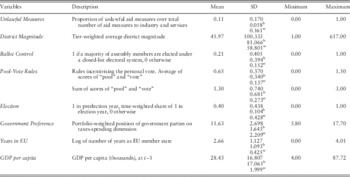
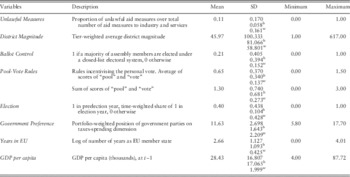
Third, noncompliance may be accidental rather than intentional as the management approach to compliance would suggest (e.g. Chayes and Chayes Reference Chayes and Chayes1995). Some national administrations are less experienced than others in dealing with EU policies and a failure to notify a measure could simply reflect gaps in administrative and legal know-how. Administrative experience has indeed been identified as an important facilitator of compliance (e.g. Berglund et al. Reference Berglund, Gange and Van Waarden2006; Kaeding Reference Kaeding2006; Steunenberg and Rhinard Reference Steunenberg and Rhinard2010; Haverland et al. Reference Haverland, Steunenberg and Van Waarden2011). As experience is generally gained over the years, we control for the length of EU membership of each country in a given year. Years in EU is (the logarithm of) the number of years since joining the EU. This variable is also a measure of the misfit that is likely to exist, especially in new member states, between EU state aid policy principles and preexisting legacies. Finally, we control for the gross domestic product (GDP) per capita to account for different levels of economic development across the EU, which may influence the propensity to spend, and therefore comply. This variable has also been used as proxy for administrative capacity – another facilitator of compliance (e.g. Mbaye Reference Mbaye2001; Falkner et al. Reference Falkner, Treib, Hartlapp and Leiber2005; Berglund et al. Reference Berglund, Gange and Van Waarden2006; Hille and Knill Reference Hille and Knill2006; Kaeding Reference Kaeding2006; Haverland and Romeijn Reference Haverland and Romeijn2007; Perkins and Neumayer Reference Perkins and Neumayer2007; Börzel et al. Reference Börzel, Hofmann, Panke and Sprungk2010, Reference Börzel, Hofmann and Panke2012; König and Mäder Reference König and Mäder2013). Descriptive statistics of the variables we use for the analysis are available in Table A.1.
Explaining the puzzle of unlawful state aid measures
Our first expectation is a straightforward relation between district magnitude and unlawful measures, whereas the second and third expectations posit two interactions, the first between district magnitude and ballot control and the second between district magnitude and the other electoral rules shaping the incentives to search for the personal vote. Therefore, we use the following general specification:
 $$\eqalignno{ Y_{{it}} =\,&\alpha _{0} {\plus}\beta _{1} DM_{{it}} {\plus}\beta _{2} BC_{{it}} {\plus}\beta _{3} DM_{{it}} {\times}BC_{{it}} {\plus}\beta _{4} PV_{{it}} \cr & {\plus}{\rm }\beta _{5} DM_{{it}} {\times}PV_{{it}} {\plus}\bibeta \circ {\bf X}_{{\mib it}} {\plus}\bibeta \circ {\mib C}_{\mib i} {\plus}\delta _{{it{\minus}1}} {\plus}\mu _{{it}} $$
where Y
it
is the proportion of unlawful measures in country i and year t, DM
it
the average district magnitude, BC
it
the indicator variable for ballot control and PV
it
the index of the other rules incentivising the personal vote.
 $\bibeta\, \circ \,$
X
it
is the Hadamard product of row vectors of βs and control variables (note that GDP per capita is lagged one year), whereas
 $$\bibeta \,\circ \,$$
Ci
is the Hadamard product of row vectors of βs and country fixed effects that model unobserved unit heterogeneity (Beck and Katz Reference Beck and Katz1995; Wilson and Butler Reference Wilson and Butler2007).Footnote
12
The specification also includes a unit-specific first-order autocorrelation coefficient δ
it−1, but we display the results with a common coefficient across countries as well. Our data set is time-series cross-sectional and unbalanced, including 15 countries in 2000 and 27 in 2012, as new member states joined the EU in 2004 and 2007. We used panel-corrected standard errors. The results of these Prais-Winstein models are displayed in Table 1.
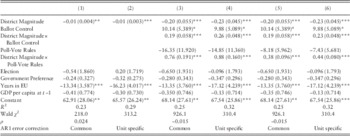
Electoral institutions and unlawful aid measures, European Union (EU) countries 2000–2012

Note: n=297; 27 groups. Prais-Winstein regressions with panel-corrected standard errors, country fixed effects and pair-wise selection. Coefficient and standard errors, in parentheses, scaled up by a factor of 100. Average of scores of “pool” and “vote” in Models 3 and 4, sum of scores in Models 5 and 6.
***p<0.01, **p<0.05, *p<0.1.
Models 1 and 2 include only district magnitude in Equation 1. They provide evidence in support of the first expectation. Governments of countries where politicians are elected in higher magnitude districts are less likely to adopt unlawful state aid measures. Recall that, on average, 11 out of every 100 measures adopted in any given year do not comply with the state aid provisions. A standard deviation increase in District Magnitude, which is approximately equivalent to the difference between the (pre-2005) Italian and Dutch electoral systems, reduces this proportion to 10 out of every 100 measures. Moving from a single-member district electoral system to the post-2005 Italian electoral system, which has the highest average district magnitude, halves the proportion for unlawful measures.
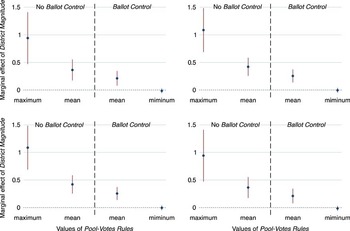
Models 3 to 6 include the full specification, and Figure 2 displays the marginal effects of District Magnitude on the proportion of unlawful measures in the presence and absence of ballot control (and for different levels of Pool-Vote Rules). Two combinations are excluded because they are logically impossible, and consequently there are no observations in our data set. Casting only a single vote for a party in open-list systems would defy the purpose of having a list of candidates to choose from. Therefore, Pool-Vote Rules never takes the minimum value of 0 when there is no ballot control. Equally, casting a single vote for a candidate, without any pooling, is not possible in a closed-list system. Therefore, Pool-Vote Rules never takes the maximum value when there is ballot control.
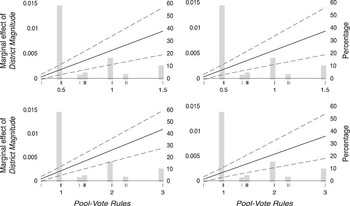
Marginal effects of an increase in district magnitude, with and without ballot control Note: Clockwise from top-left panel, Models 3–6, Table 1. The left half of each panel displays the effects in case of no ballot control, the right half in case of ballot control. Pool-Vote Rules cannot take the minimum value of 0 in case of no ballot control and the maximum value in case of ballot control.

We do not find evidence that higher district magnitude lowers the proportion of unlawful measures in closed-list systems. If the other rules incentivising the personal vote take minimum values (i.e. in case of a single party vote and party-wide pooling), an increase in magnitude has a negative impact, which is not, however, different from 0 at the standard level of significance. If these rules take average values, the impact turns positive, which is in contradiction to our expectation. On the other hand, an increase in district magnitude unequivocally leads to a higher proportion of unlawful aid in open-list systems. If we set the other rules incentivising the personal vote at their average values, the proportion of unlawful measures would increase from 11 to at least 32% with a standard deviation increase in magnitude. If we set these rules at their maximum (e.g. no pooling and multiple- or candidate-level voting), the proportion of unlawful measures increases to a considerable 65%, at least.
Consider the Irish single transferable vote system, which has candidate-centred features that match somewhat those of single-member district systems, but where four seats are available on average in any voting district. The resulting tougher competition among copartisans and the stronger incentives to get noticed could explain why the proportion of unlawful measures in Ireland is more than twice as much as it is in Britain or France, exactly as Carey and Shugart (Reference Carey and Shugart1995) expect.
These results provide strong corroboration in support of (the second part of) our second expectation. If, however, we focus on the symmetric expectation, the results are less convincing. Recall that this second hypothesis, based on Carey and Shugart (Reference Carey and Shugart1995), implies that moving from an open-list system to a closed-list system should unequivocally decrease the propensity to adopt unlawful measures, for any value of district magnitude, and that this effect should be stronger when many seats are up for grabs in any given district. We do not find support for this symmetric expectation as it is apparent by looking at the positive values of the coefficients of Ballot Control and of the interaction between District Magnitude and Ballot Control in Table 1 (the results hold good if we exclude single-member district systems). This is a further indication that only half of our hypothesis is corroborated. It is worth pointing out, nonetheless, that the relation between district magnitude and compliance in open-list systems is the opposite to the relation that can be derived from the study of Persson and Tabellini (Reference Persson and Tabellini1999, Reference Persson and Tabellini2000): higher magnitude decreases compliance.
A closer look at within-country effects of district magnitude
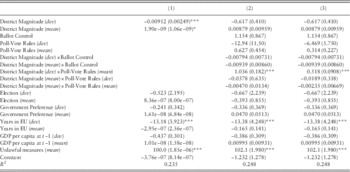
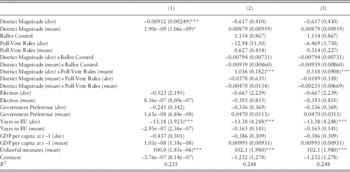
Note: n=297. Coefficient and standard errors, in parentheses, scaled up by a factor of 100. Errors clustered on country. Average of scores of “pool” and “vote” in Model 2, sum of scores in Model 3.
dev=deviation from country mean; mean=country mean; EU=European Union; GDP=gross domestic product.
***p<0.01, *p<0.1.
We move on now to the third and last expectation that posits a positive interaction between District Magnitude and Pool-Vote Rules. Figure 3 displays the marginal effects of District Magnitude on the proportion of unlawful measures for different levels of Pool-Vote Rules in the absence of ballot control.
Marginal effects of an increase in district magnitude across Pool-Vote Rules Note: Clockwise from top-left panel, Models 3–6, Table 1. No ballot control.

A standard deviation increase in District Magnitude raises the proportion of unlawful measures from 11 to 13% if the other rules incentivising the personal vote are at their minimum values for this subset of observations. Consider Slovakia and Latvia, two countries that have recently joined the EU. The proportion of unlawful measures in Slovakia is more than three times as much as in Latvia. Although both electoral systems allow for candidate-level votes, Slovakian politicians compete in a single district to become a member of the 150-seat National Council, whereas Latvian politicians are spread out in five districts to join the 100-seat Saeima. The stronger pressure to establish a personal reputation in Slovakia can explain the greater propensity to infringe the rules.
When Pool-Vote Rules is at the maximum, the proportion of unlawful measures goes from 11 to a considerable 65%, with a standard deviation increase in magnitude. On average, the proportion of unlawful measures is tripled. Moreover, an increase in magnitude has a substantially larger effect when Pool-Vote Rules takes the maximum value rather than the mean value. F-tests for the joint significance of the interaction terms reject the null hypothesis that these effects are identical (p-value⩽0.0001). These results, therefore, strongly corroborate the positive interaction prospected by Carey and Shugart (Reference Carey and Shugart1995).
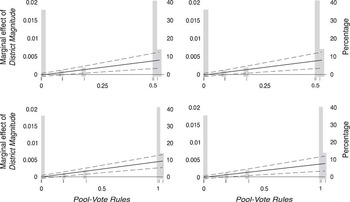
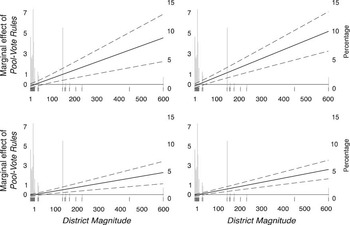
Figure 4 displays the same marginal effects of District Magnitude, but in the presence of ballot control. If voters can only choose a party and votes are pooled among all copartisans (i.e. Pool-Vote Rules takes the minimum value), an increase in magnitude has no effect on compliance. When Pool-Vote Rules is above the minimum – for instance, pooling takes place across subsets of copartisans, such as in the regional districts in Spain, or some forms of candidate-level votes are allowed in addition to the party-level vote – a standard deviation increase in magnitude leads to an average increase in the proportion of illegal aid measures from one in every 10 to one in every two measures. Therefore, an increase in magnitude has a substantially larger effect when Pool-Vote Rules takes the maximum value (for this subset of observations) rather than the minimum value. F-tests for the joint significance of the interaction terms reject the null hypothesis that these effects are identical (p-value⩽0.0001). Again, these results corroborate the expected positive interaction between district magnitude and the Pool-Votes Rules. Results hold for the symmetric expectation as well. The marginal effect of Pool-Vote Rules on the propensity to adopt unlawful measures is positive and increasing at increasing values of district magnitude (see Figure A.1).
Marginal effects of an increase in district magnitude across Pool-Vote Rules in case of ballot control Note: Clockwise from top-left panel, Models 3–6, Table 1.

Finally, the administrative experience gained over the years in dealing with EU policies facilitates compliance. For instance, the proportion of unlawful measures drops by at least one-third in the founding member states compared with the 2004 new entrants.Footnote 13
A closer look at within-country effects of district magnitude
Electoral rules change slowly over time. Descriptive statistics show that the between-units component of their standard deviation is larger than the within-units component. Therefore, our results are driven by differences across countries to a greater extent than by differences within countries. For district magnitude, however, within-country variance makes up an appreciable portion of total variance. The average magnitude has changed in 12 states over this time period, in some cases because of redistricting (Denmark, Germany, Ireland and Poland), in others because of peculiarities of the multi-tier system (Austria, Estonia and Hungary) and in yet others because of broader reforms (Belgium, Bulgaria, Greece, Italy and Romania). We complete our empirical investigation paying particular attention to the within-country effects of district magnitude.
Let
 $X_{{it}}^{d} =X_{{it}} {\minus}\overline{X} _{i} $
be the deviation of variable X
it
from the mean
 $$\overline{X} _{i} $$
of country i at time t. We use the following specification:
 $$\eqalignno{ Y_{{it}} = \,& \alpha _{0} {\plus}\beta _{1} DM_{{it}}^{d} {\plus}\beta _{2} \overline{{DM}} _{i} {\plus}\beta _{3} BC_{{it}} {\plus}\beta _{4} PV_{{it}}^{d} {\plus}\beta _{5} \overline{{PV}} _{i} {\plus}\beta _{6} DM_{{it}}^{d} {\times}BC_{{it}} \cr & {\plus}\beta _{7} \overline{{DM}} _{i} {\times}BC_{{it}} {\plus} \beta _{8} DM_{{it}}^{d} {\times}\overline{{PV}} _{i} {\plus}\beta _{9} \overline{{DM}} _{i} {\times}PV_{{it}}^{d} {\plus}\beta _{{10}} \overline{{DM}} _{i} {\times} \overline{{PV}} _{i} \cr & {\plus}\bibeta \circ {\mib X}_{{\mib it}}^{\mib d} {\plus}\bibeta \circ \overline{\mib X} _{\mib i} {\plus}\beta \overline{Y} _{i} {\plus}\mu _{{it}} $$
Each independent and control variable enters the specification as country mean, in order to account for the between-units effects, and as deviation from the country mean in order to account for the within-units effects. The only exception is Ballot Control because it is an indicator variable. The interactions operationalise H2 and H3.Footnote
14
The specification also includes the mean proportion
$$\overline{Y} _{i} $$
of unlawful measures in country i. The results are displayed in Table 2.
Model 1 provides evidence in support of the first expectation. As the district magnitude increases within countries, governments are less likely to adopt unlawful measures. Moreover, the coefficient of District Magnitude (dev) in Model 1 of Table 2 is close to the respective coefficient in Model 1 of Table 1. Therefore, the substantive effect of an increase in magnitude within countries is equivalent to the effect of an increase when within- and between-units components are pooled. In other words, within-units effects carry a greater proportion of explanatory power than between-units effects.
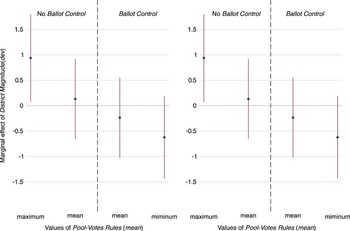
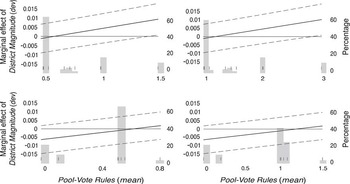
Figure 5 displays the within-country marginal effects of District Magnitude on the proportion of unlawful measures in the presence and absence of ballot control, whereas Figure 6 displays the same effects for different levels of country mean Pool-Vote Rules.
Marginal effects of a within-country increase in district magnitude, with and without ballot control Note: Left panel Model 2, right panel Model 3, Table 2. The left half of each panel displays the effects in case of no ballot control, the right half in case of ballot control. Pool-Vote Rules (mean) cannot take the minimum value of 0 in case of no ballot control and the maximum value in case of ballot control.

Marginal effects of a within-country increase in district magnitude across Pool-Vote Rules Note: First column Model 2, second column Model 3, Table 2. Top row without ballot control, bottom row with ballot control.

An increase in magnitude lowers the proportion of unlawful measures in closed-list systems, but the impact is not sufficiently different from 0 at the standard level of significance (see also bottom panels in Figure 6). In open-list systems, higher magnitude leads to a higher proportion of unlawful measures when the other rules incentivising the personal vote are at their maximum values. This effect can be seen in Figure 5 and in the upper panels of Figure 6 at the right end of the Pool-Vote Rules axis. The proportion of unlawful measures increases from 11 to 56% with a standard deviation increase in within-country magnitude. The increase in within-country magnitude has a substantially larger effect when Pool-Vote Rules takes the maximum value rather than the minimum value. F-tests for the joint significance of the interaction terms reject the null hypothesis that these effects are identical (p-value⩽0.000).
Within-country effects explain of course a smaller proportion of the variation in our dependent variable, but the results point in the same direction. Consider the Italian electoral reforms in 2005. The switch from a mixed and (mostly) open-list system to a bonus-adjusted closed-list PR system where seats are allocated to parties at the national level is associated with a drop of the proportion of unlawful measures from 12 to 5% per year.
Conclusion
The recent literature on compliance has begun to shed more light on how electoral incentives shape the propensity of elected leaders to breach international rules. Dai (Reference Dai2005, Reference Dai2006) argues that governments’ compliance is primarily responsive to domestic constituencies. Rickard (Reference Rickard2010) places emphasis on the electoral formula and finds that countries with PR are more likely to comply with international agreements.
The present study shows that the electoral formula is not the only institution that matters. PR does not unequivocally enable international cooperation, but compliance depends on several characteristics of the ballot. Following Persson and Tabellini’s (Reference Persson and Tabellini1999, Reference Persson and Tabellini2000) and Carey and Shugart’s (Reference Carey and Shugart1995) expectations, we focus on the interactive effects of district magnitude and ballot structure on the implementation of distributive measures. The combination of these electoral institutions affects the variation in compliance among and within countries.
Using data on EU state aid control policy, we show that higher district magnitude facilitates compliance. However, higher magnitude may be an obstacle if either party leaders have no control over the ballot rank or other electoral rules strengthen the incentives to cultivate a personal vote. Our findings are robust if we control for regional fiscal autonomy (see Supplementary Table A.2), but a future challenge will consist in systematically disentangling the involvement of subnational authorities in granting aid. Furthermore, these results rest on the mutual dependence between the government and the legislature in parliamentary systems, and thus they may carry over to presidential systems only where presidents heavily depend on legislative cooperation for policymaking.
Nonetheless, this study contributes to two broad research areas. First, it examines in greater depth the determinants of compliance with international obligations. A key issue in the literature is why some countries are more willing to violate international agreements (Simmons Reference Simmons2000; Mansfield et al. Reference Mansfield, Milner and Rosendorff2002; Dai Reference Dai2006; Rickard Reference Rickard2010). We suggest that electoral institutions may account for the different behaviour of national governments. This is consistent with the argument of Dai (Reference Dai2006) and the work of Rickard (Reference Rickard2010); however, unlike previous studies, we illustrate to what extent compliance relies on all the electoral institutions that produce a misalignment between the collective objectives of a government party and the individual objectives of its members. In future studies, empirical findings about, for instance, the protectionist tendencies of majoritarian democracies may be similarly qualified. For instance, Rickard (Reference Rickard2012b) finds that geographically diffuse sectors obtain more subsidies in party-centred (closed-list) systems than in candidate-centred (open-list) systems. Whether this interaction also leads to less compliance may be worth investigating, but one would have to provide a rationale for governments in closed-list systems to violate the rules.
Second, our findings innovate along several dimensions with regard to the broader literature on EU implementation and compliance, from its ambit (the application of proscriptive provisions) to its causal mechanisms, based on electoral institutions. Some studies have attended to electoral concerns in the attempt to explain outcomes (e.g. Kaeding Reference Kaeding2008; Steunenberg and Rhinard Reference Steunenberg and Rhinard2010; Dellmuth and Stoffel Reference Dellmuth and Stoffel2012), but none of them have uncovered the mechanisms we have discussed in this study. Whether the results carry over to other EU policies – most of which are of regulatory nature – is another question and should be the subject of future research.
Acknowledgements
Preliminary versions of this paper have been presented at the Conference of the ECPR Standing Group on the European Union, The Hague, June 2014, the Conference of the European Political Science Association, Edinburgh, June 2014, the XXVIII Conference of the Italian Society of Political Science, Perugia, September 2014. The authors are grateful to Bernard Steunenberg, Ellen Mastenbroek, Lars Mäder, Thomas Winzen, Andrea Ceron and the panel participants for their comments and suggestions. This research received no grants from any public, commercial or nonprofit funding agencies.
Supplementary Material
To view supplementary material for this article, please visit http://dx.doi.org/10.1017/S0143814X15000343
Appendix
Descriptive statistics
Marginal effects of an increase in Pool-Vote Rules across district magnitude Note: Single-member electoral district systems are excluded.