Introduction
Worldwide, rice is the primary staple food for more than 50% of the population (USDA-ERS 2021). India and China are the leading rice-producing countries, and they contribute about 50% of the total rice produced in the world (USDA-ESMIS 2021). In India, as per 2019–2020 statistics, rice was grown on 44 million ha with a production of 119 billion kg, accounting for 27% and 24% of harvested rice hectares and total rice produced in the world, respectively (USDA–ESMIS, 2021).
Even though India ranks first in area planted to rice, productivity is low compared with some major rice-producing countries such as China (−51%) and Indonesia (−13%) (USDA-ESMIS 2021). Several abiotic and biotic factors substantially reduce rice yields in India. Among biotic constraints, weeds are one of the major yield-limiting factors in rice. In a multi-location study conducted in India for about 10 yr, yield reductions of 14% and 21% were observed due to weeds in puddled transplanted rice (461 locations) and direct-seeded rice (DSR; 195 locations), respectively (Gharde et al. Reference Gharde, Singh, Dubey and Gupta2018). Another study reported yield losses up to 57% in transplanted rice and 82% in DSR (Mahajan et al. Reference Mahajan, Chauhan and Johnson2009). DSR is becoming increasingly popular in India and other rice-producing countries compared with transplanted rice because of its low input demand and simplicity (Raj and Syriac Reference Raj and Syriac2017). However, weed management is very challenging in DSR compared with puddled transplanted rice. In DSR, rice and weed seedlings emerge simultaneously, and there is no standing water to suppress weed emergence, resulting in early weed competition compared with transplanted rice.
Rice fields are generally infested with both monocots and dicots; however, sedges (monocots) are the most troublesome and difficult to control (Pedroso et al. Reference Pedroso, Al-Khatib, Alarcon-Reverte and Fischer2016). Among sedges, smallflower umbrella sedge, which prefers to grow in moist soils, is one of the most dominant weeds of rice in more than 46 countries, causing significant yield reductions and quality deterioration (Chauhan and Johnson Reference Chauhan and Johnson2009; Derakhshan and Gherekhloo Reference Derakhshan and Gherekhloo2013; Rao et al. Reference Rao, Johnson, Sivaprasad, Ladha and Mortimer2007; Tian et al. Reference Tian, Shen, Yuan, Song, Lu and Da2020). It can complete its life cycle in about 30 d and produces thousands of small seeds, which makes it a dominant weed in DSR systems.
Acetolactate synthase (ALS)-inhibiting herbicides have been widely used for broad-spectrum control of weeds in rice (Mascanzoni et al. Reference Mascanzoni, Perego, Marchi, Scarabel, Panozzo, Ferrero, Acutis and Sattin2018; Riar et al. Reference Riar, Tehranchian, Norsworthy, Nandula, McElroy, Srivastava, Chen, Bond and Scott2015). These herbicides proved extremely effective in controlling weeds and were readily adopted by rice growers (Choudhary and Dixit Reference Choudhary and Dixit2018; Kumar and Ladha Reference Kumar and Ladha2011). A majority of rice growers in India have been using ALS-inhibiting herbicides such as bispyribac-sodium, penoxsulam, chlorimuron-ethyl, metsulfuron-methyl, pyrazosulfuron, bensulfuron, and ethoxysulfuron for more than a decade (Choudhary and Dixit Reference Choudhary and Dixit2018). The ALS-inhibiting herbicides prevent the synthesis of branched-chain amino acids like leucine, isoleucine, and valine, which are essential for growth and development of the plant, and the absence of these amino acids leads to drastic reduction of shoot and root growth and, eventually, plant death (Lamego et al. Reference Lamego, Charlson, Delatorre, Burgos and Vidal2009). However, ALS-inhibiting herbicides are more prone to development of resistance in weeds than any other group of herbicides, resulting in rapid adaptation of weeds to these herbicides (Heap Reference Heap2021; Zakaria et al. Reference Zakaria, Saiful, Hamdani and Juraimi2018). Worldwide, ALS-inhibiting herbicides have failed to control about 165 weed species, of which ∼27 exist in the rice ecosystem (Tehranchian et al. Reference Tehranchian, Riar, Norsworthy, Nandula, McElroy, Chen and Scott2015).
Repeated use of same group of herbicides for several years exerts selection pressure on weeds for biotypes with the genetic capability of surviving herbicide at the field use rate (Goulart et al. Reference Goulart, Pacheco, Nunes and Merotto2012; Shaw et al. Reference Shaw, Culpepper, Owen, Priece and Wilson2012). Weeds may develop resistance either by altering a target site or a non-target site; some weed biotypes have developed cross-resistance to different ALS-inhibiting herbicides (Riar et al. Reference Riar, Norsworthy, Bond, Bararpour, Wilson and Scott2012, Reference Riar, Norsworthy, Srivasta, Nandula, Bod and Scott2013). Studies conducted elsewhere already confirmed that smallflower umbrella sedge has evolved resistance to ALS-inhibiting herbicides in the United States (Norsworthy et al. Reference Norsworthy, Riar and Scott2013; Osuna et al. Reference Osuna, Vidotto, Fischer, Bayer, De Prado and Ferrero2002), Australia (Graham et al. Reference Graham, Pratley, Slater and Baines1996), South Korea (Kuk et al. Reference Kuk, Kim, Kwon, Lee, Burgos, Jung and Guh2004), Brazil (Ruiz-Santaella et al. Reference Ruiz-Santaella, Bakkaliu, Osuna and De Prado2004), Spain (Galon et al. Reference Galon, Panozzo, Noldin, Concenco, Tarouco, Ferreira, Agostinetto, Silva and Ferreira2008), Italy (Vidotto et al. Reference Vidotto, Busi and Ferrero2003), and Turkey (Heap Reference Heap, Pimentel and Peshin2014).
It was reported earlier that tryptophan at residue 574 of the ALS enzyme may be the mechanism of resistance in smallflower umbrella sedge biotypes, as an alteration or mutation in this site is known to confer resistance to ALS-inhibiting herbicides (Zakaria et al. Reference Zakaria, Saiful, Hamdani and Juraimi2018). However, in smallflower umbrella sedge, two possible mechanisms for resistance against ALS-inhibiting herbicides are: (1) a mutation in the conserved region of the ALS gene (target site); and (2) lower absorption, slow translocation, greater sequestration, and improved herbicide metabolism (non-target site) (Powles and Yu Reference Powles and Yu2010; Siminszky Reference Siminszky2006; Tranel and Wright Reference Tranel and Wright2002). Similarly, based on ALS enzyme bioassay, Osuna et al. (Reference Osuna, Vidotto, Fischer, Bayer, De Prado and Ferrero2002) and Kuk et al. (Reference Kuk, Kim, Kwon, Lee, Burgos, Jung and Guh2004) found that an altered target site was the likely resistance mechanism in smallflower umbrella sedge for developing resistance against ALS inhibitors. Smallflower umbrella sedge is a self-pollinating species, and thus its primary mechanism of spreading herbicide resistance is through seed dispersal (Merotto et al. Reference Merotto, Jasieniuk and Fischer2009a).
Bispyribac-sodium, which belongs to the class of pyrimidinyl thiobenzoates, is an ALS-inhibiting herbicide widely used in rice (Kumar et al. Reference Kumar, Behera, Saha, Das, Guru and Kaviraj2020). It is a systemic postemergence herbicide that can control grasses, sedges, and broadleaf weeds of rice (Jabran et al. Reference Jabran, Hussain, Farooq, Babar, Dogan and Lee2012; Kumar et al. Reference Kumar, Rana, Chander and Ramesh2013; Yadav et al. Reference Yadav, Yadav and Punia2009). But recently, rice growers in India have complained about lack of smallflower umbrella sedge control with bispyribac-sodium (VK Choudhary, personal communication). Poor control was also reported from field studies (Choudhary and Dixit Reference Choudhary and Dixit2018). However, so far, no systematic study has been done in India to establish the facts of bispyribac-sodium resistance in this species. Florpyrauxifen-benzyl is a newly developed arylpicolinate herbicide that is a member of the synthetic auxins (HRAC Group O/WSSA Group 4). It has been registered for use in rice as a postemergence herbicide in several countries and is expected to get registration in India during 2021 to 2022. In general, synthetic auxins are used to control broadleaf weeds in grass crops, but florpyrauxifen-benzyl is claimed to have broad-spectrum activity on important grasses and sedges along with broadleaf weed species in rice. However, there is little literature available on its efficacy. Therefore, studies were conducted (1) to confirm the presence of bispyribac-sodium-resistant (BR) smallflower umbrella sedge in major rice-growing areas of India and (2) to test the efficacy of florpyrauxifen-benzyl on BR smallflower umbrella sedge biotypes.
Materials and Methods
Collection of Plant Material
To evaluate the selection pressure of bispyribac-sodium in smallflower umbrella sedge, the major rice-growing states Chhattisgarh and Kerala were intensively surveyed. In total, 188 farmers were interviewed. Based on their feedback, the Dhamtari and Raigarh districts of Chhattisgarh and the Thrissur and Alappuzha districts of Kerala were identified to collect populations of smallflower umbrella sedge suspected to be resistant to bispyribac-sodium. Samples were collected from 53 locations (Figure 1) in both states (30 from Chhattisgarh and 23 from Kerala). Random sampling was employed to collect physiologically matured seeds from five locations in each field. Seed from each field was bulked to make a single composite sample considered as one biotype. GPS coordinates were recorded at the center of each field. All seed samples collected were from direct-seeded rice fields.
Geographic distribution of the locations where the 53 smallflower umbrella sedge biotypes were collected.

Study Site and Soil Characteristics
Pot experiments were conducted for resistance screening for two seasons during the rainy months (June to August) in 2018 and 2019 at the Directorate of Weed Research, Jabalpur, India (23.2336°N, 79.9672°E). These pot experiments were conducted in the open field to simulate farmers’ practices. Subtropical climate prevails at the experimental site, with an average (50-yr) annual rainfall of 1,400 mm. The coolest month of the year is January (mean monthly temperature 4 to 7 C), and the hottest month is May (mean monthly temperature 42 to 45 C). On average, 365 mm of rain was received during the experimental period, and the mean maximum and minimum temperatures were 33 and 25 C, respectively. The soil used for the study was a medium black soil with a clay loam texture that belongs to the Kheri series (fine, montmorillonitic hyperthermic, Typic Haplusterts) with pH 7.1 and organic carbon 0.59%.
Screening of Resistance against ALS Inhibitor
All 53 biotypes collected were grown in autoclaved (at 121 C for 30 min) soil in round plastic pots that were 17-cm tall with a diameter of 17 cm. Smallflower umbrella sedge seeds are very small, so they were mixed with soil and then sprinkled evenly in each pot. Optimum soil moisture was maintained in all pots to imitate DSR field conditions. After germination, extra plants were thinned out to maintain 15 uniformly sized plants per pot. Plants were grown under a 14-h photoperiod with 30/20 ± 3 C day/night temperatures. Plants were treated with herbicides at the 4- to 5-leaf stage. Treatments include bispyribac-sodium (Nominee Gold® 10% SC, PI Industries, Gurgaon, India) at 0, 0.5, 1, 2, 4, and 8 times the recommended label rate of 25 g ha−1 and florpyrauxifen benzyl (RinskorTM active, Corteva Agriscience, Indianapolis, IN, USA) at 31.25 g ai ha−1 (1X). A completely randomized design was used in both years with six replications. Each pot with 15 plants was considered one replication. Both the herbicides were applied with 375 L ha−1 of spray volume using a solar-powered backpack sprayer (ASPL Green Ventures Private Limited, Lucknow, India) fit with a flat-fan nozzle calibrated to deliver 3 L min−1 at 350 kPa pressure. Treated plants were watered as needed. From six replications, three replications were used to assess visible control and biomass at 21 d after herbicide application (DAHA); and the remaining three replications were used to collect plant samples for ALS enzyme activity analysis at 6 DAHA. A known susceptible (S) biotype of smallflower umbrella sedge seeds collected from Thrissur, Kerala (KATCD-24) was also grown as a standard check for comparison.
Observations
Visible control estimates were recorded at 21 DAHA using a scale ranging from 0% to 100%, with 0% meaning no control and 100% meaning complete death or control of smallflower umbrella sedge. Visible control was assessed at 21 DAHA; on the same day, 3 plants were randomly selected from each pot, cut at ground level, and dried in an oven at 60 ± 2 C until stable dry biomass was achieved. The aboveground dry biomass data were converted to percent biomass reduction compared with the untreated control plants using Equation 1:
 ${\rm Biomass \;reduction (%)} = [(A - B)/A] \times 100 $
where A is the mean aboveground dry biomass of the three untreated control replicates of a biotype and B is the biomass of an individual treated replicate for the same biotype.
Of the 53 biotypes tested, 17 biotypes survived the 1X rate (25 g ha−1) of bispyribac-sodium. Therefore, after collection of plant samples for dry biomass, the remaining plants that survived the 1X rate were allowed to set seed. Those seeds were harvested separately for each biotype and used for the second year. Normally, the seed viability of smallflower umbrella sedge declines after 1 yr, so fresh seed was collected from plants that survived the 1X rate and was used for the second-year trial.
At 6 DAHA, aboveground plant samples were collected from the three replications that were maintained for enzyme analysis for all biotypes from all treatments. Plant samples were stored at −80 C and analyzed for ALS enzyme activity using the procedure suggested by Uchino et al. (Reference Uchino, Ogata, Kohara, Yoshida, Yoshioka and Watanabe2007) and expressed as percentage of untreated control.
Similar methods were used in the second year (2019), but only the 17 biotypes that survived the 1X rate of bispyribac-sodium in the first year were included.
Statistical Analysis
Out of 53 biotypes tested, 17 biotypes survived at the 1X rate of bispyribac-sodium. Hence, only the data for those 17 biotypes are presented in this paper (Table 1). There was no significant treatment by year interaction; therefore, the data from both years were pooled. The bispyribac-sodium rate required to control 50% (ED50) of smallflower umbrella sedge populations or to reduce 50% of the biomass (GR50) was determined using two-parameter log-logistic model (Equation 2) using R software (R Foundation for Statistical Computing, Vienna, Austria) with the drc extension package as described by Knezevic et al. (Reference Knezevic, Streibig and Ritz2007).
 $y=100/{1 + {\rm exp}[b({\rm log}(x)) -{\rm log}(e)]} $
where Y is the percent control score or percent aboveground biomass reduction, x is the herbicide rate, e represents the ED50 or GR50 value, and b is the slope. A log-logistic model was selected based on how close the fitted and observed plots are aligned and the P-value of the estimate. The resistance level was calculated by dividing the ED50 or GR50 value of the resistant biotype by that of the susceptible biotype.
Visible control of smallflower umbrella sedge with bispyribac-sodium and florpyrauxifen-benzyl at 21 d after herbicide application.

a In the biotype names, the first two letters represent the state code (CG, Chhattisgarh; KA, Kerala); the third letter represents the district name (D, Dhamtari; R, Raigarh; T, Thrissur); and the last two letters represent smallflower umbrella sedge (CD, Cyperus difformis).
b Susceptible biotype.
Results and Discussion
Whole-Plant Dose–Response Bioassay
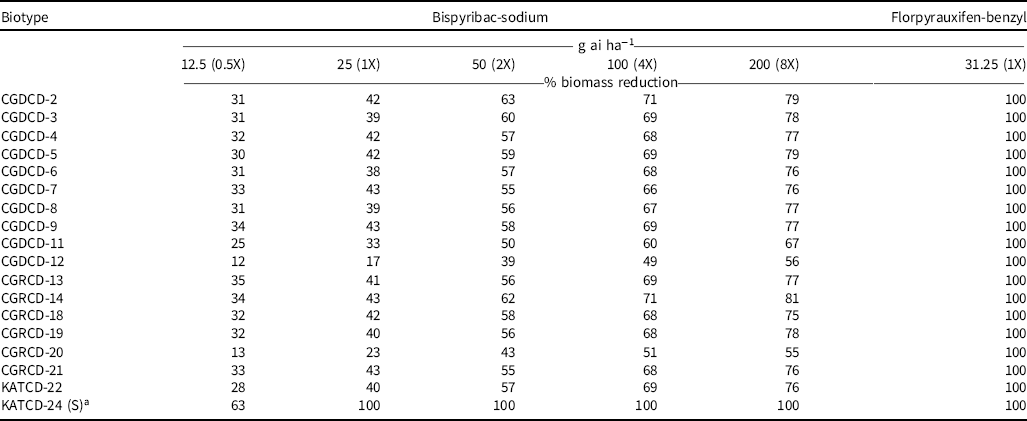
At 21 DAHA, bispyribac-sodium applied at the labeled rate (25 g ha−1) controlled putative resistant biotypes of smallflower umbrella sedge ≤60% (Table 1). The lowest control was observed in biotypes CGDCD-12 (19%) and CGDCD-20 (21%) (Figure 2). Similarly, the aboveground dry biomass in putative resistant biotypes was reduced by only 17% to 43% with the 25 g ha−1 rate (Table 2). The known susceptible biotype KATCD-24 was controlled 100% with the 25 g ha−1 (1X) rate of bispyribac-sodium. Based on visible control, ED50 of susceptible biotype KATCD-24 was 10 g ha−1 (Table 3). Conversely, for most of the putative resistant biotypes, ED50 ranged from 19 to 96 g ha−1. This was 2- to 10-fold higher than for the susceptible biotype. For biotypes CGDCD-12 and CGDCD-20, the ED50 was beyond the maximum tested rate of 200 g ha−1, which suggests those two biotypes were more than 20 times resistant to bispyribac-sodium compared with susceptible biotype.
Dose–response curves of selected bispyribac-sodium-resistant and bispyribac-sodium-susceptible (S) biotypes of smallflower umbrella sedge based on visible control data at 21 d after herbicide application.

Biomass reduction in smallflower umbrella sedge compared with the untreated control at 21 d after herbicide application.

a Susceptible biotype.
Estimates of the bispyribac-sodium dose required for 50% control of smallflower umbrella sedge biotypes and resistance levels at 21 d after herbicide application.a

a Abbreviations: ED50, effective bispyribac-sodium dose required to control 50% of the population; GR50, bispyribac-sodium dose required to reduce biomass by 50%; S, susceptible biotype.
b ED50 value estimates for visible rating were generated using the two-parameter log-logistic model. Standard error is given in parentheses.
c The resistance index was calculated by dividing the ED50 or GR50 value of the resistant biotype by that of the susceptible biotype KATCD-24 (S).
d GR50 value estimates for biomass reduction were generated using the two-parameter log-logistic model. Standard error is given in parentheses.
Similarly, the GR50 in the putative biotypes was much higher than the labeled rate. The GR50 values for most of the putative biotypes ranged from 31 to 60 g ha−1, and it was 120 and 112 g ha−1 for resistant biotypes CGDCD-12 and CGRCD-20, respectively. The GR50 for susceptible biotype KATCD-24 was 12 g ha−1, which suggests 2.6- to 10.2-fold resistance in putative resistant biotypes. Various resistance levels of smallflower umbrella sedge have been reported in different parts of the world. In a study conducted on putative resistant biotypes collected from Italy and California, up to 15.3-fold resistance levels were reported (Merotto et al. Reference Merotto, Jasieniuk, Osuna, Vidotto, Ferrero and Fischer2009b). In another study conducted on suspected ALS-resistant smallflower umbrella sedge populations in Arkansas rice, much higher resistance (>69-fold) to bispyribac-sodium was reported (Tehranchian et al. Reference Tehranchian, Riar, Norsworthy, Nandula, McElroy, Chen and Scott2015). In that research, the reported ED50 was as much as >1,120 g ha−1 of bispyribac-sodium.
With increasing bispyribac-sodium rate, the control and biomass reduction increased in all putative resistant biotypes. With the 200 g ha−1 rate (8X), most of the biotypes were controlled 63% to 95%, and their aboveground biomass was reduced by 67% to 81%. With the 200 g ha−1 rate, the maximum control achieved in resistant biotypes CGDCD-12 and CGRCD-20 was only 30% to 32%, and biomass reduction was 55% to 56%. The predicted control of these two biotypes with the recommended label rate of 25 g ha−1 was only 20% and 24%, respectively (Figure 2). However, florpyrauxifen-benzyl at 31.25 g ha−1 completely controlled all putative BR smallflower umbrella sedge biotypes (Tables 1 and 2). Similarly, in a greenhouse study in Arkansas, USA, florpyrauxifen-benzyl at 30 g ai ha−1 effectively controlled smallflower umbrella sedge (95%) compared with other herbicides available in rice, such as halosulfuron (10%), which is an ALS-inhibiting herbicide (Miller and Norsworthy Reference Miller and Norsworthy2018). This suggests that florpyrauxifen-benzyl could be used as an alternative option to control smallflower umbrella sedge that is resistant to commonly used ALS-inhibiting herbicides.
ALS Enzyme Activity Assay
At 6 DAHA, with 25 g ha−1 of bispyribac-sodium rate, ALS enzyme activity in putative BR biotypes was reduced to 63% to 71% compared with the untreated control (Table 4). In other words, 63% to 71% of ALS activity still persisted in those biotypes. Conversely, ALS activity was reduced to 52% in susceptible biotype KATCD-24. This indicates that ALS of the putative BR biotypes was considerably less sensitive to bispyribac-sodium than ALS of the susceptible biotype. Similar studies conducted on smallflower umbrella sedge biotypes from Arkansas, California, and Italy also reported an ALS enzyme activity–based resistance mechanism (Merotto et al. Reference Merotto, Jasieniuk, Osuna, Vidotto, Ferrero and Fischer2009b; Osuna et al. Reference Osuna, Vidotto, Fischer, Bayer, De Prado and Ferrero2002; Tehranchian et al. Reference Tehranchian, Riar, Norsworthy, Nandula, McElroy, Chen and Scott2015). Changes in sensitivity of ALS enzyme to ALS-inhibiting herbicides suggest an altered target site (mutations at the binding site of the herbicide on the ALS enzyme) as the possible mechanism of resistance (Guttieri et al. Reference Guttieri, Eberlein and Thill1995; Wright et al. Reference Wright, Bascomb, Sturner and Penner1998). In the present study, enzyme activity further declined with increasing bispyribac-sodium rate in all tested biotypes, but the rate of decline was greater in the susceptible biotype compared with putative BR biotypes. On average, ALS enzyme activity in BR biotypes was reduced to 58%, 46%, and 35% with 50, 100, and 200 g ha−1 rates of bispyribac-sodium, respectively. In the susceptible biotype, it was reduced to 42%, 36%, and 32% with 50, 100, and 200 g ha−1 rates, respectively. Medium to highly resistant biotypes (CGDCD-11, CDDCD-12, CGRCD-18, and CGRCD-20) managed to maintain ALS enzyme activity at 39% to 40% even with the highest rate of bispyribac-sodium (200 g ha−1) (Figure 3). There was a strong correlation between control or biomass reduction and ALS enzyme activity in all putative BR biotypes (R = −0.90 to −0.99). However, the differences in ALS enzyme activity within the putative BR biotypes at different bispyribac-sodium rates did not clearly explain the high level of resistance observed in a few biotypes in the whole-plant dose–response assay. Similar to our findings, Tehranchian et al. (Reference Tehranchian, Riar, Norsworthy, Nandula, McElroy, Chen and Scott2015) also reported differences in resistance levels of smallflower umbrella sedge to halosulfuron determined through an ALS activity assay and a whole-plant dose–response assay. This may suggest involvement of other mechanisms of resistance, such as reduced absorption or translocation and increased sequestration or metabolic degradation, which needs to be further investigated.
ALS enzyme activity in resistant and susceptible biotypes of smallflower umbrella compared with the untreated control at 6 d after herbicide application.

a Susceptible biotype.
Acetolactate synthase (ALS) enzyme activity in selected bispyribac-sodium-resistant and bispyribac-sodium-susceptible (S) biotypes of smallflower umbrella sedge compared with untreated control at 6 d after herbicide application.

In summary, this study confirmed that several biotypes of smallflower umbrella sedge in India evolved at least 2- to 20-fold resistance to bispyribac-sodium. This is the first case of smallflower umbrella sedge resistance to bispyribac-sodium in India. Even though the study indicated altered target site as a mechanism of resistance, further studies are needed to determine physiological and molecular bases of resistance. Smallflower umbrella sedge has a history of quickly evolving resistance to ALS-inhibiting herbicides. It was reported that resistance to bensulfuron-methyl in California had evolved within four consecutive seasons of its first use (Pappas-Fader et al. Reference Pappas-Fader, Turner, Cook, Butler, Lana and Carriere1993). Hence, even though this is the first reported case bispyribac-sodium resistance in smallflower umbrella sedge in India, this resistance may rapidly spread throughout the country within a few years. Repeated use of bispyribac-sodium over years coupled with faulty application practices was the main reason for resistance evolving. Therefore, best management practices such as rotating herbicides with different sites of action, using multiple sites of action, and strictly following label recommendations for rate and time of application are needed to delay resistance. The newly developed synthetic auxin herbicide florpyrauxifen-benzyl effectively controlled all putative BR biotypes at the labeled rate and can be used as an alternative herbicide to control biotypes that are resistant to bispyribac-sodium.
Acknowledgments
The authors are grateful to Corteva Agriscience (formerly Dow Agro Science Pvt. Ltd.) for providing funding for this research. The authors declare that there are no conflicts of interest.