Situating my voice and my ear in the south of Italy, from where I write, in this article I aim to discuss the sonorous corporealities that bring into motion ‘the Mediterranean question’.Footnote 2 For those who, like me, grew up on the Mediterranean shore, this sea is first of all a space of multiple cultural belongings and coexistences – Mare nostrum, il Mare, la Mer, al-Bahr al-Mutawassit. It is a dynamic polyphony that never ends its challenge, even more so nowadays, as one of the principal hubs for mass migration to Europe; it demands that other critical positionalities hear its difference. In terms of political positioning, I acknowledge that the so-called ‘migration crisis’ is not an accidental phenomenon (in many cases it has been described as an external force posing the threat of ‘invasion’ of Otherness into Europe), but rather it is a structural event deeply constitutive of European political and cultural development and directly linked to the racist and colonial legacies of Western exclusionism.Footnote 3 In the here and now of the ongoing migrant crossings, the communicative impact of sound and movement, emerging from the performance practices I observe and listen to, negotiate alternative proximities for the making of a more multiple Mediterranean.
This writing dwells on the thresholds of participatory dance projects, choreographic experimentations, and video-dance works. I begin with the international Migrant Bodies–Moving Borders (MB–MB) research project, supported by the EU Creative Europe programme, which offers examples for the inclusion of refugees and migrants through ‘polyphonic’ dance-based initiatives.Footnote 4 I approach, then, the choreographic ‘common’ sound and gesture searched for by the Italian choreographer Annika Pannitto in her work On Hospitality. When the liquidity of the sea transmigrates to the watery materiality of the screen, I discuss the virtual mobilization of international performance artists participating in the Open Borders project: a call for ‘contact’ launched online by the International Video-Dance Festival of Burgundy as a reaction to the refugee ‘crisis’ in Europe. Water becomes a sonic space of mutual recognition where dancing communities turn to and perform gestures of solidarity. Among the many performances submitted to the festival via an online call, I briefly focus my attention on the video-dance work Liquid Path, where Filomena Rusciano's sonic-body art envisions a female Mediterranean hospitality. The performative act of dancing migration and making sound is at last identified in the Montreal-based percussive dance work of Sandy Silva and filmmaker Marlene Millar: Migration Dance Film Project. In this final example, ‘trans-Mediterr-Atlantic’ corporealities reflect upon global issues of displacement by generating rhythms and sounds that are choreographed in resonance with those bodies currently moving across the diverse maritime stages.Footnote 5
This article mainly relies on the philosophical-sonorous essay Listening, by Jean Luc Nancy, which places attention on receptivity, or the ability to ‘understand’, embody and be open to an acoustic connection inside/outside the self.Footnote 6 There are two senses that I would like to borrow from Nancy's Listening. First, the concept of ‘sonorous body’, and, second the ‘resonance’ trace appearing in each act of listening. Nancy treats the body, ‘before any distinction of places and functions of resonance, as being, wholly … a resonance chamber’.Footnote 7 This is because the penetrating force of sound ‘through the ear propagates throughout the entire body’, and generates a perceived effect that does not occur visually.Footnote 8 As a result, in its corporeality, the body always resounds: it is sonorous/sonorized in the sense that it undertakes a ‘simultaneous listening to a “self” and to a “world” that are both in resonance’.Footnote 9 Nancy's thought also revolves around the idea that sound is made of referrals and that it spreads in space. ‘Resonance’, ‘repetition’, ‘repercussion’, rebrousement: the coming-and-going reverberating quality is unique to the sonorous. It is the dimensionless point of re- of the sound, and of its turning back, that is particularly interesting for the acoustic and bodily performances that I want to present. Sound rebounds from one body to another, one in the echo of another, which makes more sound and allows different Mediterranean and trans-Mediterranean soundscapes to take form through the ear.Footnote 10 Between the aural and the corporeal, then, I ask, what are the resonances occurring between the migrant – the foreign, the other – crossing the Mediterranean on a desperate journey, and the Euro-Mediterranean citizen, earwitnessing these tragic crossings from the other shore?Footnote 11 How do we register their encounter, often portrayed as a clash, without reperforming the colonial and racist divide? What are the sonorous reciprocities involved in these cultural, political and performative phenomena? The exercise of listening ‘differently’ here becomes a critical gesture in recognizing what exceeds and disturbs the stability of our Mediterranean sounds and movements. The cultivation of a politics/poetics of listening, therefore, is as advanced as the relational approach of sensing the bodily dimension of the self and the other – each on the ear of the other – and for finally reclaiming performance practices of hospitality and solidarity for the ones who arrive unexpectedly on Mediterranean shores.Footnote 12 Being a woman, researcher, and Euro-Mediterranean citizen, my ‘politics of location’ in this exercise claims to avoid falling into the trap of speaking ‘for’ the other, the migrant, the artist.Footnote 13 This would be an imperialist move that cannot be repeated. Rather, my aim is ‘listening and learning from what arrives from the seemingly elsewhere’, as the post-colonial scholar Iain Chambers suggests.Footnote 14 More relevant still, as the feminist Trinh T. Minh-ha teaches us, my intent is not to ‘speak about’, but to be ‘nearby’.Footnote 15
Polyphonic gestures
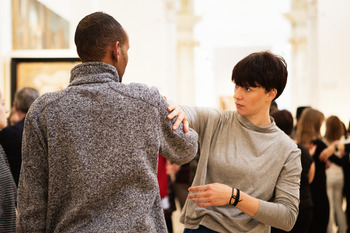
MB–MB is an act of extending oneself into another person's situation. It is an international research project ‘focused on identifying and developing new and relevant actions for the inclusion of refugees and migrants through dance and movement-based initiatives’.Footnote 16 The research started in 2017, and since then it has connected asylum seekers and migrants with local communities in the four participating nations – Austria, Croatia, France and Italy. The first workshop took place in Bassano del Grappa (Italy) in February 2018, and started with body interviews as a means of introducing the international choreographers – Andrea Rampazzo, Katharina Senk, Jordi Gali and Žak Valenta – to the workshop participants. The practice, in which both choreographers and participants were invited to produce a physical response to a received gesture which is intended as a question (see Fig. 1), is explained by Selamawit Biruk, an Ethiopian visual-art student involved in the workshop as photographer: ‘In body-interviews, they [participants and choreographers] close their eyes … It was such a great [thing] because they just answer what they feel immediately with their body … like a moment of truth, it was communicating with people without any words’.Footnote 17
Migrant Bodies–Moving Borders, body-interviews during the first workshop in Bassano del Grappa. Photograph by Selamawit Biruk (2018), copyright Operaestate Festival (Comune Bassano del Grappa).

To disseminate the difference at play, MB–MB has recently released an online publication. At its core, there is a ‘polyphonic glossary’: the gathering of a hundred words written by fifty participants and collaborators as a way to capture the intensity and the diversity of their involvement in the project. From A to Z, the glossary reveals the strategic use of dance as an art form able to dismantle prejudices and preconceptions and to perceive all the complex facets resonating with migratory issues through body movement. Roberto Casarotto, for instance – an Italian coordinator of MB–MB – indexes ‘Performance’ as the ‘Gesture of hospitality, it teaches how to be together, how to experience together’.Footnote 18 The African American choreographer Nora Chipaumire, guest artist of the project, defines ‘Dignity’ as ‘The right to be silent – the right to opacity – the right to refuse to answer to anything’.Footnote 19 Her words recall the ‘right’ claimed by Édouard Glissant for the foundation of the Poetics of Relation, an ethical stance against imperial conquest and domination.Footnote 20 In Chipaumire's definition, ‘opacity’ expresses the potentiality of silence, appealing to a ‘dignified’ affirmation of multiple perspectives impossible to reduce to a univocal and transparent sound.
Dancing migration, or, more precisely, putting collective memories of forced displacement in motion, generates survival strategies, political activism and, eventually, practices of corporeal hospitality in the new places of arrival.Footnote 21 Migration shapes dance performance and its reception. It is in this aim that projects like MB–MB help to deconstruct stereotypes erected around the receptivity of the migrant body in the way it circulates in the so-called ‘spectacles of illegality’ occurring at European borders.Footnote 22 Responding to the question ‘what is a migrant body?’, Canadian choreographer Mélanie Demers, participant in MB–MB, replies,
I think of a migrant body and I instantly see smugglers, containers, floatable boats, and abandoned suitcases … I think of modern slavery … I think of a migrant body and I see the intricacies of a personal story and the complexity of the great history that can bring a person to pack, to leave behind, to hope for the best, to regret, to expect … I think of a migrant body and I see movement … or someone dancing. For the sake of it. Unapologetically human.Footnote 23
The ‘complexity of the great history’ mentioned by Demers is directly registered on the migrant body: what he/she represents in the present. Migrants’ bodies, indeed, recall the ‘watermark of a colonial past invariably forgotten and repressed’ by Europe, a past ‘re-ignited in the clandestine histories of today's migrants who return to shadow the complex coordinates of the modern world’.Footnote 24 This means, quoting Brandstetter, Egert and Hartung, that ‘[i]n dance, the specific cultural and corporeal sensitivities of these traveling, migrating bodies can serve both as motive and motivation for critical and sometimes even existential questions, eventually leading to new aesthetics’.Footnote 25
Throughout the MB–MB research process, one of the recurring interrogations among the organizers was, ‘How can we put ourselves in a non-dominant position? How can we … set something in motion without imposing anything?’Footnote 26 The polyphonic work carried out for the construction of the performance, Babel, by Catalan choreographer Jordi Gali, provides some answers in this direction. The project was conducted with a group of families living at the Centre d'hébèrgement d'urgence migrants, and with local citizens and dance enthusiasts – ‘each carrying with them different stories, backgrounds and concerns’.Footnote 27 The aim was to build Babel, a twelve-metre-high tower made out of wooden sticks tied together by ropes, in just a few hours. All the participants were first invited to build modules in small groups, and then assemble the structure. In this collective environmental choreography no words were used. Instead, listening to the other's corporealities, moving and ‘being in tune, paying attention to the group's energy’, was enough to piece together the various elements.Footnote 28 ‘Tensegrity’ – the physical law in which a structure stands because forces are equally joined from opposite directions – is the movement that activates the construction for Babel.Footnote 29 Thus the principle standing at the heart of this performance reproduces the equivalent of a polyphonic sonorous piece in which several independent voices are layered over each other to create a complex interplay of harmonics. In other words, several communicating bodies think of ‘tensegrity’ to build a movement, a gesture, to combine forces from different and non-dominant positions, in order to hold something in the centre. The project came to its final form at La Briqueterie in Vitry-sur-Seine, and here the resonance of the body comes into play. The performance choreographs the condition of being in resonance, which occurs – unlike the ‘babelic’ physical configuration onstage – through ‘silence’. In Nancy's Listening, ‘Silence in fact … must here be understood not as privation but as an arrangement of resonance’; in Babel the perfect condition of silence is enacted, allowing the participants to hear their own body resonate across difference.Footnote 30
On Hospitality: the construction of the ‘common’
Among the ‘concrete and essential’ sound of percussions, Annika slowly starts moving her arm. She cuts, touches, embodies the air producing a singular soundscape. Nearby, Elisa makes her entrance into the relational space. In a constant state of research, Annika and Elisa's corporealities listen to each other, faced with the tension of giving up the property of one's movement and the desire to share that same movement. Gentle gestures flow from dancers to audience in the process of constructing a ‘common’ space/time and sound/gesture for ‘living together’.Footnote 31
The above description is the ‘sense’ I hear when I encounter On Hospitality: A Practice of Living Together, a choreographic project by Annika Pannitto, performed with Elisa D'Amico. The work is the outcome of the Piazza Project developed between 2015 and 2018.Footnote 32 Piazza – the ‘square’ or open architecture designed for community gatherings – is the starting point for questioning whether the space of a dance event is to be considered a zone ‘equally accessible to the producer (the dancer, the choreographer) and the receiver (the spectator) [which can] be shared as an object of knowledge’.Footnote 33 Pannitto is inspired by Paolo Virno's definition of ‘common’, which ‘is not a static object but a sort of movement that dynamically passes between “us”’.Footnote 34 In this light, the choreographer develops a constant shift of focus from the body that makes space through movement (from José Gil's ‘the space of the body’: ‘The dancer does not move in space, rather, the dancer … creates space with his movement’) and the movement as an object itself, a materiality/property to be shared.Footnote 35 Her starting question is, ‘How can one generate the common through a dance?’ One of the ‘things to do’, says Pannitto, is to experiment with working modes of ‘listening’ as an exercise of imagination:Footnote 36
If I listen, which is, I am attentive and rigorous about what happens in my body when I move, I can somehow establish a dialogue with my own dance … On the other hand, listening to the movement means also to be in tune with the other, and the audience, where all other kinds of movements are happening at the same time.Footnote 37
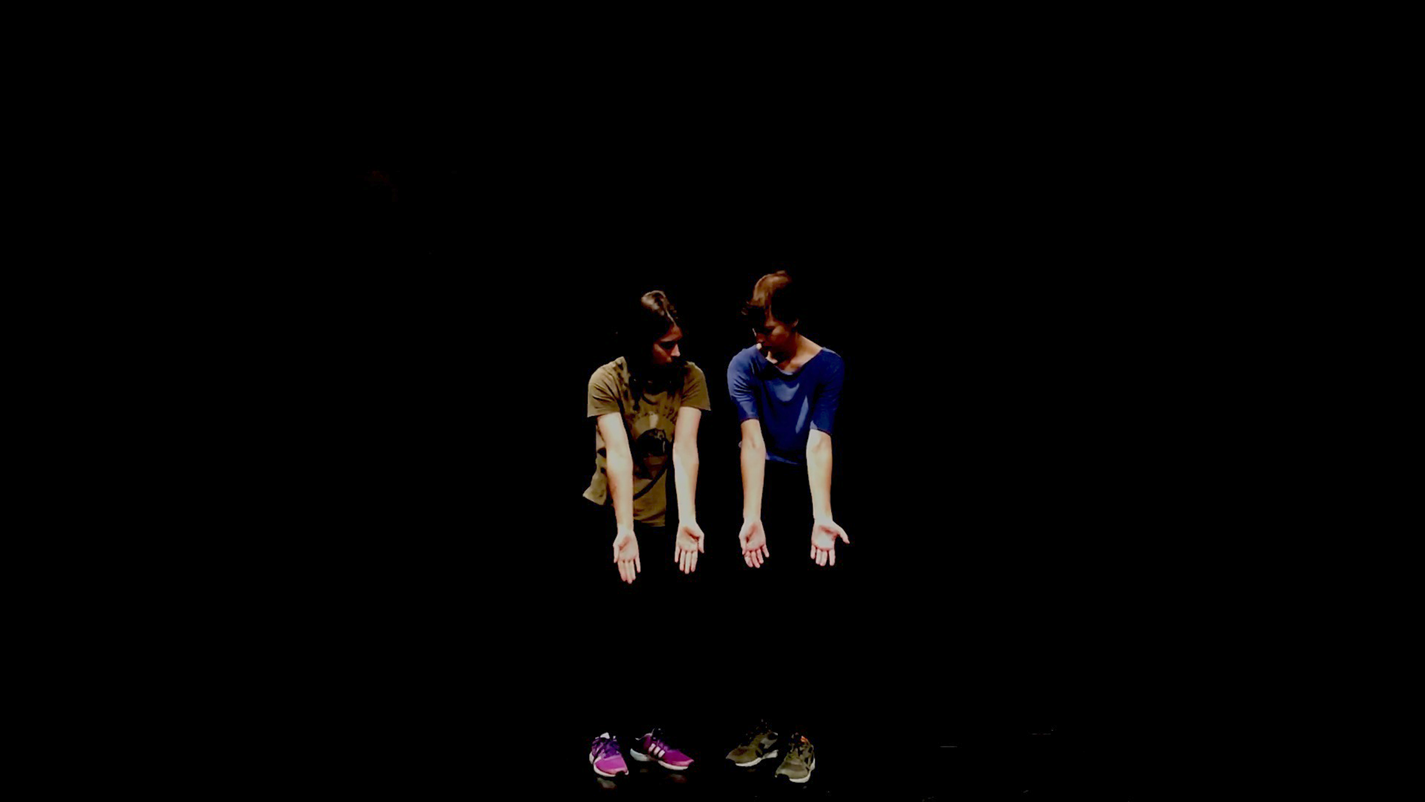
By converging on a special ‘sense’ of listening, Annika's choreographic thinking finds a corporeal access to the notion of hospitality. In Listening, Nancy perceives sound not as an ‘object’ but as a ‘sense’, and listening is not the first step in a process of signification but an ‘activity’ prior to signification.Footnote 38 If the act of listening to specific sounds and gestures always evokes, in Nancy's words, ‘The difference in sense … the condition of its resonance’, then the receptive sensory apparatus works for engendering practices of hospitality.Footnote 39 Between the aural and the corporeal, On Hospitality deals with a series of actions concerning questions of ‘property’, ‘belonging’, and ‘making space for the other’ (see Fig. 2 below). Influenced by Jacques Derrida's notion of hospitality (and more specifically by the notion of ‘unconditional hospitality’ which signifies a radical openness to an absolute and indistinguishable other), the choreographer is aware of the fact that this work could be their ‘contribution to the debate on migration and its management’.Footnote 40 In terms of movement research, Pannitto explains that:
[s]tarting from the basic element of sharing a performative space, we are reflecting on how the practice of hospitality can be used as a means to make the common … The leading thought has been: if I want to host the other, I should be clear about the rules (the organization of the movement) of my house … we used the exercise of ‘tuning’ to enter the other's organization of the body parts and sense of rhythm and space. The goal has not been to imitate the form produced by the other but to get information from the other.Footnote 41
On Hospitality, Annika Pannitto and Elisa D'Amico in their search for ‘making the space for the other’. Photograph by Kim Schonewille (2018).

A stream of words and sounds pulses through the performativity of this piece (absence of punctuation intentional): ‘…*hospitality is a physical experience *hospitality is time sharing *hospitality is a space that is unpredictable *hospitality blurs boundaries’.Footnote 42 Inside and outside the Mediterranean space and time, beyond the difference that lies between national, gender and identity boundaries, the two corporealities seem to produce an accessible and negotiable choro/sonorous environment. Between otherness and togetherness, shared between performers and audience, the stage becomes the exposure of a spatial architecture that hosts difference. Derrida claims that hospitality, like deconstruction, is an event ‘to come’, based on its very ‘im-possibility’.Footnote 43 Does the aporia of hospitality ‘to come’ take place in Annika and Elisa's common dance? The quality of their Mediterranean choreographic ritual invites the viewer/listener to encounter the ephemerality which re-sounds in the transformative condition of being-together of the event itself. On Hospitality thus assumes a phantasmal quality which constitutes a sensible memory that persists even when the event dematerializes. Their attentive motion stays on in the advent of a promise – what Derrida calls l’à-venir – addressed to who/what will ‘arrive unexpected’.Footnote 44 Will we be able to listen to their sound?
Listening/touching water
If ‘to listen … is to touch the work in each part – or else to be touched by it, which comes to the same thing’, as Nancy remarks, then all senses touch each other – ‘by touching, [they] put into play the whole system of senses’.Footnote 45 My attempt here is to extend the potentiality that resides in the performative act of listening, making it resonant with the cultivation of another sense and form of touching. To touch is here understood as the sonic–bodily gestures that co-create experiences of reciprocity through and with water. Recognizing the fact that someone is touching and is touched in return opens new sensorial ways of perceiving Mediterranean soundscapes – that is, to live and hear Mediterranean waters, and its multiple bodies of water, continually exceeding their sonorous and linguistic boundaries.
A kind of watery soundscape is produced by the multiple corporealities participating in the assemblage of Open Borders, the collective dance film project produced by the Video-Dance Festival of Burgundy after the dreadful shipwreck of more than three hundred migrants off the shores of Lampedusa in 2013.Footnote 46 Responding to a viral online call, trans-Mediterranean and Mediterranean artists were asked to submit forty- to fifty-second films, addressing concepts such as ‘borders’, ‘inclusion’, ‘asylum’, and ‘solidarity’. The video gestures were then edited together to co-create a longer film made of plural audio-visualities to be shared at festivals and through open access on the Web.Footnote 47 From Greece, Italy, Spain, Croatia, Belgium, Hungary, Switzerland, Germany, the UK and many other countries, several gestures and sounds were captured on the screen to host movements of escape, oppression and fear, but also of desire, hope and survival, in ‘tune’, or in ‘contact’, with the refugees who crossed and still cross the Mediterranean waters. Many performers chose the sea or other bodies of water as powerful sound sources for choreographing their gesture. In Drifting, for example, the dancer Natalia Barua searches for a way out of a dense forest, trapped in an inhospitable environment, as if she were on a boat surrounded by unknown water. Watery sounds inform and affect the auditory experience of this short video: something/somebody drifting can be heard coming closer and closer, waiting to be rescued.Footnote 48 As eco-feminist scholar Astrida Neimanis suggests in her theorization of an imaginary hypersea where ‘everything touches everything’, ‘We are not only bodies of water, but bodies in water, in different ways, as well’.Footnote 49 Water, indeed, ‘in its various mixtures, articulates sounds … and other matters between and across bodies’; water ‘conduits as [it conveys] streams of refugees upon ocean currents’.Footnote 50 Performing Neimanis's hydro-logics, the sonic waters of the Mediterranean imaginary extend and comprise the entangled choreographies of Open Borders, which still remain on the limit of a touch which is never grasping, never appropriating or penetrating what is touched. The editing ‘cut-and-mix’ style of Open Borders emerges from an attempt to listen to and touch what moves inside and beyond the politics of exclusion of the Euro-Mediterranean law, and it is supported by the desire to perform the right of hospitality that breaks with that law.Footnote 51 The rapid diffusion of these gestures in the liquid, non-hierarchical and deterritorialized sphere of the Internet allows the congregation of a hydro-dancing community that dissents against the European agendas of mobility control on Mediterranean borders. If hospitality means to touch and to be touched by the foreigner, then the watery bodies and sounds of Open Borders actualize a way to receive the other in a shared ecology of coexistence, or a co-gesture that happens between ‘touch’ and ‘separation’. For Nancy, this tension is the whole point about touching, and here it is realized between the touch of sounding corporealities where ‘the foreign contact’ draws near, although her/his touch remains ‘foreign in that contact’, always spaced and displaced.Footnote 52
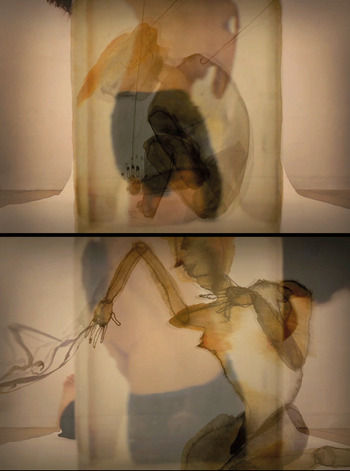
A similar tension, and desire, also return in Liquid Path, danced by the Italian choreographer Filomena Rusciano, who opens her work with the following words: ‘I embodied the migrant's courage, I wore her clothes, her hope, floating in the sea. Unsettled as a message stored in a bottle, I travel towards uncertain paths’.Footnote 53 Liquid Path plunges the viewer/listener into other watery soundscapes: sea waves and impalpable marine flows define the liquid vibrations produced by the moving body. Indeed, as Rusciano moves inside/out of a glass bottle, her body becomes blurred, opaque, almost as untouchable and ungraspable as the water. Through the experimental dissimulation of her bodily gestures into watercolour, Rusciano dilutes abstract movements and maritime rhythms on the digital screen. In doing so, she affirms the urgency of another sense, the necessity to consult a different corporeal and sonorous map of irregular routes and unusual trajectories.
In the act of listening and perceiving migrant alterity, at some point, Rusciano receives from the outside another water-based body (see Figs. 3, 4). The female body extends herself and seems to host, in a womblike environment, the liquid shape of a presence not yet born. This is a scene of gestation, the very first experience of hospitality and of listening. As Nancy declares, the ‘womb-matrix’ always already constitutes a specific space of resonance:
What is the belly of a pregnant woman, if not the space or the antrum where a new instrument comes to resound, a new organon, which comes to fold in on itself, then to move, receiving from outside only sounds, which when the day comes, it will begin to echo …?Footnote 54
In tune with the philosopher, Rusciano's gestational choreography suggests that, ‘womblike, it is always in the belly that we all end up listening, or start listening’.Footnote 55 It could be argued that the sounding corporealities of Liquid Path align with the multitude of disembodied ‘no-bodies’ – the anonymous corpses dispersed in the necropolis of the Mediterranean today. If this contact is imaginary, this sonic body of water connects with the not-yet-born, with the ones who have survived the transit, and with the ones who are now paving their existence into the new geographies of arrival. At the time of this writing, many corporeal stories remain unheard and wait to be listened to. It is the reason why we need to invent, now more than ever, new sonic and corporeal architectures for listening and performing hospitality, and in which lives might be unconditionally respected and saved.Footnote 56 From one of the many shores or borders, our ear should be stretched towards what Boaventura de Sousa Santos calls ‘deep listening’ as a corporeal activity and as a source of knowledge in the epistemologies of the South; only with other sensory methodologies will we be able ‘to listen to the voice of the movements’, listen to the ‘inaudible’, and eventually construct new practices of sharing.Footnote 57
Liquid Path: Filomena Rusciano's corporeality overlaps with another water-based body. Video-still by Rinedda (2013).

Dancing migration, making sound
Traversing the Mediterranean waters, borders and countries, we finally land on the alternative acoustic dance movements composed for the Migration Film Dance Project. This is the collection of a series of short films linked together into a fifty-two-minute production for theatrical release and broadcast. The project explores themes of migration, illustrating the complexity of transformative journeys: ‘Each chapter follows a cast of dancers and singers as they continuously travel, be it in hope of a better life, towards freedom, for survival … Song, rhythm, movement, architectural imagery and landscape combine to create a new form of choreographic storytelling’.Footnote 58
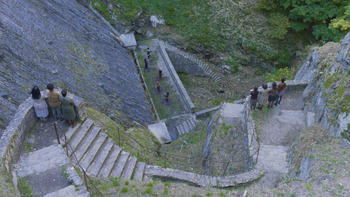
Two women guide the Migration Film Dance Project: Sandy Silva, a percussive choreographer, dancer and musician, and Marlene Millar, producer, director and editor of performance-based films with a background in contemporary dance. Their collaboration generates a plural storyline that gives voice, gesture and sound to past and current migratory experiences from a cross-cultural perspective. In this sense, the use of the expressive language is interesting inasmuch as percussive dance conveys both audible, visible, musical and physical languages (generally speaking the rhythmic drive comes from both acoustic instruments and performers playing their body) from different cultural, historical and geographical contexts.Footnote 59 Sandy Silva has travelled the world studying percussive dance and incorporating the diverse musical traditions she has encountered. Drawing upon influences ‘as diverse as Hungarian czardas, Spanish flamenco, gigue Québécoise (French Canadian step dancing) as well as the African-American and Appalachian dance traditions’, Silva has developed her own personal rhythmic vocabulary; in her choreographies she uses her body as an instrument in a musical ensemble making sounds to enhance the whole performance.Footnote 60 In the Migration Film Dance Project the act of listening is understood as a form of participation, and the sound event is a performance to be shared to connect the different corporealities involved, across differences of age, nationality, gender and social and artistic background. Therefore, the objective is to connect people to their bodies through rhythm, movement, music and listening to each other. In one of the first dance films of the project, entitled Migration (2015, 6 min.) and shot on an island in the Saint Lawrence Seaway, ten percussive dancers find themselves between two bodies of water, and under a stormy sky. They dance and make sound through sand, water and wind, interpreting the suspension of time spent waiting while in transit.Footnote 61 In another short film, Pilgrimage (2016, 10 min.), nine percussive dancers perform the transformative human experience of a collective journey, taking the audience on a rhythmic voyage through open farmlands, along parched roads, and across moonlit fields before finding refuge in a place of worship.Footnote 62 In the last work, Traverse (2018, 10 min.), the corporeal stories of five women form an energetically transitioning human landscape; their movement and sound find solidarity with the dynamics of other corporealities, those of other non-professionals dancers, who take part in the traversal, other strangers sharing a similar trajectory. They occupy and move through a massive, ancient wall, steps etched in stone, and a perilous bridge, making their soundscapes reverberate in multiple destinations and directions (see Fig. 5).Footnote 63 Since the project is still in progress, other stories will be set in motion and other sounds will be listened to, revealing correspondences between migratory narratives.
Traverse. Sandy Silva and four more women (Kimberly Robin, Hélène Lemay, Sonia Clarke, Afia Douglas) perform percussive dance on steps etched in stone (country of filming: France). Video still by Marlene Millar (2018).

From the Mediterranean to the Atlantic, the abstract quality of these percussive dances seems to communicate across time and cultures, weaving a more universal thread between forms from different contexts and spaces, signs and sounds. These ‘trans-Mediterr-Atlantic’ corporealities eyewitness and earwitness the migrant crossings of the Mediterranean waters and the many other geographical borders controlled and securitized all over the world, connecting themselves and the audience with a collective desire to move and to survive.Footnote 64 Still, in Nancy's words, what comes into play in this act of sharing is ‘[a]n unfolding, a dance, a resonance’.Footnote 65 That is, in their desire to be in communication, they dance migration and make sound.
Conclusion
Against the backdrop of some choreographic experimentations, this article has attempted to discuss the communicative impact of sounds and embodied practices generated by migration in the Mediterranean area. Migratory experiences are a political and cultural question, which, in my view, can be engaged through the very performativity of dance and sound itself. Dance is ‘migrant’ because of the erratic trace of choreography: the act of body-writing ontologically defers the established frame of comprehension elsewhere in an elsewhere, and serves as a dispositive for understanding experiences of migration, exile and diaspora.Footnote 66 In the same way Paul Scolieri proposes that ‘[t]he “dance world” is a nomadic one’, sound can be considered nomadic too.Footnote 67 In support of this view, the art historian Clémentine Proby relocates the expression ‘migrating sounds’ (usually referring to the ones that transmigrating birds make) to a human dimension, arguing that ‘[s]ounds are migrant per se … [this] makes them especially relevant to represent an experience of displacement’.Footnote 68 This sound-erratic trace actively resonates with the words of Brandon LaBelle, who, in Background Noise, affirms that ‘[s]ound performs with and through space: it navigates geographically, reverberates acoustically … inhabiting always more than one place … sound overflows borders’.Footnote 69 From the borders of my country, I have tried to stretch my ear towards some choreographic and sonorous figurations that migrate in and around the Mediterranean region, to investigate the resonances moving across this sea, and, hopefully, to perceive the potentialities of what Fred Moten names as a scene of ‘resistant objection’.Footnote 70 Between harmony and dissonance, the performance examples discussed here are desired acts of resistance. They choose to embody and dance gestures of corporeal displacement to make sound and resound both the production of new aesthetic languages and the proposal of alternative sensorial modes of inhabiting and cohabiting the Euro-Mediterranean geography – a complex cultural and political space that advocates for an exercise of historical counterdiscourse, a space that urges new practices for performing and experimenting with hospitality. Across the spectra of their technical differences, these events open the subjectivities of listeners to the one who arrives – which is always and still yet to come – who discloses new possibilities, new agencies and alternative proximities, thus creating the conditions of l’à-venir,Footnote 71 what resounds without any horizon of expectation in the multiple historiography of the Mediterranean.