





1. Introduction
The International Maritime Organization (IMO) adopted the Casualty Investigation Code (CI-Code) in 2008. According to the code, the function and purpose of marine safety investigation is to determine the truth, make future safety suggestions and prevent the occurrence of similar accidents, rather than to investigate responsibility or sanction negligence (IMO, 2008), Dekker (Reference Dekker2015) and Marine Accident Investigation Branch, MAIB (2024). The qualification requirements for marine safety investigators are as follows: basic education and marine work experience, appropriate training in human factor investigation, specialised knowledge required for investigation, and compliance with the training plan formulated by the authorities (IMO, 2020a, 2020b, 2020c). However, this specification is in fact just a suggestion; it has no mandatory force.
In short, the qualification criteria for marine safety investigators in most countries are currently based mainly on the requirements of education and experience. There are no specific studies on the differences in system establishment, appointment standards, training and assessment among countries. Therefore, it is difficult to further evaluate or demonstrate the fairness and effectiveness of the marine investigation process. In addition, the investigative reports produced are sometimes overly technical and unfavourable for general reading or provide an excessive amount of information (Johnson, Reference Johnson2002). Under this circumstance, the intricacy of follow-up may cause marine safety investigations to be too professionally stringent and unpopular, and fail to unravel the truth of incidents, or the front-line seafarers may not take the initiative to read the official investigation reports, posing an even greater obstacle to learning to improve the high-quality skills of seafarers (Mallam et al., Reference Mallam, Marit Wahl and Aas2022). According to the data and facts presented by the IMO Global Integrated Shipping Information System (GISIS) (IMO-GISIS, 2024a), many similar cases of dangerous accidents at sea continue to occur in the absence of related marine safety prevention measures. It seems that the international community has not made good use of reports on the results of marine investigations (Hovden et al., Reference Hovden, Størseth and Tinmannsvik2011). Although the IMO has required all countries to invest a large amount of resources into marine investigation, the results do not seem to have had the expected effect of prevention.
Globally renowned advanced marine countries have all established well organised domestic safety investigation teams (ATSB, 2024a, 2024b; MAIB, 2024; TSB, 2024). The investigation outcomes also comply with the mandatory and recommended requirements set by the IMO for member states under the CI-Code (IMO, 2024a). Their classification systems, procedures and regulations for case handling are comprehensive and serve as benchmarks for other countries to emulate (TTSB, 2025; Mallan et al., Reference Mallam, Marit Wahl and Aas2022). Over the years, by identifying causes in marine investigations, these countries have provided management authorities with a foundation to review and formulate more effective improvement measures, achieving significant results (Farid and Elashkar, Reference Farid and Elashkar2020). By collecting publicly available investigation reports from various countries, and comparing causes and experiences, domestic proactive safety management can be strengthened (Puisa et al., Reference Puisa, Lin, Bolbot and Vassalos2018). The primary and clear contributions of maritime investigations include enabling risk detection in the marine domain of vessels (Khan et al., Reference Khan, Yin, Mustafa and Shi2023), preventing similar incidents proactively (Antao et al., Reference Antão, Sun, Teixeira and Soares2023) and promoting a safety culture that complies with regulations (Abuelenin, Reference Abuelenin2017; Farid and Elashkar, Reference Farid and Elashkar2020).
In the study of marine safety investigation issues, there is currently no literature that comprehensively and systematically integrates and explores the complex topics related to individual differences among officials, fairness, professional competence, welfare and working environment, and the misuse of outcomes (Lin and Cheng, Reference Lin and Cheng2021; Wu et al., Reference Wu, Yip, Yan and Soares2022). Furthermore, during many marine investigations, when investigators face information provided by crew members, pilots, shipping companies, witnesses and others, they mostly have to adopt a stance of trust throughout the investigation process. In fact, it is quite common for many crew members to prefer to keep the peace or be unwilling to proactively provide information during case investigations (Baumler et al., Reference Baumler, Bhatia and Kitada2021; Hessel et al., Reference Hassel, Asbjørnslett and Hole2011). Compared with investigators in other industries, marine investigators must shoulder more expectations and responsibilities. Their appointment qualifications, future training and other aspects are of great importance to all countries.
This study aims to address the existing gap in the literature by focusing on the adjustment dimensions of official training programs. It incorporates the relevant regulatory frameworks and institutional systems of the IMO, and integrates both a comprehensive literature review and expert insights. Four key dimensions: investigators personal conditions, internal organisational limits, external effects and subsequent troubles of investigation reports, are identified as the primary influencing factors. By combining the Decision Making Trial and Evaluation Laboratory (DEMATEL) method with the Analytic Network Process (ANP) through the Decision Analysis Network Process (DANP) technique, this research derives the relative weights of the criteria. These weights are used to explore future directions for adjusting key evaluation indicators to identify optimal development strategies and recommendations. Additionally, the interrelationships and relative importance among the main dimensions and their associated criteria are thoroughly examined. Based on the analytical findings, it is recommended that government agencies, when designing future training programs for investigators, should consider adjustments in accordance with the aforementioned four key dimensions to enhance the domestic official training environment.
2. Literature review
2.1. The influence of personal conditions on training
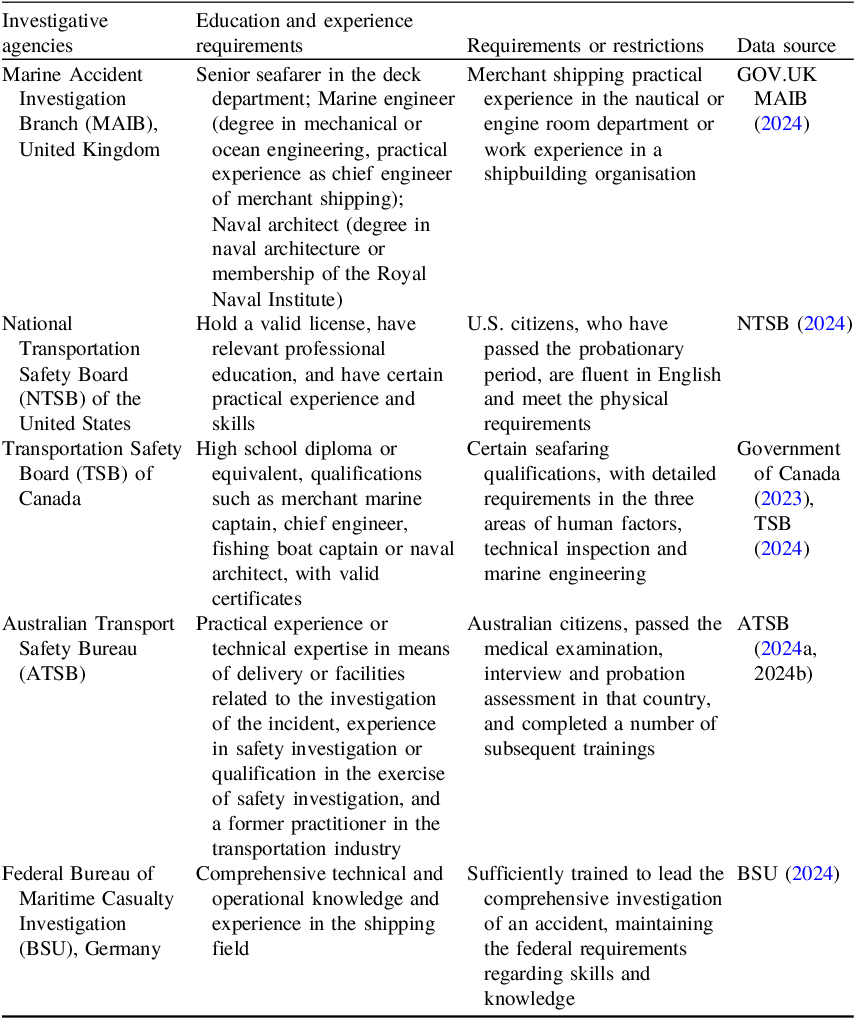
The IMO Resolution A.996(25) (IMO, 2020b) states that the skills required to become a qualified marine safety investigator are as follows: basic work knowledge and ability, practical experience in the field related to the investigation responsibility, and requirements required for investigation in the professional fields. In this paper, the stated terms and conditions for the appointment of investigators in major countries are collected and summarised in Table 1.
Qualification requirements for the appointment of marine safety investigators in some countries.

Table 1. Long description
A table comparing qualification requirements for marine safety investigators across different countries. The table has four columns: Investigative agencies, Education and experience requirements, Requirements or restrictions, and Data source. It contains five rows of data. Row 1: Investigative agencies: Marine Accident Investigation Branch (MAIB), United Kingdom; Education and experience requirements: Senior seafarer in the deck department; Marine engineer (degree in mechanical or ocean engineering, practical experience as chief engineer of merchant shipping); Naval architect (degree in naval architecture or membership of the Royal Naval Institute); Requirements or restrictions: Merchant shipping practical experience in the nautical or engine room department or work experience in a shipbuilding organisation; Data source: GOV.UK MAIB (2024). Row 2: Investigative agencies: National Transportation Safety Board (NTSB) of the United States; Education and experience requirements: Hold a valid license, have relevant professional education, and have certain practical experience and skills; Requirements or restrictions: U.S. citizens, who have passed the probationary period, are fluent in English and meet the physical requirements; Data source: NTSB (2024). Row 3: Investigative agencies: Transportation Safety Board (TSB) of Canada; Education and experience requirements: High school diploma or equivalent, qualifications such as merchant marine captain, chief engineer, fishing boat captain or naval architect, with valid certificates; Requirements or restrictions: Certain seafaring qualifications, with detailed requirements in the three areas of human factors, technical inspection and marine engineering; Data source: Government of Canada (2023), TSB (2024). Row 4: Investigative agencies: Australian Transport Safety Bureau (ATSB); Education and experience requirements: Practical experience or technical expertise in means of delivery or facilities related to the investigation of the incident, experience in safety investigation or qualification in the exercise of safety investigation, and a former practitioner in the transportation industry; Requirements or restrictions: Australian citizens, passed the medical examination, interview and probation assessment in that country, and completed a number of subsequent trainings; Data source: ATSB (2024a, 2024b). Row 5: Investigative agencies: Federal Bureau of Maritime Casualty Investigation (BSU), Germany; Education and experience requirements: Comprehensive technical and operational knowledge and experience in the shipping field; Requirements or restrictions: Sufficiently trained to lead the comprehensive investigation of an accident, maintaining the federal requirements regarding skills and knowledge; Data source: BSU (2024).
At present, the vast majority of marine investigators in various countries are government personnel by MAIB (2024), MAIIF (2014) and TSB (2024). The appointment and qualification requirements differ across countries, and individuals’ unique educational background, age, practical experience and investigation training lead to individual differences among investigators. The literature indicates that the personal background of investigators has a significant impact on work results (Li et al., Reference Li, Qian, Yang, Zheng and Wu2024). Aging accompanies a decrease in physical and mental load capacity, which leads to a decrease in investigation performance (Caporale et al., Reference Caporale, Botti, Galizia and Mora2022). In terms of marine investigations, the literature has focused mostly on suggestions for future prevention based on investigations by Gan et al. (Reference Gan, Ye, Huang, Xu, Chen and Shu2023) and Park et al. (Reference Park, Kim and Cheon2023). However, in the Praxeology field, decision-makers are not very rational and their psychology has a significant effect on decision-making (Liang et al., Reference Liang, Goh and Wang2020). For example, when police officers are granted discretionary power in investigations, their personal conditions will directly affect their behaviour on duty (Huff, Reference Huff2021). Zhu et al. (Reference Zhu, Yang and Jiang2023) find that previous studies seldom considered the uncertain impact of decision-makers’ psychological behaviour on inspection results, even though these factors may be linked. Many studies and experts agree that the personal conditions of investigators who exercise government power are already different, which affects their professional performance.
Most of the literature on marine investigators has neglected to address personal characteristics or conditions, such as work attitude and personality, stress tolerance for work on board, or experience in shipboard service on a single type of ship. Therefore, this paper proposes the importance of discussing investigators’ personal factors. This is an important theme discussed in this paper. For example, in addition to having unique academic backgrounds and practical experience, investigators have their own physiological and physical abilities and psychological factors, such as a sense of work mission and enthusiasm, which are worthy of in-depth investigation.
2.2. Restrictions within official organisations
Whether IMO member countries can provide investigators with powers and guarantees that meet international requirements depends on the extent of the national legislation of the convention (IMO, 2013). This is not an easy task because traditionally, in less-developed countries or vulnerable developing countries, administrative departments generally face the limitations of low wages, poor control and a lack of merit-based human resources (Nunberg and Taliercio, Reference Nunberg and Taliercio2012). When civil servants are satisfied with their salaries and can maintain work ethics and integrity, corruption and other problems can be curbed (Meyer-Sahling et al., Reference Meyer-Sahling, Schuster, Mikkelsen, Shrestha, Luitel and Toth2018).
Within governmental agencies, marine investigators and port state control (PSC) officials have similar problems. The implementation of the PSC system can entail challenges related to the authority, manpower and personal welfare of investigators. These are all internal issues of the official organisations (Yuan et al., Reference Yuan, Chiu and Cai2020). Studies have shown that it is often frustrating to hold a government position and employees can feel unable to fulfill their work potential and face so-called psychological powerlessness (Campbell et al., Reference Campbell, Lavallee and Kelly-Weber2021). In addition, people’s expectations of a civil servant are often not met and the cause of salary plays a very important role (Khanal et al., Reference Khanal, Gupta and Bhattarai2022). Chang et al. (Reference Chang, Ho, Liu and Chen2023) reported, for example, PSC officials and investigators in some countries are provided uncertain or inadequate protections, benefits, or support according to IMO requirements.
In practice, the salaries and benefits offered to officials in many countries are not high, and there is a significant gap compared with the salaries and benefits of the maritime industry (Anna et al., Reference Anna, Anna and George2019). However, investigators are required to be on call and on rotation around the clock. Therefore, under organisational budgetary constraints and in the absence of advantageous salary or benefits, it is difficult for government agencies to select excellent and talented individuals to become investigators. If government agencies must rely on only individuals’ conscience or sense of mission, an appropriate level of investigation is difficult to maintain and it is certainly difficult to maintain for a long time. This paper reveals that, while there are many marine transportation-related studies, there are few studies exploring this topic. This may be due to the unwillingness of interviewed investigators within the organisation to disclose details about the unfriendly internal work environment (Polyakova, Reference Polyakova2020). Although studies have proposed various factors that affect the work of officials, they have not discussed the internal situation of government agencies. Therefore, from the perspective of the literature overall, this paper suggests that when making adjustments to marine investigators’ competencies, more in-depth and pragmatic considerations should be made based on the criteria of the organisational system, welfare planning, appointment and career development, etc., to understand the subsequent impact on professional development.
2.3. The interference of external influences in investigation
Undoubtedly, human negligence is the major cause of most maritime cases (Ma et al., Reference Ma, Ma, Wang, Chen and Lan2024a; Mok et al., Reference Mok, D’agostini and Ryoo2023). The timing and location of marine disasters are often unpredictable, and the crime scene may be inaccessible. This is often the greatest difficulty faced by investigators. In addition, when marine cases occur, domino effects often arise, resulting in various injury outcomes (Wang et al., Reference Wang, Huang, Shi and Zhang2021). Therefore, investigators may encounter unexpected mixed cases at any time. In such cases, investigators can rely only on their navigation experience or on-site response capabilities.
In addition, at the scene of many marine accident cases, there are sometimes large-scale casualties and dangers, such as toxic substances and the resurgence of fire, during the investigation. There may been a need to extinguish fires, relocate items, conduct autopsy, or replace equipment or command posts (IMO-GISIS, 2018). Therefore, the self-protection, psychological quality, and communication and coordination abilities of investigators need to be fully demonstrated. In addition, if a case involves foreigners, the investigation must rely on the international cooperation of all countries (IMO, 2008). In some situations, cooperation can be carried out only after receiving notification and permission, and the investigation capacity and quality of investigators in other countries can hardly be controlled.
An important part of the investigation procedure is the interrogation of the parties concerned. However, if the person interrogated believes that they may be the perpetrator of the accident, they may hold back information, lie or deliberately fail to cooperate (Deslauriers-Varin, Reference Deslauriers-Varin2022). This is common and normal self-protection. The parties concerned definitely blur their focus, or after the party faces a major incident, they may be unable to support the investigation due to physical and mental trauma, distorted memories, or forgetfulness, which have all been confirmed in the medical literature (Jeavons, Reference Jeavons2000). In some cases, there may be no survivors, and only fragmented statements or relevant information from eyewitnesses may be provided, which may be the key to the case (Brewer and Doyle, Reference Brewer and Doyle2021). However, the correctness of the information and whether it can be used as evidence cause difficulties for the burden of proof in the investigation. Therefore, in marine investigations, there is a large component of external interference that cannot be grasped and predicted.
2.4. Difficulties during and after the investigation process
Objectively, the data show that many similar marine cases continue to occur around the world (IMO-GISIS, 2024a). After the completion of an investigation, the same dilemma emerges. First, the results of many investigation reports are unexpected, and subsequent corrective actions may be unable to be tracked because many marine safety recommendations are as suggestions and have no mandatory effect (CI-Code). At present, marine safety investigation reports are used only for academic discussion and study. The original investigator reports are seldom read by front-line seafarers. If they want to use the cases to learn and improve their navigation experience, shipping companies need to take the initiative to adapt and apply various types of data and information (Mallam et al., Reference Mallam, Marit Wahl and Aas2022). However, front-line seafarers are the real demanders and learners of investigation result reports. The current literature indicates that human error accounts for more than 80% of marine accidents. Therefore, marine human factor analysis has developed into a prominent science over the years (Lan et al., Reference Lan, Ma, Qiao and Ma2022; Ma et al. Reference Ma, Ma, Wang, Zhao and Lan2024b). How to enable the frontline seafarers who actually control ships to use the findings of investigation reports to increase their professional learning skills, learn from past mistakes and prevent the recurrence of marine cases is an important issue.
Some IMO member countries have entrusted external agencies to handle marine safety investigation matters (International Registries, 2024; Liberian Registry 2024), and there may be doubts about whether these agencies meet the IMO specifications and quality. In addition, despite the clear stipulations of the CI-Code, marine safety investigations do not criticise or punish actors for negligence. However, countries implement different forms and scopes of administrative power, especially in regards to complex issues of the marine industry (Vrancken, Reference Vrancken2019). Therefore, if the investigation results are used as the basis for the determination of negligence, abuse of the investigation results may also occur, which does not comply with the provisions of the CI-Code.
3. Challenges of international marine investigation
3.1. Barriers and challenges of international cooperation
In 2013, the IMO adopted legal documents regarding the implementation of the convention (IMO, 2013) to formally audit whether member countries have completed, as the flag state, the marine investigation obligation of ships and vessels, and supported cross-border cooperation in investigations in accordance with the specifications of the convention. However, more than one-third of the member countries, such as small island developing member countries or less-developed member countries, cannot keep up with international progress and need technical support and guidance (IMO Technical Cooperation, 2020). For example, a study pointed out that for Montenegro to join an inspection organisation in the European region, it must first complete its domestic legalisation, provide training for officials and offer sufficient support (Nikcevic, Reference Nikcevic2018). Developing countries can turn to advanced countries for valuable assistance in training official marine personnel (Yuan et al., Reference Yuan, Chiu and Cai2020). Some countries in Central and South America have limited ability to protect particularly sensitive sea areas beyond their jurisdiction and need the assistance of the IMO via international regulations (Rodríguez et al., Reference Rodríguez, Jiménez, Arce and Thompson2023), while the internal conditions of some countries entail advantages as well as difficulties that need to be overcome (Karahan and Kirval, Reference Karahan and Kirval2018). Therefore, there are certain gaps in the implementation of shipping practices among countries and some disadvantageous national conditions. In some cases, member countries have inconsistent understandings of the complex legal instruments of the IMO, have incomplete domestic legal systems (Nam, Reference Nam2021) or have not cooperated with the IMO to complete the current stage of mandatory audits (IMO-GISIS, 2024b). Because the IMO does not interfere with the management of member countries’ internal affairs, it has no coercive power over the member countries that do not actively promote safety investigations. Finally, it is uncertain whether the implementation capabilities or legal force of each country is sufficient.
3.2. Risks and restrictions arising from the investigation
Shipwrecks can occur anytime and anywhere, and shipwreck locations cannot be predicted. This makes investigations difficult for marine officials. As shown in Figure 1, although aerial cameras can be used for remote evidence collection, small boats can be used to approach an accident site from the seaward side or underwater vehicle technology can be used to provide support, there are still restrictions. Investigators must arrive at the scene before they can actually obtain information about the wreckage, records, voyage date recorder (VDR), etc. Therefore, harsh weather environments, such as reefs, coastlines with elevation differences, wind and waves, rain and snow, poor visibility, etc., limit investigators’ access to the scene and places them at risk. Unfortunately, sometimes when investigators arrive at the scene, the ship has already sunk, burned up or sustained severe damage, causing the disappearance of evidence; or the entire crew has been killed and no one can answer questions to help the investigators understand the circumstances of the case; all of these issues increase the difficulty and reduce the completeness of evidence collection (IMO-GISIS, 2018; Korea Maritime Safety Tribunal, KMST 2022).
(a) Scene where the evidence was lost. (b) Scene of witnessed casualties. (c) Evidence collected of an underwater wreckage after the incident. (d) A Scene that could not be investigated.

3.3. Challenges and dilemmas regarding the adjust of investigator training standards
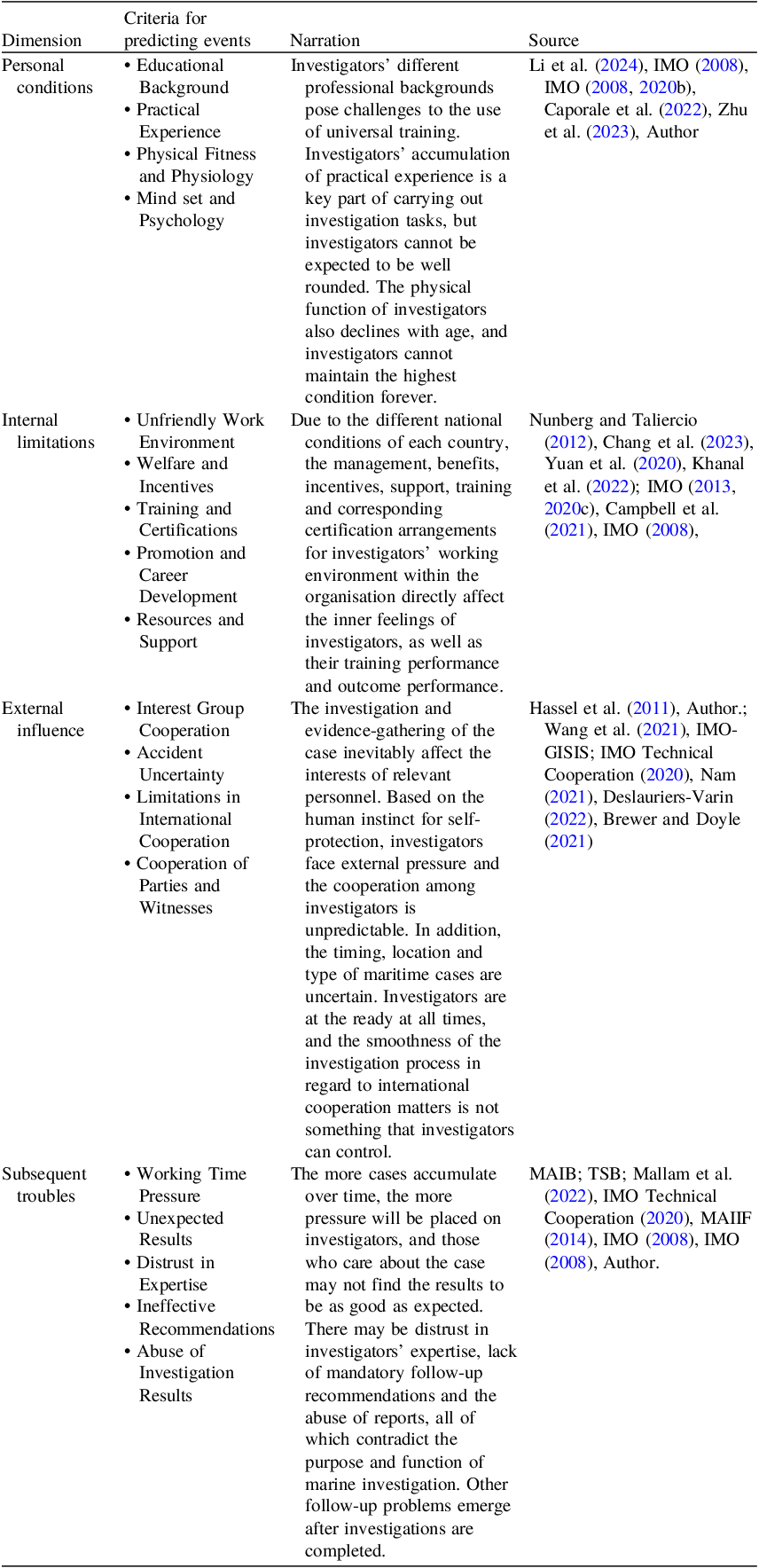
Based on the above, this paper proposes four main dimensions that countries should consider for the future training of investigators. Under personal conditions, how to reduce interpersonal differences and maintain a consistent level; under internal organisational constraints, how to improve the system and create an advantageous working environment; under external pressure, how to ensure the impartiality of the investigation and the safety of investigators; and under the challenges faced in the follow-up after the completion of the investigation, how to enable investigators to withstand pressure, remain active and correct the misunderstandings of nonprofessionals are all elements that must be considered by safety investigation organisations when training investigators. Each detailed criterion under the main dimension can be identified to support countries in training more talented professionals who can share their skills with future investigators, and perform investigations impartially and independently. Table 2 lists the relationships between the dimensions and criteria.
Explanation of the training dimensions and criteria of investigators from the compilation.

Table 2. Long description
The table has four main columns: Dimension, Criteria for predicting events, Narration, and Source. It lists various dimensions such as Personal, Internal, External influence, and Subsequent troubles. Each dimension has specific criteria and corresponding sources. For example, under Personal conditions, criteria include Educational Background, Practical Experience, Physical Fitness and Stamina, and Mind set and Psychology. The Narration column provides explanations for each criterion, and the Source column lists references. The table aims to guide countries in training investigators by considering these dimensions and criteria.
3.4. Methods for improving the ability and qualification standards of investigators
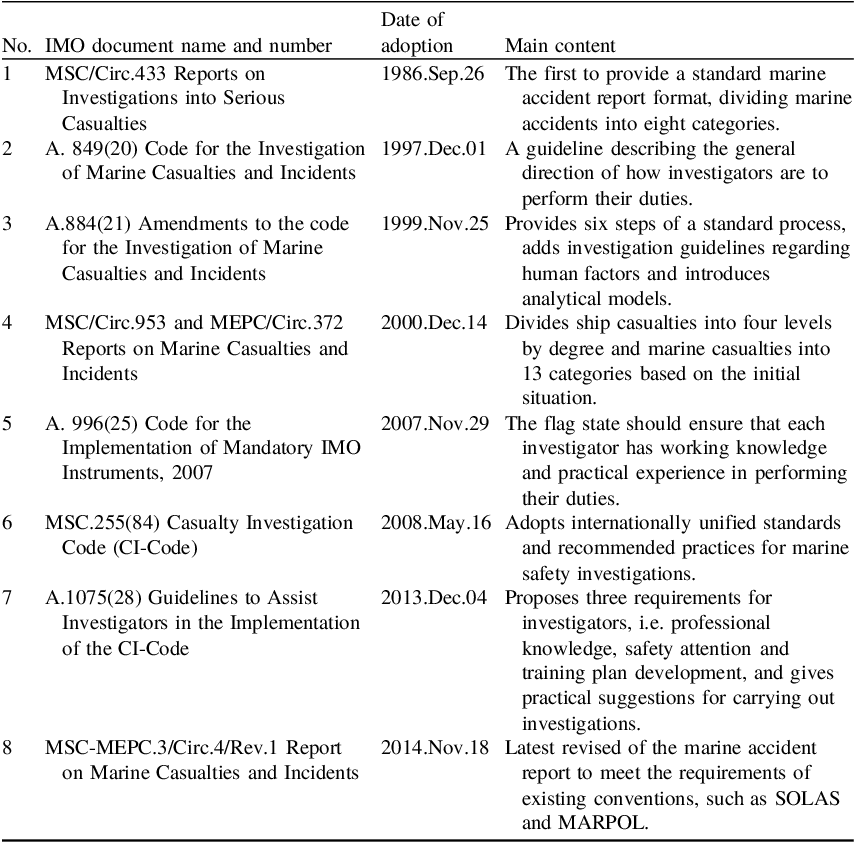
Marine safety investigators shoulder the responsibility of discovering the truth of the case and putting forward suggestions for prevention after the shipwreck. In addition to having professional knowledge and experience, they should have physical strength, enthusiasm for work and a sense of mission, and healthy psychological resistance to stress. Competent investigators must be on call 24/7 given the unpredictable occurrence of unknown cases. By including the regulations of marine investigations in Regulation I/6, Chapter 11 of the Appendix to the International Convention for the Safety of Life at Sea (SOLAS), the IMO has made it a mandatory requirement that investigators be supported in performing their duties. The technical documents of the IMO on survey execution are compiled in Table 3.
Relevant documents of the IMO in support of marine investigation.

Table 3. Long description
A table with eight rows and four columns. The columns are labeled No., IMO document name and number, Date of adoption, and Main content. The table lists various IMO documents related to marine investigations, their adoption dates, and a brief description of their main content. Row 1: No. 1, IMO document name and number: MSC/Circ.433 Reports on Investigations into Serious Casualties, Date of adoption: 1986.Sep.26, Main content: The first to provide a standard marine accident report format, dividing marine accidents into eight categories. Row 2: No. 2, IMO document name and number: A. 849(20) Code for the Investigation of Marine Casualties and Incidents, Date of adoption: 1997.Dec.01, Main content: A guideline describing the general direction of how investigators are to perform their duties. Row 3: No. 3, IMO document name and number: A.884(21) Amendments to the code for the Investigation of Marine Casualties and Incidents, Date of adoption: 1999.Nov.25, Main content: Provides six steps of a standard process, adds investigation guidelines regarding human factors and introduces analytical models. Row 4: No. 4, IMO document name and number: MSC/Circ.953 and MEPC/Circ.372 Reports on Marine Casualties and Incidents, Date of adoption: 2000.Dec.14, Main content: Divides ship casualties into four levels by degree and marine casualties into 13 categories based on the initial situation. Row 5: No. 5, IMO document name and number: A. 996(25) Code for the Implementation of Mandatory IMO Instruments, 2007, Date of adoption: 2007.Nov.29, Main content: The flag state should ensure that each investigator has working knowledge and practical experience in performing their duties. Row 6: No. 6, IMO document name and number: MSC.255(84) Casualty Investigation Code (CI-Code), Date of adoption: 2008.May.16, Main content: Adopts internationally unified standards and recommended practices for marine safety investigations. Row 7: No. 7, IMO document name and number: A.1075(28) Guidelines to Assist Investigators in the Implementation of the CI-Code, Date of adoption: 2013.Dec.04, Main content: Proposes three requirements for investigators, i.e. professional knowledge, safety attention and training plan development, and gives practical suggestions for carrying out investigations. Row 8: No. 8, IMO document name and number: MSC-MEPC.3/Circ.4/Rev.1 Report on Marine Casualties and Incidents, Date of adoption: 2014.Nov.18, Main content: Latest revised of the marine accident report to meet the requirements of existing conventions, such as SOLAS and MARPOL.
In addition, based on the requirements of investigators gathered from surveyed agencies in various countries, the most important appointment condition is practical experience with a type of sea vehicle (ship). The appointee must be an expert in this field. When countries make subsequent arrangements for marine survey services, special education and training for different types of ships can be used to maximise the training benefits. Additional case-specific or disaster-specific training can be conducted as appropriate.
Based on the literature and with reference to the typical course textbook of Model Course 3.11 (IMO, 2014), as well as the international marine laws and regulations of each country and the standard process for investigating the facts of the case, the training conditions and important factors for qualified and excellent marine safety investigators are constructed, as shown in Figure 2.
International qualifications and ability requirements for marine safety investigators.
Source: Resolution A.884(21), CI-Code, Model course 3.11, MAIIF, Author.

4. Research methods and discussion of the results
This paper uses the decision analytic network process (DANP) method, which is a type of multiple criteria decision-making (MCDM) model. First, the decision-making trial and evaluation laboratory (DEMATEL) method, which is based on experts’ points of view of a topic, was used to simplify the complicated causal relationship. Then, matrix operations were used to analyse the causal relationship and the degree of mutual influence between the factors and the criteria. The interrelationships could thus be compared and expressed in a cause-and-effect diagram to help identify the core problems and improvement directions in the complex system. Next, the weight of each criterion was set according to the analytic network process (ANP) to reach a conclusion (Chang and Tai, Reference Chang and Tai2021; Rad et al., Reference Rad, Fard, Khazanedari, Toopshekan, Ourang, Khanali, Gorjian, Fereidooni and Kasaeian2024).
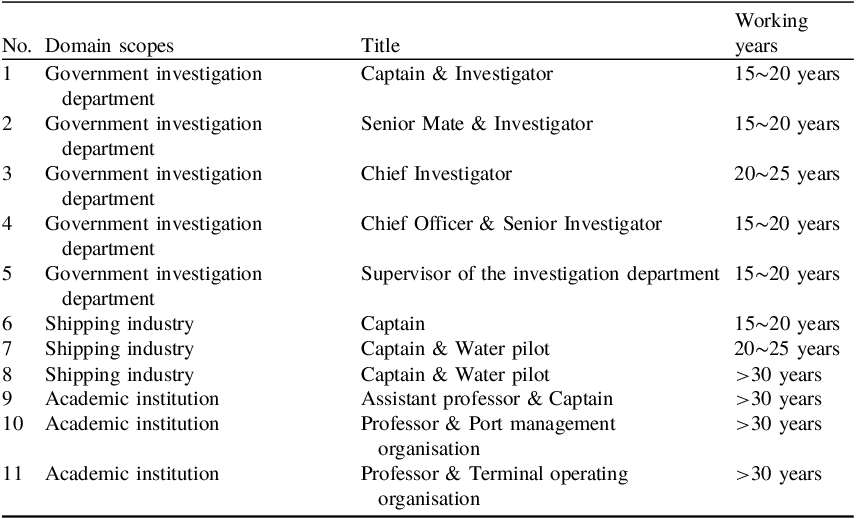
The topic of this study is highly specialised and cannot be conducted using traditional census-style questionnaires. Therefore, after extensive review of the literature, the four most suitable main dimensions and a total of 18 criteria were summarised, and the survey was conducted with a total of 11 marine experts, listed in Table 4, who understood this professional topic. They all had experience in the marine industry, operating experience, sea voyage experience or experience serving as captain, and together, they represented three identities in different fields related to marine cases, namely, investigation workers, sea crew members-turned-investigators and impartial researchers from academic institutions. Before the interviews, they all fully agreed with the criterion structure in Table 2 and Figure 3.
Background of the experts interviewed.

Table 4. Long description
A table titled ‘Background of the experts interviewed’ with 11 rows and 4 columns. The columns are labeled ‘No.’, ‘Domain scopes’, ‘Title’, and ‘Working years’. The table lists experts from various domains such as government investigation departments, shipping industries, and academic institutions. Each row provides details about the expert’s domain, title, and years of working experience. For example, Row 1: Government investigation department, Captain & Investigator, 15~20 years. Row 2: Government investigation department, Senior Mate & Investigator, 15~20 years. Row 3: Government investigation department, Chief Investigator, 20~25 years. Row 4: Government investigation department, Chief Officer & Senior Investigator, 15~20 years. Row 5: Government investigation department, Supervisor of the investigation department, 15~20 years. Row 6: Shipping industry, Captain, 15~20 years. Row 7: Shipping industry, Captain & Water pilot, 20~25 years. Row 8: Shipping industry, Captain & Water pilot, >30 years. Row 9: Academic institution, Assistant professor & Captain, >30 years. Row 10: Academic institution, Professor & Port management organisation, >30 years. Row 11: Academic institution, Professor & Terminal operating organisation, >30 years.
Criteria for the improved development of investigators.

4.1. The DEMATEL methodology
First, DEMATEL was used to establish the influence correlation degree of the main dimension and the important criteria, and determine the mutual influence relationship between the dimensions and the criteria. The steps and methods are summarised below.
Step 1. Obtain the influence relationship data between the main dimension and each criterion
The values of the mutual influence relationship between the criteria were obtained through the expert questionnaire. The assessment scale was set to five levels, 0, 1, 2, 3 and 4, representing ‘no impact’, ‘low impact’, ‘medium impact’, ‘high impact’ and ‘very high impact’, respectively.
Step 2. Create a direct-relationship matrix X
For n criteria, the degree of influence among the criteria is compared pairwise through the expert questionnaire to obtain a matrix
 ${\rm{n}} \times {\rm{n}}$
, which is called the direct-relationship matrix X. In the matrix
 $,\;{X_{ij}}$
represents the degree to which criterion i influences criterion j, and the diagonal of the matrix is the degree of influence of each criterion on itself, which is set to 0 because it has no effect, as shown as
 $${\rm{X}} = \left[ {\matrix{ 0 & {\matrix{ {{x_{12}}} & \cdots \cr } } & {{x_{1n}}} \cr {\matrix{ {{x_{21}}} \cr \vdots \cr } } & {\matrix{ {\matrix{ 0 & \cdots \cr } } \cr {\matrix{ \vdots & \ddots \cr } } \cr } } & {\matrix{ {{x_{2n}}} \cr \vdots \cr } } \cr {{x_{n1}}} & {\matrix{ {{x_{n2}}} & \cdots \cr } } & 0 \cr } } \right]$$
Step 3. Create a normalised direct-relationship matrix D
Using the maximum value of the sum of the vectors in each row or column as the normalisation reference can prevent polarisation in the subsequent calculation of the values in the matrix. The normalised direct-relationship matrix is set as D, and the normalisation benchmark is set as S; then, the calculations of D and S are as shown in Equations (1) and (2):
 $${\rm{D}} = {\rm{SX}}$$
 $${\rm S} = {1 \over {\max \left[ {{{\max }_{1 \le i \le n}}\sum\nolimits_{j = 1}^n {{x_{ij}},{\mkern 1mu} {\mkern 1mu} } {{\max }_{1 \le j \le n}}{\mkern 1mu} \sum\nolimits_{i = 1}^n {{x_{ij}}} } \right]}}$$
Step 4. Create a total-influence matrix T
After the normalised direct-relationship matrix D is obtained, it can be converted to the total-influence matrix T using Equation (3), where I is the identity matrix.
 $${\rm T}= \mathop {\lim }\nolimits_{{\rm{k}} \to \infty } {\left( {D + {D^2} + \cdots + {D^k}} \right)^{\rm{n}}} = D{\left( {I - D} \right)^{ - 1}}$$
Step 5: Obtain the d value and r value from the total-influence matrix
By summing each row and column of the total-influence matrix T, the sum of di in each column and the sum of rj in each row can be obtained. The calculation is shown in Equations (4) and (5):
 $${d_i} = \mathop \sum \nolimits_{i = 1}^n {t_{ij}}{\rm{\;\;}}\left( {j = 1,2,3, \ldots, n} \right)$$
 $${r_i} = \mathop \sum \nolimits_{j = 1}^n {t_{ij}}{\rm{\;\;}}\left( {i = 1,2,3, \ldots, n} \right)$$
Step 6: Calculate the centrality (
 ${d_i} + {r_j}$
) and degree of cause (
 ${d_i} - {r_j}$
)
When i = j, (
 ${d_i} + {r_j}$
) is defined as the centrality, which indicates the total degree of influence and effect of the criterion. This value is the core degree of the criterion under this dimension; (
 ${d_i} - {r_j}$
) is defined as the causal degree, indicating the difference between the influence of the criterion and the influence to which it is subjected. This value is the degree of causality of the criterion under this dimension. If the causal degree is positive, then the criterion is an indicator in the cause cluster; otherwise, a negative value indicates that it is in the effect cluster.
Step 7. Draw a causal diagram
The causal diagram is a two-dimensional graph with (
 ${d_i} + {r_j}$
) on the horizontal axis and (
 ${d_i} - {r_j}$
) on the vertical axis. The centrality and causal degree values of the principal facets or each criterion are used as coordinates, and the values are plotted on the cause-and-effect diagram. The diagram is divided into four quadrants based on the horizontal axis (
 $_i + {r_j}$
) and the vertical axis (
 ${d_i} - {r_j}$
), and all the criteria are located in the diagram to simplify the complicated causal relationship, and to facilitate the analysis of the causal relationship and core degree of the main dimension and each criterion. The quadrants are defined as shown in Figure 4.
Interpretation methods for the four quadrants of the DEMATEL causal diagram.
Source: Chang and Tai (Reference Chang and Tai2021), redrawn by the author.

4.2. Calculate the criterion weight by combining the DEMATEL+ANP method
The results obtained via the DEMATEL method were then applied to the ANP method to determine the importance of each factor in this study. The calculation steps of the ANP method are as follows:
Step 8. Normalise and transpose the total-influence matrix T into super matrix WT
First, the total-influence matrix T (previously expressed in Equation (3) and now expressed in Equation (6)) is normalised through Equation (7) to obtain the normalised total-influence matrix
 $\;{\rm{W}}$
(Equation (8)), and it is transposed into matrix
 ${W^T}$
, where
 ${d_i}$
is the sum of the values in column T of the total-influence matrix:
 $$\left[ {\matrix{ {\matrix{ {{t_{11}}{\rm{\;\;}} \cdots } \cr \vdots \cr } } & {\matrix{ {{t_{1j}}{\rm{\;\;}} \cdots } \cr \vdots \cr } } & {\matrix{ {{t_{1m}}} \cr \vdots \cr } } \cr {\matrix{ {{t_{i1}}{\rm{\;\;}} \cdots } \cr \vdots \cr } } & {\matrix{ {{t_{ij}}{\rm{\;\;}} \cdots } \cr \vdots \cr } } & {\matrix{ {{t_{im}}} \cr \vdots \cr } } \cr {{t_{m1}}{\rm{\;\;}} \cdots } & {{t_{mj}}{\rm{\;\;}} \cdots } & {{t_{mm}}} \cr } } \right]$$
And
 $${d_i} = \mathop \sum \nolimits_{j = 1}^n {t_{ij}}$$
 $$T_1 = \begin{bmatrix} t_{11}/d_1 & \cdots & t_{1j}/d_1 & \cdots & t_{1m}/d_1 \\ \vdots & & \vdots & & \vdots \\ t_{i1}/d_i & \cdots & t_{ij}/d_i & \cdots & t_{im}/d_i \\ \vdots & & \vdots & & \vdots \\ t_{m1}/d_m & \cdots & t_{mj}/d_m & \cdots & t_{mm}/d_m \end{bmatrix} = \mathrm{W} = \begin{bmatrix} w_{11} & w_{12} & \cdots & w_{1n} \\ w_{21} & w_{22} & \cdots & w_{2n} \\ \vdots & \vdots & \ddots & \vdots \\ w_{n1} & w_{n2} & \cdots & w_{nn} \end{bmatrix}$$
Step 9. Calculate the limiting super matrix
After multiple rounds of self-multiplication and convergence of the transposed matrix (
 ${W^T})$
, a fixed and stable extreme value is reached, from which the weight values of each criterion are obtained, as shown in Equation (9). This is called the limiting super matrix L, where
 $\;{W^T}$
is the transposed matrix, z is the number of self-multiplications and the weight values of the criteria at different levels can be obtained through the above-described ANP procedure.
 $$L = \mathop {\lim }\nolimits_{{\rm{z}} \to \infty } {\left( {{W^T}} \right)^{\rm{z}}}$$
4.3. Survey results and weight value analysis
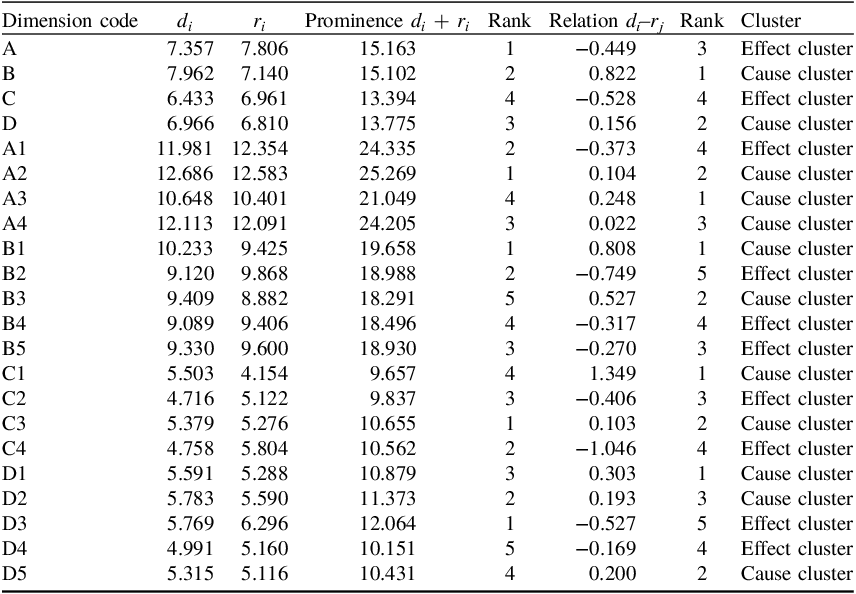
In this paper, in March 2024, a total of 11 experts from government marine investigation, the marine industry and academia with at least 15 years of working experience answered the DANP questionnaire. Based on Chang and Tai (Reference Chang and Tai2021) and Rad et al. (Reference Rad, Fard, Khazanedari, Toopshekan, Ourang, Khanali, Gorjian, Fereidooni and Kasaeian2024) and referring to Steps 1 to 6 above, the DEMATEL method was first used to identify the influence relationship between the main dimensions and the criteria to obtain the total influence matrix. Then, the column sums (
 ${d_i}$
) and row sums (
 ${r_j}$
) of the total influence matrix were calculated. The centrality (
 ${d_i} - {r_j}$
) and causal degree (
 ${d_i} - {r_j}$
) of the column sums were obtained. The questionnaire data are shown in Table 5.
Prominence and relation of important dimension and respective criteria.

Table 5. Long description
A table with 20 rows and 8 columns. The columns are labeled Dimension code, d_i, r_i, Prominence d_i + r_i, Rank, Relation d_i - r_j, Rank, and Cluster. The table lists various dimensions with their respective values for d_i, r_i, prominence, rank, relation, and cluster. Each row provides specific values for these attributes, indicating the prominence and relation of important dimensions and respective criteria.
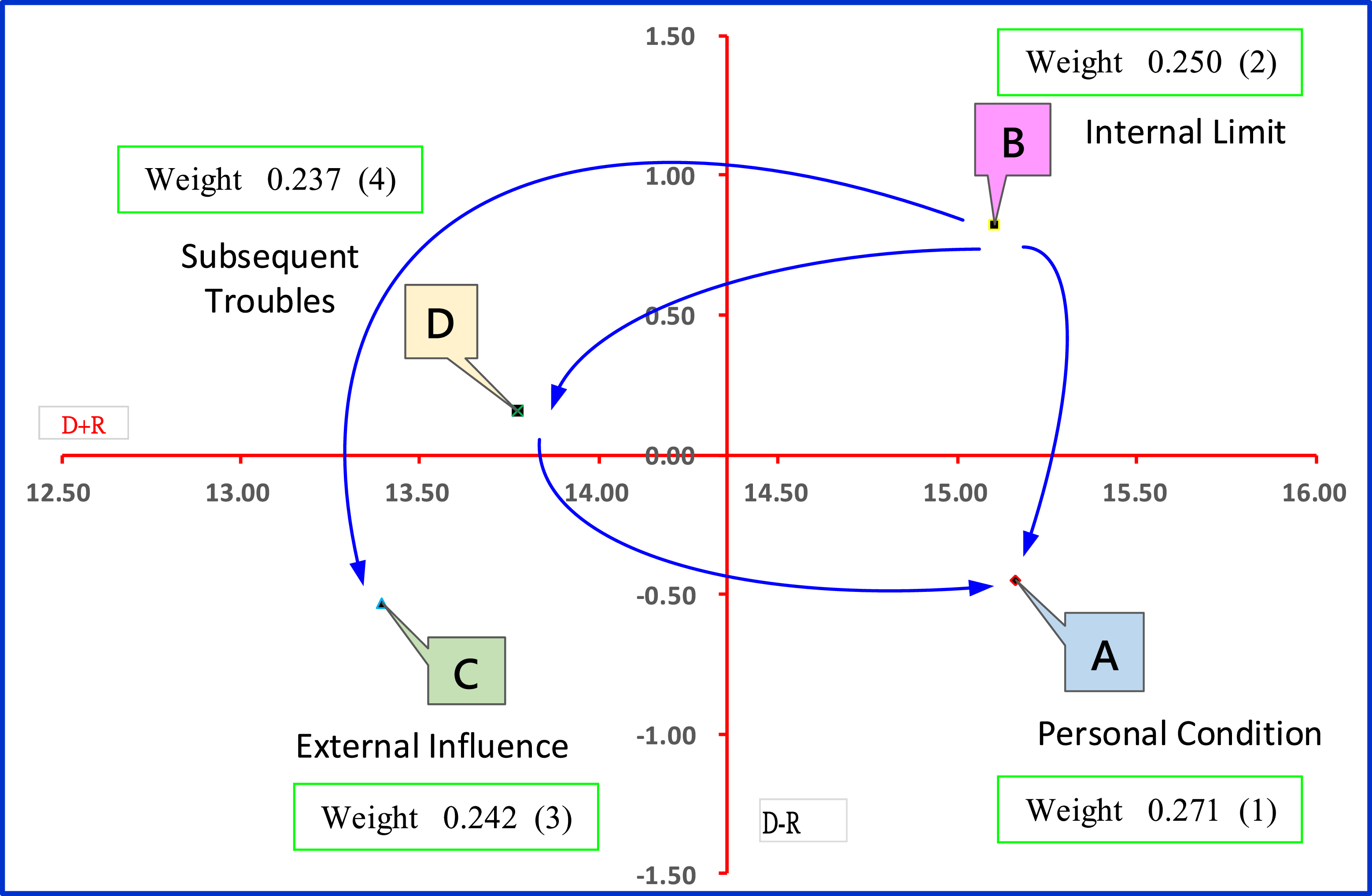
Subsequently, according to the method in Figure 4, the above data were marked on two-dimensional (2D) coordinates to construct a cause-and-effect diagram. If the criterion is located above the x-axis, it is in the ‘cause group’; otherwise, it is in the ‘effect group’. In the present study, if there is a significant causal relationship, the criterion value is used for quartile calculation and adopted as the threshold value for the main dimension and each criterion. A value greater than this value indicates that there is a significant effect and the value is reserved; otherwise, it is set to 0. Finally, the overall causality and correlation analysis diagram is plotted. According to Equation (7), the transposed matrix converges to calculate the fixed extreme values, that is, the weights. After the weights of each criterion are combined with the corresponding causal diagram, the summary is shown in Figures 5 and 6.
Causation and correlation analysis of the important dimension.

(a) Analysis of personal conditions criteria. (b) Analysis of internal limitations criteria. (c) Analysis of external influence criteria. (d) Analysis of subsequent troubles criteria.

Figure 5 shows the main study results.
-
1. B ‘Internal Limit’ is the cause group, which is located in the core criterion area of the first quadrant, and affects A, C and D. The results show that the government agencies to which the investigators are affiliated should prioritise investing the most resources in improving the internal problems of the organisation itself.
-
2. D ‘Subsequent Troubles’ is also a cause group located in the driving criterion area of the second quadrant and affects A. This means that after the completion of many marine investigations, the follow-up matters, such as unexpected results, distrust in professionals’ qualifications and the absence of suggestions’ practical effect, remain problematic for investigators. However, these follow-up matters can be improved through a combination of more support from the organisation and improved personal conditions rather than by delaying the investment of resources.
-
3. C ‘External Influence’ is the effect group located in the third quadrant of the independent criterion area and resources or support can be invested in this dimension last. This is because the experts interviewed all believed that the occurrence of marine incidents is unpredictable and that the external interest groups, parties and the countries are not able to control the issue, but can only handle and coordinate a case once it occurs.
-
4. A ‘Personal Conditions’ has the greatest significance, as shown in Table 5 (15.163), and is located in the fourth quadrant of the effect group. It belongs to the criteria that urgently need to be managed; that is, the first (B) and second (D) quadrants are well controlled. The criteria in this area can be improved simultaneously. The results of the study show that A is affected by B and D; therefore, investing resources to improve the internal limitations of the organisation can address the challenges after the completion of the investigation. In fact, investigators’ backgrounds and experiences are different. This situation can be remedied by arranging special training to address individual deficiencies or work pressure. Other ways to reinforce personal support for investigators can be found.
-
5. The ranking of weight values under the main dimensions is A (0.271) > B (0.250) > C (0.242) > D (0.237), which means that although A is influenced by B and D, and it belongs to the fourth quadrant, the personal conditions of investigators are the greatest focus of countries’ attention when discussing the competency criteria for marine safety investigators. The personal conditions of investigators deserve the most attention when making adjustments and improvements in appointment qualifications, and therefore, they have the highest weight.
In Figure 6, the main results are shown.
-
1. Figure 6a. Criteria A2 has the most significance for investigators’ ‘practical experience’ (25.269), and A4, ‘mindset and psychology’, is located in the first quadrant of the core and affects A1 and ‘educational background’ in the fourth quadrant. Therefore, the government should prioritise investing resources to enable investigators to enhance their practical experience after leaving the industry. A3 ‘Physical fitness and physiology’ is located in the second quadrant and has no relationship with the other criteria, indicating that experts agree that aging, and the accumulation of injuries and fatigue are normal physiological phenomena and are relatively insignificant. The master-apprentice succession method can be adopted to train instructors and replace aging senior investigators with newcomers when appropriate. The weights are ranked as A2 (0.265)>A1 (0.260)>A4 (0.255)>A3 (0.219). Since A3 has the lowest weight and the degree of its correlation with other criteria does not reach the threshold, it is recommended to give priority to addressing A1, A2 and A4.
-
2. Figure 6b. B1 is the management criterion with the highest priority, having the highest significance (19.658). B1 is related to other criteria, indicating that the working environment attributed to investigators by government agencies in some countries is unfriendly and that there is an urgent need to consider countermeasures for improvement. B2 and B5 are the affected criteria areas, being affected by criteria B1 and B3, respectively. Investigators are most affected by the benefits and incentives for undertaking investigation, as well as the resources and support given by superiors; these are also specific areas in which the friendliness of the working environment can be improved. B4 is in the independent criterion area. Because the investigation task requires a high degree of professional ability, skilled investigators are urgently needed by the organisation and, thus, there are no better future career arrangements. It is up to the government to plan for the ranks investigators expect so as to prevent the situation found in many countries, where officials are not promoted throughout their lives or end their careers as mere investigators. The weightings are ranked B2 (0.209) > B5 (0.203) > B1 (0.200) > B4 (0.199) > B3 (0.188). It is suggested that when dealing with the internal issues of the organisation, the management authority of the investigator should consider all the criteria at the same time. However, B4, promotion and career development, is the only factor that does not affect core aspects B2 and B5, but is affected only by B1. This means that promotion is not the only expectation of all investigators. Having the opportunity for promotion may not be effective in improving the working environment, so there must be other incentive programs.
-
3. Figure 6c. C4 is influenced by C1 and C3. Priority should be given to the limitation of international cooperation in C3, which is located in the core quadrant. Because investigators alone cannot undertake the coordination of cross-border investigations, as they are only contractors, government agencies can try to cooperate with each other in training and exchange activities, etc., to deepen international cooperation. The cooperation degree of C1, interest groups, depends on the investigating agencies continuing to publicise the functions and benefits of marine safety investigations. Safety investigations that do not aim for punishment or accountability require the support and efforts of all sectors. The weight rankings are C4 (0.283) > C3 (0.260) > C2 (0.251) > C1 (0.206). After C3 is prioritised for treatment, assessment is needed to determine whether to address C1 or C2 first. In theory, the occurrence of accidents is uncertain. It is very difficult to improve permanent problems. More resources may be invested in navigation safety auxiliary equipment, the installation of extensive monitoring and services in regional waters, the implementation of crew education, and the publicity of coastal navigation risks, but the results may still not be as good as expected.
-
4. Figure 6d. D3, distrust in expertise, is the affected result criterion and is influenced by all the other criteria; therefore, special attention should be given to it. The criterion to prioritise when investing resources for improvement is D2, followed by D1 and D5, indicating that the experts noted the importance of the fact that the investigation results are often not as good as expected by all parties. Crew members may hope that the investigation will clear them of responsibility or reduce their responsibility. However, the investigation of the entire case may not be satisfactory due to the limitations of evidence acquisition and the cooperation with the investigators. From the perspective of academic researchers, the data show that even if an investigation is completed, its contribution is not significant and similar cases continue to occur. Therefore, organisations should prioritise these three issues to palliation the pressure and influence of investigators. To improve this situation, investigators need to have more trust in their organisations and work freedom, and the government should improve domestic laws and regulations to clarify investigator status and implement the recommendations of marine safety investigations. Finally, D4, Ineffective Recommendations, has no effect in the area of independent guidelines and has nothing to do with the other criteria. This is reasonable because the suggestions put forward by marine safety investigations have no mandatory influence on international conventions. A country can enact its own laws and regulations to support the implementation of investigation results. The weight ranking is D3 (0.229) > D2 (0.204) > D1 (0.193) > D4 (0.188) > D5 (0.178). It is suggested that other criteria be considered together to improve D3 because distrust in investigators’ expertise can be influenced by the pressure placed on investigators and their inability to maintain work enthusiasm.
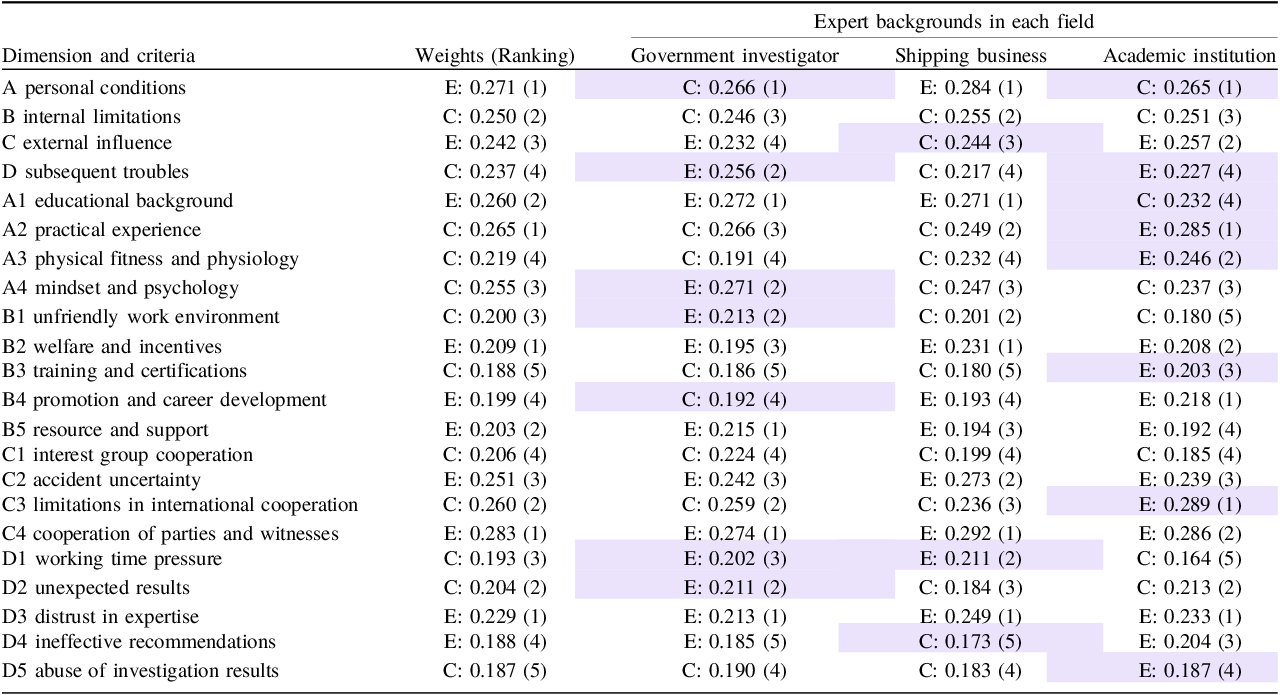
The greatest advantage of this research method is that it can determine the influence and importance of different criteria, providing a useful reference for relevant agencies. In addition, to understand the opinions of the different interviewed experts, Table 6 was compiled. The results are described as follows.
-
1. The differences in the main dimensions are as follows. The investigators and academic experts agreed on the views regarding dimensions A/D. In dimension C, the industry experts believed that external effect to interference in investigations was a cause because they themselves had investigation experience. They also knew the importance of protecting themselves and the company when accepting an investigation. Therefore, these criteria had a key influence on the investigation process.
-
2. In dimension A, the experts in academia produced significantly different results from the experts in other fields. They believe that the investigators should all have enough practical experience to meet the national requirements and there should be no doubt that they are the most suitable candidates for implementation. Therefore, criterion A2 is the affected criterion of the result category, while the causal relationships between A1 and A3 and the whole, as well as the weights are completely opposite to each other.
-
3. In dimension B, the investigators believed that the unfriendly working environment (B1) was the result of all the other criteria. This shows that they are most aware of the internal environmental conditions of their own organisation, which is very reasonable. B4 was classified as a cause, indicating that this criterion should still be addressed as a priority for improvement. The academic experts believed that B3, training and certification, were results because most investigators are educated and proper training should be a necessary part of a friendly working environment.
-
4. In dimension D, the investigators believed that D1 and D2 were both results, not causes, because they understood that in addition to distrust in their expertise, unexpected results and the pressure to meet deadlines were difficulties they faced. They enthusiastically offered feedback when discussing this dimension of the questionnaire. The industry experts regarded D1 as a result. This is because they are among the actors who accept the investigation results and are not responsible for the execution of the investigation, so they are not worried about the operation deadlines. However, after the incident takes place, operators face the psychological difficulty of waiting for clarification. They want to know the truth about the accident as soon as possible, and they look forward to learning the investigation results and finding out whether an accident was their fault. The operators also considered D4 to be a cause because they hoped that the suggestions of the safety investigations would be effectively applied to make it safer or more convenient for them to navigate at sea.
Overall DANP weights and classification based on expert background.

Table 6. Long description
A table titled ‘Overall DANP weights and classification based on expert background’ compares the weights and rankings of various criteria across different expert backgrounds. The table has 5 rows and 12 columns. The columns are labeled as follows: Dimension and criteria, Weights (Ranking), Government investigator, Shipping business, and Academic institution. The rows are labeled with criteria such as A personal conditions, B internal limitations, C external influence, D subsequent troubles, A1 educational background, A2 practical experience, A3 physical fitness and physiology, A4 mindset and psychology, B1 unfriendly work environment, B2 welfare and incentives, B3 training and certifications, B4 promotion and career development, B5 resource and support, C1 interest group cooperation, C2 accident uncertainty, C3 limitations in international cooperation, C4 cooperation of parties and witnesses, D1 working time pressure, D2 unexpected results, D3 distrust in expertise, D4 ineffective recommendations, and D5 abuse of investigation results. Each cell contains a value representing the weight or ranking of the corresponding criterion for the expert background. The table provides a detailed comparison of how different expert backgrounds perceive the importance and influence of various criteria.
5. Discussion
Countries have invested substantial resources in the development of marine safety investigations with the two aims of learning the truth about marine disasters with heavy casualties and developing prevention measures. However, similar marine cases continue to occur and the goal of global marine safety is still a long way off. Moreover, international cooperation and the entire investigation process are full of uncertainties. The root of these doubts lies in the quality and ability of the investigators, and whether they have opportunities for improvement and promotion. In addition, there are large disparities in the investment and emphasis on marine transportation among IMO member states, and cooperation with the conventions is not mandatory. Therefore, given the level and ability of the investigators in each country, we can only hope that the country itself will demonstrate the sense of mission to address this matter and develop sophisticated training to prevent the abovementioned challenges.
The IMO has established globally recognised competency standards for marine safety investigators. The results of this study demonstrate that officials encounter a range of internal limits, external effects throughout the investigative process and subsequent troubles even after the investigation has concluded. Furthermore, an investigator’s competency cannot be judged solely based on their prior experience and background before taking the role of investigator. Being able to produce a complete investigation report or participating in annual internal training does not necessarily mean they are free of any problems. International standards can never be entirely comprehensive, which results in inherent flaws in the systems established by different countries. Additionally, mechanisms for removing unqualified officials and providing guidance for job reassignment should also be included in the regulations.
Since this study uses the DANP expert questionnaire method, the reliability of the results depends not only on the number of respondents, but also, importantly, on the expertise of the respondents. In addition, professional research related to marine investigators makes it difficult to obtain reliable results through large-scale questionnaires. Although the questionnaires were distributed only in Taiwan, the carefully selected participants all have practical experience working on ships. They each hold different subjective views and exhibit variations arising from their experiences with this sensitive topic. Due to the significant differences in qualification requirements for officials among various countries and since the IMO international standards are also of a recommendatory nature, this article cannot comprehensively cover the perspectives of all parties involved in marine accidents. However, it is hoped that the situation in Taiwan can serve as a reference for other countries. The findings can be further discussed with experts in different fields of the marine industry to design more in-depth follow-up research targeting certain dimensions and expand the number of studied samples. Such research would reveal more information for reference and application regarding international marine investigators’ appointment qualifications, operational management, resource investment and training improvement.
6. Conclusion
The results of this study reveal causal relationships among four main dimensions; however, the differences in their respective weights are not significant. Among them, the ‘Internal Limit’ dimension, which is located in the core criteria area, is the item where the government needs to prioritise resource allocation for maritime investigators to create a friendly working environment. Additionally, within the ‘Personal Condition’ dimension, providing appropriate training is essential to address the individual background differences of the investigators. Regarding the ‘External Effect’ dimension, it is necessary to handle international cooperation matters from the perspective of high-level organisational status. Finally, for ‘Subsequent Troubles’, it is essential for the government organisation to provide continuous support and trust marine professional opinions. Only in this way can the investigation results be effectively used, enabling investigators to be more confident, enthusiastic and dedicated to their work. This study also uncovered very practical situations. Its findings fill the gap that has not been deeply explored in the existing literature. At the same time, it identified the causal relationships and correlations among the various criteria, as well as their relative weights. The research results can serve as a reference for government marine departments when allocating resources. They can also be used by various countries as a reference for planning internal investigators training, or for assessing the demand for new personnel and making arrangements for investigators transitions.
Compared with previous studies, the greatest contribution of this paper is the use of the scientific DANP analysis method to concretely propose adjustment criteria for the subsequent competency of investigators. It also offers different levels of indicators for evaluation, addressing this multi-criteria assessment issue. With limited resources, governments around the world can refer to this study for future policy planning by considering the ranking of weights among various criteria and their interrelated impacts. This can guide short-term or medium- to long-term arrangements, as well as evaluations of whether adjustments and improvements are needed in the current domestic investigator manpower system. This contribution holds significant practical value for countries facing similar issues as Taiwan in the future. In terms of academic value, the survey results of this paper can be provided to the IMO and its member states as a reference when conducting future training for investigators, particularly regarding the challenges they face and ways to address them. This aims to safeguard the safety of personnel, vessels and the environment within the international marine industry. It is hoped that by learning from investigative error cases, the recurrence of various marine incidents can be significantly reduced.
Acknowledgements
This study is supported in part by the National Science and Technology Council, Taiwan, R.O.C. Project Number: NSTC 112-2410-H-992-039.
Data availability statement
The data presented in this study are contained within this article.






 Open access

