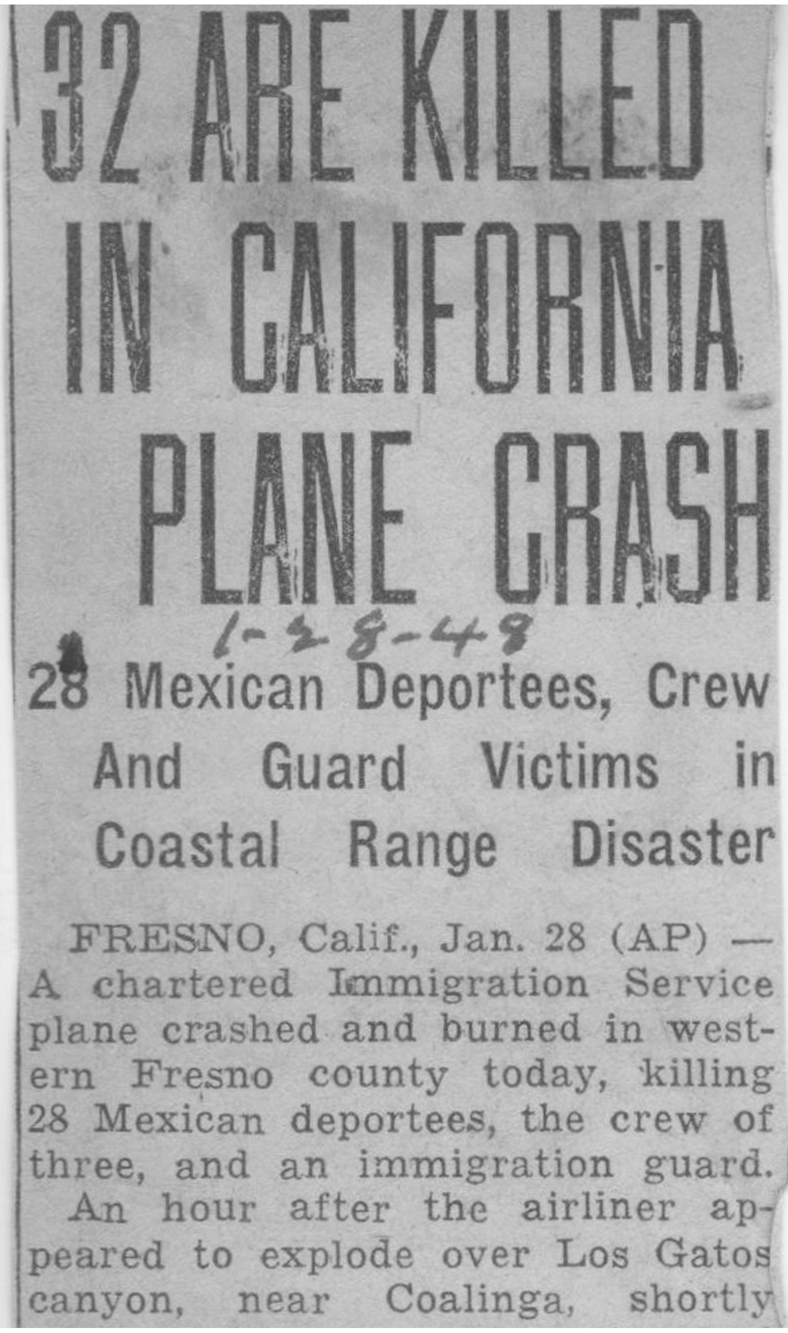
In the days of “America first” rhetoric, “zero tolerance” immigration policies, and the banishment of asylum seekers from the sphere of civil rights, we are reminded of the master narrative of United States history and the underlying assumption that the country's national identity is essentially “white,” Christian, and European. Tim Z. Hernandez's documentary novel All They Will Call You: The Telling of the Plane Wreck at Los Gatos Canyon offsets this exclusionary national imaginary by proposing an alternative cross-border memory that builds upon the attachment between US citizens and the deported Mexican migrants who died in a plane crash as they were being deported in 1948.Footnote 1 The Chicano writerFootnote 2 came across a 1948 newspaper cutting reporting the accident and realized the connection between the plane crash and Woody Guthrie's song “Plane Wreck at Los Gatos,” also known as “Deportee.”Footnote 3 Guthrie's lyrics, set to music by Martin Hoffman in 1961, propose a view from below of US history and reclaim the hills, valleys, orchards, and plains of the United States for those who work them.Footnote 4 A lament for the death of anonymous Mexican migrants in a plane crash as they were being deported in 1948, the song denounces their invisibility and creates an affective bond between the listener and those whose lives mean little in a production system built on the surplus of deportable (disposable) labor power.Footnote 5 Hernández's discovery stirred his curiosity and led to unprecedented research on the media coverage of the accident, the migrant workers’ real names, the descendants and friends of the dead passengers on both sides of the Mexican border – some of whom were never notified of the death of their relatives – the witnesses of the plane wreck, and those involved in the musical rendition of Guthrie's poem. At the time of the accident, news coverage identified only four out of the thirty-two passengers by name: two crew members, a flight attendant, and an immigration official. The media referred to the rest as “farm workers,” “deportees,” and “Mexican deportees.” On page 2 of ATWCY, Hernandez reproduces the photograph of the newspaper clipping, dated 28 January 1948, echoing the words of F. J. McCollum, chief editor of a Californian local newspaper, the Coalinga Record (Figure 1). We are told that McCollum's words would also be captured by United Press International and other major newspapers in California.Footnote 6 A later piece from another local newspaper, the Fresno Bee, listed the names of the Mexican passengers, some of which were wrong or misspelt.Footnote 7
Newspaper clipping reproduced in ATWCY, 2. Photo credit: Associated Press.

Taking his cue from Guthrie's question (“Who are all these friends, all scattered like dry leaves?) from the attachment to the migrants envisioned by the lyrics (“Goodbye, mis amigos”) and from the song's denunciation of the impersonal terms used by the media (“The radio says they are just deportees”),Footnote 8 Hernandez began a search for the names and living relatives of the unidentified Mexican passengers buried in St. John's Fresno Cemetery under a plaque that read “28 Mexican citizens who died in an airplane accident near Coalinga.” Since all he had was a dubious list of names based on the Mexican passengers’ death certificates, in March 2013 Hernandez announced his search in the bilingual local newspaper Vida en el Valle. Jaime Ramírez, a Fresno local resident and owner of the Mexican restaurant Olé Frijole, contacted him. His maternal grandfather, Ramón Paredes González, and his great-uncle, Guadalupe Ramírez Lara, were passengers on the flight. Ramírez shared with the author the documents and stories he had inherited, including a list of the correct names of passengers published in the Mexican newspaper El Faro. Finding this list encouraged the writer and his collaborators – Carlos Rascon, director of cemeteries, and Fresno signer Lance Canales – to run an online fund-raising campaign for a new memorial gravestone with an inscription that would include the names of all the deceased.Footnote 9 In the last section of the novel, titled “Fieldnotes,” Hernandez gives a personal account of the funeral ceremony in St. John's Fresno Cemetery on 2 September 2013, in which the memorial stone was unveiled before a numerous gathering of the relatives and friends of the migrant workers and the plane crew.Footnote 10 Upon its release, ATWCY received the attention of the media and the press and was featured in National Public Radio, the LA Review of Books, the San Francisco Gate, NBC News, the Smithsonian Magazine, Univision, and La Opinión, among others. Hernandez was one of four finalists for the inaugural Freedom Plow Award from the Split This Rock Foundation for his work on locating the victims of the plane wreck at Los Gatos. ATWCY earned the author the UC Santa Barbara's 15th annual Luis Leal Award for Distinction in Chicano/Latino Literature. On 29 January 2018, the California State Senate convened to formally recognize the seventieth anniversary of the plane wreck at Los Gatos Canyon. The ceremony presented memorial resolutions to the families of the victims and gave special recognition to Hernandez for the effort of bringing awareness to the plane crash, and to Joan Baez for her propagation of Guthrie's song and human rights message.Footnote 11
Based on the testimonies of witnesses at the site of the accident, and of relatives and friends of the passengers, ATWCY seeks to answer Guthrie's question by telling the story of all the plane passengers. The novel reworks their testimonies through imagination and contextualizes them within US–Mexico economic relations in the 1940s and 1950s. My discussion of Hernandez's composite text focusses on its ethical, political, and poetic import in the light of Michael Rothberg's “multidirectional memory”; on the related notions of “migrant imaginaries” and “new memory of latinidad” proposed by Alicia Schmidt Camacho and Ylce Irizarry respectively;Footnote 12 and on the textual strategies and genres that Marta Caminero-Santangelo considers to be distinctive of documentary narratives on the undocumented.Footnote 13 Hernandez's reenactment of the plane crash connects subjects of varied status and cultural backgrounds, generating a community of memory that traverses ethnic and national borders to reveal the “truth” about a single event from a multidirectional approach and to call attention to silenced lives and “ungrievable” deaths.Footnote 14 Critical work on ATWCY has emphasized the historical relevance of Hernandez's discovery of the disappeared Mexican migrants’ names and the telling of their family stories.Footnote 15 It is, however, worth noting that the work brings together the memories of all the plane passengers irrespective of their origin, race, and legal status. The wide cross-border community of memory relies on testimonies procured by the descendants of the US and Mexican dead passengers, and by the friends and relatives of Martin Hoffman, the composer of the melody for Guthrie's song: details of Frank Atkinson's pursuit and accomplishment of his dream career as a pilot, his taxing training, and his deployment to the eastern end of the Himalayan mountains in dangerous airlift missions; the stories of the families of the deported Mexican passengers in 1948 and those of their descendants’ immigration to the United States in the context of an analogous “revolving-door” policy in the 1980s and 1990s; the immigration from Poland of Elisabeth Liebersbach (flight attendant Bobby Atkinson's mother) and her father Jakob, his subsequent death resulting from harsh labor, and her difficult life as a young orphaned female immigrant; the connection between Guthrie's lyrics and Martin Hoffman's own loneliness and sense of loss. In a genuine contribution to border studies, Hernandez's “mestizx consciousness”Footnote 16 makes readers aware of how the truth about the tragedy is deep-seated in the “emotional residues”Footnote 17 of US–Mexico neocolonial relations, of successive immigration waves, and of struggles for individual and collective survival and improvement. ATWCY rescues and builds on these residual stories to create a cross-border solidary community of mourning and a multidirectional memory that dismantles the “hierarchy of grief” whereby some lives are included in and some excluded from the national sphere of citizen rights.Footnote 18
DEPORTEES, BRACEROS AND ENGANCHADOS
In the section devoted to the passengers’ stories, the chapter titled “Los Enganchados” contextualizes the re-creation of the testimonies on the maladjustment, exploitation and dehumanization of his Mexican protagonists within the simultaneous deportation and importation of documented and undocumented labor in the late 1940s. Hernandez relies on Ernesto Galarza's groundbreaking sociohistorical study Merchants of Labor: The Mexican Bracero Story. Many Mexican passengers on the plane were hired to work seasonally in agriculture under the Bracero program; others entered the US illegally. A binational agreement between Mexico and the United States from 1942 to 1964, this guest-worker program allowed 4.6 million Mexican citizens to work short-term, mainly in agriculture, allegedly to fill the wartime labor shortage. The program provided a narrative that would justify growers’ use of migrant workers at their own convenience with governmental support. It increased their control over immigrant and native labor, thwarting union organizing efforts and driving down the wages of US farmworkers. The minimum wages, living conditions, and legal provisions agreed upon by both countries were often overlooked by US employers. The program encouraged undocumented immigration and labor, was extremely lucrative, and was extended until 1964. The revolving-door policy made migrant workers both necessary and expendable at the market's discretion.Footnote 19
Plane passengers Juan Ruiz Valenzuela, Wenceslao Ruiz Flores, Salvador Hernandez Sandoval, José Sánchez Valdivia, Francisco Durán Llamas, and Luis Miranda Cuevas were hired as braceros and deported on the grounds that they were no longer necessary after the war. They arrived in cargo trains after waiting in endless lines for days and months in recruitment centers.Footnote 20 The list of deported plane passengers also included Guadalupe Ramírez Lara and Ramón Paredes González, undocumented workers who had crossed back and forth between Mexico and the US since 1923.Footnote 21 The narrator comments on the postwar hostility against Mexican and Japanese immigrants, whose fate the end of the war had suddenly reversed: “As if anti-Japanese sentiments weren't enough to make all immigrants pray for invisibility, the postwar transition spelled trouble for brown-skinned people … As thousands of Japanese Americans were being bused and trained back into city limits, Mexicans, once again, were being bused and trained out.”Footnote 22 The narrator highlights the stigmatizing racialization of legal and illegal residents of Japanese and Mexican origin whose lives are under the sway of the economic and political interests of the state. As Nicholas De Genova states, the sociopolitical category of “illegal alien” usually applied to Mexicans is “inseparable from a distinct ‘problem’ or ‘crisis’ of governance and sovereignty,” a crisis that accounts for their racialized difference, which in turn responds to a “commodity identity” as a “people reducible to the disposability of their labor for a price (regardless of immigration status or even citizenship).”Footnote 23 This idea is reinforced through the connection between the etymology of the word bracero, derived from the Spanish brazos (“arms”), and the productive function of the bodies of migrant workers, which were detached from the body politic or the national body of US enfranchised citizens; the workers were no “guests” but “soldiers of labor.”Footnote 24 Guadalupe Ramírez Lara's fictionalized musings acquire significance in the light of Hernandez's historical contextualization of the migrants’ disposability. Guadalupe rejects the terms bracero and enganchado commonly used by Mexican migrants to refer to each other and “prefers to be called by his name.”Footnote 25 For this worker, bracero has the “menacing” connotation of arms removed from the body, and enganchado suggests a body hooked by the system, “the allure of earning little money, enduring physical labor, not to mention a constant longing for home, something one comes to rely on, like an addiction.”Footnote 26
Guadalupe's musings call attention to the “histories of articulation” where bracero and enganchado are associated with other names (“Mexican,” “immigrant,” “illegal,” “deportee”) that discursively fix those they designate outside the national ethos. The accumulation of meaning through the reiteration of these terms in hegemonic discourse establishes the boundaries of “We the People,” which, in line with the hegemonic master narrative on the original settlers of the country, is imagined as culturally homogeneous, monochrome, heterosexual, and male-dominated.Footnote 27 Reiterative accumulation leaves an emotional imprint through this history of repetition; it enacts the emotional “sealing” of the national community towards the predicament of undesirable others who remain outsiders: emotions work through the “‘sticking’ of signs to bodies” by attributing feelings to others or turning them into objects of feeling.Footnote 28 If the nation is represented as too sensitive, vulnerable or soft towards the others these terms designate, it may allow racial others and migrants to become too close to the national body.Footnote 29 In line with Butler's notion of “being awake to the precariousness of life in general,”Footnote 30 both Guthrie's song and Hernandez's novel counteract the performative power of these terms by reminding us of the workers’ identity and lives, and foreground the vulnerability of those chased out of the US “like outlaws, like rustlers, like thieves,”Footnote 31 thus appealing to a “soft,” hospitable nation: in saying “goodbye” to “mis amigos” and calling them by the name they “won't have … when [they] ride the big airplane,”Footnote 32 the lyrical voice in Guthrie's song establishes an affective bond with these individuals and evokes the attachment they may have with others. ATWCY builds on Guthrie's emotional appeal through a poetics of ethical engagement which, on the one hand, involves the reader in the author/narrator's pursuit of truth through self-reflective or meta-narrative commentary, and, on the other, intertwines historical documentation, testimonial narrative, family memorabilia, and imaginative fictional devices to convey the affective component of the passengers’ life stories.
THE POETICS OF ETHICAL ENGAGEMENT
In view of the author's personal loyalty to “the people of memory” of Mexican migrant labor, and of his commitment that “certain stories [are] never lost,” the narrator in ATWCY cannot be a distant reporter or chronicler.Footnote 33 He's one whose simultaneous detachment from and involvement in the story is attained by means of fictional strategies. As a complicit “outside-insider,”Footnote 34 he is an ethically engaged mediator who introduces the element of relating to and conversing with others through imagination, thus coming close to Judith Butler's philosophical understanding of “political community” around the question of vulnerability and precariousness: a political community is wrought by speaking to another; relations of interdependence and mutual vulnerability are a dimension of our lives, as are the conditions which make some lives more vulnerable and more grievable than others.Footnote 35 The most ethical dimension of the author's poetics rests on the ways in which it makes lives “from the forgotten chasms of history” real and worth noticing through the intersection of the historical, the testimonial, and the imaginary.Footnote 36
The narrator/author uses imaginative devices to keep “otherness from slipping into the unsayable” by means of “some transfer from Same to Other in empathy and imagination.”Footnote 37 This transfer is achieved through several means: the involvement of the reader in the story through mystery and intrigue, the fictionalization of the emotional content of testimonies, the use of graphology, and self-reflective commentaries on how to best reach the truth. These strategies underscore the vulnerability and significance of the passengers’ lives within their families and communities, as well as within a larger human community of story keepers, storytellers and readers. Testimonies allow readers to be part of the story and take it personally, but not as if the story was about their feelings or their capacity to feel what others felt or what the author/narrator felt, but rather as the unique stories of others with whom we all share a human condition.Footnote 38 Readers of testimonial narratives, Sarah Ahmed says, are both “in” the story and “not in it.”Footnote 39 The story unfolds through the active involvement of the narrator/interpreter with the testimonies, so that readers participate in the relationship between the story keeper or witness, who is “in the story”, and the storyteller, who, like the readers, is “not in it,” but interprets, arranges, and makes it meaningful for them.Footnote 40 On the one hand, readers subscribe to a pact based on the reliability and veracity of factual details and accurate testimonies: official records, accident reports, immigration documents, letters, photographs, sequences, and interviews evidence Hernandez's pursuit of factual truths. On the other, readers follow the storyteller as he reworks the materials he has collected. From a position of relative privilege shared with the writer, if interpellated by the story, readers will identify with the author's task of researching, piecing together and giving narrative cohesion to the story fragments. As in any other fictional work, the imaginative re-creation of events creates ambivalence towards the referentiality of the text and requires the suspension of disbelief.
The epistemological premises of documentary, journalistic and testimonial fiction shed light on the suitability of these genres to address the question that motivates Hernandez's quest. Despite the very different Latin American and US contexts in which testimonio and literary journalism developed, both genres share the rhetorical imperative “of the urgency to communicate human rights crises.”Footnote 41 Documentary, journalistic fiction clearly shows the impingement of sociocultural and sociohistorical narratives on the lives of individuals while also portraying their subjective impressions on reality. In addition, literary journalists and documentary novelists combine “personal engagement with perspectives from sociology, anthropology, memoir writing, fiction, history-writing, and standard reporting.”Footnote 42 Although there is more freedom of invention in the documentary novel, both genres tend to avoid “closure,” bring to the foreground the subjective import of historical issues, and favor the exchange of subjectivity with the other.Footnote 43 Truth is similarly approached in the Latin American novela testimonial and novela documental: both genres turn the reader's attention to how the truth is told and to the role of the author telling it.Footnote 44 In documentary and testimonial novels the role of the author is “investigative and editorial, textual and testimonial.”Footnote 45 A figure that speaks through another seems “less” than the traditional authorial figure, but it also seems “more” than an actual editor/compiler because s/he may refashion and interpret the testimonial account and is ultimately responsible for the overall structure and composition of the text.Footnote 46 Hernandez's premise, stated in the preface or “author's note” to ATWCY, that “perception is truth” and that the unknown parts are filled by “our own glaring humanity,” refers to his role as interpreter or exegetist, a compiler/novelist/editor who resorts to “embellishment, guesswork and even re-imaginings” for storytelling.Footnote 47 Accordingly, in the documentary novel, fictional or subjective narration and factual account are not “antithetical narrative poles”;Footnote 48 they are, rather, complementary or “collaborative” in the rendition of a complex, multifaceted truth.Footnote 49 As Flis says, “once official representations of history have been discredited, the only reality that can be reproduced with any degree of assurance is that of a given event or situation.”Footnote 50
The first chapter of the novel is a sequential reconstruction of the events of 28 January 1948 as perceived by witnesses, government officials and reporters. Since, like in a mystery or detective novel, the dead are no longer there to tell the truth, for the telling of the story the author will resort to documentary evidence; to the testimony of journalists, police investigators, and public officials; and to any leads to any possible living relatives and friends of the deceased. The testimonies stem either from the direct memories of eyewitnesses and living descendants and friends of the victims, or from the “memories of memories” of later generations.Footnote 51 These testimonies contrast with the police and diplomatic officials’ factual investigation and identification of bodies. Hernandez himself blends the techniques of the realistic journalist (such as the time sequence of events and references to official reports) with the vivid account of witnesses conveying their impressions at the site and time of the accident: the “echoes of godforsaken screams” reverberate Red Childers's ears, as he, a witness from a family of landowners at the site of the accident, watches the plane falling in the premises, according to the testimony of his granddaughter June Gaston.Footnote 52 We are made privy to June's own childhood memories of a stench she could only relate to the “burnt pieces of ‘cattle’” in her family's ranch, to her perception of the scene of the accident “as if staring through ‘a window, or a dream’,”Footnote 53 and to her sister Nancy's childhood memory of the plane as a flying “monster,” the origin of her lifetime terror of planes.Footnote 54 The author also re-creates the different approaches to the truth of reporters, photographers, and government officials: the Mexican consul is interested in making a list of remaining items and survivors; Henry Stuart, the photographer hired for the newspaper Coalinga Record seeks to capture “the sensory reality whole” of the wreckage, focussing sometimes on “[e]mpty spaces … Gaps that invite the mind to make their own meaning”;Footnote 55 Lew Hegg, the photographer working for the Fresno Bee, was instructed “to get a bird's-eye view of the crash.”Footnote 56
Further evidence is provided in the second chapter of the book, “Reconstructing Stories (La Huesera).” The chapter is suggestively titled after the southwestern myth and folkloric tale recalled by one of the inmates at the Coalinga County Road Camp, Velorio Martínez Martínez, called El Indio.Footnote 57 El Indio compares the bone woman's (la huesera's) piecing together of the bones of the dead in a southwestern folkloric tale to the investigators’ reconstruction of names through evidence and guesswork.Footnote 58 Yet the author/narrator suggests that the story that results from the officials’ investigation and reconstruction of events is inaccurate and mentions intriguing unresolved issues: why would passengers James A. Guardaho, Julio Barron, and Ramón Portello be mentioned once and never referred to again in later lists of passengers’ names?Footnote 59 Why were the baby clothes found on the plane thought to belong to a Mexican passenger?Footnote 60 What are the real names of the passengers of Mexican origin? Most of them, dismembered and recklessly put together like their bodies, would be either utterly misspelled and entirely wrong in the County Hall of Records, or simply missing in the catalogue at St. John's Cemetery.Footnote 61 In ATWCY the plot revolves around the historical absence of the names, stories, and identities of most of the passengers. The contrast established between defective factual evidence and the vividness of the personal testimonies of witnesses functions as a meta-narrational commentary on the truth value of subjective perception and the fallibility of the merely factual.
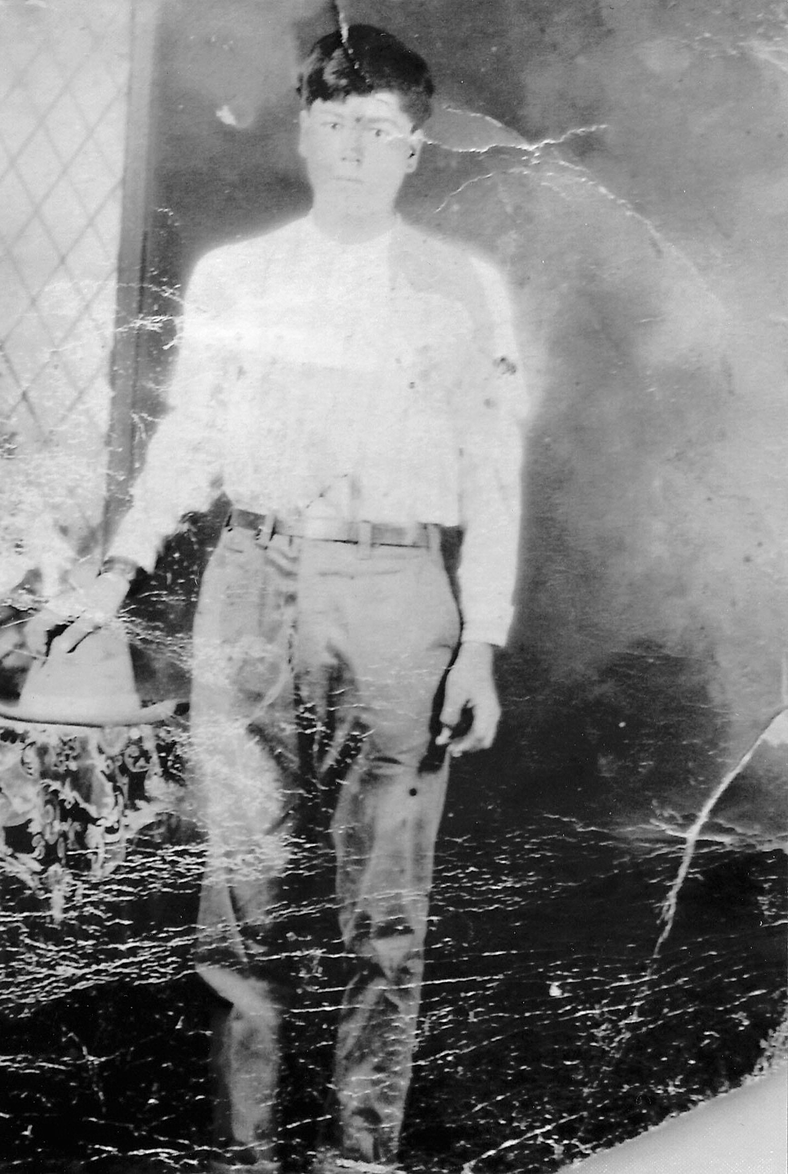
The author reworks family memorabilia and documents provided by the relatives of the deceased to convey the affective, communal ties that were severed with the migrants’ departure and their eventual disappearance. These documents function as an interpretable mnemonic truth whose value relies on their connection to the testimonial narrative they have inspired. Hence the absence of photograph captions is a literary gesture whereby images are not related to the factual realm but to the affective realm. Through the “imaginary surplus” of fiction the writer probes the emotional imprint of the visual document in people's lives, those details or puncta that must have moved, disturbed, and deeply affected the migrants and their relatives when looking at the photograph. In revisiting those details through narrative, Hernández re-creates the way they must have filled the whole photograph, and suggests a “blind field” or a “beyond” that a cultural or historical interest in the image cannot reveal.Footnote 62 In the story of Guadalupe Ramírez Lara's separation from his wife Micaela, a photograph of Guadalupe taken before his departure is described through several possible mnemonic details inspired by the testimonies of his nephews and other family members (Figure 2): Guadalupe's hand on the hat his grandfather gave to him may be a sign of his fear and insecurity before the journey, or perhaps of his appreciation of the old man's legacy; the hand on the hat might even spark a memory of Micaela's “victory” in their argument about whether or not he should take it off to have the photograph taken. For Micaela, however, the photograph has one single purpose after Guadalupe leaves Charco de Pantoja (Guanajuato) for the United States: the most piercing detail, what would “give her peace,” given his “tendency to be alone whenever he found himself in strange places,” would be the light that accidentally emanates from her husband's shirt, a hint that the “sweet mannish boy … contained enough light for the darker times to come.”Footnote 63
Photograph of Guadalupe Ramirez Lara reproduced in ATWCY. 69 Photograph used with permission of Jaime Ramirez.

In the story of Luis Miranda Cuevas, inspired by the testimonios of Casimira, his fiancée back in 1948, and Yréne Miranda, his niece, the author conveys the emotional response to a photograph that is not reproduced in the text but is given truth value in the re-creation of Luis's struggles and hopes. The photograph Casimira shows the author, which Luis would always carry on his trips, is used to elaborate on the man's melancholic disposition. The novelized account re-creates the worker's sadness at the three-year separation from his beloved and his hopes for a married life together in the future. Casimira's sultry expression in the photograph would make Luis laugh and remind him of the nickname her father gave her, “Cara de Dolorosa” (“painful face”). After backbreaking labor, he would look at the image and relive their past moments together and look forward to the end of the season and to their eventual marriage once back home. The description of Luis's memories and emotions, based on his hypothetical response to the photograph, becomes verisimilar in view of the narrativized real-life testimonios of Casimira and Yrene. To emphasize Luis's vulnerability and struggle, the narrator describes the long immigration routes followed by Mexican migrants in the 1940s.Footnote 64 The author also re-creates Luis's fears of deportation along his route to el norte (to the north, the US) and gives a meticulous description of the “test of degradation,” the medical examination and disinfection that enganchados underwent under the Bracero program.
As with the images, the truth value of real letters lies in their interaction with the re-created testimonios. In the story of Guadalupe Ramírez Lara and Ramón Paredes González, Ramón's polite, measured letter to his wife Elisa, which appears in translation, gains its dramatic power from the contrast between the emotional containment of his written expression and the distressing reality that the testimonial narrative describes:Footnote 65 as members of the ejido (land farmed communally) committee, Ramón and Guadalupe's decision to migrate was the need of a well; Ramón and Elisa have six children; Ramón suspects Elisa is losing her mind; Guadalupe and Ramón, who migrated together and gave each other support, have been forced to part and he is now on his own. Hernandez enhances a sense of self bound to a community and a history of struggle passed down from one generation to the next. Ramón and Guadalupe's epic struggle for their rights to the land as ejidatarios (communal landowners) is a story that “their children's children would speak of generations later”: in the aftermath of the Mexican Revolution in the late 1920s and early 1930s they fought against an organized “hacienda's posse”Footnote 66 and shed blood to defend communal landownership against the colonial private owners of haciendas (privately owned large estates or plantations with a dwelling house).Footnote 67 Once constituted as an ejido, they participated in the improvement of the irrigation and production system.Footnote 68 In the context of this history, a free-indirect-speech gloss on Guadalupe's thoughts reveals an “overlapping self” whose identity cannot exclusively be defined in individual terms:Footnote 69 “Enganchado or not, Guadalupe returns time and again to los Estados [the United States], because if he doesn't then the ejido withers. It's that simple. And if the ejido withers, then so do his plans to make a family with Micaela.”Footnote 70
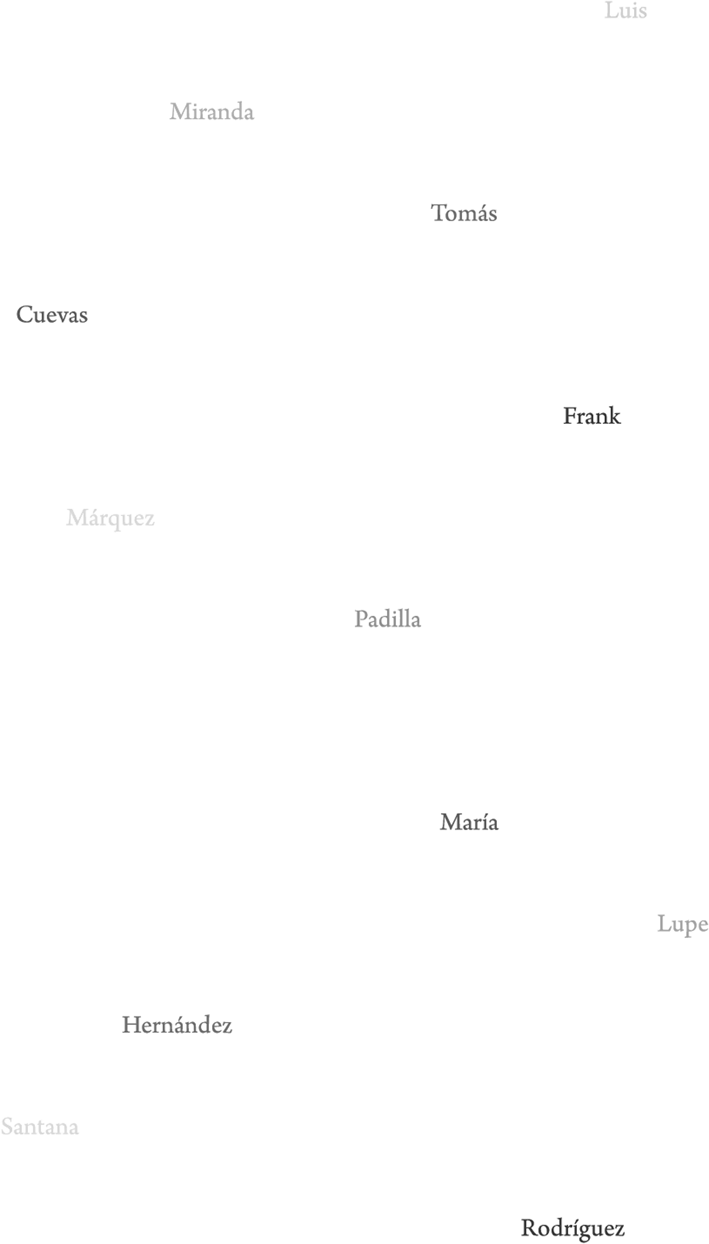
Layout and graphology have a significant role in representing the emotional content of the story involving the reader perceptually in the families’ loss of their loved ones. A three-page visual poem suddenly interrupts the narration of the passengers’ panic as the plane begins to burn and fall. Scattered and jumbled across the pages, the passengers’ broken names evoke Guthrie's image of “these friends scattered like dry leaves” and emphasize the fragmented memory resulting from deported migrants’ missing names and stories (Figure 3).Footnote 71 A single black page, placed after the re-creation of the crash at the end of chapter 34, powerfully symbolizes the sudden disappearance of the passengers, their unacknowledged deaths, and the also unacknowledged grief of their families and friends. Where there used to be the names, lives, and words, there is now only dark silence. The chapter that follows the black page is structured into very short vignettes titled after the name of the story keeper or testimony. They describe how news of each death was first heard through neighbors and media reports and its devastating effects on the families.
ATWCY, 161. Reproduced with permission of University of Arizona Press.

MULTIDIRECTIONAL MEMORY
Besides reconstructing the passengers’ family stories and affective lives, Hernandez's poetics of ethical engagement relies on creating unforeseen links between the lives of individuals of diverse origins and status. Focussing on one single event in US–Mexican history is probably the only way to approach a complex truth where multiple subaltern and non-subaltern voices and histories are entwined. The author's research and fictional refashioning of documentary evidence have the ultimate function of recovering memories that go beyond the “consent/descent” assimilationist formula or master narrative frequently applied to US immigration stories. The overarching assimilationist pattern outlined by Werner Sollors places the focus on the tension between the culture of origin and the host culture, which finally is resolved into a “socialization into Americanness,” the development of “a characteristic sense of American selfhood,” and the adoption of “the central codes of Americanness” that weld Americans as “one people.”Footnote 72 ATWCY adjusts not to this pattern but to one that shifts “the focus from the borders of ‘our’ imagined community, to construct alternative notions of ethical communities” in line with the life narratives, journalistic texts, and documentary novels on the undocumented that have proliferated at the end of the twentieth and the beginning of the twenty-first centuries.Footnote 73 It partakes of a “new memory of latinidad,”Footnote 74 which shifts the emphasis away from arrival and assimilation, and from Latinos’ and Latinas’ historical relationship with Anglo-America. This new memory encompasses the patterns of interaction among different generations of US immigrants, Chicanos, and Latinos, while it also contemplates the relationship between those who have gotten ahead, those who are arriving, and those who stay behind as constitutive of a border memory beyond geographical boundaries, citizenship, and national origin. Consequently, it generates a “migrant imaginary” and a cross-border community of mourning and memory that bespeaks a “new order of citizenship and shared interest … that follows from the struggle of the people who move.”Footnote 75
As a “narrative of loss,”Footnote 76 ATWCY underscores to the common humanity of the migrants and the crew without ignoring the “hierarchy of grief,” the structural conditions that determine that the former are less grievable than the latter.Footnote 77 The remains of the members of the crew were received by their families and their deaths were mourned in a proper burial and funeral ceremony in 1948. In contrast, the service for the Mexican passengers in Fresno in 1948 brought together several hundred local Mexican workers around nameless, almost empty, caskets that would go unidentified and lumped together for sixty-five more years under the administrative categories of “Mexican national” and “deportee.”Footnote 78 Mexican families were not notified of the service, and, despite the government's unremitting deportation of Mexican workers, the bodies of Mexican passengers were never sent back home.Footnote 79 As Ahmed and Butler remind us, those lives that are imagined as “lovable” are also imagined as “grievable,”Footnote 80 for when lives are recognized as mattering, worth remembering, and worth preserving, they can be mourned and are “harder to kill.”Footnote 81 The unequal significance of the passengers’ lives and deaths revealed by the ceremonies underscores of the “hierarchy of grief” based on nationality, race, class, and legal status. Even as the common fate calls attention to the common humanity of the passengers, the narrative eschews a decontextualized universal ethics.Footnote 82 The destiny of the crew, those whose lives as US citizens were officially recognized as vulnerable and grievable, is lethally tied to the migrants’ less valuable lives. Copilot Marion Ewin's wife files a suit denouncing that “the plane was in imperfect condition” and that it was “overloaded with passengers,”Footnote 83 which suggests that its neglected state might possibly be related to the “less valuable” lives of the passengers it was carrying.
The author's metabolization of the emotional appeal of the “I”/ “You”/ “We” of Guthrie's lyrics results in a nameless collective that is made of many names, a community of memory that will forever be bound to the location of Los Gatos Canyon in Coalinga, California.Footnote 84 The forgotten history of the canyon is revisited through the mediated testimony of one of the witnesses: Red Childers's granddaughter June Gaston. While the morphology of the canyon may have changed, the testimonies of its inhabitants voice a relationship with the charged history of the place that wouldn't otherwise be heard. Besides being the site of the tragic accident, Los Gatos Canyon has also been the location of the massacres of Yokut Indians, a home to oil miners and agricultural migrants of diverse regions, and a hideout for Mexican bandit Joaquín Murrieta.Footnote 85 In recovering the multilayered memory of the place, Hernandez connects it to episodes of Californian history involving the displacement and decimation of native tribes, and the Mexican resistance to Anglo-American colonial domination. ATWCY pays tribute to the missing subaltern in these and many other historical episodes, as proves his dedication to missing victims of violence in several international contexts: “For Ayotzinapa, Sri Lanka, Argentina, Ciudad Juárez, and for the missing everywhere.”Footnote 86 It brings together local, national and diasporic memory in ways that recall Andreas Huyssen's suggestion that national memory formations may learn a few lessons from diasporic memory.Footnote 87 The resulting historiographic memory is that of a multiple “we” around a single event and song, a “multidirectional memory” that develops from the exchanges, borrowings, and connections between the articulation of several memories, and that precludes a national master narrative and the primacy of the memory of a group over others.Footnote 88 “Multidirectional memory” is dynamic and constantly redefined through the interaction with other groups, with whose experience we may always find a bond or a connection. Far from being a “zero-sum” competitive struggle for the resources of the past to construct a straight line to differentiated identities – a pure, authentic “you” and “we” – it captures a dialogical interaction that includes elements of alterity and elements of commonality with others. Differences between historical experiences of violence and oppression remain unique in their specificity but they also illuminate others and create new possibilities of solidarity across territories, communities, and nations.Footnote 89 Multidirectional memory challenges assumptions about the makeup of collective memory because the remembrance of one story does not necessarily erase others; it rather creates the possibility of a dialogue between remembrances that encompasses both the individual, embodied aspects of memory and the collective, constructed aspects of memory.
ATWCY averts an “aggregate notion” of individual memories of the same historical episode;Footnote 90 rather, it makes us aware of the mediated, contingent, unintentional character of memory by rendering the plane wreck at Los Gatos Canyon as a tragic eventuality that marks the possibility of creating solidarity “out of specificities, overlaps and echoes of different historical experiences.”Footnote 91 It deliberately exposes connections between individuals and communities, often establishing links between memories and histories that the protagonists themselves ignore. In “A Genealogical Breakdown of the Chaffin Name,” the author uncovers the forgotten ancestry of the immigration officer's family to an English indentured servant who embarked on the Mayflower in 1620. Upon arrival in the New World, the servant sought the help of the natives for the planting of crops and became an indispensable agricultural worker for the new arrivals. Chaffin's ancestor was the “Juan Ruiz Valenzuela of his time,” says Hernandez.Footnote 92 Historical amnesia stands in the way of the officer's realization of this connection as he is staring into the patched clothes and dirty boots of deportee Juan Luis Valenzuela, feeling “a world away” from him.Footnote 93 This multidirectional approach highlights the connection between the indentured workers of the “first” colonial settlers, the indigenous inhabitants of the Americas, and present-day Mexican migrant labor, thus challenging the master narratives beneath the hegemonic understanding of “We the people of the United States” as a community with a unique common memory of immigration and assimilation, and underscoring the multifaceted character of collective memories through “dynamic transfer” between remembrances that cuts across time and space.Footnote 94 In the account of the embrace between the nephews of pilot Frank Atkinson and deportee Guadalupe Ramírez in the memorial stone funeral service, the narrator calls attention to the bonds established beyond social and geographical boundaries by a shared experience of loss and grief.Footnote 95 This connection between the memory of the pilot's family and the memory of the migrant workers is anticipated by a reference to related World War II news headlines in the account of pilot Atkinson's training as a war pilot in Alabama: “More young men flooded recruiting offices … They dropped their spots on the assembly lines and in packing houses … Soon, new headlines appeared: ‘Mexican Workers Wanted in October: California has placed orders for 6,000 imported Mexican workers’.”Footnote 96 The stories of the deported migrants on the fated plane have reverberations in the stories of the author's own relatives and in today's stories of dangerous border crossings, anonymous deaths, and family separations. In his opening “Author's Note,” the writer explains his realization, upon his grandfather's imminent death, that the old man's story cannot remain in the dark,Footnote 97 which brings him emotionally close to the migrants and makes him see, in staring into the eyes of Mexican witnesses and story keepers Guillermo and Jaime Ramírez, “how their faces resembled those of my own family.”Footnote 98 Toward the end of the novel, the words of Guadalupe's son, Don Fermín Ramírez, during a conversation with the author/narrator in Charco de Pantoja in January 2015, suggest that the feeling is reciprocal: he is “one of our own” who has “come back.”Footnote 99
MOURNING ACROSS BORDERS: LA HUESERA
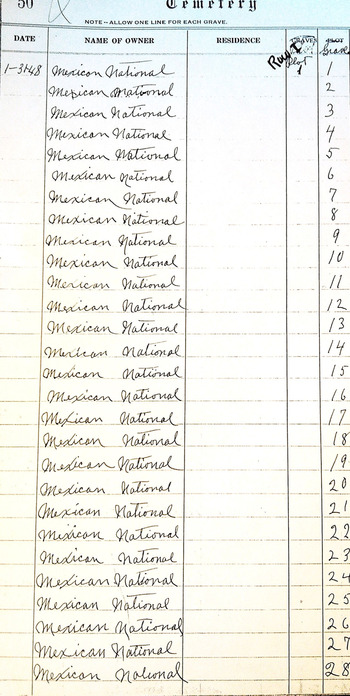
As part of a large multidirectional memorializing project, Hernandez's novel creates connections between the passengers and their families and a community of readers and mourners. The last section of the book, titled “Fieldnotes,” is a sequence of diary entries and images where the author records his findings during the persistent search for missing names and stories of the deceased (Figure 4), the emails he received from Jaime Ramírez, his impressions on the memorial stone celebration, an account of a commemorative gathering in Charco de Pantoja with the relatives of Guadalupe Ramírez Lara and Ramón Pérez González, and a long list of acknowledgments. Through these acknowledgments, the author conveys the collective component of an authorial project whose telling would have been impossible without many others: the composer of the music for Guthrie's poem that became a popular song, the story keepers, and all those individuals and institutions who helped the author in his research, the colleagues reviewing his writing, the memorial stone donors, and a long etc. These acknowledging lists of names almost act as a counterdiscourse to the historical anonymity of the migrant workers the novel strives to redress. The epigraph to these “Fieldnotes,” a quote from Ire'ne Lara Silva's short story “La Huesera or Flesh to Bone,” refers to the southwestern folkloric tale of la huesera. As defined by Chicana Jungian anthropologist Clarisa Pinkola Estés, la huesera, an embodiment of the wild-woman archetype, is a healer who gathers together the memories of her ancestors, sings over the bones of the dead, and acknowledges the psychic value of remembering them.Footnote 100 Lara Silva's quote in Hernandez's text reads, “here, where the world is undone, and their bodies are remade, their spirits rise in star-flecked spirals. The pooling blood runs backwards, their splintered hearts come together. I know all their names. I will call them, and they will come.”Footnote 101 In light of Hernández's mestizx or borderland consciousness, “a vague and undetermined place created by the emotional residue of an unnatural boundary,”Footnote 102 an existential awareness of the buried truths of neocolonial modernity and a perception that goes beyond the strictures of geopolitical and cultural boundaries, la huesera acts as a phenomenological leitmotif of a creative spirit that brings together writing, memory, and the psychological well-being derived from mourning and remembering across borders. Hernandez's role as researcher, compiler and reteller is thus similar to that of a curandero or healer, a huesero or bonesetter who collects bones, assembles them, and sings them back to life, a rebuilder of community around a shared experience of mourning and remembering that heals the splits of a community across national borders.Footnote 103 For both Estés and Lara Silva, this southwestern source of knowledge and folklore challenges cultural expectations of feminine silence, victimhood, and submissiveness, and sees memory and storytelling as a spiritually healing practice.Footnote 104 As a female archetype informing Hernandez's work, la huesera may also be viewed as a homage to the strength of grieving women like Casimira Navarro, Yréne Miranda, Micaela, and Elisa, who stayed back, remembered, and preserved the memories and stories the author compiles, reshapes, and divulges.
Cemetery cataogue list of the Mexican citizens buried in the mass grave, reproduced in ATWCY, 204. Photo credit: Fresno Diocese and Holy Cross Cemetery.

Pain has effects both in the “bodily life” of individuals and in the bodies of communities and families, as they are both damaged by unacknowledged separations and disappearances.Footnote 105 As an assemblage of multi-vocal testimony, documentation, and fiction, ATWCY becomes a “corpus” or embodied text, a compilation of names, documents, testimonies, and reimagined stories which, in the life-giving spirit of la huesera, reshapes and heals the communal body. The novel, the related fund-raising project, the funeral ceremony, the single by Lance Canales,Footnote 106 the memorial project and funeral, and the commemorative California State Senate ceremony, enact a grieving multidirectional community of memory – one that encompasses the workers, their families and friends across two countries, the plane crew and their relatives, Woody Guthrie, Martin Hoffman, Peter Seeger, the memorial-stone donors, the eight hundred people who attended the memorial ceremony, project collaborators Canales and Rascón, the California State Senate, Joan Baez, and the writer himself. At a moment of toughening policies against immigrants coming from Mexico, Tim Z. Hernández's Telling of the Plane Wreck at Los Gatos Canyon reaches out to human rights movements through the recognition of Mexican migrants’ inclusion in an international political economy as labor power, and of their simultaneous exclusion from the national community as disposable lives;Footnote 107 it crisscrosses the US–Mexico border enacting the mourning and multidirectional memory of US and Mexican lives that matter.