INTRODUCTION
Intergroup conflict is unavoidable due to functional diversities and the ongoing need to negotiate over resources (Hempel, Zhang, & Tjosvold, Reference Hempel, Zhang and Tjosvold2009). Although early research suggested that interdepartmental conflict restrains effective organizational functioning, it is no longer considered to be necessarily dysfunctional to organizations (Chan, Huang, & Ng, Reference Chan, Huang and Ng2008). Understanding the effects of intergroup conflicts between departments is important for managers seeking to increase interdepartmental coordination, reduce dysfunctional conflicts, and identify functional conflicts (De Clercq, Thongpapanl, & Dimov, Reference De Clercq, Thongpapanl and Dimov2009).
Oh, Chung, and Labianca (Reference Oh, Chung and Labianca2004) suggested that groups need to manage boundary-spanning relationships with other groups in their organizations to accumulate important informational resources that help to maintain the groups’ effectiveness. The boundary distinguishes within-group and between-group relationships (Oh, Labianca, & Chung, Reference Oh, Labianca and Chung2006). Previous studies have also demonstrated that perceptions of intergroup conflict perform important roles in within-group membership and between-group interaction (Labianca, Brass, & Gray, Reference Labianca, Brass and Gray1998; Gaunt, Reference Gaunt2011).
To delineate within- and between-group interaction, most network models utilize bonding ties to denote within-group relationships and bridging ties to denote between-group relationships (Granovetter, Reference Granovetter1973; Adler & Kwon, Reference Adler and Kwon2002; Gratton, Reference Gratton2005). As ties grow, abundant intangible resources are generated by and rooted in them, including frequent interactions, trust, and shared meaning: the so-called ‘social capital’ (Nahapiet & Ghoshal, Reference Nahapiet and Ghoshal1998). Oh, Chung, and Labianca (Reference Oh, Chung and Labianca2004) introduced the concept of ‘group social capital’ as an approach to examining group members’ social relationships within (i.e., bonding) and outside (i.e., bridging) their groups. Social capital helps a unit to maintain its effectiveness by acquiring external resources (Wei & Lin, Reference Wei and Lin2015). Due to the important role of social capital for groups (Hu & Randel, Reference Hu and Randel2014; Levin, Walter, Appleyard, & Cross, Reference Levin, Walter, Appleyard and Cross2015), this study attempts to explore intergroup conflict’s effects on bonding and bridging social capitals.
This study offers critical theoretical and practical contributions. While interdepartmental heterogeneity likely results in intergroup conflict (Bernardes, Reference Bernardes2009), the heterogeneity of contact allows group members to share different sets of information and knowledge, which further creates and reinforces values (Björk, Di Vincenzo, Magnusson, & Mascia, Reference Björk, Di Vincenzo, Magnusson and Mascia2011). The nature of interdepartmental heterogeneity indicates the necessity of research on the positive effects of intergroup conflict. Although Jehn, Greer, Levine, and Szulanski (Reference Jehn, Greer, Levine and Szulanski2008) indicated that conflict could influence within-group trust and respect, their study conducted individual-level analyses and addressed intragroup interaction. In addition, though prior studies have suggested that intergroup conflict impacts within-group cohesion and cooperation, their findings are inconsistent (Hempel, Zhang, & Tjosvold, Reference Hempel, Zhang and Tjosvold2009). Thus, this study aims to address the current literature gap and proffer valuable implications.
In addition, understanding the influences of intergroup conflict on within- and between-group relationships is critical for managing interdepartmental interactions. Maintaining sufficiently strong interdepartmental ties to engender bridging social capital is significantly costly (Hansen, Reference Hansen1999). Since intergroup conflict is an unavoidable situation within organizations, understanding its effects on group social capital, with a view to manipulating it, will likely help to reduce the cost of maintaining interdepartmental relationships, thus generating advantages for organizations. Members of a department not only benefit from bonding social capital by learning and sharing similar information and knowledge but are also able to maximize the nonredundant information received from other departments, which is ascribed to bridging social capital (Xu, Reference Xu2011). This study’s arguments will add an important nuance to the acclaimed benefits of conflict.
LITERATURE REVIEW
Conflict
Conflict arises in situations where interdependent actors are aware of discrepancies and incompatibilities (Jehn, Reference Jehn1995; Jehn & Mannix, Reference Jehn and Mannix2001; Bobot, Reference Bobot2011). In addition to diverse thought-worlds, interdepartmental conflict occurs due to different basic goals and the struggle to secure scarce resources (Williams, Reference Williams2001). For example, research and development (R&D) department focuses on issues relating to technical sophistication and product functionality, whereas a marketing department seeks to satisfy customers’ needs and maximize market share (De Clercq, Thongpapanl, & Dimov, Reference De Clercq, Thongpapanl and Dimov2009).
Conflict is multidimensional in nature and comprises task conflict and emotional conflict (Jehn, Reference Jehn1995; Jehn & Mannix, Reference Jehn and Mannix2001; De Clercq, Thongpapanl, & Dimov, Reference De Clercq, Thongpapanl and Dimov2009; Choi & Cho, Reference Choi and Cho2011). Task conflict is generally cognition-oriented and arises because of disagreements over task knowledge, including differences in viewpoints, ideas, and opinions, and disputes over how best to achieve common objectives (Jehn, Reference Jehn1995; Amason, Reference Aiken and West1996; Yang & Mossholder, Reference Yang and Mossholder2004). Emotional conflict pertains to person-driven incompatibilities that are not task-related, including diverse personal taste, personality clashes, habits, and violating personal values and norms (Jehn, Reference Jehn1995; Williams, Reference Williams2001; Jehn et al., Reference Jehn, Greer, Levine and Szulanski2008; De Clercq, Thongpapanl, & Dimov, Reference De Clercq, Thongpapanl and Dimov2009; Shaw, Zhu, Duffy, Scott, Shih, & Susanto, Reference Shaw, Zhu, Duffy, Scott, Shih and Susanto2011). It is characterized by negative feelings such as tension, friction, annoyance, frustration, irritation, suspicion, and animosity (Jehn & Mannix, Reference Jehn and Mannix2001; Choi & Cho, Reference Choi and Cho2011).
Social capital
Nahapiet and Ghoshal defined social capital as ‘the sum of actual and potential resources embedded within, available through, and derived from the network of relationships possessed by an individual or social unit’ (Reference Nahapiet and Ghoshal1998: p. 243). Oh, Chung, and Labianca (Reference Oh, Chung and Labianca2004) later introduced the concept of group social capital, which includes closure and bridging conduits. Group social capital refers to the set of resources available to a group through group members’ relationships within the social structure of the group (i.e., bonding social capital) and the cross-boundary relationships outside the group (i.e., bridging social capital) (Oh, Labianc, & Chung, Reference Oh, Labianca and Chung2006).
Nahapiet and Ghoshal (Reference Nahapiet and Ghoshal1998) categorized indicators of social capital into structural, relational, and cognitive dimensions. Structural social capital describes the extent to which actors are connected, the patterns of connections, and the usefulness of connections (Nahapiet & Ghoshal, Reference Nahapiet and Ghoshal1998; Badrinarayanan, Madhavaram, & Granot, Reference Badrinarayanan, Madhavaram and Granot2011). Social interaction and information flows are viewed as the manifestation of this dimension (Tsai & Ghoshal, Reference Tsai and Ghoshal1998; Chen, Chang, & Hung, Reference Chen, Chang and Hung2008).
Relational social capital refers to the quality of relationships (Badrinarayanan, Madhavaram, & Granot, Reference Badrinarayanan, Madhavaram and Granot2011), including trust, norms, and identification (Nahapiet & Ghoshal, Reference Nahapiet and Ghoshal1998; Tsai & Ghoshal, Reference Tsai and Ghoshal1998). Trust is defined as the confidence in exchange actors’ motives (Badrinarayanan, Madhavaram, & Granot, Reference Badrinarayanan, Madhavaram and Granot2011); it also relates to norms that create practical mutual expectations to facilitate interpretation and comprehension of others’ behavioral intentions (Watson, Scott, Bishop, & Turnbeaugh, Reference Watson, Scott, Bishop and Turnbeaugh2005). As members’ identification with a collectivity becomes evident, solidarity appears (Moody & White, Reference Moody and White2003).
Cognitive social capital embraces those resources providing shared language, narratives, and understandings among parties (Nahapiet & Ghoshal, Reference Nahapiet and Ghoshal1998). Actors need to demonstrate a shared language to share narratives and values, and to, thus, converge upon a shared understanding (Bernardes, Reference Bernardes2009; Badrinarayanan, Madhavaram, & Granot, Reference Badrinarayanan, Madhavaram and Granot2011). According to Villena, Revilla, and Choi’s (Reference Villena, Revilla and Choi2011) definition, cohesiveness, defined as a group’s shared commitment to the group goal, is also classified within this dimension.
Literature relevant to intergroup interaction
This study addresses the effects of intergroup conflict on bonding and bridging social capitals. Previous studies relevant to intergroup interaction provide clues for understanding the conflict–social capital association. For example, Bstieler (Reference Bstieler2006) found perceived conflict to be negatively related to the formation of trust in new product development partnerships between a manufacturer and its customer or supplier partner, though the author did not distinguish the type of conflict and only focused on trust. In terms of intergroup interactions within an organization, Hempel, Zhang, and Tjosvold (Reference Hempel, Zhang and Tjosvold2009) advanced that cooperative conflict between groups could reduce groups’ internal conflicts, thus strengthening trust. This implies that trust emerges within the group if functional conflict is managed well. However, it remains unknown how innate intergroup conflict affects groups’ internal and external interactions.
Regarding an individual’s perceptions of intergroup conflict, Williams (Reference Williams2001) proposed, without empirical evidence, that intergroup conflict has a negative impact on ingroups’ beliefs about outgroups. De Dreu (Reference De Dreu2010) used an experiment to explore how individual ingroups responded to intergroup conflict. Halevy, Weisel, and Bornstein (Reference Halevy, Weisel and Bornstein2012) later investigated individual motivations (i.e., a cooperative motivation to help ingroups and a competitive motivation to hurt outgroups) to participate in intergroup conflict, finding that individuals preferred to cooperate within their groups. Although the above studies did not consider the task interdependence between departments, their results imply that intergroup conflict may shape ingroups’ attitudes toward outgroups or change internal ties.
Several prior studies have considered intergroup conflict and elements of social capital (e.g., Labianca, Brass, & Gray, Reference Labianca, Brass and Gray1998; De Clercq, Thongpapanl, & Dimov, Reference De Clercq, Thongpapanl and Dimov2009; Birtel & Crisp, Reference Biggart and Castanias2012). Other studies have addressed either the consequences of intergroup conflict (Menguc & Auh, Reference Menguc and Auh2008) or the antecedents of bridging social capital (Oh, Labianc, & Chung, Reference Oh, Labianca and Chung2006). These studies imply that the joint consideration of intergroup conflict and social capital is necessary, though they did not directly examine the conflict–social capital relationship.
Some intragroup interaction literature also provides evidence on the associations between conflict and elements of social capital within a group. For instance, Nelson (Reference Nelson1989) suggested that strong intergroup ties lead to low intragroup conflict. Shah, Dirks, and Chervany (Reference Shah, Dirks and Chervany2006) indicated that groups with internal friendship networks and external bridging ties display high performance. They also documented that internal friendship networks could amplify the positive relationship between intragroup task conflict and performance. Jehn et al. (Reference Jehn, Greer, Levine and Szulanski2008) examined trust, respect, and cohesiveness as mediating the effects of intragroup conflict on group outcomes.
Theories delineating the effects of intergroup conflict on intragroup and intergroup relationships have been largely guided by social identity theory and intergroup contact theory (Richter, West, van Dick, & Dawson, Reference Richter, West, van Dick and Dawson2006). Based on social identity theory, individuals define themselves mostly in terms of their group memberships and are inclined to seek a positive social identity (Hewstone & Greenland, Reference Hewstone and Greenland2000). A positive social identity is achieved by comparing one’s own group with other groups, thereby establishing separation from and superiority over relevant outgroups (Hewstone & Greenland, Reference Hewstone and Greenland2000; Hogg, Van Knippenberg, & Rast, Reference Hogg, Van Knippenberg and Rast2012). This explains why ingroups employ solidarity mechanisms when experiencing intergroup conflict (Halevy et al., Reference Halevy, Bornstein and Sagiv2008).
Intergroup contact theory is one of the most influential theoretical approaches for improving intergroup relationships (Birtel & Crisp, Reference Biggart and Castanias2012). Because groups within an organization are required to cooperate to complete organizational tasks (Labianca, Brass, & Gray, Reference Labianca, Brass and Gray1998), they may engage in increasing intergroup contact to manage their conflicts (De Dreu, Reference De Dreu2010). In essence, when conflicts arise, intergroup contact provides channels for dispute resolution (Nelson, Reference Nelson1989). Contact theory posits that bringing together individuals from opposing groups can reduce prejudice and bias, improve positive attitudes toward the outgroup, develop positive sentiment over time, and promote intergroup harmony and future intergroup contact (Labianca, Brass, & Gray, Reference Labianca, Brass and Gray1998; Gaunt, Reference Gaunt2011). Thus, contact theory implies that the existence of intergroup conflict facilitates intergroup contact, resulting in intergroup harmony over time. According to social identity theory and intergroup contact theory, intergroup conflict seems to facilitate the growth of positive intragroup and intergroup relationships.
Intergroup conflict and bonding social capital
This study advances that members’ perceptions of intergroup conflict may influence within-group relationships. As members perceive high levels of intergroup conflict, they may seek to develop relationships with individuals who have interpersonal relations with that opponent group to thereby confirm their perceptions. Moreover, faced by a negative relationship with members of another group, a group’s members may seek to draw third parties into the encounter to acquire support in the conflict (Smith, Reference Smith1989). In this regard, colleagues in the same department are the appropriate and available third party candidates, because their shared functional backgrounds tend to lead to similar perceptions. Labianca, Brass, and Gray (Reference Labianca, Brass and Gray1998) supported the arguments that friends tend to see the world similarly and display homogenous attitudes. Accordingly, intergroup conflict may create an opportunity for members to interact with their colleagues in the same department.
Based on the exchange theory, members experiencing intergroup conflicts are motivated to engage in reciprocal behaviors with colleagues in the same department to thereby obtain colleagues’ support and assistance. Reciprocal behaviors underpin within-group relational social capital. In addition, the competence view posits that members inculcate high levels of trust as they associate positive beliefs about competence and goodwill with others (Williams, Reference Williams2001; Badrinarayanan, Madhavaram, & Granot, Reference Badrinarayanan, Madhavaram and Granot2011). A colleague’s assistance in communicating perspectives to opponents in another department or acting as a mediator encourages members to establish trust in that colleague. The internal relational social capital thereby is augmented.
Moreover, intergroup conflict provides a mechanism to cultivate a group’s ability to develop internal perceptions. The shared perceptions that develop portray the opponent group as the enemy with uncomplimentary labels, and view members in the same group positively (Labianca, Brass, & Gray, Reference Labianca, Brass and Gray1998). When interaction between two groups involves negative emotions, within-group shared language and narratives are developed. The language and narratives shared by members of the same group are associated with conflict-oriented comments regarding the opposite group, such as taunts, mocking, and ridicule. Nelson (Reference Nelson1989) found that members became more cohesive within the group while developing negative stereotypes and biased perceptions toward others in the opponent group. Thus, intergroup conflict promotes the creation of cognitive social capital within a group.
Hypothesis 1a: Members in one department of an organization have higher levels of structural bonding social capital when they perceive higher levels of intergroup conflict (i.e., task or emotional conflict) toward another department.
Hypothesis 1b: Members in one department of an organization have higher levels of relational bonding social capital when they perceive higher levels of intergroup conflict (i.e., task or emotional conflict) toward another department.
Hypothesis 1c: Members in one department of an organization have higher levels of cognitive bonding social capital when they perceive higher levels of intergroup conflict (i.e., task or emotional conflict) toward another department.
Intergroup conflict and bridging social capital
In addition to the effects of intergroup conflict on bonding social capital, this study also investigates the lagged effect of intergroup conflict on bridging social capital between departments. Previous studies have acknowledged the importance of the temporal factor, in that social capital and conflict are dynamic and change over time (Jehn & Mannix, Reference Jehn and Mannix2001; Agndal, Chetty, & Wilson, Reference Amason2008). As conflict shifts over time (Jehn & Mannix, Reference Jehn and Mannix2001), giving members time to personally bond is a form of investment in social capital (Nahapiet & Ghoshal, Reference Nahapiet and Ghoshal1998). The temporal factor not only allows increasing intergroup contact but also enables the transformation of ingroups’ attitudes toward outgroups. Keenan and Carnevale’s (Reference Keenan and Carnevale1989) spillover hypothesis suggests that intragroup relations will spread into intergroup relations. Specifically, the presence of positive ingroup relationships leads to the development of positive attitudes, and this frame of reference then becomes a lens through which individuals evaluate outgroups.
This study adopts Adler and Kwon’s (Reference Adler and Kwon2002) opportunity–motivation–ability framework, which presents three sources of social capital, to explain the associations between intergroup conflict and bridging social capital. Opportunity describes whether a tie exists that allows information flow, and thus determines structural social capital (Cheung & Chan, Reference Cheung and Chan2010). While exchange behaviors, which enable the development of relational social capital, are driven by actors’ instrumental motivations, ability describes the creation of shared beliefs relating to cognitive social capital (Adler & Kwon, Reference Adler and Kwon2002). This study advances that intergroup conflict can create or hinder the opportunity for social interaction (structural social capital), the motivation to engage in exchanges and, thereby, build trust (relational social capital), and the ability to act together to reach a common goal (cognitive social capital).
Structural social capital
According to the opportunity and exchange theory (cf., Cheung & Chan, Reference Cheung and Chan2010), opportunity describes whether a relationship exists and the opportunity to access resources (Theingi, Purchase, & Phungphol, Reference Theingi, Purchase and Phungphol2008). Granovetter (Reference Granovetter1973) advanced that bridging connections provides access to others’ resources that can be leveraged. External ties to others give the actors the opportunity to access their contacts’ resources (Adler & Kwon, Reference Adler and Kwon2002). Accordingly, opportunity relates to the creation of structural social capital. A scant level of task conflict leads to inactivity in interactions (Van de Vliert & De Dreu, Reference Van de Vliert and De Dreu1994). In such circumstances, the opportunity to build strong ties cannot be activated. When task conflict arises, between-group connection is needed as it provides a conduit to resolve disputation (Labianca, Brass, & Gray, Reference Labianca, Brass and Gray1998). Social interaction between two departments manifests the desire to find mutually beneficial solutions to task-related issues (De Clercq, Thongpapanl, & Dimov, Reference De Clercq, Thongpapanl and Dimov2009). Opportunity theory posits that creating opportunities for social interactions promotes social capital (Cheung & Chan, Reference Cheung and Chan2010). Hence, a certain level of task conflict offers an opportunity to create structural social capital between departments.
Social capital theory posits that nonredundant contact between groups creates opportunities to acquire information that is beneficial to both groups (Burt, Reference Burt1997). When task conflict increases, member representatives of each group need to devote time and effort to reconciling disagreements on similar issues. However, information exchanged may become redundant as the reconciling process is prolonged (Villena, Revilla, & Choi, Reference Villena, Revilla and Choi2011). The development of structural social capital between departments vanishes when the opportunity to create information flow decreases. In circumstances of extensive task conflict, the group, thereby, feels no necessity to maintain structural social capital with another group. Consequently, when members in a department perceive moderate levels of intergroup task conflict with another department, they will perceive higher levels of structural social capital, in contrast to the situations where members in the department perceive high or low levels of intergroup task conflict.
Unlike the curvilinear effect of task conflict, this study proposes a negative relationship between emotional conflict and structural social capital. Perceptual biases and social cognition perspectives underpin this negative relationship. The perceptual biases perspective suggests that groups involved in conflict attempt to evaluate each other through stereotypes, embodying the generalizations held by members of one group about the characteristics of another group’s members (Labianca, Brass, & Gray, Reference Labianca, Brass and Gray1998). Negative emotions resulting from an escalation in emotional conflict confirm these stereotypes and create self-fulfilling prophecies through biased information processing (Simons & Peterson, Reference Simons and Peterson2000). Members thus avoid opportunities to interact with outgroups based on these perceptual biases because they can predict unpleasant interaction. According to the social cognition perspective, which suggests that transactional memories determine interactions (Borgatti & Foster, Reference Borgatti and Foster2003), increasing emotional conflicts produces biased transactional memories, thereby decreasing opportunities for social interactions.
Relational social capital
Relational social capital refers to relationship quality displaying a high level of trust (Nahapiet & Ghoshal, Reference Nahapiet and Ghoshal1998). Trust is tied to instrumental motivation created in the process of social exchange (Adler & Kwon, Reference Adler and Kwon2002). Exchange theory implies that offering help results from a rational calculation of investment and reciprocation in the process of social exchange (Cheung & Chan, Reference Cheung and Chan2010). Both parties are motivated to develop a trust relation as they expect that trust will prevent one’s exchange partner from acting opportunistically (Thuy & Quang, Reference Thuy and Quang2005). As moderate task conflict arises, two interdependent departments cannot but interact to integrate each other’s perspectives and find a reconcilable solution. Disagreements on task issues force a deeper analysis of one’s own position and a comprehension of others’ views (Olson, Parayitam, & Bao, Reference Olson, Parayitam and Bao2007). This openness of interaction not only encourages behavioral transparency but also discourages information asymmetries in the relationship (Carey, Lawson, & Krause, Reference Carey, Lawson and Krause2011). Trust emerges between two groups as they interact to learn more about each other (Thuy & Quang, Reference Thuy and Quang2005). Accordingly, moderate task conflict conveys an instrumental motivation to exchange information and, thus, create relational social capital.
When task conflict is intensified and augmented to become extensive, the relationship between two departments becomes competitive. In this situation, members in one group engender negative affects toward outgroups, thereby undermining the formation of trust between the groups (Williams, Reference Williams2001). For example, as task conflict between departments becomes extensive, members become more inflexible and more committed to rules and procedures set by their own department (Lovelace, Shapiro, & Weingart, Reference Lovelace, Shapiro and Weingart2001). This situation, in which people tend to adhere to different rules and procedures, is detrimental to social capital (Gooderham, Minbaeva, & Pedersen, Reference Gooderham, Minbaeva and Pedersen2011). In such situations, members lack motivation to engage in reciprocal behavior, as they do not expect outgroups will adapt to their interests. Accordingly, extensive task conflict threatens to weaken relational social capital.
Friction, frustration, and tension associated with emotional conflict may create an unclear picture of expectations regarding outgroups’ opportunistic behavior (Barnes, Leonidou, Siu, & Leonidou, Reference Barnes, Leonidou, Siu and Leonidou2010). Hence, in circumstances of emotional conflict, members from distinct groups are not motivated to build trust relationships with one another due to a lack of positive beliefs. According to the congruence perspective proposed by balance theorists, members adopt an attitude congruent to the interactions of their friends in the same group with outgroups (Labianca, Brass, & Gray, Reference Labianca, Brass and Gray1998). For example, engineers in the R&D department are willing to reveal relevant information to members in the marketing department if a colleague has a positive relationship with them. Otherwise, negative affects lead these engineers to avoid openness with outgroups, potentially leading to communication breakdown (Barnes et al., Reference Barnes, Leonidou, Siu and Leonidou2010). In this situation, one group observes that the other group may act opportunistically as the exchange relationship is characterized by information asymmetry (Biggart & Castanias, Reference Birtel and Crisp2001). In this regard, negative affects substitute for the group’s motivation to build trust with others as emotional conflict increases.
Cognitive social capital
Ability, reflecting a group’s skills and competencies to conduct resource exchanges with others, determines the development of cognitive social capital (Adler & Kwon, Reference Adler and Kwon2002; Theingi, Purchase, & Phungphol, Reference Theingi, Purchase and Phungphol2008). For example, ties between R&D engineers and marketers afford the engineers access to reliable ideas related to customers. However, even if the engineer has frequent informal interactions with these colleagues (i.e., opportunity), and even if these marketers are motivated to exchange ideas and offer help (i.e., motivation), the engineer is unable to gain valuable information from these ties when the engineer and marketers do not have shared understandings or shared language (i.e., ability). Accordingly, increasing the ability to exchange denotes the development of cognitive social capital. This is important for bridging ties because different departments are heterogeneous in various aspects of their compositions.
This study proposes that moderate task conflict promotes the development of cognitive social capital by escalating ability to exchange. The presence of moderate task conflict between departments signifies the necessity of interdepartmental interaction to reconcile their disagreements (Labianca, Brass, & Gray, Reference Labianca, Brass and Gray1998; De Clercq, Thongpapanl, & Dimov, Reference De Clercq, Thongpapanl and Dimov2009). Interactions between groups permit faster dispute resolution and prevent the accumulation of grievances and grudges (Nelson, Reference Nelson1989). The close interactions triggered by moderate task conflict also enable members from distinct groups to share information and to create a common understanding related to the task(s) (Chen, Chang, & Hung, Reference Chen, Chang and Hung2008). Moreover, moderate task conflict allows boundary spanners to preserve their limited attentional resources and focus only on task issues (Shaw et al., Reference Shaw, Zhu, Duffy, Scott, Shih and Susanto2011), thereby facilitating the development of shared language. The task-based language is a critical condition (i.e., ability) for boundary spanners to exchange valuable information (Lee, Reference Lee2009).
When the intensity of task conflict exceeds a certain level, an escalation of cognitive distance between departments requires boundary spanners to engage in greater efforts to absorb what others do and say, and to communicate their own perspectives in a way that helps others to absorb them, thereby constraining joint operational actions (Bernardes, Reference Bernardes2009). The cost of maintaining the cooperative relationships increases as reconciliation becomes unavailable, thus further increasing the difficulty of effectively coordinating the resources and activities of both departments to pursue the shared goal. Accordingly, extensive task conflict may damage an organization’s cognitive social capital based on inability to exchange.
According to attentional resources theory, increasing emotional conflict causes members to be distracted from task-related issues and to focus attention on negative affects (Lau & Cobb, Reference Lau and Cobb2010; Shaw et al., Reference Shaw, Zhu, Duffy, Scott, Shih and Susanto2011). Members produce stronger perceptual biases toward and negative images concerning outgroups as intergroup conflict increases (Labianca, Brass, & Gray, Reference Labianca, Brass and Gray1998). These perceptual biases and negative affects obstruct information processing by members of both groups (Simons & Peterson, Reference Simons and Peterson2000). Accordingly, the ability to reach a shared understanding required for the creation of cognitive social capital is inhibited.
Hypothesis 2a: There is a curvilinear relationship between intergroup task conflict (time 1) and bridging social capital (time 2) between departments, such that bridging social capital (time 2) increases when task conflict (time 1) increases up to a moderate level, and decreases when it rises above a moderate level.
Hypothesis 2b: There is a negative relationship between intergroup emotional conflict (time 1) and bridging social capital (time 2) between departments.
METHOD
Data collection
This study focuses on intergroup interactions between R&D and marketing departments. Conflict (e.g., Amason, Reference Aiken and West1996) and social capital (e.g., Tsai & Ghoshal, Reference Tsai and Ghoshal1998) have been recognized for their critical roles in innovation. Sources of innovation include technology knowledge from R&D and marketing knowledge mainly residing with the marketing department (Rubera, Ordanini, & Calantone, Reference Rubera, Ordanini and Calantone2012). Atuahene-Gima and Li (Reference Atuahene-Gima and Li2000) indicated that both R&D and marketing had equivalent influence on new product decisions. Thus, innovation success requires effective exchanges between R&D and marketing departments (De Clercq, Thongpapanl, & Dimov, Reference De Clercq, Thongpapanl and Dimov2013). However, differences in personality and thought-worlds between R&D and marketing personnel lead to conflict (Atuahene-Gima & Li, Reference Atuahene-Gima and Li2000; Rubera, Ordanini, & Calantone, Reference Rubera, Ordanini and Calantone2012). The literature has recognized that intergroup conflict is particularly strong in the R&D–marketing interface (Ruekert & Walker, Reference Ruekert and Walker1987; Song, Dyer, & Thieme, Reference Song, Dyer and Thieme2006). Furthermore, my interviews with several R&D managers revealed that they were interested in the intergroup interaction between R&D and marketing departments. These factors explain my motivation for undertaking a department-level analysis by focusing on R&D and marketing departments. This study regarded R&D participants as the target because R&D is a major source of innovation (Engelen & Brettel, Reference Engelen and Brettel2012).
This study was conducted in Taiwan, a nation characterized by a blend of collectivism and individualism (Chang, Reference Chang2009). A list of sample firms was prepared by reviewing the annual reports of China Credit Information Service (CCIS). A firm with both an R&D and marketing department, each of which had more than three members (cf., Pelled, Reference Pelled1996), was eligible for inclusion in the sample. This study selected the brokerage acting as connections between different groups (cf., Burt, Reference Burt2004). Managers and other members who engage in contact with outgroups are the appropriate respondents (Taylor, Reference Taylor2007).
While some prior works employed a single-respondent design and obtained information on R&D–marketing interaction (e.g., Simons & Peterson, Reference Simons and Peterson2000; Song, Dyer, & Thieme, Reference Song, Dyer and Thieme2006; De Clercq, Thongpapanl, & Dimov, Reference De Clercq, Thongpapanl and Dimov2009, Reference De Clercq, Thongpapanl and Dimov2013), other studies expanded the number of respondents per unit from one to several, targeting those who were the most knowledgeable about their research questions (e.g., Ruekert & Walker, Reference Ruekert and Walker1987; Menguc & Auh, Reference Menguc and Auh2008). Following these studies, this study asked managers, who consented to participate in the survey, to provide details of two additional members with the most knowledge about the research variables, aiming to reduce the potential problems associated with single sourcing. Three sets of survey instruments, containing a covering letter addressed personally to the participant, a questionnaire, and a postage-paid return envelope, were sent to each participant, including the R&D manager, considered to be the most appropriate respondent (Cabello-Medina, López-Cabrales, & Valle-Cabrera, Reference Cabello-Medina, López-Cabrales and Valle-Cabrera2011). To verify the appropriateness of each respondent, they were asked to respond ‘Yes’ or ‘No’ to the personal applicability of the following statement: ‘Due to work, I have frequent communications with colleagues in our marketing department on behalf of the R&D department.’ Participants were informed that the data would be used for academic research only and that the confidentiality of all the information they provided was guaranteed.
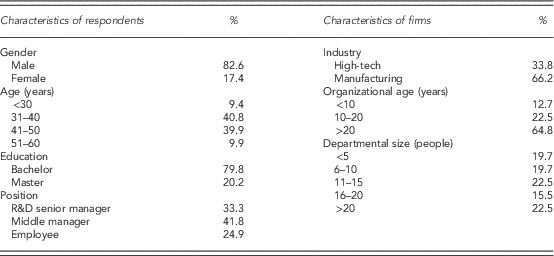
Participants were asked to respond to items relating to intergroup conflict and bonding social capital at time 1. Approximately 6 months later, another questionnaire relating to bridging social capital at time 2 was sent to the participants who had returned the completed first questionnaire. Overall, this study obtained valid questionnaires from 213 participants in 71 firms. Table 1 displays detailed information on the respondents and sample firms. Nonresponse bias was examined by comparing the early and late waves of returned surveys. Two-tailed t-statistics across all the variables show no statistically significant differences (t=0.44–1.67), indicating that nonresponse bias is not an issue.
Information on the sample firms and respondents

Note. R&D=research and development.
Measures
The measures in this study included three major parts: intergroup conflict, bonding social capital, and bridging social capital. Every questionnaire measure consisted of Likert-type scaled questions (anchored from 1=‘none’ to 7=‘a lot’ for conflict, and from 1=‘strongly disagree’ to 7=‘strongly agree’ for social capital). Originally constructed in English, the measures were translated into Chinese through a back-translation procedure (Brislin, Reference Brislin1980).
Intergroup conflict
This study measured task (six items) and emotional (six items) intergroup conflict using 12 items drawn from De Clercq, Thongpapanl, and Dimov (Reference De Clercq, Thongpapanl and Dimov2009), Jehn (Reference Jehn1995), and Jehn et al. (Reference Jehn, Greer, Levine and Szulanski2008). The wording of the scale was adapted for intergroup interaction. For task conflict, the sample items included ‘How often do people from two departments disagree about opinions regarding the work being done?’; for emotional conflict, the sample items included ‘How much friction is there among people from two departments?’ The scales used for conflict show good reliability, with coefficient α of 0.90 and 0.85, respectively.
Social capital
To measure social capital, this study drew items from the established literature in this field (i.e., Tsai & Ghoshal, Reference Tsai and Ghoshal1998; Hansen, Reference Hansen1999; Levin & Cross, Reference Levin and Cross2004; Chen, Chang, & Hung, Reference Chen, Chang and Hung2008; De Clercq, Thongpapanl, & Dimov, Reference De Clercq, Thongpapanl and Dimov2009; Molina-Morales & Martínez-Fernández, Reference Molina-Morales and Martínez-Fernández2009). The wording of the scale was adapted for within- and between-group interactions. There were six items for the structural dimension (e.g., ‘I/People in the two departments spend significant time on social occasions with people in my department/each other’), six items for the relational dimension (e.g., ‘I believe I can rely on people in my department/from the other department without any fear that they will take advantage of me, even if the opportunity arose’), and four items for the cognitive dimension (e.g., ‘My department/people from two departments share/s the same ambitions and vision at work’). The scales had acceptable coefficient α in the range of 0.83–0.90, with a mean α of 0.87.
Control variables
Following previous studies (e.g., Jehn et al., Reference Jehn, Greer, Levine and Szulanski2008; Menguc & Auh, Reference Menguc and Auh2008; De Clercq, Thongpapanl, & Dimov, Reference De Clercq, Thongpapanl and Dimov2009), this study considered several control variables, including industry category, organizational age, and departmental size. Time (Nahapiet & Ghoshal, Reference Nahapiet and Ghoshal1998) and size of a group (Adler & Kwon, Reference Adler and Kwon2002; Björk et al., Reference Björk, Di Vincenzo, Magnusson and Mascia2011) are important for developing social capital. Thus, organizational age and departmental size were included in the model. Table 1 presents further information on the control variables. Furthermore, it is possible that being embedded in closed relationships within a group might render interacting with outgroups illegitimate in the eyes of fellow ingroup members (Oh, Chung, & Labianca, Reference Oh, Chung and Labianca2004). Thus, this study also treated bonding social capital (time 1) as a control variable in examining the relationship between intergroup conflict (time 1) and bridging social capital (time 2).
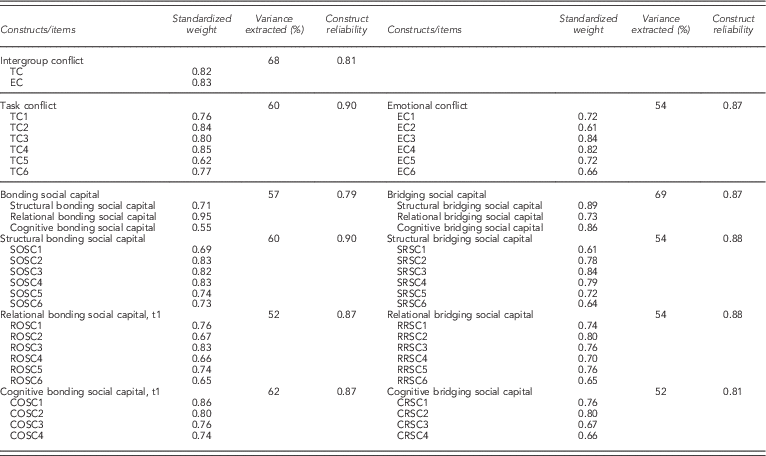
This study applied a second-order confirmatory factor analysis to examine the validity and reliability of the scale. Second-order confirmatory factor analysis models produced a χ2 of 1504.996 (df=891, p<.001) and satisfactory fitness indices (GFI [goodness-of-fit index]=0.82, AGFI [adjusted goodness-of-fit index]=0.80, CFI [comparative fit index]=0.90, RMSEA [root mean square error of approximation]=0.06). Table 2 displays each standardized loading estimate with a significant t-value higher than 0.55. The variance-extracted measure by each latent factor was approximate to or higher than 50%. The construct reliability shown in Table 2 exceeded 0.70. These results indicate that the convergent validity and reliability for each factor are adequate (Hair, Black, Babin, & Anderson, Reference Hair, Black, Babin and Anderson2010).
The results of confirmatory factor analysis

Note. COSC=cognitive bonding social capital; CRSC=cognitive bridging social capital; EC=emotional conflict; ROSC=relational bonding social capital; RRSC=relational bridging social capital; SOSC=structural bonding social capital; SRSC=structural bridging social capital; TC=task conflict.
Aggregation
This study collected data at the individual-level from multiple sources and aggregated an average of the individual scores to form group-level variables. As those individual responses within a group are interdependent, they should be aggregated into a data point. The aggregation technique reduces the effects of individual differences in perceptions within each group, thereby ensuring a more objective estimate of group-level perceptions (Simons & Peterson, Reference Simons and Peterson2000). This study followed Klein and Kozlowski (Reference Klein and Kozlowski2000) to justify aggregation by examining multiple aggregation indices, including η2 statistics, intraclass correlation coefficients (ICC(1)), r wg, and one-way analysis of variance.
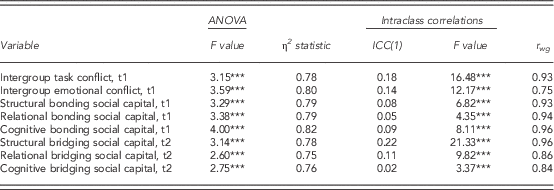
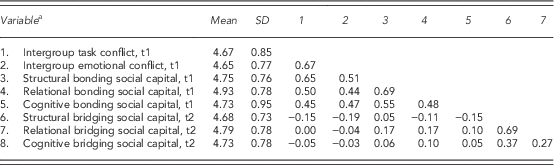
Table 3 shows the aggregation indices for each construct. One-way analysis of variance on each variable shows that the variance within firms was significantly less than the variance between firms (F=2.60–4.00, p<.001). All η2 statistics exceed 0.20, indicating individuals within a firm are more similar than individuals from other firms. A significant F-test for the ICC(1) value indicates the appropriateness of the aggregation (F=3.37–21.33, p<.001). All the r wg values exceeded 0.70, suggesting acceptable levels of agreement within firms. Overall, these indices suggest that individual firm members’ responses are homogeneous and that aggregating their scores to firm levels is appropriate. Table 4 presents the means, standard deviations, and correlations between the variables.
Aggregation indices

Note. ANOVA=analysis of variance.
***p<.001.
Means, SD, and correlations

Note.
a Means, SD, and correlations were calculated by group-level variables.
RESULTS
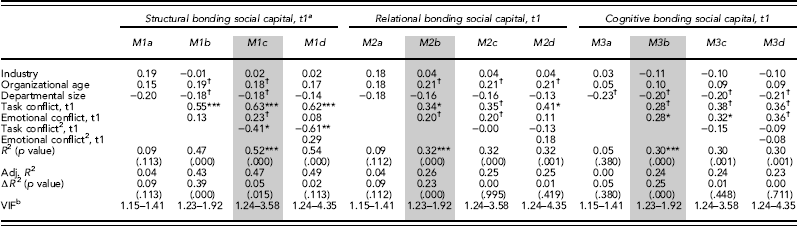
Hierarchical regressions were used to investigate the study’s research hypotheses. Hypothesis 1 predicts that the effect of intergroup conflict on levels of bonding social capital is positive. The regression results displayed in Table 5 illustrate that the curvilinear model (i.e., M1c) is significantly better than others in terms of structural social capital (∆R 2=0.05, p<.05), while the linear models (i.e., M2b and M3b) are significantly better than others in terms of relational (M2b: ∆R 2=0.23, p<.001) and cognitive social capital (M3b: ∆R 2=0.25, p<.001).
The relationships between intergroup conflict (T1) and bonding social capital (T1)

Note.
a For reducing the problem of multicollinearity, all criterion variables and predictors were centered following Aiken and West (Reference Agndal, Chetty and Wilson1991).
b Average variance inflation factor (VIF) scores of independent variables for each regression model. The scores for each variable were below 10, suggesting that multicollinearity was not a problem in the analyses (Hair et al., Reference Hair, Black, Babin and Anderson2010).
†p<.10; *p<.05; **p<.01; ***p<.001.
When the control variables are accounted for, task conflict (b=0.63, p<.001) and emotional conflict (b=0.23, p<.10) exhibit the expected positive relationships with structural bonding social capital. This result provides support for Hypothesis 1a. Surprisingly, however, there is an inverted-U relationship between task conflict and structural bonding social capital (b=−0.41, p<.05), indicating that task conflict favors structural social capital up to a certain critical level, above which the trend reverses.
Hypothesis 1b predicts that task and emotional conflicts are positively related to relational bonding social capital. The statistically significant parameter estimates (b=0.34 and 0.20, p<.10) indicate support for Hypothesis 1b. Hypothesis 1c is weakly supported, as statistically significant parameter estimates are found for the paths between task conflict and cognitive social capital (b=0.28, p<.10) and between emotional conflict and cognitive social capital (b=0.28, p<.05).
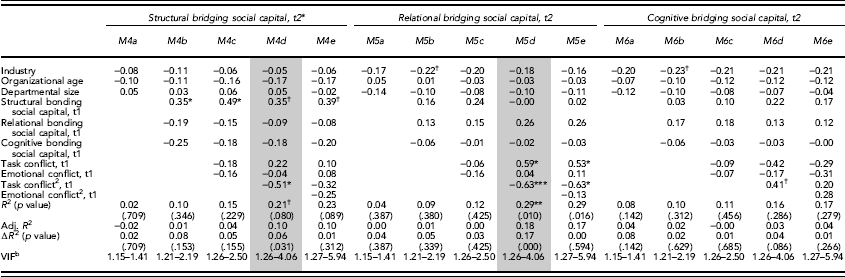
Hypothesis 2a predicts an inverted-U relationship between task conflict and bridging social capital. Table 6 reports the lagged effect of intergroup conflict on bridging social capital. The regression results show that the curvilinear models (i.e., M4d and M5d) are significantly better than the others in terms of structural and relational social capital (M4d: ∆R 2=0.06, p<.05; M5d: ∆R 2=0.17, p<.001). The parameter estimates of control variables in the curvilinear models are insignificant or weakly significant. However, none of the regression models are significant in terms of cognitive social capital (R 2=0.08–0.17, p>.10), suggesting that task and emotional conflicts have no effects on cognitive social capital.
The relationships between intergroup conflict (T1) and bridging social capital (T2)

Note.
a For reducing the problem of multicollinearity, all criterion variables and predictors were centered following Aiken and West (Reference Agndal, Chetty and Wilson1991).
b Average variance inflation factor (VIF) scores of independent variables for each regression model. The scores for each variable were below 10, suggesting that multicollinearity was not a problem in the analyses (Hair et al., Reference Hair, Black, Babin and Anderson2010).
†p<.10; *p<.05; **p<.01; ***p<.001.
The regression results displayed in Table 6 (M4d) show that while task conflict insignificantly relates to structural social capital (b=−0.18, p>.10), its square term significantly and negatively relates to structural social capital (b=−0.51, p<.05). In addition, the regression results in Table 6 (M5d) show that task conflict positively relates to relational social capital (b=0.59, p<.05) and its square term significantly and negatively relates to relational social capital (b=−0.63, p<.001). These results provide partial support for Hypothesis 2a.
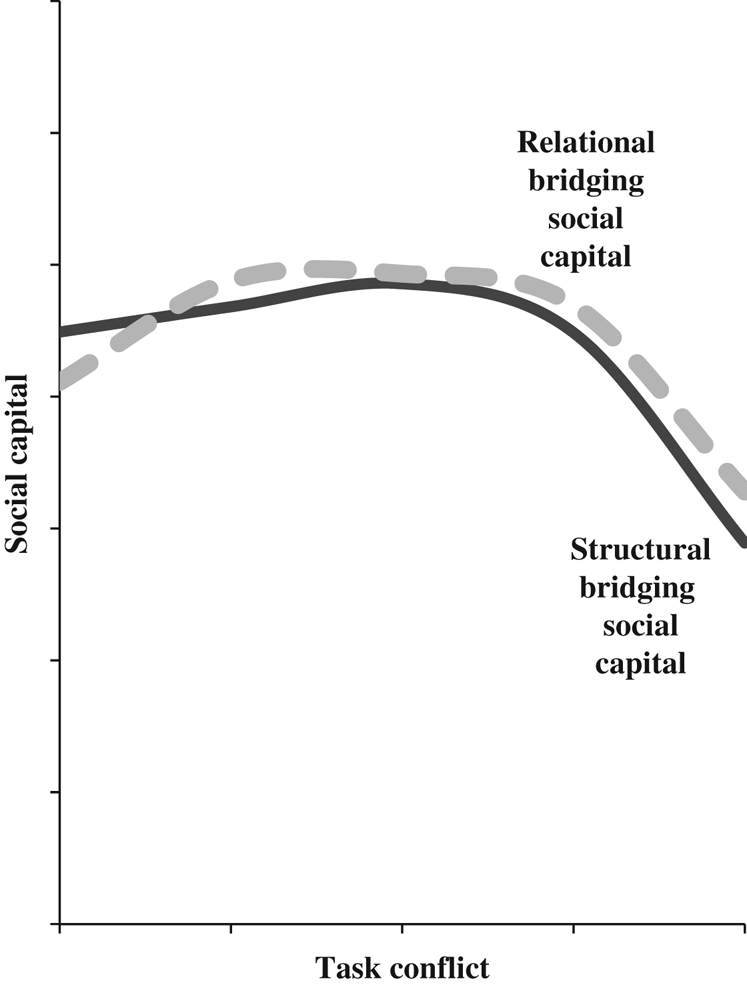
Hypothesis 2b predicts that this decline in bridging social capital is associated with a higher level of emotional conflict between departments. Table 6 indicates that emotional conflict has insignificant relationships with structural social capital (M4d: b=−0.04, p>.10) and relational social capital (M5d: b=0.04, p>.10). Thus, these results provide no support for Hypothesis 2b. For the significant curvilinear hypothesis, Figure 1 displays the scatter with smooth lines based on the relationship between task conflict and bridging social capital. The inverted-U curves also confirm the curvilinear hypothesis.
Curvilinear relationship between intergroup task conflict and bridging social capital

DISCUSSION
This study’s basic contentions are that bonding social capital within an R&D department and bridging social capital between departments can be particularly susceptible to the functional and dysfunctional effects of intergroup conflict. The results demonstrate that task and emotional conflicts between departments promote the formation of bonding social capital within the R&D department. However, increases in structural bonding social capital occur only when task conflict increases up to a certain level, beyond which further increases in task conflict cause structural bonding social capital to decline. While intergroup task conflict, in turn, favors the development of structural and relational bridging social capital between departments, intergroup emotional conflict has no relationship with bridging social capital.
Some of the results are inconsistent with the study’s expectations. Although intergroup task conflict promotes the development of structural bonding social capital, this positive effect is only effective up to a certain level of conflict. According to affective events theory, constant conflict events demand an individual’s attentional resources (Yang & Mossholder, Reference Yang and Mossholder2004). Excessive task conflict not only occupies a significant proportion of the cognitive resources of members involved but also signals the delay or failure of the task. Consequently, members involved may be unable to spare time and effort to maintain ties with colleagues in their departments. They may even stop discussing the relevant events with colleagues, fearing that others may regard these unresolved disagreements as evidence of their incapability. As the flow of relevant information thereby breaks down, structural social capital decreases accordingly.
Intergroup emotional conflict was not found to influence levels of bridging social capital between departments. Chinese cultural values may provide a reasonable explanation for this finding. Under the cultural values of Confucianism specifying the civility rule (Chang, Reference Chang2009), Chinese are taught that negative emotional displays are both unsociable and inconsequential (Barnes et al., Reference Barnes, Leonidou, Siu and Leonidou2010). They, thus, tend to control their emotions to work with others harmoniously (Hempel, Zhang, & Tjosvold, Reference Hempel, Zhang and Tjosvold2009). Chinese are attentive to keeping conflicts covert rather than overt (Gelfand, Nishii, Holcombe, Dyer, Ohbuchi, & Fukuno, Reference Gelfand, Nishii, Holcombe, Dyer, Ohbuchi and Fukuno2001). In this sense, the effect of emotional conflict is likely to be constrained by the civility rule.
Intergroup conflict is unrelated to cognitive bridging social capital. Cognitive social capital requires the acceptance of shared norms and systems of meaning (Taylor, Reference Taylor2007). Intergroup conflict implies the rejection of norms and may magnify perceptions about the differences between two parties. Thus, conflict cannot act as a medium for delivering shared meaning. However, cooperation between two departments is necessary to achieve organizational objectives. These shared goals serve as a mechanism to facilitate organizational departments integrating their resources (Tsai & Ghoshal, Reference Tsai and Ghoshal1998). This task interdependence between departments bonds the two parties without regard to the levels of intergroup conflict.
Theoretical contributions
This study makes several theoretical contributions to conflict and social capital literature, thereby enriching understanding of intergroup interactions. Previous studies have exclusively tested the effects of elements of social capital (e.g., strong ties and friendship) on conflict, but not the opposite (Nelson, Reference Nelson1989; Labianca, Brass, & Gray, Reference Labianca, Brass and Gray1998). The findings of this study add to the study of groups and networks by linking a particular negative aspect of group interactions (i.e., conflict) to a particular positive aspect of group interactions (i.e., social capital).
There are several advantages to considering intergroup conflict as a precedent of social capital. First, intergroup conflict is a common phenomenon in organizations (Bernardes, Reference Bernardes2009). The findings offer a novel means for managers to increase group social capital using the levels of conflict that naturally occur between departments. Second, the development and maintenance of social capital entails time and effort (Nahapiet & Ghoshal, Reference Nahapiet and Ghoshal1998). The findings reveal that manipulating and managing conflict is an effective approach to produce social capital. In addition, as relatively little is known about the sources of social capital (Zhang, Zheng, & Wei, Reference Zhang, Zheng and Wei2009), this study contributes to the social capital literature by examining the underlying mechanism driving group social capital. Finally, this conflict–social capital relationship is critical because the switch in focus from disagreements to strong ties invites the growth of intangible capitals.
The intergroup interaction literature has previously identified a general tension between internal group cohesion and external conflict (Pittinsky & Simon, Reference Pittinsky and Simon2007). This study offers a possible antidote to this tension by confirming a positive link between intergroup conflict and bonding social capital. As such, this study is perhaps the first to demonstrate the beneficial role of emotional conflict. In addition, these findings reflect the essentials of social identity theory, such that a tendency to favor ingroups dominates as intergroup conflict increases.
The results add important nuances to the acclaimed beneficial role of intergroup conflict. This study highlights that moderate task conflict provides an opportunity and motivation for intergroup interactions, through which structural and relational bridging social capitals emerge. This finding corresponds to Nelson’s (Reference Nelson1989) argument that intergroup contacts serve as conduits for information that help to redress biases about outgroups and build external loyalties. Therefore, this study’s arguments expand the scope of conflict research by exploring the effects that conflict can exert on group social capital, thus broadening the relevance of conflict to social network research.
Based on Adler and Kwon’s (Reference Adler and Kwon2002) opportunity–motivation–ability framework, this study elaborates on how moderate intergroup conflict facilitates bridging social capital. The findings reveal that moderate task conflict between groups provides the opportunity and motivation, but not the ability, to produce structural and relational aspects of bridging social capital. Responding to intergroup contact theory (e.g., Richter et al., Reference Richter, West, van Dick and Dawson2006; Gaunt, Reference Gaunt2011; Birtel & Crisp, Reference Biggart and Castanias2012), this study finds that moderate task conflict creates the opportunity and motivation for intergroup contact, leading to structural and relational bridging social capital.
Practical implications
The study has considerable practical implications. Intergroup conflict poses an interesting dilemma to group members: should they cooperate with their ingroups, thus indirectly hurting a competing outgroup? Alternatively, should they cooperate with their outgroups, thereby decreasing the group’s internal cohesiveness (Oh, Chung, & Labianca, Reference Oh, Chung and Labianca2004; De Dreu, Reference De Dreu2010)? This study provides a means to solve this dilemma, as its findings indicate that task conflict between groups leads to both bonding and bridging social capitals.
Group social capital results in effective groups, as each has access to the resources necessary for achieving desired levels of performance (Oh, Chung, & Labianca, Reference Oh, Chung and Labianca2004). Although no explicit checklists can be used to determine group social capital, it is possible to take actions to create the context in which group social capital can develop. Specifically, group social capital is more likely to develop in contexts where members from different groups have open-minded discussions, leading to intergroup conflict. Managers of departments should take great care to create contexts that allow the occurrence of moderate intergroup conflict.
For practitioners to utilize the research findings on the links between intergroup conflict and social capital, it is critical to distinguish the type of conflict and to understand the sources of cross-functional conflict. Organizations should provide training courses enabling managers to learn the essentials regarding types of conflict. In addition, diversity, conformity, and dependability are major sources of interdepartmental conflict (Crittenden & Woodside, Reference Crittenden and Woodside2006). Managers need to be aware of how to manage these sources, and thus learn how to manipulate intergroup conflict. They should promote the open and constructive consideration of wide ranges of opinions to elicit intergroup conflict.
Several strategies can be employed to stimulate and manipulate conflict levels. Top management should encourage a communication channel through which functional managers can voice and receive dissenting opinions (De Clercq, Thongpapanl, & Dimov, Reference De Clercq, Thongpapanl and Dimov2009). A norm that accepts conflict and encourages expressing differing views should be established within organizations (Dyck, Bruning, & Driedger, Reference Dyck, Bruning and Driedger1996; Jehn et al., Reference Jehn, Greer, Levine and Szulanski2008). In addition, other conflict stimuli techniques, such as dialectical inquiry or devil’s advocacy, can be adopted in cross-functional meetings (Dyck, Bruning, & Driedger, Reference Dyck, Bruning and Driedger1996). Moreover, using cooperative management of conflict (Hempel, Zhang, & Tjosvold, Reference Hempel, Zhang and Tjosvold2009), members engage in open-minded discussions relevant to task issues, seeking to use disagreements to promote mutual goals and to resolve disputes for mutual benefit.
In stimulating group social capital, managers should exercise careful handling of task conflict, as excessive conflict is detrimental to bridging social capital. To control conflict levels, groups need to engage in cooperative action, such as a display of liking for outgroups and increasing intergroup contact (De Dreu, Reference De Dreu2010). Imagined intergroup contact, which refers to a mental simulation of social interaction with outgroups, has been recognized as a useful strategy for promoting tolerance and positive intergroup attitudes (Birtel & Crisp, Reference Biggart and Castanias2012). Using this strategy, members from different groups can prepare themselves for future outgroup interactions with less anxiety, thereby reducing conflict. In addition, intergroup leadership, defined as the leadership of collaborative efforts of groups toward a joint goal, is another strategy to promote positive intergroup relations (Pittinsky & Simon, Reference Pittinsky and Simon2007; Hogg, Van Knippenberg, & Rast, Reference Hogg, Van Knippenberg and Rast2012). These strategies are likely to facilitate the control of excessive conflicts.
Limitations and directions for future research
The study has several limitations that indicate possible opportunities for future research. This study collected data from R&D managers and two additional members of their departments suggested by the managers themselves. Although this technique can reduce the potential problems of single sourcing, these members’ actual job roles were not subject to verification, nor were the levels of interactions between departments measured. Future researchers could endeavor to collect data from every member of the department. In addition, subgroups within a team may determine the intragroup social network. However, this study did not take subgroups into account due to the difficulty of obtaining data from intact groups. Future researchers can consider the effect of subgroups on group social capital. To address the further limitation that data was collected only from R&D department members without collecting the complementary opinions of marketing department members, future research can collect data from members of both parties, enabling direct comparisons between them.
Culture, type of department, and industries might limit the generalizability of the results to other contexts. Culture may influence Chinese perceptions about conflict and social interactions that differ from those of Westerners. Future researchers should seek to replicate the study in cultural settings where Confucianism is not universal, to confirm the generalizability of the results. Ideally, the findings will be applicable to more than just one type of department. To control for contextual factors that may influence the results, the study confines its scope to the relationship between R&D and marketing departments in high-tech and manufacturing industries. This leaves open the question of whether the results are generalizable to other contexts. In particular, the male to female ratio for R&D personnel in Taiwan approximates to 4:1 according to the survey by the Ministry of Science and Technology, Taiwan (2015). This study’s findings are most useful for departments or industries with a similar gender ratio. Future research can seek to enhance the generalizability by using different departments and industries as study contexts.
This study has not explored possible moderators in its research model. Therefore, while it provides a good starting point, illustrating how intergroup conflict can influence group social capital, this is not intended to be a comprehensive study addressing all nuances of these relationships. Bobot (Reference Bobot2011) suggested that conflict management approaches would moderate the relationship between emotional conflict and retailer–supplier relationship quality. Future research should examine the extent to which the type of conflict management approaches influences the relationship between intergroup conflict and group social capital. In addition, this study has demonstrated direct relationships between intergroup conflict and group social capital. Future research would be unique in including mediating variables that facilitate a deep understanding of why intergroup conflict affects group social capital.
About the author
Man-Ling Chang is an assistant professor of Department of Business Administration in National Chung Hsing University. Her research interests are focused on organizational behavior and human resource management. She has participated in some international conferences and she has published some papers in Journal of Organizational Behavior, R&D Management, Journal of Business Research, Industrial Marketing Management, Psychology & Marketing, Journal of Management & Organization and elsewhere.