Bilingual children do not always reply in the language that they are addressed in. Some bilingual children habitually reply to utterances in one language with utterances in another language. We refer to this behavior as interspeaker code-switching to make clear that it entails a switch from one code to another across conversational turns, that is, between speakers, as shown in (1).
(1) a. Wash your hands before dinner.
b. Oui, je sais. Je l’ai déjà fait.
(Yes, I know. I already did.)
This type of switching is distinct from intraspeaker code-switching, or the use of two codes within a speaker’s turn, as in (2).
(2) a. We ate des crêpes à l’école. Elles étaient trop bonnes.
(We ate crepes at school. They were so good.)
In this study, we focus exclusively on bilingual children’s use of interspeaker code-switching or switches across speakers as in (1). This phenomenon has received comparatively less attention in the literature on childhood bilingualism than intraspeaker code-switching. Its frequency and the factors that condition its use are, thus, not well understood.
In some groups of bilingual children, the use of interspeaker code-switching is widespread. For example, the majority of a group of Spanish–English bilingual toddlers in the United States habitually switch to English when spoken to in Spanish according to parent reports (Ribot & Hoff, Reference Ribot and Hoff2014). In a large-scale study of bilingual families in Belgium, one in four families reported that their school-aged child never used a language spoken by at least one of the parents in the home; that is, they always code-switched to Dutch when spoken to in the home language (de Houwer, Reference de Houwer2007). In other groups and contexts, it is rare: young school-aged Korean–English bilinguals in the United States make very few interspeaker code-switches in conversation with peers at school (Shin & Milroy, Reference Shin and Milroy2000) and switching to French when spoken to in English is also rare in bilingual French–English toddlers in Alberta, Canada (Paradis & Nicoladis, Reference Paradis and Nicoladis2007). Within groups, individual rates of interspeaker code-switching may also vary widely; for example, in the previously mentioned study in Alberta, children in the English-dominant group produced English when spoken to in French between 10% and 90% of the time.
The sources of variation in the use of interspeaker code-switching have been rarely studied, though some have suggested that it may result from children’s individual preferences with respect to their languages (Shin & Milroy, Reference Shin and Milroy2000), their perceptions of their own relative skill in their languages (Thomas, Apolloni, & Lewis, Reference Thomas, Apolloni and Lewis2014), and the norms for this type of switching in the larger community (Paradis & Nicoladis, Reference Paradis and Nicoladis2007). In children who habitually switch in one direction (to one language but not the other), the behavior may be largely proficiency driven: children switch to avoid speaking in the language that they have lower proficiency in. In one of the rare studies quantifying children’s proficiency and use of interspeaker code-switching, French–English toddlers in Canada switched more frequently in the direction of their dominant language, which was determined with morphosyntactic and lexical measures from spontaneous production (Paradis & Nicoladis, Reference Paradis and Nicoladis2007). Similarly, Spanish–English bilingual toddlers who interspeaker code-switch exclusively in the direction of English have significantly higher expressive lexical proficiency in English than in Spanish (Ribot & Hoff, Reference Ribot and Hoff2014). Of importance, this is different from the relationship between language proficiency and intraspeaker code-switching: children increasingly use intraspeaker code-switching for a growing range of pragmatic functions as they develop (Reyes & Ervin-Tripp, Reference Reyes and Ervin-Tripp2004), and the rate of switching positively predicts proficiency in both languages both concurrently and over time (Yow, Tan, & Flynn, Reference Yow, Tan and Flynn2018).
Interspeaker code-switching appears to form part of a cycle with imbalances in bilinguals’ proficiency. Not only are children more likely to switch away from the language for which they have lower proficiency, but there is evidence that the habit may further imbalance proficiency in the direction of the preferred language over time. In one longitudinal study, children who switched habitually to English when spoken to in Spanish grew English expressive lexical skill faster than those who did not (Ribot, Hoff, & Burridge, Reference Ribot, Hoff and Burridge2018). The authors attribute this effect to a production-specific contribution to building expressive proficiency. This finding is consistent with other research showing that a measure of children’s production, output (the amount of time they regularly spend speaking in a language), in some cases is a better predictor of (concurrent) lexical, semantic, and morphosyntactic proficiency in that language than language exposure (how much children hear a language) (Bedore et al., Reference Bedore, Peña, Summers, Boerger, Resendiz, Greene and Gillam2012; Bohman, Bedore, Peña, Mendez-Perez, & Gillam, Reference Bohman, Bedore, Peña, Mendez-Perez and Gillam2010; Cohen, Reference Cohen2016; Sheng, Lu, & Kan, Reference Sheng, Lu and Kan2011). Given that interspeaker code-switching encodes children’s willingness to produce when given the opportunity, one might expect that its frequency of use shows an even closer relationship with proficiency, though the question, to our knowledge, has not been addressed in the literature.
Factors conditioning the use of interspeaker code-switching
Several important questions remain open with respect to the use of interspeaker code-switching by bilingual children. First, most of the studies measuring this phenomenon focus on children under 5 years of age, and quantitative descriptions of the factors that relate to its use in school-aged children are few. Preliminary evidence suggests that interspeaker code-switching may be rare in older children in a school environment (Shin & Milroy, Reference Shin and Milroy2000), but little is known about its use by older children in the home environment.
Second, while there is a reported link between children’s code-switching behavior and their preferences toward their languages (Shin & Milroy, Reference Shin and Milroy2000; Wei & Milroy, Reference Wei and Milroy1995), quantitative data to support this relationship are scarce. For example, in one large scale study of Welsh–English bilingual families, researchers found that parent attitudes toward Welsh and English, both being generally positive, did not predict the language they used when speaking to children, but no analysis of children’s attitudes as predictors of their own language choices is presented (Gathercole, Thomas, Williams, & Deuchar, Reference Gathercole, Thomas, Williams and Deuchar2007).
Third and finally, there is evidence of a strong link between expressive abilities, in particular expressive vocabulary, and interspeaker code-switching frequency; however, the relationship with receptive vocabulary and grammatical proficiency are less clear. For example, children who interspeaker code-switch habitually to the home language have presented with lower receptive proficiency in the community language than the home language but the inverse was not found in children who habitually switch to the community language (Ribot & Hoff, Reference Ribot and Hoff2014). Interpreting these results, however, is complicated by the fact that the expressive and receptive tasks in this study targeted different language domains: the expressive task measured lexical skill only while the receptive task assessed semantics, morphology, syntax, and preliteracy skills. Thus, it remains an open question whether rates of interspeaker code-switching relate similarly to receptive and expressive proficiency when the tasks are more closely matched. In addition, there is little known about the relationship between interspeaker code-switching and grammatical proficiency, aside from the finding that lower mean length of utterance in a language predicts more frequent switching away from that language in bilingual toddlers (Paradis & Nicoladis, Reference Paradis and Nicoladis2007).
Interspeaker code-switching as a predictor of language proficiency
Generally, research that has sought to understand the relationship between children’s experience with their languages and their proficiency has focused on properties of children’s exposure, that is, how much they hear a language spoken around them. Measures of production have been either omitted or combined with exposure measures to create general measures of language use. However, more recent studies including production in terms of output (the proportion of time spent speaking a language) have found that it is on average more closely related to proficiency than children’s exposure (Bohman et al., Reference Bohman, Bedore, Peña, Mendez-Perez and Gillam2010; Cohen, Reference Cohen2016; Sheng et al., Reference Sheng, Lu and Kan2011). Output is also an important factor for determining children’s language dominance. In a study of Dutch–English bilingual children that related exposure, output, and lexical and grammatical measures of relative proficiency (dominance) derived from spontaneous speech, output was a better predictor of relative proficiency than exposure for most analyses (Unsworth, Chondrogianni, & Skarabela, Reference Unsworth, Chondrogianni and Skarabela2018). This study also found that the threshold above which children were categorized as being dominant in a language was higher for production than exposure, indicating that dominance in a language is characterized by higher production of than exposure to a language, which entails some use of interspeaker code-switching.
While most studies of production have relied on output estimates, we hypothesize that interspeaker code-switching frequency may be a better production measure for predicting bilingual proficiency. Like output it quantifies children’s regular production of their languages, but it in addition quantifies children’s choice to produce in a language when given the opportunity to do so. For example, two children may both spend 10 hr weekly producing in English (output), but one may be exposed to 20 hr weekly of English and interspeaker code-switch to French half of the time, while the other may be exposed to 10 hr weekly and never interspeaker code-switch to French. Imbalanced English production to exposure in the first child may indicate their French dominance and thus be associated with lower proficiency in English than the second child, a difference that would not be predicted from simply output or exposure estimates.
It is important to note that in the absence of longitudinal data, we cannot not address the direction of the relationship between interspeaker code-switching and proficiency. Rather, we aim to take a detailed snapshot of this relationship that we hypothesize to reflect both current choices motivated by variation in children’s proficiency and the effects that these choices may have had on their proficiency over time.
The present study
To sum up, the first aim of this study is to fill certain gaps in our knowledge of bilingual children’s use of interspeaker code-switching, specifically, its frequency in older (school-aged) children in the home, and the extent to which this frequency is linked to children’s preferences for their languages, their self-assessed dominance, and their expressive and receptive lexical skill and their grammatical skill. The present study extends our current understanding of its link with proficiency by using comparable receptive and expressive tasks and tasks assessing grammatical as well as lexical proficiency.
The second aim of the study is to view the relative closeness of the relationship between children’s language proficiency and their use of interspeaker code-switching frequency, in comparison to the corresponding relationships with other language experience factors, including children’s current and cumulative exposure and output in their languages. Due to its ability to capture variation in children’s choices about their language use, we predict that the relationship with interspeaker code-switching will capture more variation in proficiency than the other experiential variables.
Our research questions are thus:
1. What is the frequency of interspeaker code-switching in a group of French–English school-aged bilinguals in France?
2. How do individual factors (children’s age, preferences for their languages, and their perceptions about their dominance) relate to frequency of interspeaker code-switching?
3. How does frequency of interspeaker code-switching relate to receptive and expressive lexical proficiency and grammatical proficiency?
4. What are the relative contributions of exposure, output, and interspeaker code-switching in predicting bilingual children’s concurrent proficiency?
Method
Participants
The participants were 30 children (19 girls), ranging in age from 5 years, 2 months (5;2) to 8;11 (M = 7;1, SD = 1;1), living in Paris, France. We chose this age range because it spans the time when children spend increasing amounts of time outside of the home and in the community language, which may lead to imbalanced proficiency favoring this language. Twenty-four of the participants attended an international section of a public school in which they received between 3 and 6 hr of English instruction weekly. The remaining 6 participants were either younger siblings of children participating in the program or were recruited via word of mouth and received minimal English exposure at school (not more than 1 hr weekly). Children not receiving English exposure at school were included given that they did not differ significantly in terms of their current (p = .22) or cumulative exposure to English (p = .31) from the rest of the sample.
All children were exposed to English and French before the age of 3.Footnote 1 This cutoff was chosen based on prior work finding that variation in the age of first exposure below 36 months of age is not linked to significant group differences in proficiency (Elin Thordardottir, Reference Thordardottir2011).
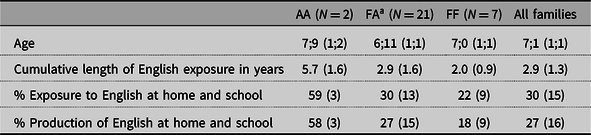
Children’s age and English exposure/production are summarized by family background (AA = two Anglophone parents, FA = one Francophone, one Anglophone parent, FF = two Francophone parents) in Table 1. Their use with different speakers in the home is summarized in Table 2. As a group, children had more exposure to French than English. Their exposure to English was generally highest at home (M = 44%, SD = 24%). Once time at school was accounted for it decreased to 30% (SD = 15%). The most comprehensive figure, which included holiday time and activities, was 34% (SD = 14%). Children come from middle to high socioeconomic backgrounds based on parental education level: the majority of parents (46 out of 60) had the equivalent of a master’s degree or higher.
Mean (SD) age, cumulative, and current exposure and production of English

a Two parents in this group were nonnative English speakers. Neither spoke their native language to their children more than 10% of the time.
Mean (SD) weekly hours of English use with household members

aIn these families, there were 6 Anglophone fathers and 15 Anglophone mothers.
Procedure
Children were recruited via a mass e-mail to parents at the school, a post on a local online Anglophone parent forum, and word of mouth. The entire protocol took place over three meetings: (a) in person or on the phone with parents to administer a questionnaire detailing children’s language experience, (b) in person with the child either at their home or in a quiet room at their school after school hours to administer a standardized test of English receptive and expressive vocabulary, and (c) also at the child’s home or school to administer a sentence repetition task and a child questionnaire. The third meeting was no later than 4 weeks after the second. Vocabulary tests were delivered orally with a flipbook and in counterbalanced order. The sentence repetition test was delivered via PowerPoint on a laptop with headphones, and the child questionnaire was delivered orally at the end of the third session. The entire protocol was delivered in English by the principal investigator.
Materials
Language experience measures
Language experience was measured with a parent questionnaire, the Bilingual Language Experience Calculator (BiLEC; Unsworth, Reference Unsworth2013). Parent questionnaires are a reliable means for estimating children’s language use (see Bohman et al., Reference Bohman, Bedore, Peña, Mendez-Perez and Gillam2010, for discussion), correlating with measures of language use obtained via direct observation (Hoff et al., Reference Hoff, Core, Place, Rumiche, Señor and Parra2012; Marchman, Martínez, Hurtado, Grüter, & Fernald, Reference Marchman, Martínez, Hurtado, Grüter and Fernald2017). In the BiLEC, each parent is asked to estimate the proportion of time that he or she addresses the child in English and the proportion of time the child addresses him or her in English. The question is repeated for all people who regularly interact with the child inside the home (other parents, siblings, and other adults such as grandparents or in-house childcare) and outside of the home (teachers and children at school, and people at out-of-school care).Footnote 2 Next parents are asked to give detailed information about the child’s regular schedule, in particular, who is present at different times of the day with the child. Children’s time spent with each interlocutor is then combined with the estimated proportion of time that person speaks and is spoken to by the child in English and summed across all interlocutors to yield total time spent speaking and hearing English on average weekly. For the hours of exposure, additional adjustments account for hours in English doing extra-curricular activities and on vacation. Finally, this figure is divided by the child’s waking hours to yield a global estimate for the current proportion of time that child has the opportunity to hear and speak in English, their estimated English exposure and output, respectively. Parental estimates were cross-validated against children’s own estimates of the same aspects of language use obtained during the child interview. For all interlocutors asked about in the BiLEC, children responded to the statement: I want you to tell me what language you use when you speak to different people. Choose one of the following answers: always in French, in French more often than English, in French and English equally, in English more often than French, always in English. The same statement was rephrased to ask about the languages people speak to them. Child and parent estimates were highly correlated (e.g., English exposure from mother: r = .92, df = 27, p < .0001).
In the same interview session, parents were asked to report on children’s interspeaker code-switching habits. The question specifically targeted interspeaker code-switching with the parent (or parents if the child has two Anglophone parents) and only in the direction of French when spoken to in English. We chose to focus on this context and this direction of switching because we believed that parent estimates would be most accurate for firsthand experiences, that is, in the direction of French when spoken to in English and in conversation with the parent(s). (In all but one case, the parent interviewed was the dominant provider of English exposure between parents.) The question was phrased: When [the English-speaking parent(s)] speak(s) to your child in English, does she reply in English: 1 = always, 2 = almost always, 3 = half of the time, 4 = rarely, or 5 = never? Children’s frequency of interspeaker code-switching in the opposite direction (to English when spoken to by the parent in French) was also later gleaned from the estimates of children’s output in English to the Francophone parent and the exposure in English from that parent. If the child’s output in English to the parent was higher than the exposure estimated to come from that parent, then the child must occasionally reply in English when spoken to in French.
Proficiency measures
Receptive lexical proficiency was measured with the Peabody Picture Vocabulary Test 4 (PPVT-4; Dunn & Dunn, Reference Dunn and Dunn2007). In this standardized picture-identification task, children are presented with four images and asked to indicate which image corresponds to a word delivered in an oral prompt, such as, “Put your finger on picking.” This test was designed for use with American English speakers, so with the help of a native speaker of British English, a modified version was created for use with participants whose primary source of English exposure (i.e., Anglophone parent) was a speaker of a non-North American variety of English (N = 14).
Expressive lexical proficiency was measured with the Expressive Vocabulary Task 2 (EVT-2; Williams, Reference Williams2006), the expressive counterpart to the PPVT-4. It consists of a picture-naming task in which children are shown an illustration and asked a question, such as “What do you see?” or “What is she doing?” or “Can you tell me another word for father?” (while showing a picture of a father). The child is instructed to give a one-word response to all questions, so for instance cat, singing, or dad. As with the PPVT-4, a version for children who were exposed primarily to non-North American varieties of English was created.
Mastery of grammatical structures was assessed with a sentence repetition (SR) task: the short version (30 items) of the Language Impairment in Multilingual Contexts (LITMUS) SR task (Marinis & Armon-Lotem, Reference Marinis, Armon-Lotem, Armon-Lotem, de Jong and Meir2015). LITMUS is a set of principles used to create a battery of SR tasks across languages to better diagnose language impairment in multilingual children. It controls across items for factors such as word frequency and age of acquisition, type of nouns used, and sentence length. It targets grammatical structures categorized into three levels of difficulty based on the age of acquisition in monolingual corpus data. A table featuring all targeted structures by difficulty level can be found in Appendix A. Again, in the original test, sentences were read by a British English speaker, so an additional version was created with all sentences spoken by a native speaker of American English for use with children whose primary source of English exposure was a speaker of a North American variety.
Attitudes and self-perceived dominance
The child questionnaire measured affective factors hypothesized to influence children’s use of interspeaker code-switching. Children were asked to report on their preferences for French and English ([1]), and how closely they identify with English and French ([2]). They were told to select the statement that was true of them of the following options:
1. a. I like English more than French.
b. I like English and French equally.
c. I like French more than English.
d. Other
2. a. I feel more English.
b. It’s the same. I feel French and English.
c. I feel more French.
d. I feel ….
Finally, children were asked about their ease of speaking French and English on a 5-point scale in the following way: For me speaking in English/French is …. 1 = very easy, 2 = easy, 3 = not easy, but not difficult, 4 = difficult, or 5 = very difficult. The differential between the French and English scores assessed their self-perceived dominance. As a second assessment of dominance, children were also asked which language they prefer to speak when tired: French, English, or neither.
Results
Question 1. Frequency of interspeaker code-switching
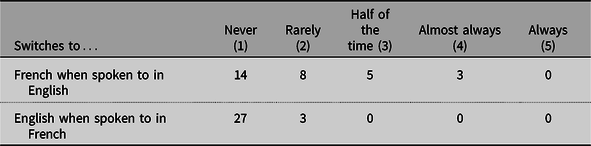
In these children, the frequency of interspeaker code-switching to French when spoken to in English by parents was assessed on a 5-point scale from never (1) to always (5). Nearly half of the children reportedly never do it and two-thirds do it no more than rarely. Converting the scalar values to percentages (e.g., 1 = 0%, 2 = 25%, etc.), children are reported on average to switch to French when spoken to in English 23% of the time (SD = 26%). The parent-estimated frequency of interspeaker code-switching to French when spoken to in English was cross-validated against the differential in the estimated proportion of English exposure from parents and the estimated proportion of English output from the child to parents. The input–output differential was correlated with parental estimated frequency (mother: r = .42, df = 28, p < .05; father: r = .5, df = 28, p < .01).
The inverse direction (switching to English when spoken to in French by parents) assessed with parent input–child output differentials is very rare. The distribution of frequency of interspeaker code-switching in both directions is shown in Table 3.
Parent-estimated frequency of interspeaker code-switching on a 5-point-scale (N = 30)

Of the children who reportedly do any interspeaker code-switching, nearly all switch only in the direction of French, the community language. Other switching patterns were very rare; only one child reportedly switches in both directions and two switch exclusively to English. As such, all analyses focused exclusively on the dominant pattern: switching to French when spoken to in English.
Question 2. Age, attitudes, self-perceived dominance, and interspeaker code-switching
Responses from the child questionnaire were converted to numeric values (–1 for English, 0 for neither, 1 for French) for the purpose of summarizing them in Table 4, with positive values indicating a preference for French. On average children have a slight preference for English but feel equally French and English.
Children’s preferences and self-assessed dominance: English = –1, Neither = 0, and French = 1 (N = 29)

It should be noted here that the child questionnaire was given in English because it was deemed more natural given that the rest of the protocol was also in English. While this could have biased children’s responses toward English, we find it unlikely that this influence altered the general pattern, which is that attitudes toward English and French are both widely positive in these children. Other indirect indicators support this; for example, children reportedly consume slightly more English (63%) than French media in their free time and split their reading time nearly equally between languages (56% English). Children also self-report a slight preference for speaking English with bilingual classmates (M = 58% of the time, SD = 27%). In terms of self-assessed dominance, children overall showed no preference for speaking either language when tired. Their differentials in ease of speaking were categorized as finding French easier, neither easier, or English easier to speak and are numerically represented in the same way (–1 for English, 0 for neither, 1 or for French). Children on average report that French is easier for them to speak, as shown by the positive value.
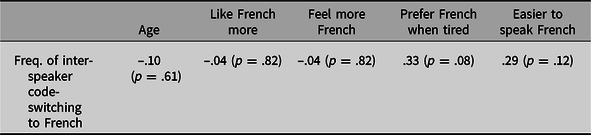
Correlations between frequency of interspeaker code-switching and several predictors are shown in Table 5. Preferences and dominance were coded numerically as described above, and frequency of interspeaker code-switching was represented on a 5-point scale from 1 (never) to 5 (always).
Pearson correlation coefficients for age, attitudes, and self-perceived dominance with frequency of interspeaker code-switching (N = 29)

Children’s frequency of interspeaker code-switching to French when spoken to in English was not correlated with their age. It was also not significantly related to their preferences and self-reported dominance, aside from a marginally significant positive relationship between preferring French when tired and the frequency of interspeaker code-switching (p = .08).
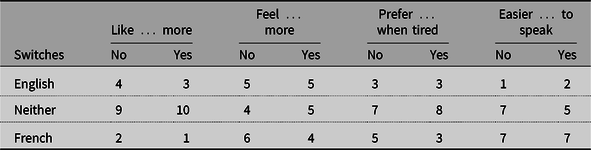
The relationships between preferences and self-assessed dominance and interspeaker code-switching were also tested with 2 × 3 contingency tables: 2 levels for interspeaker code-switching (switching never vs. any other frequency) and 3 levels for each child response (English, neither, or French). The number of children in each cell of these contingency tables are shown in Table 6.
Contingency tables summarizing preferences and self-assessed dominance for switching (any frequency) and nonswitching children

Fisher’s exact tests showed no significant relationships between preferences or self-assessed dominance and use of interspeaker code-switching (all ps > .30).
To summarize, no significant relationships were found between the rate at which children switch to French when spoken to in English and their age, their preferences for French or English, or their self-assessed dominance, aside from a marginally significant positive correlation with preferring French when tired.
Question 3. Proficiency as a predictor of rates of interspeaker code-switching
Children’s English proficiency was measured with three tasks: a picture-identification task (PPVT-4), a picture-naming task (EVT-2), and a SR task (LITMUS SR task). For the SR task, children’s performance was measured under two scoring schemes: a lax scheme in which a point was awarded for all repetitions that included the targeted structure (e.g., a short passive) regardless of whether lexical errors were made (SR target structure) and a more strict scheme in which a point was awarded only if the sentence was repeated correctly verbatim (SR verbatim). A summary of children’s raw scores on the PPVT and EVT and the percent correct on the SR task under the two scoring schemes is shown in Table 7.Footnote 3
Group means and SD for raw scores on vocabulary tasks and percent correct for sentence repetition task (vocabulary tasks: N = 30; sentence repetition: N = 29)

a One child’s data was lost for the sentence repetition task due to recorder failure.
Pearson correlation coefficients between English proficiency scores and rates of interspeaker code-switching to French are presented in Table 8. Moderate to high negative correlations were found for all proficiency scores. The strongest relationship was with the lax scoring scheme of the SR task.
Pearson correlation coefficients for English proficiency test scores with interspeaker code-switching to French frequency (PPVT and EVT: N = 30; LITMUS SR Task: N = 29)

*p < .01. **p < .001.
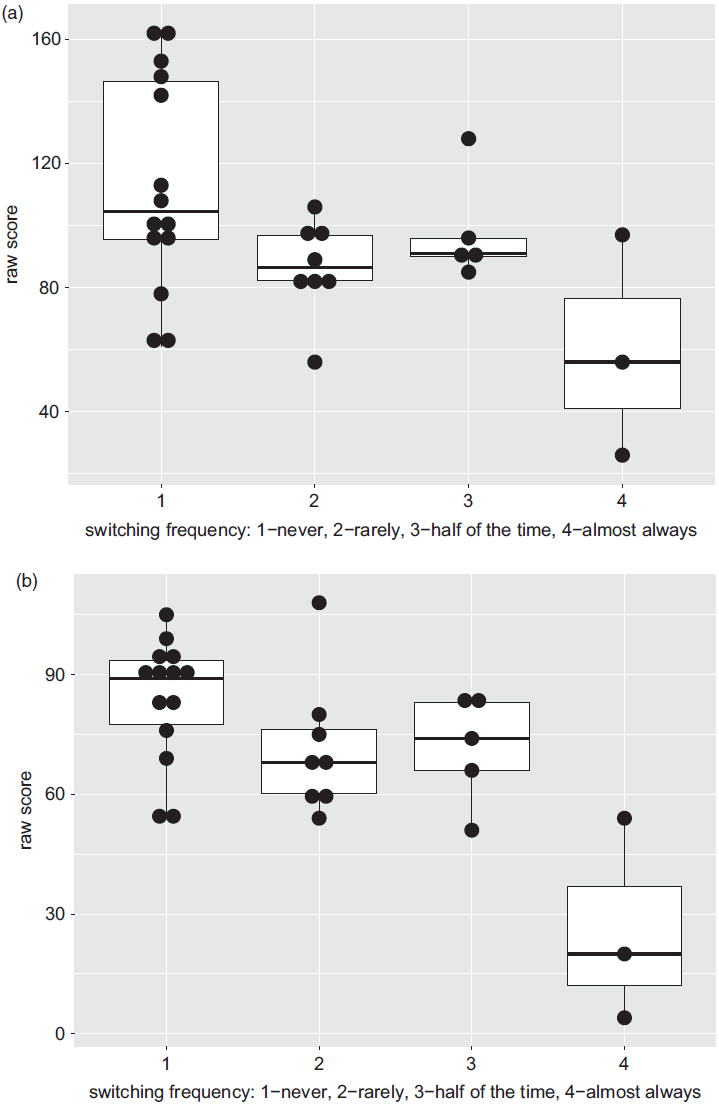
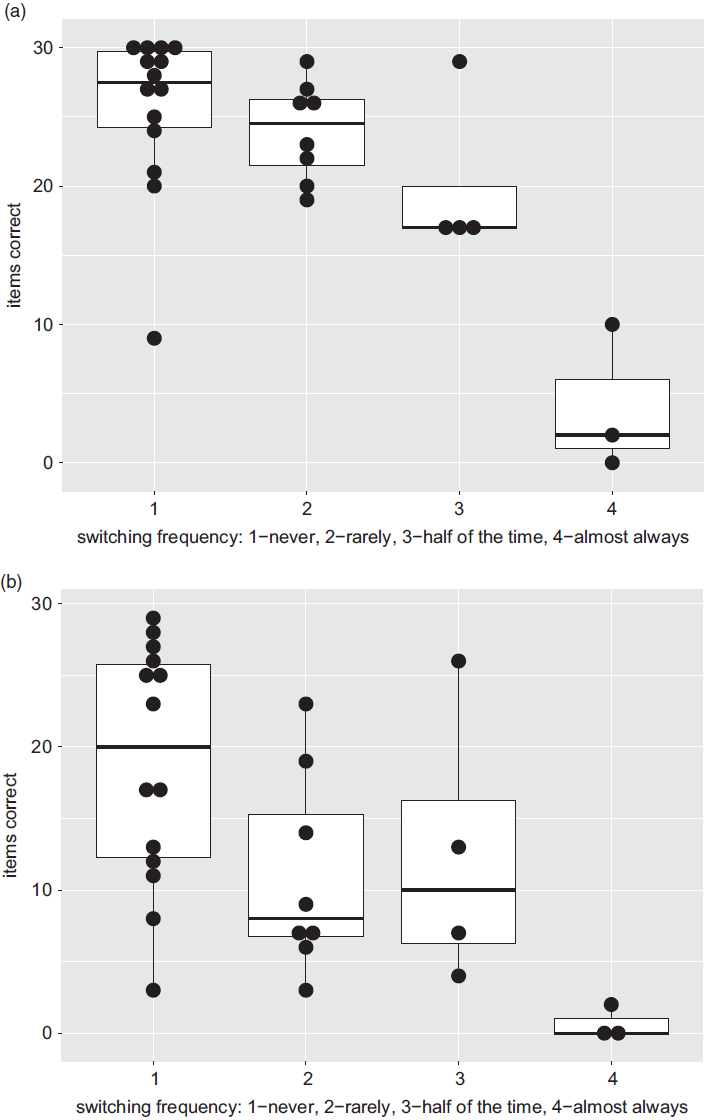
These data are represented in Figures 1 and 2 in boxplots of proficiency scores by the frequency of interspeaker code-switching. The boxes are interquartile ranges and the line is the median score. Proficiency scores generally decrease with increasing frequency of switching, except between the two intermediate frequencies (rarely and half of the time) for vocabulary and verbatim SR scores.
Vocabulary scores by frequency of interspeaker code-switching. (a) PPVT and (b) EVT (N = 30).

Sentence repetition scores by frequency of interspeaker code-switching. (a) Target structure scores and (b) verbatim scores.

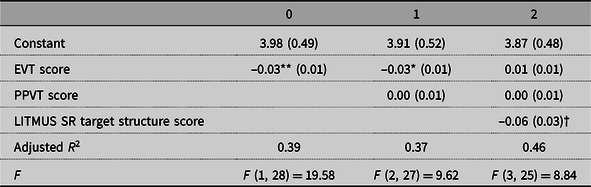
These data show a negative relationship between the tendency to switch away from English in conversation with parents and proficiency in English. This relationship is found in not only expressive lexical proficiency, as has been previously documented, but also with receptive lexical proficiency, and accuracy in SR, in terms of both repeating sentences verbatim and reproducing the targeted sentence structure. However, given that these proficiency measures are intercorrelated, we further investigated their independent contributions to predicting interspeaker code-switching rates by comparing regression models, entering a new proficiency measure with each step, as shown in Table 9. Target structure produced was used for the SR score, given that it does not penalize lexical errors, and thus may better isolate grammatical from lexical skill. Note that in this and all subsequent regression analyses, unstandardized coefficients are shown with standard error in parentheses.
Linear regression analyses predicting interspeaker code-switching frequency from English proficiency measures

†p = .06. *p < .01. **p < .001.
The addition of receptive vocabulary scores did not significantly improve the model predicting switching frequency from expressive vocabulary scores, F change (1, 27) = 0.21, p = .65. Only SR target structure score was a marginally significant predictor of switching rates in the model with all three predictors in it, explaining an incremental 9% of variance in switching frequency, F change (1, 25) = 3.89, p = .06. Thus, the contributions of these three proficiency measures to children’s rates of interspeaker code-switching overlap to a large extent. Consistent with prior reports, receptive lexical skill does not predict switching habits when the effect of expressive lexical skill is accounted for. A new finding, however, is that a measure of grammatical skill accounts for variation in switching rates not accounted for by lexical measures, although this contribution is small (.07 of variance) and of marginal significance.
Question 4. The relative strength of proficiency–experience relationships
The second aim of this study was to view the relative strength of relationships between language experience measures and language proficiency, specifically the relationship between English exposure, English output, and interspeaker code-switching to French when spoken to in English and scores on three English proficiency tests. The correlations between current and cumulative exposure and output with English proficiency scores are shown in Table 10 (the corresponding relationships for interspeaker code-switching are found in Table 8).
Pearson correlation coefficients for English proficiency scores and experience variables (N = 30 for PPVT and EVT; N = 29 for sentence repetition)

†p < .1. *p < .05. **p < .01. ***p < .001.
Significant correlations were explored with linear regression analyses. English exposure and output in these children are highly correlated (e.g., r = .96, p < .001 for exposure and output at home and school). Interspeaker code-switching frequency shows a weaker correlation with exposure and output (e.g., r = –.53, p < .001 for exposure at home and school and r = –.62, p < .001 for output at home and school). Adopting a criterion of |r|<.8 for the intercorrelations in predictor variables to be entered in linear regression models, exposure and output were not entered into the same regression model. The relative contribution of interspeaker code-switching frequency and the other two experience variables were thus viewed in separate linear regression analyses. Current exposure across all contexts was included rather than cumulative exposure as it was more closely correlated with proficiency in all cases.Footnote 4
Age was significantly correlated with all proficiency scores, so this variable is entered first in all hierarchical regressions below. Age was not correlated with current exposure or output but was marginally correlated with cumulative length of exposure.
Exposure, interspeaker code-switching, and lexical proficiency
The only experience measure that correlated significantly with scores on the picture-identification task (PPVT) was interspeaker code-switching; thus, no further analyses for this measure were done.
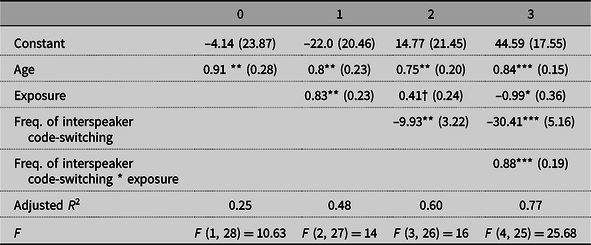
EVT scores, however, correlated with current exposure. Thus, in the regression analyses presented in Table 11, current exposure is entered after age. Next, interspeaker code-switching frequency is entered in the model, accounting for an additional .12 of the variance in scores, F change (1, 26) = 9.53, p < .01. Exposure is a marginally significant predictor in this model.
Linear regression analyses predicting EVT raw scores from age, exposure, and interspeaker code-switching frequency

†p < .1. *p < .05. **p < .01. ***p < .001.
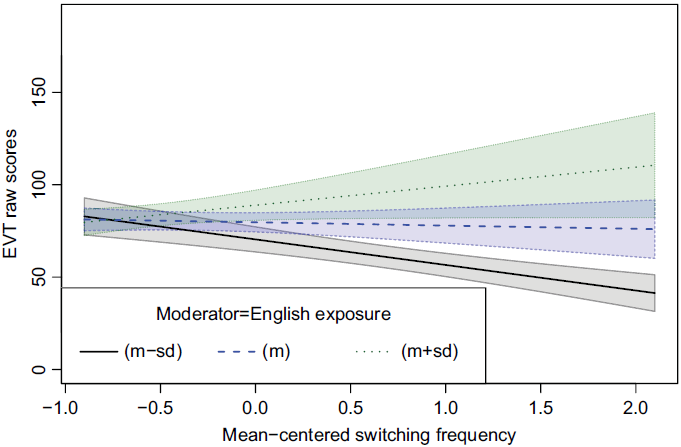
An interaction was found between the effect of frequency of interspeaker code-switching and exposure on EVT scores. This was further investigated by testing the conditional effects of code-switching at three levels of exposure: 1 SD below the mean (M-SD), at the mean (M), and 1 SD above the mean (M+SD). Exposure and interspeaker code-switching were mean-centered. These conditional effects are plotted in Figure 3.
The effect of interspeaker code-switching on expressive vocabulary scores at three levels of exposure (N = 30).

The results indicated that the effect of interspeaker code-switching frequency was modulated by exposure: at low levels of exposure, it was a significant negative predictor (B = –13.80, p < .001, SE = 2.56), at mean levels of the exposure, the effect was not significant, and at high levels of exposure it was marginally significant and positive (B = 10.32, p = .054, SE = 5.12). This could indicate that proficiency is more vulnerable to the effects of interspeaker code-switching at lower levels of exposure. This would be in line with the finding that output, which is diminished in children who frequently interspeaker code-switch, is a particularly strong predictor of proficiency at low proficiency levels, what is called “gaining traction” in the analysis of Bohman et al. (Reference Bohman, Bedore, Peña, Mendez-Perez and Gillam2010). Production may play a stronger role for children with low exposure, who need to advance beyond an initial phase of passive proficiency in a language.
Another possibility, suggested by the marginally significant positive effect of interspeaker code-switching on expressive vocabulary at higher levels of exposure is that our question assessing interspeaker code-switching could have been interpreted by parents to include the use of intraspeaker code-switching. High exposure children may be more likely to use intraspeaker code-switching, which relates positively with proficiency (Yow et al., Reference Yow, Tan and Flynn2018). However, without more detailed information on the type of switches these children make, this remains unclear.
Exposure, interspeaker code-switching, and grammatical proficiency
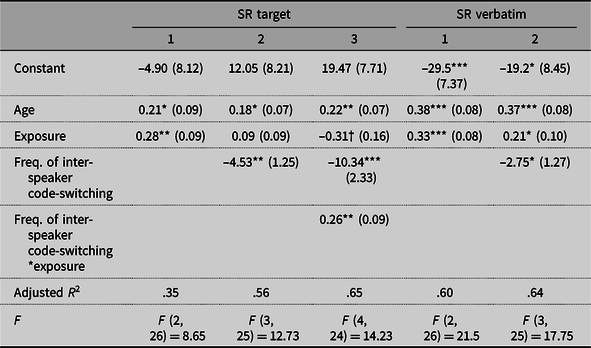
Linear regression analyses predicting SR target structure and verbatim scores from age, current exposure, and interspeaker code-switching frequency are shown in Table 12, focusing on the final model comparison only for brevity. Adding interspeaker code-switching frequency to the model with age in it accounted for an additional .21 of the variance in scores, F change (1, 25) = 12.93, p = .001. With all three predictors in the model, current exposure is no longer a significant predictor of SR target structure scores while frequency of interspeaker code-switching and age are.
Linear regression analyses predicting sentence repetition target structure and verbatim scores from age, exposure, and interspeaker code-switching frequency

†p < .1. *p < .05. **p < .01. ***p < .001.
There was a significant interaction between exposure and interspeaker code-switching (p < .01), which was further explored by testing the conditional effects of interspeaker code-switching at three levels of exposure (1 SD below, at, and above the mean). At low exposure, interspeaker code-switching was a negative predictor (B = –5.33, p < .001, SE = 1.14), but the effect was nonsignificant at mean (p = .27) and high (p = .44) exposure levels; thus, similar in nature to the interaction above for EVT scores.
For SR verbatim scores, in the model with all three predictors, exposure and frequency of interspeaker code-switching are significant predictors and an additional .04 of variance is accounted for, F change (1, 25) = 4.52, p < .05. There was no significant interaction between exposure and interspeaker code-switching rates for this score (p = .72).
Output, interspeaker code-switching, and all proficiency measures
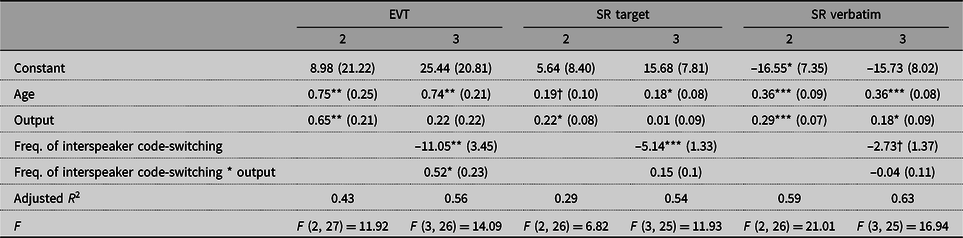
We also asked whether rates of interspeaker code-switching would be more closely related to proficiency than output estimates given that they capture not only children’s opportunity to produce in English but also their choice to do so, which may be motivated by imbalanced proficiency. This was tested with the same type of comparative analyses of linear regression models. For the sake of brevity, only the second and final models are shown for the three proficiency measures that were correlated with English output in Table 13.
Linear regression models predicting proficiency scores from age, output, and interspeaker code-switching frequency

†p < .1. *p < .05. **p < .01. ***p < .001.
Interspeaker code-switching frequency significantly predicted expressive vocabulary, F change (1, 26) = 10.26, p < .01, and SR target structure scores, F change (1, 25) = 14.87, p < .001, while output did not in the final model. Differently, output significantly predicted SR verbatim scores while interspeaker code-switching frequency was a marginal predictor, F change (1, 25) = 3.98, p = .06. There was a significant interaction between interspeaker code-switching and output in its effect on EVT scores (p < .05): the effect is only significant at low levels of output (B = –13.71, p < .001, SE = 3.41). Thus as with exposure, proficiency in low output children may be particularly sensitive to the effect of interspeaker code-switching. Alternatively, parents may have included the use of intraspeaker code-switching in their estimates, which being linked to higher proficiency in both languages (Yow et al., Reference Yow, Tan and Flynn2018), could be more common in higher output children, thus altering the pattern for these children and not mean and low output children.
To sum up, the relationships between exposure and interspeaker code-switching frequency, a measure of production, with four English proficiency scores were compared. Both expressive and receptive vocabulary scores were more closely related to interspeaker code-switching than exposure: receptive scores were not significantly related to exposure and expressive vocabulary scores were no longer significantly related to exposure when the effect of interspeaker code-switching frequency was accounted for. The SR target structure scores also showed a closer relationship with interspeaker code-switching frequency than exposure: exposure was no longer significantly related to scores when the effect of interspeaker code-switching was accounted for. Both exposure and interspeaker code-switching frequency made independent contributions to the variation in SR verbatim scores.
The relationship between proficiency and two measures of production (output, an estimate of the time children spend speaking a language, and interspeaker code-switching frequency, the rate at which children respond in one language when addressed in another) were also compared. The relationship was stronger for interspeaker code-switching for expressive lexical scores and target structure produced score but not verbatim score in the SR task.
Discussion
The present study investigated the use of interspeaker code-switching in a new population and context: French–English school-aged bilinguals in France in conversation with parents. Different from previous reports, use of interspeaker code-switching is only attested to in half of children, and most of these children use it rarely. It occurs almost exclusively in the direction of French, in line with reports that children tend to switch more frequently into the community language when spoken to in the home language than in the other direction (de Houwer, Reference de Houwer2007; Ribot & Hoff, Reference Ribot and Hoff2014). This pattern is also in the direction of children’s self-reported dominance, which on average favored French, though over a third of participants report balanced proficiency. However, on an individual level, the relationship between switching frequency and two self-reported measures of dominance showed only a marginally significant correlation (p = .08) in one case (preferring a language when tired) and failed to reach significance (p = .12) in the other (differential in reported ease of speaking). Thus, we tentatively conclude the infrequent and unidirectional use of interspeaker code-switching in these children reflects both the dominance of French in the community these children live in and their self-reported (slight) dominance in French.
We do not find that the frequency of switching is influenced by children’s language preferences as in prior reports (Shin & Milroy, Reference Shin and Milroy2000). These children show on average a slight preference for English, yet they switch from English into French more often. On an individual level, preferences were also not predictive of switching patterns. It may be that as has been reported for parents’ language choices (Gathercole et al., Reference Gathercole, Thomas, Williams and Deuchar2007), children’s attitudes play a minor role in their language choices when they are favorable toward both languages. Another possibility is that these data did not adequately capture variation in children’s attitudes. As discussed earlier, the overall English context of the experiment could have influenced children’s self-reports in favor of English. However, other indirect indicators confirm children’s self-reported slight preference for English (e.g., media consumption or language used with friends). We thus conclude that in these children a link between general language preferences and interspeaker code-switching behavior is not supported.
Proficiency, in contrast, is closely linked to frequency of interspeaker code-switching in these children. In line with prior reports, English expressive lexical skill was closely (negatively) linked to children’s use of interspeaker code-switching to French. This study viewed this relationship in new areas of proficiency including grammatical and receptive lexical skill. The ability to repeat targeted grammatical structures made a marginally significant contribution to predicting switching frequency beyond that of expressive vocabulary scores while receptive lexical skill and repeating sentences verbatim did not. Previous work has found that younger children switch more frequently from the language that they have lesser grammatical skill in (Paradis & Nicoladis, Reference Paradis and Nicoladis2007), but this is to our knowledge, the first study to link switching frequency to performance on a grammatical task in older children. That this effect was only of marginal significance calls for further investigation. It may be that our measure (targeted grammatical structure produced in SR) did not adequately control for the effect of lexical knowledge. It correlated highly (r = .89, p < .001) with EVT scores. Grammatical measures that more pointedly target (morpho)syntactic knowledge while controlling for the effect of lexical knowledge may provide stronger evidence.
The finding that frequency of switching away from a language in conversation relates negatively to proficiency in that language is intuitive, yet the underlying mechanisms for the relationship need unpacking. Language control may be relevant. Research with adult bilinguals shows that language control, measured by the cost of alternating between languages in production, increases as L2 proficiency increases (Calabria, Hernandez, Branzi, & Costa, Reference Calabria, Hernández, Branzi and Costa2012; Costa & Santesteban, Reference Costa and Santesteban2004; Meuter & Allport, Reference Meuter and Allport1999). Children who unidirectionally interspeaker code-switch, despite the terminology, actually avoid switches in their production. The switching that these children do is rather from comprehension to production. Thus, children who respond to interlocutors addressing them in different languages uniformly in their preferred language may do so because of the high cost of switching in their production, which diminishes as their proficiency becomes more balanced. Another possibility is that as they become proficient L2 speakers, it becomes actually more costly to switch to speaking in L1 after comprehending in L2. In one experimental study with adults, the cost of producing in L1 after hearing L2 increased as L2 proficiency increased (Gambi & Hartsuiker, Reference Gambi and Hartsuiker2016). Applied to our participants, this might predict that interspeaker code-switching decreases with increased proficiency not only because the knowledge gaps that it helps children circumvent become fewer but also because it becomes more costly for them to do so.
Another aim of this study was to view the relative closeness of different experiential measures (exposure, output, and interspeaker code-switching) to children’s proficiency. As hypothesized, the relationship between interspeaker code-switching frequency and English proficiency measures was stronger than the corresponding relationships with children’s output and exposure estimates. Frequency of interspeaker code-switching to French predicted performance on all English proficiency measures while exposure to and output in English were not related to receptive vocabulary scores and showed a limited relationship with other proficiency scores when the effect of interspeaker code-switching frequency was accounted for. In particular, interspeaker code-switching rates were closely linked to expressive vocabulary scores and the ability to repeat targeted grammatical structures. The interaction in these effects with children’s exposure/output suggests that children with fewer opportunities to hear and speak in English may be more sensitive to the effect of interspeaker code-switching on their developing proficiency. This is in line with work finding that children’s own production is a particularly strong predictor at low levels of proficiency (Bohman et al., Reference Bohman, Bedore, Peña, Mendez-Perez and Gillam2010).
These results raise the question of how production plays a role in language development. One possibility is that this effect is due to additional processes required in production but not comprehension. For example, Ribot et al. (Reference Ribot, Hoff and Burridge2018) hypothesize that higher production benefits proficiency because it involves retrieval (while exposure does not), which has been linked to improved learning. Another possibility is that production strengthens lexical access. Consistent with this notion, bilingual children have been found to experience more difficulty with lexical access (i.e., more tip-of-the-tongue states) in a picture-naming task than monolinguals, even when controlling for their receptive vocabularies (Yan & Nicoladis, Reference Yan and Nicoladis2007). However, we found that interspeaker code-switching was also predictive of children’s ability to repeat targeted grammatical structures, suggesting a link to learning more generally. A relevant idea from the second language acquisition literature is that production facilitates noticing of gaps in the speaker’s knowledge more so than exposure (Swain, Reference Swain, Gass and Madden1985, Reference Swain1995). Differences in the processes underlying comprehension and production are supported by psycholinguistic and first language acquisition research. Comprehension is widely reported to precede production in first language acquisition (e.g., Huttenlocher, Reference Huttenlocher and Solso1974) and in adult learning of nonce words (Gershkoff-Stowe & Hahn, Reference Gershkoff-Stowe and Hahn2013). Some propose that incomplete representations at both the word and sentence level may suffice for comprehension but not production (Huttenlocher, Reference Huttenlocher and Solso1974; Ferreira, Bailey, & Ferraro, Reference Ferreira, Bailey and Ferraro2002). Thus, children who interspeaker code-switch habitually may maintain incomplete representations for longer than children who do not. The mechanisms underlying the production–proficiency relationship provide interesting opportunities for future research. As noted earlier, a longitudinal design would be needed to determine the directionality of the production–proficiency relationship.
There are several limitations to this study. Children’s dominance was only measured with self-report, which may not have been detailed or reliable enough to detect the relationship between relative proficiency and use of interspeaker code-switching. Prior research finds that children classified as dominant in a language based on proficiency tests speak that language more often than they hear it, implying some use of interspeaker code-switching (Unsworth et al., Reference Unsworth, Chondrogianni and Skarabela2018). Future studies should directly relate children’s switching behavior and objective measures of dominance.
Another limitation is that other possible predictors of switching habits such as parents’ own proficiency, switching habits, and response strategies (Mishina-Mori, Reference Mishina-Mori2011) were not measured. Half of mothers and over two-thirds of fathers in the study report always/never speaking in English to children, that is, never code-switching, which could contribute to children’s low rates of switching. The amount of English spoken between parents at home (a plausible reflection of their relative proficiency) was negatively correlated with children’s frequency of switching to French (r = –.39, p < .05). Future studies should investigate children’s switching habits in relation to parental switching habits, their proficiency, and their reaction to children’s interspeaker code-switching.
Finally, another limitation is the reliance on parental estimates for quantifying children’s use of interspeaker code-switching. Direct observation could provide more detailed information on the contexts and interlocutors involved, which may be informative. The relationship between attitudes and language choices in the classroom, for example, has been found to be context-specific (Redinger, Reference Redinger2010). More detailed descriptions of switches in the home may detect an effect of children’s attitudes in certain contexts and other sociolinguistic factors that condition switching. The interlocutors and contexts involved may also modulate the relationship between interspeaker code-switching and proficiency. In a recent study of bilingual school-aged children in the United Kingdom, children’s “passivity” in the home language was calculated from discrepancies in global output and exposure estimates. Adding this information to models predicting proficiency from cumulative exposure did not significantly improve the fit (de Cat, Reference de Cat2020). This difference from our findings may reflect differences in the population studied (UK bilinguals with various L1s vs. French–English bilinguals in France) or in the interlocutors/contexts included (global vs. with parents). To answer this, a more detailed analysis of switching that measures switching by interlocutor and contexts as well as globally would be informative. Finally, as discussed with respect to exposure/output’s interaction in the effect of interspeaker code-switching on proficiency scores, our parental reports may also not have clearly delineated the types of switches children make (e.g., intra- and interspeaker switches), which relate differently to proficiency. Parent responses may also be sensitive to the wording of the question; for example, whether they are asked to report on how often children when addressed in English switch to French or reply in English. Thus, future research with questionnaires should make the distinction clearer to parents and use multiple questions to assess switching behavior, and whenever possible, use direct observation to validate parent estimates.
This study finds that the use of interspeaker code-switching to French when spoken to in English is rare in school-aged bilingual children and varies as a function of their lexical and grammatical proficiency. Self-reported attitudes toward English and French being generally positive did not predict children’s use of interspeaker code-switching. In comparison to other experiential measures (exposure and output in a language) interspeaker code-switching accounts for more variation in proficiency scores, perhaps due to its ability to capture children’s willingness to produce in a language as well as the effect of having done so at variable rates over time. This study suggests that children’s production relative to their exposure (indexed by interspeaker code-switching) can be a powerful predictor of their current proficiency and highlights the need for more targeted, longitudinal study of the role of production in language development.
Acknowledgments
The data in this project were collected during doctoral studies at the Graduate Center of the City University of New York. I am particularly grateful to Virginia Valian, Martin Chodorow, and to the reviewers, whose insightful feedback greatly improved the paper. Special thanks go to the families who participated and the team at the Sections Internationales de Sèvres for their support.
Targeted structures and example sentences by difficulty level in litmus sentence repetition task