Introduction
With increasing numbers of people living with dementia internationally, the World Health Organisation (2012) has recognized dementia as a public health priority. December 2013 also saw the first G8 dementia summit, again identifying this as a major international issue. While there is no cure for this progressive syndrome, emphasis must be on delivering best care and treatment to those living with dementia. One of the first priorities is to ensure that healthcare professionals are appropriately prepared to work with this group of people. However, reviews have identified that dementia education is limited in pre-registration/pre-qualifying medical, nursing, and other healthcare professionals in Europe and the USA, (Pulsford et al., Reference Pulsford, Hope and Thompson2007; Tsolaki et al., Reference Tsolaki2010; Nagle et al., Reference Nagle, Usita and Edland2013; St Clair Tullo and Gordon, Reference St Clair Tullo and Gordon2013). In line with the international literature, some students at Kingston and St George's University of London reported that, on qualifying, they felt unprepared for the work they were required to do with PWD.
This prompted a scoping exercise to review the dementia content of the curricula of all pre-qualifying health programs within the institution. The analysis showed that there was limited dementia specific content in all the curricula, which is reflected in a review of Higher Education across the UK (Pulsford et al., Reference Pulsford, Hope and Thompson2007). Apart from class-based activities, the curricula review also demonstrated that the opportunity for practice experience with PWD was predominantly in hospital settings and community services. Limited opportunities for placements in care homes (defined as establishments providing accommodation together with nursing or personal care: Care Standards Act, 2000) were available for healthcare students. This is surprising considering that there are a total of 487,000 care home places in the UK (Laing and Buisson, 2013) and approximately 80% of older people in care homes have dementia (Alzheimer's Society, 2013). In contrast, the number of NHS beds is much smaller, and according to National Health Service England (2015); Information Services Division Scotland (2014), the Welsh Government (2014), and Northern Ireland Statistics and Research Agency (2013) is estimated to be 175,000. Therefore, in the future a substantial proportion of healthcare professionals’ work will need to take place in care homes.
These findings prompted a review of the literature on dementia specific training programs for pre-qualifying healthcare students (Alushi et al., Reference Alushi, Hammond and Wood2015). This review found that there had been very few studies which had systematically evaluated education programs in the care of PWD for pre-qualifying healthcare students. The findings from the review did however suggest that best results were achieved when a practice experience was preceded by theoretical preparation.
The aim of this study was to improve the preparedness of students of healthcare by developing an educational intervention to improve their knowledge of dementia and confidence in working with PWD. The physiotherapy and learning disability nursing courses had been awarded a bonus from the NHS (Health Education South London) rewarding the quality of education. Thus, a pilot study with students of physiotherapy and learning disability nursing was devised and this paper reports on the evaluation.
The development of the intervention
The development of the intervention was informed by the scoping exercise and literature review. The overall aim of this education intervention was to improve students’ knowledge, experience, and confidence in supporting PWD. Key components included: (i) raising dementia awareness, (ii) focusing on advanced communication skills, and (iii) increasing students’ confidence in working with PWD. These components were considered appropriate to all healthcare students as, although the pilot was with physiotherapy and learning disability nursing students, it was intended to expand the program to other professional groups. Based on these intentions, the intervention was called Communication And Respect for people with Dementia: Student learning (and will be referred to as CARDS). The CARDS program consists of two parts; the IP where students received evidence-based theory on dementia and the CHE for which students could volunteer to visit care homes in order to interact with PWD.
Introductory program
A mixture of teaching and learning methods, online, didactic teaching, and workshops, were employed to maximize learning for the entire cohort regardless of individual students’ learning styles (Biggs and Tang, Reference Biggs and Tang2007). The online Social Care institute for Excellence (SCIE) Open Dementia Programme was identified as an appropriate resource to provide students with some basic knowledge of dementia which could be built upon in subsequent sessions. SCIE provides a general introduction to the syndrome and the experience of those who live with it, and is relevant for anyone who comes into contact with PWD. Thus, students were encouraged to complete the seven modules, each of which takes 20–30 minutes.
The IP consisted of four hours of classroom training to review and build on the students’ knowledge of dementia. This included a number of topics such as; a general overview of dementia, examples of communication strategies, reviewing key aspects of the Mental Capacity Act, understanding “behaviors that challenge” and the effect on those living with dementia and their carers. The sessions were delivered by lecturers, carers, and colleagues working in care homes.
This provided the base knowledge for the main focus of the IP which was to improve communication skills. This emphasis on communication was supported through a consultation of key stakeholders, including PWD and their carers. Advanced communication skills are needed when working with PWD (Chapman and Law, Reference Chapman and Law2009; Broughton et al., Reference Broughton2011; Beer et al., Reference Beer, Hutchinson and Skala-Cordes2012; Eggenberger et al., Reference Eggenberger, Heimerl and Bennett2013). Therefore, students of physiotherapy and nursing (learning disability branch) participated in a three-hour interactive workshop to facilitate the development of advanced verbal and non-verbal communication techniques. In small groups, the workshops emphasized the use of reminiscence, empathic engagement, active listening, and life story work (REAL) as developed by Reed (Reference Reed2014). It is hypothesized that these techniques can help create a positive and supportive environment making communication easier and more meaningful.
The IP was designed as either stand-alone training or to be embedded within existing curricula, and this could be negotiated with the Program teams without compromising the total number of contact hours per student. For the pilot study, CARDS was delivered as stand-alone training and all students were requires to attend.
Care home experience (CHE)
In order to provide a beneficial and positive first experience for the students, care homes were selected where residents had a range of degrees of dementia rather than only those in the later stages or with more severe psychological and behavioral symptoms. The seven care homes that hosted students were diverse but with similar characteristics to many others in the UK on the criteria of the number of residents and type of ownership, private, charity, or Local Authority. Another important factor in care home choice was a manager and team who supported the project. Developing these relationships with care homes was time consuming and, as this was a pilot study, limited resources meant that we did not have capacity to provide the experience to all students so volunteers were called for.
Based on the previous review, it was important that the CHE was subsequent to the IP. Students were encouraged to visit a care home in a volunteer capacity and interact with PWD. Although an important part of this learning intervention, it was not possible to find the volume of care homes to provide the experience for all students. This experience was in addition to students’ usual practice placements, and required them to try and “bracket” their professional identity, for instance, physiotherapy students avoided intentions of assessing mobility and providing exercise or activity plans. In this way, it was intended that students would learn about communication challenges and practice some of the strategies learned during the classroom-based sessions. Students were asked to visit the care home four times for a duration of three hours at different times of day so that they could gain an insight into care home life and the way residents’ behavior can vary at different times of the day. There were no expectations on students except to approach the experience with sensitivity, an open mind and enthusiasm to learn. Students were provided with a set of reminiscence cards from the 1940s to 1950s (Reed, Reference Reed2014) which they could use as a tool to initiate conversation with residents. Additionally, students were encouraged to be creative, and employ any other tools or activities that would interest the resident. Students were also advised to interact with visitors and learn more about their experience, explore what they could tell them about the residents and use this information in order to make interactions more meaningful.
Methods of evaluation
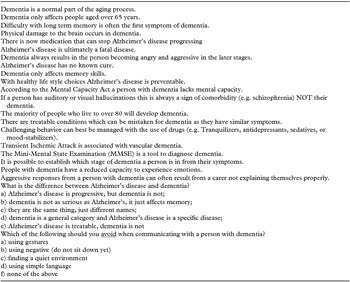
A survey design (Groves et al., Reference Groves, Fowler, Couper, Lepkowski, Singer and Tourangeau2004) was used to provide quantitative data for analysis before and after the intervention. This method provided the opportunity to invite all students involved in the intervention to participate in the evaluation. Two concepts were evaluated, knowledge and confidence. Although some evaluation tools already existed in the literature, they did not address all the aims of the CARDS intervention. Therefore, questions related to knowledge of dementia, were developed from the content of CARDS IP, verifying information from the literature and appropriate websites (e.g. Alzheimer's Society, 2015; SCIE; HEDN, 2014). Twenty knowledge questions required response choices of True, False, and Do not Know, the last two questions were multiple choice and participants were instructed to select one response. One mark was given for each correct answer (see Table 1).
Dementia knowledge questions

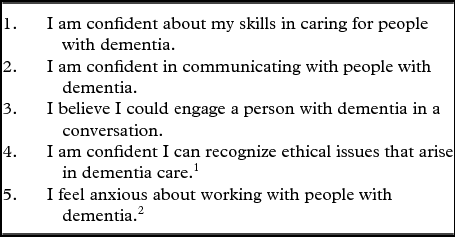
Students’ confidence in communicating, and perceived competence in working with PWD was assessed with a 5-item questionnaire (see Table 2). The questions were specifically designed to evaluate the intended outcomes of the CARDS intervention. Students were asked to rate their confidence and perceived competence level using a visual analogue scale (Gould et al., Reference Gould, Kelly, Goldestone and Gammon2001) from no confidence to very confident.
Confidence and perceived competence scale

1Excluded from scale after factor analysis (see results).
2Score reversed (i.e. 100 – score).
The questionnaire was scrutinized for relevance and accuracy, by a group of experts including a service user and carer. Furthermore, it was piloted with 120 second-year student nurses (adult branch) who would not be receiving the CARDS intervention. The pilot indicated a range of results on the knowledge scale from 0 to 18 (out of a total score of 22) and no question had 100% correct or incorrect answers, so was deemed to be discriminative.
Data was collected using a paper format at the end of compulsory teaching sessions to maximize the response rate. Data were collected at four time points (Figure 1). The baseline (time 1) was two weeks before the first IP session. The questionnaire was also completed by all students after the CARDS IP final session (time 2) and six months after the CARDS intervention was completed (time 4). For those who completed the CHE, the research assistant visited the student on their last care home visit to complete the evaluation (time 3) and they were asked to return questionnaires in a sealed envelope. Students had a unique participant code to enable matching of participant data between time points while retaining anonymity. Satisfaction with the various components of the IP was measured at time 2. Students’ indicated their rating using a visual analogue scale from strongly disagree, to strongly agree.
Participants at each time point.

Data was collected on participants’ previous experience of working with people or having friends or family with dementia. This was collected so that volunteers could be compared with other students to establish whether, on this measure, volunteers were representative of the whole group. Students’ professions were included as the program was designed to be suitable for a number of healthcare disciplines, exploration of differences could inform on the program's potential across disciplines.
CARDS statistical analysis
To explore whether the five confidence questions (Table 2) could be adequately summarized by one overall score, a factor analysis was conducted. A threshold of 70% explained variance was used to determine how many factors to retain. Given that the questions could produce numerical responses with very different variances, the correlation matrix was used in the factor analysis (Stevens, Reference Stevens2001).
Composite knowledge and confidence scores were summarized using means and standard deviations if they were approximately normally distributed, and medians and quartiles otherwise. Correspondingly, t-tests or non-parametric equivalents were used to test hypotheses. Confidence and knowledge at each time point for data collection (see Figure 1) was compared to the following time point by pairing students’ responses if they had responded at both times, using paired t-tests or Wilcoxon signed-rank tests as appropriate. To compare confidence and knowledge between sub-groups of students (those with experience of working with PWD and those with friends or family with dementia), independent samples t-tests or Mann–Whitney tests were used as appropriate. Baseline knowledge and confidence was also compared between those who volunteered for CHE and those who did not. Students who volunteered for the CHE were compared with those who did not, in terms of how many of them had previous experience of working with PWD, and how many had friends and family with dementia. Fisher's exact tests were used for this. Data were analyzed using SPSS version 21.
Ethics
The Faculty Research Ethics Committee was consulted regarding the ethics of the project. The committee judged that this was an evaluation of an educational intervention and thus did not require ethical examination by the committee, but they offered advice which was taken into account. Careful consideration was given to issues of students working with vulnerable people who may lack capacity as is the norm in education provision for healthcare students. Students were fully informed and gave voluntary consent to take part in the evaluation.
Results
Study participants
The CARDS program was implemented in the curricula of the second year BSc (Hons) Physiotherapy and second and third year BSc (Hons) Nursing, learning disability branch courses with all students being required to attend. Of those students, 21 volunteered to take part in the CHE and 13 completed the four visits interacting with a person with dementia in a care home.
For pragmatism, to maximize participating numbers and for ethical reasons, students who attended at each time point and consented to participate in the evaluation were included. Seventy five students responded at time 1, baseline, (55 physiotherapists and 20 nurses), and 47 also responded after the IP (time 2). A further 17 responded only at time 2, making 64 in total (45 physiotherapists and 19 nurses). Thirteen students (six physiotherapists and seven nurses) completed the CHE and all responded at time 3. After six months (time 4), 40 gave data on the knowledge and confidence questions (7 nurses and 33 physiotherapists). See Figure 1.
A factor analysis was performed at baseline on the five confidence questions. This suggested that one or two underlying factors would explain the variation among the responses, explaining 70.1% of the variance. After varimax rotation, it could be seen that question 4 in the confidence questionnaire on ethical issues were distinct from the other, more patient-centered questions of immediate caregiving (see Table 2). One of the questions was on anxiety rather than confidence so the score was reversed. We therefore, set question 4 aside and created a confidence score as
 $$\begin{equation*}
({\rm Q}1 + {\rm Q2 + Q3 + (100} - {\rm Q5)})/4.
\end{equation*}$$
Knowledge scores were not normally distributed, and so were analyzed using medians, quartiles, and non-parametric tests. Confidence scores, however, were approximately normal and so means, standard deviations, and t-tests were used.
Paired hypothesis testing
Individual student responses were paired and Wilcoxon signed-rank tests were used to compare the knowledge scores at the 4 time points. These showed a significant increase between baseline and time 2 (p < 0.001, n = 48, median 3.0, IQR 0.75–6.0) but not between times 2 and 3 (p = 0.44, n = 13, median 0.0, IQR 0.0–2.0) or between 3 and 4 (p = 0.17, n = 9, median 0.0, IQR −1.0–0.0). However, it remained significantly higher after six months than at baseline (p < 0.001, n = 40, median 3.0, IQR 1.0–4.5).
Similarly, paired t-tests showed that the confidence score was significantly increased between baseline and time 2 (p < 0.001, n = 47, mean 12.5, SD 12.2), and between time 2 and time 3 (p = 0.004, n = 13, mean 13.6, SD 13.7), while there was a significant decrease from time 3 to time 4, although adjustments for multiple testing could eliminate this (p = 0.01, n = 9, mean −8.6, SD 8.2). Confidence remained significantly higher at six months compared to baseline (p < 0.001, n = 40, mean 15.7, SD 17.6).
Sub-group comparisons
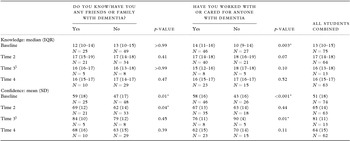
At each time point, the responses were further compared between those who had previous experience of working with PWD as well as those who had friends and family members with dementia and those who did not had this experience (see Table 3). This showed that at baseline those who had worked with PWD (n = 46) had significantly more knowledge then those who had not (n = 27) (p = 0.003). There was no significant difference in knowledge at the other time points, nor was there a significant difference in knowledge at any time point between participants with a friend or family member with dementia and the remainder of the cohort. Confidence was significantly higher at baseline in both the group who had worked with PWD (n = 46) and those with a friend or family member (n = 25) when compared with the other students (n = 26 work; and 48 friend or family) (p = < 0.001 and n = 25:48, p = 0.01 respectively). Confidence remained higher at time two in those with a friend or family member with dementia (n = 21:33, p = 0.04) but there was no significant difference at times 3 and 4. At time 3, those who had worked with PWD (n = 8) reported significantly less confidence than those who had not (n = 5) (p = 0.01) (note small numbers). There was no significant difference at times 2 and 4 between those with experience of working with PWD and other students.
Comparison between participants with previous experience of dementia and those without

Knowledge: mean (standard deviation).
Confidence: median (inter-quartile range).
* significant at <0.05 level.
§likely to be affected by small numbers.
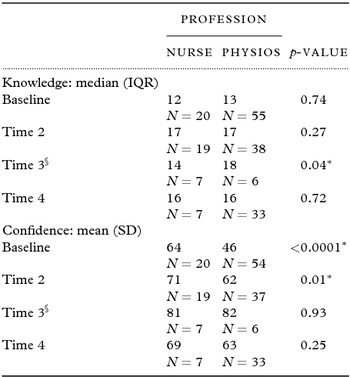
Confidence and knowledge was compared between physiotherapists and nurses (see Table 4). There was no significant difference between the professional groups on the knowledge scale at times 1, 2, and 4; however, physiotherapists scored higher at time 3 (seven nurses and six physiotherapists, p = 0.04). Confidence was significantly higher in nurses at time 1 (<0.0001 n = 20 nurses; 54 physiotherapists) and remained higher at time 2 (p = 0.01, n = 19:37) but there was no significant difference at times 3 and 4.
Comparison between nurses and physiotherapists on knowledge and confidence

*significant at <0.05 level.
§likely to be affected by small numbers.
Comparison between students who volunteered to take part in the CHE and those who did not showed that they did not differ significantly at baseline in terms of knowledge (p = 0.96) or confidence (p = 0.31). Use of a Fisher's exact test showed that they also did not differ significantly in previous experience of working with PWD (p = 1.00) or having friends and family with dementia (p = 0.76).
Students reported their satisfaction with the IP on an analogue scale (0 extremely dissatisfied to 100 extremely satisfied). Participants score highly, above 80%, on the usefulness of sessions, enhancing knowledge, and understanding of working and communicating with PWD, enhancing their communication skills, and their intention to use what they have learned. Their overall satisfaction had a mean of 83.6%.
Discussion
The findings from this evaluation demonstrate that overall the CARDS program succeeded in achieving the two aims set: to increase students’ knowledge of dementia and to increase their confidence in working with PWD. It is encouraging to note that confidence ratings significantly increased after both the IP and the CHE and despite a small decline at six months, confidence scores were still higher than at baseline. However, the same significant increase in knowledge scores was only noted after the IP with no further increase after the CHE. This is perhaps not surprising as there were no additional taught components, apart from the experiential learning in the care home. Nevertheless, knowledge scores did not decline and were sustained after six months. Therefore, a combination of online learning, class-based sessions and a communication workshop improved students’ knowledge of dementia. It appears that these sessions can also improve students’ confidence for working with PWD, which is enhanced further by real world interactions. These findings concur with the conclusions in the review on dementia education programs for pre-registration healthcare students (Alushi et al., Reference Alushi, Hammond and Wood2015) that a combination of theory and practice improves both knowledge and confidence. Similarly, Robinson and Cubit (Reference Robinson and Cubit2007) found that students who went into practice without any theoretical learning felt unprepared and uncomfortable when working with PWD and Beer et al. (Reference Beer, Hutchinson and Skala-Cordes2012) reported that theory without practice increased understanding but not confidence or perceived competence. There are limited longitudinal evaluations of such educational interventions (Alushi et al., Reference Alushi, Hammond and Wood2015) so this study provides evidence that the benefits observed remain after six months.
Interestingly, there were some differences noted between the nursing and physiotherapy students. In terms of knowledge scores, there was no significant difference between the professional groups except at time 3, and this difference might be explained by the very small numbers rather than a real difference between the students. At baseline nursing students demonstrated higher confidence scores than the physiotherapy students. The difference may be due to the amount of clinical experience the students had prior to starting the CARDS program. The second year physiotherapy students had all completed ten weeks in clinical practice prior to CARDS; however, for the second year nursing students this was >15 weeks and even more for third year nursing students. This hypothesis is supported in that students with experience of PWD, whether through work or friends and relatives had more confidence than their peers. Nevertheless, this confidence gap between professional groups narrowed after the CHE, indicating that perhaps the specific nature of the program and experience was more effective for learning than a generic experience.
Similarly, we had assumed that students, who had experience of interacting with PWD through work or relatives, may have greater knowledge and confidence. While this was reflected in the higher baseline knowledge scores for those working with PWD, this did not apply when students had friends or family with dementia. It may be that unless the student had a particular caring role with their relative, then they may not have required an in-depth knowledge base. As had been hoped the CARDS program did fill a particular gap for those students with less prior experience of working with PWD. These students demonstrated greater gains in confidence that after six months had equivalent scores to those who had prior experience.
Due to capacity, the CHE was only open to volunteers. Therefore, it may be claimed that this self-selected group may not be representative of the whole sample. However, the analysis demonstrated that there was no difference between the volunteers and the whole cohort in the measures of confidence and knowledge at baseline, nor was there a difference on whether they had experience of working with PWD or having a friend or relative with dementia. Of course there may be other parameters, not measured in the present study that may have influenced the volunteer group such as motivation and preference to work in the field of dementia once qualified. Nevertheless, the increases in confidence scores are promising and imply that healthcare students with various levels of knowledge and experience gained outside the formal curriculum have potential to improve.
As discussed in the introduction, significant numbers of people receive healthcare in care homes. The importance of students gaining experience of care home work is already valued in some countries, for example, Berntsten and Bjork (Reference Berntsten and Bjork2010) report that placements in nursing homes for older people are compulsory for nursing students in Norway. The present study indicates that when nursing/care home placement experiences are lacking or not compulsory, an educational intervention that combines class-based preparation and experience of working with PWD (such as the CARDS program), may provide an alternative and effective learning experience for students in addition to their standard placements.
As the number of PWD continues to grow internationally there is a need to ensure that healthcare professionals are appropriately prepared to work with them. It is necessary to develop appropriate educational interventions in pre-qualifying education, such as CARDS, to support this. This was a pilot study with small numbers from only two professions; this will need testing with a compulsory CHE for larger numbers and students from other disciplines in healthcare. However, it is also important to ensure that the interventions are robustly evaluated and the results disseminated so that best practice in terms of educational outcomes, as well as time and cost effectiveness, can be established.
Limitations
The main limitation of this study is the small number of participants completing the CHE. The intention is to continue to run the CHE with other professional groups over a number of years providing a larger data base. The emphasis of the CARDS program was on communication. As previously discussed, we created a combined “confidence” score to reflect aspects important in working with PWD: engaging in conversation, skills for caring, and reducing anxiety. This limits the capacity to specify which parameters improved more or less, to further shape the educational intervention. Although students indicated satisfaction with the CARDS program and that they intended to use the learning in their practice, it is not clear what learning/strategies they may use. For instance, while communication is one of the eight core principles in supporting PWD (Skills for Care and Skills for Health, 2011), it might be that students identify that they need more emphasis on practical caring skills.
Conflict of interest
None.
Acknowledgments
Thanks to student participants, care home staff and especially care home residents who made the CHE possible. Thanks go to Robert Grant who helped and advised with the analysis and writing the results.
The physiotherapy and learning disability nursing courses were awarded a bonus from the NHS (Health Education South London) rewarding the quality of education. This funding was matched by the Faculty of Health Social Care and Education, Kingston and St George's University of London.