Any fiscal adjustment hoping to be successful cannot avoid dealing with cuts in the welfare state and in government wages and employment (Alesina and Perotti Reference Alesina and Perotti1995, 227).
Introduction
The global financial and economic crisis has led to ballooning budget deficits and public debt in the advanced industrial democracies. Rising interest rates for highly indebted countries have increased the political and economic pressure on governments to adjust public finances even more. Hence, in nearly all countries of the Organisation for Economic Co-Operation and Development (OECD) world, the issue of budget consolidation is back on top of the political agenda. However, the adjustment of public finances is a difficult task for governments as cutting social security benefits, increasing taxes or making public service employees redundant triggers protests from the groups affected and may jeopardise the incumbents’ chances of re-election. Therefore, the question of how fiscal adjustments should be profiled in order to successfully reduce deficits and stabilise public debt without harming economic growth lies at the centre of the political debate.
This question is not new to public policy and economic research. On the contrary, beginning in the 1990s, many scholars, mainly economists, tackled this issue (Giavazzi and Pagano Reference Giavazzi and Pagano1990; Alesina and Perotti Reference Alesina and Perotti1995, Reference Alesina and Perotti1997; Alesina and Ardagna Reference Alesina and Ardagna1998; von Hagen and Strauch Reference von Hagen and Strauch2001). The quintessence of these studies was recently re-affirmed in an analysis by Alesina and Ardagna who came to the following conclusion (Reference Alesina and Ardagna2010, 3): “For fiscal adjustments we show that spending cuts are much more effective than tax increases in stabilizing the debt and avoiding an economic downturn”.Footnote 1 Moreover, cuts in transfers and social security spending seem to work best in terms of long-term debt stabilisation and the impact on economic growth (Alesina and Perotti Reference Alesina and Perotti1997, 211; Alesina and Ardagna Reference Alesina and Ardagna2010, 12). As a consequence, political leaders and finance ministers have usually been advised to prioritise cuts in (especially welfare) entitlements over tax increases (Sachverständigenrat 2003, 283–303).
The present paper proposes a more nuanced view on fiscal adjustments than the mainstream economic research. We add to the existing literature by introducing two recent advances from comparative welfare state research to the debate on budget consolidations – namely the use of entitlement data on the one hand (Scruggs and Allan Reference Scruggs and Allan2006), and the analysis of specific welfare state components instead of the entire social policy complex on the other hand (Castles Reference Castles2009; Jensen Reference Jensen2012; Zohlnhöfer et al. Reference Zohlnhöfer, Wolf and Wenzelburger2013). What are the consequences for our analysis? First, the use of entitlement data enables us to see more clearly if reductions in welfare spending can really be equated with cuts in welfare entitlements – as often assumed in the economic literature. Our results show that focusing the analysis on expenditures and revenues only leads to a premature assessment of consolidation strategies: whereas social spending indeed seems to be positively related to successful and expansionary adjustments, a rather different picture emerges if output indicators such as replacement rates or welfare generosity indices (Scruggs Reference Scruggs2004; Korpi and Palme Reference Korpi and Palme2008) are used. Hence, as in welfare state research, the focus on spending data has given rise to a serious measurement problem, which has, to a certain extent, obfuscated the view on the dynamics of welfare state retrenchment.Footnote 2
Second, recent studies from welfare state research show very clearly that different welfare state sectors follow different dynamics depending on if they are life course-related (such as pensions) or labour market-related (such as unemployment insurance) (Jensen Reference Jensen2012; Zohlnhöfer et al. Reference Zohlnhöfer, Wolf and Wenzelburger2013). Applying this insight to research on fiscal adjustments enables us to observe major differences in terms of the impact on the success and expansionary effect of budget consolidations depending on the welfare sector concerned. Moreover, these differences can partly explain why we find that total social spending is related to successful and expansionary adjustments but not entitlements. These are important messages for policy makers seeking to balance the composition of adjustment efforts in a most effective way.
Our argument is developed in four steps: in the following section, we review the existing literature, which claims that the composition of fiscal adjustments determines their success. On this basis, we evaluate the theoretical model underlying these studies and discuss how the theoretical relationships may be nuanced in order to come to a more accurate test of the central argument, which involves the credibility of fiscal adjustments. From this discussion we derive two propositions and one hypothesis summing up our main points. The section on definitions, data and methods discusses the dependent variable and presents alternative data, which can be used for assessing the question of whether the composition of budget consolidation has an impact on economic growth and medium-term adjustment success. Moreover, methodological issues are discussed here. The empirical analysis is found in the penultimate section, while the final section summarises the results and concludes this paper.
The conventional wisdom and its shortcomings
Literature review: the thesis of the supremacy of welfare cuts
The thesis of the supremacy of welfare cuts was first established in 1990 in an influential study by Giavazzi and Pagano (Reference Giavazzi and Pagano1990). The authors were stunned that the severe fiscal contractions in Ireland and Denmark during the 1980s had obvious expansionary effects on the economy. In the case of Denmark, the reliance on spending cuts was identified as an important explanation for the expansionary impulse on economic growth (Giavazzi and Pagano Reference Giavazzi and Pagano1990, 103), as the spending cuts created a boom in consumption – a result that the authors attributed to a change in the expectations of the population: major spending cuts would convince the population (and the markets) that the government was serious about the budgetary problems. This would at the same time raise expectations about lower taxes in the future, leading, in turn, to an increase in consumption. After this initial study, Alesina and Perotti published a series of papers that focused more closely on the effects of fiscal adjustments (Alesina and Perotti Reference Alesina and Perotti1995, Reference Alesina and Perotti1997). In their studies, they compared expansionary and non-expansionary (i.e. the effect of a consolidation on economic growth) as well as successful and non-successful adjustments (i.e. the effect of a consolidation on the long-term public debt ratio). Using comparisons of group means and t-tests, the results of their research can be summarised as follows: “To be successful, fiscal adjustments must cut the welfare state and government wages and employment” (Alesina and Perotti Reference Alesina and Perotti1995, 227) – a finding which was also supported by subsequent studies (McDermott and Wescott Reference McDermott and Wescott1996, Alesina and Perotti Reference Alesina and Perotti1997).Footnote 3
Methodologically, more sophisticated analyses relying on multivariate regressions instead of bivariate comparisons of group means corroborate the thesis of the supremacy of spending cuts – even though Heylen and Everaert (Reference Heylen and Everaert2000) do not find that reductions in the government wage bill lead to more successful adjustments. But their results, as well as the findings of von Hagen and Strauch's (Reference von Hagen and Strauch2001, 338) even more sophisticated study, support the general thesis that composition matters and that spending cuts are a key ingredient for successful and expansionary budget consolidations. The same is true for the OECD report (Guichard Reference Guichard, Kennedy, Wurzel and André2007, 15) and several other more recent studies (Mulas-Granados Reference Mulas-Granados2006; Wagschal and Wenzelburger Reference Wagschal and Wenzelburger2008b). In sum, there is ample evidenceFootnote 4 that composition matters for the success and the macroeconomic effect of budget consolidations. The fact that the above-mentioned studies relied on different operationalisations of consolidation periods and diverse indicators for the budget balance (especially with regard to the cyclical adjustment) corroborates the thesis of the supremacy of spending cuts.
Theoretical underpinnings for the “cutting-welfare” thesis and the conceptual shortcomings of existing studies
The theoretical model
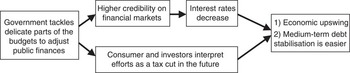
Although there is ample correlative evidence that relying on reductions of social expenditures when balancing the budget increases the chances of an expansionary effect and medium-term debt stabilisation, the theoretical underpinnings explaining this empirical finding do not consider social expenditure reductions per se. Generally,Footnote 5 two causal relationships are held responsible for the empirical correlation that has been found by the studies cited above: the first argument basically says that interest rates play the most important role, as they create incentives for people to invest and to consume. Hence, decreasing interest rates create an economic upswing and facilitate a stabilisation of the debt ratio. Consequently, governments adjusting their budgets have to care primarily about the development of interest rates. How could a reduction be achieved? Here, the theory offers a clear answer: governments that tackle politically delicate parts of the budget are considered to be more serious in their effort to consolidate public finance. This creates higher credibility on the financial markets that reduce the risk premium on government bonds, which leads in turn to lower interest rates (upper chain in Figure 1).
The causal model underlying the “cutting-welfare” thesis.

The second argument is related to the first, but does not consider interest rates to be the key in the causal chain, but expectations. The logic is as follows (lower chain in Figure 1): if governments cut delicate parts of the budgets forcefully, the people (not the markets) will interpret this as a tax cut in the future. Consequently, they will consume (and invest) more, which in turn fosters economic activity (expansionary effect). Again, medium-turn stabilisation of deficits and debt is facilitated.
As Figure 1 shows, regardless of the causal chain assumed in theory, the key to understanding expansionary effects and medium-term debt stabilisation is linked up in any case to a question of credibility. If governments can convince either the financial markets or the consumers/investors that they are serious about balancing the budget, a positive outcome is probable. For the empirical analysis, it is therefore crucial to grasp this concept of “being serious about fiscal adjustments”. We will turn to this issue in the next section.
How to grasp the credibility of governmental action: the problem of overall spending data
The mainstream answer of the economic literature about how to grasp the credibility of a governmental plan to balance the budget is straightforward: markets, consumers and investors consider a government to be serious about fiscal adjustments when it cuts the welfare state. The reasoning is convincing: we believe a government really cares about fiscal adjustments if it does what it hates to do – namely, pursue reforms that potentially lead to electoral punishment.Footnote 6 So far, the story and the causal model described above is convincing. What is problematic, however, is the conceptualisation of “cutting welfare” in the existing empirical studies. Two issues, that have been addressed in the recent social policy literature, are relevant: the operationalisation of welfare cuts on the one hand, and the fact that the welfare state covers very different programmes, which are more or less easy to retrench, on the other.
Turning to the operationalisation of welfare cuts first, recent social policy scholars seem to have reached an implicit agreement that entitlement data (such as replacement rates) are conceptually more appropriate than social spending if welfare state dynamics related to generosity are examined – a point which is discussed under the catchphrase “dependent variable problem” (Green-Pedersen Reference Green-Pedersen2004; Clasen and Siegel Reference Clasen and Siegel2007).Footnote 7 The reason is that social expenditures are influenced by many factors, which are not directly related to political decisions – the most prominent example being the influence of “demand factors” as unemployment. If governments cut the generosity of unemployment benefits in order to restore the sustainability of public finances, this saving measure could easily be overcompensated by an increase in unemployment. Hence, looking solely at the spending data, we would not be capable of seeing the cut in generosity.Footnote 8 This insight has two major consequences for our investigation. First, it is of prime importance for the causal model, because it is most probable that markets, consumers and investors care much more about the actual policy measures (e.g. if a government reduces the benefit levels in unemployment insurance) than about expenditures. From a theoretical perspective, it is therefore more appropriate to conceptualise the credibility of governmental action on the budget using entitlement indicators and not public spending. Second, the insight reminds us that the seemingly straightforward inference from the correlation between spending cuts and successful adjustments to the prominent “cutting-welfare” policy advice may well be seriously flawed: even though spending cuts are a characteristic of successful adjustments (in contrast to unsuccessful ones), this does not necessarily mean that curbing the welfare state is a successful strategy, because welfare spending increases and decreases to a certain extent independently from the generosity of the welfare state.Footnote 9 This leads us to our first proposition:
Proposition 1: Approximating welfare cuts using social expenditures is misleading, because (a) intervening variables as the unemployment rate impact extensively on the indicator and (b) the actors cited above should care more about actual policy measures.
The second issue related to the conceptualisation of “cutting welfare” and the credibility argument is the use of welfare as an “umbrella term” (Pierson Reference Pierson2001, 11) in the existing literature.Footnote 10 In fact, there are good reasons to differentiate between different sectors of the welfare state. This is the essential point made by recent social policy studies showing that life course-related programmes like pensions follow rather different dynamics than labour market-related programmes (Jensen Reference Jensen2012; Zohlnhöfer et al. Reference Zohlnhöfer, Wolf and Wenzelburger2013). One essential finding is that unemployment replacement rates have been retrenched to a much larger extent than pension replacement rates (Zohlnhöfer et al. Reference Zohlnhöfer, Wolf and Wenzelburger2013), which points to the fact that pensions seem to be more difficult to curb. One of the major reasons for this are the attitudes of the public (or in Jensen's terms – the median voter's attitudes) who favours life course-related over labour market-related benefits. This result is of major relevance for the causal model discussed above, because it affects the credibility of governmental action. If we take the argument seriously, we would expect a much stronger credibility effect if governments cut pensions entitlements than if they cut unemployment benefits. Using overall cuts in welfare entitlements (or even worse, welfare spending cuts) averages out these nuances, which are theoretically important. This leads us to:
Proposition 2: Expansionary effects and successful adjustments should be much more likely when pension entitlements are cut in comparison to unemployment benefits, because the most delicate sector (and the most difficult to retrench for left as well as right parties) within the welfare state is old age security, whereas unemployment protection is a much easier target for benefit reductions.
Summing up the two arguments presented here, our endeavour to link up theories of welfare state retrenchment and the causal arguments made above lead to a much more fine-grained assessment of the relationship between governmental action on delicate parts of the budget and the outcome – namely successful or expansionary adjustments. In line with the existing economic theories, we assume that markets, investors, businessmen and the population want to know if a government is serious about consolidating public finances when they decide upon interest rates or investments and consumption. Moreover, we believe that interest rates as well as the expectations of consumers and investors are key to understanding expansionary effects or the medium-term development of public debt. However, we depart from the existing literature in the two points mentioned above and summarised in the two propositions.Footnote 11 Our hypothesis, deducted from the theoretical literature, is as follows:
Hypothesis: The probability of expansionary and successful adjustments is higher if the budget consolidation includes cuts of pension entitlements.
Definitions, data and methods
The first step in order to test our hypothesis empirically is to define fiscal adjustments as well as their success and expansionary effect. These are our dependent variables. In order to grasp the success and expansionary effect of a budget consolidation, the usual approach in the literature involves two stages: first, periods or years of budget consolidations are identified; second, these periods are qualified in terms of success and macroeconomic outcomes.
Concerning the definition of fiscal adjustments, several approaches have been used in the literature (Wenzelburger Reference Wenzelburger2009). Broadly speaking, there are two main methods that diverge in respect of how the nature of a fiscal adjustment is treated. The first approach links the definition of budget consolidations to the annual rate of change of a specific indicator. When a certain measure for the budgetary situation of a country improves (e.g. the debt ratio decreases), a budget consolidation occurs. When it deteriorates, there is no consolidation. The advantage of this method is that the metric information of the data can be used; however, the major drawback of studies following this approach is that, in fact, they do nothing else than analysing fiscal policy. The specific nature of a consolidation, which assumes that the improvement of the budget reaches a substantial extent, is neglected. The alternative approach takes the characteristics of budget consolidations as substantial improvements of the budgetary situation into account. It defines episodes or years of (major) fiscal adjustment by establishing thresholds. If a certain indicator in a certain country satisfies the criteria during a certain period of time, this period is labelled as a consolidation. There are mainly three reasons why we stick to this approach. First, we believe that the nature of a consolidation is indeed different from usual fiscal policies. Second, as this paper is very much related to the existing economic literature, which was strongly influenced by the different studies of Alesina and his colleagues, we stick to their concepts that have been used several times in the literature and have again been laid out in the most recent publication (Alesina and Ardagna Reference Alesina and Ardagna2010). Admittedly, there are conceptual problems with their definition (Wenzelburger Reference Wenzelburger2009) and the (arbitrary) choice of thresholds can always be criticised. However, as the aim of the paper is to produce comparable results, we decided to proceed according to their practice.Footnote 12 Third, and most importantly, it is rather difficult to use metric information in the first step (when defining fiscal adjustment periods) if the goal is to examine whether an adjustment is expansionary or successful. Our dependent variable is not the fiscal adjustment itself but its impact on medium-term debt stabilisation (success) and on economic growth (expansiveness). Using metric data in the first step would therefore necessitate some procedure combining the extent of a consolidation (such as the reduction of a deficit) with a measure of success and expansiveness (e.g. economic growth after the end of the adjustment or the development of public debt in the years after the end of the consolidation). Such a procedure is not self-evident, as very different things would be mixed up, and we believe that following the standard economic approach here does not only make our results comparable but is also the more straightforward measurement. Hence, we follow Alesina and Ardagna (Reference Alesina and Ardagna2010, 9) and define a period of fiscal adjustment as a year in which the cyclically adjusted primary balanceFootnote 13 improves by at least 1.5 per cent of gross domestic product (GDP).
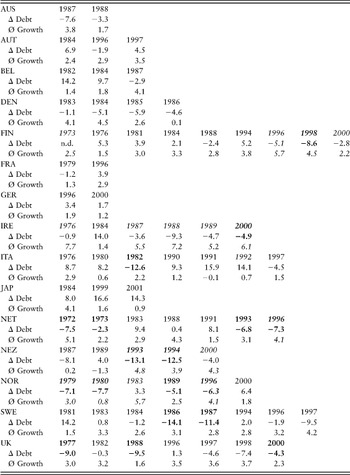
The second stage of the definition process involves the qualification of the so-defined adjustment years as expansive or successful (or both). Again, two options are possible: either a coding of adjustment years as expansionary and successful depending on a certain threshold, or the use of the metric information – that is, the development of economic growth and the debt ratio after the end of the consolidation. Again, the argument of comparability with previous economic studies suggests using a binary response variable and the thresholds of Alesina and ArdagnaFootnote 14 when coding successful and expansionary adjustments. However, it would not be very sensible to ignore the metric information of the data when this is easily possible. Therefore, in the following empirical analysis, we will use the change of the debt ratio and the average economic growth after the consolidations in order to check if the results obtained for the binary dependent variables also hold in the metric case.Footnote 15 Table 1 gives an overview of our sample and the dependent variable. As we see from the table, only a minority of the adjustments are followed by a medium-term debt stabilisation: the range goes from a debt reduction of more than 14 percentage points after the Swedish adjustment in 1986 to an increase of the debt ratio of more 16.6 percentage points after the Japanese adjustment in 1999. Moreover, success does not mean expansiveness: only eight out of 18 successful consolidation episodes were also followed by a strong economic upswing.
Definition of the dependent variable: budget consolidation periods

Sources: Alesina and Ardagna (Reference Alesina and Ardagna2010), OECD Economic Outlook (several editions).
Note: Bold: successful adjustment; italic: expansionary adjustment; bold and italic: successful and expansionary adjustment; not bold, not italic: unsuccessful and non-expansionary adjustment.
The major independent variable of our investigation is the generosity of the welfare state and pension generosity in particular. As our objective is to find out if welfare cuts (and not: spending cuts) determine the success or the macroeconomic outcome of fiscal adjustments, we measure welfare state generosity using indicators of Scrugg's Comparative Welfare State Entitlement Database (CWED) (Scruggs Reference Scruggs2004). The generosity indicators are based mainly on replacement rates but do also take into account the coverage of the existing programmes and qualifying conditions. They are available for overall generosity and disaggregated for pensions, sickness and unemployment.Footnote 16 Unfortunately, CWED data is not available for three of the countries in Alesina and Ardagna's original sample. Moreover, there is no data for the years after 2003. This reduces the number of cases to 81 (whereof 17 are expansionary and 18 are successful adjustments) (see Table 1).
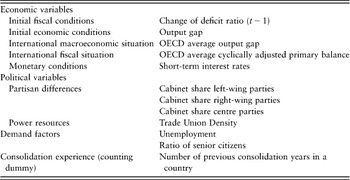
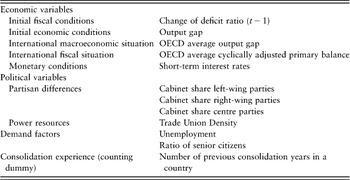
As covariates in the multivariate regressions, different variables that proved to be influential in the existing literature are included, such as the international economic and fiscal conditions, the monetary stance or the initial problem load (see Table 2) (Heylen and Everaert Reference Heylen and Everaert2000; von Hagen and Strauch Reference von Hagen and Strauch2001; Mulas-Granados Reference Mulas-Granados2006; Alesina and Ardagna Reference Alesina and Ardagna2010). Moreover, a partisan effects variable is included as the partisan make-up of a government could potentially affect the composition of fiscal adjustments (Tavares Reference Tavares2004; Mulas-Granados Reference Mulas-Granados2006). In welfare state literature, the power resources of left labour are often held responsible for the development of the welfare state (Korpi Reference Korpi1980; Esping-Andersen Reference Esping-Andersen1990). Therefore, we also include trade union density in order to check this hypothesis. Finally, we incorporate a variable that takes into account the “consolidation experience” of a country in our analysis. This dummy controls for longer consolidation periods.Footnote 17 The data is generally taken from the OECD Economic Outlook Database (OECD 2009) or from the Comparative Political Data Set (Armingeon et al. Reference Armingeon, Engler, Panajotis, Gerber and Leimgruber2010). Finally, we control for unemployment and the elderly ratio as demand factors. The measurement of the variables is included in the Appendix.
Overview of covariates used in the regression analysis
Our empirical analysis will proceed in two steps. As a general overview, we will first discuss some descriptive and graphical evidence in relation to the research question. This includes comparisons of group means and t-tests – a method widely used throughout the 1990s in the initial studies of Alesina and Perotti – on this issue. In a second step, we estimate binary logit models (for the binary dependent variable) and linear regressions (for the metric dependent variables).
Three possible problems related to the statistical analysis should be mentioned beforehand. First, we are aware of the problems that might arise when estimating a logistic regression with only 81 cases (and fewer than 20 cases in one group).Footnote 18 Therefore, our results are rigorously checked on influential cases and outliers. For each regression we report in the regression tables by how many cases the influential cases surpass the critical margins [of dfbeta = 1 in the metric case (Bollen and Jackman Reference Bollen and Jackman1993, 267] or delta χ 2 = 4 in the logistic case (Hosmer and Lemeshow Reference Hosmer and Lemeshow2000, 163). The influence of these outliers has been tested by jackknifing regarding their substantial impact on the results. When the omission of the cases has significantly changed the results, this is discussed in the text or in footnotes. Furthermore, we conducted linear discriminant analysis as a robustness check for the logistic regression (for results, see annex tables).Footnote 19 Second, endogeneity is probably an issue when analysing fiscal adjustments – for example, when we use debt levels as the covariates for problem load on the right-hand side and fiscal adjustments as the dependent variable. However, as the dependent variable is measured in t + 2, at least a direct feedback on governmental policies in t is not likely. In addition, the independent variables are lagged for one or two years (t − 1, t − 2). Finally, if heteroscedasticity has been a problem in the linear regressions, we used robust standard errors.
Empirical analysis
Two main arguments have been developed in the theoretical part of this paper: first, we have argued that approximating welfare cuts using reductions of social expenditures is misleading; and second, we contend that expansionary effects and successful adjustments should be much more likely when pension entitlements are cut in comparison to unemployment protection (or overall entitlement cuts), as they are the most delicate part of the welfare state to retrench. These arguments have been condensed into one hypothesis, which claims that expansionary and successful adjustments are much more probable if budget consolidations consist of cuts of pension entitlements. This section will provide a test of our two propositions and the hypothesis. We will proceed in two steps discussing descriptive findings first before moving on to the results of multiple regressions.
Descriptive findings
The first proposition of the theoretical argument suggests that generosity data is better suited in order to test the relationship between welfare cuts and expansionary or successful adjustments than public expenditure data. This is the case because spending data is massively influenced by demand factors such as unemployment or the number of senior citizens in a country. This obfuscates the view on the substantial policy measures. A basic way of testing if this claim holds is to correlate the different indicators. The result seems to corroborate the expectation that demand factors play a major role: whereas, the correlation between welfare generosity and total social expenditures is very weak (r = 0.012), the development of social spending and the change of the unemployment rate are rather strongly related (r = 0.43).Footnote 20
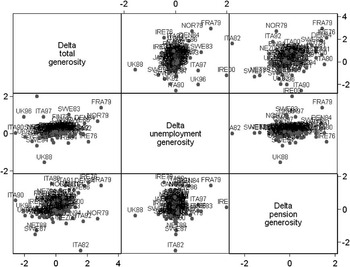
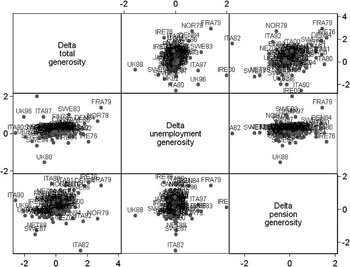
The second proposition derived above pointed out that it probably makes a difference in terms of the success or expansionary effect of a fiscal adjustment whether welfare cuts focus on unemployment benefits or on pension schemes.Footnote 21 A simple comparison of the consolidation episodes under review here indeed reveals considerable variation in terms of the development of welfare state sectors (Figure 2): overall, although the change of total generosity in adjustment years and the change of the generosity of pensions and unemployment schemes are somewhat positively related, the correlations are (1) not very strong and (2) there are some cases where total generosity falls while the generosity of either unemployment or pensions increases. Because of this variance, the disaggregation of welfare state generosity in its main components is appropriate.
Welfare generosity disaggregated.
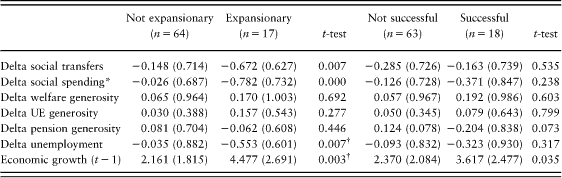
In addition to this, a comparison of the consolidation impact by groups is possible. By means of simple t-tests, we can see if the arithmetic means of certain variables are significantly different in the groups of successful/non-successful or expansionary/non-expansionary adjustments. This enables us to make a preliminary assessment of the variables that could potentially influence whether a fiscal adjustment is successful or expansionary.
Table 3 reports the means as well as the standard deviations and the t-test on the differences of group means. Several results are noteworthy: first, our analysis strongly supports the findings of the existing literature on social spending and the non-Keynesian effect of fiscal adjustments: indeed, social transfers and social spending are reduced more severely in adjustment years, which are followed by an expansionary effect. Second, the change of welfare generosity is not significantly different in the two groups – neither for success nor for expansionary effects. In fact, welfare generosity increased slightly more in the group of expansionary/successful adjustments than in the contrast group. Very interesting in this respect is the fact that pension generosity is indeed reduced to a larger extent in successful and expansionary adjustments – and slightly significantly so if we contrast successful with unsuccessful cases. In line with our hypothesis, we find this difference neither for unemployment generosity nor for overall generosity. Third, the change in unemployment and economic growth rates are significantly different between the groups: unemployment falls much more in expansionary adjustment years than in the non-expansionary ones. The opposite is true for economic growth in the year before the adjustment. This finding strongly supports our claim that intervening variables impact heavily on social spending and may at least partly explain why we do not see a significant difference between the groups in terms of overall generosity.
Comparison of means
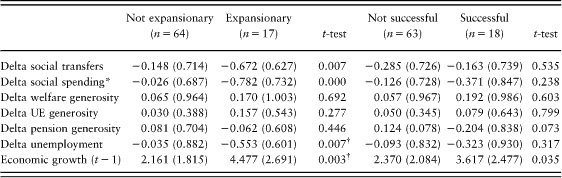
Notes: Mean, SD in parentheses.
*n (not expansionary) = 63, n (not successful) = 62.
† Adjusted t-test for unequal variances; t-test two-sided: Ha: diff ≠ 0.
n = Number of observations.
In sum, the descriptive evidence supports both theoretical arguments made before – namely, that (1) the result whereupon welfare cuts lead to expansionary and successful fiscal adjustments is premature when social spending is analysed, and that (2) pensions in particular play an important role for successful and expansionary adjustments, because cuts in this most delicate welfare state sector create a strong credibility effect. Admittedly, these results stem from simple correlative evidence and cannot be taken at face value, as we did not control for covariates that have been found to be influential in the literature. Therefore, in our next step, we will conduct multiple regression analyses.Footnote 22
Regression analysis: determinants of expansive and successful adjustments
The aim of this section is to check if the results from the bivariate and descriptive statistics still hold when different covariates are controlled for simultaneously. We will first discuss the results for expansionary adjustments, turning to the successful cases in the second part. The following regression tables display the results for two operationalisations of expansiveness and success: on the one hand, the binary case according to Alesina/Ardgana's definition that codes expansive/successful adjustments with 1 and not-successful/not-expansionary adjustments with 0; and on the other hand – as robustness check – the metric case where the change of the debt ratio in the two years after the adjustment is used to measure success, and the average economic growth in the two years after the consolidation quantifies the expansionary effect.
Expansionary adjustments
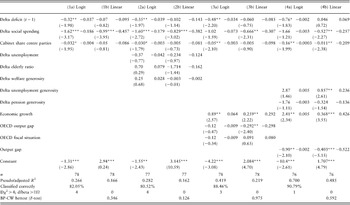
Table 4 reports the results of regression analyses. In the logistic case, the models predict the probability that the dependent variable takes the value of 1, which means that an adjustment year is followed by an expansionary effect. The four models consist of different combinations of independent variables that proved to be influential in the literature (see Table 2). We did not include all the variables in one model due to multicollinearity, and because we wanted to keep as much degrees of freedom as possible. The linear regression models are used as a check if the results for the binary outcome variable still hold when the change of the debt ratio and the average economic growth in the two years following a consolidation are analysed instead.
Regression analysis for “expansionary adjustment years”
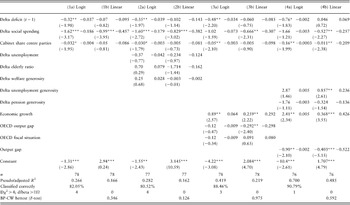
Notes: Logit models: left column: unstandardised coefficients (z-statistics in parentheses); right column: marginal effects (calculated from the mean). Linear models: left column: unstandardised coefficients (t-statistics in parentheses); right column: standardised coefficients; BP-CW-hettest = Breusch–Pagan-Cook–Weisberg–test for heteroscedasticity (H0: constant variance).
*p < 0.1, **p < 0.05, ***p < 0.01.
The most important results of the analysis with regard to our main argument of the paper are as follows: First, the change of the generosity of the welfare state is not significantly related to the probability that a fiscal adjustment is expansionary or not. The coefficient of the variable (Model 2) is highly insignificant and positive in the logistic and slightly negative in the linear case. This would also be true when adding the variable to the other models. Second, disaggregating the overall generosity is very helpful, although unemployment and pension generosity are not always significantly associated with the probability of an expansionary adjustment. However, the general tendency shows that – in line with our Proposition 2 – there are probably two different relationships at work depending on the welfare sector we look at: an increase in unemployment generosity and a cut of pension generosity both positively related to expansionary adjustments (Models 4a/b).
Several variables, which have been found to be influential in previous studies, exert a significant impact here, also. Highly significant is the coefficient for the change of social expenditures: if social spending falls during an adjustment year, a non-Keynesian effect leading to economic growth after the adjustment year is probable. However, in the logistic case, this relationship loses significance if economic growth is controlled for [equation (3)]. This can be interpreted as an effect of intervening variables: higher growth reduces social expenditures (e.g. fewer people are unemployed, fewer people are sick, etc.), and this in turn facilitates expansionary adjustments. Hence, the impact of social expenditures may well be caused by economic growth as underlying factor. Our insignificant result for the welfare generosity variable corroborates this interpretation.Footnote 23 Furthermore, the negative coefficient for the output gap (recessionary gap) is in line with previous findings. If the actual output is far from its potential value (negative value), the probability of an expansionary fiscal adjustment increases. Interestingly, a partisan effect emerges, too. With centre parties in government, expansionary adjustments seem to be less likely – even though the coefficient is only significant in the last specification of the linear regressions.Footnote 24 This result can be interpreted against the background of the welfare state reform literature, which considers the path-dependent systems of central Europe [where (Christian democratic) centre parties are traditionally strong] as especially reluctant to reform the welfare state and to consolidate public finances (Sapir Reference Sapir2006; Wagschal and Wenzelburger Reference Wagschal and Wenzelburger2008a). Thus, credibility effects (leading to expansionary adjustments) could be smaller when centre parties are in power (i.e. the people do not trust that the adjustment will be sustainable and followed by tax cuts). Finally, at least for the logit models, the initial budgetary condition (change of the deficit in the year before the adjustment occurred) plays a role: when governments are confronted with deteriorating public finances, the probability of an expansionary adjustment increases.Footnote 25 However, the results could not be replicated in the linear regressions. In contrast, several other economic variables that have been found influential in previous studies are not associated significantly with the probability of an expansionary adjustment.Footnote 26
As our sample of adjustment years is limited to 81 cases (and due to missing data, the number of cases used in the models varies between 76 and 78), a rigorous analysis of influential cases and outliers is warranted. Therefore, we analysed the leverage, standardised residuals and the delta χ 2 statistics and re-calculated the estimations omitting the most influential cases. In general, the results proved to be robust.Footnote 27
Successful adjustments
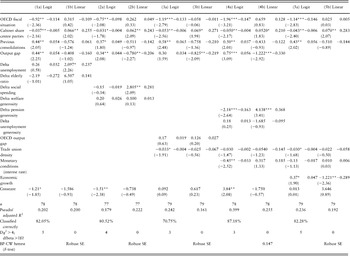
When we turn to the question of whether cuts in welfare state generosity significantly increase the probability of a successful adjustment, three major results stand out: first, as for expansionary adjustments, there is no significant relationship between cuts in the overall welfare generosity and the success of fiscal adjustments [equations (2a)/(2b) in Table 5]. Second, and probably more importantly, the results for successful adjustments strongly confirm a tendency that was already apparent when analysing expansive adjustments: the disaggregation of the total measure of welfare state generosity is crucial to understand why there seems to be no link between overall welfare cuts and successful adjustments. The reason is as expected in our hypothesis: it is not the entire welfare state that matters for the success, but just one component – pensions: a reduction of pension generosity during an adjustment significantly increases the probability of a being successful – that is, reducing the debt ratio in the years after the consolidation substantially. On the contrary, cuts in unemployment generosity do not matter. Finally, and in line with findings from the economic literature, a reduction of social expenditures during a consolidation is related to a medium-term reduction of the debt ratio. However, the coefficient for the variable is not significant in the logistic regression (although the sign points in the “right” direction).
Logistic regression analysis for “successful adjustment years”
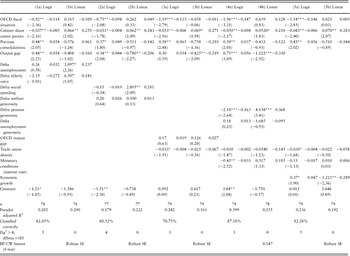
Notes: Left column: unstandardised coefficients (z-statistics in parentheses); right column: marginal effects (calculated from the mean). Linear models: left column: unstandardised coefficients (t-statistics in parentheses); right column: standardised coefficients; BP-CW hettest = Breusch–Pagan—Cook–Weisberg test for heteroscedasticity (H0: constant variance): in case of heteroscedasticity, robust standard errors (Huber/White) have been calculated. As the dependent variable in the metric case is debt reduction, a negative coefficient points in direction of a successful consolidation (the opposite is true for the logistic case).
*p < 0.1, **p < 0.05, ***p < 0.01.
Besides, the following results emerge: first, as for the expansionary case, successful adjustments are less probable if centre parties govern.Footnote 28 This is true for both operationalisations of the dependent variable. Second, the output gap indicating the initial economic condition is positively related with the probability of success, and significantly so in most estimations: a good economic situation raises the chances of a successful adjustment – a result that is corroborated by the positive impact of economic growth.Footnote 29 Third, and in line with previous findings, the fiscal environment in the OECD seems to matter – at least according to the logistic regressions. If public finances are in bad shape in the other OECD countries, the probability of starting a fiscal adjustment is higher. Fourth, according to the logistic regressions, countries, where budget consolidations had already been under way in the past, are more inclined to adjust public finances successfully.
All the results presented above were reasonably robust (see footnotes), and especially for the variable measuring the change of pension generosity, the coefficients proved to be stable when omitting individual adjustment years.Footnote 30
Summing up the empirical results
This section has investigated 81 fiscal adjustments, which occurred in 15 countries between 1975 and 2002. The main concern was to investigate the relationships between cuts in welfare generosity, reductions of social expenditures and the occurrence of successful or expansionary fiscal adjustments. In our theoretical argument we derived two propositions and one hypothesis that have guided our statistical analyses and can be evaluated as follows.
In our first proposition, we have argued that approximating welfare cuts using social expenditures is misleading, because social spending is influenced by other variables, especially demand factors such as unemployment, whereas cuts in actual welfare entitlements provide a more direct measure of government outputs. Our empirical investigation supports the contention that social expenditures and welfare generosity are two very different things. We find that a reduction of social spending is indeed related to successful and expansionary adjustments – but there is no such relationship between cuts in welfare generosity and our dependent variables. The results for our second proposition help explain this puzzle. As we find very substantial evidence for the expectation that expansionary effects and successful adjustments are more likely when pension entitlements are cut in comparison to unemployment protection, we can conclude that overall welfare generosity is too broad a measure to grasp the effect expected in the first proposition. Instead, it is a cut in pension generosity that matters for the outcome – and just because pensions are the biggest spending item in welfare budgets, this relationship is also reflected in the positive association between social expenditures and successful or expansionary adjustments known from the literature (and our regressions). Hence, our hypothesis, which claims that expansionary and successful adjustments are much more probable if budget consolidations consist of cuts of pension entitlements, is corroborated by our empirical findings.
Conclusion and discussion
“To be successful, fiscal adjustments must cut the welfare state” (Alesina and Perotti Reference Alesina and Perotti1995, 227). This statement, which nicely sums up the common thread in literature on fiscal adjustments, suffers from two serious shortcomings: first, it equates welfare cuts with reductions in social spending; and second, it does not take into account that there is not such a thing as “the welfare state” – but that different components of the welfare state follow different logics, are more or less easy to retrench and develop differently over time. These shortcomings have created some misunderstandings related to how governments are advised to profile their adjustments – namely, that curbing (whatever) welfare state entitlement is considered to be the recipe for succeeding a fiscal adjustment in the medium term and without harming economic growth.
This contribution has addressed these two weaknesses of existing studies. It has shown theoretically that (1) it is much more reasonable to expect credibility effects leading to successful and expansionary adjustments if entitlements are analysed instead of social spending, because the latter indicator is influenced by many other factors (e.g. unemployment), which are out of direct control by the government, and that (2) the credibility effect should be especially strong if governments cut pension generosity – and much less so if they curb unemployment benefits. The empirical results presented above strongly support these theoretical expectations. Using welfare state generosity, an index that consists of output measures as replacement rates and coverage, we have shown that cutting overall welfare is neither related to expansionary nor to successful adjustments. Hence, the inference from an association between social expenditures and success or expansionary effects of adjustments to the “cutting-welfare” advice is clearly premature. In fact, the relationship between spending data and political output measures as generosity is more complicated than often supposed, because intervening variables (and especially demand factors as the unemployment rate) impact considerably on social expenditures.
How is this missing link between cuts in overall welfare generosity and expansionary or successful adjustments explained? The second major advance of our contribution is the clarification of this puzzle. In order to test our second theoretical proposition, namely, that credibility effects are much more likely for cuts in pension entitlements than unemployment benefits, we used disaggregated welfare generosity data and showed that it matters for the success and expansionary effect of a fiscal adjustment which part of the welfare state is tackled by the government. Whereas cutting the welfare state generosity in general does not seem to be related to the question of whether an adjustment is successful or expansionary, retrenching pension entitlements does indeed lead to expansionary effects and a medium-term debt stabilisation after the consolidation. Thus, blending such different welfare state sectors as unemployment insurance and pension schemes together in an overall generosity measure blurs the causal relationship between pension cuts and fiscal adjustments.Footnote 31 In sum, the empirical results strongly support our hypothesis, which claimed that expansionary and successful adjustments are much more probable if budget consolidations consist of cuts in pension entitlements.
This finding makes perfect sense when interpreted in the context of the results of recent studies on welfare state retrenchment (Jensen Reference Jensen2012; Zohlnhöfer et al. Reference Zohlnhöfer, Wolf and Wenzelburger2013) – but draws a rather pessimistic picture concerning the feasibility of successful and expansionary adjustments: if we believe the welfare state scholars and pensions are indeed the most difficult welfare programmes to retrench, successful and expansionary budget consolidations are not very likely to occur. This is reflected in our data, too: fiscal adjustments are already in general quite rare events (20 per cent of the years in our sample were consolidation years) and within these, only a small percentage proves to be expansionary. In total, only around 4.5 per cent of the possible 405 country-year-observations (27 years in 15 countries) have been coded as successful or expansionary adjustments. Thus, indeed, successful and expansionary budget consolidations seem to be difficult to achieve. In this context, blame avoidance and political strategies might be useful to enable governments to implement fiscal adjustments nonetheless (Vis Reference Vis2009; Wenzelburger Reference Wenzelburger2011).
Finally, several results for the covariates used in the regression models confirmed the findings of previous studies. This is, for instance, true for the initial economic conditions and, to a smaller extent, for the fiscal stance in the OECD world. Interestingly, partisan politics seem to matter, too: incumbent centre parties seem to prevent adjustments from being successful or expansionary.
Some restrictions have to be kept in mind when interpreting our results. First, our sample was limited to 81 cases whereof in the end only between 76 and 78 could be included in the regression estimations due to missing data. Even though we checked the robustness of our findings rigorously, estimated linear as well as logistic regressions and conducted linear discriminant analyses as cross check (confirming our findings, see Appendix), the small n of our regressions leaves some room for doubt that we cannot totally dispel here. Second, the causal argument we developed needs to be deepened in future research. We suggested a simple causal model, which is based on credibility effects, and we considered variables that intervene in the relationship between spending and generosity – for instance, the demand for unemployment insurance. However, in order to focus on our main argument, we neither theorised about the causal relationships between the intervening variables nor investigated the associations between the covariates and the intervening variables. These interrelations and interactions certainly are a promising field for future research.
Acknowledgements
I am very grateful to Frank Castles and Pascal König for their remarks on earlier versions of this paper. I also want to thank the two anonymous reviewers and the editor for their helpful comments, which have significantly improved this contribution.