INTRODUCTION
Congestive heart failure (CHF) is an emerging epidemic that affected approximately 6.6 million Americans in 2010 and is projected to affect 10 million by 2030 (Heidenreich et al., Reference Heidenreich, Trogdon and Khavjou2011). CHF accounted for 1.2–1.3 million U.S. hospitalizations in 2004 (Go et al., Reference Go, Mozaffarian and Roger2013), mostly due to dyspnea. A distressing symptom, dyspnea presents in about 60–88% of patients with CHF (Solano et al., Reference Solano, Gomes and Higginson2006) and is associated with declining functional status (Laoutaris et al., Reference Laoutaris, Dritsas and Brown2004), poor quality of life (Karapolat et al., Reference Karapolat, Eyigor and Atasever2008; Caraceni, Reference Caraceni, Zecca and Martini2012) and loss of will to live (Chochinov et al., Reference Chochinov, Hack and Hassard2005). Dyspnea also has profound effects on patients with chronic obstructive pulmonary disease (Hajiro et al., Reference Hajiro, Nishimura and Tsukino1999; Holm et al., Reference Holm, Bowler and Make2009) or cancer (Gupta et al., Reference Gupta, Lis and Grutsch2007).
Opioids are the cornerstone of symptom management in dyspnea (Parshall et al., Reference Parshall, Schwartzstein and Adams2012), though they are not universally efficacious (Currow et al., Reference Currow, Plummer and Frith2007). In fact, management of refractory dyspnea in advanced illness is still one of the most challenging tasks across medical specialties (Parshall et al., Reference Parshall, Schwartzstein and Adams2012). Inotropes such as milrinone may be required for patients with CHF refractory to opioids (Felker & O'Connor, Reference Felker and O'Connor2001).
Milrinone is a phosphodiesterase-3 (PDE-3) inhibitor with inotropic, lusitropic (promoting diastolic relaxation), and vasodilator effects (Honerjager, Reference Honerjager1991). Upon PDE inhibition, cyclic AMP levels increase, which consequently increases the level of intracellular calcium and cardiac contractility and hence the cardiac index (Honerjager, Reference Honerjager1991; Majure & Teerlink, Reference Majure and Teerlink2011; Milfred-LaForest et al., Reference Milfred-LaForest, Shubert and Mendoza1999). However, the effects of PDE inhibition on heart rate or blood pressure are negligible. Milrinone is particularly effective for patients with end-stage heart failure (ESHF) (Cesario et al., Reference Cesario, Clark and Maisel1998), where symptom management is compulsory. However, toxicities related to milrinone use—such as hypotension (Cesario et al., Reference Cesario, Clark and Maisel1998), fatal arrhythmia (Holmes et al., Reference Holmes, Kubo and Cody1985), and tachyphylaxis (Cesario et al., Reference Cesario, Clark and Maisel1998; Packer et al., Reference Packer, Carver and Rodeheffer1991; Honerjager, Reference Honerjager1991)—and its potential for inducing death restrict its use to highly complex and monitored settings, such as intensive care units (ICUs). Because a palliative care unit (PCU) generally does not have monitors and due to strict hospital policies, gaining approval to administer inotropes in that setting may prove to be challenging. Opioids have no known interaction with milrinone, so they might be used in combination efficaciously.
We describe dramatic improvement in opioid-refractory dyspnea obtained using milrinone in an ESHF patient with leukemia who had been admitted to our PCU. She was subsequently transferred to hospice care and was able to maintain good symptom control with milrinone. Success in this case resulted in a major policy shift at our hospital regarding unmonitored use of milrinone and similar cardiac agents for symptom relief of dyspnea in do-not-resuscitate (DNR) patients on the PCU.
CASE DESCRIPTION
Mrs. M (the patient's name was changed in the interests of confidentiality) was a 57-year-old Caucasian female with a medical history of breast cancer who had been treated with chemotherapy, surgery, and radiotherapy 10 years prior to her most recent presentation at our treatment center. She had been treated with several lines of chemotherapy over the course of five years after having initially having been diagnosed with acute promyelocytic leukemia and later myelodysplastic syndrome, which had progressed to an acute myeloid leukemia that was refractory to treatment. The patient's comorbidities had included CHF secondary to chemotherapy-associated cardiomyopathy and diabetes mellitus. Dyspnea on exertion had progressed during the three years prior to her last admission, at which time she had presented with dyspnea at rest (class 4 New York Heart Association [NYHA] functional classification). The most recent echocardiogram had revealed a left-ventricular ejection fraction of 20–25% with global hypokinesis, moderate dilation, moderate to severe tricuspid regurgitation, and an elevated right-ventricular systolic pressure of 40–50 mm Hg.
Before her last admission, Mrs. M had presented three times in the previous three months for hypotension and CHF exacerbation. One of these presentations had required admission to the ICU. During her stay there, cardiology had recommended an intravenous milrinone drip for symptom control in view of the presence of hypotension and the refractoriness of the dyspnea. Administration of milrinone had improved the patient's symptoms, and she had been able to tolerate diuretic agents, beta blockers, and angiotensin-converting enzyme inhibitors. The patient was eventually discharged home with home healthcare on milrinone drip and oral medications.
However, the morning after discharge, she was admitted back into the hospital complaining of fever. She also had experienced anxiety and dyspnea. On arrival to the emergency center (day 1), her blood pressure was 85/48 mm Hg, her heart rate was 133 bpm, her respiratory rate 26 breaths per minute, and oxygen saturation 89% on room air. Mrs. M's lungs were clear to auscultation and percussion. Auscultation of the heart revealed tachycardia with regular rhythm and a systolic ejection murmur. The patient's lower extremities showed bilateral +2 pedal edema. Her Eastern Cooperative Oncology Group performance status score was 4. Her blood counts were unremarkable except for positive blasts on the peripheral blood smear. The chest x-ray was negative for infiltrates.
Because the leukemia was refractory, Mrs. M and her husband had a prolonged encounter with the medical team in which it was explained that she was not eligible for further therapy. The palliative medicine team assisted in communicating palliative care interventions such as symptom control with morphine and discontinuation of milrinone. The patient opted for a DNR order and agreed to be transferred to the PCU to facilitate end-of-life discussions and eventual transfer to hospice care. This discussion generated significant anxiety for Mrs. M, so the medical team provided expressive supportive counseling. She was also started on broad-spectrum antibiotics in view of a suspicion of sepsis.
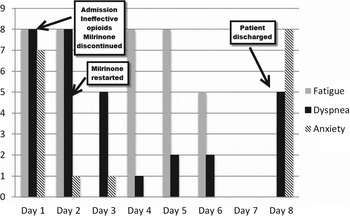
On day 2, the patient's dyspnea was still exacerbated significantly despite treatment with opioids at 60 mg of morphine equivalent daily dose (MEDD). Because of her hypotension, the morphine dose could not be increased. The physical examination revealed bilateral crackles, which was compatible with pulmonary edema. At that point, cardiology was consulted emergently, and they suggested that a milrinone drip be restarted. Intensive discussions were carried out with the hospital's pharmaceutics and therapeutics committee to allow for administration of milrinone in an unmonitored setting (i.e., the PCU) for purposes of symptom relief. After approval by the scientific director of the hospital, Mrs. M received milrinone at the PCU without telemetry at 0.5 µg/kg/hour. After this multidisciplinary team approach, her Edmonton Symptom Assessment System (ESAS) score for anxiety decreased from 7 (on day 1) to 1 (on day 2) (see Figure 1).
Edmonton Symptom Assessment System (ESAS) scores for patient. Scale ranges from 0 (no symptoms) to 10 (worst symptom ever). The patient was admitted to the hospital on day 1 and discharged to at-home hospice care on day 8.

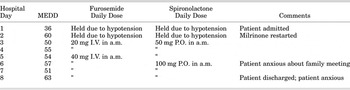
On day 4 (within 48 hours after milrinone was restarted), the patient's ESAS score for dyspnea had dropped from 8 to 1. The score for fatigue had also dropped, from 8 on day 1 to 0 on day 3. Her MEDD remained fairly stable during the rest of her PCU stay (see Table 1). Because the results of her blood and urine cultures were negative, the fever etiology was thought to be related to the leukemia, so antibiotic treatment was discontinued.
Morphine equivalent daily dose (MEDD) and diuretic doses during patient's hospital stay

During Mrs. M's 8-day PCU stay, her daily diuretic treatment with furosemide and spironolactone was adjusted satisfactorily with an acceptable fluid balance, and beta blockers were restarted. On discharge from the PCU, the patient's functional status improved dramatically. She went from being completely bedridden with dyspnea at rest to being able to ambulate with a walker, eat without discomfort, and pursue activities of daily living (bathing, brushing her hair, and getting dressed). Emotionally, Mrs. M stated that she felt very peaceful and was looking forward to spending the rest of her life at home. There were some issues with mild anxiety prior to discharge due to the uncertainty of her symptom management at home, but this was satisfactorily addressed by our psychosocial team.
In view of the proven refractoriness of this patient's dyspnea to opioids and best medical management, her insurance company agreed to pay for both hospice care and milrinone. She was able to remain at home and, according to a subsequent phone interview, had minimal discomfort. Surrounded by her family and hospice care team, she passed away 22 days after discharge.
COMMENT
Congestive heart failure is the most common cause of hospital admission and readmission among Medicare beneficiaries (Jencks et al., Reference Jencks, Williams and Coleman2009). Given CHF's epidemic proportions and the associated morbidity and mortality, evidence-based palliative care interventions to reduce both the suffering of and medical costs to patients are required, especially at the end of life. Although the use of aggressive interventions is not usual in palliative or hospice care, the case we present highlights three potential benefits of aggressive management of symptoms with the use of milrinone in ESHF, because of its pharmacologic action reviewed elsewhere (Benotti et al., Reference Benotti, Lesko and McCue1985).
First, our patient experienced a dramatic improvement in dyspnea shortly after milrinone was reinitiated. In cases of opioid-resistant dyspnea, milrinone, which directly stimulates cardiac contractility without increasing myocardial oxygen consumption (Charisopoulou et al., Reference Charisopoulou, Leaver and Banner2014), may be required to control dyspnea. The remarkable response induced by milrinone in our patient resulted in an institutional policy change: all patients with a DNR order on file and refractory symptoms related to ESHF may now receive inotropes in the PCU. Monitoring of milrinone blood levels has been advocated as a surrogate for telemetric monitoring (Vazir et al., Reference Vazir, Leaver and Lyster2011), but it is largely unpractical at the end of life, when only comfort measures are warranted. In cases of opioid-resistant dyspnea, symptom management is one of the compelling reasons to continue administering inotropes in the palliative care setting. Failure to do so will result in inappropriate rapid uptitration of opioids and the risk of delirium (Oosten et al., Reference Oosten, Oldenmenger and van Zuylen2011), and it may unnecessarily increase an early need for palliative sedation to control intractable dyspnea or delirium (Caraceni et al., Reference Caraceni, Zecca and Martini2012; Mercadante et al., Reference Mercadante, Intravaia and Villari2009). A DNR order should not prevent consultation with cardiology and other staff, who are making all efforts to provide maximal medical therapy.
Second, some clinicians might have argued against the need for admitting our patient to the PCU. However, given the high anxiety she experienced after discussion of her prognosis and the additional discussions that occurred about DNR status in the emergency department, it was determined that the PCU was, at that time, the best setting in which to care for this patient, who was now near the end of her life. A team of medical experts in symptom control and a highly skilled psychosocial team were assets in managing the patient's discomfort. In the PCU and under sufficient nurse supervision, our patient received milrinone infusion and, subsequently at home in a completely unmonitored setting. However, almost all hospitals will insist on a telemetry monitor when inotropes are provided. Such a policy is untenable compared with the use of midazolam and propofol without monitoring for palliative sedation in the PCU. For the patient and her husband, the intervention of a multidisciplinary team and best medical therapy were reassuring. As a result, our patient felt peaceful and was able to address issues that were important to her and her family.
Third, cost-containment strategies could well use inotropes in its armamentarium for short-team symptom management in CHF. The direct and indirect medical costs for CHF in 2010 were $34.4 billion, and these numbers are expected to triple by 2030 (Heidenreich et al., Reference Heidenreich, Trogdon and Khavjou2011). The mean cost of a CHF-related hospitalization was $18,000–$23,000 per patient in 2008 (Titler et al., Reference Titler, Jensen and Dochterman2008), which is a rapid escalation from the $10,000 calculated for 1991 (O'Connell & Bristow, Reference O'Connell and Bristow1994; Honerjager, Reference Honerjager1991; Jencks, Reference Jencks, Williams and Coleman2009). The care of NYHA class 4 heart failure patients, including outpatient care, is the most expensive compared to classes 1, 2, or 3 (Malek, Reference Malek1999 ), considering that more ICU admissions occur near the end of life. The patient's total expenditure for her last 11-day ICU admission alone was more than $100,000, while her 10-day PCU admission cost was $42,000. Furthermore, current government policies penalize hospitals for CHF readmissions within 30 days, but the rate of these readmissions has been estimated to be as high as 27% (Jencks et al., Reference Jencks, Williams and Coleman2009). We propose that providing intermittent inotropic infusions with milrinone for outpatients (in a hospice setting) is a cost-effective alternative. The cost of milrinone for our patient was $7 per day, with a daily range of $7–50 (Majure & Teerlink, Reference Majure and Teerlink2011). A simple cost analysis proves that the use of milrinone is financially advantageous for ESHF patients and thus for the healthcare system. In addition, the use of inotropes may reduce readmissions and decrease hospital stays by about 80% for patients with NYHA class 3 or 4 illness (Marius-Nunez et al., Reference Marius-Nunez, Heaney and Fernandez1996).
We are aware that inotropic infusions may not be covered by Medicare and that CHF patients may forsake hospice enrollment because they believe their health insurance will not cover the use of inotropes. This reasoning, which is prevalent, may explain why only 2.5–20% of CHF patients receive hospice benefits (Whellan et al., Reference Whellan, Cox and Hernandez2012). In the case of Mrs. M, coverage for both hospice and intravenous milrinone was negotiated with the patient's private insurance, which abrogated the need for hospital readmission. This case suggests that such an arrangement is feasible for ESHF patients as a cost-containment strategy, even with Medicare/Medicaid patients.
In conclusion, we strongly advocate the unmonitored use of all medications that provide comfort to patients at the end of life when being treated in a PCU setting. Patients for whom no other conventional therapies against dyspnea are available might be willing to accept the greater risk of death associated with the proarrhythmic effects of intravenous inotropes (Packer et al., Reference Packer, Carver and Rodeheffer1991) in exchange for some symptom relief. With our patient Mrs. M, good symptom control was achieved not only by us while she was admitted to the hospital but also in the outpatient setting due to arrangements made between hospice care and her insurance carrier.