I. INTRODUCTION
In the current recession, economists are showing a renewed interest in the problem of the “liquidity trap,” and the proposal of negative nominal interest has received widespread attention, not only in the academic world, but also among policymakers and monetary authorities. Footnote 1 Particularly interesting is the position taken by Gregory Mankiw, who, in an article in the New York Times, reflected on the negative interest proposal as a possible way to get through the present credit crisis (Mankiw Reference Mankiw Gregory2009, Reference Mankiw and Gregory2015; see also Goodfriend Reference Goodfriend2000; Buiter and Panigirtzoglou Reference Buiter and Panigirtzoglou2003; Buiter Reference Buiter2009; Fischer Reference Fischer2016). Recently, some local money initiatives have been activated in Germany (Regionalgeldexperiment Chiemgauer), in Austria (Waldviertler), France (Abeille), and the United Kingdom (Stroud Pound) as practical applications of this idea, in the context of complementary currencies (Godschalk Reference Godschalk2012; Lucarelli and Gobbi 2016).
The negative interest rate issue (also called “demurrage”; i.e., reduction over time in the intrinsic value of a currency) has a long tradition in the history of economic thought (Godschalk Reference Godschalk2012). In this respect, we owe an original formulation to Silvio Gesell (1862–1930), a “strange unduly neglected prophet” (Keynes Reference Keynes1936, p. 353), a German merchant, self-taught economist, and social reformer. In his main work, The Natural Economic Order, Gesell offered a theoretical basis for the practical implementation of the negative interest rate.
This proposal by Gesell, generally known as the “stamped money plan” (also called “taxing of money”), was favorably commented upon by two outstanding twentieth-century economists, Irving Fisher and John Maynard Keynes, and put into practice with some positive results during the Great Depression.
In particular, some significant similarities can be found between Gesell and Fisher in terms of their views on the effects of hoarding and deflation as major characteristics of economic crisis. This affinity between the two authors is shown by their common adhesion to quantity theory and the mainstream approach to the function of money as a medium of exchange.
The theoretical affinity between Fisher and Gesell has been neglected by historians of economic thought. Footnote 2 Since the 1940s, the focus of research on Gesell has concentrated on the relationship with Keynes, in an attempt to stress theoretical affinities, particularly with the ’liquidity trap’ (Seccareccia Reference Seccareccia1987, Reference Seccareccia1988) and political philosophy (Darity Reference Darity1995). Pursuit of this angle followed two main routes of analysis: through the Pierre-Joseph Proudhon–Gesell–Keynes connection, Footnote 3 proposed by Dudley Dillard and Charles Rist (Dillard Reference Dillard1940, Reference Dillard1942a, Reference Dillard1942b; Rist Reference Rist1955; see also Schumpeter [1954] 2006, pp. 1118, 1131; Allais Reference Allais1977, p. 275; Chick Reference Chick, Eatwell, Milgate and Newman1987; Ferreira Reference Ferreira2010), and through the analytical forerunners of Keynesian monetary theory, particularly Knut Wicksell (Herland Reference Herland1987, Reference Herland, Arena and Torre1992), and the influence of Frederick Soddy (Daly Reference Daly1980) and Nicholas A. L. A. Johannsen (Seccareccia Reference Seccareccia1987; Rühl Reference Rühl, Arestis and Sawyer2000). Recently, this perspective of research has been outlined by Guido Preparata, according to whom Keynes’s theory of money was strongly inspired, if not borrowed, from the early insights of Silvio Gesell (Preparata Reference Preparata and Zarembka2002). However, despite these similarities, two main features of Gesell’s thought—the nature of money as a medium of exchange and the quantity theory—are totally extraneous to Keynes’s monetary theory.
This paper aims to make an in-depth re-examination of Gesell’s stamped money scheme and its influence on Fisher’s policy proposal during the Great Depression. We propose a reading of Gesell’s theory of money from the point of view of quantity theory, giving prominence to elements of affinity with Fisher’s monetary theory. Also, as will be shown below, re-examination of the theoretical roots of stamped money, as well as policy implications, may cast further light on the working of the monetary system and the evolution of monetary theories during the 1930s. This re-examination entails revision of the opinion on the analytical contribution made by Gesell, who was generally tagged as a “typical monetary crank” (Garvy Reference Garvy1975, p. 392), and proves that his place in the history of economic thought is less marginal than previously thought, reinforcing critical appreciation of him (see, above all, Cahiers de Decta 1987; Ilgmann Reference Ilgmann2009).
The next section provides an overview of Gesell’s thought on the nature of money and crisis; section III outlines the stamped plan and its implementation in Europe and America; sections IV and V discuss the connection among Gesell, Fisher, and Keynes. Finally, the conclusions show the centrality of Gesell’s monetary thought during the Great Depression.
II. THE NATURE OF MONEY AND CRISIS IN SILVIO GESELL’S THOUGHT
By the end of the nineteenth century, when Silvio Gesell Footnote 4 wrote his first contributions, economic science had achieved broad agreement on the nature and the function of money, although other theoretical elements of monetary orthodoxy, inherited from classical economics, were subjected to thorough critical revision (Laidler Reference Laidler1991, p. 7).
This mainstream view was grounded on the thesis that money serves the essential function of a medium of exchange (Laidler Reference Laidler1991, p. 8), and the functions of measure of value and store of value “must not be attributed to money as such, since these are of a merely accidental nature and are not an essential part of the concept of money” (Menger [1871] 2007, p. 280).
The theoretical context in which Silvio Gesell completed his formation (his first work, Die Reformation im Münzwesen als Brücke zum sozialen Staat, was published in 1891) clearly influenced his opinion on the nature and origin of money.
Gesell approved of the “orthodox thesis” that money is essentially a means of payment: money is a product of the division of labor and it is the means to solve the difficulties of barter, guaranteeing fast and cheap intermediation of goods (money is no more than a simple medium of exchange). Following, again, the traditional view, not all commodities are able to perform the important function of means of payment efficiently: indeed, consumption goods cannot, because the salt, tea, flour, etc. received in exchange did not circulate; “they never returned to their start-point, the port at which they were unloaded: they were bought because of their material properties, and consumed” (Gesell 1958, pp. 166–167). Footnote 5
A form of money replaces another when it has become inefficient in facilitating exchanges; thus, gold replaced silver, and gold would eventually be replaced by banknotes and paper money (Gesell 1958, p. 378). Paper money, Gesell argued, is the best instrument of exchange, because it is useless for any other purposes beyond the needs of exchange; its only utility coincides with its function as an instrument of exchange (Gesell 1958, p. 175). This property does not belong to precious metals, which have their own utility as normal goods, as distinct from their monetary function. In these terms, Gesell anticipated the general diffusion of the fiat money system, fully guaranteed by the state. Footnote 6
Despite this particular nature—i.e., its sole utility as means of exchange—paper money remains a commodity, Footnote 7 even though special, and, like other goods, its price is determined by reciprocal interaction between demand and supply. This principle is evident for paper money, but it equally applies to metal money.
The demand for money derives from the need to exchange goods. Exchanging future money for present money does not represent demand for money: it is desire for money. The demand for money is formulated only by sellers; the desire for money characterizes speculators and usurers. Footnote 8 These different motivations (generally confused) affect the determinants that regulate its evolution, because the desire for money is regulated by interest, while the demand for money is regulated by prices (Gesell 1958, pp. 204–205). If the demand for money is determined by the needs of exchange, it necessarily coincides with the stock of goods on the market (Gesell 1958, p. 215). Footnote 9 Coinciding with the stock of goods, the demand for money is conditioned by all the causes that change production: variation of the population and division of labor, technical and commercial progress, distribution of property, social conflicts, etc. (Gesell 1958, pp. 209–216). In particular, credit exercises a dominant influence on the demand for money, because it reduces the amount of goods exchanged with monetary means. Footnote 10 Credit instruments render money superfluous for transactions (Gesell 1958, p. 214). Barter has an analogous effect on the demand for money.
Similarly, the money supply coincides with the demand for goods and is defined by the stock of money in circulation Footnote 11 and the velocity of circulation of money (Gesell 1958, p. 221). Footnote 12
On the market, the supply of money (or the demand for goods) has an advantage over the demand for money: by virtue of its material nature (metal or paper), money can be withdrawn indefinitely from the market without entailing any storage costs, unlike goods, which may be perishable or involve costs and losses if stored in a warehouse. Thanks to this asymmetry between money and goods exchanged, the holder of money can derive benefit, a kind of tribute, from forgoing liquidity, compelling the holder of wares Footnote 13 to make him a special payment in return for refraining from holding back his money (Gesell 1958, p. 374). Footnote 14
This special payment constitutes the interest, which, as we know on the evidence of thousands of years of experience, amounts to about 4% or 5% of the sum of money involved (Gesell 1958, p. 389) and is to be distinguished from normal commercial profit (Gesell 1958, p. 384). The interest paid adds to the other remaining costs of exchange, obstructing the normal flow of commerce like a tribute, comparable with the tolls exacted in the Middle Ages by robber barons, and until lately by the state for the use of roads (Gesell 1958, pp. 385–386). To pay this tribute, the consumer must always spend more money than he receives as producer. This surplus is obviously delivered to money capitalists for their personal use (Gesell 1958, p. 389).
Gesell calls this interest “basic interest” (Urzins); it is a form of monetary interest that coincides with a premium required by the money holder to forgo liquidity. It is a monetary phenomenon, made possible only by market conditions and not correlated with temporal preference or capital productivity (Dillard Reference Dillard1942a, p. 350). It is not interest on a loan, or determined by demand for supply, but it is an exchange transaction exacted because the possessor of money can refuse or allow the exchange (Gesell 1958, p. 389).
This form of interest is in contrast with return on real capital, which has a natural tendency to fall to zero, following the law of diminishing marginal productivity (Keynes did not hesitate to call it “marginal efficiency of capital” [Keynes Reference Keynes1936, p. 355]), but real capital “must therefore necessarily yield interest equal to the tribute which money can impose as basic interest upon the exchange of wares,” otherwise money remains inactive and investments fall (Gesell 1958, p. 390). Basic interest becomes the point of equilibrium around which interest on all forms of real capital must oscillate (Gesell 1958, p. 394). Interest on real capital stimulates saving and accumulation, and the higher the interest, the greater the incentive to save, because the capitalist’s surplus is proportionally greater. Every rise in interest on real capital above basic interest automatically causes an increase in the new production of real capital. Under the pressure of increasing supply, the interest soon falls back to the point of equilibrium represented by the basic interest level: the greater the fall in interest, the greater the amount of real capital created. No economic or psychological obstacles can interfere with this automatic process (Gesell 1958, p. 397).
Money can also be called “basic capital,” because it paves the way for real capital and prepares the market conditions that enable real capital to exact interest equal to basic interest. Only by spending a sum of money can real capital, just like wares, generate interest. Exclusive control of money creates an artificial limitation of the production of real capital, keeping its supply constantly below the demand (Gesell 1958, p. 292). Consequently, this monetary system inevitably creates unemployment (proletariat) and waste of economic resources.
Another two components must be added to basic interest: a risk premium and an inflation premium, which Gesell calls “Hausse-premium” (Hausseprämie) (Gesell 1958, pp. 431–436).
The claim to basic interest is based on the scarcity of money supply determined by the asymmetry between the holder of wares and the seller. Money interest is limited only by competition from the other forms of non-monetary exchange, such as barter, bills of exchange, and subsistence/autarchic production.
If monetary exchange is too expensive for the amount of basic interest, it is convenient to resort to several forms of autarchic production, barter, or credit (bill of exchange), which reduce monetary exchanges (Gesell 1958, pp. 377–379). So, the rise and fall of interest are not determined by competition among money lenders, but only by these direct substitutes for money (Gesell 1958 p. 382).
Basic interest has a clear influence on the real economy, because it constitutes the minimum premium for foregoing liquidity. Real assets have to yield at least as much as the basic interest to induce the money holder to forgo liquidity. In Gesell’s view there is an interaction between the real and monetary sector; this constitutes an affinity between his theory and Knut Wicksell’s (Herland Reference Herland1987, Reference Herland, Arena and Torre1992; Blanc Reference Blanc2002).
Demand or regular supply of money for goods, Gesell argued, exists only when the market conditions guarantee money holders both sufficient security against loss and the payment of a tribute for money.
The asymmetry between money holders and sellers of goods undermines the unity between purchases and sales. Even if not directly cited, this unity is represented by Say’s Law, which Gesell thus implicitly refuted (Ferreira Reference Ferreira2010, p. 216).
The tribute influences every type of exchange in which money plays a role. In particular, on the commodity market this tribute is determined by the difference between purchase price and sale price that the buyer expects to realize (Gesell 1958, p. 230). Footnote 15 In periods of prosperity, when average prices rise, the tribute can easily be paid and expectations are fulfilled. In a period of depression, when the average prices fall, the exchanges become “mathematically impossible,” because the tribute is not feasible.
If the demand for goods (money supply) is greater than the supply (demand for money), the price level rises. In other terms, an ample supply of money determines good growth in prices. Footnote 16 A general rise in the prices of goods means, for the possessor of money, a loss exactly proportionate to this rise; the only way to avoid this loss is to offer the money in exchange for goods. In this situation the circulation of money is compulsory and losses are avoided (Gesell 1958, p. 381).
The prices rise also because the credit sales increase, “since the quantity of wares offered in exchange for money decreases by the amount of these credit sales, and since demand and supply—the ratio in which money and wares are exchanged—determine price” (Gesell 1958, p. 233).
The phase of expansion is characterized by an elevated velocity of circulation of money and an increased level of credit, bringing about a very high level of activity in economic life (Gesell 1958, p. 240). The banks’ reserves disappear and the rate of interest rises. Footnote 17 Thus, a high price level and high interest level are the signs that characterize economic booms. Footnote 18
To account for this apparent contradiction, Gesell refers to a particular component of the interest rate, besides basic interest, dependent on variations in the general level of prices, which Gesell calls “Hausse-premium.”
When a general price rise is expected, in trade boom or business prosperity, borrowed money can be paid back with extra profit, a surplus, above the legitimate profit of commerce realized on the market. This surplus provokes a “universal appetite” for buying proportionate to the degree of certainty in the expected rise of prices (Gesell 1958, p. 431). In this situation the possessor of ready money and claims on ready money (government loans, mortgage, etc.) is threatened with loss, for he will see the commodities obtainable with his money steadily dwindling (holders of securities with fixed interest rates have much to fear with price rises). The only way the possessor of money can protect himself against losses is to sell securities and, with the money brought in, buy industrial shares, commodities, and other real assets whose prices are expected to rise.
Expectations of a general rise in prices will boost the demand for money loans, and the holder of money is consequently in a position to exact a higher rate of interest (Gesell 1958, p. 433): Footnote 19 “what the possessor of money loses through a rise of prices has then gone over into the rate of interest” (Gesell 1958, p. 432). The increased amount of interest reduces the profit from transactions and induces downward readjustment of expectations: “in this way a kind of equilibrium is established” and “the appetite for money disappears” (Gesell 1958, p. 432). There is no stimulus to purchase, and money finds its way back into the banks; consequently, the rate of interest falls and the Hausse-premium disappears from the rate of interest.
If price expectations are pessimistic and prices show a general downward trend, there will be market stagnation and unemployment, and the economic system will collapse in a period of depression. According to Gesell, the crisis then takes on the form of generalized deflation. Footnote 20 “The phenomenon of a commercial crisis,” Gesell argued, “so ridiculous to the onlooker, must have a ridiculous cause. Demand becomes smaller because it is already too small, and supply becomes larger because it is already too large” (Gesell 1958, p. 232).
Prices can fall for three reasons:
-
1. when the production of gold is insufficient and the money supply does not adapt to the supply of goods (Gesell 1958, p. 242);
-
2. when the production of goods is increasing and the rate of interest on real capital falls, and consequently the formation of new real capital falls too. So the capital goods market, which is an important component of production, stagnates (Gesell 1958, p. 242); and
-
3. when production and prosperity increase, and metal money obtained in exchange for products is melted down and disappears from circulation (Gesell 1958, p. 242).
In these circumstances, the production of goods rises more than proportionally with respect to changes in money supply, and prices decrease. The price reduction leads to a period of economic stagnation and an additional reduction of money supply (velocity of circulation and credit tend to fall); consequently, the demand for goods decreases (Gesell 1958, p. 242). In economic stagnation “prices fall, demand withdraws, money is hoarded” (Gesell 1958, p. 233).
The effect of the crisis is an increase in liabilities in proportion to assets, and those who have entered contracts to deliver money (bills of exchange, bonds, rents, insurances, etc.) now consider their commitments unfavorable, given the falling price of commodities. In this situation suspension of payments sets in (Gesell 1958, p. 234). Gesell outlines a debt-deflation process in these pages. Footnote 21
Overproduction determines a fall in interest on real capital, and the employers cannot pay the interest on the use of savings. Money remains in the saving banks, sales dwindle, and prices fall further (Gesell 1958, p. 248). There is no mechanism to restore equilibrium: “the equilibrating forces, of which so much is written, never come into play. The evil is intensified, not mitigated; there is no sign of any compensatory tendency” (Gesell 1958, p. 234).
III. THE “FREE MONEY” SOLUTION
In Gesell’s view, the solution and, above all, the prevention of crises require a radical reform of the monetary system, going off the gold standard with the use of paper money, offered in all possible circumstances, even when interest on money and real capital falls (Gesell 1958, p. 243). Gesell’s reform proposal is a particular contribution to the debate on the need to establish a system of managed money, considered more suitable in ensuring macroeconomic stability than a pure gold standard regime (Laidler Reference Laidler1991, p. 2).
In a metal money system (gold standard), in fact, expansion of the money supply supporting a moderate and constant rise in prices Footnote 22 is not feasible, given the exogeneity of the stock of precious metals. However, even a managed fiat-money system controlled by the state would be inadequate. If the state controls the amount of money issued, but neglects the direct control over its circulation, all anomalies revealed in the functioning of the metal money system will continue to exist (Gesell 1958, p. 245). Footnote 23
Specifically, the issue of paper money, as in the case of the discovery of gold, increases credit and the velocity of circulation of money, raising demand and prices. The rise in prices stimulates production, and abundant investment depresses the rate of interest on real capital. The production of goods increases out of proportion to the increase of money, and prices begin to fall, bringing the economic system back to stagnation.
When money is withdrawn from circulation, the state can print new money and advance it to employers, reducing the rate of interest on money. But this remedy proves ineffective. The state replaces only hoarded money and stimulates new production, causing a fall in the rate of interest on real capital. Many savers, especially smaller ones, prefer to keep their savings at home, foregoing interest. Soon, a large number of savers find little profit in taking their money to savings banks, considering it safer in their own possession than under the control of the banks. In this situation a stream of money flows from the banks of issue into millions of saving boxes (Gesell 1958, p. 251). Finally, when the market is saturated, and interest on real capital is close to zero, everyone will keep their savings in their own possession. This is de facto a liquidity trap situation.
If interest disappears, bills of exchange also become useless for trade purposes. The state can issue an equivalent amount of money to purchase bills of exchange, mortgages, and other securities, but “money is a medium of exchange, and as such should be issued only against wares” (Gesell 1958, p. 253). If the state issued money only for mortgages, promissory notes, and bills of exchange that bore no interest, no ready money could be recalled. Gesell argued, “The State misunderstood the functions of money when it advanced to the employers the money refused them by the savers” (ibid.). This action facilitates speculation: “the rise of prices would immediately bring speculators for a rise of prices upon the scene, and once they had pocketed their first gains from the differences in price-levels there would be no holding back the flood of paper-money. Any action by the State would then come too late” (Gesell 1958, p. 254). Any new issue of money starts a sequence of events that promotes speculation:
the merchants who believe prices are about to rise buy more than they immediately require. They obtain the money for these purchases by offering interest to the savers of money. These savings, coming into circulation, now make the rise of prices reality. This stimulates new borrowing and new speculative purchases. So the process would proceed, step by step, until all the money from the saving-box had been drawn into circulation by the upward movement of prices. (ibid.)
That is the inevitable effect of a monetary reform that leaves untouched the use of money as a medium of saving.
To achieve the aim of the managed money principle and to avoid speculation, it is necessary to completely separate the function of the instrument of exchange from the function as a store of value: “money was not made to be saved!” (Gesell 1958, p. 248). The demand for money must be separated from human desires, from the state of the market, and from business projects (Gesell 1958, p. 205).
An increase in money supply, through a new issue of currency, is ineffective if the interest differential remains unvaried. An effective increase in money supply to stimulate a rise of prices can be obtained only through an increase in the velocity of circulation.
This aim can be achieved by realizing a means of exchange “subject to a material, inherent compulsion to circulate” (Gesell 1958, p. 246), because currency is based on a built-in depreciation mechanism that over time reduces its intrinsic value (ibid.). Footnote 24 If the supply is under compulsion, as is inherent to the nature of goods, a similar compulsion must be imposed on the demand. In this way the demand for goods would always meet an interrupted money supply, which adapts to commercial necessity.
This purpose, according to Gesell, is realized through the instrument of “free” money (Freigeld), initially determined by the scheme of “tabular” (or table) money (Die Reformation im Münzwesen als Brücke zum sozialen Staat, 1891a) and subsequently by the stamped money plan (Die Verwirklichung des Rechts auf den vollen Arbeitsertrag durch die Geld- und Bodenreform, 1916), suggested by Swiss merchant George Nordmann.
Free money, in the material form of paper money, loses its face value 5% annually (the holder must keep the notes at their face value by attaching the currency stamps to them; Gesell 1958, pp. 273–274). The purpose of free money is to break the unfair privilege enjoyed by money (Gesell 1958, p. 274).
Free money is an inconvertible currency issued by a government institution (the National Currency Office). Its peculiarity is that it is subject to a periodic “tax” in the form of a stamp, which has to be attached weekly to the back of the note. The cost of the stamp is minimal (one-thousandth of the face value of the banknote), but in Gesell’s view this amount (which corresponded to an approximately 5% yearly depreciation of the currency) would be sufficient to discourage hoarding and to increase the velocity of circulation: each agent has an obvious interest in spending the scrip rapidly so as not to pay the tax. Every year the fully stamped banknotes would be replaced by new ones, and the process would continue indefinitely.
After the introduction of free money, basic interest will disappear, and interest on loans will be exactly determined by interest on real capital. Borrowers of money will no longer pay interest as tribute on the goods, but because demand for loans will exceed the supply (Gesell 1958, p. 414). The offer of savings will not be interrupted: “saving is practiced throughout nature without the incentive of interest…. If a person saves, that is, produces more wares than he consumes, and finds someone to whom he can lend his surplus on condition that after a certain period his savings are to be given back without interest but without loss, the saver has concluded an extraordinarily advantageous bargain” (Gesell 1958, p. 405).
Furthermore, contrary to the gold standard, free money could be managed with the purpose of stabilizing prices. By adopting a simplified version of the quantitative approach, Footnote 25 Gesell maintains that notes should be “issued or withdrawn in accordance with index numbers of prices, with the aim of stabilising the general level of prices” (Gesell 1958, p. 273). The similarities between this proposal and Fisher’s stabilization plans are indeed striking (Fisher Reference Fisher1920).
A plan of “aging money” was proposed also by Nicholas A. L. J. Johannsen (Reference Johannsen1913), another German amateur economist, in his currency reform called “Marktaler,” a variant of the free money mechanism, which has in common with Gesell’s approach the idea of devaluation of paper money, to overcome the danger of a saving glut in times of crisis. Footnote 26
Gesell’s ideas became remarkably popular during the interwar period, and not only in German-speaking countries (Suhr 1989, pp. 98–101; Seccareccia Reference Seccareccia, Cohen, Hagemann and Smithin1997). Die Natürliche Wirtschaftsordnung was re-edited several times, and associations aimed at propagating the principles of free money and free land, such as a Freiwirtschaftsbund (Free Economic League), were founded in 1919 in Germany, Austria, and Switzerland to promote Gesell’s theories and proposals. Footnote 27 However, harsh criticism was also expressed, especially in academic circles (Gaitskell 1933). In Great Britain and the United States, instead, the entire scheme remained practically unknown until 1929, when an English translation of Gesell’s book was published (Gaitskell 1933, p. 385). Footnote 28 The onset of the Great Depression dramatically created the conditions for a renewed interest in Gesell’s ideas, and in Europe, the United States, and Canada, various practical schemes were implemented (Greco Reference Greco2001; Gatch Reference Gatch2006; Warner Reference Warner2008, Reference Warner2010; Dow Reference Dow2016; Godschalk Reference Godschalk2012, pp. 63–64). Footnote 29
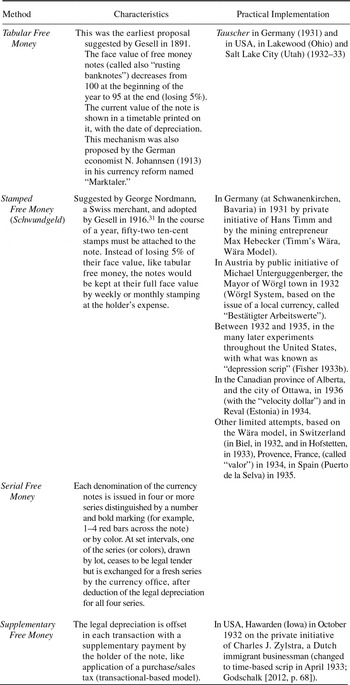
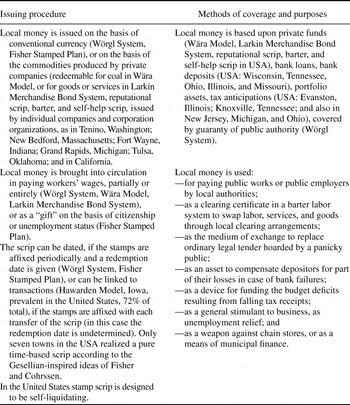
Different methods of applying the plan of free money are shown in tables 1 and 2. Footnote 30
Methods of Applying the Plan of Free Money

Sources: P. M. A. Pye, “Methods of applying the principle of Free-Money,” in Gesell (1958, pp. 445–447); Onken (1983); Hubert (2004, p. 107); Gatch (Reference Gatch2008); Godschalk (Reference Godschalk2012).
Characteristics of Stamp Plans Implemented (1930–1936)

Sources: Fisher (Reference Fisher, Cohrssen and Fisher1933b); Brown (Reference Brown1941); Mitchell and Shafer (Reference Mitchell and Shafer1984); Greco (Reference Greco2001); Gatch (Reference Gatch2004, Reference Gatch2006, Reference Gatch2008, Reference Gatch and Blanc2012); Hubert (Reference Hubert2004); Elvins (Reference Elvins and Blanc2012).
Only the stamped money scheme was implemented in practice, but these different projects were stopped by legal interdiction imposed by the national monetary authorities in Europe and in America. Footnote 33 All local projects terminated with the redemption of all the scrip money issued.
IV. FISHER ON THE “STAMPED MONEY” SOLUTION
In October 1929, two days before the Wall Street Crash, a headline in the New York Times proclaimed “Fisher Says Prices of Stock Are Low” (McGrattan and Prescott Reference McGrattan and Prescott2004, p. 991). This erroneous prediction by the eminent Yale economist Irving Fisher eclipsed his role as a theorist, and in the stock market crash he lost between $8 and $10 million, a “sizable sum, even for an economics professor” (Galbraith 1977, p. 192).
Fisher’s wrong prediction, based on the evidence of the value of intangible assets, and in particular on the great expansion of spending on scientific and technological research (McGrattan and Prescott Reference McGrattan and Prescott2004, p. 991), led to his isolation in the scientific community in the following decade.
The Great Depression focused Fisher’s attention on a new theoretical explanation of the economic cycle. The result of this research was the definition of the well-known new model of debt deflation, elaborated in 1932–33 (Assous Reference Assous2013).
According to Fisher, the crisis is caused by interaction between overindebtedness and a process of deflation. This interaction is summarized in a nine-step process.
Assuming, that, at some point of time, a state of over-indebtedness exists, this will tend to lead to liquidation, through the alarm either of debtors or creditors or both. Then we may deduce the following chain of consequences in nine links: (1) Debt liquidation leads to distress selling and to (2) Contraction of deposit currency, as bank loans are paid off, and to a slowing down of velocity of circulation. This contraction of deposits and of their velocity, precipitated by distress selling, causes (3) A fall in the level of prices, in other words, a swelling of the dollar. Assuming, as above stated, that this fall of prices is not interfered with by reflation or otherwise, there must be (4) A still greater fall in the net worths of business, precipitating bankruptcies and (5) A like fall in profits, which in a “capitalistic,” that is, a private-profit society, leads the concerns which are running at a loss to make (6) A reduction in output, in trade and in employment of labor. These losses, bankruptcies, and unemployment, lead to (7) Pessimism and loss of confidence, which in turn lead to (8) Hoarding and slowing down still more the velocity of circulation.
The above eight changes cause (9) Complicated disturbances in the rates of interest, in particular, a fall in the nominal, or money, rates and a rise in the real, or commodity, rates of interest. (Fisher Reference Fisher1933a, pp. 341–342; emphasis in original)
The essence of crisis dynamic is deflation, “the root of almost all evils” (Fisher Reference Fisher1932, p. 39). Repayment of banks and loss of confidence cause banks and the public to hoard cash, and consequently the velocity of circulation of money slows down, contracting the money supply without the monetary base having fallen (Dimand Reference Dimand1994, p. 98). “Hoarding, once introduced, becomes a tremendous factor in the vicious spiral, and can continue it with or without over-indebtedness. Hoarding lowers the price level. The lowered price level hurts business (debts or no debts); hurt business increases fear, and the fear increases the hoarding” (Fisher Reference Fisher1932, p. 36).
In the case of deflation, an increase in money supply, to replace money hoarded, might fail to raise the price level: “for a prompt boost of the price level, a mere increase in M [volume of money] might prove insufficient, unless supplemented by some influence exercised directly on the moods of people to accelerate V [velocity]—that is, to convert the public from hoarding” (Fisher Reference Fisher1932, p. 140).
In his Booms and Depressions (1932), Fisher proposed different policies designed to accelerate the velocity of money as the key to solving the crisis; in particular, the Yale economist focused his attention on the stamped money plan, considering it an “ingenious scheme” (Fisher Reference Fisher1932, p. 226). In a footnote, Fisher ascribed the paternity of the plan to Silvio Gesell, citing as his source an article on the Wära Model published by Hans Cohrssen, a young activist of the Freiwirtschaft movement, in The New Republic, a liberal American magazine (Cohrssen Reference Cohrssen1991, p. 825). Footnote 34
In the following years, Fisher became an active supporter of the stamped money plan. In collaboration with Cohrssen, the Yale economist published a handbook (Stamp scrip, Fisher Reference Fisher, Cohrssen and Fisher1933b, also with the collaboration of Fisher’s brother, Herbert Wescott) on the issue of stamp scrip, an emergency currency issued in the United States by cooperatives, associations, municipalities, companies, and ordinary citizens during the financial and economic crisis of the 1930s. Footnote 35 This experiment involved 450 communities, in particular Pennsylvania, which asked Fisher “to personally supervise the issuance of $100,000 of such scrip” (Cohrssen Reference Cohrssen1991, p. 826; see also Cohrssen Reference Cohrssen, Fisher, Cohrssen and Fisher1933, Reference Cohrssen and Suhr1989; Gatch Reference Gatch2004, Reference Gatch2006, Reference Gatch2008).
In Booms and Depressions, Fisher proposed the issue of special dollar bills, the reverse side of which was divided into twelve spaces, each the size of a one-cent postage stamp and each space dated on the first day of twelve consecutive months. One hundred of these special dollars would be given as a “gift” to each citizen, or confined to the unemployed, and utilized as legal tender. Each dollar bill required a one-cent stamp on it each month to preserve its status as legal tender. After all the twelve stamp spaces had been filled, the dollar bills could be redeemed by another of the same kind or by an ordinary dollar (Fisher Reference Fisher1932, pp. 226–227). “If the stamped dollar,” Fisher argued, “runs for nine years (108 months), the funds for this redemption will have already been provided to the government by the public in the 108 cents paid for the affixed stamp, with 8 cents in excess” (Fisher Reference Fisher1932, p. 227). If $100 were given to forty million people, this excess would amount in all to $320 million revenue for the government. So this plan would operate as a stamp tax on hoarding, because no holder would be likely to keep this special dollar more than one month for fear that it would cost him another stamp. The effect of this plan is the increase in the velocity as well as the quantity of money, and it would help solve two problems at once: unemployment and deflation (Fisher Reference Fisher1932, pp. 227–228).
In his handbook Stamp scrip, Fisher illustrates in detail the main characteristics of this instrument:
-
1. The scrip is an emergency issue, temporary (dated type), small in amount, and short in duration, redeemable in any form of legal tender (Fisher Reference Fisher, Cohrssen and Fisher1933b, ch. VII). Footnote 36
-
2. Despite its local implementation, a nationwide application is desirable, “still in quantities as small, proportionately to the size of the nation,” but with uniform typology based on the Wörgl System (time-based or hybrid form time/transaction; Fisher Reference Fisher, Cohrssen and Fisher1933b, ch. VII).
-
3. It is an instrument to increase the reduced volume of business caused by deflation (“the crux of the depression” (Fisher Reference Fisher, Cohrssen and Fisher1933b, ch. VIII).
-
4. It cannot raise the price level if confined to localities, because if prices try to go up in a locality, buyers will promptly forsake that locality (Fisher Reference Fisher, Cohrssen and Fisher1933b, ch. VIII).
-
5. It is an effective instrument of reflation; i.e., “degree of controlled inflation which is needed to compensate for recent, fast, and big deflation. Reflation is not inflation starting from the threshold and aiming at the sky—it is inflation starting at the bottom of the pit and aiming back at the threshold. It is a corrective process, like the turns of the steering wheel that keep you on the road” (Fisher Reference Fisher, Cohrssen and Fisher1933b, ch. VIII; Dimand Reference Dimand1994, p. 98). Footnote 37
In his subsequent book After Reflation, What? (Fisher Reference Fisher1934b), Fisher again assigns the major responsibility for stabilizing the price level to Federal Reserve monetary policy, within the analytical framework of the equation of exchange (Fisher Reference Fisher1934b, chs. 7, 8; Fisher Reference Fisher1934c; Patinkin Reference Patinkin1993, p. 22).
Fisher’s attempt to influence political decisions was fruitless (Allen Reference Allen1977) and his search for political support was illusory, and it was in fact the political powers that would soon call a halt to the experiment of stamped money in the United States and in Europe. Footnote 38 His scientific isolation certainly contributed to the fact that the reform project fell into oblivion (Dimand Reference Dimand1994, p. 93). Footnote 39
Indeed, Fisher’s reflation policy was in contrast with the subsequent literature that, on the contrary, saw deflation as a stabilizing mechanism, strongly influenced by the Pigou effect or real balance effect. According to Arthur Cecil Pigou, deflation, by increasing the real value of wealth, stimulates consumption and aggregate demand (Pigou Reference Pigou1943). Pigou’s approach emphasized the gains of the creditors, while Fisher’s argument focused on the losses of the debtors (Gotz 2005, p. 5). This hypothesis, reinforced by Don Patinkin (1948, 1965), became a relevant argument in the neoclassical synthesis, favoring rehabilitation of the classical “self correcting” mechanism.
Debt-deflation theory was largely ignored until it was revisited and re-evaluated by James Tobin (Reference Tobin and Tobin1980), another Yale economist. Footnote 40
Irving Fisher had reached a diagnosis precisely the opposite of Pigou’s. Fisher thought that reflation, not deflation, was the remedy. He was struck by the increased burden that lower prices imposed on debtors-corporations, proprietors, home-owners, farmers. Debt squeezes, defaults, and bankruptcies, he thought, intensified and spread the slump in economic activity. He urged measures—monetary expansions, devaluation, marking up gold prices—designed to restore commodity prices to pre-Depression levels. For Fisher in 1932–3, more even than Keynes in 1936, raising prices was a step indispensable to recovery, not just an incidental byproduct of other measures. (Tobin Reference Tobin and Tobin1980, p. 9)
According to Tobin, Fisher’s debt deflation dominates Pigou’s wealth effect, because the propensity to spend is higher for debtors than for creditors, “even by a small amount” (Tobin Reference Tobin and Tobin1980, p. 10). Footnote 41 Moreover, the drop in prices, reducing the value of capital stock and equity, makes consumption and investments less attractive (Tobin Reference Tobin1975).
Deflation is an intensifier of depressions rather than the cure for recessions and depressions, as shown in the Pigou effect:
Deflation in real time—unless engineered by governmental fiat rather than by markets—may generate expectations of further deflation. Now expected deflation increases the demand for money, making it more attractive relative to others’ assets, particularly to goods and equities in goods. This effect counters the price level effect and may be stronger. If so, deflation does not correct the initial deficiency in aggregate demand that triggered it. The deflation has no stopping point. The symmetrical case is hyper-inflation, in which the velocity of money rises astronomically. (Tobin Reference Tobin and Tobin1980, p. 18; emphasis in original)
Tobin reconsidered Fisher’s debt-deflation theory at the beginning of the 1980s, disapproving of the disinflation policies adopted in the United States and United Kingdom (Tobin Reference Tobin and Tobin1983, p. 297). According to Tobin, in times of unexpected disinflation and high rate of interest, the real burden of debt increases, causing underproduction and unemployment, as Fisher’s theory shows. Footnote 42
This “Yale approach” to deflation is further developed by Hyman Minsky (Reference Minsky1982), who explores the role of asset price, focusing the effect of financial distress on asset prices, price level, and aggregate spending. Footnote 43 Distress selling to raise money for repaying debt reduces asset prices on financial markets, and the resulting losses exacerbate the level of indebtedness, causing further distress selling (von Peter 2005, p. 6). Footnote 44
Another variant of the debt-deflation theory was developed by Ben Bernanke (Reference Bernanke1983), who focuses his contribution on the connection between debt deflation and widespread bankruptcy. Footnote 45 According to Bernanke, borrower default and bank runs raise the costs of financial intermediation, causing a credit contraction; thus, the debt crisis is “added to the banking crisis as a potential source of disruption of the credit system” (Bernanke Reference Bernanke1983, p. 267). The credit contraction depresses aggregate demand, further protracting the economic depression (Bernanke Reference Bernanke1983, p. 257).
Subsequent to the financial crisis of 2008 and the resulting recession, these arguments against deflation have no longer been only theoretical: as chairman of the Federal Reserve, Bernanke has operated on the presupposition that price deflation and depression are strictly linked, and his monetary policy has been designed to avoid the vicious cycle of deflation, using unconventional tools such as the quantitative easing program, already experimented with in Japan. Footnote 46
V. KEYNES’S CRITICISM
In chapter XIII (paragraph VI) of The General Theory of Employment, Interest and Money, Keynes recognizes that the theory of this “strange, unduly neglected prophet” contains “flashes of deep insight ... [but he] only just failed to reach down to the essence of the matter” (Keynes Reference Keynes1936, p. 353). Gesell’s main work, The Natural Economic Order, according to Keynes, “is written in cool, scientific language; though it is suffused throughout by a more passionate, a more emotional devotion to social justice than some think decent in a scientist” (Keynes Reference Keynes1936, p. 355).
In Keynes’s opinion, Gesell’s main contributions to the theory of money and interest are as follows (Keynes Reference Keynes1936, pp. 355–357):
-
1. There is a clear distinction between the rate of interest and the marginal efficiency of capital.
-
2. The interest rate sets a limit to the growth rate of real capital. This brake has to be removed, allowing an unlimited expansion of real capital with a zero money rate of interest.
-
3. The interest rate is a purely monetary phenomenon.
-
4. The peculiarity of money as a means of storing wealth entails negligible carrying charges, unlike a stock of commodities.
-
5. The rate of interest, unlike most commodity rates of interest, cannot be negative.
In spite of these merits, Keynes argues, Gesell “has constructed only half a theory of the rate of interest” (Keynes Reference Keynes1936, p. 355), because he does not prove why the money rate of interest is positive, and “he fails to explain why the money-rate of interest is not governed (as the classical school maintains) by the standard set by the yield on productive capital” (Keynes Reference Keynes1936, p. 356).
These shortcomings in Gesell’s theoretical contribution, according to Keynes, are the result of his failure to grasp the notion of liquidity preference (Keynes Reference Keynes1936, p. 356). Indeed, for Keynes, Gesell’s theory is limited to the liquidity premium attached to money, overlooking the fact that “money was not unique in having a liquidity-premium attached to it, but differed only in degree from many other articles, deriving its importance from having a greater liquidity-premium than any other article” (Keynes Reference Keynes1936, p. 357; emphasis in original). Footnote 47
This difference between Gesell and Keynes on the liquidity preference is an important analytical point.
For Keynes, the propensity to hoard money (or the state of liquidity preference) depends on uncertainty about the future. Footnote 48 It is the characteristic of money as a store of wealth, usually overlooked, that offers a shield against fear of uncertainty. Changes in the rate of interest affect the propensity to hoard, because “[t]he rate of interest measures—just as the books on arithmetic say it does—the premium which has to be offered to induce people to hold their wealth in some form other than hoarded money (Keynes Reference Keynes1937, p. 216).
In Gesell’s theory, the function of money as a store of wealth is completely unheeded (“money was not made to be saved!” [Gesell 1958, p. 248]), and the propensity to hoard money is not caused by uncertainty about the future, but only by deflation, which, on the market, reduces or annuls the premium required by the money holder to forgo liquidity. For Gesell, it is the changes in the price level, and not the variation of interest rate, that affect the propensity to hoard. The relation between interest and money is superficially sketched in the concept of “desire of money,” the exchange of future money for present money (Gesell 1958, pp. 204–205), which, according to Gesell, does not represent demand for money.
Keynes’s criticism of Gesell’s theoretical contribution can be explained on the basis of different hypotheses on the nature of money. Gesell shared the mainstream approach according to which money is primarily a medium of exchange, while Keynes argued the “money of account comes into existence along with debts, which are contracts for deferred payment, and price lists, which are offers of contracts for sale or purchase … [and] can only be expressed in terms of a money of account” (Keynes 1930, p. 3; see also Wray 2006, p. 11).
For this different conception of money, extraneous to the commodity money approach, Keynes definitively rejects the quantity theory, which, on the contrary, constitutes a central element in Gesell’s theoretical system. According to Keynes, as we know, the equation of exchange MV=PT, though formally correct, does not explain that the determination of the level of prices occurs in the sphere of production. In the General Theory, Keynes definitively rejects the link between money supply and price level, establishing a new, more complex relation between monetary wages, production level, and prices (Keynes Reference Keynes1936, chs. XIX, XXI). These significant theoretical differences account for Keynes’s marked skepticism regarding Gesell’s policy proposals.
Keynes criticizes the measure of reflation, because he considers that the velocity of money depends on “many complex and variable factors” (Keynes Reference Keynes1936, p. 299), Footnote 49 and, at any rate,
an increased income-velocity of money may be a symptom of a decreased liquidity-preference. It is not the same thing, however, since it is in respect of his stock of accumulated savings, rather than of his income, that the individual can exercise his choice between liquidity and illiquidity. And, anyhow, the term ‘income-velocity of money’ carries with it the misleading suggestion of a presumption in favour of the demand for money as a whole being proportional, or having some determinate relation, to income, whereas this presumption should apply, as we shall see, only to a portion of the public’s cash holdings; with the result that it overlooks the part played by the rate of interest. (Keynes Reference Keynes1936, p. 194; emphasis in original)
Moreover, if expectations remain pessimistic, a considerable part of the new money issued may be held as an inactive balance.
In the end, although the theory underlying the stamped money plan is correct, Footnote 50 Keynes argues that Gesell’s suggestion of an actual charge equivalent to 5.2% per annum is not feasible because it is too high “in existing conditions” (Keynes Reference Keynes1936, p. 357). According to Keynes, the correct application would be found by trial and error, implemented on a limited scale, and “it should be roughly equal to the excess of the money rate of interest (apart from the stamps) over the marginal efficiency of capital corresponding to a rate of new investment compatible with full employment” (Keynes Reference Keynes1936, p. 357).
Despite these differences, there are several important affinities between Keynes and Gesell on the nature of monetary economy. With Gesell, Keynes shares the following opinions:
-
1. Money has an elasticity of substitution nearly equal to zero: “as the exchange value of money rises there is no tendency to substitute some other factor for it” (Keynes Reference Keynes1936, p. 231).
-
2. The utility of money “is solely derived from its exchange-value” (Keynes Reference Keynes1936, p. 231).
-
3. Money has low (or negligible) carrying costs (Keynes Reference Keynes1936, p. 233; Suhr 1989; Darity Reference Darity1995). Footnote 51
-
4. Crisis is caused by the dominance of demand for money stock (inactive funds) that stops the flow of money (active funds) and keeps the economy stagnant.
VI. CONCLUSIONS
Silvio Gesell, generally tagged as a typical monetary “crank” and derided as a proponent of economic absurdity (Allais Reference Allais and Sills1968, p. 481), had no marginal role in the evolution of monetary theories during the 1930s, and his main proposal of negative nominal interest has received widespread attention.
Re-examination of Gesell’s analytical contribution from the point of view of commodity money approach and the quantity theory shows the elements of affinity with mainstream theory, and in particular with Irving Fisher.
Indeed, Fisher’s theoretical analysis of crisis and his policy conclusions (explained in the debt-deflation theory) are convergent with those outlined by Gesell (whom Fisher called a “quasi economist” [Fisher Reference Fisher, Cohrssen and Fisher1933b, p. 17]); this is one of the few cases in the history of economic thought in which a policy proposed by an outsider economist is accepted by a notable member of the academic establishment.
This convergence between Gesell and Fisher is determined by the substantial analytical affinity regarding the common framework of the quantity theory, although Fisher rejects Gesell’s theory of interest, Footnote 52 and totally neglects the separation of the function as instrument of exchange from the function as store of value, the main theoretical nucleus of Gesell’s thought.
On the basis of this same theoretical approach, both stress the deflationary character of the crisis and propose as a feasible solution a measure of reflation with an increase in money supply and velocity of circulation (Cot Reference Cot2013). For Fisher, as for Gesell, adoption of a reflation policy to restore the price level to its pre-Depression level was the decisive remedy, and the stamp scrip proposed would constitute immediate purchasing power to reactivate the circuit of exchange as a temporary device to overcome the crisis. Like Gesell, Fisher “was an apostle of managed money” (Allais Reference Allais and Sills1968, p. 476).
This affinity between Fisher and Gesell has been neglected by historians of economic thought, the focus of research on Gesell being concentrated on the relationship with Keynes, in an attempt to stress theoretical affinities. Footnote 53 However, despite these similarities, two main features of Gesell’s thought—the nature of money as a medium of exchange and the quantity theory—are totally extraneous to Keynes’s monetary theory.
Moreover, rejecting quantity theory, Keynes showed marked skepticism regarding the measure of reflation, and subsequent Keynesian literature (particularly the neoclassical synthesis) considered deflation a stabilizing mechanism, strongly influenced by the Pigou effect or real balance effect. Only at the beginning of 1980s did the Keynesian James Tobin reconsider Fisher’s debt-deflation theory, to contrast disinflation policies adopted in the United States and United Kingdom. This reconsideration implicitly rehabilitates Gesell’s contribution, within the Keynesian approach.
These various connections with two, opposing, theoretical approaches (Fisher’s and Keynes’s) undoubtedly show the (neglected) centrality of Gesell’s monetary thought during the Great Depression. Footnote 54
In the current recession, monetary policy, with ample theoretical consensus, has been designed to avoid the vicious cycle of deflation, using unconventional tools.
For the present economic crisis with a liquidity trap and low or even negative interest rates, it could be possible to actualize Gesell’s old-fashioned stamp scrip by applying modern digital technologies (Goodfriend Reference Goodfriend2000; Buiter Reference Buiter2009). And, in view of the ecological crisis, it may also be worth ascertaining where Gesell’s money and land reform theory could be helpful in developing solutions to these problems (Löhr Reference Löhr2012, Reference Löhr2014). Footnote 55