1. INTRODUCTION
In the early morning of 28 February 2015, the container ship Maersk Garonne made her approach to the Port of Fremantle, Western Australia. The local maritime pilot who had joined the ship ordered full speed ahead and reported the ship's position to the Vessel Traffic Services (VTS). In further communication between the pilot and VTS, berthing arrangements and tug assistance were also confirmed. To coordinate the ship's approach with the arriving tugs, the pilot advised the tug masters that he intended to delay the ship by passing outside the first fairway buoy – contrary to convention. This intention, which would position the ship outside of the fairway, was queried by the ship master and the chief officer who had overheard the pilot's communication with the tug masters. As the manoeuvre nevertheless progressed, the ships’ crew further alerted the pilot to the presence of shallow water. A few minutes later the vessel ran aground. Following several unsuccessful attempts by the pilot to re-float the ship, VTS was informed of the incident and asked to arrange additional tug assistance and a relief pilot.
This event, reported by the Australian Transport Safety Bureau (ATSB, 2015), illustrates some of the issues related to teamwork in the Maritime Traffic System (MTS). Although maritime accidents are rare, teamwork has been identified as an area of concern and reports suggest there is room for improvement. The basis for any attempt to improve safety should, according to Hollnagel (Reference Hollnagel2014), be an understanding of how everyday activities are performed. The aim of this current study, which is the initial part of an ongoing research project, has therefore been to explore the topic and get an insight into the everyday activity of navigating and manoeuvring ships in port waters. To get such an insight, the perceptions of ship masters, maritime pilots, tug masters and VTS operators active in Australia have been probed through qualitative research interviews. A conceptual framework based on Clark's (Reference Clark1996) work on joint activity has been used to guide the study.
2. BACKGROUND
The MTS is a complex sociotechnical system involving people of different nationalities, who speak different languages, with different social and professional backgrounds. They often have limited experience working together, they are geographically dispersed, and they rely on technology to interact with each other and to get information on what is going on. The MTS is also a dynamic and safety-critical system, often characterised by the presence of uncertainty and disturbances. All of these features add to the system complexity (Vicente, Reference Vicente1999), not least when navigating and manoeuvring ships in port waters. Key participants involved in this activity are the ship master, the maritime pilot, the tug master, and the VTS operator.
-
• The ship master is the commander of a ship and ultimately responsible for its safe navigation. In order to establish common standards of competence for ship masters and other seafarers, the International Maritime Organization (IMO) has adopted the Convention on Standards of Training, Certification and Watchkeeping for Seafarers (STCW) (IMO, 2011). The STCW require ship masters on large vessels to, for example, have knowledge about the Collision Regulations (COLREGs) (IMO, 2003) and be able to understand and use Standard Marine Communication Phrases (SMCP) (IMO, 2002).
-
• The maritime pilot is often described as a person with local knowledge who provides guidance to the ship master. It is a regulatory requirement in many ports for ships to employ a local pilot, and the pilot may navigate and manoeuvre the ship once on board. A pilot does not, however, relieve the ship master from the responsibility for the safe navigation. Although the IMO recommends governments implement pilotage services where they would contribute to the safety of navigation (IMO, 1968), the IMO is not involved in the certification or licencing of pilots or with the systems of pilotage in various countries (IMO, 2004). Instead this is dealt with on a national, regional, or local basis.
-
• The tug master operates a tug – a powerful vessel predominantly used to expedite the progress of another vessel (Kovats, Reference Kovats1980). It is often compulsory for ships to employ one or more tugs when entering or leaving a port in order to enable the ship to be manoeuvred as required. As tugs are often limited in size and in trading area, the standards of competence of tug masters are not always covered by international conventions such as the STCW.
-
• VTS are shore-based systems implemented by a Competent Authority to improve safety and efficiency of vessel traffic and to protect the environment (IMO, 1997). The IMO has established general principles for VTS, though more comprehensive recommendations and guidelines for VTS are provided by the International Association of Marine Aids to Navigation and Lighthouse Authorities (IALA). These recommendations and guidelines state, for example, that the VTS operator is “responsible for establishing and maintaining a vessel traffic image, which will facilitate interaction with the vessel traffic thus ensuring the safety of navigation” (IALA, 2012, p. 97).
Previous studies have highlighted issues related to teamwork in the MTS. Major safety concerns were raised in the United States following a number of maritime disasters, which led to a comprehensive assessment of the state of ship navigation and piloting practices. The report of this assessment (National Research Council, 1994) describes how local pilots are increasingly relied upon due to an uncertainty of the proficiency among foreign seafarers. However, concerns regarding the pilots’ qualifications and professional development, and regarding the inconsistent implementation and provision of pilot services, are also raised. The report furthermore describes how the lack of a formalised organisational structure for interdependent decision-making, for example between ships and between ship and shore, can make coordination in the MTS difficult. As a means to facilitate coordination and hence improve safety, the authors of the report suggest further implementation of VTS. Equally concerned by the frequency and potential consequences of issues related to teamwork in the MTS, the Transportation Safety Board of Canada (TSB, 1995) carried out a study of the relationship between seafarers and pilots. The recurring misunderstandings, lack of communication, and lack of coordination was found to be intimately linked to maritime accidents and incidents. These problems were concluded to be “symptomatic of more profound issues with bridge practices” which “frequently reflect an absence of teamwork” (TSB, 1995, p. 31).
More recently, in their study of maritime pilots and VTS operators, Lutzhoft and Bruno (Reference Lutzhoft and Bruno2009) uncovered problems with communication and trust. They suggest there is a lack of common ground in terms of the role of different team members, what skills and competencies they have, and in the use of language and phraseology to communicate. Consequently, they argue, this leads to the inability to predict each other's actions, and hence to coordinate. Lutzhoft and Bruno (Reference Lutzhoft and Bruno2009) call for further research on how common ground between ship and shore can be created and supported, emphasising that focus should be on the humans rather than on the technology. Brodje et al. (Reference Brodje, Lundh, Jenvald and Dahlman2012) found informal hierarchies to be a strong element among participants in the MTS. Issues regarding roles and responsibilities as well as the existence of distrust were also found to be sources of complications. These authors discuss the maritime team as “dysfunctional” or even a “non-existent team construct” (Brodje et al., Reference Brodje, Lundh, Jenvald and Dahlman2012, p. 355), and recommend further research focused on understanding and defining the different roles involved in the MTS. Similarly, Norros (Reference Norros2004) suggests further research aimed at understanding maritime pilots’ core task, while Praetorius (2012) recommends further research into the role and the purpose of VTS.
Recognising these issues, a number of interventions have been implemented. The International Safety Management (ISM) Code (IMO, 2010), for example, addresses some of the issues with roles and responsibility and the ability to communicate, and the STCW now requires seafarers to be trained in leadership and teamwork. Several other organisations, such as the insurance providers UK P&I Club (2015) and North P&I Club (2015), have also issued guidelines and recommendations related to teamwork during navigation and manoeuvring in port waters. This calls attention to the ongoing character of the issues related to teamwork in the MTS and the need for further research. It also highlights the wide-ranging nature of the issues. To help clarify how everyday activities are performed in the MTS, a conceptual framework has been used to guide this study.
3. CONCEPTUAL FRAMEWORK
‘People doing things together’ has been the focus of much research and discussion. Weber (Reference Weber1947), for example, describes ‘social actions’ as those where an acting individual (or individuals) takes account of, and is oriented to, the behaviour of others. Cohen and Levesque (Reference Cohen and Levesque1991) discuss teamwork as jointly performed actions and activities where “a group acts more like a single agent with beliefs, goals, and intentions of its own, over and above the individual ones” (p. 487). Salas et al. (Reference Salas, Dickinson, Converse, Tannenbaum, Swezey and Salas1992) define a team as “a distinguishable set of two or more people who interact dynamically, interdependently and adaptively toward a common and valued goal/objective/mission, who have each been assigned specific roles or functions to perform, and who have a limited life span of membership” (p. 4). Malone and Crowstone (Reference Malone and Crowstone1994) discuss how actors can work together harmoniously and coordinate by “managing interdependencies between activities performed to achieve a goal”. Concepts such as the Team Mental Model; mental representations of relevant elements which are shared across team members (Klimoski and Mohammed, Reference Klimoski and Mohammed1994), and Team Situation Awareness; the overlap of team members’ perception, comprehension, and projection of relevant elements (Endsley, Reference Endsley1995), have frequently been referred to in studies on teamwork.
In this study, however, we view teamwork in light of, and base our conceptual framework on, Clark's (Reference Clark1996) work on joint activity. While no single model or theory is likely to provide a complete account of how ‘people do things together’, many of the concepts commonly identified in research and discussions related to teamwork are encompassed in Clark's work.
Clark argues that when people have a common goal and their actions are interdependent, they have to coordinate to reach that goal. What emerges when people act in coordination with each other, Clark calls joint actions and joint activities. Joint actions are individual actions intended to be performed in coordination with someone. For example, two people paddling a canoe perform individual actions in coordination with each other and what emerges is a joint action. In contrast, autonomous actions are individual actions performed without the intention to coordinate. For example, a person paddling a kayak. A sequence or hierarchy of joint actions form a joint activity. For example, a pair of people performing a sequence of joint actions by paddling a canoe from one place to another.
Joint activities are carried out by participants in particular roles that help shape what each does and is understood to be doing. Participants’ roles may, however, change between different activities or as the nature of the joint activity becomes clear. Although they participate to achieve a certain dominant goal, participants often also pursue other goals such as procedural, interpersonal, and private goals. It is however the public goals, those which are openly recognised by all participants, that define the joint activity. What is required to coordinate then, Clark argues, is common ground of the participants. Clark describes the concept of common ground as the sum of people's “mutual, common, or joint knowledge, beliefs, and suppositions” (Clark, Reference Clark1996, p. 93). Common ground divides into three parts; initial common ground (presuppositions when entering the joint activity), current state of the activity (presuppositions of what is occurring at the moment), and public events so far (presuppositions of what have occurred so far).
As people cannot always know what is common ground, what they act on is what they believe is common ground. The fundamental representation of common ground is therefore, according to Clark, a shared basis for that belief. Clark describes two types of shared bases for common ground; the first type concerns evidence about the cultural communities people belong to, such as their nationality, profession, or language. This evidence is used as a basis for inferring what they know, believe, or assume, and leads to communal common ground. The second type concerns evidence from people's direct personal experiences with each other, such as joint perceptual experiences or joint actions, and leads to personal common ground. These shared bases are according to Clark what enables people to coordinate. They can for example be a convention (a regularity in behaviour), an explicit agreement, a precedent, or anything which is salient, prominent, or conspicuous with respect to the participants’ current common ground. Such bases Clark calls coordination devices.
Although Clark uses conversation as the prime example, his work is relevant to any joint action or joint activity. It has for example been applied to understand collaborative work in air traffic control (Fairburn et al., Reference Fairburn, Wright and Fields1999) and to explore maritime communication between ship and shore (Kataria and Praetorius, Reference Kataria and Praetorius2014). Clark's work has also been used in the Computer Supported Collaborative Work Domain (Gutwin and Greenberg, Reference Gutwin and Greenberg2002) and in the Human Computer Interaction Domain (Monk, Reference Monk and Carroll2003). Furthermore, Klein et al. (Reference Klein, Feltovich, Bradshaw, Woods, Rouse and Boff2005) applied their interpretation of Clark's work to activities including team sports and driving in traffic. Their interpretation was also applied in an account of challenges in joint human-agent activity (Klein et al., Reference Klein, Woods, Bradshaw, Hoffman and Feltovich2004).
4. METHODS AND PROCEDURES
Given that people act on what they believe is common ground to coordinate with each other (Clark, Reference Clark1996), the perceptions of participants are important in order to understand a joint activity. In this current study, qualitative research interviews were conducted to probe the perceptions of ship masters, maritime pilots, tug masters and VTS operators. Qualitative research interviews attempt to understand the world from the subjects’ perspective and allow them to describe their activities, experiences and opinions in their own words (Kvale, Reference Kvale1996). While traditionally being conducted in individual form, the interaction among subjects in group interviews may bring forth more spontaneous views and give better access to views on sensitive topics (Brinkmann and Kvale, Reference Brinkmann and Kvale2015). Both individual and group interviews were used in this study. Additionally, an interactive polling tool was used in one of the group interviews. This allowed subjects to respond to questions anonymously via a smartphone in real time. Responses were then instantly displayed on a screen which served as a basis for further discussion without singling anyone out for raising a sensitive issue.
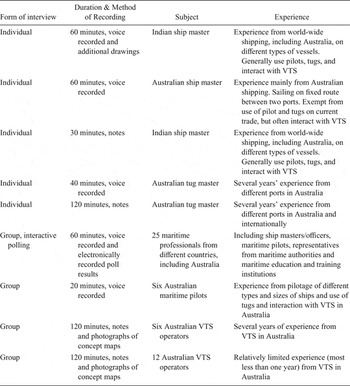
Data was collected on nine occasions with a total of 54 subjects, as outlined in Table 1. All responding shipmasters were certified in accordance with STCW and the pilots and tug masters were certified in accordance with national requirements. The VTS operators were all working within organisations which publically promulgate that they operate a VTS. According to the Australian Maritime Safety Authority (AMSA), the Competent Authority for VTS in Australia (AMSA, 2013), none of these organisations were however, at the time of the data collection, authorised to provide VTS (AMSA, 2015). Moreover, less than half of the responding VTS operators were actually certified in accordance with IALA recommendations and guidelines.
Data collections

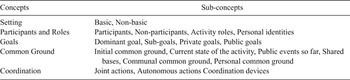
The topics discussed during the interviews were based on the concepts outlined in Table 2. Sub-concepts were used as a guide for follow-up questions with some prompts given where required. Rather than strictly predetermined and binding questions, the concepts provided an outline for the interviews. Transcripts, notes, polling responses and other collected material were qualitatively analysed. An initial step of analysis took place during the interviews where subjects described their view of the topic and were asked for clarification to confirm the interviewer's interpretations of what was said. This step also helped in highlighting multiple views or possible contradictions. The main analysis was carried out when the data had been transcribed; the procedure was to code the transcripts’ and other materials’ content into categories based on the concepts in Table 2.
Concepts and sub-concepts used to guide the study, based on (Clark, Reference Clark1996).

As a means to address potential issues related to credibility, member checks were carried out. In these member checks the results of this study were tested with members of the groups of stakeholders from which the data was collected. Informally this was continuously done through conversations with various maritime professionals during the course of the study. Formally it was done by inviting four maritime professionals to read the results of this study and provide comments regarding factual and interpretative accuracy. These comments were taken into consideration before completion of this paper.
5. RESULTS AND DISCUSSION
The results obtained through the qualitative analysis are presented and discussed by category as outlined in Table 2. Following this, methodological and theoretical considerations are also provided.
5.1. Setting
Generally, the ship master and maritime pilot interact with each other in a basic face-to-face setting. They share the same physical environment, can see and hear each other, and perceive each other's actions without delay. Additionally, their language fades quickly and they can produce and receive language simultaneously. They do however lack one feature of a basic face-to-face setting; the ability to take actions which leave no record or artefacts. Today most ships are equipped with a Voyage Data Recorder which collects data from various sensors on board, including voice recordings. Being recorded has, according to Clark, far-reaching effects on how people proceed with their actions. This was also the perception of subjects in this study. One pilot, for example, stated that you must watch what you say on the bridge as it is recorded and can later be used ‘against you’.
Tug masters lack some of the features of a face-to-face setting when interacting with other participants in the MTS. It was noted that communication via Very High Frequency (VHF) radio could be challenging as the sound quality was often poor. It was further described that in order to hear the pilot's directions on one VHF channel, tug masters often had to turn down the volume on the channel used by VTS. Although the tug master is not co-located with the ship master and the pilot, they do share some aspects of the same setting. They can for example all sense what the local traffic or weather conditions are without having to rely on technology.
VTS operators interact with the other participants in a setting which lacks many of the features that characterise a face-to-face setting. Located ashore they are often far from the ship and cannot see or hear the other participants and their surroundings without interference. As on board a ship, VTS operators’ actions are also often recorded. Two VTS operators described how they had been confronted by superiors who had reviewed the recordings. This made them feel uncomfortable and had prompted them to proceed more cautiously. Another matter discussed by five VTS operators was that they regularly used mobile phones to communicate with pilots as it offered better sound quality than VHF radio. It was also stated that the mobile phone allowed for more natural conversation and has fewer interruptions.
Clark describes the face-to-face setting as the basic and primary setting for language use. This setting is universal to human societies and when any of its features are missing the joint activity becomes more complex and people have to apply special tools and procedures to interact. In the MTS, as the setting ranges from basic to non-basic, special tools and procedures, such as VHF radio and SMCP, are provided. However, participants perceive that some of these aids are not always satisfactory and hence employ tools and procedures beyond those provided, such as mobile phones. In some instances this may lead to unexpected or undesired outcomes by for example cutting certain participants out of the loop, with the effect of further complicating the joint activity.
5.2. Participants and Roles
The joint activity of navigating and manoeuvring ships in port waters was generally considered to commence and end when the pilot embarked or disembarked the ship. Most subjects also considered the pilot to be the only actor who remained a participant during the whole activity. Pilots were furthermore perceived by the other participants as having a great deal of power, and both the tug masters and VTS operators considered the pilot to be the leader of the joint activity. One ship master described how the pilot could potentially make the passage, or one's career, very difficult. If a ship master disagreed with the pilot, the pilot could, according to the subject, refuse to pilot the ship and hence make it impossible/illegal to continue the passage. It was therefore considered very important to ‘keep the pilot happy’. The authority of the pilot and importance of keeping the pilot happy was also emphasised both by the majority of VTS operators and by one of the tug masters.
Ship masters were considered to vary in their level of participation in the joint activity. For example, two pilots described how ship masters were often unable or unwilling to participate actively and sometimes withdrew from the bridge to attend to administration or to rest. On the other hand, one ship master described how he sometimes felt excluded from the joint activity by pilots, tug masters and VTS operators. He described how the pilots, tug masters, and VTS operators often directed their communication only to each other, using local terminology and sometimes did not consult the ship master before making decisions.
The role and responsibility of the tug master was perceived to be clear; they ensured they were available and did as directed by the pilot. Some VTS operators did note that there could sometimes be a problem as the tug masters often stayed on stand-by at home between jobs and could be difficult to contact. There was limited possibility for VTS operators to know if the tug masters were aware, ready or on time for their next job, and in some ports tug masters did not report to VTS when navigating in the port waters. This was perceived as limiting in terms of the ability to coordinate.
Both pilots and tug masters generally described the role of VTS operators as largely administrative, and in the service of the port. One particularly important responsibility of VTS operators, discussed both by pilots and by VTS operators themselves, was to deal with ship agents and ship operators. This view was contrasted by that of two ship masters and two pilots who said the role of VTS in Australia was different from other places in the world and often not in accordance with international recommendations and guidelines. Three VTS operators explicitly agreed with this view. The level of participation of VTS operators was also perceived to vary. One issue discussed was that although the VTS operator may monitor the ship and thereby participate in the activity, other participants could not be certain this was the case. Instead they may believe the VTS operator was busy monitoring another ship or with administrative work. The majority of subjects highlighted that the role of VTS was unclear, or in their responses demonstrated that they had differing perceptions of what VTS operators did, or should be doing.
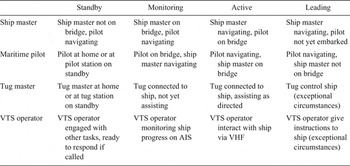
Based on the results obtained it appears that the role of participants in the MTS, with the exception of the tug masters, often differs from that prescribed in rules and procedures. It also appears that the level of participation of different participants varies. It is not simply a case of participants being in or out of the loop, as some participants may be on standby until they need to be actively involved. The challenge lies in the fact that participants are sometimes uncertain of each other's level of participation hence coordinating expectations becomes more difficult. For example, a VTS operator may be on standby, or monitoring the joint activity, with other participants being uncertain of which. The ship master may assume the VTS operator is monitoring the activity and expect them to provide warning of potential hazards while in fact the VTS operator may be on standby, unaware of the ship's situation. Table 3 provides working concepts suggested by the authors of this paper to indicate level of participation. These concepts and the examples given are derived from the analysis of the results obtained.
Level of participation in the joint activity; stand-by, monitoring, active, or leading.

5.3. Goals
There was a consensus among subjects that the dominant goal of the joint activity was to ensure the ship gets from one position to another, and that this should be achieved as efficiently as possible without compromising safety. It was also a perception among subjects that participants other than themselves often had private sub-goals. For example, ship masters, tug masters, and VTS operators had the perception that maritime pilots often wanted to get the job done as fast as possible so they could go home. In contrast, there was a perception among pilots and VTS operators that in order to be efficient, ship masters often wanted to get the job done with as few expenses as possible; for instance by minimising the use of tugs, linesmen and pilots. VTS operators themselves discussed efficiency in yet another manner and framed it in terms of maintaining the schedule and minimising potential conflicts with ship agents and ship operators.
In terms of interpersonal goals, several pilots and VTS operators mentioned the importance placed by some ship masters on ‘saving face’. One pilot and one VTS operator with a seafaring background described how ship masters sometimes chose to withdraw from the bridge rather than to submit to the pilot. They believed some ship masters felt humiliated by being directed by the pilot and that it sometimes disturbed the social harmony on board. This social harmony was perceived to be valued highly; sometimes at the expense of raising issues that could disturb it. The majority of VTS operators felt they had to pursue multiple conflicting goals simultaneously, for example placing the commercial interests of one key ship operator above another while at the same time maintaining the schedule and complying with rules and procedures without compromising safety. Some described this as ‘daunting’ and ‘overwhelming’. When asked to describe their everyday work, no VTS operator spontaneously mentioned any task related to monitoring and interacting with ship traffic before being explicitly asked by the interviewer. As monitoring and interacting with ship traffic is a primary task for VTS operators according to international recommendations and guidelines, this result is considered significant.
Based on the results obtained, it appears there is a consensus on the dominant goal of the joint activity. Participants also have sub-goals, one of which is to be ‘efficient’, though efficiency had different meanings for different participants. This is important to recognise in order to avoid a mismatch of expectations. Similarly, goals that are not openly recognised by all participants, for instance certain interpersonal goals such as the ship master's wish to ‘save face’, pilots’ desire to go home or VTS operators’ commercial obligations, can also lead to discrepant expectations. This is noteworthy since expectations of each other's actions are fundamental for coordination and joint activity.
5.4. Common Ground
Nationality was used as a basis for assumptions about each other. People of certain nationalities were perceived to be more competent than others; with competency, or expectations thereof, used as a basis for perceptions of common ground. This view was expressed explicitly by more than a third of the subjects. For example, one pilot described nationality as a more accurate predictor of a ship master's competence than a certificate issued in accordance with STCW. Furthermore, one ship master described how the competence of VTS operators differed significantly between countries with some being well trained, often with maritime experience, and others having little training and no maritime experience. The same ship master stated he did not trust VTS operators unless he knew they were competent. Similar concerns regarding VTS were raised in all data collections including those with VTS operators themselves. At least four VTS operators explicitly said that their VTS was not able to provide the service expected in accordance with international guidelines and recommendations. Another ship master noted how maritime pilots were traditionally recruited among experienced ship masters but that increasingly both less experienced seafarers and ex-navy personnel, with no commercial maritime experience, were being recruited. According to the ship master, these pilots often lacked particular inside information which was generally acquired through extensive experience from commercial ships in world-wide trade with multicultural crews. Similar observations regarding inexperienced pilots were also made by a VTS operator and a tug master. Given both STCW and VTS were established to achieve international harmonisation – to provide initial common ground and a basis for expectations, it is noteworthy that these conventions are perceived by the subjects to be poor evidence of common ground.
English proficiency was also used as a basis for expectations regarding competency. One pilot said ship masters who spoke English well were more likely to be competent. Similarly, a VTS operator said that the master of a ship who spoke poor English was assumed to be less competent and reliable than one who spoke English well. Another VTS operator noted how the service level could sometimes be adapted depending on a ship masters’ English proficiency for example by allowing more time for communication and by being more flexible regarding its correctness. Another VTS operator said that it was likely that certain local rules and procedures would be more stringently applied to a ship whose master spoke poor English. Although many subjects mentioned the existence of a standard maritime terminology, more than half of the subjects were not familiar with SMCP. Two VTS operators stated they had been instructed not to use SMCP by their superiors and another five stated they had been discouraged from using SMCP by pilots, as in the pilots’ views, it was not considered correct maritime communication. One ship master also noted that SMCP was rarely used in maritime training and education. Both these findings support the conclusions in previous research by Lutzhoft and Bruno (Reference Lutzhoft and Bruno2009). The results are also consistent with Clark's model in terms of using evidence about the cultural communities people belong to, such as nationality, profession or language, when inferring what they know, believe or assume.
According to the subjects, one particularly useful external representation of the current state of the activity, which forms an important part of common ground, is the Automatic Identification System (AIS). The ship masters and pilots use this technology to get an overview of the traffic in the area and to predict future events. VTS operators often use AIS as the primary tool for monitoring vessel traffic while tug masters use it to check on the progress of ships they are assigned to assist. It was furthermore mentioned both by two VTS operators and one tug master that they often use a commercial website providing AIS information, rather than their own equipment, which has limitations in geographical coverage and available ship data. The commercial website with AIS information also had pictures and particulars of ships which was perceived as a useful feature in order to get an idea of what to expect.
5.5. Coordination
Most coordination in the MTS was facilitated by the maritime pilot, who led and directed the joint activity. However, as many formal conventions were considered poor quality evidence for common ground, and as communication was often problematic due to the setting and a lack of language proficiency, coordination was often difficult. With this difficulty, dependency and the need to coordinate could become a burden hence pilots sometimes preferred to perform autonomous actions rather than joint actions. One pilot described how piloting often was a ‘one-man show’ while another pilot explained that they could not afford to rely on other participants. According to one pilot, coordination worked best when they had previous personal experience from working with the ship masters, tug masters and VTS operators and they knew what to expect from each other. A VTS operator described how they often minimised the communication with a ship before the pilot had embarked; after which they exclusively communicated with the pilot and not the ship master. Similarly, a tug master said they exclusively communicated with the pilot and never with the ship master. This highlights that the lack of common ground makes coordination difficult, and that participants sometimes reduce the complexity of the activity by reducing interaction and coordination.
5.6. Methodological Considerations
The conceptual framework based on Clark's work helped view teamwork from a different perspective and some of these concepts have not previously been the focus of research in the MTS. Clark's work appears to provide a strong basis for understanding how people do things together and, with levels of participation suggested in this paper, could potentially be further expanded. Qualitative research interviews proved a valuable means of accessing participants’ perceptions. In particular, the loosely structured interviews, allowing subjects to express their views in their own words and to speak freely, were beneficial. The interviewer's (the first author of this paper) familiarity with the maritime domain helped in posing relevant questions and to interpret what they were trying to say. Ample time allocated for the interview was however required in order to access in-depth data, though arranging such interviews was a challenge - especially with ship masters. Voice recordings may have been a barrier to accessing in-depth data as some subjects declined to be recorded. While the interactive polling proved more useful as an ‘icebreaker’ for further discussion than a tool for collecting data, this method may have the potential to be further developed for future studies.
6. CONCLUSIONS
The aim of this study was to explore the topic and gain an insight into the everyday activity of navigating and manoeuvring ships in port waters. Focus was on the ship masters’, maritime pilots’, tug masters’ and VTS operators’ perceptions of this joint activity. Results indicate that in order to get the job done, these maritime professionals employ tools and procedures beyond those intended to be used, vary their level of participation, assume roles which differ from those prescribed, sometimes base their assumptions and expectations on poor quality evidence and occasionally avoid communication. While the adaptations may be necessary to get the job done, they also reduce the participants’ ability to establish common ground – which is essential for coordination. As a way forward it is suggested that further research be conducted to explore the trade-off between common ground and participants’ ability to be adaptive. How can these two concepts co-exist during joint activity in the MTS?
ACKNOWLEDGMENTS
The authors thank everyone who has taken part in this study, helped with arranging the data collections, and contributed to the member checking process. The authors assert that all procedures contributing to this work comply with the ethical standards of the relevant national and institutional committees on human experimentation and with the Helsinki Declaration of 1975, as revised in 2008. Ethical approval issued by the Tasmania Social Sciences Human Research Ethics Committee, ref: H0014748 and H0014485. This research received no specific grant from any funding agency, commercial or not-for-profit sectors.