


During the 2020 presidential election, the candidates offered contrasting visions for the nation’s future, particularly in how the United States should address the contentious issue of immigration. Simultaneously, the murder of George Floyd at the hands of Minneapolis police officers ignited widespread protests and heightened national attention to the Black Lives Matter (BLM) movement, pushing issues of race, policing, and discrimination to the forefront of public consciousness. Amid these policy debates, many voters—especially white Americans—were confronted with choices that involved not only policy preferences but also questions about what it means to be American and who is included in the “imagined community” of the nation (Anderson Reference Anderson1991). For some white Americans, racial identity and views on these issues were related to shifts in partisan identification. This raised a key question: To what extent did racial identity and related policy views drive white Americans to shift toward the Republican Party or the Democratic Party or to become an Independent between 2016 and 2020?
Using American National Election Study (ANES) panel data, we tested the idea that identity-related issues and strength of racial identity were associated with the likelihood that an individual changed his or her partisan identification between 2016 and 2020 among white respondents. We limited our sample to those individuals who changed categories between the two election cycles. Key variables of interest included the importance of white identity, attitudes toward immigration levels, and evaluations of the BLM thereby capturing personal, international, and domestic dimensions of identity-related issues.
The findings suggest that identity-related issues were related to shifts in partisan identification between the 2016 and 2020 elections. Stronger white identity and a desire to decrease immigration levels were linked to a greater likelihood of shifting toward the Republican Party and a reduced likelihood of moving toward the Democratic Party. In contrast, support for BLM was associated with an increase in shifting toward the Democratic Party and a decrease in shifting toward the Republican Party. These findings suggest that the Republican Party’s focus on identity-related issues attracted a subset of white voters in 2020. By disentangling the factors that were associated with partisan change, this research sheds light on how identity and identity-related issue positions continue to shape American political alignment. Future research should explore the durability of these shifts and whether similar patterns emerge among non-white voters.
WHITE IDENTITY
In 2016, Donald J. Trump won the US presidency on a populist, identity-driven platform, prompting extensive research into the factors behind his victory. Indeed, in the years surrounding Trump’s 2016 win, academic and popular writers analyzed the role of racial identity in the political choices of white Americans (Cramer Walsh Reference Cramer and Katherine2012; Gest Reference Gest2016; Hochschild Reference Hochschild2016; Jardina Reference Jardina2019; Mutz Reference Mutz2018). Some scholars argued that identity issues such as immigration and racial justice appeared to have magnified partisan divisions in the 2020 election (Sides, Tausanovitch, and Vavrek Reference Sides, Tausanovitch and Vavrek2022) whereas, four years later, American voters turned out in record numbers (Hartig et al. Reference Hartig, Daniller, Keeter and Van Green2023) to deny Trump a second term and giving the White House to Democrat Joe Biden.
Demographically, the United States is expected to become a minority-majority nation by 2045 (Frey Reference Frey2018). Globally, in heterogeneous societies where ethnicity is salient, ethnic parties tend to emerge (Bormann Reference Bormann2019; Koev Reference Koev2019, Reference Koev2022), which suggests that we should expect to see this in the United States. Indeed, as US demographics continue to change, the landscape of American political parties also appears to be evolving. There is evidence, in recent years, that the Republican Party has become increasingly an ethnically white party (Bartels Reference Bartels2020; Boot Reference Boot2018; Ehrenberg Reference Ehrenberg2022; Espinoza Reference Espinoza2021). In contrast, the Democratic voter coalition is more racially diverse than the Republican coalition of voters (Pew Research Center 2024; Tesler Reference Tesler2020).
The concept of white identity captures the relative importance of being white to individuals’ conception of themselves. Politicians are able to capitalize on identity by emphasizing differences and grievances among groups, and identity is associated with polarization (Huddy Reference Huddy, Sears, Huddy and Jervis2003). This led to our first hypothesis:
H1: As white identity increased, we expected respondents to be more likely to have switched their partisan affiliation toward the Republican Party from 2016 to 2020.
IDENTITY-RELATED ISSUES
In addition to racial identity, other identity-related issues were prominent in the 2020 presidential campaign. According to the ANES (2021), 39% of voters listed identity-related issues as one of the top three most important issues in 2020. If we accept, as research suggests, that political choices are shaped by the proximity of candidates’ policies to voters’ preferences (Lacy and Paolino Reference Lacy and Paolino2010), then it follows that partisan differences in identity-related issues would lead to a shift in partisan alignment for those voters who place importance on them. Research shows that identity increasingly shapes white political behavior (Mutz Reference Mutz2018; Tesler Reference Tesler2013; Townsend et al. Reference Townsend, Hammond, Walker, Argyle and Pope2025), with higher levels of white identity being associated with more conservative stances regardless of party (Townsend et al. Reference Townsend, Hammond, Walker, Argyle and Pope2025).
Research shows that identity increasingly shapes white political behavior, with higher levels of white identity being associated with more conservative stances regardless of party.
Trump’s campaign explicitly tied immigration to issues such as the economy and the COVID-19 pandemic (Norwood Reference Norwood2020). In fact, research suggests that Trump both stoked and benefited from anti-immigrant sentiment (Enns and Jardina Reference Enns and Jardina2021; Schaffner Reference Schaffner2022). Historically, immigration policy has been used as a way to control the demographic composition of the United States (Jardina Reference Jardina2019), which makes it inherently an identity-related issue. Democrats promoted immigration reform that would allow more immigrants to be and stay in the United States and provide a pathway to citizenship for undocumented immigrants. Conversely, Republicans suggested decreasing the numbers of both legal and undocumented immigrants using policies that included requiring asylum seekers to wait outside of the country for a hearing, being detained in a detention center, and sending migrants to third-party countries (Norman Reference Norman2020).
The American political system in the late 2010s has been described as calcified, with increasingly polarized political parties becoming more entrenched on opposite sides of major policy debates (Sides, Tausanovitch, and Vavrek Reference Sides, Tausanovitch and Vavrek2022). Research on identity and political behavior suggests that if individuals are going to change their partisan affiliation, identity-related issues—such as immigration—are likely to play a central role in the direction of those changes. Because immigration policy directly shapes the boundaries of national inclusion, individuals who are concerned with preserving the country’s current character and slowing demographic change are more likely to favor lower levels of immigration. In contrast, those who are less troubled by ongoing demographic shifts tend to be more supportive of higher levels of immigration. Thus, we assumed that people who are more concerned with identity-related issues would prefer lower levels of immigration. This led to our second hypothesis:
H2: As support for decreased immigration levels increased, we expected a greater likelihood that a respondent switched to the Republican Party from 2016 to 2020.
Because immigration policy directly shapes the boundaries of national inclusion, individuals who are concerned with preserving the country’s current character and slowing demographic change are more likely to favor lower levels of immigration. In contrast, those who are less troubled by ongoing demographic shifts tend to be more supportive of higher levels of immigration.
Immigration is tied closely to American national identity, with citizens of the nation constituting the ingroup and immigrants—or potential immigrants—positioned as the outgroup. Domestic race relations, in contrast, involve a distinct set of identity considerations because people in both the ingroup and the outgroup are Americans. During the summer of 2020, BLM protests erupted in cities across the country in response to the killing of George Floyd by Minneapolis police (Michener Reference Michener2020). Initially, public opinion had been relatively unified in opposition to unjust policing practices (Sides, Tausanovitch, and Vavrek Reference Sides, Tausanovitch and Vavrek2022). However, as demonstrations continued, President Trump criticized the protesters, which turned support for BLM from a largely bipartisan concern into a partisan issue (Sides, Tausanovitch, and Vavrek Reference Sides, Tausanovitch and Vavrek2022). Although BLM protests heightened perceptions of the movement’s potential to achieve racial equity, the protests also contributed to declining approval of the movement among some white Americans (Mclaren and Walker Reference McLaren and Walker2024). In this context, we expected negative evaluations of BLM and its objectives to be associated with movement toward the Republican Party in 2020Footnote 1 as President Trump actively leveraged the protests to polarize the electorate. This led to our third hypothesis:
H3: As feelings toward the BLM movement became more negative, we expected a greater likelihood that a respondent switched to the Republican Party from 2016 to 2020.
DATA AND METHODS
To evaluate shifts in partisan identification, we used the 2016–2020 ANES panel data. The 2016 ANES used a design consisting of face-to-face interviews and Internet interviews. The face-to-face sample targeted US citizens who were 18 and older and living in the 48 contiguous states and the District of Columbia, whereas the Internet sample included all 50 states and Washington, DC. The 2020 panel component included follow-up interviews with 2016 respondents. The dataset included 2,839 respondents who completed both the 2016 pre- and post-election surveys, as well as the 2020 pre-election survey. Among the panel respondents, 1,999 were white, 499 of whom shifted their partisan identification between 2016 and 2020, which represents 25.2% of the white panel respondents.Footnote 2 Among those who shifted political party, 40.3% identified as Democrat, 13.5% identified as Independent, and 46.1% identified as Republican in 2016, whereas in 2020, 36.3% identified as Democrat, 8.0% identified as Independent, and 55.7% identified as Republican (Branton and Niezgoda Reference Branton and Niezgoda2026).Footnote 3
Dependent Variable
To construct the dependent variable (i.e., shift party), we drew on party-identification measures from the 2016 and 2020 ANES surveys. To examine the direction of white-voter partisan change, we restricted the sample to white voters who switched partisan affiliation between the two waves. This was determined by comparing responses to the question: “Generally speaking, do you usually think of yourself as a Democrat, a Republican, an Independent, or what?” in 2016 and 2020. For those respondents whose partisan identification differed across the two time points, we created a categorical variable coded as follows: 1=shifted to Democrat, 2=shifted to Independent, and 3=shifted to Republican.Footnote 4 The distribution of responses was as follows: 25.6% (N=115) shifted to Democrat, 32.3% (N=145) shifted to Independent, and 42.1% (N=189) shifted to Republican. Given the nominal nature of this variable, we estimated the models using multinomial logistic regression.
Key Independent Variables
The three key independent variables are white identity, immigration attitudes, and support for BLM. The key variables presented in table 1 are from the 2020 ANES. White identity was measured using responses to the question: “How important is being white to your identity?” Response options ranged from 1 (“not at all important”) to 5 (“extremely important”). Immigration attitudes were assessed using the question: “Do you think the number of immigrants from foreign countries who are permitted to come to the United States to live should be increased a lot, increased a little, left the same as it is now, decreased a little, or decreased a lot?” This variable was coded on a 5-point scale from 1 (“increase a lot”) to 5 (“decrease a lot”). Support for BLM was captured through a feeling-thermometer question: “How would you rate the Black Lives Matter movement?” Responses ranged from 0 to 100, with higher values reflecting greater support for BLM.
Shift in Partisan Affiliation Between 2016 and 2020

Table 1. Long description
Notes: Multinomial logit models predicting partisan shifts, with Independent as the reference category. Columns 1–2 report coefficients and robust standard errors for shifts to Democrat; columns 3–4 report coefficients and robust standard errors for shifts to Republican. Positive coefficients indicate a higher likelihood of shifting to the indicated party relative to remaining Independent. Survey weights are used to compute linearized standard errors. †p<.10, * p<0.05, ** p<0.01, *** p<0.001
Notes: Multinomial logit models predicted partisan shifts, with Independent as the reference category. Columns 1–2 report coefficients and robust standard errors for shifts to Democrat; columns 3–4 report coefficients and robust standard errors for shifts to Republican. Positive coefficients indicate a higher likelihood of shifting to the indicated political party relative to remaining Independent. Survey weights were used to compute linearized standard errors. †p<0.10, *p<0.05, **p<0.01, ***p<0.001. Source: 2016 and 2020 ANES.
Control Variables
The models incorporate a set of individual-level control variables, including gender, age, educational attainment, political ideology, view of one’s personal finances, view of the national economy, religiosity, and racial resentment.Footnote 5 Female was coded 1 if a respondent was a female and 0 if the respondent was a male. Age was a continuous measure reflecting a respondent’s age and ranged from 18 to 90. Education was measured using a categorical variable that ranged from 1 (less than a high school degree) to 4 (postgraduate education). Political ideology was accounted for using two measures. Ideology was a 7-point scale ranging from 1 (“extremely liberal”) to 7 (“extremely conservative”). A second variable, no ideology, was included to account for question nonresponses; it was coded 1 if a respondent refused to answer the ideology question and 0 otherwise. Perceptions of one’s personal finances were based on the question: “Would you say that [you/you and your family living here] are [much better off financially, somewhat better off, about the same, somewhat worse off, or much worse off] than you were a year ago?” This variable was coded from 1 “much worse off” to 5 “much better off.” Perceptions of the national economy were based on the question: “Now thinking about the economy in the country as a whole, would you say that over the past year the nation’s economy has gotten better, stayed about the same, or gotten worse?” This variable was coded from 1 “gotten better,” 2 “stayed about the same,” to 3 “gotten worse.”
The model included two religiosity variables: non-Evangelical and Evangelical. Evangelical was coded 1 if respondents indicated that they identify as Evangelical Protestant and 0 otherwise. Non-Evangelical was coded 1 if a respondent identified as mainline Protestant, Black Protestant, undifferentiated Protestant, Catholic, other Christian, Jewish, or other religion, and 0 otherwise. The baseline category was non-religious.
To account for the role of racial attitudes in shaping partisan affiliation, the model included a measure of racial resentment derived from responses to four survey items. Respondents were asked to indicate their level of agreement with the following statements:
-
(1) “Irish, Italian, Jewish, and many other minorities overcame prejudice and worked their way up. Blacks should do the same without any special favors.”
-
(2) “Generations of slavery and discrimination have created conditions that make it difficult for Blacks to work their way out of the lower class.”
-
(3) “Over the past few years, Blacks have gotten less than they deserve.”
-
(4) “Over the past few years, Blacks have gotten more than they deserve.”
Response options ranged from “strongly agree” to “strongly disagree” on a 5-point scale. Statements were recoded so that higher values indicated less racially progressive attitudes. These four statements then were subjected to factor analysis to construct the racial-resentment scale, which ranged from -1.71 to 1.47, with a mean of 0.21. Higher scores reflected greater levels of racial resentment.
RESULTS
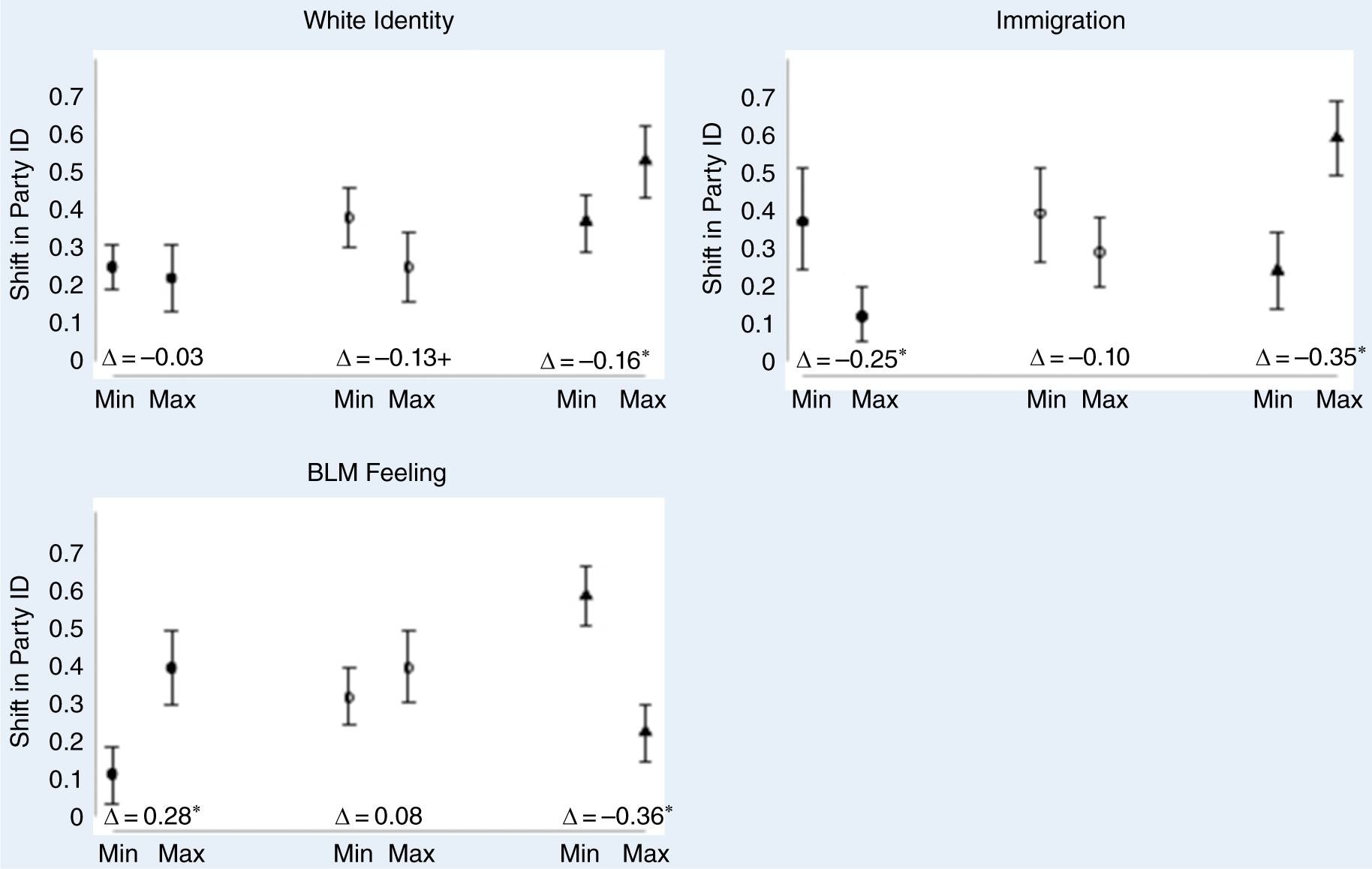
The multinomial logistic regression results are presented in table 1. The first two columns list the coefficients; corresponding standard errors represent a shift to the Democratic Party. The last two columns list the coefficients; corresponding standard errors represent a shift to the Republican Party. The baseline category (or omitted category) represents a shift to Independent. To aid interpretation, changes in predicted probabilities for each key independent variable are presented in figure 1. The top-left panel displays results for white identity, the top-right panel for immigration attitudes, and the bottom-left panel for feelings toward BLM. Within each panel, predicted probabilities are shown for shifts to Democrat (solid circle), Independent (hollow circle), and Republican (triangle) identification. Each plot illustrates the predicted probabilities at the minimum and maximum values of the independent variable with the corresponding numerical difference.
Predicted Probabilities Across Key Variables
Notes: The figure presents three panels showing predicted probabilities of partisan shifts by key variables: white identity (top left), immigration attitudes (top right), and feelings toward BLM (bottom left). Symbols indicate shifts in political-party identification (solid circle=Democrat, hollow circle=Independent, triangle=Republican). Each panel presents predicted probabilities at the minimum and maximum values of the independent variable with the numerical difference. Predicted probabilities were derived from multinomial logistic regression results in table 1. Significance indicators are shown for differences (†p<0.10, *p<0.05).

Figure 1 Long description
This figure presents three panels showing predicted probabilities of partisan shifts by key variables: white identity (top left), immigration attitudes (top right), and feelings toward Black Lives Matter (bottom left), with symbols indicating shifts in party identification (solid circles = Democrat, hollow circles = Independent, triangles = Republican). Each panel presents predicted probabilities at the minimum and maximum values of the independent variable, along with the numerical difference; predicted probabilities are derived from multinomial logistic regression results in Table 1, and significance indicators are shown for differences († p < .10, * p < .05).
We began our analysis by examining the association between white identity and shifts in partisan affiliation (top-left panel). Our sample was limited to white respondents who switched their partisan affiliation between 2016 and 2020. The results indicated that white identity was significantly associated with a shift toward Republican identification but not with a shift to Independent or Democratic identification. As white identity increased from minimum to maximum value, the predicted probability of shifting to Republican identity increased from 0.37 to 0.53 (Δ=0.16). Substantively, these findings suggest that individuals who reported stronger white identity tended to have a higher predicted probability of shifting toward the Republican Party.
Next, we examined the association between immigration attitudes and shifts in partisan affiliation (top-right panel). The findings indicate that immigration attitudes were significantly associated with shifts to both Democratic and Republican identification but not to Independent. As support for reducing immigration increased from the minimum to the maximum value, the predicted probability of shifting to Republican identity increased from 0.24 to 0.59 (Δ=0.35), whereas the predicted probability of shifting to Democrat decreased from 0.37 to 0.12 (Δ=–0.25). Substantively, these patterns suggest that more restrictive views on immigration corresponded to a higher probability of moving toward the Republican Party and a reduced likelihood of aligning with the Democratic Party.
We then examined the relationship between support for BLM and shifts in partisan affiliation (bottom-left panel). The results show that support for BLM was significantly associated with shifts toward both Democratic and Republican identification but not associated to Independent status. Specifically, as favorable feelings toward the BLM increased from 0 to 100, the predicted probability of shifting to Democrat identity increased from 0.11 to 0.39 (Δ=0.28) and the predicted probability of shifting to Republican decreased from 0.58 to 0.22 (Δ=–0.36). In practical terms, these findings suggest that more favorable evaluations of BLM were associated with a higher likelihood of moving toward the Democratic Party and a lower likelihood of shifting toward the Republican Party.
Finally, we examined the relationship between perceptions of the national economy and shifts in partisan affiliation. Extant research commonly demonstrates that economic evaluations shape political behavior (Kinder and Kiewiet Reference Kinder and Kiewiet1981), which suggests that it may be associated with shifts in partisan affiliation. We therefore assessed whether perceptions of the national economy were associated with political-party shifting. The results indicated that evaluations of the national economy were significantly associated with a shift toward Republican affiliation but not to Independent or Democrat affiliation. Specifically, the predicted probability of shifting to Republican identity among respondents who indicated that the nation’s economy had gotten better was 0.31 compared to 0.52 among those who indicated that it had gotten worse (Δ=0.21). Substantively, these findings suggest that the more negative assessments of the national economy corresponded to a higher probability of shifting toward the Republican Party. This pattern is somewhat counter to expectations from extant research insofar as respondents who reported economic decline were more likely to move toward the political party in power. A possible explanation is that these respondents attributed economic conditions to the COVID-19 pandemic and assigned greater responsibility for the state-level response to Democrats than to Republicans.
The results indicated that evaluations of the national economy were significantly associated with a shift toward Republican affiliation but not to Independent or Democrat affiliation.
CONCLUSIONS
This study examines the relationship between key attitudinal factors and shifts in partisan affiliation among white Americans between 2016 and 2020. The sample was limited to white respondents who switched their partisan affiliation between 2016 and 2020. Our findings show that white identity, immigration attitudes, and support for the BLM movement each shaped partisan movement in distinct ways. White identity was significantly associated with movement away from Independent identification and toward the Republican Party, suggesting that strong racial identity among white respondents reinforced alignment with the GOP. Immigration attitudes also had a polarizing role: restrictive views were linked with an increased likelihood of identifying as Republican and a decreased likelihood of identifying as Democrat. In contrast, support for the BLM movement was strongly associated with shifts toward the Democratic Party and away from the Republican Party, underscoring how identity- and race-related issues continue to structure partisan alignment. Together, these findings provide insight into how identity and identity-related policy attitudes, as well as evaluations of national conditions, contributed to partisan instability among white Americans in an era of heightened polarization. White identity and attitudes about race and immigration continue to push partisanship toward clearer ideological poles.
Future research could build on the findings of this analysis in several directions. First, using the 2024 ANES panel data would allow scholars to assess whether these observed patterns persist in a new electoral context and across additional election cycles. This would clarify whether these shifts reflect a more durable realignment or a more temporary partisan movement. By examining whether voters who switched affiliations remained in their new political party, continued to shift across parties, or reversed course, future research could provide insight into the stability of contemporary partisan attachments.
Second, scholars might explore whether these patterns persist across other racial and ethnic groups or whether different mechanisms are at play. Third, additional work could investigate how media consumption, local context, and political messaging mediate the relationship between identity-based attitudes and partisan change. Fourth, researchers might examine the durability of these partisan shifts—whether they represent stable realignments or temporary reactions to political and social events. By disentangling the factors that drive partisan movement, our research contributes to the understanding of how attitudinal dynamics continue to shape the American political landscape in volatile and often unpredictable ways.
Supplementary material
To view supplementary material for this article, please visit http://doi.org/10.1017/S1049096526102509.
ACKNOWLEDGMENTS
We thank the editor and the anonymous reviewers for their helpful feedback.
DATA AVAILABILITY STATEMENT
Research documentation and data that support the findings of this study are openly available at the PS: Political Science & Politics Harvard Dataverse at https://doi.org/10.7910/DVN/H9TSBA.
CONFLICTS OF INTEREST
The authors declare that there are no ethical issues or conflicts of interest in this research.



 Open access

